Review
MSI Creator 17 review
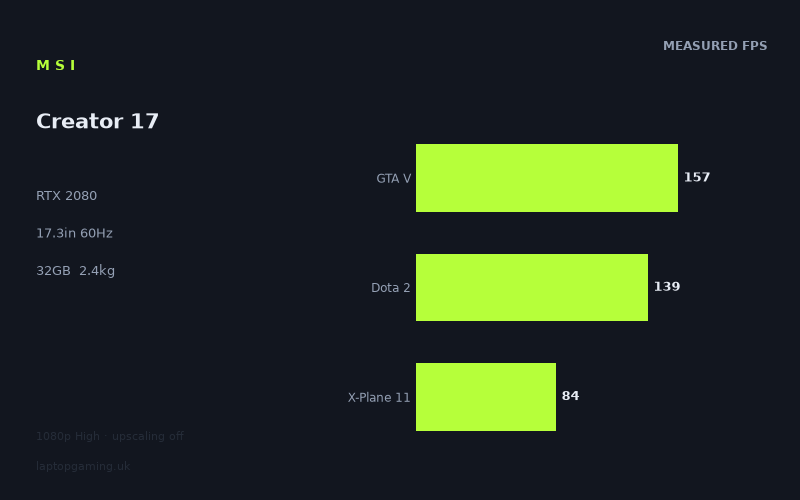
Frame rates
1920×1080, High preset, upscaling off.
Measured on this machine. Source: Notebookcheck, 2020-07-17.
Not scored: incomplete benchmark suite
Every scored laptop on this site is averaged over the same 5 games, and this one is short of Cyberpunk 2077, Baldur's Gate 3. A mean over 3 games is not comparable to a mean over 5, so we publish the figures we have and leave the score blank rather than rank it against machines tested on a different set. The numbers below are real - the suite is just incomplete.
How these numbers were produced
Frame rates here are not measured by us, and we label how each one was arrived at. A figure marked measured comes from a published run on that exact machine. A figure marked representative is derived from the GPU and its power limit (TGP) and cross-referenced against published reviews - a sound estimate of what that configuration delivers, but not a measurement of that specific laptop. Unless stated otherwise, numbers are 1920x1080, High preset, upscaling off. Where a laptop ships in several power configurations we use the wattage of the exact SKU listed, because a 140W RTX 5070 and a 115W one are not the same product.
In use
The short version
The MSI Creator 17 is a powerful large-screen machine with an unusual split personality. Its Core i7-10875H, RTX 2080, 32GB of memory and 2TB SSD are backed by strong published gaming figures at 1920x1080 on the High preset, while its 17.3in Mini LED display is a 3840x2160, 60Hz panel aimed much more obviously at detailed visual work than at high-refresh competitive play. That combination can make sense for someone who needs a large, high-resolution screen and also wants serious gaming performance away from a desk. It is less convincing for somebody buying primarily for games, particularly if their priority is making the most of a fast panel.
Notebookcheck’s measured figures show that the Creator 17 has no trouble exceeding its screen’s 60Hz refresh rate in every listed game at 1920x1080 and High settings, with upscaling off. Even Red Dead Redemption 2, the lowest result in the supplied data, reaches 62fps. That is a useful result, but it needs interpreting correctly. It does not mean that every game will run at 60fps at the panel’s native 3840x2160 resolution, because the available benchmarks are at 1920x1080 only. The display has far more pixels than the tested resolution, and there is no measured 3840x2160 gaming data here from which to make an honest native-resolution performance claim.
At 1920x1080, however, the performance is plainly substantial. FIFA 20 reaches 217fps, GTA V 157fps, Dota 2 139fps, The Witcher 3 138fps and Battlefield V 127fps. Modern games with heavier graphics workloads remain in good shape: Call of Duty Modern Warfare 2019 and Gears Tactics each record 114fps, Shadow of the Tomb Raider reaches 105fps, and Rage 2 and Star Wars Jedi Fallen Order each reach 102fps. This is not a machine short of GPU performance at the tested setting. The limitation for many buyers is instead the panel: a 60Hz display cannot show the full benefit of figures well beyond 60fps in the same way that a high-refresh gaming screen can.
The Creator 17 should therefore be considered as a creator-led desktop-replacement laptop that happens to be very capable in games, rather than as a conventional gaming-first design. Its 2.39kg weight is comparatively manageable for a 17.3in machine, but it is still a large-screen laptop and the supplied information does not include its physical dimensions. It is portable in the sense that it can be carried between places; it is not the sort of computer to treat like a compact everyday travel machine without accepting the bulk associated with a 17.3in display.
There is no confirmed UK price in the fact sheet, which matters a great deal. A machine with this specification could be a sensible proposition or poor value depending on what it costs beside newer alternatives. Without a confirmed price, the sensible conclusion is narrower: the MSI Creator 17 has strong measured 1080p High-preset gaming performance, a potentially excellent fit for screen-focused creative work because of its 3840x2160 Mini LED panel, and a less natural fit for players who want a high-refresh gaming display. Buy it for the screen, the large chassis format and the combination of work-oriented specification with strong 1080p gaming results. Do not buy it simply because it carries an RTX 2080 badge, and do not assume that its 1080p figures describe what it will do at native 3840x2160.
Performance
What the measured figures actually show
The benchmark data comes from Notebookcheck, measured on 2020-07-17 at 1920x1080 using the High preset with upscaling off. That test condition is important. It gives a useful comparison point for the Creator 17’s hardware, but it is not the screen’s native resolution and it is not a guarantee for a different preset, a different game version, a different driver, or a different resolution. It is best read as a controlled snapshot of the machine’s gaming ability rather than a promise that can be transferred unchanged to every use case.
Within that snapshot, the Creator 17 is consistently quick. The supplied scoring-suite figures are 157fps in GTA V, 139fps in Dota 2 and 84fps in X-Plane 11, producing a mean of 127fps across those games. That average is useful only as a summary of those particular titles. It should not be treated as a general expectation for all games, because the wider list makes the variation very clear. X-Plane 11 sits well below GTA V and Dota 2, while the more demanding games further down the list sit closer to the panel’s refresh rate. A single average cannot explain what a buyer will experience in a specific game.
FIFA 20 is the clear outlier at 217fps. That is a very high measured figure, and it demonstrates that the laptop has considerably more 1080p High-preset performance than the integrated 60Hz panel can visibly present in that title. GTA V at 157fps and Dota 2 at 139fps tell a similar story. The system is producing frames far faster than the display’s refresh rate in these games. That headroom can still be useful: it suggests that the hardware is not struggling at the tested settings, and it can offer scope to prioritise image quality or to use an external display. But the built-in panel remains 60Hz, so the creator-oriented display rather than raw gaming speed defines the on-screen experience.
The Witcher 3 reaches 138fps and Battlefield V reaches 127fps, both still well beyond the display refresh rate. These results are particularly useful because they show that the Creator 17 does not only excel in the lightest titles. At the tested 1920x1080 High setting, it has enough performance to run visually demanding games above the screen’s 60Hz limit. Call of Duty Modern Warfare 2019 and Gears Tactics, each at 114fps, continue the pattern. Shadow of the Tomb Raider at 105fps, Rage 2 at 102fps and Star Wars Jedi Fallen Order at 102fps all remain comfortably above 60fps in the supplied measurements.
The lower end of the list is where the data becomes more relevant to owners of the integrated panel. Far Cry New Dawn reaches 98fps, X-Plane 11 records 84fps, Borderlands 3 reaches 80fps and Control reaches 71fps. These are still above the panel’s refresh rate at the benchmarked resolution and preset, but they leave less margin than FIFA 20 or GTA V. Red Dead Redemption 2 is the most demanding result supplied, at 62fps. That clears the 60Hz target, but only narrowly. It is not evidence that the Creator 17 has lavish performance in every demanding game. Rather, it shows why the headline GPU name is not enough by itself: game engines, graphics workloads and processor demands all affect the outcome.
The performance range runs from 62fps in Red Dead Redemption 2 to 217fps in FIFA 20. That broad spread is exactly why it would be misleading to reduce the Creator 17 to one number. A player focused on FIFA 20, GTA V, Dota 2, The Witcher 3 or Battlefield V will see a machine with more than enough performance for its internal 60Hz display at the tested setting. A player focused on Red Dead Redemption 2, Control or Borderlands 3 is still looking at results that exceed 60fps at 1920x1080 High, but with much less spare capacity. Those are different experiences, even though all are technically above the panel refresh rate in the available results.
The RTX 2080 needs context
The RTX 2080 designation suggests a high-end GPU, and the available results support the view that this is a powerful 1080p gaming system. But laptop GPU names do not tell the whole story. Power limits, cooling behaviour and chassis design can materially affect how a given GPU performs. The fact sheet does not provide a GPU power limit for this Creator 17, so it would not be credible to attach a wattage to it or claim that it is configured like another RTX 2080 laptop. The benchmark data is more useful than an assumption: it tells us what this particular implementation achieved in the listed Notebookcheck tests.
That distinction matters especially when comparing laptops carrying related GPU labels. A mobile RTX 2080 is not an automatic guarantee of a fixed level of performance across every chassis. The Creator 17’s results should be judged as its own published output, not as a theoretical result derived from the GPU name. The comparison section reinforces this point. The Creator 17 is almost level with two RTX 2070-equipped rivals in the shared-game comparisons, yet trails the Alienware m17 R3 with an RTX 2080. This is not a contradiction. It is the normal consequence of comparing complete laptops rather than simply comparing graphics branding.
There is also no supplied evidence about sustained clock behaviour, thermal behaviour, noise or the exact cooling arrangement. Those factors are often central to explaining why one laptop implementation differs from another, but they are not provided here and should not be invented. The proper conclusion is limited but valuable: at the stated benchmark conditions, the Creator 17 delivers results ranging from 62fps to 217fps, with a 127fps mean across its available scoring-suite games. It is evidently strong at 1920x1080 High, but the data does not establish precisely how MSI achieved that result or how the system behaves under a different sustained workload.
Which games suit the internal screen best
Every game in the supplied list exceeds 60fps at 1920x1080 High with upscaling disabled. For the internal 60Hz panel, that means every listed title reaches the display’s nominal refresh rate under the stated benchmark conditions. The difference is in the amount of headroom above that point.
- Very large headroom: FIFA 20 at 217fps, GTA V at 157fps, Dota 2 at 139fps and The Witcher 3 at 138fps all sit far above 60fps. The laptop has considerably more performance than the integrated panel can show at the tested setting.
- Strong headroom: Battlefield V at 127fps, Call of Duty Modern Warfare 2019 at 114fps, Gears Tactics at 114fps, Shadow of the Tomb Raider at 105fps, Rage 2 at 102fps and Star Wars Jedi Fallen Order at 102fps all remain substantially beyond the panel refresh rate.
- Useful but narrower headroom: Far Cry New Dawn at 98fps, X-Plane 11 at 84fps, Borderlands 3 at 80fps and Control at 71fps are above 60fps, but the gap is smaller in games that place a heavier demand on the hardware.
- Closest to the display limit: Red Dead Redemption 2 at 62fps is above 60fps, but only just. It is the clearest reminder that demanding games can use much of the machine’s available performance even at 1920x1080 High.
For games that are already well above 60fps, the screen is the more obvious constraint than the GPU. A player who mainly plays FIFA 20, Dota 2, GTA V or Battlefield V may prefer the responsiveness of a high-refresh laptop display over the Creator 17’s 3840x2160 presentation. There is no supplied response-time figure, so no claim should be made about motion clarity beyond the simple 60Hz refresh limitation. But a panel refreshing at 60Hz cannot display a distinct new frame for every frame produced at 139fps, 157fps or 217fps.
For the lower figures, the balance changes. Red Dead Redemption 2 at 62fps and Control at 71fps show a system operating closer to the refresh rate of its own display. In those games, the Creator 17’s 60Hz panel is less obviously holding back the measured result at 1920x1080 High. That does not turn it into an ideal gaming screen for everyone; it simply means that the GPU’s output and display refresh are more closely matched in the most demanding entries in the benchmark list.
Why the numbers vary so much
The benchmark spread does not suggest inconsistent hardware. It reflects the fact that games ask different things of a laptop. FIFA 20 at 217fps and Red Dead Redemption 2 at 62fps are not comparable workloads merely because they are both measured at 1920x1080 on High settings. Their engines, visual features and balance of CPU and GPU demand differ. X-Plane 11 at 84fps also illustrates that point: its result is well below GTA V and Dota 2 despite sharing the same processor and graphics hardware.
That is also why buyers should avoid building a purchasing decision around only the highest result. FIFA 20 confirms that the Creator 17 can generate extremely high frame rates in an appropriate game. Red Dead Redemption 2 and Control are more informative for someone deciding whether the system has enough performance margin for demanding modern titles at the tested settings. Neither is poor at 1920x1080 High; both are above 60fps. But their figures show that the system is not immune to demanding workloads simply because it has an RTX 2080.
The reverse error is equally unhelpful. Focusing solely on Red Dead Redemption 2 at 62fps would understate what the laptop can do in much of the rest of the supplied data. The Creator 17 reaches at least 98fps in a substantial part of the list, and it reaches at least 102fps in several visually demanding games. For a buyer using the laptop with an external high-refresh display at 1920x1080, those higher numbers are meaningful. For a buyer committed to the internal 3840x2160, 60Hz panel, the key issue is not whether 102fps or 157fps is higher, but that neither result tells us native-resolution performance.
No complete score comparison
The supplied scoring-suite data is incomplete. We have results for GTA V, Dota 2 and X-Plane 11, but not for Final Fantasy XV or Strange Brigade. Every scored laptop is averaged over the same five games, so this partial result cannot be ranked fairly against systems with a complete set. The 127fps mean is useful as a description of the three available scoring-suite games; it is not a complete score and should not be treated as one.
This is more than a technicality. GTA V and Dota 2 are much faster here than X-Plane 11, so adding further games could alter how the laptop looks relative to other systems. A fair ranking requires comparable coverage. The shared-game rival comparisons below are therefore more useful than pretending the Creator 17 has a directly comparable overall benchmark standing.
The screen
The Creator 17’s display is central to its identity. It is a 17.3in Mini LED panel with a 3840x2160 resolution and a 60Hz refresh rate. That is a specification built around screen area, pixel density and image-focused work rather than around the high-refresh priorities of a conventional gaming laptop. The large 17.3in format provides more physical space than a smaller laptop panel, while the 3840x2160 resolution provides a much denser workspace than the 1920x1080 benchmark resolution. The Mini LED panel type further underlines that MSI positioned this as a Creator model rather than a gaming-only machine.
There are no supplied figures for brightness, contrast, colour coverage, colour accuracy, response time or HDR behaviour. Mini LED alone is not enough to establish those details. It would be inappropriate to claim a particular level of image quality from the panel without the relevant measurements. What can be said is that the hardware specification is aimed at people who value a high-resolution display and that the measured gaming data does not directly test gaming at that native resolution.
A 3840x2160 screen and 1920x1080 benchmark figures are not interchangeable
The available results are all at 1920x1080, while the Creator 17’s panel is 3840x2160. That gap should shape the buying decision. The figures of 217fps in FIFA 20, 157fps in GTA V, 127fps in Battlefield V, 80fps in Borderlands 3 and 62fps in Red Dead Redemption 2 are valid for the stated 1920x1080 High setting with upscaling off. They are not measured native-panel results. There is no published 3840x2160 frame-rate figure in the fact sheet for any of the games listed.
It would be tempting to turn the 1080p data into estimates for 3840x2160. That would not be reliable. Games scale differently with resolution depending on their engine, settings and the balance between processor and graphics workload. Some titles in the list may be limited more by factors other than raw pixel rendering at 1920x1080, while others may be much more sensitive to resolution. Without actual measurements, an estimate would only create a number that looks precise without being attributable. This site’s standard should be higher than that.
The practical consequence is straightforward. Buyers who want to game at the panel’s full 3840x2160 resolution should not assume that the Creator 17 will reproduce its 1920x1080 High-preset results there. Buyers who are content to use 1920x1080 for games have evidence that the laptop is fast at that resolution. Whether that image scaling arrangement is acceptable is a personal preference, but it is a question worth considering before purchase because the screen’s primary attraction is its native high resolution.
This mismatch is not necessarily a flaw. Plenty of prospective Creator 17 owners may value a 3840x2160 desktop workspace, image work or general visual detail more than they value very high refresh gaming. For that buyer, gaming at 1920x1080 may be an acceptable compromise when performance matters more than native resolution. The point is simply that the machine does not offer the cleanest one-setting solution for a buyer who wants both native-resolution gaming and a fast gaming panel. The fact sheet supports the first part of that statement through the panel specification, and it leaves the native-resolution gaming part unmeasured.
The 60Hz refresh rate is the gaming trade-off
The 60Hz refresh rate is the clearest reason not to treat the Creator 17 as an obvious choice for competitive gaming. Notebookcheck’s figures exceed 60fps in every supplied title, often by a large amount. FIFA 20 at 217fps is far beyond what the internal display can refresh. GTA V at 157fps, Dota 2 at 139fps, The Witcher 3 at 138fps and Battlefield V at 127fps are likewise far beyond the panel refresh rate. In those games, the laptop’s graphics performance is stronger than the integrated screen’s ability to present each generated frame as a separate refresh.
That does not mean high frame rates are meaningless on a 60Hz panel. They can indicate available performance headroom and may matter if an external display is part of the intended setup. But it does mean that a buyer who wants to see the benefit of very high frame rates directly on the laptop should look carefully at alternatives with a higher-refresh panel. The Creator 17 gives up that gaming-led specification in favour of a 3840x2160 Mini LED display.
Conversely, the 60Hz screen is not a problem simply because it is 60Hz. For slower-paced games, narrative games, strategy games, creative work and general desktop use, a high-resolution large display may be the more useful feature. Gears Tactics reaches 114fps in the published benchmark, yet its genre does not necessarily demand the same panel priorities as a competitive multiplayer title. The hardware can provide the performance; the screen determines how much of that performance is visible at once.
The best way to frame the display is as a deliberate preference rather than a universally superior or inferior choice. It is preferable for someone who wants a 17.3in, 3840x2160 Mini LED laptop and considers gaming performance an important secondary capability. It is less preferable for someone whose main aim is to play esports-style games at the highest visible refresh rate on the built-in display. The data supports both statements clearly.
Build, size and portability
The Creator 17 weighs 2.39kg. For a laptop with a 17.3in screen, 32GB of memory, a 2TB SSD, a Core i7-10875H and an RTX 2080, that weight suggests a machine intended to move between workplaces, homes, studios or desks rather than one intended to disappear into a small bag. It is not an unreasonable weight for its class, but the distinction between transportable and genuinely light still matters. A 17.3in laptop remains a substantial object to carry, particularly when its larger screen is the reason for choosing it.
The fact sheet does not provide physical dimensions, so there is no basis for a claim about thickness, footprint, bag fit or how much desk space it occupies. The 17.3in display size tells us that it is a large-screen design, but it does not justify more exact statements. Buyers who need a machine for frequent commuting should confirm the dimensions and the weight of the charger before making a final decision, because those details materially affect day-to-day portability and are not supplied here.
The 82Wh battery is a meaningful capacity specification, but there is no measured battery-life figure in the fact sheet. Battery capacity is not battery life. It cannot tell us how long the Creator 17 will last in web use, creative work, video playback, gaming or standby without measurements from a defined workload. Gaming away from mains power is also not something that can be assessed from the available information. The right conclusion is that it has an 82Wh battery, not that it lasts for any particular duration.
The 32GB memory allocation is appropriate for a system that combines a large 3840x2160 screen with a work-oriented identity and strong gaming hardware. It gives the Creator 17 a more creator-focused balance than a specification built solely around the graphics card. The 2TB SSD capacity also gives it substantial internal storage on paper. However, the fact sheet does not include storage speed, slot configuration or upgrade information, so there is no evidence here on whether the drive arrangement is especially fast, whether additional storage can be added, or how the machine is laid out internally.
That limitation is important because “Creator” is a use case, not a measurable quality by itself. The available specification supports the idea that the laptop is equipped for workloads that benefit from memory, storage capacity and a high-resolution display. It does not provide benchmarks for creative applications, details of ports, information about card readers, webcam quality, keyboard feel, speakers, chassis materials or display calibration. Those may matter as much as gaming frame rates to the intended buyer, but they are outside the supplied evidence.
For a buyer who works primarily at a desk and periodically moves their computer, the 2.39kg weight and 17.3in display are a plausible compromise: more screen space and more desktop-like presence than a smaller laptop, without being fixed in one location. For somebody carrying a laptop all day, every day, the same qualities may feel like a burden. That is not a criticism of the Creator 17 so much as an acknowledgement that large-screen performance laptops are inherently more specialised than compact machines.
How it compares
The rival data is deliberately limited to games both machines hold, with preference given to the scoring suite. That is the right basis for comparison. Comparing headline GPU names or unrelated game lists would tell less than comparing shared benchmark results. It is also important that the comparisons are averages across shared games, not blanket declarations that one system wins every title or every workload.
Against the Acer Aspire 17 with RTX 2050 at 35W
The Creator 17 averages 38fps ahead of the Acer Aspire 17 across three shared games. That is the largest positive gap in the supplied rival set, and it is substantial. The Acer is listed with an RTX 2050 at 35W, while the Creator 17 has an RTX 2080. The published shared-game result confirms that the difference is not merely nominal: on the available common benchmarks, the Creator 17 is decisively faster.
For a buyer choosing between these two types of machine, the Creator 17 is the clear performance choice at the available test conditions. Its own results already show enough 1920x1080 High-preset performance to exceed the built-in 60Hz display in every listed game. A 38fps shared-game advantage over the Acer means the Creator 17 has substantially more room for demanding games at that same resolution and preset. It is also the machine for somebody who needs the 17.3in 3840x2160 Mini LED specification, because the Acer comparison does not change the Creator 17’s screen-led appeal.
Neither machine has a confirmed UK price in the supplied information. That prevents a value judgement. The Creator 17 is faster in the measured shared games, but “worth paying for” depends on an actual price difference that is not available. It would be wrong to assume that the performance lead automatically settles the buying decision without knowing the cost.
Against the Razer Blade 15 with RTX 2070 Super Max-Q
The Creator 17 averages only 1fps ahead of the Razer Blade 15 RTX 2070 Super Max-Q across three shared games. This is effectively a near-level result in the context of the available data, not persuasive evidence of a meaningful gaming advantage for the MSI. The Creator 17’s RTX 2080 name does not translate into a notable shared-game lead here.
The supplied explanation for near-zero differences is important: at 1920x1080, lighter titles in the shared set can be CPU-bound and compress genuine GPU gaps. That means a small margin should not be read as proof that the GPUs are equivalent in every situation. It means that, in the particular common games and test conditions available, the performance difference is too small to be a useful reason to choose one over the other.
That leaves the screen and form factor as more meaningful differentiators for the Creator 17. Its 17.3in 3840x2160 Mini LED panel and 2.39kg weight describe a very different proposition from a 15in-class gaming laptop, even without making unsupported claims about the Razer’s own screen or weight. A buyer who wants a large, high-resolution creator-oriented display may have a reason to prefer the MSI. A buyer who is simply looking for more gaming speed cannot point to this shared-game comparison as a reason to do so.
Against the MSI GE66 Raider with RTX 2070
The Creator 17 averages 1fps behind the MSI GE66 Raider across three shared games. Again, that is a near-zero gap. The meaningful conclusion is not that the Creator 17 is materially slower; it is that these two machines are effectively tied in the available shared-game sample. A 1fps difference is not a practical basis for selecting between them.
The same CPU-bound explanation applies. At 1920x1080, the lighter games in the shared set can limit the extent to which GPU differences appear in the average. The Creator 17’s RTX 2080 and the GE66 Raider’s RTX 2070 should not be reduced to a simplistic conclusion from this narrow result. The shared figures show parity under the common benchmark conditions, not universal parity in all games, all presets or all resolutions.
For a prospective Creator 17 owner, this comparison is a warning against paying for a GPU label without considering the rest of the system. If the GE66 Raider and Creator 17 are close in the games available to compare, the decision should turn on the specific features a buyer needs: the Creator 17’s 17.3in Mini LED 3840x2160, 60Hz panel; its 32GB memory; its 2TB SSD; its 2.39kg weight; and any price difference once confirmed. Gaming performance alone does not establish a meaningful advantage for the Creator 17 in this head-to-head sample.
Against the Alienware m17 R3 with RTX 2080
The Creator 17 averages 18fps behind the Alienware m17 R3 across three shared games. This is the largest negative gap in the supplied rival set and the clearest evidence that an RTX 2080 label is not sufficient to predict laptop gaming performance. Both machines are listed with an RTX 2080, yet the Alienware is ahead by a meaningful amount in the shared data.
The fact sheet does not provide the Creator 17’s GPU power limit, nor does it provide thermal, noise or sustained-performance evidence that would explain the difference in detail. It would therefore be speculation to say exactly why the Alienware is faster. What can be said with confidence is that the Creator 17 is not the fastest available RTX 2080 implementation in this comparison group at the shared 1920x1080 benchmark conditions.
For a gaming-first buyer, that 18fps deficit matters more than the near-ties against the RTX 2070 rivals. If the goal is maximum performance from this GPU generation, the Alienware’s shared-game advantage is a reason to investigate it closely. For a buyer who specifically wants the Creator 17’s 17.3in 3840x2160 Mini LED panel, the comparison is more nuanced. The MSI’s appeal is not solely frame rate. But a buyer should be honest about the trade: choosing the Creator 17 means choosing its display and creator-oriented specification despite evidence that another RTX 2080 laptop is faster in the available shared games.
What the rival spread tells us
The four comparisons form a useful pattern. The Creator 17 is far ahead of the Acer Aspire 17 with its RTX 2050 at 35W. It is effectively level with the Razer Blade 15 RTX 2070 Super Max-Q and the MSI GE66 Raider RTX 2070 in the available shared-game samples. It trails the Alienware m17 R3 RTX 2080 by a clear margin. That spread is much more informative than saying the Creator 17 has an RTX 2080 and leaving it there.
It suggests that the Creator 17 is strong, but not automatically dominant among similarly positioned gaming laptops. Its published 1080p results are good enough for the internal panel in every listed game, and often far beyond what the 60Hz display can show. Yet the rival comparisons demonstrate that a buyer seeking the best possible gaming performance should compare actual measurements rather than assume the highest GPU name settles the matter.
Price remains the missing part of the equation. No confirmed UK price is available for the Creator 17 or the listed rivals. That means there is no defensible value ranking. A laptop that trails an alternative in shared-game performance might still be the better purchase if it costs less or has features the buyer values more. Equally, a laptop with a better screen may be hard to justify if its price premium is excessive. Until prices are confirmed, the comparison can establish performance positions, not value.
Who it’s for
Buy the Creator 17 if the screen is the reason you are here
The strongest case for the MSI Creator 17 is a buyer who genuinely wants a 17.3in 3840x2160 Mini LED display and also wants gaming performance that is comfortably strong at 1920x1080 High settings. The panel specification is the feature that separates this machine from a more conventional gaming laptop. If your work benefits from a large, high-resolution screen and you play games alongside that work, the Creator 17’s hardware balance makes sense.
That buyer should be content with the fact that the available gaming data is at 1920x1080 rather than at the screen’s native resolution. This is not a minor detail. The performance evidence is very good at the tested resolution: every supplied game is above 60fps, and most are well above it. But native 3840x2160 gaming is not benchmarked here. A purchaser who accepts 1920x1080 gaming when appropriate can buy the Creator 17 based on evidence. A purchaser who requires proven native-resolution performance needs more data before committing.
It is also a sensible fit for somebody who uses demanding games but does not require a high-refresh internal panel. Red Dead Redemption 2 at 62fps, Control at 71fps, Borderlands 3 at 80fps and X-Plane 11 at 84fps show that the machine can meet or exceed its 60Hz refresh rate in the most demanding results supplied. At the other end of the list, FIFA 20, GTA V, Dota 2, The Witcher 3 and Battlefield V make clear that the system is not short on 1080p capability.
The 32GB memory and 2TB SSD are further reasons for a work-and-play buyer to consider it. They suit a laptop expected to carry substantial files and run demanding multitasking workloads, although the supplied data does not include application benchmarks. The 82Wh battery may also be relevant to a mobile user, but capacity should not be confused with measured battery life. Anyone for whom unplugged endurance is decisive should seek proper battery measurements before buying.
Buy something else if gaming display speed is the priority
A player who primarily buys a laptop for competitive gaming should look elsewhere. The Creator 17’s 60Hz panel is the wrong match for many of its own 1920x1080 results. FIFA 20 at 217fps, GTA V at 157fps, Dota 2 at 139fps, The Witcher 3 at 138fps and Battlefield V at 127fps all indicate more frame-rate capability than the internal display can visibly use as separate refreshes. A faster panel would make more direct use of that performance.
This is especially true for someone choosing a laptop mainly for games such as FIFA 20, Dota 2 or other titles where the Creator 17 is likely to be well above 60fps under comparable settings. There is no need to dismiss the Mini LED screen to reach that conclusion. It may be excellent for the right buyer. But the stated 60Hz refresh means that it is not configured around the priorities of players chasing high-refresh motion on the built-in display.
Buyers who want the highest available gaming performance from this class of hardware should also consider alternatives carefully. The Alienware m17 R3 is 18fps ahead on average across the three shared games available. There is not enough information to explain that gap in engineering terms, but it is enough to establish that the Creator 17 is not the performance leader among the listed RTX 2080 rivals. If frame rate is the deciding factor, measured shared-game results should carry more weight than the Creator branding or the RTX 2080 name.
Buy something else if native 3840x2160 gaming is non-negotiable
The Creator 17’s high-resolution screen should not be mistaken for proof of high-resolution gaming performance. The Notebookcheck figures are all 1920x1080 High-preset results with upscaling off. There is no 3840x2160 figure for FIFA 20, GTA V, Dota 2, The Witcher 3, Battlefield V, Call of Duty Modern Warfare 2019, Gears Tactics, Shadow of the Tomb Raider, Rage 2, Star Wars Jedi Fallen Order, Far Cry New Dawn, X-Plane 11, Borderlands 3, Control or Red Dead Redemption 2 in the supplied material.
If the intention is to run demanding games at the panel’s full resolution without making compromises, this review cannot validate that use case. That does not mean the Creator 17 cannot do it in any particular title. It means there is no attributable frame-rate evidence here that says how well it does. A careful buyer should seek native-resolution measurements for the actual games they play rather than extrapolate from the 1080p figures.
Buy something else if portability means daily light travel
The 2.39kg weight is not extreme for a 17.3in performance laptop, but it is still substantial. Buyers who regularly carry a laptop through a full day, need a compact bag, or work in confined spaces may be better served by a smaller machine. The Creator 17 is best understood as portable enough to relocate, not as a minimal-load travel laptop.
Because dimensions are not supplied, prospective buyers should not assume it has an unusually slim footprint or that it will suit a particular bag. Likewise, because there is no battery-life measurement, they should not assume that the 82Wh battery will meet a particular day away from a charger. Those omissions do not make the machine unsuitable; they mean the portability decision needs information beyond this fact sheet.
The final buying position
The MSI Creator 17 is a compellingly specified large-screen creator laptop with strong published gaming capability at 1920x1080 High. Its measured figures are good across a wide range of games, from 217fps in FIFA 20 through 157fps in GTA V and 127fps in Battlefield V to 62fps in Red Dead Redemption 2. Every listed result exceeds the refresh rate of its 60Hz display at the tested setting. That is a strong foundation.
Its compromises are equally clear. The 3840x2160 Mini LED panel is not matched with published native-resolution gaming results, and its 60Hz refresh rate leaves a great deal of the available 1080p performance unseen in faster titles. Rival data shows that it is well ahead of the RTX 2050-equipped Acer Aspire 17, essentially tied with the listed Razer Blade 15 and MSI GE66 Raider in the shared samples, and behind the Alienware m17 R3 despite both machines carrying an RTX 2080.
Choose the Creator 17 for its large high-resolution screen, its 32GB memory and 2TB SSD configuration, and its proven ability to game strongly at 1920x1080. Choose another laptop if you want high-refresh gaming on the built-in panel, measured proof of native 3840x2160 gaming performance, the lightest possible travel machine, or the best shared-game performance among the listed RTX 2080 systems. With no confirmed UK price, no stronger value conclusion is possible.