Review
MSI Vector GP66 review
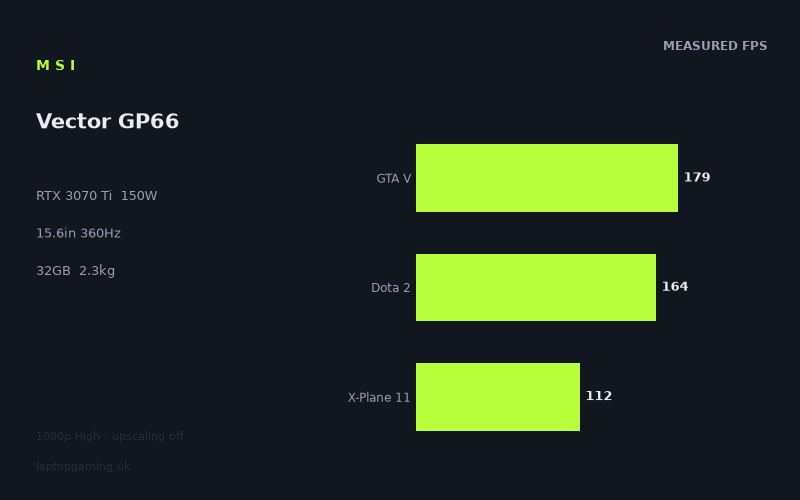
Frame rates
1920×1080, High preset, upscaling off.
Measured on this machine. Source: Notebookcheck, 2022-03-03.
Not scored: incomplete benchmark suite
Every scored laptop on this site is averaged over the same 5 games, and this one is short of Cyberpunk 2077, Baldur's Gate 3. A mean over 5 games is not comparable to a mean over 5, so we publish the figures we have and leave the score blank rather than rank it against machines tested on a different set. The numbers below are real - the suite is just incomplete.
How these numbers were produced
Frame rates here are not measured by us, and we label how each one was arrived at. A figure marked measured comes from a published run on that exact machine. A figure marked representative is derived from the GPU and its power limit (TGP) and cross-referenced against published reviews - a sound estimate of what that configuration delivers, but not a measurement of that specific laptop. Unless stated otherwise, numbers are 1920x1080, High preset, upscaling off. Where a laptop ships in several power configurations we use the wattage of the exact SKU listed, because a 140W RTX 5070 and a 115W one are not the same product.
In use
The short version
The MSI Vector GP66 (12UGS) is a high-performance 15.6in gaming laptop built around a Core i9-12900H and a GeForce RTX 3070 Ti configured with a 150W GPU power limit. Its measured gaming results are strong at its native 1920x1080 resolution, especially in the lighter and better-scaling games in Notebookcheck’s benchmark data. Strange Brigade reaches 244fps, The Witcher 3 reaches 224fps, GTA V reaches 179fps and Dota 2 reaches 164fps. Those are substantial figures for a laptop with a 360Hz IPS panel.
The important qualification is that the 360Hz display is not a promise of 360fps in every game. The measured figures show a much more realistic picture. The Vector GP66 is comfortably above 100fps in every listed title at 1920x1080 using the High preset with upscaling disabled, but it is nowhere near 360fps in the more demanding games. Final Fantasy XV runs at 115fps and X-Plane 11 at 112fps. Far Cry 5 reaches 145fps. That is still good 1080p gaming performance, but the panel’s maximum refresh rate is a ceiling the GPU will only approach in relatively light games, rather than a target it reaches across the board.
The 150W GPU limit matters. RTX 3070 Ti laptop implementations are not interchangeable simply because they share the same name. The power limit is part of the specification that determines how much room the GPU has to perform. In this case, the Vector GP66 uses a 150W RTX 3070 Ti rather than a lower-powered implementation intended for a thinner or more restrained chassis. The published results support the idea that this is a performance-led configuration: its five-game scoring-suite mean is 163fps, and it is competitive with several RTX 3080 Ti laptops in the shared-game comparisons.
That does not make it an uncomplicated buying recommendation. There is no confirmed UK price for this exact Vector GP66 configuration. As a result, we do not publish an overall score: value forms part of that calculation and cannot be assessed honestly without a current UK price. That is not a criticism of the machine or its benchmark coverage; the benchmark suite is complete and the laptop ranks normally on the frame-rate leaderboard. It simply means that performance can be judged, while value cannot.
Buy the Vector GP66 if the priorities are strong 1080p frame rates, a very high-refresh-rate screen, 32GB of memory, 1TB of SSD storage and a laptop GPU configured with a substantial 150W power limit. It makes particular sense for someone who wants high frame rates in games such as Strange Brigade, The Witcher 3, GTA V and Dota 2, while retaining enough performance for more demanding titles at the same resolution and High preset.
Look elsewhere if the central requirement is guaranteed 360fps-class performance in demanding games, a confirmed UK price before making a buying decision, or a machine chosen principally for low weight and frequent travel. At 2.314kg, the GP66 is not unusually enormous for a performance-focused 15.6in gaming laptop, but neither is it a light machine in the way an ultraportable is light. The 65Wh battery is also a known specification, but there is no battery-life measurement in the supplied data, so no claim should be made about how long it lasts away from mains power.
Performance
A 150W RTX 3070 Ti is the key specification
The defining performance component here is not merely “RTX 3070 Ti”; it is an RTX 3070 Ti with a 150W GPU power limit. Laptop graphics chips can appear in machines with very different power limits, and that makes direct comparisons based only on the GPU name unreliable. A lower-powered RTX 3070 Ti and a 150W RTX 3070 Ti are not necessarily expected to deliver the same frame rates, even if both carry the same Nvidia branding.
The Vector GP66 is therefore best understood as a laptop designed to give its GPU meaningful performance headroom rather than as a thin-and-light machine making do with a reduced-power graphics configuration. The benchmark data backs that reading. Across the five scoring-suite games, Notebookcheck’s measured mean is 163fps at 1920x1080, using the High preset with upscaling off. That is a strong average for the screen resolution supplied here, and it is particularly relevant because the laptop has a 1920x1080 display rather than a higher-resolution panel demanding more from the GPU per frame.
The Core i9-12900H also matters to the overall result. At 1080p, especially in lighter games and games capable of reaching very high frame rates, processor performance can become more important. The GPU is not the only component deciding whether a laptop reaches 164fps or 244fps. This is one reason why differences between apparently distant GPU tiers can narrow in shared 1080p benchmark results. It is also why a large GPU specification advantage on paper does not automatically translate into a correspondingly large lead in every game.
The combination of Core i9-12900H, 32GB of memory and the 150W RTX 3070 Ti gives the GP66 a balanced high-end specification for the measured workload. Nothing in the supplied configuration suggests an obvious memory shortfall, and 1TB of SSD storage is a sensible capacity for a gaming system. Storage capacity does not alter the published frame rates, of course, but it does mean this is not a performance-led laptop paired with an unusually small drive.
The measured results, game by game
Notebookcheck measured Strange Brigade at 244fps. This is the highest result in the supplied game list and demonstrates the sort of workload in which the Vector GP66 can make convincing use of a 360Hz display. It is not reaching 360fps, so the panel is still not being fully saturated according to this result. However, 244fps is high enough that a conventional 60Hz or 144Hz screen would be the more obvious limitation in the chain. On this laptop, the display retains room above the measured frame rate rather than capping it at a lower refresh ceiling.
The Witcher 3 runs at 224fps in the same 1920x1080 High-preset, no-upscaling test conditions. That is another exceptionally high result. Like Strange Brigade, it falls below the panel’s maximum 360Hz refresh rate, but it is far above the level required for ordinary 60Hz or 120Hz displays. For a buyer interested in consistently high frame rates rather than merely meeting a basic smoothness threshold, this is one of the more persuasive figures in the dataset.
GTA V records 179fps. That is lower than Strange Brigade and The Witcher 3, but it remains a very high frame rate. It is above half of the panel’s 360Hz maximum refresh rate and well above 144Hz. The significance is not that the GP66 somehow turns every title into a 360fps game; it does not. The significance is that even when a game lands below the top two results, the laptop is still operating in a high-frame-rate range at its native resolution without the assistance of upscaling.
Dota 2 is measured at 164fps. This result exactly matches the machine’s broad performance character: high enough for a fast display to matter, but not evidence that the panel’s 360Hz mode is automatically attainable. Dota 2 is also one of the scoring-suite games used in the 163fps mean. It sits extremely close to that mean, meaning it is a useful representation of the GP66’s average scoring-suite result rather than an unusually favourable or unusually demanding outlier.
Far Cry 5 reaches 145fps. That remains a strong 1080p result and still sits just above 144fps, which is worth noting because 144Hz has long been a common high-refresh target for gaming laptops. Yet it also underlines how quickly the practical relationship between hardware and a 360Hz panel changes once the workload becomes more demanding. At 145fps, the screen can display every new frame at a 144Hz refresh rate in principle, but its 360Hz maximum is much higher than the frame rate being produced. The screen is not the bottleneck; the game workload is.
Final Fantasy XV is measured at 115fps. This is the first supplied result that falls materially below 144fps, although it remains clearly above 100fps. The difference between 115fps and the 244fps result in Strange Brigade is important. It is a reminder that “RTX 3070 Ti at 1080p” is not itself a frame-rate promise. Games vary in engine behaviour, graphics workload and the balance between CPU and GPU demand. The GP66’s frame rate changes substantially by title, even under the same broad test conditions.
X-Plane 11 records 112fps, the lowest figure in the supplied list. It is still an entirely respectable result for a laptop at 1920x1080 and the High preset with upscaling disabled, but it is far from the display’s 360Hz headline. A buyer whose main interest is simulation workloads represented by X-Plane 11 should use this number rather than assuming that the higher Strange Brigade result tells the whole story. The difference is not a flaw in the benchmark data; it is the point of having several games in the first place.
What the 163fps mean does and does not say
The five-game scoring-suite mean is 163fps. This is a useful summary number because it takes the individual results from Strange Brigade, GTA V, Dota 2, Final Fantasy XV and X-Plane 11 and turns them into one broad indication of performance. It says the Vector GP66 is a strong 1080p gaming machine in this measured suite. It also provides a practical reference point for comparing it with machines in the leaderboard when the same test coverage is available.
It should not be treated as a promise that every game runs at 163fps. The supplied results themselves prove why. Strange Brigade is measured at 244fps, while X-Plane 11 is at 112fps. The gap between those two figures is substantial. A mean is useful for seeing the overall level of a laptop, but anyone buying for a particular game should give the individual result more weight than the average.
There is also an important distinction between “high average frame rate” and “full use of a 360Hz panel”. A 163fps mean is strong, but it is well below 360fps. The GP66 has the hardware and display combination to make high-refresh gaming credible across a broad set of games, but the available evidence does not support presenting it as a laptop that routinely delivers 360fps at High settings. In the measured games, it does not.
The most useful reading is more nuanced. The Vector GP66 can produce very high frame rates in lighter or more favourable games, as shown by 244fps and 224fps. It can also keep more demanding games above 100fps at the native resolution, as shown by the 115fps and 112fps results. That is a strong range. The machine does not collapse in the more demanding titles, but neither does it erase the difference between a demanding workload and an easier one.
The frame-rate spread is the real story
The performance spread from 112fps to 244fps is wide enough that the buyer should not focus only on the 163fps mean. The highest result is more than twice the lowest result. That tells us the Vector GP66 is not constrained by a simple fixed frame-rate ceiling. It has substantial performance available, but different games draw on that performance differently.
In the lighter titles, and particularly at 1080p, CPU limitations can become increasingly important. Once a graphics card is fast enough to render frames rapidly at this resolution, the processor, game engine and other parts of the system can limit how far the frame rate continues to rise. That is why the shared-game comparisons against RTX 3080 Ti laptops are so close. The result does not mean an RTX 3070 Ti has become equivalent to every RTX 3080 Ti in every scenario. It means that, in these particular shared 1080p tests, the available performance can be compressed by CPU-bound or otherwise lighter workloads.
In the more demanding games, the Vector GP66’s 150W RTX 3070 Ti still produces good results, but the frame-rate distance from 360Hz becomes obvious. Final Fantasy XV at 115fps and X-Plane 11 at 112fps are the clearest examples. A buyer choosing this laptop for the panel should therefore view 360Hz as valuable headroom and as a feature for the games that can exploit it, not as a universal measured outcome.
The test conditions deserve emphasis because they are unusually useful here. These are 1920x1080 results using the High preset with upscaling off. The GP66 is not relying on an upscaling mode to present these figures. That makes the results straightforward to read: they are native-resolution High-preset measurements from Notebookcheck, rather than figures boosted through a separate upscaling setting. It also means there is no need to guess what the laptop might achieve with different image-quality compromises; the measured numbers already establish a clear baseline.
Performance verdict
The Vector GP66 is convincingly fast at 1080p. Its RTX 3070 Ti is given a 150W power limit, and the measured results show a laptop capable of excellent frame rates in a range of games. The fastest results are genuinely high-refresh territory. The slowest results remain above 100fps. The five-game mean is strong, and the laptop compares unusually well with several RTX 3080 Ti systems in the specific shared tests available.
The limitation is not weak performance. It is expectation management around the 360Hz screen. The hardware can make strong use of that panel in some games, but the measured results do not support buying it on the assumption of 360fps at High settings across demanding titles. Anyone comfortable with that distinction will find the performance proposition persuasive.
The screen
A 15.6in 1920x1080 IPS panel with a 360Hz refresh rate
The Vector GP66 has a 15.6in IPS display with a 1920x1080 resolution and a 360Hz refresh rate. This is a deliberately performance-focused screen specification. The resolution keeps the GPU workload lower than a higher-resolution display would, while the refresh rate provides far more headroom than a standard 60Hz panel and more than a conventional 144Hz gaming display.
The IPS panel type is another relevant specification. The supplied information confirms the panel technology, resolution and refresh rate, but does not include brightness, contrast, colour coverage, response-time measurements or any other display-quality data. It would be wrong to infer those missing characteristics from the IPS label alone. What can be said confidently is that the screen combines IPS technology with a 1080p resolution and an unusually high 360Hz refresh target.
For this particular laptop, 1920x1080 is a sensible pairing with the RTX 3070 Ti. The benchmark data demonstrates why. At this resolution and the High preset, the GP66 reaches 244fps in Strange Brigade, 224fps in The Witcher 3, 179fps in GTA V and 164fps in Dota 2. A higher-resolution panel would likely change the balance between image detail and frame rate, but there is no higher-resolution measurement in the supplied data and no reason to speculate. At the included screen resolution, the measured results are plainly strong.
Can the GPU drive 360Hz?
The honest answer is: sometimes it can make meaningful use of the panel, but the supplied figures do not show 360fps in any listed game. The highest measured result is 244fps in Strange Brigade. The Witcher 3 follows at 224fps. These are very high results, and they make a 360Hz display more defensible than it would be on a laptop routinely limited to much lower frame rates. Yet neither reaches the panel’s maximum refresh rate.
GTA V at 179fps and Dota 2 at 164fps are also clearly high-frame-rate results, but again they sit well below 360fps. The screen’s 360Hz mode is therefore best described as headroom. It allows the display to accommodate the highest measured frame rates without being limited to 144Hz, while leaving further capacity for games or settings that may run faster. It is not evidence that every game will run at the display’s full refresh rate.
The lower results reinforce that conclusion. Far Cry 5 at 145fps, Final Fantasy XV at 115fps and X-Plane 11 at 112fps all demonstrate that the GPU cannot be expected to fill the panel at 360Hz in every workload. Those figures are still good, especially at the stated High preset with upscaling disabled, but they are not close enough to 360fps for the display’s maximum refresh rate to be the central practical limit.
This does not make the screen a mismatch. It makes it a specialist feature. A 360Hz panel is most meaningful for the games capable of reaching very high frame rates. The GP66’s data shows that it has several such results, particularly in Strange Brigade and The Witcher 3. In more demanding titles, the advantage is less about reaching a specific 360fps figure and more about the display not imposing a low refresh-rate ceiling on a system still delivering well over 100fps.
Resolution versus refresh rate
The Vector GP66 clearly prioritises refresh rate over resolution. That is neither automatically good nor automatically bad; it depends on what the buyer values. A 1920x1080 panel asks less of the GPU than a higher-resolution display, which helps the laptop produce the frame rates shown in the benchmark data. In return, the buyer is choosing a screen where the standout feature is 360Hz rather than extra pixels.
For a player focused on high frame rates in the measured games, that choice makes sense. The RTX 3070 Ti at 150W is able to return 163fps across the five scoring-suite games, and the strongest individual figures go substantially higher. The screen specification aligns with that kind of performance target. A 60Hz display would leave much of that measured performance unused; a 144Hz display would be a closer fit in some games but would cap the higher results more quickly.
For a buyer whose priority is a higher resolution rather than high frame rate, the GP66’s screen is less obviously tailored to that preference. The supplied machine is explicitly a 1920x1080 model, and its published measurements are only at that resolution. It should be bought for what it is: a fast 1080p gaming laptop with a 360Hz IPS panel, not as a compromise-free answer for every type of display preference.
Build, size and portability
Weight is known; dimensions are not
The MSI Vector GP66 weighs 2.314kg. That is the key portability figure available in the supplied specification. It places the laptop firmly in the performance-gaming category rather than in the lightweight ultraportable category. A 2.314kg laptop can be moved between locations, but it is substantial enough that a buyer should think of portability as occasional mobility rather than effortless all-day carry.
No dimensions are included in the supplied data. That means there is no basis for claiming how thin, deep or wide the GP66 is, or for comparing its physical footprint with its listed rivals. The weight is enough to establish the broad point: this is not a featherweight machine, and its component specification reflects a preference for performance. The Core i9-12900H, 32GB of memory and 150W GPU configuration are not the specifications of a laptop designed solely around minimum mass.
The 15.6in screen also gives the machine a more compact class than the named 17in rivals, although no dimensions are available to quantify the difference. A 15.6in laptop is not automatically easy to carry, and a 17in laptop is not automatically difficult to carry; the missing chassis measurements prevent more precise conclusions. Still, someone deciding between the GP66 and the Razer Blade 17, Schenker XMG Pro 17 E22 or MSI Raider GE77 HX should recognise that those rival names identify 17in machines, whereas the Vector GP66 is a 15.6in machine.
Battery capacity without invented battery-life claims
The battery capacity is 65Wh. That is a useful specification to know, but it is not a battery-life measurement. There is no published runtime figure in the supplied fact sheet, so there is no factual basis for stating how long the Vector GP66 lasts in gaming, web use, video playback, productivity work or standby.
This distinction matters more than it may appear. Battery life depends on workload, settings, display behaviour and other factors that are not supplied here. A 65Wh battery does not translate honestly into a specific number of hours without measured evidence. Buyers who need a laptop to spend long periods away from mains power should seek battery testing for this exact configuration before deciding. The available information establishes capacity, not endurance.
For gaming use, the benchmark figures should also be read as desktop-style performance references rather than as evidence of unplugged behaviour. Notebookcheck’s numbers tell us what was measured in the stated benchmark conditions. They do not provide a basis for saying that 244fps, 163fps or any other listed result will be maintained away from mains power. That is not a weakness in the numbers; it is simply a question the supplied data does not answer.
What the form factor means in practice
The GP66 appears best suited to a buyer who wants a machine that can travel when needed but will spend much of its time being used as a serious gaming laptop rather than as a minimal-weight companion device. The 2.314kg weight is not an argument against transport. It is an argument for being realistic about the kind of transport involved.
There is no supplied information on chassis materials, ports, keyboard layout, webcam, speakers, cooling behaviour, fan noise or surface temperatures. Those are all relevant buying considerations, but they cannot be filled in with generic assumptions. The performance data is strong; the physical-use information is limited to the 15.6in screen, 2.314kg weight and 65Wh battery capacity. Anyone for whom keyboard feel, port selection, acoustic behaviour or battery runtime is decisive should treat those as outstanding questions rather than assuming the performance specification answers them.
How it compares
Against the MSI Prestige 15 with RTX 3050 Ti at 105W
The widest favourable comparison in the supplied rival group is against the MSI Prestige 15, which uses an RTX 3050 Ti at a 105W power limit. Across four shared games, the Vector GP66 averages 89fps ahead. That is a major gap, and it is the clearest evidence in this comparison set that the GP66 belongs in a distinctly higher gaming-performance tier than the Prestige 15.
The GPU difference is important, but so is the power-limit difference. The GP66 has an RTX 3070 Ti at 150W, while the Prestige 15 has an RTX 3050 Ti at 105W. The names identify different GPU classes, and the power limits are also materially different. The 89fps shared-game advantage is therefore not a marginal leaderboard quirk. It is a large real-world benchmark separation in the available data.
That does not mean the Prestige 15 is automatically a bad purchase for every buyer. There is no confirmed UK price for the listed Prestige 15 configuration either, so value cannot be compared from the supplied information. Nor are dimensions, weight or battery-life figures for that rival provided here. What the data does establish is simpler: if the objective is substantially higher gaming frame rates in the games shared by both machines, the Vector GP66 is decisively ahead.
The GP66’s 360Hz display also makes more sense alongside this level of performance. A machine averaging 89fps behind it in the shared games is less likely to make similarly strong use of a very high-refresh 1080p screen. The GP66 does not hit 360fps in the listed results, but its 244fps and 224fps figures show much more headroom for such a panel than a lower-tier GPU configuration.
Against the Razer Blade 17 with RTX 3080 Ti at 100W
The comparison with the Razer Blade 17 is more revealing because the Razer is listed with an RTX 3080 Ti, a GPU name that appears higher in the range than RTX 3070 Ti. Yet across five shared games, the Vector GP66 averages 0fps behind. In other words, the published shared-game average is effectively identical.
This is not evidence that every RTX 3070 Ti is equal to every RTX 3080 Ti. The Razer Blade 17 uses an RTX 3080 Ti at a 100W power limit, while the Vector GP66 uses an RTX 3070 Ti at 150W. Power configuration matters. The GP66 gives its lower-tier-named GPU a much higher stated power limit than the Blade 17 gives its RTX 3080 Ti. That is precisely why comparing laptop GPU labels without the power figures can be misleading.
The near-zero difference also reflects the test environment. At 1080p, lighter titles in the shared set can become CPU-bound and compress genuine GPU gaps. Once frame rates are already high, the graphics subsystem is not always the sole limit. A faster GPU on paper may not create a visible average lead if the processor or game engine is restricting the result first. The identical shared-game average should be read as a real outcome in these tests, while not being stretched into a claim of universal hardware equivalence.
The Razer Blade 17 has a confirmed UK price of £4,500. The Vector GP66 does not have a confirmed UK price in the supplied data, so a fair direct value conclusion cannot be made. It would be irresponsible to infer that the GP66 is cheaper, better value or worse value without the missing price. Performance-wise, however, the shared benchmark result is striking: the 150W RTX 3070 Ti GP66 keeps pace with the 100W RTX 3080 Ti Blade 17 in the five games held in common.
Against the Schenker XMG Pro 17 E22 with RTX 3080 Ti
The Schenker XMG Pro 17 E22 provides a second RTX 3080 Ti comparison, and it again produces an average difference of 0fps across five shared games. The GP66 and the Schenker are level in the published shared-game average.
This repeated result gives more weight to the conclusion that the Vector GP66 is an unusually competitive 1080p performer in this dataset. One zero-difference comparison might be dismissed as a quirk of a particular matchup. A second zero-difference result against another RTX 3080 Ti laptop makes the pattern harder to ignore. The GP66’s 150W RTX 3070 Ti is not merely respectable for its label; it is producing shared-game performance that can match the listed RTX 3080 Ti systems under the available test conditions.
There is still a limit to what can be concluded. The supplied information does not state a GPU power limit for the Schenker XMG Pro 17 E22. It also does not provide a confirmed UK price for this configuration. Without those details, there is no basis for a power-limit explanation as specific as the one available for the Razer Blade 17, and no basis for a value comparison. The sound conclusion is limited but useful: in five shared games, the benchmark averages are level.
As with the Razer comparison, 1080p can compress GPU differences in lighter or CPU-bound games. The shared average should therefore be seen as evidence of how these specific systems perform in the overlapping benchmark data, not as a blanket statement that the two GPUs are interchangeable in all games, resolutions or settings.
Against the MSI Raider GE77 HX with RTX 3080 Ti at 175W
The most difficult listed rival for the Vector GP66 is the MSI Raider GE77 HX. It uses an RTX 3080 Ti at a 175W power limit, and the GP66 averages 6fps behind across five shared games. This is the largest deficit in the supplied comparison group, but it is still small enough to be notable rather than embarrassing.
The Raider’s specification gives a straightforward reason to expect an advantage. It combines an RTX 3080 Ti with a higher 175W GPU power limit, compared with the GP66’s RTX 3070 Ti at 150W. Unlike the 100W RTX 3080 Ti Razer Blade 17, this is a rival that pairs the higher GPU tier with an even higher stated power limit. The Raider’s 6fps lead is therefore entirely credible and should not be dismissed.
At the same time, a 6fps shared-game gap is a far smaller separation than the difference in GPU names alone might lead a buyer to expect. Again, the 1080p test environment is important. Lighter titles in the shared set can be CPU-bound, limiting how much further a more powerful graphics configuration can pull ahead. The Raider wins the comparison, but the benchmark data says it does so by a narrow average margin rather than by a decisive one.
No confirmed UK price is supplied for the Raider GE77 HX configuration, so this cannot become a value verdict. The Raider may justify its performance advantage for some buyers, but price is essential to that decision and is unknown here. For the Vector GP66, the important positive is that its 150W RTX 3070 Ti stays close to a 175W RTX 3080 Ti laptop in the shared tests. The important caution is that it does not beat that machine: the Raider remains ahead.
What these comparisons collectively mean
The rival spread is unusually informative. Against the MSI Prestige 15 with RTX 3050 Ti at 105W, the GP66 is far ahead by an 89fps shared-game average. Against the Razer Blade 17 with RTX 3080 Ti at 100W and the Schenker XMG Pro 17 E22 with RTX 3080 Ti, it is level across five shared games. Against the MSI Raider GE77 HX with RTX 3080 Ti at 175W, it is only 6fps behind across five shared games.
The conclusion is not that GPU model names do not matter. They do. The conclusion is that laptop GPU power limits, resolution, game workload and CPU limits all matter as well. The GP66’s 150W RTX 3070 Ti is a strong configuration, and the shared results show that it performs far above what a simplistic “3070 Ti versus 3080 Ti” comparison might suggest.
Buyers should also resist the opposite mistake. The GP66’s excellent shared results against some RTX 3080 Ti laptops do not make it a substitute for every higher-tier system under every condition. The Raider GE77 HX leads it, and the supplied data is entirely limited to the shared games at the stated 1080p High-preset settings. Different games, higher resolutions, other presets and other workloads may alter the relationships. The useful claim is the measured one: in this benchmark set, the Vector GP66 is highly competitive.
Who it’s for
Buy it if high-refresh 1080p gaming is the priority
The clearest audience for the MSI Vector GP66 is the buyer who wants high frame rates at 1920x1080 and values a fast 360Hz screen. The machine’s strongest measured figures are exactly where that proposition works best: 244fps in Strange Brigade, 224fps in The Witcher 3, 179fps in GTA V and 164fps in Dota 2. These results give the display a reason to exist beyond marketing specification-sheet theatre.
It also suits someone who wants a high-performance GPU configuration without assuming that an RTX 3080 Ti label is the only route to competitive results. The 150W RTX 3070 Ti performs level with the listed Razer Blade 17 and Schenker XMG Pro 17 E22 RTX 3080 Ti systems in their five shared games, and it is only 6fps behind the 175W RTX 3080 Ti MSI Raider GE77 HX. That is a strong argument for examining the whole laptop specification rather than shopping purely by GPU badge.
The 32GB memory allocation is appropriate for a buyer who does not want to start with a minimal memory specification, while the 1TB SSD offers a practical storage capacity for a gaming laptop. Neither figure needs exaggeration. They are simply solid pairings for the Core i9-12900H and RTX 3070 Ti combination.
The GP66 also suits someone happy with a 15.6in machine weighing 2.314kg. It is the kind of laptop for a user who wants performance to remain the primary consideration while retaining the ability to move the system between locations. The available specifications do not establish more than that, but the weight makes clear that this is not a laptop selected chiefly for minimum mass.
Do not buy it for guaranteed 360fps in demanding games
The 360Hz screen is impressive, but it must be interpreted through the benchmark data. The GP66 does not record 360fps in any supplied game. Its highest figure is 244fps. In Final Fantasy XV and X-Plane 11, it produces 115fps and 112fps respectively. Those are good results, but they are not close to the panel’s maximum refresh rate.
A buyer whose requirement is “360fps at High settings in every game” should not buy this laptop on that basis. The published figures do not support it. The Vector GP66 is a very fast 1080p machine; it is not a universal 360fps machine. That distinction is especially important because the panel specification can otherwise create an expectation the measured results do not meet.
Do not buy it without resolving the missing price if value is the deciding factor
The exact UK price is not confirmed. That means the GP66 cannot be judged properly as a value purchase from the available information. A machine with this performance could be compelling or poor value depending on its actual selling price, and the absence of that number prevents a responsible conclusion.
This matters especially because one of the named rivals, the Razer Blade 17 with RTX 3080 Ti at 100W, is listed at £4,500 while producing an equal shared-game average against the GP66. That comparison is interesting for performance, but it cannot become a statement about which laptop is the better buy until the Vector GP66 has a confirmed UK price. The correct response is not to guess; it is to wait for a confirmed figure.
Buy something else if portability, battery runtime or detailed chassis behaviour matters most
The GP66 is not the obvious choice for someone whose first priority is low weight. At 2.314kg, it is a substantial 15.6in laptop. It may still be portable enough for the right buyer, but it is not a specification built around extreme lightness.
It is also not possible to recommend it specifically for long battery runtime because only the 65Wh battery capacity is known. There is no measured battery-life figure in the supplied information. Buyers who expect regular use away from mains power should not substitute capacity for runtime evidence.
Finally, anyone choosing primarily on keyboard quality, port selection, acoustic behaviour, thermal behaviour, chassis materials or display brightness should seek further published information. Those details are not in the fact sheet. The Vector GP66 earns its case through the known specification and the attributable frame-rate data, not through unsupported assumptions about the rest of the ownership experience.
Final recommendation
The MSI Vector GP66 is a serious 1080p gaming laptop with a particularly strong performance configuration. Its Core i9-12900H, 32GB of memory, 1TB SSD and 150W RTX 3070 Ti are backed by Notebookcheck measurements showing 163fps across the five-game scoring suite, with individual results ranging from 112fps in X-Plane 11 to 244fps in Strange Brigade.
The standout strength is not merely that it is fast. It is that its 150W RTX 3070 Ti performs competitively against several RTX 3080 Ti laptops in the shared-game data, while being decisively ahead of the RTX 3050 Ti MSI Prestige 15. The caveat is equally clear: its 360Hz screen has more refresh capacity than the GPU reaches in the supplied demanding-game measurements, and the lack of a confirmed UK price prevents a proper value judgement.
If the aim is a fast 15.6in 1080p system that can deliver genuinely high frame rates without relying on upscaling in the measured tests, the Vector GP66 has a strong case. If the aim is a confirmed bargain, an all-day portable, or a machine guaranteed to run every demanding game at 360fps, the available evidence says to look elsewhere.