Review
MSI Titan GT77 review
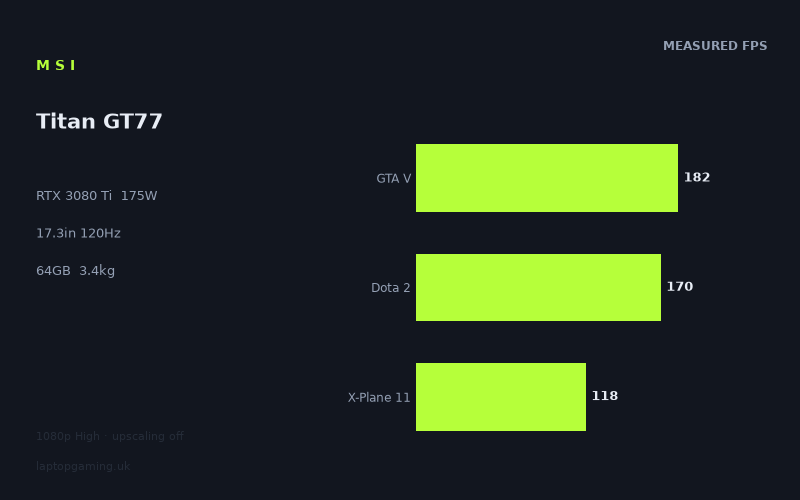
Frame rates
1920×1080, High preset, upscaling off.
Measured on this machine. Source: Notebookcheck, 2022-09-01.
Not scored: incomplete benchmark suite
Every scored laptop on this site is averaged over the same 5 games, and this one is short of Cyberpunk 2077, Baldur's Gate 3. A mean over 5 games is not comparable to a mean over 5, so we publish the figures we have and leave the score blank rather than rank it against machines tested on a different set. The numbers below are real - the suite is just incomplete.
How these numbers were produced
Frame rates here are not measured by us, and we label how each one was arrived at. A figure marked measured comes from a published run on that exact machine. A figure marked representative is derived from the GPU and its power limit (TGP) and cross-referenced against published reviews - a sound estimate of what that configuration delivers, but not a measurement of that specific laptop. Unless stated otherwise, numbers are 1920x1080, High preset, upscaling off. Where a laptop ships in several power configurations we use the wattage of the exact SKU listed, because a 140W RTX 5070 and a 115W one are not the same product.
In use
The short version
The MSI Titan GT77 (12UHS) is a large, heavy performance machine built around an RTX 3080 Ti running at a 175W GPU power limit, a Core i9-12900HX processor and 64GB of memory. The published benchmark data is strong at 1920x1080 on the High preset with upscaling disabled: every measured game except X-Plane 11 reaches or exceeds the screen’s 120Hz refresh rate, and several lighter or better-scaling titles run far beyond it. The result is a laptop that has no difficulty delivering high-refresh gaming at the benchmark settings, provided the game is not one of the more demanding titles in the set.
The important qualification is the display. This Titan has a 17.3in IPS panel with a 3840x2160 resolution and a 120Hz refresh rate, while the available figures are measured at 1920x1080. Those are useful numbers for judging the underlying performance of the system, but they are not evidence that every game here will run at 3840x2160 and 120fps on the High preset. They do show that there is a large amount of performance available when playing at 1920x1080, using a lower internal render resolution, or choosing settings with the panel’s refresh ceiling in mind. They do not establish native-resolution gaming results.
The Titan’s measured average across the five scoring-suite games is 167fps. That is clearly high enough to make the 120Hz panel relevant rather than aspirational at the benchmark settings. Strange Brigade, GTA V, Dota 2 and Final Fantasy XV all sit above 120fps, while X-Plane 11 is the exception at 118fps. The gap between the highest and lowest results is substantial, however, so this is not a machine where one headline average tells the whole story. It can produce 240fps in The Witcher 3 and 233fps in Strange Brigade, but that does not mean every game will behave like those titles. The 118fps X-Plane 11 result is the reminder that the platform can still be limited by a demanding game engine or workload even when the GPU is operating at its specified 175W limit.
This is therefore a sensible choice for someone who wants a very high-performance 17.3in gaming laptop and expects to spend most of their time plugged in, using a desk or a substantial bag rather than treating the machine as something to carry casually every day. At 3.385kg before considering the rest of a travel setup, it is not a lightweight option. The 64GB memory allocation and Core i9-12900HX also make it a specification aimed at buyers who value headroom as well as gaming performance, although the supplied data does not include application, battery, acoustics or thermal measurements.
There is no confirmed UK price for this exact configuration, so no value judgement can be made for it here. The performance evidence is complete, but a price is necessary before a meaningful buying recommendation can account for cost rather than frame rates alone.
Buy the Titan GT77 primarily for its combination of a 175W RTX 3080 Ti, a 120Hz 3840x2160 display and consistently high 1920x1080 benchmark results. Do not buy it on the assumption that the available figures prove native 3840x2160 performance, or if a 3.385kg laptop conflicts with how you intend to use it. Its strengths are clear, but they are the strengths of a powerful, desk-oriented machine rather than a universally convenient one.
Performance
Notebookcheck’s figures were measured at 1920x1080, using the High preset with upscaling disabled. That test method matters. It gives a clean view of the laptop’s performance without an upscaling mode changing the comparison between titles, but it also means the figures should be read as 1920x1080 High results rather than as a direct forecast for the Titan’s 3840x2160 panel. The system’s average across the five scoring-suite games is 167fps, which is comfortably above the screen’s 120Hz refresh rate. That average is valuable as an overview, yet the individual game results are more useful when deciding whether the machine suits a particular type of play.
The highest published result is 240fps in The Witcher 3. That is twice the panel refresh rate, so the display cannot show every individual frame produced at that setting. The practical point is not that the laptop needs a higher-refresh display for this one result; it is that The Witcher 3 has considerable performance headroom at 1920x1080 High. A buyer prioritising responsiveness, consistency or the option to raise settings from the measured preset has more room to work with in this title than in the lower-scoring games. The available data does not say what happens after changing resolution, graphics settings or rendering features, but 240fps at the stated test settings is an emphatic result.
Strange Brigade follows closely at 233fps. As a scoring-suite result, it contributes directly to the 167fps mean and helps explain why the Titan ranks strongly on the frame-rate leaderboard despite a wider spread elsewhere in the suite. Again, 233fps is far beyond the display’s 120Hz ceiling. That does not make the result irrelevant. It shows that, in this game at 1920x1080 High with no upscaling, the RTX 3080 Ti and Core i9-12900HX combination is not merely reaching the panel refresh rate but clearing it by a substantial margin. It is the kind of result that supports using the machine for high-refresh play at the benchmark resolution, rather than only for conventional 60fps targets.
F1 2021 reaches 205fps. That is another result well beyond 120fps and reinforces the same conclusion: this Titan is not struggling to supply the 120Hz panel at 1920x1080 in the better-running games in the set. F1 2021 also sits between the exceptionally high Witcher 3 and Strange Brigade figures and the more moderate games below, making it useful evidence that the strong results are not confined to one isolated title. The published data shows a broad upper group consisting of The Witcher 3, Strange Brigade and F1 2021. All three exceed the panel refresh rate by a considerable amount.
GTA V records 182fps. This remains comfortably above 120fps, although it is notably below the three fastest results. That difference is precisely why it is better to examine the individual benchmarks than to turn the 167fps suite average into a promise for every game. The Titan is fast in GTA V by the measured standard, with enough output to exceed the panel refresh rate at 1920x1080 High. But the result also shows that the laptop’s game performance is not a flat line. Even within titles that are clearly very playable, the measured output can vary materially.
Dota 2 posts 170fps, again above the 120Hz refresh rate. Alongside GTA V, this result gives the Titan a middle tier of games that are not producing the extreme outputs seen in The Witcher 3 or Strange Brigade but are still clearly able to feed the display at the stated settings. At 170fps, there is 50fps of measured headroom above 120Hz. That is useful headroom, but it is not the same as the 120fps gap seen in The Witcher 3. The distinction matters if the intention is to change graphical settings or move away from the benchmark resolution. The published figures support confidence at the exact test settings; they should not be stretched into claims about settings that have not been measured.
Far Cry 5 comes in at 161fps. It is not part of the five-game scoring-suite mean, but it is still an important part of the wider benchmark picture. At 161fps, it clears the panel refresh rate and joins the group of games where the Titan can make practical use of a 120Hz display at 1920x1080 High. The gap between Far Cry 5 and Dota 2 is small compared with the much larger separation between The Witcher 3 and X-Plane 11. That makes these results a useful centre point: they are strong, clearly high-refresh figures without relying on the unusually high outputs of the fastest games.
Final Fantasy XV reaches 131fps. This is still above 120Hz, but only by 11fps. It is therefore the first result where the distinction between “above the refresh rate” and “comfortably above the refresh rate” becomes important. The Titan can exceed the panel’s 120Hz refresh rate in this title at 1920x1080 High with upscaling disabled, but there is much less margin for changed conditions than there is in The Witcher 3, Strange Brigade or F1 2021. A small change in resolution, graphics settings, scene complexity or game behaviour could matter more here than it would in a title already far beyond 120fps. The supplied figures do not show those scenarios, so the responsible conclusion is simply that 131fps is a successful high-refresh result at the stated benchmark settings, not a guarantee of a large reserve.
X-Plane 11 is the lowest figure at 118fps. It misses the panel’s 120Hz refresh rate by only 2fps, so this is not evidence of poor performance. It is evidence that the Titan does not produce identical results in every game, even at 1920x1080 High. The system is still very close to the screen refresh rate in X-Plane 11, but it does not quite meet it in the published measurement. For a buyer whose main priority is flight simulation or this particular title, that distinction is more relevant than the 167fps scoring-suite average. A machine should be judged by the games that matter to its owner, and X-Plane 11 is a clear example of why the lower end of the benchmark spread deserves attention.
The complete range runs from 118fps in X-Plane 11 to 240fps in The Witcher 3. That is a 122fps spread. It is not surprising that different games place different demands on a laptop, but the scale of the variation is the central performance story here. The Titan GT77 is consistently powerful, yet “powerful” does not mean a fixed frame rate across all engines and workloads. Some games are able to produce far more frames than the 120Hz panel can display at the measured settings. Others sit close to the refresh limit. The laptop’s output is therefore best understood as a collection of strong game-specific results rather than a single uniform level of performance.
The 175W GPU power limit is significant because it identifies this as a high-power implementation of the RTX 3080 Ti rather than a specification where the graphics processor name alone tells the whole story. The comparison data supports that interpretation. The Titan is effectively level with the Asus ROG Strix Scar 17 SE using an RTX 3080 Ti at 150W, level with the Alienware x17 R2 using an RTX 3080 Ti at 175W, and 2fps behind the MSI Raider GE77 HX using an RTX 3080 Ti at 175W across their shared-game sets. A 175W limit gives the Titan a performance-oriented configuration, but it does not create an automatic lead over every other RTX 3080 Ti laptop.
That point is particularly important for buyers who assume that a higher listed GPU power limit must always translate into a clean benchmark advantage. The supplied rival figures do not support that simple conclusion at 1920x1080. The Titan’s 175W RTX 3080 Ti does not pull ahead of the 150W RTX 3080 Ti in the Asus ROG Strix Scar 17 SE across the five shared games. The stated explanation is that lighter titles at 1920x1080 can become CPU-bound, compressing real GPU differences. In other words, the lack of separation is not proof that GPU power limits are meaningless. It is a reminder that the measured resolution and games can shift the bottleneck away from the graphics processor.
This is also why the Titan’s own high frame rates need careful interpretation. In games running at 240fps, 233fps or 205fps, the system is already operating at a level where the benchmark may not be exposing only GPU capability. At 1920x1080, lighter titles can be limited by processor performance, game engine behaviour or other parts of the platform rather than by raw graphics power alone. The Core i9-12900HX is therefore relevant to the result, not just the RTX 3080 Ti. The available data does not isolate CPU and GPU contributions, but the near-identical rival outcomes between systems with different GPU limits strongly suggest that the platform as a whole, rather than the graphics chip in isolation, determines the published numbers in at least part of the shared set.
The Titan’s 64GB of memory is also part of a specification that is clearly not constrained to minimal gaming hardware. However, there are no supplied tests showing whether 64GB improves any of the game results listed here, nor are there memory configuration details beyond the capacity. It would be wrong to claim a measured frame-rate benefit from that capacity. What can be said is that the laptop is specified with 64GB rather than a smaller stated amount, and that this sits alongside the Core i9-12900HX and 175W RTX 3080 Ti as part of a high-end configuration. Buyers should avoid assigning a benchmark advantage to the memory unless they have workload-specific evidence.
For gaming at the measured settings, the practical hierarchy is straightforward. The Witcher 3, Strange Brigade and F1 2021 are not merely playable; they run well beyond 120fps. GTA V, Dota 2 and Far Cry 5 also exceed 120fps with useful headroom. Final Fantasy XV is above the target but much closer to it. X-Plane 11 falls just short of the display refresh rate. This is a very good set of 1920x1080 High results, but it is not a reason to assume identical behaviour in all current or future games, at all resolutions or at all visual settings.
The absence of upscaling in the test method deserves emphasis. The Titan’s frame rates are not being boosted by a named upscaling mode in the published figures. That makes the numbers easier to read as a baseline for the listed preset and resolution. It also means there is no measured evidence here about how an upscaling mode might change performance at 3840x2160, whether the image quality would be acceptable to a particular buyer, or whether a given game would reach 120fps at the panel’s native resolution. Those may be relevant questions for a 3840x2160 laptop, but they are outside the supplied benchmark record.
The screen
The MSI Titan GT77 uses a 17.3in IPS display with a 3840x2160 resolution and a 120Hz refresh rate. On paper, that is a screen designed to offer both a large workspace and a higher refresh ceiling than a conventional 60Hz panel. The size and resolution make it a very different proposition from a smaller 1920x1080 gaming display, while the 120Hz refresh rate means that frame rates above 120fps can matter only up to the point where the panel reaches its own limit. The benchmark results show that the laptop often has enough performance to meet that refresh rate at 1920x1080 High, but they do not prove the same at 3840x2160.
This mismatch between benchmark resolution and panel resolution is the main screen-related buying consideration. The laptop is equipped with 3840x2160 pixels, while Notebookcheck’s figures were captured at 1920x1080. Moving from the benchmark resolution to the display’s native resolution changes the rendering workload substantially, but the fact sheet does not provide native-resolution results. A careful review cannot fill that gap with assumed scaling. The Titan may be used at its native resolution, at 1920x1080, or with other game-specific settings, but only the 1920x1080 High measurements are attributable here.
At the benchmark resolution, the 120Hz panel is well matched to much of the available data. The Witcher 3 at 240fps, Strange Brigade at 233fps, F1 2021 at 205fps, GTA V at 182fps, Dota 2 at 170fps, Far Cry 5 at 161fps and Final Fantasy XV at 131fps all meet or exceed 120fps. For those games and settings, the display’s refresh rate is not wasted. In several cases, the laptop is producing more frames than the panel can refresh. That is a good position to be in for a 120Hz screen, because it avoids the opposite situation where the display specification looks impressive but the machine regularly fails to approach it.
X-Plane 11 at 118fps is the counterpoint. It is close to 120Hz but does not quite reach it in the published figure. This does not undermine the screen choice, but it does show that the screen should not be treated as a universal 120fps promise. The 120Hz specification describes what the panel can display, not what every game will necessarily supply. The Titan’s own figures demonstrate both sides: plentiful performance in some titles, near-refresh operation in others.
The IPS panel type is worth noting, but the supplied information stops there. There are no panel brightness measurements, contrast figures, colour coverage figures, response-time measurements or HDR information in the fact sheet. It would be inappropriate to describe the display as especially bright, colour-accurate, fast-moving or suitable for a particular content-creation standard without those details. The evidence supports identifying it as a 17.3in, 3840x2160, 120Hz IPS panel. It does not support a more detailed judgement of image quality.
The resolution also changes the way the Titan should be considered as a gaming purchase. A 3840x2160 screen gives the owner the option of using that native resolution, but the machine’s attributable performance record is at 1920x1080. Buyers who mainly want very high frame rates should focus on the benchmark resolution and the 120Hz refresh relationship. Buyers who mainly want native-resolution detail should recognise that the supplied data does not answer their key performance question. Neither approach is inherently wrong; they are simply different priorities, and the current evidence is much stronger for the first one.
For the strongest measured games, the Titan has far more than enough output at 1920x1080 High to make 120Hz useful. For Final Fantasy XV, the 131fps result leaves a more limited margin. For X-Plane 11, the 118fps result is just below the panel’s limit. That progression illustrates why the display cannot be assessed separately from the benchmark spread. A 120Hz panel is an excellent fit where the machine produces 170fps, 182fps, 205fps, 233fps or 240fps. It is a closer fit where the output is 131fps, and it becomes a ceiling the laptop does not quite reach where the result is 118fps.
Build, size and portability
The one supplied physical measurement is weight: 3.385kg. That is enough to establish that the Titan GT77 is not a casual carry-everywhere laptop. A machine at this weight is best understood as one that will spend much of its time on a desk, table or other stable surface, with travel being possible but deliberate. It may suit a buyer who moves between fixed locations, but it is less naturally suited to someone who needs a light machine for frequent daily carrying.
The 17.3in display reinforces that conclusion. This is a large-screen laptop, and the product’s priorities are clear from the combination of screen size, 3840x2160 resolution, 120Hz refresh rate, 175W RTX 3080 Ti, Core i9-12900HX and 64GB memory. The specification is focused on performance and screen space rather than minimising weight. That does not make it unsuitable for travel; it means portability needs to be assessed honestly. A buyer who considers 3.385kg manageable may find the trade-off acceptable. A buyer looking for a laptop that disappears into a bag will likely want something else.
No dimensions are provided in the fact sheet, so there is no basis for claiming a particular footprint, thickness or bag compatibility. The 17.3in screen and 3.385kg weight provide a useful sense of category, but they do not replace actual dimensions. Similarly, there are no supplied details on chassis materials, keyboard layout, trackpad, ports, speakers, webcam, battery behaviour, charger size, fan noise or operating temperatures. Those areas should remain unjudged rather than being inferred from the Titan name or from the hardware specification.
The 175W GPU power limit also fits the machine’s desk-oriented character. High-power graphics configurations are relevant to the Titan’s benchmark positioning, and the laptop delivers strong frame rates at 1920x1080 High. But the fact sheet does not include thermal or noise figures, so there is no evidence here about how the system behaves acoustically or thermally while producing those results. Buyers who are particularly sensitive to fan noise, warm surfaces or long unplugged use need information that is not contained in the supplied measurements.
What can be concluded is more limited but still useful. The Titan GT77 is a 3.385kg, 17.3in gaming laptop with a high-power RTX 3080 Ti configuration and a 3840x2160 120Hz IPS screen. It makes sense where performance and screen size take priority over low weight. It makes less sense where the main requirement is regular mobile use. The physical compromise is not hidden in the specification, and prospective buyers should treat it as central rather than secondary.
How it compares
The rival data places the Titan in a revealing position. It is dramatically ahead of the MSI Prestige 15 with an RTX 3050 Ti at 105W, but it is effectively tied with two RTX 3080 Ti laptops and only fractionally behind another RTX 3080 Ti system. The comparison is valuable because it shows both the advantage of the Titan’s class of hardware and the limits of expecting a unique lead simply from its 175W GPU power limit.
Against the MSI Prestige 15, the Titan averages 96fps more across four shared games. The Prestige 15 is listed with an RTX 3050 Ti at 105W, while the Titan uses an RTX 3080 Ti at 175W. The performance gap is substantial. It supports a clear conclusion that the Titan belongs in a much higher performance tier for the shared games. This is the comparison that best illustrates what buyers gain from the Titan’s graphics configuration: not a marginal improvement, but a large increase in measured frame rate across the available common set.
That 96fps advantage should not be reduced to a vague statement that the Titan is “faster”. The magnitude matters because it changes the likely experience at the measured settings. A large shared-game average gap can affect whether a laptop is merely able to run a game well or has the additional headroom needed for a high-refresh display. The exact per-game comparison figures are not supplied, so it would be wrong to assign the whole advantage to any individual title. But the four-game average makes the overall difference unmistakable.
Against the Asus ROG Strix Scar 17 SE, the Titan averages 0fps difference across five shared games. The Asus is listed with an RTX 3080 Ti at 150W, compared with the Titan’s RTX 3080 Ti at 175W. A zero average difference is not a missing result or a reason to dismiss the comparison. It is a real outcome in the stated shared-game sample. At 1920x1080, lighter titles in the shared set can be CPU-bound, which compresses genuine GPU differences. That explanation is more useful than simply repeating that the average difference is zero.
For a buyer comparing these two machines mainly through 1920x1080 benchmark averages, the data says there is no measured frame-rate reason to assume the Titan will be ahead. That does not prove the systems are identical in every game, at every setting or at the Titan’s 3840x2160 native resolution. It says that in the five shared games used for this comparison, the observed average is level. The Titan’s additional listed GPU power limit does not create a visible advantage in this particular sample.
The Alienware x17 R2 is even closer in specification on the supplied information: it also has an RTX 3080 Ti at 175W. Across five shared games, the Titan again averages 0fps difference. This is the cleanest evidence that a matching GPU model and matching power limit can produce essentially the same outcome in the shared 1920x1080 set. Neither laptop establishes a measurable average advantage over the other in these figures.
For potential buyers, this means the Titan should not be selected over the Alienware x17 R2 on the expectation of a frame-rate lead in the five shared games. The benchmark data does not support one. Other differences may exist, but they are not supplied here and should not be invented. On performance alone, the available comparison is a tie. That is useful information, especially because buyers are often tempted to treat a large, high-power laptop as automatically superior to every machine using the same graphics processor.
The MSI Raider GE77 HX provides the one comparison where the Titan is slightly behind. The Raider is listed with an RTX 3080 Ti at 175W, the same GPU power limit as the Titan, and the Titan averages 2fps fewer across five shared games. This is a very small difference. It is not a basis for describing the Raider as decisively faster, just as the Titan’s own 175W rating is not a basis for describing it as decisively faster than every rival. The sensible reading is that these systems are effectively in the same performance band in the shared sample, with the Raider holding a narrow measured edge.
The 2fps deficit also helps put benchmark precision into context. When a machine is averaging 167fps across the Titan’s scoring suite, a 2fps difference across a separate five-game shared set does not overturn the broader picture of a high-performance RTX 3080 Ti laptop. It does, however, prevent overclaiming. The Titan is not the outright frame-rate winner against every listed rival. The best-supported statement is that it is level with the Asus ROG Strix Scar 17 SE, level with the Alienware x17 R2, fractionally behind the MSI Raider GE77 HX, and far ahead of the MSI Prestige 15 in the supplied common-game comparisons.
The rival spread is more informative than a single nearest comparison. The Prestige 15 demonstrates the large step up from an RTX 3050 Ti at 105W to the Titan’s RTX 3080 Ti at 175W. The Asus shows that the 175W versus 150W distinction does not necessarily appear at 1920x1080 in a shared set that includes lighter titles. The Alienware shows parity between two 175W RTX 3080 Ti machines. The Raider shows that even an identical listed GPU power limit does not guarantee that the Titan is ahead. Together, these comparisons argue for looking at attributable game data rather than buying solely on graphics names or power-limit labels.
Who it's for
The MSI Titan GT77 is for the buyer who wants a large-screen, high-performance gaming laptop and is comfortable with a 3.385kg machine. The best fit is someone who values the 17.3in 3840x2160 IPS display, wants a 120Hz refresh rate, and expects to play a meaningful amount of their games at 1920x1080 or otherwise prioritise frame rate over an unverified native-resolution target. The Notebookcheck data is especially convincing for players focused on The Witcher 3, Strange Brigade, F1 2021, GTA V, Dota 2 or Far Cry 5 at the measured settings, where the Titan exceeds 120fps.
It is also for buyers who recognise that the 175W RTX 3080 Ti is part of a broader high-end configuration rather than a guarantee of unmatched results. The Core i9-12900HX and 64GB memory place the Titan firmly in a performance-focused category, while the benchmark figures show it can produce a 167fps mean across the five scoring-suite games. Someone who wants a system with substantial measured 1920x1080 gaming throughput and does not require a lightweight form factor has a clear reason to consider it.
It is particularly suitable for someone who uses a laptop as a main machine at a desk but still values the fact that it remains a laptop rather than a separate display and desktop tower. The fact sheet does not provide information about ports, external display support, battery life or charger size, so those details cannot be used to define its role. But its weight, screen size and high-power GPU configuration make a mostly fixed-location use case the most natural fit.
It is not the obvious choice for someone who travels lightly or carries a laptop throughout the day. At 3.385kg, the Titan is simply a different proposition from a smaller, lighter machine. A buyer for whom portability is the first requirement should choose something else, even if that means accepting lower frame rates. The 96fps shared-game lead over the MSI Prestige 15 shows the performance cost of moving to a lower-class RTX 3050 Ti configuration, but the Titan’s weight means that performance comes with a real practical trade-off.
It is also not the right purchase for someone who requires confirmed 3840x2160 gaming performance before buying. The display is 3840x2160, but the attributable benchmark data is at 1920x1080 High with upscaling disabled. The Titan may have considerable native-resolution capability, but that is not demonstrated by the supplied figures. A buyer focused on native-resolution gaming should seek measured results at that resolution rather than treating the 1920x1080 numbers as a substitute.
Players whose priority is a locked or consistently exceeded 120fps in every game should also be cautious. The Titan does this in most of the measured titles, but not all. Final Fantasy XV reaches 131fps, leaving limited room above the panel refresh rate, and X-Plane 11 reaches 118fps. Those are still strong results, but they are not identical to the 205fps, 233fps and 240fps outcomes elsewhere in the set. The right expectation is excellent performance with title-dependent variation, not a universal 120fps guarantee.
Finally, the Titan is not automatically the best performance choice among every RTX 3080 Ti rival. The shared-game data shows it tied with the Asus ROG Strix Scar 17 SE and Alienware x17 R2, while the MSI Raider GE77 HX is 2fps ahead on average across its five shared games. Buyers choosing among these particular machines should not assume that the Titan’s 175W GPU power limit gives it a decisive benchmark lead. Its case rests on the complete combination of its screen, weight class, Core i9-12900HX, 64GB memory and strong measured frame rates, not on a claim that it defeats every comparable RTX 3080 Ti laptop.
The measured evidence ultimately supports a focused recommendation. The MSI Titan GT77 is a powerful 17.3in gaming laptop that can make very good use of its 120Hz display at 1920x1080 High in most of the benchmarked games. It is strongest for buyers who want high frame rates, a large 3840x2160 IPS panel and a desk-oriented machine with a 175W RTX 3080 Ti. It is less suitable for buyers who need low weight, verified native-resolution results, or a categorical performance advantage over every competing RTX 3080 Ti laptop.