Review
HP Envy 17-cr0079ng review
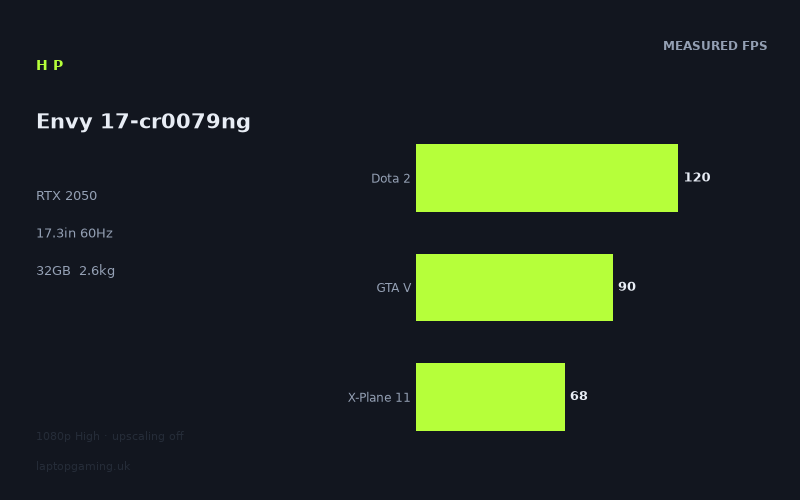
Frame rates
1920×1080, High preset, upscaling off.
Measured on this machine. Source: Notebookcheck, 2023-04-14.
Not scored: incomplete benchmark suite
Every scored laptop on this site is averaged over the same 5 games, and this one is short of Cyberpunk 2077, Baldur's Gate 3. A mean over 5 games is not comparable to a mean over 5, so we publish the figures we have and leave the score blank rather than rank it against machines tested on a different set. The numbers below are real - the suite is just incomplete.
How these numbers were produced
Frame rates here are not measured by us, and we label how each one was arrived at. A figure marked measured comes from a published run on that exact machine. A figure marked representative is derived from the GPU and its power limit (TGP) and cross-referenced against published reviews - a sound estimate of what that configuration delivers, but not a measurement of that specific laptop. Unless stated otherwise, numbers are 1920x1080, High preset, upscaling off. Where a laptop ships in several power configurations we use the wattage of the exact SKU listed, because a 140W RTX 5070 and a 115W one are not the same product.
In use
The short version
The HP Envy 17-cr0079ng is a large, high-resolution laptop with a gaming result that is more mixed than its name, screen size and RTX badge might suggest. Its Core i7-1255U, RTX 2050, 32GB of memory and 1TB SSD form a capable general-purpose specification on paper, but the important gaming evidence is the published benchmark data: at 1920x1080 on the High preset with upscaling off, Notebookcheck recorded results ranging from 120fps in Dota 2 to 20fps in Dead Space Remake.
That range matters more than the 75fps mean across the scoring-suite games. This is not a machine that turns every modern game into a smooth 60Hz experience at the tested settings. It can do that in a substantial part of the measured library, including Dota 2, F1 22, GTA V, Monster Hunter Stories 2, GRID Legends, X-Plane 11, F1 2021 and Strange Brigade. Yet it falls below the display’s 60Hz refresh rate in The Witcher 3, Far Cry 5, Final Fantasy XV and Dead Space Remake. The gap between those groups is too large to dismiss as minor variation. The RTX 2050 is adequate for selected games at 1080p High, but the benchmark spread shows that it is not a dependable answer to every demanding game at that preset.
The bigger mismatch is between the gaming measurements and the built-in display. This Envy has a 17.3in IPS panel at 3840x2160 and 60Hz, while the supplied gaming figures are at 1920x1080 rather than the panel’s native resolution. The published data therefore supports a conclusion about Full HD gaming, not 3840x2160 gaming. There are no measured frame rates here for the native panel resolution, and there are no upscaling results to fill that gap. Anyone buying this machine principally for native-resolution gaming would be relying on an assumption rather than attributable benchmark evidence.
That does not make the Envy 17-cr0079ng a poor choice for every buyer. It makes it a machine that needs to be bought for the right priorities. It is most convincing for someone who wants a 17.3in 3840x2160 IPS screen, 32GB of memory and 1TB of storage in a laptop that can also play a defined set of games at 1920x1080 High. It is less convincing for someone whose main requirement is consistently strong gaming performance, particularly in demanding releases represented by Final Fantasy XV and Dead Space Remake.
The weight also frames the purchase. At 2.556kg, this is a substantial 17.3in laptop, not a machine to choose on the assumption that it will disappear into daily travel. The fact sheet does not provide physical dimensions, so there is no basis for claiming how much desk or bag space it takes beyond its 17.3in screen and stated weight. It also lists a 55Wh battery, but no battery-life measurement. That means portability has to be judged cautiously: the weight is known, while runtime is not.
No overall score can be calculated because there is no confirmed UK price for this exact configuration. The benchmark suite is complete and the machine ranks normally on the frame-rate leaderboard, but a price-dependent value assessment cannot be made without a confirmed UK price.
The sensible verdict is therefore conditional but clear. Buy the HP Envy 17-cr0079ng if the large 3840x2160 IPS screen, 32GB memory and 1TB SSD matter as much as gaming, and if the games you care about resemble the better-performing part of the measured library. Look elsewhere if you expect the RTX 2050 to make full use of a 3840x2160 panel in current demanding games, or if you want High-preset 1080p performance that stays above the 60Hz panel refresh rate regardless of title.
Performance
What the measured results actually show
All of the supplied figures come from Notebookcheck, recorded on 2023-04-14 at 1920x1080, using the High preset with upscaling off. That is an important test condition. It is a straightforward Full HD High comparison with no upscaling result contributing extra performance, but it is not a test of the screen’s 3840x2160 native resolution. The figures are useful because they establish a consistent picture of what the HP can deliver under a defined setting, not because they answer every possible gaming scenario.
The strongest result is Dota 2 at 120fps. That is twice the panel’s 60Hz refresh rate on the published measurement, and it is the clearest example of a title where the HP has performance to spare relative to its display refresh. The result also helps explain why a single average cannot tell the whole story. Dota 2 materially lifts the overall picture, but it should not be treated as a proxy for the results in every other game.
F1 22 follows at 93fps, while GTA V and Monster Hunter Stories 2 both reach 90fps. These are strong 1080p High results relative to the 60Hz screen. They show that the Envy can run several of the measured games above the display refresh at the tested settings, with no upscaling involved. For a buyer who mainly plays these particular games, the gaming case is much stronger than it is for someone concentrating on the bottom end of the results.
GRID Legends and X-Plane 11 each record 68fps. F1 2021 reaches 66fps, and Strange Brigade records 61fps. These figures sit much closer to the panel’s 60Hz refresh rate. They still clear it in the supplied measurement, but they do not offer the same headroom as Dota 2, F1 22, GTA V or Monster Hunter Stories 2. The distinction matters because a result only just above 60fps should be read differently from a result such as 120fps. The former tells you that the tested setting aligns with the panel refresh in the measured run; the latter shows a much larger performance margin in that particular title.
The next group is where the Envy’s limits become more obvious. The Witcher 3 records 58fps, placing it below the 60Hz panel refresh rate. Far Cry 5 is lower again at 53fps. Final Fantasy XV records 35fps, and Dead Space Remake is the clear outlier at 20fps. Those final two results are not close to the rest of the list. They are evidence that the RTX 2050 configuration can be comfortable in some games while being poorly matched to others at exactly the same 1920x1080 High test conditions.
The 75fps mean across the five scoring-suite games is useful as a broad leaderboard figure, but it must be interpreted alongside the individual measurements. The scoring-suite results are Dota 2 at 120fps, GTA V at 90fps, X-Plane 11 at 68fps, Strange Brigade at 61fps and Final Fantasy XV at 35fps. That is not a tightly grouped set of outcomes. It combines a result far above the panel refresh rate with a result well below it. The mean describes the collection, but it cannot turn Final Fantasy XV into a 60fps result or make Dota 2 representative of every game.
The performance tiers within the measured library
The most useful way to read the numbers is to divide the measured games by what they imply for this laptop’s 60Hz display at the tested settings.
- Clearly above the 60Hz refresh rate: Dota 2 at 120fps, F1 22 at 93fps, GTA V at 90fps and Monster Hunter Stories 2 at 90fps.
- Above 60Hz, but much closer to the display limit: GRID Legends at 68fps, X-Plane 11 at 68fps, F1 2021 at 66fps and Strange Brigade at 61fps.
- Below the panel refresh rate: The Witcher 3 at 58fps, Far Cry 5 at 53fps, Final Fantasy XV at 35fps and Dead Space Remake at 20fps.
This division is more useful for a prospective owner than a generic claim that the laptop is or is not “good for gaming”. The evidence supports both positive and negative conclusions, depending on the game. It is entirely fair to say that the HP can deliver more than 60fps at 1080p High in Dota 2, F1 22, GTA V, Monster Hunter Stories 2, GRID Legends, X-Plane 11, F1 2021 and Strange Brigade. It is equally fair to say that it does not reach 60fps in The Witcher 3, Far Cry 5, Final Fantasy XV or Dead Space Remake under those same stated test conditions.
That is why title selection is central to the buying decision. A buyer whose regular games are represented by the faster group may find the Envy’s measured performance well aligned with its 60Hz panel. A buyer focused on the slower group should not take the better results as reassurance that their games will behave similarly. The data does not support that leap. The range from 120fps to 20fps is the evidence against treating the RTX 2050 here as a uniform-performance gaming part.
What the GPU power limit does, and does not, tell us here
The fact sheet identifies the HP’s GPU as an RTX 2050, but it does not state a GPU power limit for this exact HP configuration. That absence matters because there is no attributable basis for assigning this Envy a wattage figure, or for claiming that it runs its RTX 2050 at a higher or lower power level than another laptop. The published frame rates are the evidence available for this machine’s actual performance.
Two of the listed rivals, the Acer Aspire 17 and Acer Aspire 5, are explicitly identified as RTX 2050 systems at 35W. The HP is not supplied with an equivalent stated power figure. It would therefore be wrong to infer the HP’s wattage from its results, even though its shared-game averages sit 2fps ahead of the Acer Aspire 17 and level with the Acer Aspire 5. The results establish those measured comparisons; they do not explain them with a confirmed power-limit figure for the HP.
This is particularly relevant because the HP’s closest results against those RTX 2050 rivals are nearly flat. A small shared-game average difference can easily be misread as proof that the machines are effectively identical in every gaming respect. It is not. It simply means that, in the shared 1080p High games used for the comparison, the published averages are close. The fact sheet specifically notes that lighter titles in the shared set can become CPU-bound at 1080p, compressing genuine GPU gaps. In other words, a near-zero difference in this comparison is a real result, but it is not a licence to claim that every underlying part of each machine performs identically.
The same caution applies to the Envy’s own results. The frame-rate spread cannot be reduced to a single explanation from the supplied information. The data shows that some games are much more comfortable for this configuration than others. It does not provide a per-game GPU power reading, CPU utilisation, memory behaviour, thermals, clock data or noise data. There is no basis for inventing any of those explanations. The responsible conclusion is simply that game demands vary sharply in the measured set, and the HP’s results vary with them.
How demanding games expose the limit
Dead Space Remake at 20fps is the result that should stop buyers from assuming that an RTX-branded laptop will automatically be suitable for every recent demanding game on High. The result is not merely below the 60Hz refresh rate; it is far removed from the figures in Dota 2, F1 22, GTA V and Monster Hunter Stories 2. It demonstrates the risk of buying this machine solely on the basis of the RTX 2050 name, the Core i7 label or the 32GB memory capacity.
Final Fantasy XV at 35fps makes a similar point from a different position in the table. It is considerably ahead of Dead Space Remake, but it remains below the panel refresh rate and below the results in the majority of the supplied game list. For buyers who consider 60Hz the target for their chosen settings, the HP has a clear limitation in this title. The machine’s 75fps scoring-suite mean should not obscure that Final Fantasy XV is itself part of that scoring suite and sits at 35fps.
The Witcher 3 at 58fps is a more marginal result. It is below 60Hz, but it is near the display refresh rather than in the same range as Final Fantasy XV or Dead Space Remake. Far Cry 5 at 53fps is also below the panel target, though closer to it than the lowest results. These figures are important because they show that not every shortfall is equally severe. The evidence presents a gradient: some games are comfortably above 60fps, some hover around that level, some fall materially below it, and Dead Space Remake sits at the far end of the range.
That gradient is the correct basis for setting expectations. The HP Envy 17-cr0079ng is not best described as a 120fps machine simply because Dota 2 records 120fps. Nor is it best described as a 20fps machine simply because Dead Space Remake records 20fps. It is a laptop with a measured 1080p High profile that runs from 20fps to 120fps, with the individual game result being far more useful than the highest or lowest headline number alone.
The screen
A 3840x2160 panel with 1080p gaming evidence
The HP Envy 17-cr0079ng has a 17.3in IPS screen at 3840x2160 with a 60Hz refresh rate. This is one of the machine’s most distinctive specifications. The resolution is far above the 1920x1080 benchmark setting, and the display refresh is fixed at 60Hz in the supplied specification. For general use, the combination of a large 17.3in panel and 3840x2160 resolution is clearly a different proposition from a typical Full HD gaming display. For gaming, though, the gap between panel resolution and benchmark resolution must be treated honestly.
Notebookcheck’s supplied figures were recorded at 1920x1080, not at 3840x2160. The data therefore demonstrates what the HP can do at Full HD High with upscaling off. It does not demonstrate that the machine can drive the panel at its native 3840x2160 resolution in Dota 2, F1 22, GTA V, Monster Hunter Stories 2, GRID Legends, X-Plane 11, F1 2021, Strange Brigade, The Witcher 3, Far Cry 5, Final Fantasy XV or Dead Space Remake.
This distinction should affect the purchase decision. The 3840x2160 screen is a feature you can value for reasons beyond the supplied gaming data, but it should not be treated as a gaming-performance promise. The RTX 2050 results are already mixed at 1920x1080 High. In the absence of attributable 3840x2160 measurements, there is no evidence here that would justify promising a similar result at the panel’s native resolution.
The lack of upscaling in the test setup also matters. The measured figures are not boosted by an upscaling mode, which makes the 1080p High results a clean baseline for comparison. At the same time, the fact sheet contains no measurements with upscaling enabled. It would be wrong to fill in those missing results with estimated frame rates, or to imply that an upscaling setting solves the native-resolution question. The only defensible statement is that the supplied benchmark data is 1920x1080 High with upscaling off.
How well the measured games fit a 60Hz screen
The 60Hz refresh rate is a useful point of reference because it allows the published frame rates to be read in practical display terms without inventing any extra measurement. Dota 2 at 120fps, F1 22 at 93fps, GTA V at 90fps and Monster Hunter Stories 2 at 90fps all exceed 60fps. GRID Legends and X-Plane 11 at 68fps, F1 2021 at 66fps and Strange Brigade at 61fps also exceed 60fps, although by a narrower margin.
In this group, the display is not a problem in the sense that the measured frame rates are already at or above its 60Hz specification. The panel refresh does, however, set a different ceiling from the performance figures themselves. A 120fps result in Dota 2 tells you that the benchmark result is well above 60fps, while the panel remains a 60Hz panel. Buyers seeking a display specification above 60Hz should not assume it exists here; the stated refresh rate is 60Hz.
The slower titles reveal the opposite relationship. The Witcher 3 at 58fps, Far Cry 5 at 53fps, Final Fantasy XV at 35fps and Dead Space Remake at 20fps all fall short of the screen’s 60Hz refresh rate in the published figures. Here, the display is not the limiting reference point; the benchmark result is. A 3840x2160 panel does not alter the fact that these Full HD High measurements are below 60fps.
This is why the panel and GPU need to be considered as a pairing rather than isolated specifications. The Envy offers a large, high-resolution IPS display, but its tested gaming performance is strongest in a group of games at 1920x1080. If your priority is a large 3840x2160 screen for uses not covered by the gaming benchmark sheet, the screen may be a central reason to choose it. If your priority is gaming at native 3840x2160, the fact sheet does not provide the evidence needed to recommend it with confidence.
IPS, size and refresh in context
The supplied panel type is IPS. Beyond that classification, the fact sheet does not provide brightness, contrast, colour coverage, response-time measurements or any other display-quality result. Those are not details to guess at. A buyer who needs a particular brightness level, colour result or response measurement should seek an attributable display test rather than infer those characteristics from the IPS label alone.
The 17.3in size and 3840x2160 resolution do make this a notably large-screen specification. That can be attractive to a buyer who wants more display area from a laptop, but it also reinforces the point that this is not a conventional high-refresh gaming design. The screen is specified at 60Hz, and the benchmark data has to be read against that reality. The laptop can exceed 60fps in many of the measured games at 1080p High, but the display itself is not specified beyond 60Hz.
Build, size and portability
The hard portability figure is the HP’s 2.556kg weight. Combined with the 17.3in screen, that places the Envy firmly in the large-laptop category by its own stated specification. It should be approached as a machine likely to spend meaningful time on a desk or table, rather than bought on the assumption that it has the convenience profile of a smaller laptop. That is not a judgement based on having carried the machine; it follows from the published weight and screen size.
There are no dimensions in the fact sheet. As a result, there is no basis here for claims about thickness, footprint, hinge design, port layout, keyboard quality, chassis materials or whether the machine fits a particular bag. Those details can matter a great deal with a 17.3in laptop, but they are simply not established by the supplied information. A prospective buyer should check the physical dimensions from a reliable specification source before deciding whether the machine suits their workspace or travel needs.
The 55Wh battery is another specification that needs restraint. Battery capacity is provided, but no measured battery life is supplied. It would be irresponsible to turn 55Wh into a claimed number of hours, whether for video, web use, office tasks or gaming. The only confirmed point is that the battery is rated at 55Wh. Buyers who need long unplugged use should not assume a runtime from capacity alone; they need a measured battery-life result for this exact configuration or an appropriately documented equivalent.
The internal specification is more generous than the gaming GPU result might lead some buyers to expect. The HP has 32GB of memory and a 1TB SSD. Those are concrete capacities, and they make the Envy different from a stripped-back gaming configuration focused solely on frame rates. The supplied facts do not identify the memory type, storage speed, number of storage slots or upgrade options, so no claim should be made about those areas. Still, 32GB and 1TB are meaningful parts of the listed configuration for buyers who want a laptop that is not solely defined by game performance.
The Core i7-1255U is also part of the stated configuration, but the available data does not include processor benchmarks, productivity measurements or sustained-performance testing. The gaming results show what the complete laptop achieved in the listed games under Notebookcheck’s conditions. They do not isolate the processor, nor do they establish how the machine performs in rendering, compiling, video work or any other task not covered by the supplied results.
That means the sensible physical-use case is specific. This is a large 17.3in laptop with a 2.556kg weight, 55Wh battery, 32GB memory and 1TB SSD. It is suitable for a buyer who deliberately wants that combination and who can assess the missing physical and battery details before purchase. It is not suitable for a buyer who needs documented long battery life, documented compact dimensions, or a lighter machine. The fact sheet cannot support those claims.
How it compares
The rival comparison is useful because it avoids pretending that every RTX 2050 laptop, or every older RTX laptop, produces the same results. These comparisons are based only on games both machines hold, preferring scoring-suite games. That shared-game limitation is important: a comparison average is not a universal ranking across every game, every resolution or every setting. It is a defined measurement result from the common titles.
Against the Schenker XMG Core 15 with RTX 2060
Against the Schenker XMG Core 15 with RTX 2060, the HP Envy 17-cr0079ng averages 2fps ahead across 3 shared games. This is a near-zero result in practical comparative terms, and the correct response is explanation rather than exaggeration. The HP is not shown as decisively faster in the shared set; it is shown as extremely close on the available comparison.
The fact sheet explains why such a close outcome can be genuine without proving that the GPUs are identical in all circumstances. At 1080p, lighter titles in the shared set can be CPU-bound and compress genuine GPU gaps. That means the 2fps advantage is a real published average, but it should not be converted into a sweeping statement that the HP’s RTX 2050 is broadly superior to the XMG’s RTX 2060. The comparison is narrow, based on 3 shared games, and the benchmark context matters.
For a buyer choosing specifically between these machines, the result says that the HP does not trail the XMG Core 15 in the available shared-game average. It does not say that the HP will lead in every game, at every resolution or under every graphics setting. The Envy’s own wide spread, from 120fps in Dota 2 to 20fps in Dead Space Remake, is reason enough to avoid broad conclusions from a small shared set.
Against the Acer Aspire 17 with RTX 2050 at 35W
The HP averages 2fps ahead of the Acer Aspire 17 with RTX 2050 at 35W across 5 shared games. This is again a very close result, but it has more shared-game coverage than the Schenker comparison. The Envy is ahead in the stated average, yet the margin is too small to support a claim of a major gaming-performance advantage.
The useful conclusion is that the HP’s measured 1080p High performance is competitive with this particular 35W RTX 2050 rival in the shared set. It is not correct to attribute that result to a particular HP GPU power limit because no HP power figure is supplied. The Acer’s 35W specification is known; the HP’s is not. The comparison should remain tied to what the data actually says: the HP is 2fps ahead on average across 5 shared games.
For a buyer who sees both machines as large-screen alternatives, this is a reminder to look beyond the GPU label. The shared-game result is close enough that screen specification, memory, storage, weight, confirmed price and other documented features could matter more than a 2fps average. In this case, however, no confirmed UK price is provided for either configuration in the fact sheet, so price cannot be used to settle the comparison.
Against the Acer Aspire 5 with RTX 2050 at 35W
The Acer Aspire 5 with RTX 2050 at 35W is the closest result of all: the HP averages +0fps across 5 shared games. That is not a missing comparison or an uncertain result. It is a real published near-zero difference across the shared titles. The HP and Acer are level on this defined average.
It would be easy to overread this as proof that the machines offer the same gaming experience in every respect. The supplied context warns against that. At 1080p, lighter titles in the shared set can be CPU-bound, which compresses genuine GPU gaps. The shared average is therefore useful precisely because it is limited: it says the available common-game average is level, not that every component, thermal profile, display, storage arrangement or unmeasured game behaves the same way.
For the HP, the practical implication is that the Envy does not establish a performance lead merely by being a 17.3in system with an RTX 2050. Its direct result against this Aspire 5 is level in the shared benchmark selection. Buyers should therefore choose between them on documented configuration differences and confirmed pricing where available, rather than expecting the HP name or larger screen to guarantee higher frame rates.
Against the MSI GT76 Titan DT with RTX 2080
The MSI GT76 Titan DT with RTX 2080 is the other end of the comparison spread. The HP averages 76fps behind across 5 shared games. Unlike the near-zero gaps against the Schenker and Acer systems, this is a substantial separation in the published shared-game data. It demonstrates that the Envy is not a substitute for a much higher-performing gaming laptop simply because it can post strong results in selected titles.
The contrast is especially useful when read alongside the HP’s individual results. Dota 2 at 120fps, F1 22 at 93fps and GTA V at 90fps may look strong in isolation, but the 76fps shared-game deficit to the MSI shows that the Envy occupies a clearly lower performance tier in this rival set. It also reinforces the need to distinguish between being adequate for a 60Hz display in some games and being a performance-led gaming machine.
There is no need to diminish the HP’s better results to acknowledge this. The Envy can exceed 60fps in many of its measured games at 1920x1080 High. But against the specific RTX 2080 rival, the common-game average is decisively lower. Buyers whose priority is the strongest frame-rate performance should treat that gap as more meaningful than the Envy’s isolated high results in lighter or more favourable titles.
Who it’s for
Buy it if the screen and general configuration are central to the purchase
The HP Envy 17-cr0079ng makes the most sense for a buyer who wants a 17.3in IPS display at 3840x2160, 32GB of memory and a 1TB SSD, and who sees gaming as an important secondary use rather than the sole purpose of the laptop. Those specifications are concrete strengths of the configuration. The gaming evidence supports that use case when the target is 1920x1080 High in games that resemble the stronger part of the benchmark list.
Dota 2 players have the clearest positive result at 120fps. F1 22 at 93fps, GTA V at 90fps and Monster Hunter Stories 2 at 90fps also show that this machine can exceed the panel’s 60Hz refresh rate in several games at the tested settings. GRID Legends and X-Plane 11 at 68fps, F1 2021 at 66fps and Strange Brigade at 61fps extend that list, though with less headroom. A buyer whose regular library sits around these measured games has an evidence-based reason to consider the HP.
It also suits someone who does not need a display above 60Hz. The screen is specified at 60Hz, and much of the measured library reaches or exceeds that level at 1920x1080 High. If the goal is not to chase a higher-refresh gaming panel, the results in the better-performing games are sufficient to make the machine viable as a gaming-capable large-screen laptop.
The 2.556kg weight also makes more sense for a buyer expecting primarily desk-based use. A large screen, 32GB memory and 1TB SSD can be more appealing when the laptop is intended to occupy a regular workspace. The lack of documented dimensions and battery runtime means this should not be read as a claim of exceptional portability. It is simply the use case most consistent with the published 17.3in screen and 2.556kg weight.
Choose something else if gaming performance is the priority
Buy something else if the main goal is consistent 60fps-or-better gaming in demanding titles at the supplied 1920x1080 High setting. The HP misses the 60Hz refresh rate in The Witcher 3 at 58fps and Far Cry 5 at 53fps, then falls much further behind in Final Fantasy XV at 35fps and Dead Space Remake at 20fps. That is too uneven a profile for a buyer who wants a laptop selected primarily around demanding-game performance.
It is also the wrong choice for someone who expects the RTX 2050 to drive games at the 3840x2160 native resolution of the built-in panel. The benchmark data is entirely at 1920x1080, with upscaling off. There is no native-resolution evidence in the fact sheet. The sensible alternative is a machine with attributable results at the resolution and settings you actually intend to use, rather than an assumption based on the presence of a 3840x2160 screen.
Buyers who want a high-refresh gaming display should also look elsewhere. The HP panel is specified at 60Hz. While Dota 2, F1 22, GTA V and Monster Hunter Stories 2 exceed 60fps in the supplied results, the screen itself remains a 60Hz display. If a higher refresh rate is part of the requirement, it is not present in this configuration.
The MSI GT76 Titan DT comparison provides the clearest performance-led alternative in the supplied rival set. The HP trails that RTX 2080 machine by 76fps on average across 5 shared games. That does not mean the MSI is automatically right for every buyer, because the fact sheet does not provide confirmed UK prices for either machine. It does mean that buyers seeking a much stronger common-game result should recognise the scale of the performance separation.
Finally, choose something else if low weight or proven battery life is essential. The HP weighs 2.556kg, and although it has a 55Wh battery, there is no supplied battery-life measurement. A buyer who needs a documented travel machine should prioritise a laptop with confirmed dimensions, weight and measured runtime that match their needs.
The bottom line
The HP Envy 17-cr0079ng is best understood as a large, high-resolution laptop with selective rather than universal gaming strength. At 1920x1080 High with upscaling off, Notebookcheck’s figures show very good results in Dota 2, F1 22, GTA V and Monster Hunter Stories 2; workable results around the 60Hz panel limit in GRID Legends, X-Plane 11, F1 2021 and Strange Brigade; and clear weakness in Final Fantasy XV and Dead Space Remake.
Its closest rival comparisons are effectively tied: it averages 2fps ahead of the Schenker XMG Core 15 across 3 shared games, 2fps ahead of the Acer Aspire 17 with RTX 2050 at 35W across 5 shared games, and level with the Acer Aspire 5 with RTX 2050 at 35W across 5 shared games. Those small gaps should be read carefully because lighter shared titles at 1080p can be CPU-bound and compress GPU differences. Against the RTX 2080 MSI GT76 Titan DT, however, the HP is 76fps behind across 5 shared games, confirming that it is not a performance-first gaming choice.
Buy it for the 17.3in 3840x2160 IPS screen, 32GB memory, 1TB SSD and proven 1080p performance in the games where its RTX 2050 is comfortable. Do not buy it on the expectation of measured native-4K gaming, assured 60fps in demanding titles, high-refresh gaming, low carry weight or known long battery life. The published evidence is good enough to make a clear recommendation for the right buyer, and equally good enough to warn the wrong buyer away.