Review
Lenovo Legion Slim 5 review
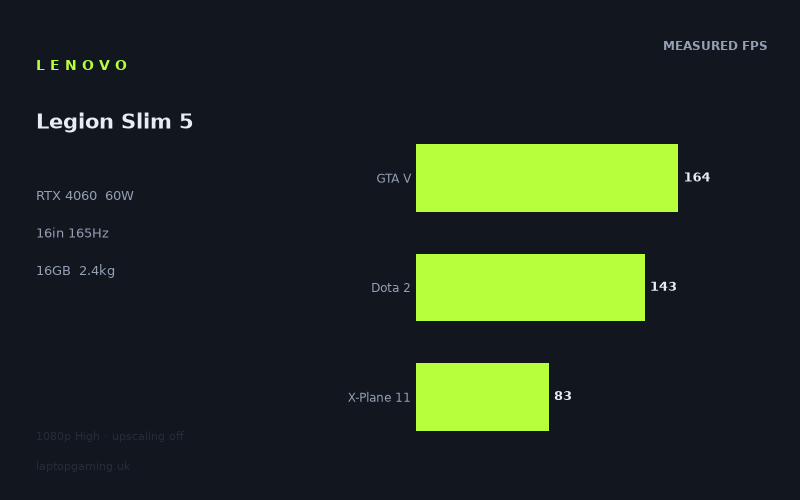
Frame rates
1920×1080, High preset, upscaling off.
Measured on this machine. Source: Notebookcheck, 2023-08-11.
Not scored: incomplete benchmark suite
Every scored laptop on this site is averaged over the same 5 games, and this one is short of Cyberpunk 2077, Baldur's Gate 3. A mean over 3 games is not comparable to a mean over 5, so we publish the figures we have and leave the score blank rather than rank it against machines tested on a different set. The numbers below are real - the suite is just incomplete.
How these numbers were produced
Frame rates here are not measured by us, and we label how each one was arrived at. A figure marked measured comes from a published run on that exact machine. A figure marked representative is derived from the GPU and its power limit (TGP) and cross-referenced against published reviews - a sound estimate of what that configuration delivers, but not a measurement of that specific laptop. Unless stated otherwise, numbers are 1920x1080, High preset, upscaling off. Where a laptop ships in several power configurations we use the wattage of the exact SKU listed, because a 140W RTX 5070 and a 115W one are not the same product.
In use
The short version
The Lenovo Legion Slim 5 (16APH8) is a difficult machine to judge in the usual “buy it or avoid it” terms because its UK price is not confirmed. That matters here. The published performance figures show a laptop capable of very strong 1920x1080 High-preset gaming in a wide spread of titles, but the machine also combines that RTX 4060 with a 60W GPU power limit and a 2560x1600 display. Those details pull in opposite directions: the benchmark results are often excellent at 1920x1080, while the screen asks substantially more of the GPU when games are run at its native resolution.
Notebookcheck’s figures show the Legion Slim 5 delivering 193fps in Strange Brigade, 180fps in The Witcher 3, 167fps in F1 22 and 164fps in GTA V. Those are high enough figures to make meaningful use of the 165Hz panel in the right games. Dota 2 reaches 143fps, which is still very fast but does not fully meet the panel’s refresh rate. More demanding games tell a different story: Tiny Tina’s Wonderlands reaches 105fps, Final Fantasy XV 94fps, Returnal 87fps, Cyberpunk 2077 1.6 85fps and X-Plane 11 83fps. Those are not poor figures; they are simply not the same sort of high-refresh results as the lighter and older titles above them.
The central point is that this is not a laptop whose measured results support a blanket claim that it will drive every game at 165Hz. It clearly will not in the heavier titles listed, at least not under the published 1920x1080 High-preset conditions with upscaling disabled. What it does offer is a wide performance range: very high frame rates in several games, comfortably fast results in others, and enough evidence to suggest that the RTX 4060 remains useful even when a game is substantially more demanding than GTA V or Dota 2.
The 60W GPU power limit is important. The product name says RTX 4060, but the configuration matters as much as the GPU label. A low-power RTX 4060 and a higher-power RTX 4060 cannot be treated as automatically equivalent, particularly in GPU-heavy games or at higher resolutions. The striking complication is that the supplied shared-game comparison puts the Legion Slim 5 level with the Lenovo Legion Slim 7, despite that machine having an RTX 4060 at 140W, and also level with the HP Omen 17-db0079ng with an RTX 4070. That is not proof that 60W is irrelevant. It is evidence that the particular shared 1920x1080 games used for that comparison are light enough, or limited enough elsewhere in the system, that their results compress the expected GPU gap.
That makes the Legion Slim 5 a sensible choice for a buyer who plays a mixed library rather than only the newest GPU-intensive releases, values a 16in 2560x1600 IPS screen, and is prepared to set sensible expectations around native-resolution gaming. It is much less convincing for someone who wants the GPU to be the unquestioned priority, expects every game to exploit 165Hz, or is buying mainly for demanding titles at 2560x1600. There is no confirmed UK price, so it is not possible to make a responsible value judgement. The performance is clear; whether that performance is good buying depends entirely on what Lenovo is actually charging.
Performance
What Notebookcheck’s figures show
Notebookcheck measured the Lenovo Legion Slim 5 at 1920x1080, using the High preset with upscaling disabled. That test condition is useful because it gives a direct, clean view of conventional gaming performance without relying on an upscaling mode to increase the result. It is also not the laptop’s native display resolution. The Legion Slim 5 has a 2560x1600 panel, so these figures should be read as 1920x1080 performance data rather than a promise of identical results on the internal screen at native resolution.
At the top of the table are Strange Brigade at 193fps and The Witcher 3 at 180fps. Both results exceed the panel’s 165Hz refresh rate. In practical terms, those are the games in this data set where the screen’s high refresh rate is most obviously justified. The laptop has enough measured performance in those titles to supply more frames than the panel can refresh each second under the stated benchmark settings. The relevant limitation there is no longer a shortage of measured GPU performance; it is the panel’s refresh ceiling and the game’s own behaviour.
F1 22 reaches 167fps, placing it just above the 165Hz refresh rate, while GTA V reaches 164fps. These figures are effectively at the display’s intended high-refresh territory. There is no need to overstate the distinction between them. One sits above the panel figure and the other just below it, but both show that the Legion Slim 5 can deliver an exceptionally responsive frame-rate level in the right kind of game at 1920x1080 High. The machine is not merely capable of passing 100fps in these titles; it is close to the screen’s own refresh limit.
Dota 2 at 143fps is also a strong result, but it is worth being precise about what it means. It is well above the frame-rate level many buyers would consider smooth, yet it does not reach the panel’s 165Hz rating. A buyer focused on competitive games should see that as encouraging rather than disappointing: 143fps is substantial performance. At the same time, the number is a reminder that a 165Hz screen is not a guarantee of 165fps in every game, even one that is generally less demanding than the heaviest titles in the list.
The next group is where the Legion Slim 5 becomes more representative of a mainstream RTX 4060 laptop configured around a constrained GPU power limit. Tiny Tina’s Wonderlands reaches 105fps, Final Fantasy XV 94fps, Returnal 87fps, Cyberpunk 2077 1.6 85fps and X-Plane 11 83fps. These are all good frame rates in the sense that they are well clear of the low-performance territory that makes a game feel compromised, but they are far from the 165Hz headline of the display. This distinction matters because it separates “fast gaming laptop” from “high-refresh machine in every title”. The Legion Slim 5 is the former. The supplied numbers do not support calling it the latter.
The 130fps mean across GTA V, Dota 2 and X-Plane 11 gives a useful snapshot of the machine’s spread across the scoring-suite titles available here. It is a healthy average, but it should not be mistaken for a universal expectation. GTA V is measured at 164fps, Dota 2 at 143fps and X-Plane 11 at 83fps. The average sits between very different experiences. Someone buying for GTA V and Dota 2 sees a machine that comes close to making full use of a 165Hz screen. Someone buying mainly for X-Plane 11 sees a laptop operating much further from that panel ceiling.
This is why averages are useful only when they are accompanied by the individual results. A 130fps mean can sound like the laptop will generally sit in a high-refresh range, but the game-by-game figures show that the outcome depends heavily on the title. The Legion Slim 5 is not inconsistent in a suspicious way; it is simply being asked to run games with very different demands. The correct purchasing conclusion is not that the average is misleading, but that buyers should start with the games closest to their own library.
The significance of the 60W RTX 4060
The RTX 4060 is paired here with a 60W GPU power limit. That is the key specification behind the review, because it tells us that this is not merely a generic RTX 4060 result. The GPU name establishes the graphics family, but the power limit establishes the particular implementation being considered. Buyers comparing listings should not assume that every RTX 4060 laptop behaves like this Legion Slim 5, or that this Legion Slim 5 behaves like every other RTX 4060 laptop.
The measured results show that 60W does not prevent high frame rates in games that are favourable to the system at 1920x1080. Strange Brigade at 193fps, The Witcher 3 at 180fps, F1 22 at 167fps and GTA V at 164fps make that very clear. It would be wrong to look at the 60W figure alone and conclude that the Legion Slim 5 is automatically a low-frame-rate machine. The data says the opposite in those titles. There is ample performance for fast play in several games, even before considering any use of upscaling, which was disabled for the published measurements.
What the 60W limit does change is the margin available once a game becomes more demanding. Returnal at 87fps, Cyberpunk 2077 1.6 at 85fps and X-Plane 11 at 83fps are the important results here. None is a failure, but none comes remotely close to using every refresh cycle of a 165Hz panel. A higher-power graphics configuration may be able to create more headroom in such situations, but the supplied data does not provide a game-by-game higher-power RTX 4060 comparison beyond the shared-game averages discussed below. The responsible conclusion is therefore modest: this 60W configuration performs very well in some games and has materially less room for high-refresh ambitions in others.
It is also important not to make the opposite mistake and treat every shortfall from 165fps as proof of a GPU limitation. The rival data explicitly notes that the lighter titles in the shared 1920x1080 set are CPU-bound and compress genuine GPU gaps. That means a game can show similar results across laptops with very different GPU specifications because the graphics processor is not the only part determining the final number. The Ryzen 7 7840HS is therefore relevant even though the review is focused on GPU performance: at 1920x1080 in lighter games, system-level limitations can matter more than the GPU label or its power limit.
This is why the Legion Slim 5’s apparent parity with a 140W RTX 4060 laptop in the limited shared set should be read carefully. It is a real result, not a typo to dismiss, and it is valuable because it shows how little the GPU power difference matters in those particular games under those particular conditions. But it does not establish broad equivalence between 60W and 140W RTX 4060 configurations. The shared games are only part of the picture, and the published Legion Slim 5 results already show that game demand changes the outcome substantially.
High refresh is selective, not universal
The 165Hz panel is best understood as a ceiling the Legion Slim 5 can reach in selected games, rather than a target the laptop sustains across the board. Strange Brigade and The Witcher 3 exceed it. F1 22 reaches it. GTA V is effectively alongside it. Dota 2 is close enough to remain clearly within the high-frame-rate category, although it is below the panel rating. These results give the display real purpose for players who spend time in games of similar demand.
For Tiny Tina’s Wonderlands, Final Fantasy XV, Returnal, Cyberpunk 2077 1.6 and X-Plane 11, the 165Hz figure is more about the screen’s capability than the frame rate shown by this configuration at the published settings. At 105fps, Tiny Tina’s Wonderlands is fast, but it is not 165Hz-fast. The same is true more strongly at 94fps, 87fps, 85fps and 83fps. The screen is not wasted in those games; a high-refresh panel can still be a desirable part of the machine. But a buyer should not pay for this laptop on the assumption that its measured performance is consistently aligned with the panel’s maximum refresh rate.
The difference between the fast group and the demanding group is exactly why a gaming-laptop review should not reduce the machine to a single frame-rate figure. A buyer who mainly plays Strange Brigade, The Witcher 3, F1 22, GTA V or Dota 2 can reasonably expect very rapid performance at the stated benchmark settings. A buyer centred on Returnal, Cyberpunk 2077 1.6 or X-Plane 11 should think in terms of strong conventional frame rates rather than full 165Hz operation. Those are not competing interpretations of the same data; they are both contained within it.
There is no measured result here for the laptop’s own 2560x1600 resolution, and that absence should affect expectations. The screen has more pixels than the 1920x1080 benchmark setting. The published numbers demonstrate what the system can do at 1920x1080 High with upscaling off. They do not demonstrate what it will do at 2560x1600 High, nor do they provide evidence for a specific native-resolution frame rate in any game. Anyone for whom native-resolution gaming is non-negotiable should treat that as an information gap rather than filling it with assumptions.
What the benchmark spread says about real buying priorities
The Legion Slim 5’s strongest case is not that it produces the same result everywhere. Its case is that it offers a useful range of performance from 83fps to 193fps across the published titles, with several results around or above the display refresh rate and several demanding games remaining above 80fps. That is a broad and generally capable showing at 1920x1080 High without upscaling. It is more informative than a single synthetic result because it shows both the upside and the limits.
The downside is that the performance spread is wide enough that buyers need to be honest about their priorities. A purchaser seeking the most consistent possible high-refresh result should not focus on the 193fps Strange Brigade figure and ignore the 83fps X-Plane 11 figure. Equally, a purchaser concerned that a 60W RTX 4060 must be inadequate should not focus on X-Plane 11 and ignore the 180fps The Witcher 3 result. The machine has genuine strengths, but they are title-dependent.
There is also a useful lesson in the Cyberpunk 2077 1.6 figure. At 85fps, it is a solid result under the stated conditions, but it does not give the panel a 165Hz workload. That is a more realistic performance indicator for buyers whose libraries lean towards graphically demanding modern games than the very high figures in older or lighter titles. It does not make the Legion Slim 5 unsuitable for those games. It simply puts it in the category of laptop where settings choices and resolution choices are likely to matter more if high refresh is the goal.
The benchmark configuration had upscaling disabled, which is valuable because it avoids pretending that a rendered frame and an upscaled frame are the same thing for comparison purposes. It also means the results are a baseline rather than an exploration of every available graphics option. There is no published upscaling-on figure in the fact sheet, so no claim should be made about what the Legion Slim 5 might achieve with it enabled. Buyers should use the measured figures that exist, not imagined gains that may or may not apply to a particular title.
The screen
The Legion Slim 5 has a 16in IPS display with a 2560x1600 resolution and a 165Hz refresh rate. On paper, that is a strong gaming-oriented combination. The 16in size and 2560x1600 resolution point towards a display with more working space than a 1920x1080 panel, while 165Hz gives the screen the ability to show very rapid motion when the system can provide enough frames. IPS is the panel type listed, but there are no published figures in the fact sheet for brightness, contrast, colour coverage, response time or any other panel-quality measure. Those aspects cannot be judged from the available information.
The important practical tension is between the screen resolution and the benchmark resolution. Notebookcheck’s figures were recorded at 1920x1080, while the panel is 2560x1600. The published data therefore confirms performance at a lower resolution than the display’s native setting. That does not make the benchmarks irrelevant. It makes them correctly limited. They are useful for comparing this laptop against other machines tested under the same conditions and for understanding its 1920x1080 High-preset capability. They are not native-screen performance figures.
For games where the Legion Slim 5 reaches 193fps, 180fps, 167fps and 164fps, the 165Hz panel is a sensible match at the tested resolution. Strange Brigade, The Witcher 3, F1 22 and GTA V all show why Lenovo paired this machine with a high-refresh display. The laptop has measured results close to or beyond the panel rating in those titles. If those games, or similarly light games, make up a large part of a buyer’s play time, the screen is not excessive.
Dota 2 at 143fps is also close enough to 165Hz that the display remains relevant. It does not hit the stated refresh figure, but it is clearly operating in a fast-rendering range. This is the kind of result where a buyer should resist simplistic language. Saying that the Legion Slim 5 “cannot use” its 165Hz screen would be wrong. Saying it “always drives” the screen at 165Hz would also be wrong. The measured number shows a strong but not complete match between rendered frame rate and panel refresh.
For the more demanding titles, the screen has more headroom than the GPU is using under the published settings. Tiny Tina’s Wonderlands at 105fps, Final Fantasy XV at 94fps, Returnal at 87fps, Cyberpunk 2077 1.6 at 85fps and X-Plane 11 at 83fps are all substantially below 165Hz. That does not make the display a mistake. A 165Hz IPS panel can still be attractive outside the narrow question of maximum in-game frame rate. But for gaming specifically, the benchmark data says that the panel’s full refresh potential is selective rather than universal.
The 2560x1600 resolution is likely to be a selling point for buyers who do not use the laptop only for games. It is a higher-resolution screen than the benchmark setting, and the extra display area may appeal to users who want a larger workspace. However, no claim should be made that the RTX 4060 at 60W will sustain any particular frame rate at that resolution, because no native-resolution measurements are supplied. The right conclusion is not “it will be fine” or “it will struggle”. The right conclusion is that the available benchmark evidence stops at 1920x1080.
For a buyer who regards native resolution as essential, that limitation should be treated seriously. The machine may still be appropriate, but the evidence provided here cannot verify its behaviour at 2560x1600 High. For a buyer content to judge gaming performance at 1920x1080, the data is much more reassuring: several games reach or approach 165Hz, and even the demanding games listed remain well above the low end of the performance range.
Build, size and portability
The Lenovo Legion Slim 5 weighs 2.357kg. That is the key portability figure available. It is neither a figure that supports calling the machine effortlessly light nor one that places it outside the range of laptops intended to move between locations. The more useful reading is straightforward: it is a 16in gaming laptop with a substantial carry weight. A buyer who expects to transport it regularly should take that number seriously rather than relying on the word “Slim” in the product name.
The name may suggest a particularly portable machine, but the published weight is the evidence that matters. At 2.357kg, the Legion Slim 5 is likely to suit someone who wants one system for a desk, another room, university accommodation, work travel or occasional trips, provided they are comfortable carrying a machine of this weight. It is less obviously suited to someone whose priority is minimum bag weight above all else. The fact sheet does not include the charger weight, so the total carried weight cannot be stated.
No dimensions are supplied. That means there is no basis for claims about thickness, footprint, bag compatibility or how much desk space the chassis occupies. It would be easy to infer those things from the 16in display and the “Slim” branding, but that would not be evidence-based. Buyers with a strict bag-size limit should look for confirmed dimensions before making a purchase decision.
The Legion Slim 5 has an 80Wh battery. Battery capacity is not battery life. There is no published runtime figure in the fact sheet for gaming, video playback, office work, web use or idle operation, so no endurance claim can be made. A buyer choosing between this machine and another laptop should not assume that 80Wh tells the whole battery story. It tells us the battery capacity; it does not tell us how long the laptop lasts in a particular workload.
The combination of a 16in screen, 2.357kg weight and 80Wh battery suggests a laptop intended to balance a larger gaming display with some degree of mobility, but it is important not to turn that into a claim about real-world handling. There is no information here about chassis materials, keyboard quality, trackpad, ports, cooling noise, temperatures, webcam, speakers, upgrade access or internal layout. Those omissions matter. The benchmark data is useful for deciding whether the performance is appropriate; it is not enough to judge every ownership detail.
That uncertainty should shape the purchase decision. If gaming performance and screen specification are the main priorities, the available facts give the Legion Slim 5 a credible case. If the buyer’s decision depends on quiet operation, low temperatures, a particular port selection, a thin chassis, a light charger or long battery life, this fact sheet does not provide the evidence required to recommend the laptop confidently on those grounds.
How it compares
Against the MSI Thin GF63
Against the MSI Thin GF63 with an RTX 4050, the Lenovo Legion Slim 5 averages 42fps ahead across the shared games. That is the largest positive gap in the supplied comparison set, and it is meaningful. The Legion Slim 5 is not merely fractionally ahead in this match-up; the benchmark data gives it a clear performance advantage across the games both machines hold.
The comparison is especially useful because it shows that the Legion Slim 5’s 60W RTX 4060 should not be dismissed as indistinguishable from every lower-tier GPU configuration. The Legion’s measured results demonstrate strong 1920x1080 performance, and the shared-game average indicates that it is materially ahead of the RTX 4050 MSI Thin GF63. Buyers choosing between those two laptops should not assume that an RTX 4050 machine offers the same gaming experience simply because both sit in the same broad laptop market.
There is no confirmed UK price for the MSI Thin GF63, just as there is no confirmed UK price for the Legion Slim 5. That prevents a complete value conclusion. A substantial performance lead does not automatically make the Legion Slim 5 the better purchase if the price difference is also substantial. But on the evidence available, the Lenovo has the stronger gaming position. If the prices are close enough to make performance the deciding factor, the 42fps shared-game advantage is a persuasive reason to prefer the Legion Slim 5.
Against the Lenovo Legion Slim 7
The nearest comparison in product family is the Lenovo Legion Slim 7, equipped with an RTX 4060 at 140W. Across the shared games, the Lenovo Legion Slim 5 averages the same result. This is an important outcome because the GPU power limits are very different: the Legion Slim 5 is listed at 60W and the Legion Slim 7 at 140W. Yet the supplied shared-game figures do not show a frame-rate advantage for the higher-power machine in that limited comparison.
The correct response is not to declare the two machines equal in every situation. The fact sheet explicitly explains why near-zero differences can happen here: at 1920x1080, lighter titles in the shared set are CPU-bound and compress genuine GPU gaps. That explanation is more useful than simply repeating that the average is level. In games where the GPU is not the main limiting factor, providing more GPU power does not necessarily create a visibly higher benchmark result.
For a buyer, this means the Legion Slim 5’s 60W limit may be less damaging than expected in lighter 1920x1080 titles. It does not mean that a 140W RTX 4060 has no reason to exist, or that it would necessarily remain tied in more GPU-intensive games or at the Legion Slim 5’s 2560x1600 native resolution. The available comparison is real but narrow. Treat it as proof of parity in the shared data, not proof of universal parity.
Neither machine has a confirmed UK price in the fact sheet. That makes the choice incomplete. If the Legion Slim 7 is substantially more expensive, the shared-game tie would make the Slim 5 difficult to dismiss. If the prices are close, a buyer would need fuller evidence on the games they play, plus the unlisted aspects of each laptop, before deciding whether the higher-power configuration is worth pursuing. The benchmark data alone does not settle that broader question.
Against the HP Omen 17-db0079ng
The HP Omen 17-db0079ng uses an RTX 4070, yet the supplied shared-game comparison is again level with the Legion Slim 5. On the face of it, that may look surprising: the Lenovo has an RTX 4060 at 60W, while the HP carries an RTX 4070. But the fact sheet gives the reason not to overread the result. The shared 1920x1080 games are light enough for CPU limits to compress the expected graphics gap.
This comparison is valuable because it prevents a common mistake in laptop buying: assuming that the GPU name alone predicts every game result. In the limited shared set, the RTX 4070 label does not translate into a higher average frame rate than the Legion Slim 5. The Legion is therefore not outclassed in those specific tests. That is useful evidence for a buyer whose own games resemble the shared titles and who is considering whether a more expensive GPU category automatically produces a better experience.
It is not evidence that the RTX 4060 at 60W is broadly equivalent to every RTX 4070 laptop. The Legion Slim 5’s own results in Returnal, Cyberpunk 2077 1.6 and X-Plane 11 show that performance becomes more constrained as game demand rises. Since no fuller game-by-game comparison is supplied against the HP, there is no basis to claim that the two laptops would remain tied outside the shared set. The safest conclusion is specific: they are level in the shared games, under the stated comparison conditions.
Again, there is no confirmed UK price for either laptop. Without price, it is impossible to say whether the Omen’s RTX 4070 configuration represents better value, poor value or an unjustified premium. The Legion Slim 5 should not be rejected simply because the HP has a higher GPU label, but it also should not be chosen on the assumption that the labels are functionally identical.
Against the Asus ROG Strix Scar 17
The largest deficit in the supplied rival set is against the Asus ROG Strix Scar 17, which has an RTX 4090 at 25W. The Legion Slim 5 averages 69fps behind across the shared games. This is a clear result. Whatever the unusual-looking power figure may suggest, the benchmark comparison places the Asus well ahead in the games both machines hold.
The gap is useful because it establishes the upper end of the comparison spread. The Legion Slim 5 can match the supplied shared-game averages of a higher-power RTX 4060 laptop and an RTX 4070 laptop where CPU limits compress the results, but it cannot match the ROG Strix Scar 17 in the same comparison. That distinction prevents the Legion’s strong lighter-game figures from being exaggerated into a claim that it performs like every more powerful gaming laptop.
For the buyer, the conclusion is simple: if the priority is the highest available shared-game performance among these listed machines, the Asus is ahead by a substantial margin. There is no confirmed UK price for the ROG Strix Scar 17, so it cannot be called better value. It can only be called faster in the supplied comparison. That may justify a higher outlay if the eventual price is acceptable and gaming performance is the overriding priority, but price is exactly the information missing here.
Why the Legion Slim 5 cannot be ranked
The Legion Slim 5 should not be given an overall benchmark ranking from the incomplete scoring-suite data. There are published figures for GTA V, Dota 2 and X-Plane 11, producing a 130fps mean across those available scoring-suite games. However, there are no figures for Cyberpunk 2077 and Baldur’s Gate 3 in that scoring suite. Every scored laptop is averaged across the same set of games, so a partial result cannot be ranked fairly against machines with complete data.
This is not a minor technicality. A missing game can materially change where a laptop sits relative to another machine, particularly when the missing titles are more demanding than GTA V or Dota 2. The honest position is therefore that the Legion Slim 5 has a useful partial scoring-suite mean and a broader list of Notebookcheck frame rates, but not a complete basis for a formal score or ranking. The individual game figures are more useful than pretending the missing data does not matter.
Who it’s for
The Lenovo Legion Slim 5 is for a buyer who wants a 16in 2560x1600 IPS gaming laptop and plays a library containing lighter, older or well-optimised games alongside more demanding titles. Strange Brigade at 193fps, The Witcher 3 at 180fps, F1 22 at 167fps, GTA V at 164fps and Dota 2 at 143fps show a machine that can produce very high frame rates at 1920x1080 High in the right games. For that buyer, the 165Hz screen is not just a specification-sheet flourish. Several measured results can genuinely approach or exceed it.
It is also for someone who accepts that a high-refresh display and a high-resolution display serve different priorities. The screen is 2560x1600 and 165Hz, while the supplied performance data is at 1920x1080. A buyer who is comfortable selecting settings and resolution according to the game will find the benchmark results more useful than someone who expects one native-resolution High preset to suit every title. The machine’s measured performance is strong enough to give that flexibility at 1920x1080, but no native-resolution figure is available.
The Legion Slim 5 is a reasonable candidate for someone who values strong frame rates without assuming that the most expensive or highest-wattage GPU configuration is necessary for every game. Its shared-game parity with the 140W RTX 4060 Legion Slim 7 and RTX 4070 HP Omen 17-db0079ng shows that, in lighter 1920x1080 titles, a 60W RTX 4060 can produce results that do not look disadvantaged. That is especially relevant to players whose main games resemble the shared benchmark set.
It is also suitable for a buyer who can live with a 2.357kg laptop. The weight does not make it an ultra-light machine, but it does not prevent it being moved between locations by someone comfortable carrying that amount. The 80Wh battery is a useful capacity figure to know, but buyers should not purchase on an assumed battery-life claim because none is supplied.
Someone who should buy something else is the player whose sole priority is driving demanding games as close as possible to 165Hz. The published data does not support that use case. Returnal at 87fps, Cyberpunk 2077 1.6 at 85fps and X-Plane 11 at 83fps are respectable results, but they are far below the panel refresh rate. A buyer who regards 165Hz performance in demanding games as essential should look for a machine with benchmark evidence that directly demonstrates it in those games.
Buyers focused mainly on 2560x1600 gaming should also be cautious. The panel is native 2560x1600, but Notebookcheck’s measurements are at 1920x1080 High with upscaling disabled. There is no basis to state how the Legion Slim 5 performs at native resolution in Strange Brigade, The Witcher 3, F1 22, GTA V, Dota 2, Tiny Tina’s Wonderlands, Final Fantasy XV, Returnal, Cyberpunk 2077 1.6 or X-Plane 11. If native resolution is the deciding requirement, more evidence is needed before committing.
The Asus ROG Strix Scar 17 is the clearer alternative for a buyer who wants substantially higher shared-game performance and is willing to consider a different class of machine. The Legion Slim 5 trails it by 69fps across the shared games. That does not make the Asus automatically the better purchase, because neither machine has a confirmed UK price, but it does make the performance hierarchy clear in the available comparison.
The MSI Thin GF63 is the alternative to avoid if the decision is mainly about the strongest available shared-game performance and prices do not radically favour the MSI. The Legion Slim 5 holds a 42fps average advantage across their shared games. With no confirmed prices, it is not possible to say how much extra that lead is worth, but the performance difference is substantial enough that the Legion should be the more attractive gaming option if the cost gap is reasonable.
The Lenovo Legion Slim 7 and HP Omen 17-db0079ng require a more nuanced decision. The Legion Slim 5 is level with both in the limited shared-game comparison, despite the Slim 7’s 140W RTX 4060 and the Omen’s RTX 4070. That makes the Legion Slim 5 a credible alternative rather than an obvious compromise. But the CPU-bound nature of lighter 1920x1080 games means those ties should not be treated as a complete performance verdict. Buyers whose libraries contain heavier titles should seek broader game-specific evidence before deciding that the lower-power RTX 4060 is enough.
The final recommendation is therefore conditional rather than absolute. The Lenovo Legion Slim 5 has strong, attributable 1920x1080 High-preset results from Notebookcheck, a 165Hz 2560x1600 IPS display, a Ryzen 7 7840HS, 16GB of memory, an 80Wh battery and a 2.357kg weight. It is a convincing gaming laptop for players whose games match its strongest benchmark results and who accept that more demanding titles sit well below 165fps. It is not yet possible to judge whether it is good value in the UK because the price is not confirmed. Until that figure is known, the sensible conclusion is that the performance is promising, the screen is ambitious, and the purchase case depends on whether Lenovo prices the 60W RTX 4060 configuration realistically.