Review
MSI Crosshair A17 HX review
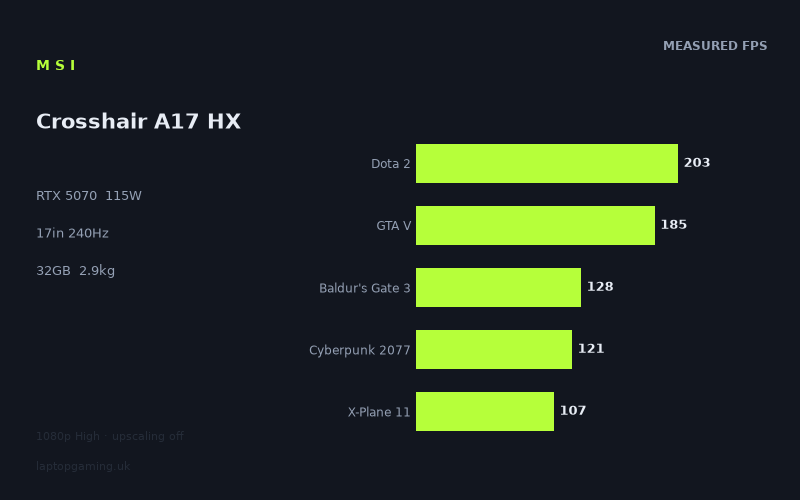
Frame rates
1920×1080, High preset, upscaling off. Averages 148fps across the 5 core benchmark games.
Measured on this machine. Source: Notebookcheck, 2025-08-12.
Not scored: no confirmed UK price
We have the full benchmark suite for this machine, so it ranks on the frame rate leaderboard like any other. What we don't have is a UK listing for this exact configuration - it's sold as a European review unit, or only in specifications that differ from the one tested. Since 30% of our score is value for money, scoring it would mean pretending price is no object, which would flatter it against every laptop you can actually buy. The frame rates below are real and comparable; there is just no buying recommendation to make yet.
How these numbers were produced
Frame rates here are not measured by us, and we label how each one was arrived at. A figure marked measured comes from a published run on that exact machine. A figure marked representative is derived from the GPU and its power limit (TGP) and cross-referenced against published reviews - a sound estimate of what that configuration delivers, but not a measurement of that specific laptop. Unless stated otherwise, numbers are 1920x1080, High preset, upscaling off. Where a laptop ships in several power configurations we use the wattage of the exact SKU listed, because a 140W RTX 5070 and a 115W one are not the same product.
In use
The short version
The MSI Crosshair A17 HX is a large-format gaming laptop built around an RTX 5070 running at a stated 115W GPU power limit, a Ryzen 9 8940HX processor, 32GB of memory and a 17in 2560x1600 IPS display with a 240Hz refresh rate. The specification is serious enough for demanding PC games, and Notebookcheck’s measured results show that it is particularly strong in lighter and well-optimised titles. Dota 2 reaches 203fps, F1 25 manages 199fps and GTA V delivers 185fps at 1920x1080 using the High preset with upscaling disabled. Those are genuinely high frame rates, and they make sense of the 240Hz panel in a limited number of games.
That does not mean the Crosshair A17 HX is a 240fps machine across modern releases. The benchmark spread is wide. At the same 1920x1080 High settings, Cyberpunk 2077 records 121fps, Ghost of Tsushima reaches 92fps, Horizon Forbidden West produces 83fps, Doom: The Dark Ages records 68fps and Senua’s Saga Hellblade 2 drops to 51fps. The measured figures are not inconsistent; they show exactly why a laptop should not be judged by one headline frame rate. Some games are light enough, old enough or sufficiently scalable to run at very high speeds. Others place much heavier demands on the graphics hardware and will not get close to the panel’s maximum refresh rate without reducing settings or using upscaling technologies not included in these figures.
The five-game scoring-suite mean is 149fps, which is a strong overall result from the available benchmark data. More importantly, the individual results show a machine that has enough performance for smooth play across the measured suite at 1080p High, while offering exceptionally high frame rates in selected competitive and older titles. It is not a machine whose display specification should be read as a promise that every current blockbuster will run at 240fps. Its screen is capable of 240Hz; the GPU performance depends heavily on the game.
The Crosshair A17 HX makes the most sense for someone who wants a 17in laptop with a high-refresh display, substantial memory capacity and a full 1TB SSD, and who expects to play a mixture of esports-oriented titles, established games and current single-player releases. It also suits someone who values a bigger screen over carrying convenience. At 2.924kg, this is not an incidental amount of weight. It is a laptop for a desk, a semi-permanent setup, or occasional transport between places rather than regular all-day carrying.
There is one important buying limitation. The exact UK price of this configuration is not confirmed, so no overall score can be calculated. That is not a performance concern and it does not mean the machine is absent from the frame-rate rankings: the benchmark suite is complete and it ranks normally there. It simply means value cannot be assessed responsibly without a confirmed price. Do not treat the specification alone as proof of good value. Compare it with the named alternatives once a genuine UK selling price is available.
The most interesting performance point is that the Crosshair A17 HX holds its own against several close rivals in the shared-game comparisons, including some machines fitted with RTX 5070 Ti graphics. It averages 1fps ahead of the Lenovo Legion 5 Pro across eight shared games, 3fps ahead of the Lenovo Legion Pro 5 16IAX10 across eight, 3fps ahead of the Alienware 16X Aurora across five, and 4fps ahead of the Acer Predator Helios Neo 16S AI across five. The MSI Crosshair A16 HX is the one listed rival that comes out ahead, averaging 4fps more across six shared games. These are small average gaps, not decisive wins, but they reinforce the point that laptop GPU names alone do not establish real-world gaming speed.
Performance
What the benchmark data says
Notebookcheck’s measurements were taken at 1920x1080, High preset, with upscaling disabled. That matters because it gives the results a consistent basis and avoids presenting frame-generation or upscaling output as though it were a direct measurement of the laptop’s native rendering performance. It also means these numbers are useful for comparing games and machines in the same benchmark conditions, but they should not be mistaken for native-resolution results on the Crosshair A17 HX’s 2560x1600 panel.
The headline result is the 149fps mean across the five scoring-suite games: Dota 2, GTA V, Baldur’s Gate 3, Cyberpunk 2077 and X-Plane 11. That average is informative, but it is not the whole story. It combines games with very different engines, ages, workloads and scaling behaviour. Dota 2 records 203fps. GTA V reaches 185fps. Baldur’s Gate 3 returns 128fps. Cyberpunk 2077 manages 121fps. X-Plane 11 records 107fps. Those results range from comfortably above 200fps to just above 100fps, despite using one common resolution and preset.
That spread is the reason to look beyond a mean. A 149fps average does not mean a player will see something close to 149fps in every game. It means the measured set, taken together, produces that average. For the person deciding whether the Crosshair A17 HX is right for them, the more relevant question is which end of the range resembles the games they actually play.
For Dota 2, the Crosshair A17 HX is extremely well placed. Notebookcheck’s 203fps figure at 1080p High is high enough to make meaningful use of the 240Hz panel, even though it does not reach the panel’s stated maximum refresh rate in this measurement. A 203fps result is not the same thing as 240fps, but it is far closer to the display’s ceiling than most demanding single-player games in the list. Players concentrating on games with similar performance characteristics should see why MSI paired this machine with a 240Hz panel.
F1 25 is similarly strong at 199fps. That is another result close enough to the display’s refresh capability to make the 240Hz specification relevant, particularly for a player who prioritises smooth motion and rapid response over pushing a game’s graphical settings further. Again, 199fps is below 240Hz, and the measurement does not establish a locked 240fps experience. It does establish that the Crosshair A17 HX can produce very high frame rates in this game without upscaling at the tested settings.
GTA V reaches 185fps. That is a very good result, though it is further from 240Hz than Dota 2 and F1 25. It still leaves substantial room for a high-refresh screen to show more frames than a conventional lower-refresh panel. The result also illustrates a practical point: the difference between 185fps and 240fps matters less than the difference between 68fps and 240fps when choosing how to use the display. The Crosshair A17 HX is already operating at a high frame rate in GTA V. The display is not wasted simply because the benchmark does not land exactly at its ceiling.
Final Fantasy XV records 142fps. That sits close to the overall scoring-suite mean, though it is not one of the five games used to calculate that mean. At 142fps, the Crosshair A17 HX is clearly delivering a high-refresh experience, but it is no longer within touching distance of the display’s maximum 240Hz capability. This is the middle ground where a high-refresh panel remains valuable, but where sensible expectations matter. The laptop can offer smooth, fast output without turning every game into a 240fps title.
Baldur’s Gate 3 returns 128fps. That is a strong result for a game where the frame-rate experience can be materially different depending on scene complexity and workload, but the only figure available here is the published benchmark result. It shows that the Crosshair A17 HX has no problem delivering comfortably above 100fps under the stated test conditions. It does not prove that every area or scenario will behave identically, and it should not be used to claim a constant frame rate outside the benchmark data.
Cyberpunk 2077 reaches 121fps. This is one of the most useful numbers in the entire set because it anchors expectations for a modern, demanding game. The Crosshair A17 HX is not struggling at 1080p High with upscaling disabled; 121fps is a strong measured result. But it is also only around half of the display’s 240Hz refresh rate. That gap is not a criticism of the laptop. It is evidence that the panel is designed with headroom for lighter games, less demanding settings, or technologies outside this test, rather than as an indication that every demanding title will naturally saturate 240Hz.
X-Plane 11 records 107fps. That is still above 100fps, but it is one of the slower results in the scoring suite. It also helps explain why the Ryzen 9 8940HX should not be treated as a background specification. Laptop game performance is not determined by the GPU alone. Some games can place a heavier emphasis on processor behaviour, engine design or simulation workload. The available figures do not isolate CPU and GPU contributions, so it would be wrong to attribute the 107fps result to one component alone. What can be said is that the Crosshair A17 HX delivers a solid measured result rather than matching its best-performing games.
The games that expose the limits
The more demanding section of the benchmark list is where the Crosshair A17 HX needs to be judged with greater care. Ghost of Tsushima records 92fps, Horizon Forbidden West reaches 83fps, Doom: The Dark Ages records 68fps, The Elder Scrolls IV Oblivion Remastered reaches 65fps and Senua’s Saga Hellblade 2 records 51fps. All of those figures are at 1920x1080 High with upscaling off. They are not native 2560x1600 results, and they are not results obtained with visual settings reduced below High.
Ghost of Tsushima at 92fps is a good example of a game where the Crosshair A17 HX can still provide a fast and smooth experience without coming close to 240Hz. A player with a 60Hz display would see a very different proposition from someone using the MSI’s 240Hz panel, but a 92fps benchmark is nevertheless far from the display ceiling. This is where variable performance expectations matter more than the specification sheet. The machine has enough speed to run the game strongly in the measured test, but the panel’s maximum refresh rate is not a target the benchmark result reaches.
Horizon Forbidden West at 83fps reinforces the same conclusion. The machine is delivering above 60fps at the tested settings, which is an important practical threshold for many players, but the result is not in the high-refresh territory of Dota 2, F1 25 or GTA V. Someone buying this laptop primarily for current demanding open-world games should read the 83fps figure as the more relevant kind of expectation than the 203fps Dota 2 number. Both are real measurements, but they describe very different workloads.
Doom: The Dark Ages at 68fps and Oblivion Remastered at 65fps show the point more sharply. These are not bad results in isolation, especially considering that upscaling was disabled and the preset was High. They are, however, well removed from the 240Hz display specification. If these are the kinds of games that dominate your library, the Crosshair A17 HX should be viewed as a laptop that can deliver playable high-settings performance under the published test conditions, not one bought mainly to exploit a 240Hz screen in every new release.
Senua’s Saga Hellblade 2 is the lowest measured result at 51fps. This is the benchmark that prevents any simplistic claim that the Crosshair A17 HX is universally a high-frame-rate laptop. It is high-refresh capable in some games and substantially more constrained in others. The 51fps measurement does not mean the laptop is unsuitable for the game; it means this title is much more demanding in the stated test than the faster games in the list. A buyer whose priorities centre on graphically intensive cinematic games needs to pay attention to this lower end of the range, not just the overall mean.
The distance between 203fps in Dota 2 and 51fps in Senua’s Saga Hellblade 2 is not a minor fluctuation. It is the defining characteristic of this performance profile. The Crosshair A17 HX is not limited by one universal ceiling. Its results move substantially according to the title. That comes from the different rendering workloads, game engines and system demands represented by the benchmark suite. The available measurements do not allow a precise breakdown of which component limits each title, and it would be wrong to invent one. They do demonstrate that a single GPU badge cannot communicate the whole gaming experience.
What the 115W GPU power limit means
The RTX 5070 in this configuration has a stated GPU power limit of 115W. That figure is important because laptop GPUs are not defined only by their name. A laptop RTX 5070 is a configured component operating within the manufacturer’s chosen power limits and cooling design. The 115W figure describes the power limit MSI has specified for this GPU implementation. It is therefore more useful than simply saying that the Crosshair A17 HX has an RTX 5070 and leaving it at that.
What the 115W figure does not tell us on its own is exactly how the Crosshair A17 HX will compare with every other RTX 5070 laptop in every game. The published benchmark data is needed for that, and in this case the results show a machine that is highly competitive with the named alternatives. Across eight shared games, the Crosshair A17 HX averages 3fps ahead of the Lenovo Legion Pro 5 16IAX10, another RTX 5070 laptop. Across five shared games, it averages 3fps ahead of the RTX 5070-equipped Alienware 16X Aurora. These are small leads, but they show that the 115W configuration is not obviously leaving the MSI behind those specific competing RTX 5070 systems in the games shared by the database.
The result against RTX 5070 Ti machines is even more revealing. The Crosshair A17 HX averages 1fps ahead of the Lenovo Legion 5 Pro across eight shared games and 4fps ahead of the Acer Predator Helios Neo 16S AI across five. Those comparisons should not be stretched into a claim that the RTX 5070 is generally faster than the RTX 5070 Ti. They are limited shared-game averages between specific laptop configurations. They do show that the complete laptop matters: power limit, processor, memory, firmware, cooling behaviour and the games selected all matter alongside the GPU name.
For a buyer, the practical lesson is straightforward. Do not pay extra for a graphics label without checking measured results from the exact machine or a closely matched configuration. The Crosshair A17 HX’s 115W RTX 5070 produces performance that is, in the listed comparisons, within a few frames of every named rival and ahead of several. That does not establish a universal hierarchy. It establishes that this MSI should be evaluated as a capable implementation rather than dismissed because another laptop carries a higher-tier GPU label.
The Crosshair A16 HX is the important internal comparison. It is also an RTX 5070 machine, and the Crosshair A17 HX averages 4fps behind it across six shared games. That is still a small gap, but it is larger than the Crosshair A17 HX’s lead over several external rivals. If both Crosshair models are available at similar prices, the A16’s measured advantage deserves attention. Without confirmed UK pricing for either exact comparison here, though, it is impossible to turn that frame-rate difference into a value judgement.
Frame rate and real buying decisions
The measured numbers divide the Crosshair A17 HX into three broad use cases. First, there are titles where it is close to the 240Hz panel’s capability: Dota 2 at 203fps and F1 25 at 199fps. These are the games where the display specification has immediate practical value. Second, there are games in a high but clearly sub-240fps range: GTA V at 185fps, Final Fantasy XV at 142fps, Baldur’s Gate 3 at 128fps, Cyberpunk 2077 at 121fps and X-Plane 11 at 107fps. Here, the panel still has more refresh capacity than the benchmark output, but the laptop is producing enough frames to benefit from a fast display.
Third, there are demanding games where the performance is more naturally described as solid rather than high-refresh: Ghost of Tsushima at 92fps, Horizon Forbidden West at 83fps, Doom: The Dark Ages at 68fps, Oblivion Remastered at 65fps and Senua’s Saga Hellblade 2 at 51fps. These figures are enough to make clear that the Crosshair A17 HX is not merely an esports machine, but neither is it a machine that turns demanding visual showcases into 240fps experiences under the measured conditions.
If your gaming is dominated by Dota 2, racing games, older releases or titles that are similarly light on the graphics hardware, the Crosshair A17 HX has a compelling performance profile. If you spend most of your time in the most demanding current games, it is still capable, but the case for a 240Hz panel becomes less about hitting 240fps and more about having a high-quality ceiling for less demanding titles and future setting choices. The benchmark results support that distinction very clearly.
The screen
The Crosshair A17 HX has a 17in 2560x1600 IPS display with a 240Hz refresh rate. On paper, that is a very attractive combination for a gaming laptop: a large panel, a resolution above 1920x1080 and a refresh rate high enough for serious fast-paced gaming. But a screen should be judged in relation to the graphics hardware driving it, and that is where the available benchmark data needs careful interpretation.
Every published frame rate here was measured at 1920x1080, not at the panel’s native 2560x1600 resolution. As a result, none of the figures can be honestly presented as native-screen performance. There is no supplied 2560x1600 benchmark result for Dota 2, F1 25, Cyberpunk 2077 or any other game in the list. Anyone claiming that the Crosshair A17 HX delivers a particular native-resolution frame rate would be inventing a number.
That limitation matters because the display has substantially more pixels than the benchmark resolution. The machine’s 240Hz panel may be capable of displaying up to 240 refreshed images per second, but the 1080p results already show that even at the lower tested resolution, only a few games approach that figure. Dota 2 at 203fps and F1 25 at 199fps are the strongest examples. GTA V at 185fps remains high. Beyond that, the gap between game output and display refresh grows.
For demanding games, the panel should therefore be understood as offering flexibility rather than guaranteeing native-resolution high-refresh gaming. Cyberpunk 2077 at 121fps, Ghost of Tsushima at 92fps, Horizon Forbidden West at 83fps, Doom: The Dark Ages at 68fps and Hellblade 2 at 51fps were all measured below 240fps before moving to the display’s 2560x1600 resolution. That does not mean native resolution is unusable; it means the data supplied does not support a numerical claim about it.
The 240Hz refresh rate is best matched to the Crosshair A17 HX’s faster games. Dota 2 is the clearest fit, with 203fps measured. F1 25 at 199fps is another strong pairing. GTA V at 185fps also makes good use of a high-refresh display, even without reaching its full stated maximum. In these cases, a 240Hz screen is not decorative specification-sheet excess. The GPU can feed it with substantially more than 60fps at the test settings.
The slower games show a different benefit. A 240Hz panel does not require a game to run at 240fps to be worthwhile. It can still display the frames the system produces, whether that is 121fps in Cyberpunk 2077 or 68fps in Doom: The Dark Ages. But buyers should distinguish between “benefits from a high-refresh panel” and “fully drives a 240Hz panel”. The Crosshair A17 HX demonstrably does the former in many games and only approaches the latter in the fastest results listed.
The IPS panel type is also specified, but no measurements are supplied for brightness, colour coverage, contrast, response behaviour or outdoor visibility. It would be irresponsible to infer those characteristics from the panel technology alone. IPS describes a display type, not a complete verdict on image quality. The specification confirms the screen’s size, resolution, refresh rate and panel family. It does not provide the evidence needed to rank it against another panel for colour-critical work, dark-scene performance or use in bright environments.
For gaming, the more concrete conclusion is that the screen is ambitious relative to the benchmark profile. That is mostly positive. It gives Dota 2, F1 25 and GTA V room to run at very high frame rates, while providing a large 2560x1600 workspace for less performance-sensitive tasks. But anyone buying specifically for native-resolution 240fps in modern demanding games should stop at the evidence: those figures are not available, and the 1080p results in the heaviest games suggest that such an expectation would be unrealistic without changes not covered by the benchmark data.
Build, size and portability
The Crosshair A17 HX weighs 2.924kg. That alone tells you a great deal about how it should be used. This is a large gaming laptop built around a 17in display, not a compact machine intended to disappear into a bag and be carried all day without thought. It is portable in the literal sense that it is a laptop, but its weight makes it much better suited to being moved occasionally than carried constantly.
A 2.924kg machine makes sense for someone who wants a desktop-replacement style gaming system that can still be relocated between home, university accommodation, an office or a second residence. It also makes sense for a player who wants a larger screen without committing to a separate monitor. The 17in panel is likely to be a larger practical benefit when the laptop spends most of its life on a desk than when it is repeatedly packed and unpacked during a day of travel.
The supplied specification does not include chassis dimensions, so there is no basis for claiming that the Crosshair A17 HX is thin, compact, deep, narrow or easy to fit into a particular bag. Weight is the only physical portability measurement provided. That is enough to make the main buying point: 2.924kg is a meaningful commitment, and buyers who walk long distances with their laptop should take it seriously.
The 90Wh battery is a substantial listed capacity, but battery runtime has not been supplied. There is no published figure here for web browsing, video playback, idle use, gaming away from the mains or charging speed. The battery capacity should therefore be treated as a specification, not as evidence of all-day battery life. Gaming performance measurements are also not battery-life measurements, and the frame rates listed should not be assumed to apply away from mains power.
The processor, memory and storage specification supports the Crosshair A17 HX’s role as a more substantial system rather than a stripped-back gaming-only machine. The Ryzen 9 8940HX is paired with 32GB of memory and a 1024GB SSD. The 32GB memory capacity is particularly appropriate for a machine positioned around demanding games and a 17in high-resolution display, although the supplied data does not include memory speed, upgrade access, storage performance or the number of available slots. The 1024GB SSD provides a stated 1TB of storage capacity, but no read or write measurements are available.
There is no supplied information on keyboard quality, trackpad behaviour, ports, speakers, webcam, chassis materials, cooling noise or surface temperatures. Those omissions matter because a 17in gaming laptop is used differently from a smaller machine. Desk comfort, external display support, peripheral connectivity and fan behaviour can affect ownership as much as a few frames per second. With no attributable facts for those areas, they should remain questions to check before purchase rather than assumptions made from the MSI name or the Crosshair range.
The best description of the Crosshair A17 HX is therefore a transportable performance laptop. Its 2.924kg weight, 17in screen, 90Wh battery capacity, 32GB memory and 1TB SSD all point toward a machine intended to do serious work and gaming from a stable base. It is not the obvious choice for someone whose first priority is minimum baggage weight. It is the more sensible choice for someone who values screen size and gaming capability enough to accept the weight.
How it compares
The Crosshair A17 HX’s closest listed rivals produce an unusually tight set of shared-game averages. That is important because it means the decision between them should not be made as though one machine is in a different performance class. The available comparisons show differences of only a few frames per second. Such margins can matter in a specific game or at a specific price, but they do not justify sweeping claims.
Lenovo Legion 5 Pro
The Lenovo Legion 5 Pro is listed with an RTX 5070 Ti and no confirmed UK price. Across eight games both machines have in common, the MSI Crosshair A17 HX averages 1fps ahead. This is the closest comparison in the data and perhaps the most useful warning against judging laptops solely by GPU branding. The RTX 5070 Ti label does not automatically translate into a lead over this 115W RTX 5070 implementation in the shared-game average.
At the same time, a 1fps average advantage is extremely small. It should not be framed as a decisive MSI win, and it certainly does not prove that the Crosshair A17 HX will outperform the Legion 5 Pro in every game. The comparison covers eight shared titles, not every game a buyer might play. The sensible conclusion is that their measured gaming performance is extremely close in the overlapping data. With no confirmed UK price for the Legion 5 Pro and no confirmed UK price for this Crosshair configuration, value cannot separate them here.
Lenovo Legion Pro 5 16IAX10
The Lenovo Legion Pro 5 16IAX10 is an RTX 5070 machine listed at £2,173. Across eight shared games, the Crosshair A17 HX averages 3fps ahead. That is a modest but real measured lead for the MSI in this comparison. It suggests that the Crosshair’s RTX 5070 at its stated 115W limit is competitive with a directly named RTX 5070 rival rather than merely relying on its large display and memory specification to make its case.
However, the price comparison cannot be completed because the Crosshair A17 HX’s UK price is not confirmed. The Lenovo’s £2,173 figure gives a concrete reference point for the market, but it does not tell us whether the MSI is cheaper, similarly priced or more expensive. A 3fps shared-game average advantage could be welcome if the Crosshair is competitively priced, but it could be irrelevant if the MSI carries a substantial premium. Until the exact price is known, performance is the only responsible basis for comparison.
Alienware 16X Aurora
The Alienware 16X Aurora is another RTX 5070 rival, listed at £2,569. The Crosshair A17 HX averages 3fps ahead across five shared games. As with the Lenovo Legion Pro 5 16IAX10, this is a small advantage rather than a transformative one. The two machines are close enough in the available gaming data that a buyer should care about their respective screen formats, physical size, connectivity, keyboard and noise characteristics. Those factors are not available in this fact sheet, so they cannot be used to declare a winner.
What can be said is that the MSI does not appear underpowered against this more expensive listed rival in the shared benchmarks. The Crosshair A17 HX’s 115W RTX 5070 implementation is fractionally ahead on the available data. Whether that turns into better value cannot be determined without the MSI’s confirmed UK price.
Acer Predator Helios Neo 16S AI
The Acer Predator Helios Neo 16S AI is listed with an RTX 5070 Ti and a price of £2,679. Across five shared games, the Crosshair A17 HX averages 4fps ahead. This is the largest positive shared-game average in the rival list, but it still needs proportion. Four frames per second across five games is not enough evidence to state that the MSI is categorically faster in all workloads. It does, however, show that the MSI should not be assumed to trail simply because the Acer has an RTX 5070 Ti badge.
The Acer’s £2,679 listed price gives the comparison potential value significance, but again the Crosshair lacks a confirmed UK price. If MSI’s exact configuration appears at a much lower price, the benchmark data would make it an especially interesting alternative. If it appears at a similar or higher price, the decision would need a broader comparison than the frame-rate averages supplied here. The key point is that the Crosshair A17 HX has the performance evidence to be considered seriously beside it.
MSI Crosshair A16 HX
The MSI Crosshair A16 HX is the one listed rival that averages ahead of the Crosshair A17 HX. It also has an RTX 5070, and it averages 4fps more across six shared games. This is a more meaningful comparison than it might initially appear because the two machines share the Crosshair name and GPU class. It demonstrates again that implementation matters. The A17’s 115W configuration is competitive overall, but the A16 has the stronger shared-game average in the data available.
Neither exact configuration has a confirmed UK price in the fact sheet. That prevents a proper recommendation between them. The A16’s 4fps shared-game lead is worth noting, but it is not enough to tell a buyer which one is better for their money without knowing the price gap. The A17’s 17in 2560x1600 240Hz screen may suit some buyers better than a smaller alternative, but only the A17’s display specification is provided here, so no direct screen comparison should be invented.
Who it’s for
The MSI Crosshair A17 HX is for the buyer who wants a large gaming laptop with a genuine high-refresh display and does not expect it to be a lightweight daily commuter machine. The 2.924kg weight is the first filter. If your laptop will mostly live on a desk and occasionally move between locations, the size and 17in screen are easier to justify. If it needs to be carried through a city, campus or workplace every day, the weight should make you look carefully at lighter alternatives.
It is also for players whose game library includes titles where the laptop can exploit its 240Hz panel. Dota 2 at 203fps and F1 25 at 199fps are the clearest examples. GTA V at 185fps is also a strong match for a fast screen. In these games, the Crosshair A17 HX is not merely adequate; Notebookcheck’s measured figures show very high frame rates at 1080p High with upscaling disabled.
It is a good fit for someone who wants strong all-round 1080p High performance rather than one narrow speciality. The scoring-suite mean of 149fps is backed by 128fps in Baldur’s Gate 3, 121fps in Cyberpunk 2077 and 107fps in X-Plane 11. Those are varied games, and the results indicate a machine that can run well beyond basic 60fps expectations in much of the measured suite.
The 32GB memory and 1024GB SSD also make it more appropriate for someone who expects to install a substantial game library and run demanding applications alongside gaming, though no storage performance or multitasking benchmark figures are available. The Ryzen 9 8940HX, RTX 5070 and 32GB memory configuration is appropriately substantial for a machine of this size and weight.
It is not the right choice for someone who assumes a 240Hz screen means 240fps in current visually demanding games. The evidence does not support that. Ghost of Tsushima records 92fps, Horizon Forbidden West 83fps, Doom: The Dark Ages 68fps, Oblivion Remastered 65fps and Hellblade 2 51fps at the supplied test settings. Those results are not failures, but they are far below 240fps. Buyers focused on these kinds of games should regard the display as a flexible high-refresh panel rather than a target they will routinely saturate.
It is also not the obvious machine for a buyer who wants confirmed value before committing. There is no confirmed UK price for this exact configuration, and that prevents a responsible value verdict. The Crosshair A17 HX has competitive benchmark results against rivals priced at £2,173, £2,569 and £2,679, but those prices do not tell us whether MSI’s machine is a bargain, fair purchase or expensive option. Wait for a confirmed UK price, then compare it directly with the Lenovo Legion Pro 5 16IAX10, Alienware 16X Aurora and Acer Predator Helios Neo 16S AI.
Finally, it is not for someone who needs verified information on battery runtime, noise, temperatures, keyboard quality, ports, webcam quality or chassis dimensions before buying. None of those facts are supplied here. The 90Wh battery capacity is known, but endurance is not. The 2.924kg weight is known, but the dimensions are not. The benchmark performance is well documented, but ownership details outside that evidence need checking from attributable sources before purchase.
For the right buyer, the Crosshair A17 HX is a compelling performance-led 17in system: strong measured 1080p results, a large 2560x1600 240Hz IPS screen, 32GB memory and 1TB storage. Its strongest argument is not that it wins every benchmark by a huge amount. It does not. Its argument is that its 115W RTX 5070 delivers competitive results against a very close group of rivals, including several machines with higher-tier GPU branding, while producing genuinely high frame rates in the games best suited to its 240Hz display. The remaining question is price, and until that is confirmed, it should remain the deciding question rather than an assumption.