Review
Medion Erazer Beast X30 review
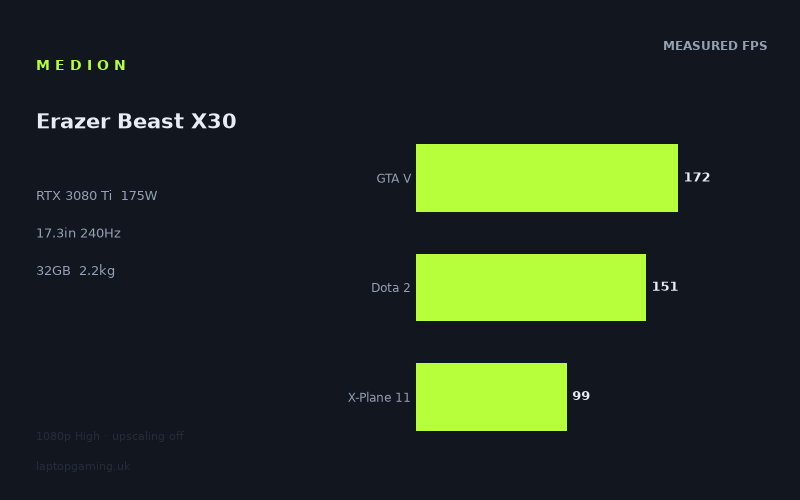
Frame rates
1920×1080, High preset, upscaling off.
Measured on this machine. Source: Notebookcheck, 2022-05-09.
Not scored: incomplete benchmark suite
Every scored laptop on this site is averaged over the same 5 games, and this one is short of Cyberpunk 2077, Baldur's Gate 3. A mean over 5 games is not comparable to a mean over 5, so we publish the figures we have and leave the score blank rather than rank it against machines tested on a different set. The numbers below are real - the suite is just incomplete.
How these numbers were produced
Frame rates here are not measured by us, and we label how each one was arrived at. A figure marked measured comes from a published run on that exact machine. A figure marked representative is derived from the GPU and its power limit (TGP) and cross-referenced against published reviews - a sound estimate of what that configuration delivers, but not a measurement of that specific laptop. Unless stated otherwise, numbers are 1920x1080, High preset, upscaling off. Where a laptop ships in several power configurations we use the wattage of the exact SKU listed, because a 140W RTX 5070 and a 115W one are not the same product.
In use
The short version
The Medion Erazer Beast X30 is a high-power gaming laptop built around an RTX 3080 Ti running at a 175W GPU power limit, a Core i9-12900HK, 32GB of memory and a 17.3in 2560x1440 IPS display with a 240Hz refresh rate. On the measured 1920x1080 High-preset results from Notebookcheck, it is plainly fast. The benchmark data shows excellent frame rates in a wide range of games, with several titles well beyond the level needed for smooth high-refresh gaming and a generally strong floor even in heavier releases.
Its central limitation is not performance but certainty around value. There is no confirmed UK price for this exact configuration, so there is no responsible way to judge whether it is a sensible deal against competing machines. That does not mean there is anything incomplete about the benchmark record: the benchmark suite is complete and the Beast X30 ranks normally on the frame-rate leaderboard. It simply means that a gaming laptop cannot be called good value, poor value or fairly priced when its actual UK purchase price is not confirmed.
On raw performance, the Beast X30 is for someone who wants a large-screen machine with enough GPU power to make demanding games comfortable at sensible settings, while also getting very high frame rates in lighter competitive and older titles. The measured figures show 222fps in Strange Brigade, 215fps in F1 2021, 214fps in The Witcher 3, 180fps in Rainbow Six Extraction, 172fps in GTA V and 151fps in Dota 2. Those are substantial results, and they make the machine particularly compelling for players who divide their time between visually demanding single-player games and titles where a fast screen matters.
It is not, however, a laptop that can be assumed to drive its 240Hz panel at full refresh in every game. None of the published 1920x1080 High-preset measurements reaches 240fps. The closest is Strange Brigade at 222fps, followed by F1 2021 at 215fps and The Witcher 3 at 214fps. That is still extremely quick, but it matters because there is a difference between buying a 240Hz screen and consistently supplying 240 frames per second. The Beast X30 comes close in some of the lighter or better-scaling games measured, but the data does not support the idea that 240fps is its normal outcome across modern games.
The 17.3in 2560x1440 screen is also more demanding than the benchmark resolution. Notebookcheck’s figures are at 1920x1080, High preset and with upscaling disabled. They are useful because they show the underlying pace of the hardware without relying on an image-reconstruction mode, but they cannot be treated as native-resolution results for the laptop’s own display. Anyone buying specifically to play every new game at 2560x1440, at High settings and near 240Hz should be cautious: there are no measured figures here at that resolution, so that claim cannot be made.
The best case for the Beast X30 is therefore straightforward. It is a strong choice for a buyer who values a large 2560x1440 display, wants high frame rates without giving up the headroom associated with a 175W RTX 3080 Ti, and understands that the screen’s 240Hz capability is most useful in the faster-running games rather than a guarantee for every title. It is less convincing for someone who needs a clearly priced purchase today, someone who wants a machine primarily for very frequent travel, or someone who expects the available evidence to prove native 2560x1440 performance in the latest demanding games.
Performance
A fast result, but not a uniform one
The most useful way to read the Beast X30’s benchmark record is as a spread rather than a single headline number. Its mean across the five scoring-suite games is 147fps, but the individual results range from 222fps in Strange Brigade to 89fps in Final Fantasy XV. That range is not a flaw in the measurements. It shows why a mean frame rate is only the start of the discussion. Different games place very different demands on the processor, graphics hardware, memory subsystem and game engine, and a laptop that is extremely fast in one game can be merely good in another despite using the same components.
At the top of the list, Strange Brigade reaches 222fps. F1 2021 is effectively alongside it at 215fps, while The Witcher 3 records 214fps. These are the games in which the Beast X30 is closest to making practical use of the 240Hz panel’s full refresh rate. They do not quite hit 240fps in the measured configuration, but they are close enough that the screen is clearly not excessive for this class of hardware. The machine has enough performance in these titles to offer a genuinely high-refresh experience rather than simply a fast display on paper.
Rainbow Six Extraction comes next at 180fps, followed by GTA V at 172fps and Dota 2 at 151fps. These are still very strong results. A game running at 180fps or 172fps is well above the conventional expectations for smooth play, while Dota 2 at 151fps gives the 240Hz panel meaningful work even if it does not fill every refresh cycle. In practical buying terms, these figures say that the Beast X30 has enough speed for players who care about responsiveness and fluid motion in games that can take advantage of higher frame rates, not merely for buyers focused on cinematic single-player presentation.
The next group is important because it demonstrates the difference between “fast” and “maxing out a 240Hz display”. Far Cry 5 records 139fps, Ghostwire Tokyo 126fps, Tiny Tina’s Wonderlands 124fps, GRID Legends 117fps and Forza Horizon 5 116fps. None of these results is disappointing in isolation. Each is comfortably above 100fps at the stated 1920x1080 High preset with upscaling off. But they are also well below 240fps, and that gap matters if the reason for paying for a 240Hz panel is to maintain its maximum refresh rate in modern, visually richer games.
X-Plane 11 records 99fps and Final Fantasy XV records 89fps. These are the lower end of the published results, and they are useful precisely because they prevent an overconfident reading of the Beast X30’s RTX 3080 Ti badge. The machine is not slow in either game; 99fps and 89fps are respectable frame rates. But the figures show that even a 175W RTX 3080 Ti laptop can be substantially below the headline refresh rate of its display depending on the title. Buyers should expect variation, not a fixed level of performance based solely on the GPU name.
What the 175W RTX 3080 Ti means
The RTX 3080 Ti is not enough information by itself to understand laptop gaming performance. GPU power limits matter, because laptops carrying the same nominal GPU can be configured to operate at different levels. Here, the Beast X30’s RTX 3080 Ti is specified at 175W. That places the emphasis on performance rather than a low-power or thin-and-light interpretation of the GPU. The measured results support that reading: this is not a machine whose RTX 3080 Ti is present only for the specification sheet. It delivers high frame rates across the benchmark set.
That does not mean 175W turns the Beast X30 into a universal 240fps machine. A high GPU power limit gives the graphics hardware the scope to perform strongly when a game is graphics-limited, but it cannot remove every other limitation in the system or in the game itself. At 1920x1080, particularly in lighter titles, processor performance and game-engine behaviour can become more important. This is one reason that laptops with apparently different graphics hardware can sometimes look surprisingly similar in shared 1080p results. The data should not be read as evidence that GPU specification no longer matters; it should be read as evidence that game workloads do not all expose GPU differences to the same degree.
The Core i9-12900HK is the processor paired with the RTX 3080 Ti here, and 32GB of memory means the published configuration is not a stripped-back one. However, the available data is game benchmark data rather than a set of processor, memory or storage measurements. It would be wrong to claim a specific productivity advantage, compile-time result, rendering result or multitasking result that is not in the fact sheet. What can be said is that the machine has a high-end processor and memory allocation appropriate to the class of GPU, and the gaming results do not suggest an obvious mismatch between the listed components.
The 1TB SSD is also a sensible capacity on paper for a gaming machine, but there are no storage speed figures, loading-time measurements or expansion details provided. A buyer who needs unusually large local game storage should not assume anything about extra drive bays or upgrade options from this review. The listed capacity is 1TB; beyond that, the available specification does not establish how the storage is configured or how it performs.
The strongest measured games
Strange Brigade at 222fps is the Beast X30’s highest published result. It is also one of the scoring-suite games, making it especially useful for comparing this laptop with other machines on the same leaderboard. At this frame rate, the laptop is close to the 240Hz panel’s ceiling even before considering that the benchmark uses a 1920x1080 resolution rather than the display’s native 2560x1440. This is the sort of result that validates the presence of a very fast screen, even if it does not quite saturate it.
F1 2021 at 215fps and The Witcher 3 at 214fps reinforce the same point. These figures are nearly identical, but the games are not identical workloads. The fact that the Beast X30 delivers more than 200fps in both shows broad strength at the benchmark settings rather than a single unusually favourable result. For a buyer who plays these games, or games with similar demands at 1920x1080 High settings, the available performance headroom is substantial.
GTA V at 172fps and Dota 2 at 151fps remain strong scoring-suite results. They also contribute to the 147fps mean across the scoring-suite games. That mean should not be mistaken for a promise that every game will run around 147fps; the rest of the data proves otherwise. It is better understood as a useful summary of the machine’s position across a fixed set of games. The individual results are what tell a buyer whether the performance profile matches their own library.
Rainbow Six Extraction at 180fps is notable because it sits between the very highest results and the more demanding middle group. It indicates that the Beast X30 is not reliant on older or especially light games to produce high frame rates. At the stated settings, it can still deliver a rate that makes a 240Hz panel relevant, even though 180fps is below the panel’s maximum refresh rate.
The middle of the chart matters more than the headline
Far Cry 5 at 139fps, Ghostwire Tokyo at 126fps and Tiny Tina’s Wonderlands at 124fps form a useful middle tier. These are figures that should satisfy most buyers seeking a smooth gaming experience at 1920x1080 High settings without upscaling. They also show why the Beast X30 should not be described simply as a high-refresh esports laptop. Its performance is high enough to make it versatile, but the measured results are not uniformly close to 240fps once the game workload becomes more demanding.
GRID Legends at 117fps and Forza Horizon 5 at 116fps are another reminder that high refresh rate and high graphical demand are separate targets. The Beast X30 has enough performance to clear 100fps in both at the benchmark settings, which is a strong result. But neither result makes full use of 240Hz. A buyer who prioritises a stable, fast feel in racing games has encouraging data here. A buyer who is focused specifically on keeping the panel at its maximum refresh rate has less reason to assume that will happen without changing settings, and there are no alternative preset measurements in the fact sheet to show what those changes would achieve.
X-Plane 11 at 99fps and Final Fantasy XV at 89fps are especially valuable for setting expectations. Neither number is a reason to reject the machine outright, but both demonstrate that the Beast X30’s performance margin is not limitless. In games that are heavier, structured differently or less favourable to this configuration, the gap between the measured frame rate and the display refresh rate is considerable. That should guide the purchasing decision more than the best-case 222fps figure does.
It is also important that all the published numbers were recorded with upscaling off. That makes the figures easier to interpret as direct performance at the stated resolution and preset, rather than results partly shaped by a particular upscaling mode. It does not tell us what frame rates would be possible with upscaling enabled, because no such results are supplied. Buyers should not fill that gap with assumptions. The strength of this dataset is that each stated result has a clear source and setting; the limitation is that it does not answer every possible configuration question.
The screen
A large, high-refresh 2560x1440 display
The Beast X30’s screen is a 17.3in IPS panel with a 2560x1440 resolution and a 240Hz refresh rate. That is an appealing combination for a gaming laptop intended to spend much of its time on a desk or at a regular gaming position. The 2560x1440 resolution offers more desktop space than 1920x1080, while the 240Hz refresh rate gives the display the capacity to show very high frame rates when the game and hardware can supply them.
The IPS panel type is part of the confirmed specification, but there are no measurements here for brightness, contrast, colour coverage, response time, backlight behaviour or outdoor visibility. It would be wrong to pretend that “IPS” alone establishes how good this particular panel is. IPS identifies the panel technology, not a complete picture of the display’s quality. Anyone buying primarily for colour-critical work, dark-room film viewing, competitive response-time requirements or outdoor use would need display measurements that are not included in the fact sheet.
The resolution is arguably the more consequential part of the specification. A 2560x1440 screen asks more of the GPU than the 1920x1080 benchmark setting. That does not make the 1920x1080 figures irrelevant. They show the Beast X30 has considerable performance at High settings with upscaling off, and they demonstrate how the machine behaves across a wide selection of games. But they cannot establish native-resolution performance. There are no measured 2560x1440 frame rates in the supplied data, so no precise native-screen gaming claim should be made.
Can it make use of 240Hz?
At the benchmark resolution, the answer is: often to a meaningful extent, but not completely in the measured games. Strange Brigade reaches 222fps, F1 2021 reaches 215fps and The Witcher 3 reaches 214fps. Those results sit close to the 240Hz target and make the high-refresh panel worthwhile. Rainbow Six Extraction at 180fps, GTA V at 172fps and Dota 2 at 151fps also provide frame rates where a 240Hz display has clear value.
At the same time, no result reaches 240fps. The distinction matters. The screen can refresh at 240Hz, but the benchmark figures do not show the Beast X30 rendering 240 frames per second in any listed title at 1920x1080 High settings with upscaling off. If a buyer’s priority is simply a fast and fluid display, the machine has plenty of evidence in its favour. If the priority is saturating 240Hz across a broad game library at high settings, the evidence does not support that expectation.
The lower results make the limitation clearer. Far Cry 5 is at 139fps, Ghostwire Tokyo at 126fps, Tiny Tina’s Wonderlands at 124fps, GRID Legends at 117fps, Forza Horizon 5 at 116fps, X-Plane 11 at 99fps and Final Fantasy XV at 89fps. These are all below half of the panel’s refresh rate in some cases or well short of it in others. There is nothing contradictory about pairing a 240Hz screen with these results: the display remains capable of presenting high frame rates in games where the system can generate them. But it means the 240Hz specification should be seen as capacity, not a performance guarantee.
There is another reason to be cautious when relating the measurements to the built-in panel. The published results are at 1920x1080, while the screen is 2560x1440. Running games at the panel’s native resolution involves a different workload, and the provided figures do not quantify the difference for any title. A buyer who intends to use 1920x1080 for competitive games and 2560x1440 for less demanding or more cinematic games may find the specification appealing, but that is a use case rather than a measured native-resolution conclusion.
Who the screen suits
The screen specification makes the most sense for a buyer who values range. The 17.3in size and 2560x1440 resolution are useful for more spacious desktop use, while 240Hz is useful in titles where the Beast X30 reaches well into the high-frame-rate territory shown by Strange Brigade, F1 2021, The Witcher 3 and Rainbow Six Extraction. The display is not limited to one style of gaming.
It is less clearly suited to someone who wants every game to run at native 2560x1440 at the display’s maximum refresh rate, because there is no data to support that. It is also difficult to recommend the panel specifically for image quality without brightness, contrast, gamut and response-time measurements. The screen’s core specification is strong. The detailed display verdict must remain limited to what is confirmed.
Build, size and portability
The confirmed weight is 2.24kg. That places the Beast X30 in a class where portability is possible but should not be mistaken for effortless. A 17.3in gaming laptop with a 175W RTX 3080 Ti is not being positioned by its specifications as a minimal-travel machine. The larger display, high GPU power limit and high-performance processor point towards a system intended to prioritise gaming capacity over the smallest possible footprint.
At 2.24kg, the Beast X30 can be moved between rooms, taken to a regular workplace, carried to a friend’s home or used as a machine that sometimes travels. But the specification does not suggest that portability is its defining appeal. Buyers who want a gaming laptop to spend most of its life in a backpack may prefer to compare it with smaller-screen alternatives rather than treating the Beast X30 as a direct equivalent.
There are no chassis dimensions in the supplied fact sheet. That means there is no basis for stating its thickness, footprint, bag compatibility or desk space requirement beyond the known 17.3in screen size. Similarly, there are no measurements for battery life, charging hardware, keyboard layout, trackpad, ports, webcam, speakers, cooling temperatures or fan noise. These omissions are important because they are precisely the details that shape daily ownership once the frame-rate discussion is over.
The absence of those measurements does not make the Beast X30 unsuitable; it means the available evidence is concentrated on gaming performance and core specifications. A buyer who mainly wants to know whether the RTX 3080 Ti configuration is fast enough has useful benchmark data. A buyer who needs quiet operation, a particular port selection, long unplugged use or a known chassis size needs additional verified information before committing.
The combination of 17.3in screen size and 2.24kg weight nevertheless gives a clear broad picture. This is more naturally a transportable desktop replacement than a compact everyday carry laptop. That is not criticism. A larger display is often exactly what a buyer wants for gaming, and the benchmark record suggests the hardware has the pace to justify the screen’s high-refresh ambition in many titles. It simply means that the Beast X30 should be bought for its performance-and-screen combination, not under the assumption that it has the convenience profile of a smaller laptop.
How it compares
Against the MSI Prestige 15
The MSI Prestige 15 is the clearest example of the performance gulf between the Beast X30 and a lower-tier GPU configuration from the same generation. The Prestige 15 uses an RTX 3050 Ti at 105W, while the Beast X30 uses an RTX 3080 Ti at 175W. Across the four shared games, the Beast X30 averages 74fps more.
That is a substantial gap, and it is consistent with what the Beast X30’s own numbers suggest. This is not merely a small advantage that would disappear into benchmark variation. The two machines occupy different performance expectations. The Beast X30 is the better fit for a buyer who wants high frame rates in demanding games, wants to make practical use of a 240Hz panel, or wants a large amount of performance headroom at 1920x1080 High settings with upscaling off.
The comparison does not establish value because neither exact configuration has a confirmed UK price in the supplied information. It also does not settle non-gaming questions such as portability, display quality or battery life. But on shared-game frame rates, the Beast X30 is convincingly ahead. Anyone deciding between these machines on gaming performance alone should regard the Beast X30 as the much stronger option.
Against the Aorus 17X XES
The Aorus 17X XES has an RTX 3070 Ti, yet the Beast X30 averages +0fps across five shared games. That near-zero result needs explanation rather than repetition. It does not mean the RTX 3080 Ti at 175W is automatically interchangeable with every RTX 3070 Ti laptop in every game, and it does not mean the GPU specification is meaningless.
The key context is the benchmark resolution and the type of games involved. At 1920x1080, lighter titles in the shared set can be CPU-bound, which compresses genuine GPU gaps. Once a game is constrained more by processor performance or engine behaviour than by the available graphics throughput, a more powerful GPU does not necessarily produce a proportionally higher frame rate. The published +0fps shared-game average is therefore a real result, but it should be interpreted as a limit of this particular comparison rather than proof that the two graphics configurations have equal capability in every workload.
For a buyer, the lesson is useful. Do not buy the Beast X30 assuming that its RTX 3080 Ti label guarantees a dramatic 1080p High-preset lead over every RTX 3070 Ti rival. In this shared-game set, it does not. The individual laptop design, power configuration, processor and game workload all matter. The Beast X30’s own benchmark record remains strong; the comparison simply shows that headline GPU hierarchy does not always translate into an obvious lead in every 1920x1080 test.
There is no confirmed UK price for the Aorus 17X XES in the supplied information, so no value conclusion can be made. If the decision is solely about the shared frame rates, the published comparison does not separate the machines. Buyers would need to consider confirmed pricing and verified differences in screen, size, weight, cooling, ports and other ownership factors, none of which are established here for the Aorus.
Against the Razer Blade 17 RTX
The Razer Blade 17 RTX uses an RTX 3070 at 130W and is listed at GBP 2,581. Across five shared games, the Beast X30 averages -0fps against it. Again, the near-zero difference is a genuine published result, not an error to be rounded away. But it needs the same careful interpretation as the Aorus comparison.
At 1920x1080, lighter games in the shared set can be CPU-bound and can compress the performance gap that might otherwise be expected from the Beast X30’s RTX 3080 Ti at 175W. A shared-game average of -0fps does not establish that the Beast X30 is slower in all circumstances, nor does it establish that the Razer’s RTX 3070 at 130W is equivalent to a 175W RTX 3080 Ti. It establishes only what the benchmark comparison says: in these five shared games under the available conditions, there is effectively no frame-rate separation.
This is exactly why attributable benchmarks are more useful than specification-sheet assumptions. A buyer looking only at GPU labels might expect a simple result. The shared measurements show a more complicated one. The Beast X30 remains a strong performer across its full published set, but the Razer comparison shows that a higher-tier GPU does not automatically deliver a visible average advantage in every 1080p shared-game scenario.
The important practical difference is that the Razer Blade 17 RTX has a listed UK price of GBP 2,581 while the Beast X30 does not have a confirmed UK price. It would be irresponsible to turn that into a value judgement about the Medion. The Beast X30 could be attractively priced, expensive or broadly comparable; the supplied information does not say. What can be said is that the Razer’s price is known and the Beast X30’s is not, so a buyer cannot make a complete like-for-like financial comparison yet.
Against the MSI Raider GE77 HX
The MSI Raider GE77 HX is the rival that most clearly outperforms the Beast X30 in the supplied comparison group. It also uses an RTX 3080 Ti at 175W, but it averages 23fps more across five shared games. Unlike the near-zero outcomes against the Aorus and Razer machines, this is a meaningful separation in the published shared-game data.
That result matters because the two laptops share the same named GPU and the same stated 175W power limit. It demonstrates that GPU name and GPU power limit still do not completely define a laptop’s gaming performance. Processor configuration, memory behaviour, cooling implementation, firmware choices and the particular games in the shared set can all influence results. The available data does not identify which factor explains the MSI’s advantage, so it would be wrong to assign a cause. But the outcome is clear: on the games both machines hold, the Raider is faster by an average of 23fps.
For a buyer focused on extracting the highest available frame rate from this GPU class, the MSI Raider GE77 HX has the stronger shared-game record. The Beast X30 is not weak by comparison; its own results remain high across the full set. But the Raider’s lead prevents any claim that the Medion is the definitive performance choice among 175W RTX 3080 Ti laptops from this generation.
There is no confirmed UK price for the Raider GE77 HX in the supplied information, so the performance advantage cannot be balanced against a known cost difference. That is an important limitation. A 23fps shared-game lead is meaningful, but whether it is worth paying for depends entirely on the price gap, and that gap is not available here.
What the rival results really say
The comparison set gives the Beast X30 a more nuanced position than its specification alone would suggest. It is far ahead of the MSI Prestige 15, effectively level with the Aorus 17X XES in the shared set, effectively level with the Razer Blade 17 RTX in the shared set, and behind the MSI Raider GE77 HX in the shared set.
That is not a contradiction. It is what laptop benchmarking often looks like when systems are compared at 1920x1080. The Beast X30’s 175W RTX 3080 Ti gives it a strong performance foundation, but real results depend on the games used and the surrounding platform. In lighter shared titles, CPU limits can compress the gaps between GPUs. In other workloads, a stronger implementation can pull ahead. The correct conclusion is not that the Beast X30 is overrated or that its GPU is irrelevant. The correct conclusion is that it is a fast gaming laptop whose exact position varies by game, and the published numbers are more trustworthy than broad assumptions.
Who it's for
Buy it if performance and screen size are the priority
The Beast X30 makes the most sense for a buyer who wants a large gaming laptop with strong verified 1920x1080 performance and a 2560x1440 240Hz screen. The measured frame rates are especially attractive for someone playing a varied library. Strange Brigade at 222fps, F1 2021 at 215fps, The Witcher 3 at 214fps, Rainbow Six Extraction at 180fps, GTA V at 172fps and Dota 2 at 151fps show that the laptop can deliver genuinely high frame rates rather than merely adequate ones.
It is a good fit for competitive-minded players who play titles that can run at very high frame rates, while also wanting enough GPU power for more demanding games. The 240Hz panel is not wasted here. Although none of the listed measurements reaches 240fps, several are close enough to make high refresh a meaningful part of the experience, and several more are far above 100fps.
It also suits a buyer who understands the appeal of a 17.3in machine. The larger display and 2.24kg weight point towards a laptop that is likely to be used mostly in a regular place, perhaps moving occasionally rather than travelling constantly. For that buyer, the combination of large screen, 2560x1440 resolution and high-refresh capability has a clear purpose.
A buyer who values direct, attributable performance evidence should also appreciate the available benchmark record. The figures come from Notebookcheck, were recorded at 1920x1080 High settings with upscaling off, and cover a useful range of game types. That does not answer every question about ownership, but it provides a better basis for judging gaming speed than a generic claim attached to an RTX 3080 Ti label.
Buy something else if price certainty matters
The most concrete reason to look elsewhere is the lack of a confirmed UK price for this exact Beast X30 configuration. Gaming laptops are expensive purchases, and value is not a minor detail that can be guessed from the component list. Without a confirmed price, there is no way to say whether the Beast X30 is a bargain, fairly positioned or poor value against its alternatives.
A buyer who needs to purchase now and compare spending precisely should favour a machine with a confirmed UK price. The Razer Blade 17 RTX is listed at GBP 2,581, while the Beast X30 has no confirmed price in the supplied information. That does not make the Razer better value; it simply means its cost is known and the Medion’s is not. Until the Beast X30’s price is confirmed, the value question remains open.
Buy something else if you need proven native-resolution results
The Beast X30’s own display is 2560x1440, but all published frame rates are at 1920x1080. A buyer whose main requirement is native 2560x1440 gaming needs benchmark data at that resolution. The supplied results show excellent 1920x1080 High-preset performance with upscaling off, but they do not provide a measured answer for Strange Brigade, F1 2021, The Witcher 3, Ghostwire Tokyo, Forza Horizon 5 or any other listed game at the panel’s native resolution.
This matters particularly for a buyer who expects to use the 240Hz screen at its maximum refresh rate in new, demanding games. The Beast X30 does not reach 240fps in any supplied 1920x1080 result. Since 2560x1440 is a more demanding resolution than the tested setting, there is no evidence here to support an expectation of native-resolution 240fps across the game list. Buyers who need that specific outcome should seek directly comparable native-resolution measurements rather than extrapolating from the available data.
Buy something else if maximum performance within this comparison set is the aim
The MSI Raider GE77 HX is the more suitable choice for a buyer who is choosing strictly on the shared-game frame-rate comparison and can accept the absence of a confirmed price. It averages 23fps more than the Beast X30 across five shared games, despite also using an RTX 3080 Ti at 175W. The reason for that lead is not established by the supplied data, but the lead itself is clear.
Conversely, a buyer considering the MSI Prestige 15 primarily for gaming should recognise the Beast X30’s substantial advantage: 74fps more on average across four shared games. The Aorus 17X XES and Razer Blade 17 RTX comparisons are more finely balanced in the shared 1920x1080 data, with +0fps and -0fps respectively. Those results should push a buyer to examine confirmed pricing and practical features rather than assuming the Beast X30’s GPU label alone settles the decision.
Final recommendation
The Medion Erazer Beast X30 is a capable large-screen gaming laptop with a high-power RTX 3080 Ti configuration and a benchmark record that backs up its performance credentials. Notebookcheck’s figures show very high frame rates in several games, strong results above 100fps in much of the list, and a realistic lower end of 99fps in X-Plane 11 and 89fps in Final Fantasy XV. It is fast, but the spread across titles makes clear that it is not a blanket 240fps machine.
The 17.3in 2560x1440 240Hz IPS screen is a strong specification match for the machine’s faster results, but native-resolution gaming performance is not measured here and should not be assumed. The 2.24kg weight makes the Beast X30 more suitable as a transportable performance laptop than as a compact travel-first machine. The lack of confirmed information on dimensions, battery life, noise, temperatures and other everyday-use details means the review can only be definitive about the areas the evidence covers.
Buy the Beast X30 for its verified gaming pace, large high-refresh display and 175W RTX 3080 Ti configuration if its eventual UK price makes sense for your budget. Do not buy it solely because the screen says 240Hz, because the published data does not show 240fps in the measured games. Do not buy it on a value assumption either, because the UK price is not confirmed. Its performance case is strong; its value case must wait for a real price.