Review
Razer Blade 15 Advanced Model Early review
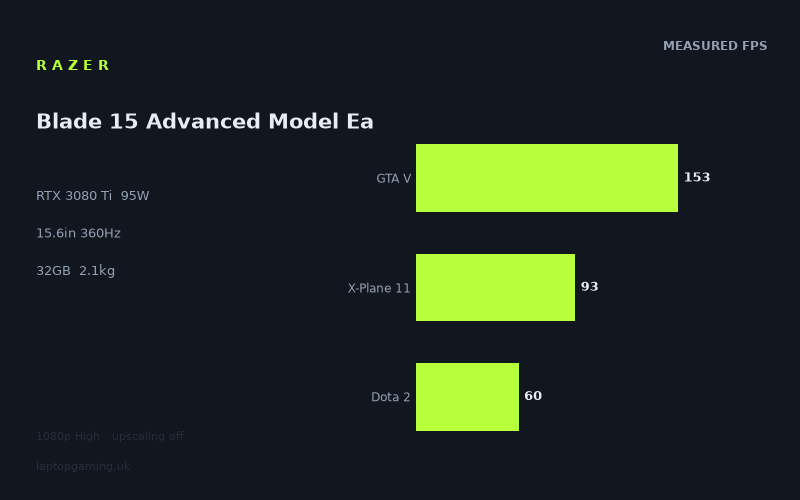
Frame rates
1920×1080, High preset, upscaling off.
Measured on this machine. Source: Notebookcheck, 2022-05-04.
Not scored: incomplete benchmark suite
Every scored laptop on this site is averaged over the same 5 games, and this one is short of Cyberpunk 2077, Baldur's Gate 3. A mean over 5 games is not comparable to a mean over 5, so we publish the figures we have and leave the score blank rather than rank it against machines tested on a different set. The numbers below are real - the suite is just incomplete.
How these numbers were produced
Frame rates here are not measured by us, and we label how each one was arrived at. A figure marked measured comes from a published run on that exact machine. A figure marked representative is derived from the GPU and its power limit (TGP) and cross-referenced against published reviews - a sound estimate of what that configuration delivers, but not a measurement of that specific laptop. Unless stated otherwise, numbers are 1920x1080, High preset, upscaling off. Where a laptop ships in several power configurations we use the wattage of the exact SKU listed, because a 140W RTX 5070 and a 115W one are not the same product.
In use
The short version
The Razer Blade 15 Advanced Model Early is a difficult gaming laptop to judge in the usual buying sense because there is no confirmed UK price for this exact configuration. That does not mean there is anything incomplete about the machine or its benchmark record: the frame-rate suite is complete, it sits on the frame-rate leaderboard normally, and the missing price simply prevents a price-dependent overall rating from being calculated. Without a price, there is no honest way to call it good value or poor value.
What can be judged clearly is the performance profile. This is a 15.6in laptop with an RTX 3080 Ti, but it is not using the kind of GPU power limit associated with the fastest RTX 3080 Ti laptops. Its GPU is limited to 95W. That matters more than the GPU name. Notebookcheck’s measured figures show a machine that can produce very high frame rates in some games at 1920x1080 on the High preset with upscaling off, but which is not remotely close to filling its 360Hz panel in the six measured games.
The strongest numbers are 168fps in Strange Brigade, 156fps in The Witcher 3 and 153fps in GTA V. Those are quick results, and they make the Blade 15 Advanced Model Early suitable for players who want a fast 1080p experience in games that are able to run well on this hardware. The picture changes in X-Plane 11, Final Fantasy XV and Dota 2, where the measured figures are 93fps, 90fps and 60fps respectively. The mean across the five scoring-suite games is 113fps, which is good evidence that this is a capable 1080p gaming laptop, but not evidence that the 360Hz screen will be fully exploited in demanding games.
The central issue is not whether this laptop is fast. It is. The issue is that the 95W RTX 3080 Ti behaves very differently from the highest-power RTX 3080 Ti implementations, while its 360Hz IPS screen sets an extremely ambitious refresh target. The Blade makes most sense for someone who values a relatively light 2.09kg gaming laptop, wants 32GB of memory and a 1TB SSD, and understands that the GPU badge alone does not guarantee desktop-replacement-class performance.
It is much less convincing for a buyer choosing purely on graphics performance. Notebookcheck’s shared-game comparison against the MSI Raider GE77 HX, another RTX 3080 Ti laptop but one with a 175W GPU power limit, shows the Blade averaging 56fps behind across five shared games. That is not a trivial difference and it is not something that can be dismissed as ordinary run-to-run variation. It is a reminder that an RTX 3080 Ti at 95W and an RTX 3080 Ti at 175W are not interchangeable products simply because they carry the same GPU name.
The more surprising comparison is with lower-tier GPUs. Against the MSI Prestige 15 with an RTX 3050 Ti at 105W, the Blade is ahead by an average of 45fps across four shared games. That is the kind of lead its specification suggests it ought to have. Yet against the Schenker XMG Focus 15 with an RTX 3050 Ti at 75W, it averages only 1fps ahead across five shared games, and it is effectively level with the Asus TUF Dash F15 with an RTX 3050 across five shared games. Those near-ties do not mean the RTX 3080 Ti has no advantage. They show how heavily 1080p results in lighter shared titles can be compressed by CPU limits, where a faster GPU cannot turn unused graphics headroom into proportionally higher frame rates.
Buy this Blade if the combination of a 15.6in 1080p IPS display, 360Hz refresh rate, 32GB memory, 1TB SSD and 2.09kg weight matches your priorities, and if you are content with strong but inconsistent game-by-game performance rather than buying on the RTX 3080 Ti label alone. Buy something else if your priority is extracting the most possible performance from an RTX 3080 Ti, if you expect a 360Hz screen to be routinely fed at anything close to 360fps, or if you need a price-led recommendation today. The missing confirmed UK price makes the last point unavoidable.
Performance
A 95W RTX 3080 Ti is the key specification
The Blade 15 Advanced Model Early combines an RTX 3080 Ti with an Intel Core i7-12800H, 32GB of memory and a 1TB SSD. On a specification list, the RTX 3080 Ti is the component most likely to draw attention. In practice, the more useful line is the GPU power limit: 95W.
That power limit is important because it defines the performance class of this particular implementation more accurately than the GPU name does. A mobile RTX 3080 Ti can appear in laptops with very different power limits, and this Blade is not configured as a maximum-power example. The comparison with the MSI Raider GE77 HX makes that clear. The Raider also uses an RTX 3080 Ti, but its GPU has a 175W power limit. Across five shared games, the Blade averages 56fps behind it.
The practical conclusion is straightforward. Do not approach this laptop as though every RTX 3080 Ti gaming laptop will perform similarly. The GPU name tells you the family of chip; the 95W limit tells you that Razer has placed that chip in a notably lower-power configuration than the 175W Raider. Notebookcheck’s figures show that difference in actual games.
That does not make the Blade slow. It means the machine needs to be judged as a 95W gaming laptop with a premium GPU designation, not as a substitute for the highest-power RTX 3080 Ti systems. That distinction is especially important for a buyer comparing listings quickly. A search result that says “RTX 3080 Ti” does not tell you enough on its own. In this case, the supplied power limit and measured frame rates are far more useful than the badge.
The 95W limit also gives the benchmark spread context. In games where the Blade reaches 168fps, 156fps or 153fps, the laptop is plainly capable of high-frame-rate 1080p gaming. In games where it reaches 93fps, 90fps or 60fps, the same hardware looks much less suited to the panel’s 360Hz ambition. The difference is not a contradiction. It is what game-by-game data is for: it prevents a single average or a single GPU label from disguising the range of outcomes.
The measured frame rates
Notebookcheck measured the Razer Blade 15 Advanced Model Early at 1920x1080, using the High preset with upscaling off. The published figures are from 2022-05-04. That test setting matters. These are native-resolution results for the laptop’s 1920x1080 screen rather than figures boosted by upscaling, and they therefore give a direct view of what the hardware delivered under the stated High preset.
- Strange Brigade: 168fps
- The Witcher 3: 156fps
- GTA V: 153fps
- X-Plane 11: 93fps
- Final Fantasy XV: 90fps
- Dota 2: 60fps
The mean across the five scoring-suite games is 113fps. That mean is useful as a broad indication of gaming capability, but it should not be mistaken for the experience in every title. The highest measured result, 168fps in Strange Brigade, is 108fps above the lowest measured result, 60fps in Dota 2. Even if Dota 2 is set aside because it is not part of the five-game scoring suite, the range across the scoring-suite results remains substantial: 168fps in Strange Brigade against 90fps in Final Fantasy XV.
That spread is exactly why buyers should read individual results rather than stopping at the 113fps mean. Someone primarily interested in games that behave more like Strange Brigade, The Witcher 3 or GTA V will see a very different performance picture from someone interested in titles that behave more like X-Plane 11 or Final Fantasy XV. A single average cannot tell you which side of that divide matters more to your library.
Strange Brigade, The Witcher 3 and GTA V: the Blade at its best
Strange Brigade is the Blade’s best result in the supplied data, at 168fps. That is a genuinely high figure for the stated 1920x1080 High test condition without upscaling. It makes this one of the clearest examples of what the laptop can do when a game responds well to its CPU and 95W GPU combination. It also shows that the Blade is not merely a machine designed to keep frame rates around the 60fps mark. In the right game, it is comfortably beyond that level.
The Witcher 3 follows at 156fps, while GTA V is close behind at 153fps. The gap between those two results is only 3fps, so they tell a similar story: the Blade is capable of delivering a fast 1080p experience in these games at the tested settings. The fact that all three results sit above 150fps is important for the 360Hz display discussion. They are high enough to make the fast panel more meaningful than it would be on a laptop limited to figures around 60fps, but they are still far below 360fps.
For a player whose priority is responsive-feeling 1080p play rather than maximising image resolution, these are encouraging numbers. Strange Brigade at 168fps, The Witcher 3 at 156fps and GTA V at 153fps all indicate that the Blade can make use of a high-refresh display to a substantial degree. The screen’s 360Hz specification is not wasted in the sense that the laptop is only producing 60fps everywhere. But the available data does not support treating the machine as a 360fps-class system in these games.
There is also an important difference between saying that a laptop has a 360Hz panel and saying that it can deliver 360fps. The Blade has the former. Notebookcheck’s six measured results do not show the latter. Its fastest published result is 168fps. That is fast, but it is less than half the panel’s refresh rate. The same is true of the 156fps and 153fps results.
That should not be read as a criticism of high refresh itself. A 360Hz panel can still be an appealing feature for a buyer who wants a fast screen. The point is simply that the measured figures set realistic expectations. In the supplied game data, the Blade’s performance is better described as high-frame-rate 1080p than as 360fps gaming.
X-Plane 11 and Final Fantasy XV: the more demanding side of the data
X-Plane 11 records 93fps, while Final Fantasy XV records 90fps. These are still usable-looking results in the context of the stated High preset and native 1920x1080 resolution, but they sit in a completely different performance bracket from the 153fps to 168fps group.
The 93fps result in X-Plane 11 is 75fps below Strange Brigade’s 168fps. Final Fantasy XV at 90fps is 78fps below Strange Brigade. Those are large differences, and they demonstrate that the Blade’s real-world gaming proposition depends strongly on the title. The RTX 3080 Ti branding does not erase that variation, and neither does the 360Hz display.
For these games, the panel’s extreme refresh ceiling is much more aspirational than practical at the tested settings. A measured 93fps or 90fps does not approach 360fps. Buyers should therefore be careful not to buy the Blade specifically because they assume every game will run at a frame rate suited to a 360Hz target. The available benchmark data does not support that assumption.
It is also worth resisting the opposite mistake. A result of 93fps or 90fps is not evidence that the Blade cannot game properly at 1080p. These are not low figures in isolation. They are simply much lower than the laptop’s best numbers, and much lower than the screen’s maximum refresh rate. That distinction matters. A buyer who wants broadly strong 1080p performance may be satisfied; a buyer who wants consistency near the display’s maximum refresh will not find it here.
The difference between 93fps in X-Plane 11 and 90fps in Final Fantasy XV is only 3fps, making these two results effectively a matched pair in the published set. That consistency is useful because it shows that the Blade has a lower performance band in the data, not merely one unusual outlier. If the games you care about tend to place comparable demands on the machine, the 90fps to 93fps region is more relevant to your decision than the 168fps headline.
Dota 2 and the limits of assuming easy games equal huge frame rates
Dota 2 is the lowest measured result at 60fps. That is particularly useful data because it warns against a simplistic reading of the specification. It would be easy to see RTX 3080 Ti, Core i7-12800H and 360Hz in the same machine and assume that every lighter or competitive title will automatically produce an extremely high frame rate. The published number says otherwise for this tested game and setting.
The 60fps Dota 2 result is 108fps behind Strange Brigade’s 168fps and 96fps behind The Witcher 3’s 156fps. Those gaps illustrate how unsuitable it is to make a buying decision from a GPU name alone. Different games place different demands on a system and can be limited in different ways. The benchmark data has to be read title by title.
Dota 2 also reinforces the point that a 360Hz panel is a capability of the screen, not a guarantee of a matching game frame rate. In the measured data, Dota 2 reaches 60fps. The display can refresh at 360Hz, but the game result supplied here does not come close to that figure. Buyers whose main interest is Dota 2 should not infer better performance from the screen specification than Notebookcheck’s measured number supports.
There is no need to make excuses for the result or to force it into a narrative where the Blade must be outstanding in every game because of the RTX 3080 Ti label. A trustworthy review should report the spread honestly. The Blade is fast in Strange Brigade, The Witcher 3 and GTA V; it is around 90fps in X-Plane 11 and Final Fantasy XV; and it records 60fps in Dota 2. All of those statements are true at once.
What the 113fps mean does and does not tell you
The five-game scoring-suite mean is 113fps. It is a useful midpoint because it includes Strange Brigade at 168fps, GTA V at 153fps, X-Plane 11 at 93fps, Final Fantasy XV at 90fps and Dota 2 at 60fps. It captures the fact that this Blade is a strong 1080p gaming laptop overall, while avoiding the distortion that would come from quoting only its best result.
At the same time, 113fps should not be treated as a prediction for every game. The individual results are too widely spread for that. A buyer should expect the machine’s performance to depend significantly on the game being played. The difference between 60fps and 168fps is not small enough to smooth over with one average.
The mean also should not be compared directly with the 360Hz panel refresh rate as though it were a target that the Blade nearly meets. It does not. A mean of 113fps is 247fps below 360Hz. Even the best supplied result, 168fps, is 192fps below 360Hz. The panel is therefore much faster than the measured game output in every title here.
That does not make the display specification meaningless. It means the laptop’s gaming story is not “360Hz performance”. It is “a 360Hz-capable display paired with game results that vary from 60fps to 168fps in the published test set”. That is a more accurate and more useful description for someone deciding whether the screen specification is worth paying for when a confirmed UK price eventually becomes available.
The screen
The Razer Blade 15 Advanced Model Early has a 15.6in IPS display with a 1920x1080 resolution and a 360Hz refresh rate. This is a clearly gaming-focused screen specification. The resolution keeps the benchmark setting aligned with the panel’s native pixel count, while the refresh rate is far above the frame rates associated with ordinary 60Hz laptop displays.
The choice of 1920x1080 is important to the performance story. The published figures were measured at 1920x1080, so there is no mismatch between the benchmark resolution and the panel resolution. Strange Brigade at 168fps, The Witcher 3 at 156fps, GTA V at 153fps, X-Plane 11 at 93fps, Final Fantasy XV at 90fps and Dota 2 at 60fps are all directly relevant to how this screen will be used at its native resolution under the stated High preset with upscaling off.
The 360Hz refresh rate is the part that needs the most careful interpretation. None of Notebookcheck’s measured results reaches 360fps. The best result is 168fps in Strange Brigade. The Witcher 3 reaches 156fps and GTA V reaches 153fps. Those numbers can make use of a high-refresh screen in a way that 60fps cannot, but they do not make full use of a 360Hz ceiling.
The lower figures make the mismatch more obvious. X-Plane 11 at 93fps and Final Fantasy XV at 90fps are well below the panel’s maximum refresh rate, while Dota 2 at 60fps is further away again. The screen is capable of refreshing far more frequently than the game output recorded in every measured title. Buyers should therefore treat 360Hz as screen headroom rather than a promise of 360fps gaming performance from this configuration.
The panel type is IPS. The supplied specification confirms that, but there are no published facts here about brightness, contrast, colour coverage, response behaviour, calibration, outdoor use or HDR capability. It would be wrong to invent those details or imply that an IPS label by itself settles them. All that can be said from the fact sheet is that this is a 15.6in IPS panel at 1920x1080 with a 360Hz refresh rate.
For the right buyer, the resolution and refresh combination is coherent. The 1920x1080 panel allows the Blade to reach its strongest measured figures in the 153fps to 168fps range, which would be harder to achieve at a higher native resolution using the same settings and no upscaling. The downside is that the panel’s 360Hz headline remains substantially beyond the measured game output. That is not necessarily a reason to avoid the screen, but it is a reason to avoid paying for it on the assumption that the GPU can routinely match it.
The most sensible expectation is this: the 360Hz panel is a fast display attached to a laptop that can produce high frame rates in some games, moderate high-frame-rate results in others, and 60fps in Dota 2 under the supplied test conditions. If you want a screen that can accommodate the Blade’s best 153fps to 168fps results without being limited by a lower refresh ceiling, the specification is easy to understand. If your aim is specifically to see results near 360fps, the published figures do not justify that expectation.
Build, size and portability
The most concrete portability figure supplied for the Blade 15 Advanced Model Early is its weight: 2.09kg. For a laptop with a 15.6in screen, RTX 3080 Ti, Core i7-12800H, 32GB of memory and 1TB SSD, that figure places portability firmly in the conversation. This is not a machine that has to be treated purely as a stationary desktop substitute.
That said, 2.09kg is still a meaningful amount of weight. It is reasonable to describe the Blade as more transportable than a very large gaming laptop, but not as something whose gaming hardware disappears into the background when carried. The right interpretation is that it is a gaming machine designed in a 15.6in format rather than a compact non-gaming laptop that happens to have gaming capability.
There are no dimensions in the supplied facts, so there is no basis for claims about thickness, footprint, bag compatibility or desk space. There are also no measured chassis temperatures, fan-noise figures or material details in this fact sheet. Those points matter to many gaming-laptop buyers, especially where a 95W GPU and a 360Hz screen are involved, but they cannot be filled in with assumptions.
The 80Wh battery is another specification that needs restraint. Battery capacity is provided, but there is no measured battery-life figure. It would be misleading to turn 80Wh into a claimed number of hours, either for gaming or ordinary use. The fact sheet supports saying that the Blade has an 80Wh battery; it does not support saying how long it lasts.
What the available specifications do show is a particular kind of compromise. Razer has put an RTX 3080 Ti and 32GB of memory into a 2.09kg, 15.6in machine with an 80Wh battery and a 95W GPU limit. The power limit is likely the more important clue than the GPU name when assessing that compromise. The Blade is not built around the 175W RTX 3080 Ti approach seen in the MSI Raider GE77 HX. Its published performance makes that plain.
For buyers who move between locations but still want a full 15.6in gaming display and substantial memory capacity, 2.09kg is one of the Blade’s strongest practical specifications. For buyers whose priority is maximum gaming output while the laptop stays on one desk, the comparison with the 175W Raider is more relevant than the weight figure. The Blade’s portability case is real, but so is the performance cost associated with its 95W GPU configuration.
How it compares
The rival comparisons are particularly revealing because they cover a wide spread of machines from the same GPU generation. They include the two closest results, the laptop that the Blade beats by the largest margin, and the laptop that beats it by the largest margin. All comparisons use only games both machines hold, with preference for the scoring suite.
MSI Prestige 15: a clear advantage for the Blade
Against the MSI Prestige 15, equipped with an RTX 3050 Ti at 105W, the Razer Blade 15 Advanced Model Early averages 45fps ahead across four shared games. This is the comparison that most closely matches what many buyers would expect from the component names. The Blade’s RTX 3080 Ti, Core i7-12800H and 32GB memory configuration produces a substantial measured lead over the Prestige’s RTX 3050 Ti configuration.
The 45fps average margin is useful because it confirms that the Blade can pull away decisively when the shared benchmark set exposes a meaningful performance difference. It prevents the more surprising near-ties with other RTX 3050-class machines from being misread as proof that the Blade has no graphics advantage. It clearly does have an advantage in this comparison.
There is no confirmed UK price for the MSI Prestige 15 in the supplied facts, so this cannot become a value comparison. The correct conclusion is only about performance: across the four shared games, the Blade is materially faster. If the decision is between these two machines on game performance alone, the Blade has the stronger evidence.
Schenker XMG Focus 15: a near-tie that needs explaining
Against the Schenker XMG Focus 15 with an RTX 3050 Ti at 75W, the Blade averages only 1fps ahead across five shared games. On paper, that is surprising. The Blade has an RTX 3080 Ti at 95W; the Schenker has an RTX 3050 Ti at 75W. It would be a mistake, however, to turn this near-zero shared-game difference into a claim that the GPUs are equivalent.
The supplied comparison notes explain why such results can occur. At 1920x1080, lighter titles in the shared set can be CPU-bound, compressing genuine GPU gaps. When a game is limited elsewhere rather than by available GPU performance, a faster graphics chip may not produce a proportionally higher frame rate. In that situation, the benchmark result is real, but it does not reveal the full underlying difference between the GPU classes.
The right reading is therefore careful rather than dismissive. The Blade is only 1fps ahead in the five-game shared comparison. That is a genuine near-tie in these particular measurements. It does not mean that the 95W RTX 3080 Ti should be considered interchangeable with a 75W RTX 3050 Ti in all games, settings or resolutions. It means that the shared 1080p game selection has compressed the gap.
This is exactly why the Blade’s own six-game results matter. It can produce 168fps in Strange Brigade, 156fps in The Witcher 3 and 153fps in GTA V, but it also records 93fps, 90fps and 60fps elsewhere. The hardware is not represented adequately by a single shared average against a lower-tier rival. The comparison is valuable because it shows the limitation of relying on GPU labels and the limitation of relying on one average at the same time.
Asus TUF Dash F15: effectively level in the shared data
The Asus TUF Dash F15 has an RTX 3050, and the Blade averages effectively 0fps behind across five shared games. This is the most striking comparison in the rival list because the RTX 3050 sits below RTX 3050 Ti and far below RTX 3080 Ti in naming terms, yet the shared-game average offers no meaningful lead for the Blade.
Again, the result should be taken seriously without being overextended. A near-zero difference is a real benchmark outcome. It is not a typo to be ignored because the specifications look unusual. But it also needs explanation. At 1920x1080, the lighter titles in the shared set are CPU-bound and can compress genuine GPU differences. A result that is constrained by factors other than the GPU will not scale neatly with the GPU hierarchy.
This comparison is therefore a warning to buyers who shop by graphics badge alone. In the shared games, the Blade’s RTX 3080 Ti at 95W does not establish a meaningful average advantage over the TUF Dash F15’s RTX 3050. That does not make the machines broadly identical, and it does not invalidate the Blade’s 45fps lead over the MSI Prestige 15 or its 56fps deficit to the MSI Raider GE77 HX. It shows that context decides the result.
For someone who mainly plays games resembling the shared set used here, the Blade’s expensive-looking GPU name should not automatically be taken as evidence of a large practical performance lead. For someone whose games place more weight on GPU capability, the specific shared comparison may be less representative. The benchmark data tells us the first point; it does not justify inventing figures for the second.
MSI Raider GE77 HX: the performance ceiling the Blade does not reach
The MSI Raider GE77 HX is the clearest evidence of what the Blade gives up by using a 95W RTX 3080 Ti. The Raider uses the same RTX 3080 Ti GPU family but has a 175W power limit. Across five shared games, the Blade averages 56fps behind.
This is the most important rival comparison for a buyer considering the Blade because it isolates the danger of assuming that the RTX 3080 Ti name settles the question. It does not. A 56fps average deficit across five shared games is a major gap. The Raider is not merely a little faster; the shared data puts it in a clearly higher performance position.
The Blade does have a 2.09kg weight figure, while no Raider weight is supplied here. It would therefore be wrong to make an unsupported portability comparison between the two. Likewise, there is no confirmed UK price for either exact configuration in the supplied facts, so there can be no price-based verdict. The supported conclusion is narrower and more useful: if maximum RTX 3080 Ti gaming performance is the objective, the Raider’s 175W configuration has a decisive published advantage over this 95W Blade.
The Blade remains a sensible machine only if that compromise is acceptable in return for what its own specification offers: a 15.6in chassis, 2.09kg weight, 360Hz 1920x1080 IPS screen, 32GB memory and 1TB SSD. If those characteristics matter more than pursuing the strongest possible RTX 3080 Ti benchmark output, the Blade has a coherent identity. If they do not, the Raider comparison is hard to ignore.
Who it’s for
Buy it if you want a high-spec 15.6in 1080p machine, not a maximum-power RTX 3080 Ti
The Blade 15 Advanced Model Early suits the buyer who wants a 15.6in gaming laptop with a fast 1920x1080 IPS display, 360Hz refresh rate, 32GB of memory and 1TB SSD, while keeping the laptop weight at 2.09kg. The benchmark data supports calling it a strong 1080p gaming machine, particularly in Strange Brigade at 168fps, The Witcher 3 at 156fps and GTA V at 153fps.
It also suits a buyer who understands the appeal of a fast screen without demanding that every game reaches the panel’s maximum refresh rate. The Blade does not hit 360fps in any of the published results, but its stronger figures are high enough that a 360Hz display is not an absurd pairing. It offers more refresh headroom than the measured frame rates require, rather than being fully saturated by them.
The 32GB memory configuration may also appeal to buyers who specifically want that capacity stated in the machine specification rather than a lower-memory configuration. The 1TB SSD similarly gives the Blade a straightforward high-capacity storage specification. There are no storage-performance measurements supplied, so the sensible conclusion is limited to capacity: it has 1TB of SSD storage.
Buyers who travel with a gaming laptop often should also consider the 2.09kg weight seriously. It does not prove anything about dimensions or carrying comfort, because those facts are not supplied, but it does distinguish the Blade’s 15.6in format from the idea of an enormous, permanently desk-bound gaming system. The 80Wh battery is a known capacity, although there is no measured runtime to support claims about how long it lasts away from mains power.
Buy something else if maximum frame rate is the priority
The clearest reason to choose something else is simple: you want the strongest possible RTX 3080 Ti performance. The MSI Raider GE77 HX shows what a 175W RTX 3080 Ti can do against this 95W Blade, with the Blade averaging 56fps behind across five shared games. If your purchase is fundamentally about gaming output rather than weight, screen refresh specification or the rest of the Blade’s configuration, that comparison points away from Razer’s lower-power implementation.
You should also look elsewhere if your main goal is to drive a 360Hz display at anything close to 360fps in the games measured here. The highest Notebookcheck figure is 168fps in Strange Brigade. The Witcher 3 reaches 156fps and GTA V reaches 153fps. X-Plane 11 reaches 93fps, Final Fantasy XV reaches 90fps and Dota 2 reaches 60fps. None supports a claim that this laptop is a 360fps machine under the stated 1920x1080 High test settings with upscaling off.
A buyer who wants a more consistent performance level across different games should also be cautious. The Blade’s figures range from 60fps to 168fps. That is a broad spread. It means that strong results in one title are not a reliable substitute for checking a result in another. If your main games are closer in behaviour to X-Plane 11, Final Fantasy XV or Dota 2, the 153fps to 168fps results should not dominate your decision.
Finally, do not buy this exact configuration on a presumed value argument. There is no confirmed UK price in the supplied facts. No honest review can say whether the Blade is competitively priced, overpriced or a bargain without that information. The performance data is sufficient to judge speed; it is not sufficient to judge value.
The bottom line
The Razer Blade 15 Advanced Model Early is a capable but very specific RTX 3080 Ti laptop. Its 95W GPU power limit means it should not be grouped automatically with the fastest RTX 3080 Ti machines. The 56fps shared-game deficit to the 175W MSI Raider GE77 HX is the evidence that matters most there.
At the same time, the Blade’s own frame rates are strong in several games: 168fps in Strange Brigade, 156fps in The Witcher 3 and 153fps in GTA V are substantial 1080p results at the stated High preset without upscaling. The lower figures of 93fps in X-Plane 11, 90fps in Final Fantasy XV and 60fps in Dota 2 prevent the machine from being described as uniformly fast or as a natural 360fps partner for its 360Hz screen.
Its best audience is someone who wants the complete package represented by the fact sheet: 15.6in IPS, 1920x1080, 360Hz, 32GB memory, 1TB SSD and 2.09kg weight, with solid 1080p gaming performance but without a need for maximum-power RTX 3080 Ti results. Its worst audience is someone buying purely for the GPU badge, someone expecting 360fps-class results from the measured games, or someone who needs a price-backed value recommendation before spending money.