Review
Schenker XMG CORE 16 (L23) review
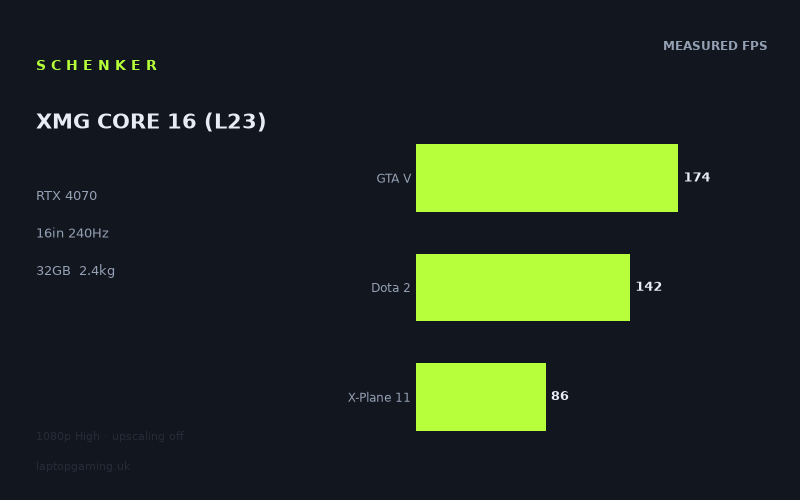
Frame rates
1920×1080, High preset, upscaling off.
Measured on this machine. Source: Notebookcheck, 2023-10-10.
Not scored: incomplete benchmark suite
Every scored laptop on this site is averaged over the same 5 games, and this one is short of Cyberpunk 2077, Baldur's Gate 3. A mean over 3 games is not comparable to a mean over 5, so we publish the figures we have and leave the score blank rather than rank it against machines tested on a different set. The numbers below are real - the suite is just incomplete.
How these numbers were produced
Frame rates here are not measured by us, and we label how each one was arrived at. A figure marked measured comes from a published run on that exact machine. A figure marked representative is derived from the GPU and its power limit (TGP) and cross-referenced against published reviews - a sound estimate of what that configuration delivers, but not a measurement of that specific laptop. Unless stated otherwise, numbers are 1920x1080, High preset, upscaling off. Where a laptop ships in several power configurations we use the wattage of the exact SKU listed, because a 140W RTX 5070 and a 115W one are not the same product.
In use
The short version
The Schenker XMG CORE 16 (L23) is a well-specified gaming laptop on paper, with an RTX 4070, Ryzen 7 7840HS, 32GB of memory, a 16in 2560x1600 IPS display and a 240Hz refresh rate. Notebookcheck’s measured figures show that it can be extremely quick in some games at 1920x1080 on the High preset with upscaling disabled. Strange Brigade reaches 249fps and The Witcher 3 reaches 245fps, both essentially matching the panel’s 240Hz refresh rate in that particular benchmark configuration.
That headline speed needs context. The same benchmark data places GTA V at 174fps, Dota 2 at 142fps and X-Plane 11 at 86fps. The measured mean across the available scoring-suite games is 134fps. That is a healthy result for 1080p High gaming, but it is not a result that means every game will make full use of a 240Hz screen, and it certainly does not prove that the laptop will sustain comparable frame rates at the panel’s native 2560x1600 resolution.
The central issue is not that the XMG CORE 16 is slow. Its available results are plainly strong. The issue is that the specification combines a very fast refresh-rate target with a higher-resolution display, while the published benchmarks are at 1920x1080. The fastest measured games show what the RTX 4070 can do when the workload allows it. The slower results show that game engine behaviour, processor limits and the demands of simulation-style titles matter as much as the GPU name on the box.
There is also an important limitation to how far this machine can be ranked. The available scoring suite is incomplete: there are no figures for Cyberpunk 2077 or Baldur’s Gate 3. Every fully scored laptop is averaged across the same five games, so this Schenker cannot be placed fairly into that complete ranking from the partial data. It would be misleading to present it as if its 134fps mean were directly equivalent to the complete results recorded for other machines. The available figures are useful, but they are not a complete verdict.
For a buyer considering this exact configuration, the strongest case is straightforward. If the priority is a 16in machine with 32GB of memory, a 99Wh battery, a 240Hz IPS screen and high 1080p High-preset performance in the measured games, the data gives the XMG CORE 16 a credible case. It is particularly convincing where frame rates are near 240fps, because that is where the display’s refresh rate has the clearest practical relevance.
The weak point is price certainty. There is no confirmed UK price for this configuration. That means there is no responsible way to call it good value, poor value or a bargain. The specification may be attractive and the benchmark data may be good, but gaming-laptop value depends heavily on what the retailer actually charges. Until a confirmed GBP price is available, the sensible position is to assess it as a performance-and-specification option rather than a completed buying recommendation.
The XMG CORE 16 is best treated as a laptop for someone who wants a powerful 1080p gaming experience, expects to play some lighter or older titles at very high frame rates, and values a 16in 2560x1600 240Hz IPS panel even when not every game can fill it. It is less convincing for someone whose sole aim is to run modern demanding games at the screen’s native resolution while staying close to 240fps, because Notebookcheck’s published figures do not demonstrate that outcome.
Performance
What the published benchmark data actually says
Notebookcheck measured the Schenker XMG CORE 16 at 1920x1080, using the High preset with upscaling disabled. Those conditions matter. They create a clean view of conventional rendered performance without an upscaling mode affecting the result, but they are not the same as running games at the laptop screen’s native 2560x1600 resolution.
In Strange Brigade, the measured result is 249fps. In The Witcher 3, it is 245fps. Those are the standout results in the published set. Both sit effectively at the level of the display’s 240Hz refresh rate, showing that the combination of RTX 4070 and Ryzen 7 7840HS can produce exceptionally high frame rates in these particular games under these particular test conditions.
GTA V records 174fps. That is clearly below 240fps, but it remains a high frame rate and is well suited to a high-refresh display. Dota 2 reaches 142fps, again far short of the panel’s maximum refresh rate but still substantially above a conventional lower-refresh gaming experience. X-Plane 11 is the slowest available scoring-suite result at 86fps. That does not make the laptop unusable for X-Plane 11; it does show that this machine’s real-world gaming experience will vary dramatically by title.
The difference between 249fps in Strange Brigade and 86fps in X-Plane 11 is the most important performance story here. A laptop cannot be reduced to a single frame-rate claim, especially when the available games place very different demands on the hardware. The XMG CORE 16 can look close to a 240Hz specialist in the fastest results and much more like a high-performance, rather than ultra-high-refresh, machine in X-Plane 11. Both statements are true, because both are directly supported by the benchmark data.
- Strange Brigade: 249fps
- The Witcher 3: 245fps
- GTA V: 174fps
- Dota 2: 142fps
- Final Fantasy XV: 125fps
- X-Plane 11: 86fps
The measured mean across the available scoring-suite games is 134fps. That average is useful as a concise summary of the available GTA V, Dota 2 and X-Plane 11 results, but it should not be allowed to hide the spread. A mean of 134fps sounds like a consistently high-refresh outcome, yet the individual numbers range from 86fps to 174fps in those scoring-suite titles. The result is not uniform enough to assume that every game will feel like GTA V, nor weak enough to treat it as if it were an ordinary lower-frame-rate gaming laptop.
The fastest games and the 240Hz display
Strange Brigade at 249fps is the clearest example of the hardware and screen specification lining up. The measured frame rate is slightly above the display’s 240Hz refresh rate. In a game producing that result under the stated benchmark conditions, the panel is not an unrealistic inclusion. The system has the available performance to deliver frames at roughly the screen’s maximum refresh capability.
The Witcher 3 at 245fps tells a similar story. The result is very close to 240Hz, and it confirms that Strange Brigade is not the only title in the available data where the XMG CORE 16 can operate at that level. Anyone buying the machine for games which behave like these measured examples has a genuine reason to value the 240Hz panel rather than treating it as an unused specification.
That does not mean 240Hz becomes a universal promise. These figures are measured at 1920x1080, High preset and with upscaling off. The built-in screen is 2560x1600. The benchmark data therefore demonstrates that the XMG CORE 16 can reach the display’s refresh territory in selected games at the tested resolution; it does not demonstrate the same result at 2560x1600.
This distinction matters because the display specification can otherwise create the wrong expectation. A 240Hz panel tells a buyer what the panel is capable of refreshing. It does not tell a buyer that every game will be rendered at 240fps. The available figures make that especially clear. Even at the 1920x1080 benchmark resolution, GTA V, Dota 2, Final Fantasy XV and X-Plane 11 do not reach 240fps. The screen gives the laptop headroom in the fastest measured titles, but it does not erase the differences between games.
The middle of the benchmark spread
GTA V at 174fps is a strong result, even though it falls well below the panel’s 240Hz ceiling. It shows that the XMG CORE 16 can offer a high-frame-rate experience without necessarily reaching the display’s maximum refresh rate. For many buyers, this middle ground is likely to be more representative of why a 240Hz screen can still be worthwhile: the panel is not only useful at precisely 240fps, and a result of 174fps is still comfortably in high-refresh territory.
Dota 2 at 142fps is a more restrained result. It remains above the measured mean of 134fps across the available scoring-suite games, but it is not close to 240fps. It is a useful corrective to the notion that less visually extravagant games will automatically run at the display maximum. The data does not support that simple assumption. The laptop reaches 249fps in Strange Brigade and 245fps in The Witcher 3, but Dota 2 records 142fps under the same stated benchmark conditions.
Final Fantasy XV at 125fps occupies another important part of the spread. It is below the available scoring-suite mean, although it is not itself included in that stated scoring-suite mean. The result remains a substantial frame rate, but it reinforces the same point: this is not a machine that can be described honestly as a 240fps laptop in every game. It is a machine capable of very high results in some titles and high but more moderate results in others.
The most useful way to read the middle results is not as a disappointment compared with Strange Brigade or The Witcher 3. They instead show the benefit of looking at a range of games. If only the 249fps and 245fps figures were considered, it would be easy to assume that the XMG CORE 16 routinely drives its screen at maximum refresh. If only X-Plane 11 were considered, it would be easy to assume that the laptop is merely adequate. Neither conclusion would reflect the whole dataset.
X-Plane 11 shows the limits of a simple GPU reading
X-Plane 11 records 86fps, the lowest result in the available benchmark list. This is still a measured number rather than an estimate, and it deserves the same weight as the much higher Strange Brigade and The Witcher 3 figures. A prospective buyer focused on X-Plane 11 should pay closer attention to 86fps than to the laptop’s 240Hz display, because the benchmark result does not approach the panel’s maximum refresh rate in that game.
It would be wrong to blame this result solely on the RTX 4070. The available comparisons make clear that shared 1080p results can become compressed by CPU-bound behaviour in lighter titles, and game performance is not determined by GPU tier alone. X-Plane 11 is a useful reminder that a gaming laptop’s outcome depends on the game being run, not merely the graphics badge in the specification.
The result also underlines why a buyer should be cautious about broad marketing-style claims. “RTX 4070 laptop” sounds like a complete description, but it does not tell someone whether their preferred game will behave like Strange Brigade, GTA V or X-Plane 11. Notebookcheck’s figures show all of those possibilities in this one machine. The sensible buying decision starts with the games a person actually plays, rather than with the fastest single frame-rate number.
What the RTX 4070 power limit means here
The fact sheet identifies the XMG CORE 16 as an RTX 4070 laptop, but it does not provide a GPU power limit for this Schenker configuration. That is a meaningful omission for performance analysis. Laptop GPUs with the same name can appear in machines with different power settings, and the stated rival comparison specifically identifies the Acer Predator Triton Neo 16 as an RTX 4070 at 110W. No equivalent figure is supplied for the XMG CORE 16.
As a result, it would be irresponsible to state that the Schenker’s RTX 4070 runs at a particular power level, to assume that it matches the Acer’s 110W configuration, or to claim that its cooling and power behaviour explain the published frame rates. The benchmark figures show the outcome; they do not provide the missing configuration detail needed to attribute that outcome to a precise GPU limit.
What can be said is that the XMG CORE 16 and the Acer Predator Triton Neo 16 are separated by only 1fps on average across their three shared games, despite the Acer being identified as an RTX 4070 at 110W. That near-zero result means there is no evidence from those shared results of a meaningful practical gaming gap between the two systems in the tested games. It does not prove that their GPU power settings are the same. It simply shows that the available measured outcomes are extremely close.
The same caution applies to the Razer Blade 14 RTX comparison, where the Schenker is also ahead by 1fps on average across three shared games. The closest comparisons are too tight to support dramatic claims about one RTX 4070 implementation dominating another. In this part of the data, the sensible conclusion is that the machines are effectively tied in the shared benchmark selection.
For a buyer who regards GPU power limit as a deciding specification, the correct response is to seek a confirmed power figure from the seller or manufacturer before making a final purchase decision. The published performance data is valuable, but it is not a substitute for a missing configuration specification. No review should fill that gap with an assumed number.
How to interpret the measured mean
The stated 134fps mean covers GTA V, Dota 2 and X-Plane 11. It is not an average of every game listed for the XMG CORE 16, and it is not a complete five-game scoring-suite average. That distinction is essential.
As a summary of the available scoring-suite results, 134fps is encouraging. It shows that the laptop is not dependent on only one unusually favourable game to produce a strong number. GTA V contributes 174fps, Dota 2 contributes 142fps and X-Plane 11 contributes 86fps. There is both strong performance and meaningful variation within that small set.
As a complete ranking result, however, it is insufficient. Cyberpunk 2077 and Baldur’s Gate 3 are not available for this machine. Every fully scored laptop is averaged across the same five games, so using the available three-game mean as though it were directly interchangeable with a five-game result would distort the comparison. The missing games could alter the overall picture, and there is no honest way to know by how much without measured figures.
This does not make the published data unhelpful. It simply defines its limits. The XMG CORE 16 has strong measured 1080p High-preset performance in the games available. It cannot be assigned a fair complete-suite rank from an incomplete suite. Buyers should appreciate both parts of that statement.
The screen
A high-specification panel with a demanding native resolution
The XMG CORE 16 has a 16in IPS screen with a 2560x1600 resolution and a 240Hz refresh rate. This is a notably ambitious display specification for a laptop with an RTX 4070. The panel is not merely high refresh; it also has a resolution above the 1920x1080 setting used for Notebookcheck’s frame-rate measurements.
That pairing can be appealing because it gives the owner flexibility. The panel has the refresh capability for the fastest measured games, while the 2560x1600 resolution gives the machine a higher-resolution native display mode than the benchmark setting. But flexibility is not the same thing as a guarantee. The available data proves performance at 1920x1080 High with upscaling off. It does not prove performance at 2560x1600, and no native-resolution figures have been supplied.
That limitation should shape expectations from the start. Strange Brigade at 249fps and The Witcher 3 at 245fps are excellent 1080p results, but they cannot be converted into a claimed native-resolution result. GTA V at 174fps, Dota 2 at 142fps, Final Fantasy XV at 125fps and X-Plane 11 at 86fps likewise remain 1080p benchmark figures. Anyone intending to use the panel exclusively at 2560x1600 should not treat them as direct native-resolution forecasts.
Where the 240Hz refresh rate is clearly justified
The display is clearly justified in the fastest measured titles. Strange Brigade at 249fps and The Witcher 3 at 245fps both show the system operating around the panel’s 240Hz capability at the tested resolution. There is no need to pretend that a 240Hz panel is always excessive when the available benchmark data includes results of that level.
Those figures make the XMG CORE 16 a sensible option for a buyer whose library includes games that can reach comparable frame rates. The screen has a meaningful role in the machine’s overall proposition when performance is that high. It is not simply a number added to a specification table without evidence that the hardware can use it.
There is a second benefit to the headroom represented by 240Hz: results below 240fps are not made invalid by the panel’s maximum refresh rate. GTA V at 174fps, Dota 2 at 142fps and Final Fantasy XV at 125fps remain high frame-rate results. The screen does not need to be driven at exactly 240fps before it becomes relevant. The mistake would be to interpret the specification as a promise that every measured game should reach that ceiling.
Where the screen specification outpaces the benchmark result
X-Plane 11 is the clearest case where the 240Hz specification is not the central practical story. The measured result is 86fps at 1920x1080 High with upscaling off. That is well below 240fps, and it means the panel’s maximum refresh capability is not being approached in the published test.
Dota 2 at 142fps and Final Fantasy XV at 125fps also leave substantial unused refresh headroom. They are not weak results, but they show why a buyer should choose the laptop for the full specification rather than solely for its 240Hz label. The high refresh rate is an advantage when the game can exploit it; it is not a substitute for the game-by-game performance evidence.
The native 2560x1600 resolution introduces another layer of caution. Because every supplied frame-rate result is at 1920x1080, the data does not show whether the fastest games would remain near 240fps at the native panel resolution. Nor does it show what GTA V, Dota 2, Final Fantasy XV or X-Plane 11 would achieve there. There is no need to guess. Buyers wanting native-resolution performance evidence should look for measured 2560x1600 figures rather than extrapolations.
IPS panel type and what can be said responsibly
The panel is IPS. That is a confirmed specification. Beyond that, the fact sheet does not provide brightness, contrast, colour coverage, response measurements, backlight behaviour or any other display-quality measurements. It would therefore be wrong to make claims about image quality, outdoor usability, colour work or motion performance beyond the stated resolution, panel type and refresh rate.
The safe conclusion is that the screen specification is strong for a gaming laptop: 16in, 2560x1600, IPS and 240Hz. The performance data shows that the hardware can make practical use of the refresh rate in some 1080p High-preset games. It does not provide enough evidence to make a broader display-quality judgement.
Build, size and portability
Weight matters more here than unsupported assumptions
The Schenker XMG CORE 16 weighs 2.39kg. That places a real portability consideration alongside its gaming-focused specification. This is not a weight figure that can be ignored when choosing a machine for regular travel, commuting or carrying between rooms. At the same time, the fact sheet does not provide the laptop’s dimensions, charger weight or total travel weight, so it would be wrong to present a complete portability calculation.
What can be said is that 2.39kg is the confirmed machine weight, and a buyer should assess that figure against how often the laptop will actually be carried. Someone planning to use it mainly in one place may see the weight as an acceptable trade-off for the RTX 4070, 32GB of memory, 16in screen and 99Wh battery. Someone expecting the laptop to spend much of its life in a bag should treat 2.39kg as a major part of the decision rather than an afterthought.
There is no supplied information about chassis materials, thickness, port selection, keyboard layout, touchpad, speakers, webcam, upgrade access or build quality. There is also no basis for claiming that the laptop feels premium, robust, compact, bulky or easy to carry. Those are physical-use judgements that require information not present in the fact sheet.
The 99Wh battery is capacity, not battery-life evidence
The XMG CORE 16 has a 99Wh battery. That is the confirmed battery specification, and it is a substantial part of the machine’s feature set. It should not, however, be confused with measured battery life. No battery-runtime results are provided. There is no published figure here for browsing, video playback, light work, gaming or idle use.
Battery capacity and battery life are not interchangeable claims. A 99Wh battery tells a buyer the capacity fitted to the laptop. It does not reveal how long this configuration lasts away from mains power in any specific workload. The Ryzen 7 7840HS, RTX 4070, 16in 2560x1600 240Hz display and 32GB memory are all part of the configuration, but the fact sheet does not provide measured endurance for that combination.
For that reason, the right description is that the XMG CORE 16 includes a 99Wh battery, not that it has good, poor, long or short battery life. Buyers who need dependable unplugged endurance should wait for measured runtime data before treating the battery capacity as a decisive advantage.
How this specification is likely to be used
The available facts point to a machine that makes most sense as a performance-led 16in laptop rather than something selected solely for minimum carrying weight. The 2.39kg chassis weight, 99Wh battery, RTX 4070, Ryzen 7 7840HS, 32GB memory and high-specification display form a package with clear gaming intent.
That does not mean it cannot travel. It means the buyer should be realistic about the compromise. The performance data is gathered with the laptop operating in a gaming benchmark, at 1920x1080 High with upscaling off. The screen specification is 2560x1600 at 240Hz. The system has substantial performance ambition, and the 2.39kg weight belongs in the same conversation as that ambition.
Without dimensions, there is no evidence to say whether the footprint is particularly convenient on a train table, in a smaller bag or on a compact desk. Without charger information, there is no evidence to say how much additional travel burden the power supply creates. Without battery-life testing, there is no evidence to say whether the 99Wh battery changes the practical need to carry that charger. The correct conclusion is deliberately limited: it weighs 2.39kg, carries a 99Wh battery, and needs more published physical and runtime data for a full portability verdict.
How it compares
Against the MSI Thin GF63
Against the MSI Thin GF63 with an RTX 4050, the Schenker XMG CORE 16 averages 46fps ahead across three shared games. The MSI has no confirmed UK price in the supplied data, so this cannot become a clean value comparison. It can, however, be read as a meaningful performance separation.
A 46fps average advantage across three shared games is not the kind of result that should be dismissed as benchmark noise or a negligible implementation difference. It supports the conclusion that the XMG CORE 16 is materially faster in the overlapping measurements. For someone choosing based primarily on available 1080p High-preset gaming performance, the Schenker has a clear data-backed advantage over the RTX 4050 MSI.
That does not mean the MSI is automatically the wrong purchase. No confirmed UK price is available for either machine in the supplied information, and price could significantly affect the buying decision. It also does not mean every game will be separated by exactly the same margin. The 46fps figure is an average across the shared selection, not a promise for all titles. But where the question is simply which of these two machines has the stronger measured gaming result, the Schenker is ahead by a substantial amount.
The comparison also reinforces why GPU tier remains relevant even when game-to-game variation is large. The XMG CORE 16’s own results range from 249fps to 86fps, so no laptop can be described by a single universal number. Yet the shared-game average advantage over the MSI is still large enough to establish that this Schenker occupies a stronger performance position in the data available.
Against the Acer Predator Triton Neo 16
The Acer Predator Triton Neo 16 is the more revealing close comparison. It also uses an RTX 4070 and is specified at 110W. Its listed UK price is GBP 2,060. Across three shared games, the Schenker XMG CORE 16 averages only 1fps ahead.
That is effectively a tie in the shared benchmark data. It would be misleading to present 1fps as a meaningful real-world victory for the Schenker, and equally misleading to claim that the Acer’s identified 110W RTX 4070 produces a notable advantage over the XMG CORE 16. The result is near-zero.
The fact sheet gives a useful explanation for why these close shared-game results should not be overinterpreted: at 1080p, lighter titles in the shared set can be CPU-bound and compress genuine GPU gaps. In other words, a narrow average does not necessarily mean the graphics configurations are identical in every possible situation. It means that, in the shared 1080p figures available, the laptops end up essentially level.
This is exactly why buyers should resist purchasing decisions based on GPU branding alone. Both are RTX 4070 machines, but one is explicitly identified as 110W while no power limit is supplied for the Schenker. The measured shared-game outcome is still only 1fps apart. The benchmark data tells a buyer that there is no clear gaming-performance reason to choose one over the other from these shared results alone.
The Acer does have a confirmed price of GBP 2,060, while the Schenker has no confirmed UK price. That makes the price question decisive rather than optional. If the XMG CORE 16 is available at a materially different price, then value could change sharply despite the near-identical shared-game performance. Without the Schenker price, the only defensible conclusion is that the gaming results are effectively tied and the purchase decision needs confirmed pricing plus whichever non-performance features matter to the buyer.
Against the Razer Blade 14 RTX
The Razer Blade 14 RTX is another near-tie. It uses an RTX 4070, has no confirmed UK price in the supplied information, and sits 1fps behind the Schenker on average across three shared games. Again, that is a real result, but it is not a meaningful performance lead in practical terms.
The Schenker does not earn a convincing claim of superiority from an average margin of 1fps. The available shared-game data says the two machines perform at essentially the same level in that limited comparison. As with the Acer, the 1080p shared set can compress genuine GPU differences where lighter titles become CPU-bound. The data should therefore be interpreted as a tie in those games, not as evidence that every aspect of the hardware is equivalent.
There is no confirmed UK price for the Razer Blade 14 RTX and no confirmed UK price for the Schenker. That prevents the comparison from becoming a value verdict. Nor does the fact sheet provide the Razer’s weight, display specification, battery capacity or other physical details, so it would be wrong to turn this into a broad design comparison. The reliable conclusion is deliberately narrow: in the three shared games, there is effectively no meaningful measured performance difference.
Against the Asus ROG Strix Scar 17
The Asus ROG Strix Scar 17 is the machine that beats the Schenker by the largest stated margin in this rival group. It uses an RTX 4090, is listed at GBP 4,883, and averages 65fps ahead across three shared games.
That is a clear performance gap. Unlike the 1fps differences against the Acer and Razer, 65fps is large enough that there is no honest case for calling the systems effectively level. If absolute measured frame rate is the only priority, the Asus is in a stronger position in the shared games.
The price difference cannot be calculated because the Schenker has no confirmed UK price. Even so, GBP 4,883 is the confirmed figure for the Asus, and it establishes the level at which that greater performance is being offered. A buyer should not assume that the Scar 17 is automatically better value merely because it is faster. Faster performance and better value are separate arguments, especially when one machine lacks a confirmed UK price.
The comparison is useful because it defines the XMG CORE 16’s place in the performance spread. It can decisively outperform the RTX 4050 MSI in the shared data. It can run effectively level with the two closely matched RTX 4070 rivals. It is clearly outperformed by the RTX 4090 Asus. That is a more useful portrait than either claiming that the XMG CORE 16 is unbeatable or treating it as inadequate because a far more expensive RTX 4090 machine is faster.
What the rival spread tells a buyer
The rival list creates a useful ladder without pretending that every comparison is identical. The RTX 4050 MSI sits materially behind the Schenker by 46fps on average across three shared games. The Acer Predator Triton Neo 16 and Razer Blade 14 RTX are effectively tied with it, each separated by only 1fps on average. The RTX 4090 Asus ROG Strix Scar 17 is substantially ahead by 65fps.
The closest comparisons are perhaps the most important for a buyer considering an RTX 4070 system. A 1fps difference is not a sensible basis for purchase. It does not justify paying more, accepting a less suitable screen, tolerating extra weight or overlooking a better warranty arrangement, although no warranty information is supplied here. When the available gaming data is that close, price and the rest of the specification become more important than a nominal benchmark lead.
The larger comparisons are more straightforward. The Schenker’s lead over the MSI confirms a meaningful increase in shared-game performance. The Asus lead confirms that substantially greater performance exists higher up the GPU range. Whether either gap is worth paying for depends on confirmed pricing and a buyer’s game priorities.
Who it’s for
Buy it if the specification fits your actual use
The Schenker XMG CORE 16 makes the strongest case for a buyer who wants a high-performance 16in laptop with an RTX 4070, Ryzen 7 7840HS, 32GB of memory, a 99Wh battery and a 2560x1600 240Hz IPS panel. The specification is focused enough that someone seeking both gaming capability and a large memory allocation can reasonably put it on a shortlist.
It is particularly suitable for someone who plays games similar to the fastest measured results and values very high frame rates at 1920x1080 High with upscaling disabled. Strange Brigade at 249fps and The Witcher 3 at 245fps are the evidence that supports this use case. Those figures show that the display’s 240Hz refresh rate can be genuinely relevant rather than merely theoretical.
It is also suitable for someone happy with high, rather than always maximum-refresh, performance. GTA V at 174fps, Dota 2 at 142fps and Final Fantasy XV at 125fps show a machine that can still deliver strong frame rates even where it does not reach 240fps. A buyer who understands that distinction will probably appreciate the screen more than someone expecting every game to run at its maximum refresh rate.
The XMG CORE 16 also makes sense for a buyer whose main concern is avoiding a meaningful performance deficit against other RTX 4070 laptops. The shared-game comparisons against the Acer Predator Triton Neo 16 and Razer Blade 14 RTX are effectively level, each with only a 1fps average difference. That means the Schenker is not shown to be giving up anything important in those particular shared benchmarks.
Finally, it is a logical candidate for a buyer who sees 2.39kg as an acceptable weight for a 16in gaming machine and values the 99Wh battery capacity, while recognising that capacity is not measured battery life. The portability proposition is a trade-off, but it is an explicit one rather than something hidden by an ultra-light claim.
Buy something else if your priorities are different
Do not buy the XMG CORE 16 solely because it has a 240Hz screen if your main games behave more like X-Plane 11 in the published data. X-Plane 11 records 86fps at 1920x1080 High with upscaling off. That is a respectable measured outcome, but it is nowhere near the display’s maximum refresh rate. For that buyer, the important question is whether 86fps in the relevant game is enough, not whether the panel can refresh at 240Hz.
Do not buy it on the assumption that it will run every game at 2560x1600 and near 240fps. No supplied benchmark was run at 2560x1600. All available figures are from 1920x1080 High with upscaling disabled. The display has a 2560x1600 native resolution, but the evidence does not establish native-resolution gaming performance.
Buy something else, or wait for more data, if Cyberpunk 2077 or Baldur’s Gate 3 are central to your purchase. There are no figures for either game in the available scoring suite. Since those results are absent, there is no basis to make a performance claim for this laptop in either title.
Buy something else if you need a confirmed value judgement immediately. The Schenker’s UK price is not confirmed. That does not mean it is overpriced; it means there is no evidence to say whether it is competitively priced against the Acer Predator Triton Neo 16 at GBP 2,060 or the Asus ROG Strix Scar 17 at GBP 4,883. A gaming laptop can be excellent at one price and poor value at another, so the missing price is not a minor detail.
Buy something else if absolute performance matters more than budget, and the cost of the Asus ROG Strix Scar 17 is acceptable. The Asus averages 65fps ahead across three shared games. That is a substantial advantage. The Schenker remains a strong performer, but the available data does not support pretending that it can match the RTX 4090 Asus where raw frame rate is concerned.
Buy something else if the lowest possible laptop weight is your overriding requirement. The confirmed weight is 2.39kg. There are no dimensions or charger-weight figures available, so a fuller travel comparison cannot be made, but this is not a specification to choose without considering the reality of carrying 2.39kg.
Final buying position
The Schenker XMG CORE 16 (L23) has a strong performance case, but it is not a simple universal recommendation. Notebookcheck’s data shows genuinely excellent 1080p High-preset results in Strange Brigade and The Witcher 3, strong performance in GTA V, Dota 2 and Final Fantasy XV, and a more limited 86fps result in X-Plane 11. That range is the machine’s real character.
The 240Hz 2560x1600 IPS display is an attractive specification, and the laptop can make persuasive use of its refresh capability in the fastest measured games. The benchmark data does not, however, establish 2560x1600 performance, and it does not show every game approaching 240fps even at 1920x1080. Buyers should choose it for demonstrated high-frame-rate capability, not for an assumed all-game maximum-refresh experience.
Its closest RTX 4070 rivals are effectively tied in the shared results. It is clearly faster than the RTX 4050 MSI Thin GF63 and clearly slower than the RTX 4090 Asus ROG Strix Scar 17. That places it in a sensible middle position: strong enough to be competitive with comparable RTX 4070 machines, but not a substitute for a far more expensive top-end GPU configuration.
The missing UK price and incomplete five-game scoring suite prevent a final value or ranking judgement. Until those gaps are filled, the most accurate verdict is that the XMG CORE 16 is a promising high-performance 16in RTX 4070 laptop with excellent measured results in selected games, a meaningful 240Hz screen, 32GB of memory and a 99Wh battery, but one that still requires confirmed pricing and broader benchmark coverage before it can be recommended without reservation.