Review
Dell G16 review
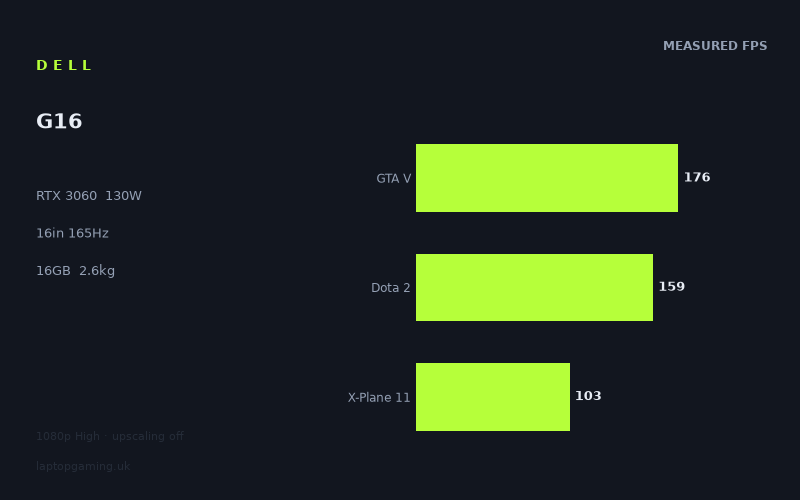
Frame rates
1920×1080, High preset, upscaling off.
Measured on this machine. Source: Notebookcheck, 2022-10-19.
Not scored: incomplete benchmark suite
Every scored laptop on this site is averaged over the same 5 games, and this one is short of Cyberpunk 2077, Baldur's Gate 3. A mean over 5 games is not comparable to a mean over 5, so we publish the figures we have and leave the score blank rather than rank it against machines tested on a different set. The numbers below are real - the suite is just incomplete.
How these numbers were produced
Frame rates here are not measured by us, and we label how each one was arrived at. A figure marked measured comes from a published run on that exact machine. A figure marked representative is derived from the GPU and its power limit (TGP) and cross-referenced against published reviews - a sound estimate of what that configuration delivers, but not a measurement of that specific laptop. Unless stated otherwise, numbers are 1920x1080, High preset, upscaling off. Where a laptop ships in several power configurations we use the wattage of the exact SKU listed, because a 140W RTX 5070 and a 115W one are not the same product.
In use
The short version
The Dell G16 (7620) is a high-powered RTX 3060 gaming laptop built around a 130W GPU limit, a Core i7-12700H, 16GB of memory and a 16in 2560x1600 IPS display with a 165Hz refresh rate. The important point is that this is not an RTX 3060 configured as a low-power, thin-and-light part. Its 130W limit gives it the headroom to produce strong 1080p High-preset results in the available Notebookcheck benchmark data, particularly in games that are either less demanding or can make good use of the CPU.
The measured figures are excellent in Strange Brigade, GTA V, The Witcher 3 and Dota 2. Those results are high enough to make the Dell’s 165Hz panel meaningful in some titles, although not in every game and not necessarily at the screen’s native 2560x1600 resolution. The data was gathered at 1920x1080, High settings and with upscaling disabled, so it should be read as a clear indication of the machine’s 1080p performance rather than a promise of identical results at native resolution.
The harder games show the more realistic limit of this hardware. X-Plane 11 runs at 103fps, Final Fantasy XV at 89fps and Cyberpunk 2077 1.6 at 80fps. Those are still comfortably playable results, but they are not figures that fill a 165Hz display. This is therefore best understood as a laptop that can deliver high frame rates in a substantial part of its game library, rather than one that can make every modern demanding game run near the panel’s maximum refresh rate.
There is also an unusually revealing comparison result here. Across the shared games, the Dell is effectively level with both the MSI GP66 Leopard with an RTX 3080 and the Razer Blade 15 OLED (Early 2022) with an RTX 3070 Ti at 110W. That does not mean that every RTX 3060 is equivalent to every RTX 3080 or RTX 3070 Ti. It means that, in the shared 1080p set used for these comparisons, lighter games can become CPU-bound and narrow the gaps that would be more visible in GPU-heavy workloads. The Dell’s 130W GPU configuration and Core i7-12700H clearly help it make the most of the games measured.
It is a more straightforward recommendation for someone who wants a relatively substantial gaming laptop to use mostly near mains power, values strong 1080p results, and is comfortable adjusting settings or resolution in the most demanding releases. It is a less convincing choice for somebody whose priority is carrying a light machine every day, demanding native-resolution performance in every game, or specifically buying for uncompromised high-refresh gaming in the most graphically intensive titles.
There is no confirmed UK price for this exact configuration. That means its value cannot be judged responsibly here: price is essential to any buying recommendation, and there is no basis for guessing what this Dell should cost. The benchmark suite is complete and the machine can still be assessed normally for performance, but whether it is good value depends entirely on a confirmed UK price.
Performance
A 130W RTX 3060 matters
The RTX 3060 name alone does not tell the whole story in a gaming laptop. Laptop GPUs with the same name can be configured with different power limits, and that affects the level of performance available over sustained gaming workloads. This Dell’s RTX 3060 has a 130W power limit. That is the figure that matters when interpreting its results: this is a configuration intended to give the GPU substantial room to perform, rather than one designed primarily around the lowest possible weight or the smallest possible chassis.
That does not permit a blanket conclusion that it will beat every laptop carrying a nominally faster GPU. Processor choice, power limits, cooling behaviour, the game being tested and the selected settings all matter. But the Notebookcheck figures show that this Dell is not leaving obvious performance on the table in the measured 1080p High-preset games. It produces a mean of 141fps across the five scoring-suite titles, which is a strong result for this class of hardware at those settings.
The Core i7-12700H is relevant as well. At 1920x1080, especially in older, lighter or highly optimised games, the graphics card is not always the sole limit. A game may instead be constrained by CPU performance, by the game engine, or by a mixture of CPU and GPU demands. That is why the Dell’s strong processor should not be treated as an incidental specification. It helps explain why a well-powered RTX 3060 can appear very close to machines with higher-tier GPUs in a shared set of lighter 1080p tests.
The results also demonstrate why buyers should avoid choosing a laptop only from its graphics badge. There is a large practical difference between knowing that a system has an RTX 3060 and knowing that it is paired with a 130W limit, a Core i7-12700H and 16GB of memory. The latter tells a more useful story about the kind of gaming result the machine can deliver. In this case, the published numbers show a laptop that is capable of very high frame rates in suitable games, while still facing understandable limits in more demanding titles.
The strongest measured results
Strange Brigade is the standout result at 180fps. At the measured 1920x1080 High preset, that is above the screen’s 165Hz refresh rate. In that specific game and at that specific test setup, the Dell has enough performance to keep the display fed at its maximum refresh rate, at least in terms of the benchmark average. It is one of the clearest examples of the Dell’s configuration making sense: the panel is not merely a specification that exceeds what the hardware can use.
GTA V follows closely at 176fps. Again, that is above 165Hz. For a player focused on this sort of title, the Dell’s combination of a high-refresh display and strong measured 1080p performance is well matched. The gap between the game’s measured result and the panel refresh rate is not large, so this should not be read as vast unused performance. It does, however, show that the system has the ability to reach the display ceiling in the benchmark conditions.
The Witcher 3 records 167fps. That is just above the panel’s 165Hz refresh rate, which makes it another game where the Dell can effectively make use of the display’s full refresh capability at the tested resolution and settings. The result is especially useful because it shows that the laptop is not dependent on only one unusually light benchmark to reach that level. Across Strange Brigade, GTA V and The Witcher 3, the measured data places the Dell at or beyond the panel’s refresh rate.
Dota 2 runs at 159fps. That is slightly below 165Hz, but it is still close enough that the display’s high refresh rate remains relevant. The difference is not one that turns the panel into wasted hardware. Instead, it shows the more typical relationship between a 165Hz display and a mid-range gaming GPU: some games will reach or exceed the refresh ceiling, some will sit just under it, and more demanding titles will run well below it while remaining entirely playable.
These results should be particularly attractive to players who spend much of their time in games that are not at the very top end of graphical demand. The Dell’s measured performance is not merely adequate in these titles; it is fast enough to support a genuinely high-refresh experience at the tested 1080p settings. That is a meaningful distinction from a system that can play the same games but only at conventional frame rates.
The middle of the range
X-Plane 11 comes in at 103fps. That is a markedly different result from the 180fps in Strange Brigade or the 176fps in GTA V, and it is a reminder that a single average frame-rate figure cannot describe an entire gaming laptop. The Dell’s five-game scoring-suite mean is 141fps, but the individual games range substantially around that number. A buyer interested in flight simulation should therefore pay more attention to the X-Plane 11 result than to the mean.
At 103fps, X-Plane 11 is still running at a high frame rate by normal standards. It is comfortably below the screen’s 165Hz maximum, though, so it does not exploit the full refresh capability in the way Strange Brigade, GTA V and The Witcher 3 do. That does not make the display inappropriate. A 165Hz panel can still show the benefit of movement above lower refresh rates even when a game does not reach its maximum, but the benchmark data does not support claiming that the Dell will deliver 165fps-class performance in this title.
Final Fantasy XV records 89fps. That is another clearly playable result, but it sits further away from the refresh ceiling. It is a useful practical marker for buyers deciding whether this laptop is aimed at broad high-refresh gaming or at strong mainstream performance. At the tested settings, the Dell is closer to the latter in this game. It delivers a smooth-looking frame rate without approaching the maximum update rate of its display.
The difference between 103fps in X-Plane 11 and 89fps in Final Fantasy XV also illustrates why game-by-game evidence is more useful than general claims such as “excellent for gaming”. Both are good results, but they support slightly different expectations. The X-Plane 11 figure suggests a high-frame-rate experience that remains below the display limit. Final Fantasy XV suggests a more conventional high-performance result where the laptop is doing well, but the GPU is being asked to work harder relative to what the panel can show.
Cyberpunk 2077 shows the harder limit
Cyberpunk 2077 1.6 is measured at 80fps. That is the lowest published figure in the supplied data, and it is the most important number for setting expectations around demanding modern games. The Dell can run it at 1920x1080 on the High preset with upscaling disabled at a comfortably playable frame rate. That is a respectable result. But it is not remotely close to 165fps, and buyers should not approach this laptop expecting every graphically intensive title to behave like GTA V or Strange Brigade.
The gap between 180fps in Strange Brigade and 80fps in Cyberpunk 2077 1.6 is 100fps. That spread is not a flaw in the Dell; it reflects the very different demands games place on a laptop. It is exactly why a review should present the individual results rather than hiding them behind a single average. A buyer who mainly plays lighter, older or more competitive titles can reasonably focus on the higher results. A buyer whose library consists mainly of demanding modern releases should focus on the lower end of the range.
Cyberpunk 2077 1.6 also helps put the 130W RTX 3060 in perspective. The power limit gives the GPU a strong basis for its class, but it does not turn the RTX 3060 into a top-tier graphics solution. There is a point at which game complexity outweighs the advantage of having a comparatively generous GPU power allocation. In those situations, the Dell still produces a usable result, but it cannot sustain the sort of frame rates needed to fully exploit a 165Hz display without changing the balance of resolution, settings or upscaling. The benchmark data supplied here does not include those alternative configurations, so no numerical claim should be made about how much they would help.
What the 141fps mean does, and does not, say
The 141fps mean across Strange Brigade, GTA V, Dota 2, X-Plane 11 and Final Fantasy XV is helpful as a broad summary of the Dell’s measured 1080p capability. It indicates a machine that is capable of high frame rates across a varied set of games. It also places the Dell in a strong position for users who do not want to choose between visual quality and responsiveness in every title.
However, the mean should not be mistaken for a promise of 141fps in an arbitrary game. The individual results make that very clear. Strange Brigade reaches 180fps, while Final Fantasy XV is at 89fps. The Dell is not delivering the same experience across every engine, genre and workload. Its performance is strong, but it is variable in the way gaming performance always is.
The mean also excludes Cyberpunk 2077 1.6 because the supplied scoring-suite mean is explicitly based on the five named scoring-suite games. Cyberpunk’s 80fps result remains highly relevant to a purchase decision, despite not being part of that particular mean. It represents the kind of demanding game that can expose the distance between a high-refresh panel and the frame rate the GPU can sustain at High settings without upscaling.
The sensible interpretation is that the Dell G16 is a capable high-frame-rate 1080p machine with a meaningful ceiling in demanding games. It is not a laptop whose display will be fully saturated in every title, but neither is the 165Hz panel absurdly ambitious for the hardware. In the games where the workload is favourable, the measured figures show that it can meet or exceed that refresh rate. In more demanding games, the panel offers headroom rather than a target the laptop necessarily reaches.
The screen
A high-resolution, high-refresh 16in IPS panel
The Dell has a 16in IPS display with a 2560x1600 resolution and a 165Hz refresh rate. On paper, this is a more demanding screen than a conventional 1920x1080 panel because it has a higher native resolution. It also has a higher refresh target than a standard 60Hz display. Those two characteristics pull in different directions for the GPU: the resolution asks it to render more pixels, while the refresh rate rewards it for producing more frames.
The IPS panel type is relevant because it identifies the display technology, but the supplied facts do not include measurements for brightness, contrast, colour coverage, response times or other display characteristics. Those are all important details for judging a screen fully, particularly for someone buying for colour-sensitive work or competitive gaming. They should not be assumed from the IPS label alone. The available information supports an assessment of resolution, size, panel type and refresh rate, not a broader claim about image quality.
The 16in format and 2560x1600 resolution give the Dell a screen with more native pixel detail than the 1920x1080 benchmark resolution. That can be desirable outside games as well as in them, but the supplied information does not include productivity measurements or any assessment of desktop scaling. For gaming, the key consequence is simpler: native-resolution gaming requires more from the GPU than the published benchmark setup.
The benchmark results are at 1920x1080, not native resolution
Every frame-rate figure supplied for this Dell was measured by Notebookcheck at 1920x1080, High settings, with upscaling disabled. That is essential context. The panel’s native resolution is 2560x1600, so none of the listed figures should be presented as native-resolution results.
This matters most for games already running below 165fps at 1920x1080. X-Plane 11 at 103fps, Final Fantasy XV at 89fps and Cyberpunk 2077 1.6 at 80fps are all well below the panel limit before moving to the higher native resolution. It would be irresponsible to assume that the Dell will retain those exact numbers at 2560x1600. No such measurement is provided, and there is no value in pretending otherwise.
The same caution applies even to the faster results. Strange Brigade at 180fps, GTA V at 176fps and The Witcher 3 at 167fps are above the panel’s 165Hz refresh rate in the stated 1080p test. But the existence of headroom at 1920x1080 does not prove that these games will remain above 165fps at 2560x1600. The higher-resolution screen gives the owner a choice between greater native detail and the highest possible frame rate; the published data establishes the 1080p side of that choice, not the native-resolution side.
This should not be read as criticism of the screen. A 2560x1600, 165Hz panel is a versatile specification because it can suit both sharper desktop use and high-refresh gaming. The practical compromise is that an RTX 3060, even at 130W, will be asked to do more at 2560x1600 than at 1920x1080. Buyers who are happy to tune settings according to the game will have more flexibility than buyers who insist on native resolution, a High preset and a near-165fps result simultaneously.
When 165Hz is useful
The Dell’s display is well aligned with its measured performance in several games. Strange Brigade at 180fps is above the refresh rate, while GTA V at 176fps and The Witcher 3 at 167fps also reach or exceed it. Dota 2 at 159fps is close enough that the panel is still being put to substantial use. For these kinds of results, 165Hz is not merely an aspirational specification; it is a real part of the experience the laptop can offer under the tested conditions.
In the slower games, the display remains a quality-of-life feature rather than a maximum target. At 103fps, 89fps or 80fps, the machine is not filling every refresh cycle. Yet those are still substantially higher frame rates than 60fps, and a 165Hz display does not become pointless simply because a game runs below its ceiling. The correct expectation is not that 165Hz must always be reached for the screen to have value. It is that the panel gives the hardware room to stretch in lighter titles and leaves room for variation across a mixed game library.
For a buyer whose main concern is competitive play in games similar to Dota 2, the measured 159fps is encouraging. For someone focused on visually demanding games similar to Cyberpunk 2077 1.6, the 80fps figure is the more relevant guide. The same panel can suit both users, but the reason for buying it differs. One buyer is using its high-refresh potential; the other is accepting that the display’s resolution and refresh are broader capabilities than the GPU will always fully exploit.
Build, size and portability
The Dell G16 weighs 2.615kg. That is the clearest available indicator of how it is likely to fit into daily use, and it points towards a laptop that is more at home as a substantial gaming machine than as an ultra-portable system. A 2.615kg laptop can certainly be moved between rooms, taken to work or carried on trips, but the weight makes it a different proposition from a machine chosen primarily for effortless daily carrying.
That weight also fits the performance configuration. The Dell combines a 130W RTX 3060, a Core i7-12700H, 16GB of memory, an 84Wh battery and a 16in 165Hz display. The supplied facts do not establish how Dell has arranged its internal cooling, how thick the chassis is, or how the laptop behaves under sustained load, so those details should not be invented. But the specification is clearly not that of a minimal-power ultraportable.
For someone using the Dell mainly on a desk, a 2.615kg weight is less important than the performance it supports. In that role, the laptop’s strongest measured results are the attraction: 180fps in Strange Brigade, 176fps in GTA V, 167fps in The Witcher 3 and 159fps in Dota 2 at the stated benchmark settings. The weight is the price paid in portability terms for a machine built around a well-powered laptop GPU rather than a more constrained configuration.
For someone commuting daily, the same weight deserves more attention. The laptop itself is 2.615kg before considering any other items that may need to travel with it. That does not make it unusable away from a desk, but it means portability should be considered part of the buying decision rather than an afterthought. Buyers who need the lightest possible computer for frequent travel should not assume that a gaming laptop with this performance profile will meet that priority.
No physical dimensions are provided in the fact sheet. It is therefore not possible to state its thickness, footprint or how much room it takes in a bag. Similarly, there are no measured battery-life results. The Dell has an 84Wh battery, which identifies battery capacity, but capacity alone is not a battery-life measurement. Gaming battery life, web-use battery life and video playback time are not available here and should not be guessed.
The practical conclusion is straightforward. The G16 is suited to a user who values laptop flexibility but expects the machine to spend a great deal of its time near a desk or mains power. It can travel, but its 2.615kg weight means it should not be selected primarily as a lightweight companion. Its appeal is performance-first portability: a system that remains movable, not one that disappears into a bag.
How it compares
Against the MSI Prestige 15
Against the MSI Prestige 15 with an RTX 3050 Ti at 105W, the Dell is ahead by an average of 78fps across four shared games. That is the largest favourable comparison in the supplied rival group, and it is a substantial practical margin. It indicates that the Dell’s RTX 3060 at 130W is operating in a distinctly higher performance tier than the Prestige 15’s RTX 3050 Ti at 105W in the games both machines hold.
This comparison is useful because it shows that the Dell’s performance is not simply the product of CPU-limited results compressing every gap. A 78fps average advantage is large enough to change the kind of high-refresh experience a buyer can expect. The Dell’s 165Hz screen is much easier to justify when paired with the 180fps, 176fps, 167fps and 159fps results seen in its strongest games. A lower-performing machine may still be suitable for gaming, but it is less likely to offer the same breadth of high-frame-rate headroom.
The comparison is limited to four shared games, so it should not be expanded into a universal claim about every workload. But it does provide clear evidence that the Dell is the more gaming-focused performance choice between these two. A buyer choosing the MSI Prestige 15 would need reasons outside this published gaming comparison, because the Dell’s advantage in the available shared-game data is decisive.
Against the MSI GP66 Leopard
The MSI GP66 Leopard carries an RTX 3080, yet the Dell averages effectively the same frame rate across four shared games. This is the sort of result that can look surprising if GPU names are treated as complete performance descriptions. It should not be interpreted as proof that an RTX 3060 is generally interchangeable with an RTX 3080.
The supplied comparison notes explain why this can happen. At 1080p, lighter titles in the shared set can be CPU-bound, compressing genuine GPU gaps. Once a game is limited more by CPU performance or the game engine than by graphics throughput, moving to a larger GPU does not necessarily produce a proportionate gain in the average frame rate. The Dell’s Core i7-12700H and 130W RTX 3060 configuration are evidently strong enough to keep it close in those particular shared tests.
This result is still important for a buyer. It says that, in the shared 1080p games, paying for a higher nominal GPU tier does not automatically guarantee a visible advantage. But it does not remove the reason higher-tier GPUs exist. More GPU-limited games, higher resolutions and different settings can expose differences that a CPU-bound 1080p game may hide. The Dell should be praised for matching the GP66 Leopard in this particular comparison, without claiming it has erased all possible advantages of an RTX 3080 configuration.
Against the Razer Blade 15 OLED (Early 2022)
The Razer Blade 15 OLED (Early 2022), equipped with an RTX 3070 Ti at 110W, is also effectively tied with the Dell across five shared games. This is a stronger comparison than the GP66 result in one respect because it covers five games rather than four. Again, the sensible conclusion is not that the GPU labels do not matter. It is that the measured shared set does not give the Razer a meaningful average lead at 1080p.
The Dell’s 130W RTX 3060 has a higher stated power limit than the Razer’s 110W RTX 3070 Ti. That does not make their GPUs equivalent in specification, but it does help explain why the Dell can compete so closely in a limited shared benchmark set. Power limits are part of the performance equation, and the Dell is configured to let its RTX 3060 operate with substantial headroom.
The CPU-bound explanation remains relevant here. The shared 1080p selection contains lighter titles where the graphics card may not be the only limiting factor. When the bottleneck shifts away from GPU throughput, the expected hierarchy based on GPU name can compress or disappear. The Dell’s result is impressive precisely because it does not rely on vague claims; the shared-game data shows a tie. It should simply not be stretched beyond the conditions of that data.
Against the MSI Raider GE77 HX
The MSI Raider GE77 HX with an RTX 3080 Ti at 175W is the rival that beats the Dell by the largest margin in the supplied group. Across five shared games, the Dell trails by an average of 28fps. That is a meaningful difference, and unlike the near-ties against the GP66 Leopard and Razer Blade 15 OLED, it shows a higher-powered GPU configuration establishing a clear advantage in the available comparison.
The Raider’s RTX 3080 Ti has a 175W power limit, compared with 130W for the Dell’s RTX 3060. It is also a higher-tier GPU by name. The shared-game average reflects the combined effect of that higher class and higher power allocation. For a buyer who wants the maximum available frame rate in the games represented by the shared set, the Raider is the stronger performer.
That does not make the Dell’s result poor. Being behind by 28fps on average while still posting a 141fps mean across its five scoring-suite games describes a capable machine, not an inadequate one. The difference matters most to buyers who are specifically chasing the highest possible refresh utilisation or who want more margin for demanding games and higher rendering workloads. For buyers whose target is strong 1080p High-preset play rather than outright maximum performance, the Dell remains credible.
The comparison group as a whole is revealing. The Dell is dramatically ahead of the RTX 3050 Ti-equipped MSI Prestige 15, effectively level with the RTX 3080 MSI GP66 Leopard and RTX 3070 Ti Razer Blade 15 OLED in their shared 1080p results, and clearly behind the 175W RTX 3080 Ti MSI Raider GE77 HX. That spread is exactly why laptop GPU buying needs more than a glance at the product name. Configuration, game selection and power limits all materially affect the result.
Who it’s for
Buy it for strong measured 1080p gaming
The Dell G16 is best suited to a player who wants strong 1080p High-preset performance from a laptop that has enough graphical headroom to make a 165Hz panel worthwhile in many games. The Notebookcheck figures support that case directly. Strange Brigade at 180fps, GTA V at 176fps, The Witcher 3 at 167fps and Dota 2 at 159fps show that the system can deliver the sort of high frame rates that change how a high-refresh display feels.
It also suits someone whose game library is mixed. The Dell is not restricted to light esports-style titles in the available data. X-Plane 11 at 103fps, Final Fantasy XV at 89fps and Cyberpunk 2077 1.6 at 80fps show that it can still provide good results in more demanding software. The compromise is that these games do not fully exploit the 165Hz display at the tested settings, and that becomes more important if native 2560x1600 gaming is a priority.
The laptop makes particular sense for a buyer who understands that settings are a tool rather than a fixed rule. The supplied benchmarks use High settings with upscaling off, which is a demanding and useful baseline. There are no measurements here for other settings, other resolutions or upscaling modes, so no specific performance gain should be promised. But the basic purchasing logic remains sound: a machine capable of 80fps in Cyberpunk 2077 1.6 at the stated settings has a usable starting point for someone willing to prioritise either image quality or frame rate according to the game.
It is also a sensible fit for someone who values performance over minimum carry weight. At 2.615kg, it is not a machine for buyers who want their gaming laptop to feel incidental in a backpack. It is for people who accept a substantial laptop because the performance configuration matters more than shaving every possible gram from the system.
Buy something else if native-resolution maximum settings are non-negotiable
Buy something else if the requirement is to run demanding games at the panel’s native 2560x1600 resolution, High settings, no upscaling and close to 165fps. The supplied data cannot support that expectation. The benchmarks are at 1920x1080, and even there the Dell reaches 80fps in Cyberpunk 2077 1.6, 89fps in Final Fantasy XV and 103fps in X-Plane 11. Those are good results, but they show that the GPU is not universally capable of driving its 165Hz panel to the limit in demanding games.
A buyer who wants the largest available performance margin should also look elsewhere. The MSI Raider GE77 HX is ahead by an average of 28fps across five shared games, and its RTX 3080 Ti has a 175W power limit. The Dell cannot match that evidence of higher performance. It remains competitive against some higher-named GPU configurations in the supplied shared games, but the Raider comparison demonstrates that there are machines with clearly greater headroom.
Choose something else if low weight is the overriding requirement. The Dell’s 2.615kg figure is not automatically a problem, but it is a real commitment for regular travel. There are no dimensions or battery-life measurements in the supplied information, so there is no basis for claiming that the G16 compensates for its weight with exceptional compactness or endurance. Buyers who need a laptop for constant commuting should seek a machine selected explicitly around portability, rather than assuming this Dell will behave like one.
Finally, do not buy purely because it appears to tie an RTX 3080 or RTX 3070 Ti rival in the supplied comparison. Those near-zero shared-game differences are real results, but they are context-specific. At 1080p, lighter games can become CPU-bound and compress GPU differences. The Dell has earned credit for its strong configuration and measured performance, but it should be bought for what its own numbers show: a 130W RTX 3060 laptop that is excellent in several 1080p High-preset games, capable in more demanding ones, and limited by the usual gap between a mid-range GPU and a 165Hz, 2560x1600 display in the heaviest workloads.