Review
Razer Blade 15 Base Edition 2021, i7-10750H RTX review
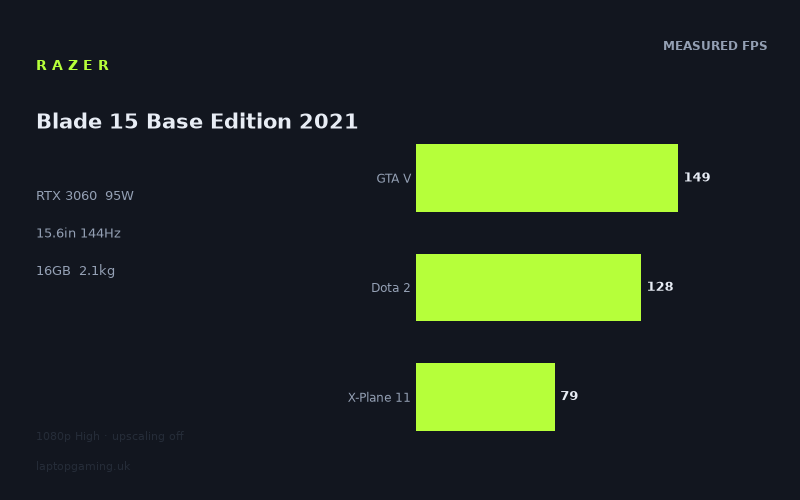
Frame rates
1920×1080, High preset, upscaling off.
Measured on this machine. Source: Notebookcheck, 2021-03-14.
Not scored: incomplete benchmark suite
Every scored laptop on this site is averaged over the same 5 games, and this one is short of Cyberpunk 2077, Baldur's Gate 3. A mean over 5 games is not comparable to a mean over 5, so we publish the figures we have and leave the score blank rather than rank it against machines tested on a different set. The numbers below are real - the suite is just incomplete.
How these numbers were produced
Frame rates here are not measured by us, and we label how each one was arrived at. A figure marked measured comes from a published run on that exact machine. A figure marked representative is derived from the GPU and its power limit (TGP) and cross-referenced against published reviews - a sound estimate of what that configuration delivers, but not a measurement of that specific laptop. Unless stated otherwise, numbers are 1920x1080, High preset, upscaling off. Where a laptop ships in several power configurations we use the wattage of the exact SKU listed, because a 140W RTX 5070 and a 115W one are not the same product.
In use
The short version
The Razer Blade 15 Base Edition 2021 sits in an interesting position: it is a 15.6in gaming laptop with an RTX 3060 running at a 95W GPU power limit, a Core i7-10750H, 16GB of memory and a 144Hz Full HD IPS screen, but its measured gaming results do not behave like a simple “mid-range GPU equals mid-range result” story.
Notebookcheck’s figures show a machine that can be extremely quick in some 1920x1080 High-preset games. Strange Brigade reaches 164fps, The Witcher 3 reaches 155fps and GTA V reaches 149fps. Those are strong results for a 144Hz display: in the games where the Blade is producing figures around that level, the screen’s refresh rate is not wasted. Dota 2 at 128fps is also a good fit for the panel, even if it does not fully reach 144fps in the measured run.
The limitation is that this level of performance is not universal. Final Fantasy XV records 81fps and X-Plane 11 records 79fps. Both are comfortably playable-looking figures in isolation, but they are far below the display’s 144Hz refresh rate. The Blade 15 therefore makes much more sense as a laptop for someone who wants a fast Full HD gaming experience across a varied library than as a machine that should be assumed to deliver 144fps in every demanding game at High settings.
Across the five games in the scoring suite, the mean is 120fps. That is a useful broad summary, but it should not be treated as a promise of a 120fps experience in every title. The spread is wide, from 79fps in X-Plane 11 to 164fps in Strange Brigade. The average describes the overall level of performance; the individual results tell a prospective buyer whether their own game habits suit this laptop.
The other striking point is the comparison with the listed rivals. The Blade is substantially ahead of the MSI Prestige 15 with an RTX 3050 Ti at 105W, averaging 56fps more across four shared games. Yet it is level, on the shared-game averages, with both the Acer Predator Helios 300 with an RTX 3070 at 100W and the Asus ZenBook Pro Duo UX582 with an RTX 3070 at 85W. Against the much more powerful-looking MSI Raider GE77 HX with an RTX 3080 Ti at 175W, it trails by 49fps on average across five shared games.
That tells you not to buy this Blade purely on the GPU name. Its RTX 3060 and 95W power limit produce excellent results in some games, but the published shared-game comparisons also show that at 1080p, lighter titles can become CPU-bound and compress what might otherwise look like clear GPU differences. The fact that it can match two RTX 3070 machines in the available comparison data is real, but it is not evidence that an RTX 3060 is universally equivalent to an RTX 3070. It is evidence about these machines, in the shared games, under the reported conditions.
The practical recommendation is therefore fairly clear. This is for a buyer who values a 2.09kg 15.6in laptop, wants Full HD gaming, mainly plays titles that can take advantage of high frame rates, and is prepared to judge each game on its own measured result rather than expecting every demanding title to run at 144fps. It is also for someone who can live with 512GB of SSD storage and does not need the review to make claims about battery endurance, panel brightness, colour coverage, thermals or fan noise, because those figures are not available here.
It is not an automatic recommendation for someone shopping exclusively for the highest possible frame rates in more demanding games, for someone who requires confirmed battery-life evidence, or for someone whose purchase decision depends on a confirmed UK price. The UK price is not confirmed, so it would not be responsible to declare it cheap, expensive or good value. Performance can be assessed from Notebookcheck’s benchmark data; value cannot be settled without a price.
Performance
The measured gaming picture
All of the frame-rate figures discussed here come from Notebookcheck, dated 2021-03-14. They were measured at 1920x1080 using the High preset with upscaling off. That matters. These are not maximum-settings figures, not results from a lower resolution, and not figures assisted by upscaling. They are a useful and fairly direct match for the laptop’s native 1920x1080 display, but they should be read as results for this specific test condition rather than as a guarantee for every setting combination or every game.
At the fast end of the measured range, Strange Brigade reaches 164fps. This is the only listed result that clears the 144Hz panel refresh rate by a meaningful margin. In that game, the Blade has enough measured performance to supply more frames than the display can show in one refresh cycle. That does not make the extra performance meaningless; it provides headroom rather than merely arriving exactly at the panel limit. But in display terms, the important conclusion is simple: the 144Hz screen can be properly exercised in Strange Brigade at the stated 1920x1080 High setting.
The Witcher 3 follows at 155fps. Again, that is above the 144Hz refresh rate. For a buyer whose interests include this sort of result, the Blade’s panel and its measured performance are well matched. The laptop is not carrying a high-refresh display that its own benchmark figures obviously fail to use. In the measured run, it reaches the display’s update rate and goes beyond it.
GTA V is close behind at 149fps. That is also above 144fps, though by a smaller margin than The Witcher 3 or Strange Brigade. It remains an important result because it reinforces that the Blade can reach the panel’s refresh rate in more than one game. The key distinction is not whether it is a few frames above 144fps or many frames above it. The key distinction is between this group of games, where 144Hz is realistically relevant, and the lower-performing group, where the display still offers a smooth high-refresh platform but cannot be fully fed by the measured frame rate.
Dota 2 records 128fps. That is below the panel’s 144Hz rating, but it is still close enough that the 144Hz display remains a sensible pairing. It is not a case of the screen having twice the refresh rate that the game can use. Instead, the benchmark figure sits in the high-frame-rate range, just short of the panel’s maximum stated refresh rate. A buyer should not read 128fps as “144fps”, because it is not, but neither should they treat it as a poor result for a Full HD gaming laptop.
Final Fantasy XV presents a different performance tier at 81fps. The measured figure is less than the panel refresh rate, so the 144Hz screen cannot be fully utilised in the same straightforward way as it is in Strange Brigade, The Witcher 3 or GTA V. Still, 81fps is not a low number in the abstract. It indicates that the Blade can run the game at the reported 1920x1080 High preset without falling into the much lower figures that would make a high-refresh panel feel entirely mismatched. The important qualification is that a buyer seeking a consistent 144fps target cannot use the higher results elsewhere to assume this game will reach it.
X-Plane 11 is the lowest listed scoring-suite result at 79fps. It is very close to Final Fantasy XV’s 81fps, and the pair should be considered together when judging the laptop. They establish that this Blade’s performance is not defined only by its best-case 149fps, 155fps and 164fps results. In the measured data, some games sit around 80fps rather than around 144fps. That is not a defect in the benchmark table; it is exactly why a review should report the spread instead of relying only on an average.
The mean across the five scoring-suite games is 120fps. A mean of 120fps makes the laptop look less spectacular than its leading 164fps result and stronger than its weakest 79fps result, which is exactly what a mean should do. It gives a broad indication of gaming capability at the stated settings, but it smooths over the distinction between titles that reach the display refresh rate and titles that do not. Buyers should use the 120fps mean as a summary and then return to the game-by-game figures.
Why the range matters more than a single average
The 85fps gap between Strange Brigade at 164fps and X-Plane 11 at 79fps is the central performance fact about this laptop. A product description that focuses only on the RTX 3060, the Core i7-10750H or the 120fps mean would hide that gap. A buyer playing the games near the top of the list can reasonably expect the Blade’s 144Hz Full HD screen to make sense. A buyer focused on games behaving more like the bottom of the list should expect a substantially lower relationship between the rendered frame rate and the display refresh rate.
There is no single “RTX 3060 frame rate”. The Notebookcheck figures demonstrate that directly. The same laptop, at the same stated resolution and High preset, produces 164fps in Strange Brigade and 79fps in X-Plane 11. That is why shopping by GPU label alone is a poor substitute for looking at attributable benchmark data. The Blade is not “a 164fps laptop” and it is not “an 79fps laptop”. It is a laptop with a documented spread across the games measured.
The data also makes a practical case for choosing settings game by game rather than treating High as a permanent rule. The reported results are all at High with upscaling off, so they establish a clear reference point. In the games already above 144fps, a buyer may care more about visual settings than about extracting more frames. In the games around 79fps to 81fps, a buyer who prioritises frame rate would need to make their own settings decisions, because the measured High-preset result does not reach the 144Hz panel’s refresh rate. The benchmark data does not provide results for other presets, so no specific alternative frame rate should be assumed.
This is particularly important for anyone buying the Blade principally because it has a 144Hz screen. A high refresh rate is a capability of the display, not a guarantee that every game will render at that rate. The strongest measured results show that the laptop can make meaningful use of the panel. The lower results show that the display specification is not the whole story. The GPU, CPU, game workload and test conditions all matter, and the published figures show the outcome rather than requiring buyers to infer it from components.
What the 95W GPU power limit tells us
The RTX 3060 in this Razer Blade has a 95W GPU power limit. That is a specification worth treating as part of the performance description, rather than as an obscure line item. The GPU model alone does not fully describe a gaming laptop’s implementation. This machine is specifically an RTX 3060 configuration at 95W, paired with a Core i7-10750H, 16GB of memory and a 1920x1080 screen.
The measured results show what that particular 95W implementation delivers in the listed games. It produces results from 79fps to 164fps, with a 120fps mean across the five scoring-suite titles. Those numbers are more useful than attempting to infer performance from the GPU name or power limit alone. The power limit provides context; the attributable benchmark data shows the actual outcome in the tested titles.
It is also useful when comparing this Blade with the listed rivals. The MSI Prestige 15 has an RTX 3050 Ti at 105W, the Acer Predator Helios 300 has an RTX 3070 at 100W, the Asus ZenBook Pro Duo UX582 has an RTX 3070 at 85W, and the MSI Raider GE77 HX has an RTX 3080 Ti at 175W. Those labels and power limits describe very different configurations. Yet the reported shared-game comparison does not produce a simple ranking in which every higher-numbered GPU always produces a clearly higher average in every shared set.
The Blade’s 95W RTX 3060 is 56fps ahead on average across four shared games against the Prestige 15’s 105W RTX 3050 Ti. It is level on average across five shared games with the Helios 300’s 100W RTX 3070, and also level on average across five shared games with the ZenBook Pro Duo UX582’s 85W RTX 3070. Against the Raider GE77 HX’s 175W RTX 3080 Ti, it is 49fps behind on average across five shared games.
The useful conclusion is not that 95W is somehow a magic number, nor that the Blade’s RTX 3060 should be treated as interchangeable with every RTX 3070. The useful conclusion is that a GPU power limit must be read alongside the game data, resolution and shared titles. In the 1080p shared sets, lighter titles can be CPU-bound and compress genuine GPU gaps. The near-zero average differences against the RTX 3070 machines are therefore meaningful reported results, but they also need context. They do not erase the difference in GPU designation or the fact that the Raider’s higher-powered RTX 3080 Ti establishes a substantial average lead in its shared-game comparison.
CPU, memory and the practical interpretation of the results
The Blade uses a Core i7-10750H and 16GB of memory. The available data does not separate CPU performance, memory performance or GPU performance into isolated measurements, so it would be wrong to credit a particular benchmark result to one component with certainty. What can be said is that the published 1080p figures reflect the complete configuration: Core i7-10750H, RTX 3060 at 95W, 16GB of memory, and the tested software settings.
The rival information gives an especially useful warning here. The shared-game averages against the Helios 300 and ZenBook Pro Duo UX582 are effectively level despite their RTX 3070 GPUs. The supplied comparison context explains why a near-zero difference can be real: at 1080p, lighter titles in the shared set are CPU-bound and compress genuine GPU gaps. That is not an excuse for ignoring the comparison. It is the explanation for why a component-specification hierarchy does not always turn into a neat benchmark hierarchy.
For a buyer, this means that the Blade is most convincingly judged by the actual games closest to their own library. If the games played resemble the titles in which the Blade produces 149fps, 155fps or 164fps, the machine’s Full HD high-refresh proposition is strong. If the games played resemble X-Plane 11 or Final Fantasy XV under these conditions, the expectation should be closer to the recorded 79fps to 81fps results. The same laptop can feel very different depending on which side of that spread dominates a player’s time.
The screen
Full HD and 144Hz are a coherent pairing here
The Blade 15 has a 15.6in IPS display with a 1920x1080 resolution and a 144Hz refresh rate. The resolution is directly aligned with the published benchmark conditions, since Notebookcheck’s frame rates were measured at 1920x1080. That removes one common uncertainty in laptop analysis: these are not benchmark figures recorded at a resolution different from the panel’s native resolution.
The 144Hz refresh rate is not merely decorative in the measured data. Strange Brigade reaches 164fps, The Witcher 3 reaches 155fps and GTA V reaches 149fps. Those results show that the laptop can meet or exceed 144fps in several of the listed titles at the reported settings. Dota 2 at 128fps is below 144fps but remains close enough that the panel’s high-refresh capability is still relevant.
The lower results are equally important. Final Fantasy XV at 81fps and X-Plane 11 at 79fps are not near the 144Hz figure. In those games, the display still has a 144Hz refresh rate, but the reported frame rate is the limiting part of the pairing. Anyone buying this laptop because they want every game to operate at the screen’s maximum refresh rate should not rely on the fastest three results and ignore the slowest two.
That distinction makes the screen a sensible match for the measured performance, but not a universally saturated one. The panel is well used in the games near or above 144fps. It has more refresh-rate capacity than the recorded output in the games around 80fps. That is a normal and honest way to describe a 144Hz gaming laptop: the screen provides the potential, while the game-by-game benchmark data determines how much of that potential is realised.
What is known about the panel, and what is not
The confirmed panel information is its IPS type, 15.6in size, 1920x1080 resolution and 144Hz refresh rate. That is enough to discuss its format and the relationship with the benchmark figures. It is not enough to make claims about brightness, contrast, colour coverage, response behaviour, outdoor usability or any other aspect not provided in the fact sheet.
The IPS designation should therefore not be inflated into a broader display-quality verdict. A buyer can say that this is an IPS 144Hz Full HD panel. They cannot responsibly infer from the available data that it is particularly bright, especially colour-accurate, especially fast in pixel response, or especially suitable for colour-critical work. Those may matter to some buyers, but they are not established by the supplied specifications or benchmark results.
For gaming specifically, the useful question is whether the 1920x1080 and 144Hz specification is supported by the measured frame rates. The answer is mixed in a constructive rather than negative way. The Blade has enough documented performance to reach the panel refresh rate in Strange Brigade, The Witcher 3 and GTA V, and to approach it in Dota 2. It does not reach that level in Final Fantasy XV or X-Plane 11 at the measured High preset with upscaling off. That is a much more useful conclusion than simply calling the screen “good” or “fast”.
Build, size and portability
The confirmed portability figure is a weight of 2.09kg. That places the Blade’s physical mass at a level where portability should be considered part of the buying decision, rather than treating it as a purely desk-bound machine by definition. At the same time, 2.09kg is still a meaningful amount of weight for regular travel. It is not sensible to describe it as weightless, nor is it sensible to claim that it is too heavy to move. The better interpretation is that it is a 15.6in gaming laptop whose weight needs to be accepted as part of carrying a system with this class of hardware.
No dimensions are provided, so there is no basis here for claims about thickness, footprint, bag fit or desk space. Likewise, there is no information about chassis materials, keyboard layout, trackpad, port selection, webcam, speakers or upgrade access. A careful buyer should not let assumed Razer characteristics fill those gaps. This review can assess the stated 2.09kg weight, but it cannot claim to have handled the machine or describe unprovided physical details.
The battery is rated at 65Wh. That figure tells us the battery capacity, but it does not tell us how long the laptop lasts away from mains power in gaming, browsing, video playback or any other workload. No battery-life measurement is supplied, so there is no responsible battery-runtime claim to make. Anyone who needs a laptop for long periods away from a charger should seek measured battery-life data rather than treating 65Wh as a duration.
The storage configuration is a 512GB SSD. Again, that is a concrete capacity specification, but the fact sheet does not state the available capacity after software installation, SSD performance, storage expansion options or how the laptop is configured internally. The important buying point is simply that the supplied machine has 512GB of SSD storage, not an unspecified larger capacity. A buyer with a large installed game library should treat that capacity as a decision point rather than assuming extra storage provision.
The 16GB memory configuration is also worth noting as part of the stated specification, but no memory speed, layout or upgrade information is available. The benchmark figures should be understood as results from the listed 16GB configuration, not as evidence for an alternative memory setup.
How it compares
Against the MSI Prestige 15 with RTX 3050 Ti at 105W
The clearest lead in the listed rival set is against the MSI Prestige 15, which uses an RTX 3050 Ti at 105W. Across four shared games, the Razer Blade averages 56fps more. That is a substantial difference, not a marginal result that needs to be explained away as normal benchmark variation.
The comparison is useful because it shows that the Blade’s RTX 3060 at 95W is not held back to the point where it becomes indistinguishable from a lower-tier RTX 3050 Ti configuration. Despite the Prestige 15 having a stated 105W GPU power limit, the Blade has the documented shared-game advantage. That is exactly why the GPU label and power limit need to be interpreted through benchmark results rather than treated as standalone verdicts.
There is no confirmed UK price for the Prestige 15, so this cannot become a value comparison. The Blade’s 56fps shared-game lead establishes performance separation only. Without confirmed prices, it would be speculation to say whether that performance lead costs an appropriate amount or whether either machine represents better value.
Against the Acer Predator Helios 300 with RTX 3070 at 100W
The Acer Predator Helios 300 comparison is more surprising on paper. The Helios 300 has an RTX 3070 at 100W, while the Blade has an RTX 3060 at 95W. Yet across five shared games, the average difference is effectively zero. The Blade is level with it in the reported shared-game average.
This should not be turned into a simplistic claim that the Blade’s RTX 3060 is equal to an RTX 3070 in all circumstances. The supplied context is explicit: at 1080p, lighter titles in the shared set can be CPU-bound and compress genuine GPU gaps. That explanation matters because the comparison is not an abstract GPU contest. It is a comparison of laptop results in games both machines hold, using the stated method for selecting shared titles.
Still, the near-zero difference is a real result. A buyer choosing between these two machines should not dismiss the Blade merely because its GPU label is lower. In the reported shared set, it keeps pace. The sensible next step would be to consider the specific games, screen requirements, weight, price and other features, but no confirmed UK price is available for either system in this fact sheet and no additional feature comparison is supplied.
Against the Asus ZenBook Pro Duo UX582 with RTX 3070 at 85W
The Asus ZenBook Pro Duo UX582 presents a second near-level RTX 3070 comparison. Its RTX 3070 has an 85W power limit, while the Blade’s RTX 3060 is listed at 95W. Across five shared games, the reported average difference is effectively zero, with the Blade neither establishing a meaningful average lead nor suffering one.
That result reinforces the need for caution with GPU hierarchy assumptions. The Blade’s 95W RTX 3060 can match the reported shared-game average of this 85W RTX 3070 machine, but only in the selected shared set and under the relevant measurement conditions. It does not mean there are no circumstances in which the RTX 3070 configuration has an advantage. It means that the available shared-game data does not show one in the average.
For a buyer who has narrowed the choice to these two models, this is a reminder to prioritise the games they actually play. A hardware label suggests one thing; the benchmark data for shared titles reports another. Because neither machine has a confirmed UK price in the supplied information, no value conclusion should be made.
Against the MSI Raider GE77 HX with RTX 3080 Ti at 175W
The MSI Raider GE77 HX is the rival that establishes the largest advantage over the Blade. It uses an RTX 3080 Ti at 175W and averages 49fps more across five shared games. This is a substantial performance lead, and it provides an important boundary around the Blade’s otherwise impressive results against the RTX 3070 rivals.
The Raider comparison demonstrates that the Blade is not competing at the top end of the listed performance spread. The Razer can be quick enough to reach 144fps in several of its own measured games, but the Raider’s shared-game average advantage shows there is clearly more performance available in the rival set. Buyers who are shopping primarily for the highest possible frame rates, especially with less interest in the Blade’s 2.09kg weight, should take this result seriously.
Again, performance is not the same as value. There is no confirmed UK price for the Raider in the supplied information, and there is no confirmed UK price for the Blade. The 49fps difference can be discussed as benchmark evidence; whether it is worth paying for cannot be determined here.
Who it’s for
The Razer Blade 15 Base Edition 2021 is for the buyer who wants a 15.6in Full HD gaming laptop with a 144Hz IPS screen and is willing to make a decision from measured game results rather than from component labels alone. The strongest case is for someone playing games that resemble Strange Brigade, The Witcher 3, GTA V and Dota 2 in the available data. At 164fps, 155fps, 149fps and 128fps respectively, those results make convincing use of a 144Hz display.
It is also for the buyer who sees 2.09kg as an acceptable trade-off. The weight is not an irrelevant specification on a 15.6in gaming machine. Someone regularly moving between locations may reasonably prefer it to a heavier alternative, though no dimensions are supplied and no claims should be made about the laptop’s overall physical bulk beyond the stated mass.
The machine also suits a buyer who accepts the limits of the 512GB SSD configuration and 16GB memory configuration as stated. The fact sheet does not provide upgrade information, so the purchase should be made on the basis of the listed configuration rather than on assumptions about future changes.
It is not the right fit for a buyer whose central requirement is that demanding games run at 144fps at the reported High preset with upscaling off. Final Fantasy XV at 81fps and X-Plane 11 at 79fps show that this expectation would not be supported by the available benchmark data. The Blade can be a strong high-refresh Full HD machine without being a universal 144fps machine.
It is also not the obvious choice for someone seeking the largest documented performance figure among the listed rivals. The MSI Raider GE77 HX is 49fps ahead on average across five shared games. The Blade’s strengths are its own strong Full HD results and its 2.09kg weight, not an argument that it beats every more powerful configuration.
Finally, it is not possible to make a responsible value recommendation until the UK price is confirmed. There is no price in the supplied data, so the correct conclusion is not that the Blade is cheap or expensive. A buyer should judge its performance, screen format, weight, battery capacity and storage capacity from the facts available, then compare those against a live UK price before deciding whether it is worth buying.