Review
Eurocom Nightsky TXi317 review
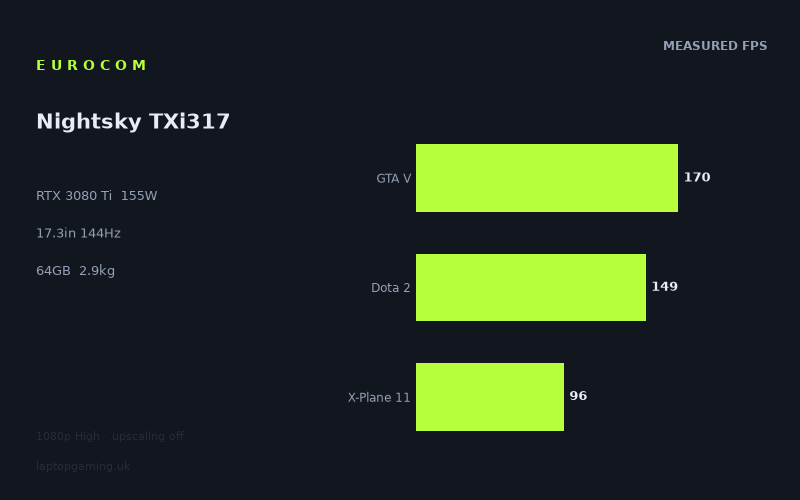
Frame rates
1920×1080, High preset, upscaling off.
Measured on this machine. Source: Notebookcheck, 2022-10-26.
Not scored: incomplete benchmark suite
Every scored laptop on this site is averaged over the same 5 games, and this one is short of Cyberpunk 2077, Baldur's Gate 3. A mean over 5 games is not comparable to a mean over 5, so we publish the figures we have and leave the score blank rather than rank it against machines tested on a different set. The numbers below are real - the suite is just incomplete.
How these numbers were produced
Frame rates here are not measured by us, and we label how each one was arrived at. A figure marked measured comes from a published run on that exact machine. A figure marked representative is derived from the GPU and its power limit (TGP) and cross-referenced against published reviews - a sound estimate of what that configuration delivers, but not a measurement of that specific laptop. Unless stated otherwise, numbers are 1920x1080, High preset, upscaling off. Where a laptop ships in several power configurations we use the wattage of the exact SKU listed, because a 140W RTX 5070 and a 115W one are not the same product.
In use
The short version
The Eurocom Nightsky TXi317 is a powerful 17.3in gaming laptop built around an RTX 3080 Ti running at a 155W GPU power limit, a Core i7-12700H and 64GB of memory. On the published 1920x1080 High-preset benchmark data, it is plainly fast enough for high-refresh-rate gaming in lighter and older titles, while still delivering strong results in demanding games such as Cyberpunk 2077 1.6 and X-Plane 11.
The important qualification is that the 144Hz display is not equally well served by every game. The measured figures are comfortably beyond the panel refresh rate in Strange Brigade, The Witcher 3 and GTA V, while Dota 2 sits only just above it. Final Fantasy XV, Cyberpunk 2077 1.6 and X-Plane 11 are all below 144fps at the stated settings. That is not a criticism of the machine so much as a useful reminder that an RTX 3080 Ti laptop GPU, even at a substantial 155W limit, does not make demanding games automatically easy at high settings.
This is therefore a machine for someone who wants a large 1080p gaming screen, substantial memory capacity and high-end performance without chasing higher-resolution rendering. It looks especially sensible for players whose library includes a mix of competitive games, older AAA games, simulation titles and modern demanding releases. The screen’s 144Hz refresh rate has enough headroom for the faster results, while 1080p keeps the harder games in a range where settings can be adjusted without sacrificing the basic clarity of the panel.
It is less convincing for a buyer who wants a genuinely portable laptop. At 2.879kg, this is a large-system proposition rather than something chosen primarily for daily travel. The available specifications do not include chassis dimensions, so it is not possible to judge its footprint or thickness from the supplied information, but the weight alone makes its intended role fairly clear: desk use, occasional movement, and gaming where mains power is available.
There is also no confirmed UK price for this exact configuration. That means there is no overall value judgement to make here: the benchmark suite is complete and the machine ranks normally on frame-rate performance, but value cannot be assessed without a confirmed price.
If the aim is to buy a high-performance 1080p gaming laptop on the strength of attributable benchmark data rather than marketing labels, the Nightsky TXi317 has a credible case. Its numbers show a machine that can fully exploit its 144Hz screen in several games and remain quick in the titles that resist very high frame rates. What it does not show is a reason to assume every RTX 3080 Ti laptop will behave the same way. The comparison data makes that especially clear: power limits, laptop design and the games selected can compress or widen apparent differences dramatically.
Performance
What the benchmark data says
The available frame rates were measured by Notebookcheck at 1920x1080 using the High preset with upscaling disabled. That last point matters. These are not results boosted by an upscaling mode, and they are not figures from a lower resolution intended to flatter the hardware. They show the Nightsky TXi317 running games at the same native resolution as its 17.3in display.
Across the five-game scoring suite, the Eurocom records a mean of 151fps. That is a strong headline result for a 144Hz laptop panel, but the mean should not be read as a promise that every game will run at roughly that rate. The spread is wide, from 115fps in Final Fantasy XV to 226fps in Strange Brigade. Cyberpunk 2077 1.6 and X-Plane 11 both return 96fps, showing that the mean is being pulled upwards by lighter or better-scaling games rather than representing a uniform experience.
Strange Brigade is the standout result at 226fps. On a 144Hz panel, the practical message is straightforward: the GPU has more rendering performance available than the display’s nominal refresh rate can show as distinct refreshes. That is useful headroom. It means the machine is not merely scraping past the panel target in this game; the measured result is comfortably above it. Players who prioritise response and consistent high frame rates in games with similar demands should see this as one of the Nightsky’s strongest use cases.
The Witcher 3 reaches 212fps in the same test conditions. Again, that is well beyond 144Hz. It demonstrates that the RTX 3080 Ti at 155W is not constrained to merely hitting a high-refresh target in older or less punishing AAA workloads. It has substantial surplus performance in this game at 1920x1080 and High settings. The distinction matters because a result just above a display refresh rate can fall below it when scenes become heavier or background activity changes. A figure of 212fps is not a guarantee about every possible scene, but it leaves much more room than a marginal result would.
GTA V returns 170fps. That is another result above the display refresh rate, although less dramatically so than Strange Brigade or The Witcher 3. The machine can still drive the panel at its 144Hz rating in the measured run, but GTA V is closer to the screen target. The difference between 170fps and 144Hz is not the same as the gap between 226fps and 144Hz. The latter clearly indicates abundant GPU performance for the workload; the former indicates that the target is met, but with less spare capacity for unusually demanding scenes, settings changes or other factors not represented by the supplied benchmark result.
Dota 2 records 149fps. This is technically above the 144Hz refresh rate, but it should not be grouped casually with the 226fps and 212fps results. It is a narrow pass rather than a large one. The Nightsky TXi317 can reach the panel’s refresh rate in the benchmark data, yet the result is close enough to the display limit that it should be treated as a near-match, not as a game in which the laptop has vast unused performance. It is still a good result, particularly because the screen’s native resolution is being used and upscaling is off, but the distinction is worth making for a buyer choosing a laptop specifically for high-refresh competitive play.
Final Fantasy XV lands at 115fps. That is a strong frame rate in isolation and should look substantially smoother than a conventional lower-refresh gaming target, but it does not fully reach 144Hz under the stated conditions. The useful conclusion is not that the machine struggles with Final Fantasy XV. It clearly does not. The conclusion is that High settings at native 1080p can still keep a high-end mobile GPU below the maximum refresh rate of a 144Hz panel in certain games. This is the kind of result that makes the Nightsky’s screen a sensible match for its GPU rather than an excessive one. There is room to improve performance through settings changes if a player values frame rate above image quality, but the supplied data does not say what those adjusted results would be.
Cyberpunk 2077 1.6 records 96fps. This is one of the most informative results in the list because it shows the other side of the RTX 3080 Ti laptop experience. The Nightsky TXi317 can produce a clearly high frame rate in a demanding modern game at 1920x1080, High settings and with upscaling off, but it does not approach the panel’s 144Hz ceiling. A buyer whose priority is keeping every demanding AAA game at the screen’s maximum refresh should not assume this laptop will do so without compromises. The measured 96fps is still a strong outcome for this workload, but it is a different class of result from the 170fps in GTA V or the 226fps in Strange Brigade.
X-Plane 11 also records 96fps. Matching Cyberpunk 2077 1.6 numerically does not mean the two games place identical demands on the system. The point for a buyer is that the Nightsky does not have a single simple performance label. It can be well beyond 144fps in some games and below 100fps in others, even at the same resolution and nominal quality level. Simulation workloads can be affected by factors beyond straightforward GPU rendering demand, and this result reinforces the value of checking game-specific numbers rather than shopping only by GPU name.
The meaning of the 155W GPU power limit
The RTX 3080 Ti badge is useful shorthand, but it is not the whole performance specification. Laptop GPUs are configured with different power limits, and the Nightsky TXi317’s RTX 3080 Ti is listed at 155W. That is a substantial limit, but it is neither the lowest nor the highest RTX 3080 Ti configuration represented in the comparison group.
The significance of the 155W figure is that this Eurocom is not using an especially constrained version of the GPU. It is configured as a performance-oriented part. At the same time, the comparison data shows why a buyer should resist turning that observation into a simplistic ranking. The MSI Raider GE77 HX has an RTX 3080 Ti at 175W, yet the Eurocom is not automatically close to it in every sense simply because both laptops use the same GPU family. Across the shared games, the Nightsky trails that Raider by 18fps on average. That gap is meaningful, and it is consistent with the idea that the more aggressively powered GPU has scope for more performance, but the benchmark spread also depends on the rest of the platform and the workloads involved.
Equally, the Razer Blade 15 uses an RTX 3080 Ti with a 110W limit, which is much lower than the Eurocom’s 155W figure. Yet the Nightsky is only 1fps behind the Razer across five shared games. That does not mean the power limit is unimportant. It means the shared 1080p set is not exposing a large real-world separation between these two machines. In lighter titles at 1080p, the GPU can cease to be the sole performance limiter. CPU behaviour, game-engine limits and the frame-rate characteristics of the title can compress the visible difference between graphics configurations that appear far apart on paper.
This is one of the main lessons of the Nightsky’s data. A 155W RTX 3080 Ti gives it the foundation for strong performance, but wattage is not a portable performance guarantee. The GPU limit tells you something important about the machine’s intended performance class. The game results tell you what that intention actually delivers. Here, the delivery is excellent in several titles, strong but short of 144fps in others, and competitive with very different RTX 3080 Ti laptop implementations when the games are light enough to hide some of the underlying GPU advantage.
The Nightsky’s 151fps mean across the scoring suite should therefore be treated as evidence of breadth, not as a substitute for the individual results. It is an effective 1080p gaming system. It is not a system that makes every game behave the same. Buyers who mostly play games resembling Strange Brigade, The Witcher 3, GTA V or Dota 2 can reasonably expect the 144Hz panel to be relevant. Buyers focused on games with the demands of Cyberpunk 2077 1.6 or X-Plane 11 should regard the panel as providing headroom rather than as a refresh target guaranteed at High settings.
Why the numbers vary so much
The frame-rate range is not an inconsistency in the data. It is the normal consequence of different games imposing different limits. Strange Brigade at 226fps and Cyberpunk 2077 1.6 at 96fps are both measured at 1920x1080, High settings and with upscaling off, but they are not comparable workloads in the simplistic sense of being two versions of the same test. The GPU may be the main limiter in one scene, while the processor, game engine or a mixture of system resources may have a stronger effect in another.
The Core i7-12700H and 64GB of memory put the Nightsky in a strong overall hardware class, but the supplied figures do not isolate CPU performance from GPU performance. It would be wrong to claim from this data alone that a particular result is definitely CPU-bound or definitely GPU-bound. What can be said is that the very high frame rates in several titles help explain why comparisons between laptop GPUs can become compressed at 1080p. Once performance is high enough, the difference between a 155W RTX 3080 Ti and another configuration may be less obvious in a shared game set than the power-limit labels suggest.
Dota 2 is a particularly useful example. At 149fps, it is only just beyond the 144Hz display refresh rate. It is fast, but it does not create the same gulf above the panel target as Strange Brigade. The result reminds buyers that a game can be visually less demanding in broad reputation yet still not necessarily produce extreme frame rates in every laptop configuration or benchmark path. The Nightsky reaches the screen target in the measured result, but it does not produce the kind of surplus seen in the fastest games here.
X-Plane 11 is useful for the opposite reason. Its 96fps result is not low in an absolute sense, yet it is well below the 144Hz panel’s maximum. Simulation players often care about consistency and responsiveness as much as the peak number, but the supplied data contains only the measured average frame rate. It does not include frame-time data, minimum frame rates or scenario variation. A buyer should not infer those missing details from the average. The correct reading is narrower but still valuable: on this benchmark, at these settings, the Nightsky produces 96fps.
Cyberpunk 2077 1.6 is similarly important because it prevents the review from becoming a story about the RTX 3080 Ti simply overwhelming 1080p. It does not. It delivers 96fps, which is good performance, but the game remains demanding enough to keep the system below the panel maximum. For someone buying a laptop to run visually demanding games at high settings without upscaling, that is arguably a more useful result than another extremely high number in an older title. It shows that the Nightsky has enough performance to stay well above basic smoothness expectations, while also showing that settings decisions remain relevant.
Final Fantasy XV at 115fps sits between those extremes. It is below 144Hz but above the Cyberpunk 2077 1.6 and X-Plane 11 results. That middle position is significant because many games will not be as easy to run as Strange Brigade or as punishing as Cyberpunk 2077 1.6. The Nightsky’s overall character is therefore not merely “144Hz in easy games, 96fps in hard ones”. There is also a substantial middle ground where it produces high frame rates that make good use of a 144Hz panel without necessarily saturating it.
The screen
A sensible resolution for the measured performance
The Nightsky TXi317 uses a 17.3in IPS display with a 1920x1080 resolution and a 144Hz refresh rate. Based on the benchmark data, 1080p is a sensible pairing for the RTX 3080 Ti at 155W. The GPU can deliver results beyond 144fps in several games, while more demanding titles remain at strong frame rates instead of being pushed into a lower-performance range by a higher native resolution.
A higher-resolution screen would offer a different kind of appeal, but it would also require more graphics performance for the same settings. There is no higher-resolution benchmark data in the supplied information, so it would be wrong to claim what this machine would achieve on a different panel. What the existing results do show is that the 1920x1080 screen allows the Nightsky to produce 226fps in Strange Brigade, 212fps in The Witcher 3, 170fps in GTA V and 149fps in Dota 2. Those are exactly the sort of figures that make a 144Hz display worthwhile.
The 144Hz refresh rate is not wasted merely because some games do not reach it. A display does not need to be fully saturated in every title to be a good choice. Final Fantasy XV at 115fps, Cyberpunk 2077 1.6 at 96fps and X-Plane 11 at 96fps are still high frame-rate results. The panel gives the machine room to show that performance without imposing an artificial ceiling at a lower refresh level. The important point is simply that buyers should understand the difference between “high frame rate” and “full 144Hz performance”. The Nightsky offers both in some games, and the former rather than the latter in others.
The IPS panel type is another relevant specification, although the supplied information does not provide measurements for brightness, contrast, colour coverage, response time, backlight behaviour or viewing angles. IPS alone should not be treated as proof of a particular image-quality standard. It tells you the panel technology, not how well this specific panel has been calibrated or how it behaves in a dark room. The available facts support a conclusion about resolution, size and refresh rate; they do not support a detailed display-quality verdict.
How well the machine can drive 144Hz
There are four distinct positions in the benchmark results relative to the 144Hz panel. First, there are the titles that are comfortably above it: Strange Brigade at 226fps and The Witcher 3 at 212fps. These show clear surplus performance. Second, there is GTA V at 170fps, which is above the panel refresh rate with less excess performance. Third, there is Dota 2 at 149fps, a close match to the panel. Finally, there are the titles below the refresh ceiling: Final Fantasy XV at 115fps, plus Cyberpunk 2077 1.6 and X-Plane 11 at 96fps.
That pattern makes the display a better fit for varied gaming than a lower-refresh panel would be. In the games where the Nightsky is very fast, 144Hz can display the benefit. In the games where the GPU is held below that level, the panel is not the limiting element. There is no evidence here that the screen is mismatched to the machine. Instead, the data suggests that it gives the RTX 3080 Ti enough room to stretch in the faster titles without demanding the extra rendering work that a higher native resolution would bring.
For competitive players, the most relevant results are likely to be Strange Brigade and Dota 2. Strange Brigade’s 226fps indicates very large performance headroom against the panel refresh rate. Dota 2’s 149fps is a more cautious result: the benchmark reaches 144Hz territory, but only narrowly. A buyer who plays one title almost exclusively should always focus on data from that title or the closest available workload, rather than assuming that an especially high result in another game will transfer directly.
For single-player AAA players, GTA V, The Witcher 3, Final Fantasy XV and Cyberpunk 2077 1.6 offer a more useful cross-section. The Nightsky is exceptionally quick in The Witcher 3, clearly above the panel target in GTA V, high but below 144fps in Final Fantasy XV, and still strong at 96fps in Cyberpunk 2077 1.6. That is a convincing range of outcomes for a 1080p laptop. It also establishes sensible expectations: high settings and native rendering can coexist with high frame rates, but the most demanding games still require a choice between maximising image settings and pursuing the screen’s highest refresh rate.
Build, size and portability
A desktop-replacement direction
The Nightsky TXi317 weighs 2.879kg. That places it firmly in the substantial end of gaming-laptop use. It is not a machine that makes sense primarily as a light daily-carry computer. The weight does not make it unusable away from a desk, but it does mean that portability is a compromise rather than a core strength.
The 17.3in screen already signals a larger format than a compact gaming laptop, and the 2.879kg weight supports that impression. This is the sort of configuration that suits a fixed gaming space, a home office, a student room with a regular desk setup, or travel where performance matters more than minimising bag weight. It should appeal to someone who wants an integrated display and keyboard but expects the laptop to spend much of its time in one place.
No chassis dimensions are supplied, so there is no basis for claims about how much desk space it needs, whether it fits particular bags, or how thick it is. Those details matter with a 17.3in machine, especially for buyers who move between home, work and university. The known weight is enough to establish that this is not a featherweight system, but not enough to make precise claims about portability beyond that.
The 80Wh battery is a meaningful specification, but capacity is not battery life. There are no measured runtime figures in the supplied facts, and gaming battery life, video playback time, office-use endurance and idle consumption cannot be inferred reliably from capacity alone. The correct expectation is simply that this machine has an 80Wh battery, not that it will last for any particular number of hours. Buyers who need dependable unplugged use should seek measured battery data before treating this as a travel-first laptop.
Memory and general use
The 64GB memory configuration is notable because it goes beyond the capacity associated with straightforward gaming alone. The benchmark results do not establish a performance advantage from that memory amount in any particular title, but the specification makes the Nightsky more plausible for users who keep demanding applications open alongside games, work with larger projects, or want the system to serve multiple roles.
That does not mean every buyer needs 64GB. Someone purchasing primarily for games represented by the benchmark list should focus first on the GPU performance and screen pairing. The 64GB capacity is best understood as a flexibility feature. It helps position the Nightsky as a large, powerful general-purpose machine rather than a narrowly tuned esports laptop. Whether that matters depends on the buyer’s workload, and the supplied information does not provide productivity benchmarks that would justify more specific claims.
How it compares
Against the MSI Prestige 15 with RTX 3050 Ti
The widest gap in the comparison group is against the MSI Prestige 15 with an RTX 3050 Ti at 105W. Across four shared games, the Eurocom Nightsky TXi317 averages 79fps more. That is a substantial difference, and it is the clearest evidence in the supplied comparisons that the Nightsky belongs in a much higher gaming-performance class.
The comparison is useful because it shows that GPU naming and laptop category both matter. The Prestige 15’s RTX 3050 Ti is not simply a smaller numerical step below the Nightsky’s RTX 3080 Ti. The shared-game average difference is large enough to affect what sort of screen target and game settings a buyer can reasonably pursue. The Eurocom’s 17.3in 144Hz display is supported by results such as 226fps in Strange Brigade and 212fps in The Witcher 3; a system averaging 79fps less across the shared set is operating in a materially different performance bracket.
This does not make the Prestige 15 automatically a bad laptop. The supplied data gives no confirmed UK price for it, and there are no details here about its screen, weight, battery or intended use beyond its GPU configuration. It simply means that a buyer prioritising gaming frame rates should not regard the two machines as close alternatives. The Nightsky has the clear advantage where the benchmark data is available.
Against the Lenovo Legion 5 Pro 16 G7 with RTX 3070 Ti
The comparison with the Lenovo Legion 5 Pro 16 G7 is much more surprising. Across five shared games, the Nightsky TXi317 averages 0fps more. In practical terms, the supplied shared-game data shows no average frame-rate advantage for the Eurocom despite its RTX 3080 Ti and 155W GPU power limit.
This is not a reason to dismiss the Nightsky’s RTX 3080 Ti. It is a reason to be careful about assuming that a higher-tier GPU name will always create a visible gaming advantage at 1920x1080. The shared comparison set is important here. At 1080p, lighter titles can become constrained by factors beyond raw GPU throughput. When that happens, genuine differences between GPU configurations are compressed. A result close to zero can therefore be real without implying that the two graphics chips are identical in every game or at every setting.
For a buyer choosing between these machines, the sensible approach is to look beyond the GPU label. The Nightsky brings a 17.3in 144Hz IPS display, 64GB of memory and a 2.879kg weight. The supplied information does not provide equivalent configuration details for the Lenovo beyond its RTX 3070 Ti, so it cannot support a full machine-versus-machine recommendation. On shared gaming performance, however, there is no average separation to rely on. The Eurocom should be chosen for its complete configuration and its own measured results, not on the assumption that it necessarily outruns this Lenovo in the shared 1080p games.
Against the Razer Blade 15 with RTX 3080 Ti
The Razer Blade 15 comparison is arguably the most instructive one because both machines use an RTX 3080 Ti, but their stated power limits differ sharply. The Razer uses a 110W configuration, while the Eurocom uses 155W. Despite that, the Nightsky averages 1fps less across five shared games.
That near-zero result is not a typo-like anomaly to be brushed aside. It is exactly the kind of outcome that demonstrates why laptop GPU specifications need to be read alongside game data. At 1080p, particularly in lighter games, performance can become compressed by CPU limits or game-engine behaviour. In that situation, additional GPU power does not necessarily translate into a large average frame-rate advantage. The Eurocom’s 155W limit remains relevant, but the shared benchmark results do not show it producing a meaningful average lead over the Razer in this set.
It would be wrong to conclude that the 155W and 110W configurations are interchangeable in all circumstances. The comparison covers five shared games, not every game, resolution or graphics setting. It would also be wrong to conclude that the Nightsky is underperforming merely because it does not establish a clear lead here. The individual Eurocom numbers remain strong: 226fps in Strange Brigade, 212fps in The Witcher 3 and 170fps in GTA V are not weak results. The better conclusion is that the 1080p shared set is not exposing a large separation between these particular implementations.
For a buyer, this is a warning against paying for a GPU badge or power limit without checking the games that matter personally. If the aim is 1080p gaming in titles that behave like the shared set, the Nightsky and Razer are effectively tied on average. Other differences may matter more, but the supplied facts do not provide enough information about the Razer’s screen, weight, memory or price to identify a broader winner.
Against the MSI Raider GE77 HX with RTX 3080 Ti
The MSI Raider GE77 HX is the comparison in which the Nightsky is beaten by the largest margin. Both use an RTX 3080 Ti, but the Raider’s GPU has a 175W power limit against the Eurocom’s 155W. Across five shared games, the Nightsky averages 18fps fewer.
Unlike the Razer comparison, this is not a near-zero result that can be explained away as a compressed 1080p outcome. An average gap of 18fps is meaningful. It does not tell us the exact difference in every individual game, because only the shared-game average is supplied, but it establishes that the Raider has the stronger result across that group.
The power-limit difference offers a plausible part of the explanation, though the benchmark facts do not isolate power from other design factors. The Raider has a 175W RTX 3080 Ti, and the Eurocom has a 155W RTX 3080 Ti. The MSI therefore has a more aggressive stated GPU limit. That aligns with the average outcome, but buyers should still avoid treating the 20W difference as a direct formula for 18fps. Games do not scale in a uniform way, and laptop platform behaviour is more complex than a single specification.
The useful buying conclusion is that the Nightsky is not the outright fastest RTX 3080 Ti laptop in this comparison group. If the sole aim is maximum frame rate from this GPU generation, the Raider’s shared-game result is better. But the Eurocom remains competitive in a broader sense because it avoids the much larger deficit seen between it and the lower-tier RTX 3050 Ti system, while delivering a complete set of strong 1080p results of its own. The right choice depends on whether a buyer values the highest available performance or sees the Nightsky’s 144Hz 1080p configuration as sufficient for the games they actually play.
Who it’s for
Buy it if the brief is powerful 1080p gaming on a large screen
The Nightsky TXi317 makes most sense for a buyer who wants a large 17.3in display and intends to game mainly at 1920x1080. Its RTX 3080 Ti at 155W is well matched to that resolution in the supplied results. It can exceed the 144Hz panel refresh rate in Strange Brigade, The Witcher 3, GTA V and Dota 2, while still producing 115fps in Final Fantasy XV and 96fps in both Cyberpunk 2077 1.6 and X-Plane 11.
It is particularly suitable for someone who wants performance across different game types rather than a laptop aimed only at one niche. The results include a very high frame rate in Strange Brigade, a strong older AAA result in The Witcher 3, high performance in GTA V, a near-144Hz result in Dota 2, a solid middle result in Final Fantasy XV, and demanding-game results from Cyberpunk 2077 1.6 and X-Plane 11. That is a useful spread because it shows the machine succeeding in both easy-to-drive and difficult workloads.
The 64GB memory configuration also makes it a sensible choice for users who want their gaming laptop to serve as a broader high-capacity system. The evidence here is not enough to make claims about specific creative or professional workloads, but the memory specification gives the Nightsky more flexibility than a gaming-only configuration aimed at the lowest possible system cost.
It also suits someone who will use the laptop mainly from a desk. At 2.879kg, this is not a machine whose main attraction is travel convenience. A buyer with a stable gaming location, a home office or a regular mains-powered setup is more likely to appreciate the large display and performance focus than someone who needs to carry the laptop every day.
Look elsewhere if portability is the priority
A buyer who needs a laptop primarily for commuting, frequent travel or regular movement between locations should be cautious. The 2.879kg weight is significant. The fact sheet does not include dimensions, so there is no basis for detailed bag-fit advice, but it is clear enough that this is not a compact lightweight system.
The 80Wh battery should not be treated as an answer to that portability concern. Battery capacity does not reveal measured runtime, and there are no supplied figures for gaming, office work or media playback away from mains power. Someone who expects long unplugged sessions needs actual battery-life measurements before making a decision. The Nightsky may be portable in the basic sense that it is a laptop, but the available facts do not support describing it as a travel-first machine.
Look elsewhere if every game must reach 144Hz at High settings
The 144Hz screen is a good match for the Nightsky, but it is not fully driven in every measured game. Final Fantasy XV reaches 115fps, while Cyberpunk 2077 1.6 and X-Plane 11 both reach 96fps. Those are strong results, but they are not 144fps.
Buyers who view a 144Hz display as a target that must be met in every modern AAA release at High settings should set expectations carefully. The benchmark data shows that the Nightsky can deliver extremely high frame rates in some games and excellent but lower results in others. A player willing to adjust graphics settings may have more options, but there is no adjusted-settings data supplied here, so no specific performance claim can be made.
If maximum performance is the overriding priority, the MSI Raider GE77 HX is the important rival in this set. Its RTX 3080 Ti has a 175W power limit, and it beats the Nightsky by 18fps on average across five shared games. That does not automatically make it the better purchase overall, since there is no confirmed UK price for either exact configuration and no full specification comparison is provided, but it does make the Raider the stronger choice on shared-game frame-rate performance.
Do not buy on GPU branding alone
The Nightsky’s comparison results make a strong case for choosing by measured performance rather than graphics-chip label alone. It is far ahead of the RTX 3050 Ti-equipped MSI Prestige 15, averaging 79fps more across four shared games. Yet it is level on average with the RTX 3070 Ti Lenovo Legion 5 Pro 16 G7 across five shared games, sits 1fps behind the lower-power RTX 3080 Ti Razer Blade 15, and trails the higher-power RTX 3080 Ti MSI Raider GE77 HX by 18fps across five shared games.
That is a remarkably broad set of outcomes for a machine carrying an RTX 3080 Ti. It does not undermine the Nightsky; it makes the published numbers more useful. The Eurocom is clearly a capable high-end 1080p gaming laptop. But the evidence also shows that laptop gaming performance is shaped by more than the GPU name printed in a specification list.
The final judgement is therefore straightforward. The Eurocom Nightsky TXi317 is a strong choice for desk-based buyers who want a large 144Hz 1080p IPS display, 64GB of memory and high-end frame rates across a varied game library. Its RTX 3080 Ti at 155W is powerful enough to run several measured games beyond the panel refresh rate and demanding titles at high frame rates. It is not the lightest kind of laptop, it is not shown to reach 144fps in every game, and it is not the fastest RTX 3080 Ti system in the supplied comparison group. But judged on the attributable benchmark data, it is a capable, well-targeted large-screen gaming machine rather than a GPU badge in search of evidence.