Review
MSI Raider 16 Max HX review
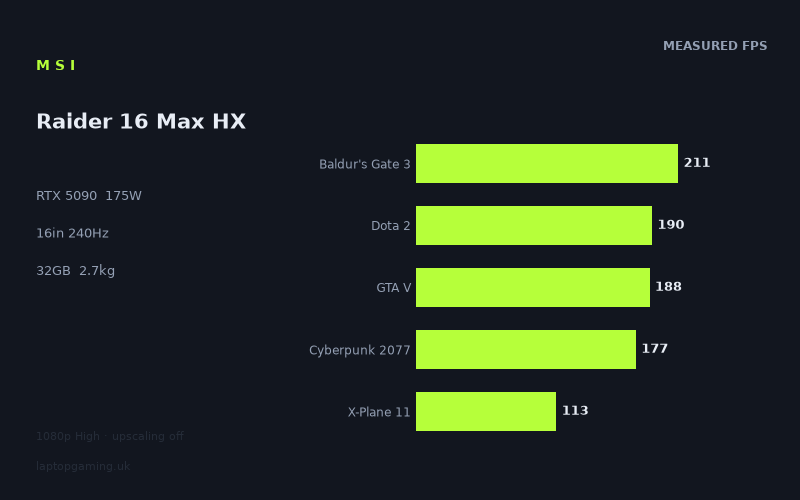
Frame rates
1920×1080, High preset, upscaling off. Averages 175fps across the 5 core benchmark games.
Measured on this machine. Source: Notebookcheck, 2026-06-09.
Not scored: no confirmed UK price
We have the full benchmark suite for this machine, so it ranks on the frame rate leaderboard like any other. What we don't have is a UK listing for this exact configuration - it's sold as a European review unit, or only in specifications that differ from the one tested. Since 30% of our score is value for money, scoring it would mean pretending price is no object, which would flatter it against every laptop you can actually buy. The frame rates below are real and comparable; there is just no buying recommendation to make yet.
How these numbers were produced
Frame rates here are not measured by us, and we label how each one was arrived at. A figure marked measured comes from a published run on that exact machine. A figure marked representative is derived from the GPU and its power limit (TGP) and cross-referenced against published reviews - a sound estimate of what that configuration delivers, but not a measurement of that specific laptop. Unless stated otherwise, numbers are 1920x1080, High preset, upscaling off. Where a laptop ships in several power configurations we use the wattage of the exact SKU listed, because a 140W RTX 5070 and a 115W one are not the same product.
In use
The short version
The MSI Raider 16 Max HX is a very fast RTX 5090 laptop built around a 175W GPU limit, a Core Ultra 9 290HX processor, 32GB of memory and a 16in 2560x1600 240Hz OLED display. Notebookcheck’s measured figures show that it is capable of exceptionally high frame rates in lighter and older games, while still delivering strong results in the more demanding modern titles included here. It is not a machine bought for occasional gaming or for carrying around all day. At 2.655kg before allowing for its charger and other kit, this is a high-performance laptop intended primarily for a desk, a fixed home setup, or travel where gaming performance matters more than weight.
The key point is that the Raider’s RTX 5090 is not merely present on the specification sheet: the published numbers indicate that it is being used effectively. Strange Brigade reaches 471fps, F1 24 manages 364fps, Baldur’s Gate 3 records 211fps, Final Fantasy XV reaches 205fps, Dota 2 produces 190fps, GTA V records 188fps and Cyberpunk 2077 reaches 177fps. Those are extremely high results for the 1920x1080 High preset with upscaling disabled. Even the most demanding games in the set remain playable at strong frame rates, with Black Myth: Wukong at 97fps and Assassin’s Creed Shadows at 89fps.
There is an important limitation to the verdict: the exact UK price of this MSI Raider 16 Max HX configuration is not confirmed. That means the page cannot calculate a value result, because value depends on price as well as performance. This is not a caveat about the laptop’s benchmark standing; the benchmark suite is complete and the machine ranks normally on the frame-rate leaderboard. It simply means there is no evidence-based way to say whether this particular configuration is good value in the UK until a confirmed price exists.
For buyers who want one of the fastest portable gaming systems available and who specifically want a 16in OLED panel rather than a larger 18in design, the Raider makes a convincing performance case. The RTX 5090’s 24GB of VRAM, the 175W GPU limit and the measured frame-rate results put it firmly in the top tier. The complication is not whether it is fast enough. It plainly is. The complication is deciding whether its particular strengths match the games you play and whether a 240Hz 2560x1600 screen is the display you actually want to drive.
Its strongest use case is a buyer playing a broad mix of competitive, older, less demanding and demanding single-player games, while also wanting a screen that can show very high refresh rates in the titles where the GPU can deliver them. F1 24, Strange Brigade, Baldur’s Gate 3, Dota 2 and GTA V all demonstrate that the Raider can produce frame rates close to, at or well beyond the panel’s 240Hz refresh ceiling at the stated benchmark settings. That is valuable for players who prioritise smooth motion and low-latency response in games that are not held back by extreme graphical load.
It is less straightforward for someone buying solely to run every new graphically intensive game at the display’s native 2560x1600 resolution and at 240fps. The available figures are measured at 1920x1080, High settings and with upscaling off. They are excellent data for comparing machines under the same conditions, but they do not prove that every title will reach 240fps at 2560x1600. Black Myth: Wukong at 97fps and Assassin’s Creed Shadows at 89fps make that clear even at the benchmark resolution and preset. A 240Hz display is an opportunity, not a guarantee that every game will run at 240fps.
The Raider therefore looks like a very capable premium gaming laptop whose performance credentials are secure, but whose final purchasing case depends on the eventual UK price. If the requirement is maximum laptop gaming performance in a 16in format, it deserves serious consideration. If the requirement is a machine that can genuinely be treated as light, compact or easy to carry every day, its 2.655kg weight argues against it. If the requirement is simply the highest frame rate in every title without regard to size, then the comparison group shows that several other RTX 5090 machines are close enough that display preference, chassis size and eventual price will matter greatly.
Performance
A 175W RTX 5090 with results to support it
The MSI Raider 16 Max HX pairs an RTX 5090 with a 175W GPU power limit. In laptop gaming, the GPU name alone is not the whole story. Different laptops can use the same GPU with different power limits, cooling approaches and overall platform designs, so the measured result matters more than a badge on the lid. Here, the published benchmark data shows a machine operating at the highest end of current laptop gaming performance.
Notebookcheck’s figures were measured at 1920x1080 using the High preset with upscaling disabled. That matters because the results represent conventional rendered performance rather than frame rates boosted by upscaling. It also makes the numbers useful for comparing this Raider with the listed rivals, because the rival comparisons are based only on games both machines have in common.
Across the five scoring-suite games, the Raider averages 176fps. That is an extremely strong mean, but the average needs to be read alongside the individual results. The five games are not equally demanding, nor do they place the same emphasis on the GPU and CPU. A laptop capable of 211fps in Baldur’s Gate 3 and 113fps in X-Plane 11 is not behaving inconsistently; it is demonstrating how dramatically game engines and workloads can differ. The useful question is not whether the average is high, because it is. The useful question is where the Raider reaches the 240Hz display’s ceiling, where it falls just short, and where a more demanding game means that smooth performance matters more than chasing the panel’s maximum refresh rate.
The 175W limit is significant because it places this RTX 5090 in the high-power end of laptop implementations. It should not be assumed that every RTX 5090 laptop will produce identical results simply because it uses the same GPU name. The Raider’s comparison results support that caution. Against other RTX 5090 systems, it is narrowly ahead of some and narrowly behind others. The differences are small enough to show that this is a closely matched class, but real enough to show that model-level benchmarking remains necessary.
Games that can make strong use of the 240Hz panel
Strange Brigade is the standout result at 471fps. That is far beyond the 240Hz refresh rate of the built-in display. The panel cannot show more than 240 refreshes per second, but the result remains meaningful: it shows that, in this game at the stated settings, the Raider has substantial performance headroom. Buyers who play titles with similarly light demands will not be buying the RTX 5090 because they need every available frame just to make a game playable. They will be buying it to sustain very high frame rates while using the screen’s fast refresh capability.
F1 24 at 364fps is also comfortably above the display’s 240Hz refresh rate. Again, the practical takeaway is not that every one of those frames is individually visible on the panel. The takeaway is that the Raider can drive this game well beyond the screen’s refresh ceiling under the benchmark conditions. For players who value a high-refresh experience in racing games, that is a strong result. It also means there is performance margin available if settings are changed, although the available data does not quantify how much margin remains for any specific setting change.
Baldur’s Gate 3 at 211fps sits below 240fps but remains close enough to make the 240Hz panel relevant. It does not fully saturate the panel at the measured settings, yet it is well into high-refresh territory. A result of 211fps suggests a notably different experience from a laptop limited to lower frame-rate territory, even though it does not meet the display’s maximum refresh figure. Buyers who spend substantial time in Baldur’s Gate 3 should see this as a very strong showing rather than as a missed target.
Final Fantasy XV at 205fps tells a similar story. The Raider does not reach 240fps in this title at the tested settings, but 205fps is still an exceptionally high result. The gap between the measured frame rate and the display refresh rate matters only if a buyer expects every game to run exactly at the panel maximum. That expectation would not be sensible for a mixed game library. In practical buying terms, 205fps makes the 240Hz display a plausible match for the game, even if it does not fully use every refresh cycle.
Dota 2 produces 190fps. That is below the panel maximum, but it remains firmly in high-refresh territory. Dota 2 is also part of the five-game scoring suite, so it contributes to the Raider’s 176fps mean. This result reinforces an important point about buying a 240Hz laptop: the panel is not wasted simply because a game measures below 240fps. A machine does not need to hit the absolute refresh ceiling in every title for a high-refresh display to make sense. It needs to produce consistently high frame rates in the games a buyer plays, and 190fps is clearly a high result.
GTA V records 188fps, again below 240fps but still very strong. Alongside Dota 2 at 190fps, it shows the Raider maintaining a high level of performance across different games without relying on upscaling. The difference between 471fps in Strange Brigade and 188fps in GTA V is also a reminder that a single headline frame rate tells very little about a gaming laptop. Game engine behaviour, graphical workload and platform limits all affect the outcome. The Raider’s data is useful because it covers a spread of games rather than leaning on one unusually favourable benchmark.
Demanding games where raw speed still matters
Cyberpunk 2077 reaches 177fps. That is a particularly important figure because Cyberpunk 2077 remains a demanding game in this benchmark set, yet the Raider still produces a result well above conventional high-refresh thresholds at 1920x1080 High with upscaling off. It does not reach the 240Hz screen limit, but it does not need to for the laptop to demonstrate its class. A measured 177fps is evidence that the Raider has substantial performance for players who want demanding action games to feel smooth without depending on upscaling in the benchmark configuration.
X-Plane 11 produces 113fps. This is the lowest result among the five scoring-suite games and it pulls the five-game mean down relative to the results in Baldur’s Gate 3, Dota 2, GTA V and Cyberpunk 2077. It is also the clearest warning against reading the Raider’s average as though it applied evenly to every game. A laptop can average 176fps across the scoring suite while recording 113fps in one title and 211fps in another. For simulation players, the X-Plane 11 result is more relevant than the 471fps Strange Brigade figure.
At 113fps, X-Plane 11 is still delivering a strong frame rate. It is not close to filling a 240Hz display, though, so a buyer primarily interested in flight simulation should not choose the Raider solely because its panel refresh rate is 240Hz. The display may still be desirable for other reasons, but the benchmark data does not support an assumption that this game will make full use of 240 refreshes per second. It is better to buy based on the frame rates in the games that matter to you than on the maximum refresh number printed in the specification.
Black Myth: Wukong records 97fps. This is a good example of why the Raider should be described as very fast rather than as universally capable of 240fps gaming. A result near 100fps is strong for a demanding modern game at the stated settings, particularly with upscaling disabled, but it is far from the display’s 240Hz maximum. It shows that the RTX 5090 and 175W power limit give the laptop a meaningful level of performance in difficult workloads, while also showing that modern graphical demands can absorb a huge amount of GPU capability.
Assassin’s Creed Shadows records 89fps, the lowest frame rate in the published set. This is still a playable figure, but it is the clearest evidence that the Raider’s 240Hz screen should not be interpreted as a promise of 240fps in every current game. A buyer focused mainly on games with comparable demands should value the Raider for its ability to remain near 100fps rather than expect it to drive the screen at its maximum refresh rate. That is not a weakness unique to the Raider; it is simply what the available data says about this particular game at this particular benchmark configuration.
The range from 89fps in Assassin’s Creed Shadows to 471fps in Strange Brigade is enormous, and that spread is central to understanding this laptop. The GPU is not producing one fixed level of performance. It is responding to very different game workloads. Less demanding titles can run far beyond the screen’s refresh limit. Many high-performance games sit between roughly the high-100fps and low-200fps region. The most demanding games in this set land below the 240Hz ceiling despite the RTX 5090 and its 175W limit.
That is why a buyer should not reduce the Raider to the 176fps scoring-suite mean. The mean is useful as a broad ranking tool, but the individual frame rates are more useful for deciding whether the laptop suits a specific library. A Dota 2 player sees 190fps. A Baldur’s Gate 3 player sees 211fps. A Cyberpunk 2077 player sees 177fps. A flight simulation player sees 113fps in X-Plane 11. A buyer centred on Black Myth: Wukong sees 97fps, while an Assassin’s Creed Shadows player sees 89fps. Those are not minor variations around one shared result. They describe meaningfully different demands on the laptop.
What the performance data does and does not prove
The data makes a compelling case for the Raider as a high-end gaming laptop. It proves that the machine can produce leading frame rates at 1920x1080 High with upscaling disabled. It proves that the 175W RTX 5090 implementation belongs alongside other top-tier RTX 5090 laptops. It proves that the machine can exceed 240fps in Strange Brigade and F1 24, come close in Baldur’s Gate 3 and Final Fantasy XV, and remain strong in much more demanding games.
The data does not establish native 2560x1600 performance for these titles, because the published measurements are at 1920x1080. It does not establish performance at different quality presets. It does not establish results with upscaling enabled, because the benchmark configuration has upscaling off. It also does not establish noise, temperatures, battery life, keyboard quality, speaker quality, port selection or storage expansion. Those may matter to a buyer, but there are no figures or specifications here to support specific claims about them.
That restraint matters especially for a machine at this performance level. It is easy to see an RTX 5090, 24GB of VRAM and a 240Hz OLED display and assume that every part of the experience will be equally exceptional. The benchmark figures justify confidence in gaming speed, not assumptions beyond the available evidence. The Raider’s performance story is already strong enough without adding claims that the published data cannot support.
The screen
A 16in 2560x1600 240Hz OLED panel
The Raider’s display is a 16in OLED panel with a 2560x1600 resolution and a 240Hz refresh rate. On paper, this is a notably ambitious screen specification. The 2560x1600 resolution gives the laptop more display space than a 1920x1080 panel, while the 240Hz refresh rate targets buyers who want a high-refresh gaming experience. The OLED panel type is also a meaningful part of the specification, although the available facts do not provide measured brightness, colour coverage, contrast, response behaviour or any other panel-quality figures. It would be wrong to invent those details.
The important question is whether the RTX 5090 can make practical use of a 240Hz display. The answer is yes in some games, often partially in others, and not fully in the most demanding titles represented by the benchmark data. Strange Brigade at 471fps and F1 24 at 364fps both exceed 240fps at the tested settings. In those games, the Raider has enough performance to reach beyond what the internal panel can refresh. For buyers focused on games of similar demand, the 240Hz specification is not decorative. It is backed by the available frame-rate data.
Baldur’s Gate 3 at 211fps and Final Fantasy XV at 205fps are also credible matches for a 240Hz panel, even though they fall short of the full refresh rate. These results are close enough that the display’s high-refresh capability remains relevant. Dota 2 at 190fps, GTA V at 188fps and Cyberpunk 2077 at 177fps are further below 240fps but still clearly sit in a high-frame-rate range.
For X-Plane 11, Black Myth: Wukong and Assassin’s Creed Shadows, the situation changes. The measured 113fps, 97fps and 89fps results do not come close to 240fps. That does not make the screen inappropriate. It means the buyer should understand that the screen refresh rate is a ceiling, not a performance target that every game will reach. A demanding game can still benefit from high frame rates below 240fps, but the available evidence does not support saying that the Raider can fully drive its display in every title.
Resolution and benchmark resolution are not the same thing
The screen’s native resolution is 2560x1600, while Notebookcheck’s benchmark figures are measured at 1920x1080. This distinction should be treated seriously. The results are not native-resolution numbers for the built-in panel. They are comparable benchmark figures collected under a stated 1920x1080 High configuration with upscaling off.
That does not reduce the value of the results. The measurements remain highly useful for ranking the Raider against other laptops and for showing the performance class of the 175W RTX 5090. But it does mean that a buyer planning to use the screen at 2560x1600 should not read 471fps, 364fps or 177fps as guaranteed native-resolution outcomes. The fact sheet does not provide those results, so no exact native-resolution frame-rate claim can be made.
This is particularly relevant because the Raider combines a high-resolution display with a very high refresh rate. That combination gives buyers flexibility, but it also means different games will use the display in different ways. Some games have enough performance headroom in the published data to make the refresh rate the main limit. Other games will be more constrained by their own demand. The laptop’s broad frame-rate spread shows why a buyer should set expectations title by title rather than assume one universal behaviour.
Who should prioritise this screen
The screen specification suits a buyer who wants one laptop to cover both high-refresh gaming and more demanding visually intensive games. A player alternating between F1 24, Dota 2, GTA V, Cyberpunk 2077 and newer demanding releases can make use of both sides of the panel specification: high refresh in lighter games and a high-resolution display for everything else. The performance data supports that mixed-use case better than it supports a narrow claim that the laptop is a 240fps machine in every game.
It is also suited to buyers who specifically want a 16in format. The closest comparison group includes 18in models, but a larger screen is not automatically better for every buyer. Some people want a more contained laptop footprint without dropping into a lower performance class. The Raider’s RTX 5090, 175W GPU limit and 16in display are aimed directly at that buyer.
Buyers who care more about the absolute largest display than a 16in form factor should look carefully at the larger rivals in the comparison section. Buyers who care only about competitive games where frame rate takes priority over resolution should also consider whether they need a 2560x1600 panel at all. The Raider can produce very high figures in several games, but the right display choice depends on the games, settings and usage priorities of the person spending the money.
Build, size and portability
High-end performance in a 2.655kg laptop
The MSI Raider 16 Max HX weighs 2.655kg. That immediately places it in a different category from laptops intended to be carried casually throughout the day. It is portable in the basic sense that it is a laptop rather than a desktop, but it is not light. A buyer should think of it as a transportable high-performance system: suitable for moving between rooms, taking to a regular destination, travelling when performance is worth the burden, or using in a fixed desk setup that occasionally changes location.
The 2.655kg figure is easier to justify when viewed alongside the hardware. This is not a thin-and-light system with an entry-level GPU. It contains an RTX 5090 running at a 175W power limit, a Core Ultra 9 290HX processor, 32GB of memory, a 1024GB SSD, 24GB of GPU VRAM and a 16in 240Hz OLED panel. The specification and benchmark data point towards a machine designed to prioritise gaming capability. Buyers should therefore assess its weight against the performance they need, not against the expectations they would apply to an everyday office laptop.
There are no dimensions in the available fact sheet, so there is no basis for a precise claim about its footprint or thickness. The 16in screen tells us its display class, and the 2.655kg weight tells us it is substantial, but it would be speculation to describe it as especially thin, thick, compact or bulky compared with another specific laptop without dimensions.
Desk-first rather than commute-first
The most sensible way to approach the Raider is as a desk-first gaming laptop. Its performance level encourages use with demanding games, a mains-powered setup and enough space to accommodate a 16in system comfortably. That does not mean it cannot travel. It means its weight makes travel a deliberate choice rather than something that disappears into a bag without thought.
For someone who regularly moves between home and university, home and work, or between multiple gaming locations, 2.655kg may still be acceptable if the RTX 5090 performance is the priority. The case for carrying it is stronger when a buyer genuinely needs the performance away from a primary desk. The case is weaker when the laptop will mostly run lighter games or when portability is the main requirement. In that situation, the Raider’s considerable performance capacity may be more than necessary.
The storage allocation is 1024GB, and the memory allocation is 32GB. Those are important parts of the configuration, but the fact sheet does not provide expansion information, drive speed figures or memory configuration details. It is reasonable to say that this is a well-equipped gaming specification on paper. It is not reasonable to claim more than that about long-term upgrade options or storage behaviour without evidence.
What the chassis role means for buyers
The Raider’s role is clear: it is a premium performance laptop in a 16in format, not a minimal-weight machine. The 175W GPU power limit is consistent with that role. A buyer should be prepared to accept a heavier laptop in return for the kind of gaming results shown here. If that trade-off is acceptable, the Raider’s 2.655kg weight is understandable. If it is not acceptable, there is little point trying to rationalise it away. A laptop’s portability is not measured only by whether it technically fits into a bag; it is measured by whether you will realistically want to carry it often.
This is also why the 16in size matters. It does not turn the Raider into a lightweight device, but it keeps the machine in a smaller display class than the 18in rivals listed below. For buyers who want flagship-class performance without committing to an 18in laptop, that is a real positioning advantage. For buyers who want the largest possible panel for a fixed desk, it may not be enough of an advantage to outweigh the appeal of the larger alternatives.
How it compares
Against the Medion Erazer Beast 16 X1 Ultimate
The Medion Erazer Beast 16 X1 Ultimate is the closest confirmed-price RTX 5090 rival in the list. It is priced at £4,884 and uses an RTX 5090. Across six shared games, the MSI Raider averages 2fps ahead. That is a very small performance advantage. It is enough to say that the Raider is marginally faster in the shared-game comparison, but not enough to present it as a decisive victory.
The important consequence is that the eventual confirmed UK price of the Raider will matter greatly. The benchmark gap is narrow. If a buyer is choosing only on shared-game frame rates, the Raider has the edge, but it is an edge measured in 2fps on average. Display preference, portability, configuration differences and price will likely carry more weight than that small performance separation.
The Raider has a 16in 2560x1600 240Hz OLED panel, while the facts provided here do not state the Medion’s screen specification. There is therefore no evidence-based basis for a direct panel-quality comparison. The correct conclusion is simply that the Raider is slightly ahead on the shared benchmarks and that the Medion has a confirmed UK price of £4,884.
Against the Lenovo Legion 9 18IAX10 RTX
The Lenovo Legion 9 18IAX10 RTX uses an RTX 5090 and has no confirmed UK price in the available data. Across seven shared games, the MSI Raider averages 4fps behind it. That is still a close result, but it places the Lenovo ahead on the available shared-game comparison.
A 4fps average gap should be read with care. It is larger than the Raider’s 2fps lead over the Medion, yet it remains small relative to the Raider’s own performance range. The Raider spans from 89fps in Assassin’s Creed Shadows to 471fps in Strange Brigade. Against that background, a 4fps shared-game deficit does not transform the MSI into a meaningfully lower class of machine. Both are RTX 5090 systems operating at the top end of laptop gaming performance.
The more substantial practical distinction is the Lenovo’s 18in class versus the MSI’s 16in display. The Raider is for buyers who want a smaller screen class than an 18in machine while retaining RTX 5090 performance. The Lenovo’s benchmark lead may matter to buyers chasing the highest available shared-game results, but the size difference means these are not interchangeable choices. A buyer who wants the largest panel may favour the Lenovo’s category. A buyer who wants flagship performance in a more contained format may favour the Raider despite the small shared-game deficit.
Against the Lenovo Legion Pro 7i 16 Gen 10
The Lenovo Legion Pro 7i 16 Gen 10 is particularly interesting because it is a 16in-class rival using an RTX 5080 at 175W rather than an RTX 5090. It has a confirmed UK price of £3,662. Across eight shared games, the MSI Raider averages 6fps behind it.
That is the comparison most likely to make a buyer pause before assuming that the RTX 5090 badge alone settles the matter. The Lenovo uses a lower-tier RTX 5080 designation, yet the shared-game comparison puts it ahead by 6fps on average. The data does not tell us why that is the case in each game, and it would be wrong to invent an explanation. What it does tell us is that the Raider’s performance should be judged as a complete machine rather than by GPU name alone.
The Lenovo’s £3,662 confirmed UK price is also highly relevant, although the Raider cannot be given a direct value judgement without its own confirmed price. If the Raider eventually arrives at a substantially different price, the choice could look very different. Until then, the responsible conclusion is that the Legion Pro 7i is a very serious performance rival in the same broad 16in category, with a small shared-game lead and a confirmed UK price.
The Raider still has meaningful specification advantages on paper, including the RTX 5090 and 24GB of VRAM. But a buyer should not assume those advantages automatically produce a lead in every benchmark comparison. The available shared-game average says the opposite in this case. Buyers who want to spend carefully should keep the Legion Pro 7i on the shortlist rather than dismiss it because of the RTX 5080 label.
Against the Schenker XMG Neo 16 E25 RTX 5090 Laptop
The Schenker XMG Neo 16 E25 RTX 5090 Laptop is one of the clearest direct rivals because it is also a 16in-class RTX 5090 system with a 175W GPU limit. Across nine shared games, the MSI Raider averages 7fps ahead. That is a more meaningful lead than its 2fps advantage over the Medion and its 4fps deficit to the Legion 9, although it remains a close contest within an elite performance bracket.
The shared-game lead matters because the two machines have the same RTX 5090 designation and the same 175W GPU limit. This is exactly the type of comparison that demonstrates why published benchmark data is more useful than marketing claims. The MSI’s result does not prove that it will be faster in every game, but it does show a 7fps average advantage across nine games both machines have been measured in.
Neither machine has a confirmed UK price in the provided data. That prevents a proper value comparison. It also means that a buyer deciding between them should wait for confirmed pricing rather than attempt to infer value from performance alone. The Raider has the shared-game edge. Whether that edge is worth paying for depends entirely on prices that are not yet confirmed.
Against the Asus ROG Strix Scar 18
The Asus ROG Strix Scar 18 is another RTX 5090 laptop with a 175W GPU limit. Across ten shared games, the MSI Raider averages 8fps behind it. This is the largest listed deficit for the Raider, but it is still not evidence that the MSI is uncompetitive. It is evidence that the Asus has the better shared-game result in a close high-end class.
The ten-game shared comparison is useful because it covers more common results than the smaller shared-game sets. An 8fps deficit over ten shared games is enough to describe the Asus as the faster machine on that specific comparison. It is not enough to suggest that the Raider lacks high-end performance. Notebookcheck’s standalone Raider figures remain extremely strong, including 471fps in Strange Brigade, 364fps in F1 24 and 177fps in Cyberpunk 2077.
The Asus is an 18in model, while the MSI has a 16in display. That difference will matter as much as the 8fps shared-game gap for many buyers. An 18in laptop is likely to appeal most to buyers treating it as a replacement for a desktop setup, while the Raider’s 16in format will appeal to buyers who want a more contained machine. There is no confirmed UK price for the Asus in the available data, so the performance comparison cannot be turned into a value conclusion.
What the rival results say overall
The Raider’s rival picture is nuanced rather than one-sided. It is 2fps ahead of the Medion Erazer Beast 16 X1 Ultimate across six shared games. It is 4fps behind the Lenovo Legion 9 18IAX10 RTX across seven shared games. It is 6fps behind the Lenovo Legion Pro 7i 16 Gen 10 across eight shared games. It is 7fps ahead of the Schenker XMG Neo 16 E25 RTX 5090 Laptop across nine shared games. It is 8fps behind the Asus ROG Strix Scar 18 across ten shared games.
That spread shows that the Raider belongs in a tightly packed top-end group rather than sitting alone at the front. It wins some comparisons and loses others. Its wins and losses are measured in small average frame-rate differences, not in a collapse from premium performance to ordinary performance. Anyone shopping among these laptops should therefore avoid exaggerated conclusions from any one GPU label or one benchmark result.
The Raider’s strongest comparative appeal is its combination of 16in format, RTX 5090, 175W GPU power limit, 24GB of VRAM and 240Hz OLED display. Its weakness is not a lack of performance; it is that the closest alternatives are also extremely fast, and some are marginally faster in their shared games. With no confirmed UK price for the MSI, the sensible approach is to treat it as a performance-first contender and wait for pricing before deciding whether it is the most sensible purchase.
Who it’s for
Buy the Raider 16 Max HX if high-end performance is the priority
The MSI Raider 16 Max HX is for the buyer who wants flagship-class laptop gaming performance in a 16in machine and is prepared to accept a 2.655kg weight to get it. The RTX 5090 at 175W, 24GB of VRAM, Core Ultra 9 290HX, 32GB of memory and 1024GB SSD form a properly high-end configuration. More importantly, Notebookcheck’s measured figures support the specification: 471fps in Strange Brigade, 364fps in F1 24, 211fps in Baldur’s Gate 3, 205fps in Final Fantasy XV, 190fps in Dota 2, 188fps in GTA V and 177fps in Cyberpunk 2077 are not marginal results. They are the results of a laptop designed to sit near the top of the gaming market.
It is especially suited to someone who plays both high-refresh titles and visually demanding single-player games. The 240Hz OLED panel makes sense when paired with the very high figures in Strange Brigade and F1 24, while the RTX 5090’s performance remains valuable in Black Myth: Wukong and Assassin’s Creed Shadows even though those games do not approach 240fps in the published data.
It is also suited to a buyer who wants a 16in system rather than an 18in alternative. The Raider will not feel light at 2.655kg, but it remains in a smaller display class than the Lenovo Legion 9 18IAX10 RTX and Asus ROG Strix Scar 18. That makes it a sensible middle ground for someone who wants a serious gaming laptop without moving to the largest category of portable systems.
Consider something else if portability is the main requirement
Buy something else if your first requirement is low weight and easy everyday carrying. At 2.655kg, the Raider is substantial. The performance may justify that for a buyer who genuinely needs RTX 5090 capability away from a desk, but it is not a machine chosen for minimal luggage weight. If your games are mostly less demanding titles and you regularly carry your laptop for long periods, the Raider’s performance reserve may not justify its mass.
Also consider something else if your main game is one of the titles that does not come close to 240fps in the published figures and the display refresh rate is your sole reason for buying. X-Plane 11 at 113fps, Black Myth: Wukong at 97fps and Assassin’s Creed Shadows at 89fps show that the 240Hz panel is not fully utilised in every demanding title. That does not make the screen poor; it means you should buy according to the games you actually play, not according to a maximum refresh figure in isolation.
The Lenovo Legion Pro 7i 16 Gen 10 deserves special attention from buyers who are not committed to the RTX 5090 label. Its RTX 5080 runs at 175W, it has a confirmed UK price of £3,662, and it averages 6fps ahead of the Raider across eight shared games. The MSI may still be preferable for its RTX 5090, 24GB VRAM, OLED panel or other preferences, but the benchmark evidence says the Lenovo cannot be dismissed as a lower-performance option simply because it uses an RTX 5080.
The final buying position
The MSI Raider 16 Max HX is a serious top-tier gaming laptop. The performance evidence is clear, the 175W RTX 5090 is backed by excellent published frame rates, and the 16in 2560x1600 240Hz OLED screen is an ambitious match for a machine capable of exceptionally high results in several games. It is best viewed as a powerful desk-first laptop that can travel when necessary, rather than as a lightweight all-purpose notebook.
Its biggest strengths are straightforward: very high benchmark performance, 24GB of VRAM, a 175W RTX 5090 implementation, a high-refresh OLED display and a 16in format that avoids moving into the 18in class. Its main cautions are equally straightforward: it weighs 2.655kg, the most demanding games do not reach the screen’s 240Hz ceiling in the available measurements, native 2560x1600 benchmark results are not provided, and the exact UK price is not confirmed.
If you want a premium 16in gaming laptop with the performance to run far beyond 240fps in some games and remain strong in demanding ones, the Raider 16 Max HX belongs on the shortlist. If you are deciding between it and another flagship RTX 5090 laptop, do not assume a GPU badge settles the comparison. The shared-game data shows close margins in both directions. Wait for a confirmed UK price, compare the machines on the games you play, and choose the screen size and weight you are genuinely willing to live with.