Review
Asus TUF Gaming F15 review
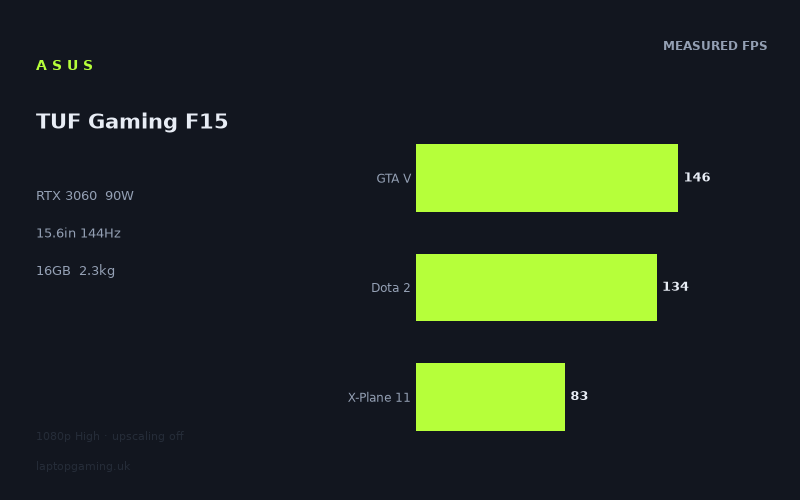
Frame rates
1920×1080, High preset, upscaling off.
Measured on this machine. Source: Notebookcheck, 2021-06-26.
Not scored: incomplete benchmark suite
Every scored laptop on this site is averaged over the same 5 games, and this one is short of Cyberpunk 2077, Baldur's Gate 3. A mean over 5 games is not comparable to a mean over 5, so we publish the figures we have and leave the score blank rather than rank it against machines tested on a different set. The numbers below are real - the suite is just incomplete.
How these numbers were produced
Frame rates here are not measured by us, and we label how each one was arrived at. A figure marked measured comes from a published run on that exact machine. A figure marked representative is derived from the GPU and its power limit (TGP) and cross-referenced against published reviews - a sound estimate of what that configuration delivers, but not a measurement of that specific laptop. Unless stated otherwise, numbers are 1920x1080, High preset, upscaling off. Where a laptop ships in several power configurations we use the wattage of the exact SKU listed, because a 140W RTX 5070 and a 115W one are not the same product.
In use
The short version
The Asus TUF Gaming F15 FX506HM is a straightforward 1080p gaming laptop built around an RTX 3060 running at a 90W GPU power limit, a Core i7-11800H and 16GB of memory. Its measured gaming results are strong enough to make the supplied 144Hz IPS display meaningful in lighter and better-scaling games, while heavier titles are still comfortably playable at the stated 1920x1080 High preset without upscaling.
Notebookcheck’s benchmark data places this machine in an interesting part of its generation. It is decisively ahead of the listed RTX 3050 Ti rival, but its shared-game results sit almost level with the listed RTX 3070 laptops. That does not mean the RTX 3060 is universally equivalent to an RTX 3070. It means that, in this particular 1080p High benchmark set, some of the games are light enough or processor-limited enough that the graphics hardware cannot fully separate the machines. The TUF’s results are still good, but the near ties need interpreting rather than celebrating as a permanent class win.
The key measured figures are 155fps in Strange Brigade, 146fps in GTA V, 144fps in The Witcher 3, 134fps in Dota 2, 83fps in X-Plane 11 and 78fps in Final Fantasy XV. Across the five scoring-suite games, the mean is 119fps. That is a healthy result for a laptop configured around a Full HD 144Hz screen. It tells you that the TUF can often get close to the panel’s maximum refresh rate, but not that every game will do so. The demanding end of the results is important: X-Plane 11 and Final Fantasy XV remain below the display’s refresh ceiling at High settings, even before considering that more demanding future games may require lower settings or upscaling.
This is therefore best treated as a capable, older-generation Full HD gaming laptop rather than a machine to buy specifically for maximum-detail gaming in every title. Its strengths are clear: a solid Core i7-11800H, 16GB of memory, a 90W RTX 3060, a 144Hz IPS panel and a substantial 90Wh battery capacity. Its limitations are equally clear from the benchmarks: the 90W RTX 3060 is not the sort of configuration that guarantees 144fps in heavier games at High settings, and the 2.269kg weight makes this more of a transportable gaming laptop than an effortless daily carry.
There is no overall value assessment for this exact configuration because a confirmed UK price is not available. That is not a judgement on the laptop itself: the benchmark suite is complete and the machine can be ranked normally for frame-rate performance. It simply means any value conclusion would be speculation without an attributable UK price.
Buy the FX506HM if the appeal is a measured, credible Full HD gaming result rather than an assumption based on the RTX badge alone. It makes sense for someone playing a mixture of esports-friendly titles, older games and mainstream AAA releases at High settings, particularly where a frame rate around the panel’s refresh rate is useful but not an absolute requirement in every game. It is less compelling for someone who wants a laptop that is demonstrably ahead of RTX 3070 systems in demanding games, who expects the internal display to be fully saturated in every modern title, or who needs a genuinely light machine for frequent commuting.
Performance
A 90W RTX 3060 is not the same thing as every RTX 3060
The most important specification here is not merely “RTX 3060”. The FX506HM uses that GPU with a 90W power limit. Laptop graphics names describe the underlying graphics tier, but the configured power limit has a material effect on what the chip can sustain. Two laptops carrying the same GPU name can therefore produce meaningfully different results when their power limits, cooling arrangements and platform tuning differ.
That is why the 90W figure should frame expectations before looking at a single game result. This is not an RTX 3060 described only by its marketing tier; it is an RTX 3060 operating within a specific 90W configuration. The Notebookcheck figures show what that configuration achieved at 1920x1080, High preset and with upscaling disabled. That context matters because the numbers are not theoretical peak claims, nor are they figures from a different resolution or a lower preset chosen to flatter the hardware.
The overall picture is good for the class. The five-game scoring-suite mean is 119fps, which is close enough to the screen’s 144Hz refresh rate to make the display more than a decorative specification. A mean is not a promise of uniform performance, however. It conceals the gap between the games that run far beyond 144fps and the titles that do not reach even 100fps. That spread is exactly what a buyer should focus on.
At the fast end, Strange Brigade reaches 155fps. GTA V follows at 146fps. The Witcher 3 lands at 144fps exactly. These are the games that demonstrate why pairing this GPU with a 144Hz panel makes sense. Strange Brigade is above the panel’s stated refresh rate, GTA V is also above it, and The Witcher 3 matches it. In these titles, the machine has enough measured performance for the display’s high-refresh capability to be relevant rather than hypothetical.
Dota 2 at 134fps is slightly below the panel’s 144Hz maximum, but it remains a high frame-rate result. The practical point is not that the figure misses a neat threshold by a small amount. The important point is that the TUF is operating in the high-refresh territory that competitive and fast-moving games benefit from. The panel is not wasted here, even if the benchmark result is not a literal 144fps match.
The lower end of the figures is represented by X-Plane 11 at 83fps and Final Fantasy XV at 78fps. Both remain clearly playable by the standards implied by the benchmark, but both are well short of 144fps. This is where the difference between “a 144Hz gaming laptop” and “a laptop that can always drive 144fps” becomes important. The F15 is the former. It has the display hardware for high refresh, and several measured games can use it fully or nearly fully. It does not establish a 144fps result across every title in the set.
The contrast between 155fps in Strange Brigade and 78fps in Final Fantasy XV should not be treated as inconsistency in the laptop. Different games put different demands on the processor, graphics hardware, memory subsystem and game engine. The test settings are consistent, but the workloads are not. A result in a lighter or better-scaling game says relatively little about performance in a heavier title, while a demanding game result should not be used to dismiss the machine’s strengths in titles that run much faster.
The faster games
Strange Brigade is the standout result at 155fps. Since the display refresh rate is 144Hz, this is a case where the notebook has more measured performance than the panel can show as distinct refreshes at its specified maximum rate. That is still useful. It provides headroom against normal fluctuations in demanding scenes, and it means the laptop is not merely brushing against 144Hz in an unusually favourable moment. The published result is above the panel’s stated ceiling.
GTA V at 146fps tells a similar story. The measured figure is just beyond the 144Hz panel refresh rate, making it another title in which the supplied display is appropriately matched to the hardware. A buyer whose gaming habits include older but still demanding mainstream games should take this seriously. Full HD remains a sensible resolution for this GPU configuration because it allows the system to produce frame rates that are visibly suited to a high-refresh screen instead of forcing the GPU into a sharper but much slower rendering target.
The Witcher 3 is particularly tidy at 144fps because it aligns exactly with the display specification. It is not necessary to exaggerate that result into a wider conclusion about every RPG or every open-world game. It is simply a strong measured outcome in a well-known game at the stated settings. It shows that the F15 can meet its own panel’s refresh rate in more than a lightweight competitive title.
Dota 2 at 134fps is also significant because it underlines the point that high-refresh gaming is not an all-or-nothing category. There is a tendency to treat a 144Hz display as useful only when a game produces precisely 144fps or more. That is too narrow. A figure of 134fps is still much closer to the display’s high-refresh purpose than the lower results in the same suite. It makes the panel a sensible fit for games where responsiveness and motion clarity are part of the appeal, while recognising that the benchmark does not show an exact 144fps match.
These stronger results also explain why comparing GPU names in isolation can be misleading. At 1080p, particularly in lighter shared benchmarks, a system can reach a point where the graphics processor is no longer the only meaningful limit. The Core i7-11800H is part of the performance story. So are the game engine and the test workload. When the CPU or software behaviour becomes a larger constraint, a faster GPU may not show the lead its specification suggests. The rival comparisons later make that especially clear.
The demanding games
X-Plane 11 is measured at 83fps. It is one of the figures that gives the review its necessary caution. This is not an unusable result; it is a respectable Full HD High result. But it is also nowhere near the screen’s 144Hz refresh rate. A buyer interested primarily in simulation games should look at this number rather than the much higher Strange Brigade result. The latter demonstrates potential in a different workload, while X-Plane 11 is the more relevant evidence for this kind of usage.
Final Fantasy XV at 78fps reinforces that point. The F15 can run the game at the stated High preset and Full HD resolution without upscaling, but the measured result is not a high-refresh result in the same sense as Strange Brigade, GTA V or The Witcher 3. The 144Hz panel remains a quality-of-life advantage for desktop use and less demanding games, but it should not be mistaken for a guarantee that visually demanding games will run at that refresh rate.
The fact that both X-Plane 11 and Final Fantasy XV sit in a similar broad area is useful because it prevents the 119fps mean from being read too optimistically. The mean is a useful summary of the scoring suite, but a buyer should not use it as the expected result for every game. The measured figures show a laptop that ranges from above the panel’s refresh limit in some titles to roughly half that display rate in others. That is normal gaming-laptop behaviour, but it means settings choices matter.
For games resembling the heavier end of this suite, the sensible approach is to regard High settings as a target that delivers good playability, not necessarily maximum-refresh performance. If an individual game matters more than visual settings, lowering selected settings may be the practical route to higher frame rates, but there are no published figures here for alternative settings. Equally, upscaling may be available in some games, but the supplied results specifically use upscaling off, so the review cannot attribute a performance gain to it.
This is also why the 90W GPU limit matters in practice. It does not stop the laptop from producing high results in suitable games. The 155fps, 146fps and 144fps results prove that. But it defines the headroom available when games become more demanding. A higher-tier or higher-power graphics configuration may be better positioned to preserve high settings while chasing the panel’s maximum refresh rate in heavier titles. The comparison with the 175W RTX 3080 Ti system illustrates that point more convincingly than an abstract specification comparison could.
What the 119fps mean does and does not say
The 119fps mean across the five scoring-suite games is a useful shorthand for the TUF’s overall Full HD performance. It is high enough to establish the laptop as a credible high-refresh machine rather than a basic entry-level gaming notebook. It is also close enough to 144Hz that the display choice looks proportionate. A lower-refresh panel would have left some of the measured performance unused in the faster games.
Yet the mean must be read alongside the individual figures. The scoring suite includes Strange Brigade at 155fps, GTA V at 146fps, Dota 2 at 134fps, X-Plane 11 at 83fps and Final Fantasy XV at 78fps. Those figures do not describe a flat performance profile. They describe a machine with substantial performance in games that can exploit it, but with more ordinary results in workloads that place greater demands on the platform.
The Witcher 3 result of 144fps is not included in that five-game scoring-suite mean, but it remains useful evidence because it provides another well-known game that reaches the display’s specified refresh rate. It reinforces the conclusion that the screen and GPU are sensibly matched for a substantial portion of the laptop’s likely gaming use. It does not remove the need to judge X-Plane 11 and Final Fantasy XV on their own terms.
A sensible buyer should therefore use the benchmark set as a range, not as a single headline. If your games resemble Strange Brigade, GTA V, The Witcher 3 or Dota 2, the F15’s 144Hz screen has clear purpose. If your gaming is dominated by titles that behave more like X-Plane 11 and Final Fantasy XV at the same settings, the laptop is still capable, but the screen’s refresh rate is more of an upper limit than a target the system routinely reaches.
The screen
The TUF Gaming F15 uses a 15.6in IPS display with a 1920x1080 resolution and 144Hz refresh rate. On specification alone, that is the conventional pairing for a gaming laptop with an RTX 3060. The measured results support that pairing. Full HD is a realistic rendering target for the 90W GPU, and 144Hz gives the machine room to show the higher frame rates achieved in several games.
The resolution is particularly important. At 1920x1080, the F15 records 155fps in Strange Brigade, 146fps in GTA V, 144fps in The Witcher 3 and 134fps in Dota 2. Those are results that justify a high-refresh Full HD screen. Had Asus used a much higher-resolution panel, the machine would have had a sharper native target to drive, but there is no basis in the supplied data to assume comparable frame rates at that different resolution. The available evidence instead shows that Full HD is the performance-oriented choice.
The 144Hz refresh rate is not merely theoretical in this configuration. Strange Brigade exceeds it, GTA V exceeds it and The Witcher 3 matches it. Dota 2 sits close at 134fps. In these games, the display can show why it is a gaming panel rather than simply a standard laptop screen with an enthusiast label attached.
At the same time, the display should not be judged only by the games that produce the most flattering numbers. X-Plane 11 reaches 83fps and Final Fantasy XV reaches 78fps. Those results are lower than 144Hz, and they make the screen’s refresh rate a ceiling rather than an expectation. This is not a fault in the panel. It is the normal result of matching a fixed-refresh display to games with very different performance demands. The benefit of a 144Hz panel is that it does not constrain the laptop in the games it can run quickly; it cannot create frames the GPU and CPU do not produce.
The IPS panel type is a welcome part of the specification because it avoids presenting the laptop as though refresh rate were its only display consideration. However, no measurements are supplied for brightness, colour coverage, contrast, response times or panel uniformity. It would be wrong to infer those qualities from “IPS” alone. The available information supports calling it a 15.6in Full HD 144Hz IPS display, and supports judging how well the published frame rates fit its refresh rate. It does not support claims about image quality beyond that.
For gaming, the central conclusion is simple. The panel is well matched to the F15’s best measured outcomes and remains sensible for its slower ones. In games around 144fps or beyond, it can display the performance the hardware produces. In games around 78fps or 83fps, it is not fully utilised, but it is not a disadvantage either. The laptop’s screen does not force the GPU to chase an unnecessarily high native resolution, which is valuable for an RTX 3060 at 90W.
For work, media and general use, the fact sheet gives no colour, brightness or battery-runtime data, so there is no evidence to place it against specialist creator or travel-oriented laptops. The screen should be bought for its known gaming characteristics: 1920x1080, 144Hz and IPS technology. Those are meaningful specifications, but they are not a complete display assessment.
Build, size and portability
The most useful physical figure provided for the F15 is its 2.269kg weight. That puts the machine firmly in gaming-laptop territory. It is portable in the literal sense that it can be moved from home to university, work, a friend’s house or another fixed location, but it is not a laptop that disappears into a bag in the way a lighter general-purpose model might.
The distinction matters because a 15.6in gaming laptop is often bought with ambitions to use it everywhere. At 2.269kg, the F15 is better understood as a machine that can travel when required than one intended to be carried without thought every day. The hardware choice supports that interpretation. The Core i7-11800H, RTX 3060 and 144Hz display are gaming-focused components, and the weight reflects a larger performance-oriented category rather than an ultraportable design.
No dimensions are supplied in the fact sheet, so there is no attributable basis for judging its footprint, thickness or how easily it will fit a particular bag. Buyers with a strict carrying case, desk-space or airline-luggage requirement should check the exact physical dimensions from an appropriate product listing before purchase. The available data supports a conclusion about weight, not a detailed conclusion about the chassis shape.
The 90Wh battery is a substantial capacity on paper, but capacity is not battery life. There are no published runtime figures in the fact sheet, and it would be misleading to translate 90Wh into a claimed number of hours. Gaming battery life in particular depends heavily on workload, settings, display behaviour and system power management. The safe conclusion is that the F15 has a 90Wh battery capacity; it is not possible here to say how long it lasts away from mains power.
That distinction is especially important for prospective students and commuters. A large battery capacity may be attractive, but anyone whose purchase depends on a specific unplugged working day should seek measured battery-life evidence for this exact configuration. The benchmark data tells us about gaming performance at Full HD High settings with upscaling off. It does not tell us how long the laptop can run while browsing, streaming, writing, gaming or sitting idle.
Similarly, there are no supplied noise or temperature measurements. Gaming laptops with a 90W GPU and Core i7-class processor can be expected to manage meaningful heat output under load in a general sense, but the fact sheet does not provide attributable acoustic or thermal data for this specific F15. It would not be responsible to label it quiet, loud, cool or hot. Anyone sensitive to fan noise should find measured acoustics for the exact model rather than assuming the TUF name determines the outcome.
The practical portability verdict is therefore bounded by what is known. The F15 weighs 2.269kg and includes a 90Wh battery. That makes it a substantial 15.6in gaming machine with a relatively large battery capacity, not a lightly built travel laptop. It should suit buyers whose primary use is at a desk or in a regular location with occasional transport. It is less obviously suited to someone who carries a laptop all day and values the lowest possible bag weight above gaming performance.
How it compares
Against the MSI Prestige 15 with RTX 3050 Ti at 105W
The clearest performance separation in the listed comparisons is against the MSI Prestige 15, which uses an RTX 3050 Ti at 105W. Across four shared games, the Asus TUF Gaming F15 averages 56fps ahead. That is not a marginal result and it gives the F15 a convincing advantage over this RTX 3050 Ti rival in the shared benchmark selection.
The comparison is useful because it shows that GPU naming still matters even when power limits do not follow a simple hierarchy. The Prestige’s RTX 3050 Ti is listed at 105W, while the F15’s RTX 3060 is listed at 90W. Despite the lower power limit, the RTX 3060-equipped TUF is substantially ahead across the shared games. The broader GPU tier provides an advantage that the higher listed power figure on the RTX 3050 Ti system does not erase.
For a buyer deciding between these two classes of laptop, the conclusion is direct. The F15 is the stronger gaming choice on the supplied data. A 56fps shared-game average advantage is enough to affect not just a benchmark chart but the type of display target and settings flexibility a machine can support. There is no need to claim that every game will show precisely the same gap, because the comparison covers four shared games rather than every possible title. The evidence does show a clear class separation in the games available.
This does not settle every purchasing question between the two laptops, because the fact sheet does not provide pricing for either exact configuration and does not provide comparative display, battery-runtime, noise or chassis data. But if gaming performance is the main requirement, the TUF’s advantage over the RTX 3050 Ti Prestige is decisive on the available measurements.
Against the MSI GP76 Leopard with RTX 3070 at 95W
The MSI GP76 Leopard comparison is more surprising at first glance. The GP76 uses an RTX 3070 at 95W, while the TUF has an RTX 3060 at 90W. Across three shared games, the TUF averages 1fps ahead. Taken literally, that is effectively a tie in the available shared-game data.
It would be wrong, however, to turn that near-zero difference into a claim that the F15 is generically faster than an RTX 3070 laptop. The comparison is based on three shared games, not a complete set of every relevant game or workload. More importantly, the supplied comparison notes explain why such close results can occur: at 1080p, lighter titles in the shared set can become CPU-bound and compress genuine GPU differences. Once the graphics card is no longer the sole limiting component, moving from one GPU tier to another may not produce the expected separation.
That explanation fits the F15’s own high results in the lighter end of the suite. Strange Brigade at 155fps, GTA V at 146fps and The Witcher 3 at 144fps are all high enough that platform and engine limits become increasingly relevant. The Core i7-11800H is not irrelevant in that environment. Neither are game-specific bottlenecks. A stronger GPU can have less room to demonstrate itself when the game is already running at a high frame rate at Full HD.
The practical implication is that buyers should not pay for an RTX 3070 badge alone expecting it to dominate this F15 in every 1080p game. The shared-game result says that, in some workloads, the real-world gap can be negligible. Conversely, buyers should not infer that the TUF has somehow erased all RTX 3070 advantages. A higher-tier GPU may show more separation in a more graphics-limited game, at more demanding settings or at a higher resolution, but those are not results supplied here.
Between these two specific machines, the measured conclusion is a near tie in the three shared games. That is valuable evidence because it guards against simplistic product sorting. The GP76’s RTX 3070 specification is not enough, by itself, to prove a meaningful lead in this stated comparison. The TUF’s 90W RTX 3060 performs more competitively than a name-only comparison would suggest.
Against the Acer Predator Helios 300 with RTX 3070 at 100W
The Acer Predator Helios 300 offers an equally close comparison from the other direction. It uses an RTX 3070 at 100W and averages 1fps ahead of the TUF across five shared games. Again, that is a real result, but it is not a meaningful performance gulf.
The Helios comparison is particularly useful because it includes five shared games, giving it a broader basis than the three-game GP76 comparison. Even so, the average difference remains only 1fps. That is a strong indication that the shared 1080p benchmark selection is compressing the hardware gap between the 90W RTX 3060 and the RTX 3070 configuration.
The same CPU-bound explanation applies. At Full HD in lighter titles, the GPU may not be the component determining the final frame rate. In that situation, an RTX 3070 can have theoretical or workload-dependent advantages without translating them into a dramatic lead in the measured games. The F15’s strong results in Strange Brigade, GTA V and The Witcher 3 make that plausible: once frame rates are near or above the 144Hz display target, the benchmark can become less effective at exposing raw GPU separation.
For a buyer choosing between the TUF and this Helios 300, the shared data should reduce confidence in broad claims about RTX 3070 superiority at 1080p. The Acer is ahead in the available comparison, but only by 1fps on average. That is not the sort of lead that should determine a purchase by itself. Other factors could matter more, but the supplied information does not provide attributable comparisons for price, screen quality, battery runtime, weight, noise or temperature.
The important caveat is that a near tie in these shared games is not proof of permanent equivalence. It is evidence of near equivalence under these specific test conditions: 1920x1080, High settings and upscaling off, in the games both machines hold. That is still highly relevant evidence for someone who intends to game at Full HD High, which is exactly what the TUF’s own screen is built for.
Against the MSI Raider GE77 HX with RTX 3080 Ti at 175W
The MSI Raider GE77 HX provides the other end of the comparison spread. Its RTX 3080 Ti is listed at 175W, far above the TUF’s RTX 3060 at 90W, and it averages 50fps ahead across five shared games. This is the comparison that restores the expected order when the performance gap is large enough and the GPU configuration is much more powerful.
A 50fps average deficit is substantial. Unlike the near-zero differences against the listed RTX 3070 laptops, this is not a result likely to be explained away by minor benchmark variation or a single constrained game. Across five shared games, the Raider establishes a materially higher level of performance. The TUF is not a substitute for a much higher-power RTX 3080 Ti system if the aim is to maximise frame rates in demanding gaming workloads.
The power-limit contrast is central. The Raider’s RTX 3080 Ti is listed at 175W, while the TUF’s RTX 3060 is listed at 90W. The GPU tier difference is large and the available power difference is also large. The resulting shared-game gap gives a useful real-world meaning to those specifications: the higher-end machine has considerably more performance headroom.
That headroom matters most where the F15’s own results are below the 144Hz display rate. At 83fps in X-Plane 11 and 78fps in Final Fantasy XV, the TUF is plainly capable but not at its screen’s maximum refresh rate. A machine that averages 50fps ahead across the shared set represents a different performance class. It may be the better fit for someone whose priority is demanding games, high frame-rate targets and more margin for future titles, though the fact sheet does not provide per-game Raider figures here and does not support claims about exactly where that advantage appears.
The comparison should not become a value argument because no confirmed UK price is supplied for either exact configuration. The Raider’s large performance advantage is factual; whether it is worth any price difference cannot be assessed without prices. What can be said is that the TUF competes surprisingly closely with the listed RTX 3070 systems in this 1080p shared-game set, but it does not approach the performance level of the listed 175W RTX 3080 Ti Raider.
What the rival spread really means
The four listed rivals give a more useful picture than a single nearest competitor would. The TUF is far ahead of the RTX 3050 Ti Prestige 15, effectively tied with the RTX 3070 GP76 Leopard in the limited shared set, effectively tied just behind the RTX 3070 Predator Helios 300 across a broader shared set, and clearly behind the RTX 3080 Ti Raider GE77 HX.
That spread says the F15 should not be dismissed as merely a mid-tier RTX 3060 laptop. At 1080p High settings, it can produce results that are extremely close to some RTX 3070 systems in the listed shared games. At the same time, it should not be promoted as a replacement for a genuinely higher-power machine. The RTX 3080 Ti Raider comparison shows that more powerful hardware retains a clear advantage when the performance class changes substantially.
The most disciplined reading is also the most useful. The Asus is a strong Full HD performer whose benchmark position is helped in some shared games by the way 1080p and lighter workloads can expose CPU limits. It is not proof that every RTX 3060 at 90W will do the same, nor proof that every RTX 3070 result will be similarly compressed. It is evidence about this machine, this configuration and these published measurements.
Who it’s for
The Asus TUF Gaming F15 FX506HM is for a buyer who wants Full HD gaming performance supported by attributable results. The strongest case is someone playing a broad mix of games rather than a narrow list of only the most graphically punishing releases. Strange Brigade at 155fps, GTA V at 146fps, The Witcher 3 at 144fps and Dota 2 at 134fps show that the F15 has real high-refresh capability. The 144Hz IPS screen is therefore a meaningful part of the package for the right games.
It is also for buyers who prefer the practical balance of 1920x1080 and a 90W RTX 3060 to a higher-resolution panel that would demand more from the GPU. The benchmark data makes Full HD look like the right target for this configuration. The machine can drive its display well in several games, and its lower results remain respectable rather than collapsing into poor playability.
It is a sensible option for players whose main concern is mainstream gaming at High settings without relying on upscaling in the published benchmark scenario. The results in X-Plane 11 and Final Fantasy XV show that the laptop does not need to be confined to lightweight esports games. It can handle heavier titles at the tested settings. The caveat is simply that those games do not use the 144Hz panel to its full stated refresh rate.
It should also appeal to someone comparing it with an RTX 3050 Ti laptop and deciding whether the step up is worthwhile for gaming. Against the MSI Prestige 15, the F15’s 56fps shared-game average advantage is substantial. If frame rates are the deciding factor, that is the clearest comparison in the set.
The F15 is less suitable for a buyer who wants certainty of 144fps in demanding games. The measurements do not support that expectation. X-Plane 11 at 83fps and Final Fantasy XV at 78fps are clear evidence that the laptop’s performance varies substantially by title. If the requirement is to keep every game near the display maximum at High settings, a more powerful graphics configuration is the safer direction.
It is also not the obvious choice for someone whose priority is the highest possible graphics performance regardless of size or weight. The MSI Raider GE77 HX with RTX 3080 Ti at 175W averages 50fps ahead across five shared games. The TUF competes well within its own range, especially against the listed RTX 3070 laptops in this particular Full HD set, but it is not the performance leader of the group.
Frequent travellers and commuters should be realistic about the 2.269kg weight. The laptop can be moved, but it is not a lightweight machine. The 90Wh battery capacity is encouraging as a specification, yet there is no measured battery-life figure here to establish how long it will last in a bag-free working day or away from a mains socket. Buyers who prioritise all-day mobility should seek dedicated runtime evidence and compare lighter alternatives.
Finally, this is not the laptop to choose if a purchase decision depends on confirmed value for money right now. The exact UK price is not confirmed, so no responsible price-to-performance conclusion can be made. The performance evidence is solid and complete; the pricing evidence is not. That leaves the F15 as a machine to evaluate on its measured Full HD gaming ability, screen specification, 2.269kg weight and 90Wh battery capacity, rather than on a speculative bargain claim.
For the right buyer, that is enough to form a clear view. The Asus TUF Gaming F15 FX506HM is a capable 1080p gaming laptop with a well-matched 144Hz display, strong results in several high-frame-rate games and sensible performance in heavier titles. It is not universally a 144fps machine, not a lightweight travel laptop and not a substitute for a much higher-power RTX 3080 Ti system. But the Notebookcheck figures show that its 90W RTX 3060 performs well enough to make it a credible choice for Full HD gaming, and competitive enough in the listed shared games to make a simple GPU-name comparison inadequate.