Review
Samsung Galaxy Book4 Ultra review
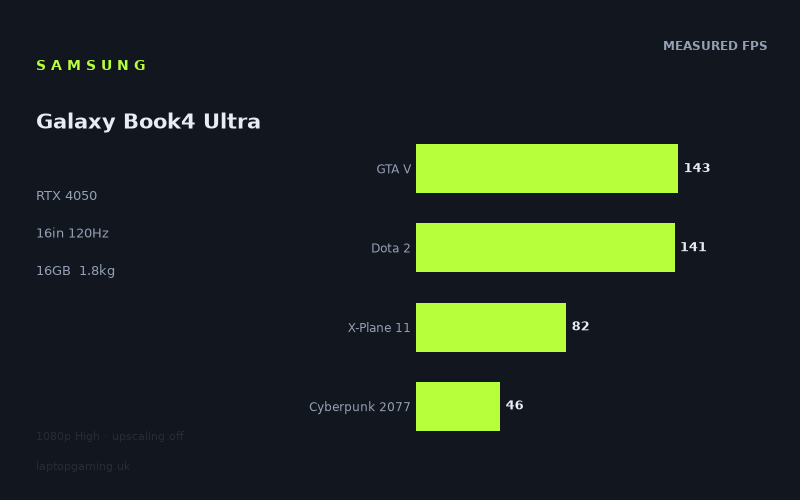
Frame rates
1920×1080, High preset, upscaling off.
Measured on this machine. Source: Notebookcheck, 2024-03-17.
Not scored: incomplete benchmark suite
Every scored laptop on this site is averaged over the same 5 games, and this one is short of Baldur's Gate 3. A mean over 4 games is not comparable to a mean over 5, so we publish the figures we have and leave the score blank rather than rank it against machines tested on a different set. The numbers below are real - the suite is just incomplete.
How these numbers were produced
Frame rates here are not measured by us, and we label how each one was arrived at. A figure marked measured comes from a published run on that exact machine. A figure marked representative is derived from the GPU and its power limit (TGP) and cross-referenced against published reviews - a sound estimate of what that configuration delivers, but not a measurement of that specific laptop. Unless stated otherwise, numbers are 1920x1080, High preset, upscaling off. Where a laptop ships in several power configurations we use the wattage of the exact SKU listed, because a 140W RTX 5070 and a 115W one are not the same product.
In use
The short version
The Samsung Galaxy Book4 Ultra is a thin-and-light-looking proposition on paper, but its gaming case rests on a more complicated set of figures. It combines an RTX 4050, a Core Ultra 7 155H, 16GB of memory, a 512GB SSD and a 16in 2880x1800 120Hz OLED display in a 1.823kg machine. That is an unusual balance: the display is much sharper than a conventional 1920x1080 gaming panel, while the graphics hardware is being asked to support both everyday work and modern games.
Notebookcheck’s measured results show that it can be a capable 1920x1080 High-preset gaming laptop when upscaling is switched off. GTA V reached 143fps, Dota 2 reached 141fps, Strange Brigade reached 127fps and The Witcher 3 reached 121fps. Those are strong results for games that are either lighter, older or more willing to run at high frame rates on this class of GPU. They also give the 120Hz panel a real purpose in some games: GTA V, Dota 2, Strange Brigade and The Witcher 3 all reached or exceeded the screen’s refresh rate in the measured configuration.
The more demanding end of the results needs more careful reading. F1 23 ran at 94fps, Far Cry 5 at 88fps, X-Plane 11 at 82fps and Final Fantasy XV at 57fps. Cyberpunk 2077 managed 46fps. These are not bad figures for 1920x1080 at the High preset with no upscaling, but they show clearly that the Galaxy Book4 Ultra is not a laptop that will deliver 120fps in every modern game just because it has a 120Hz screen. The panel’s refresh rate is a ceiling, not a guarantee.
The measured mean across the available scoring-suite games is 103fps, based on GTA V, Dota 2, X-Plane 11 and Cyberpunk 2077. That sounds comfortably high until the individual games are separated. Dota 2 and GTA V pull the average upwards with 141fps and 143fps, while Cyberpunk 2077 is at 46fps. This is therefore a machine whose average is useful as a broad summary but not as a buying decision on its own. If the games you actually play resemble GTA V, Dota 2, Strange Brigade or The Witcher 3, the Galaxy Book4 Ultra can make excellent use of its display’s 120Hz refresh rate at 1920x1080. If your priorities are Cyberpunk 2077, Final Fantasy XV or similarly demanding games, the result is more about acceptable High-preset play than consistently high-refresh gaming.
There is no confirmed UK price supplied for this configuration, so it is not possible to make a responsible value judgement. That matters more than usual here. The Galaxy Book4 Ultra has a premium-looking specification in some areas, particularly the 16in 2880x1800 OLED display, but it uses an RTX 4050 rather than a higher-tier gaming GPU. Whether that combination makes sense depends heavily on what Samsung is charging in the UK. Without a confirmed price, the sensible conclusion is about fit rather than value: this is for somebody who wants a relatively light 16in laptop with a high-resolution OLED screen and credible 1920x1080 gaming ability, not somebody buying solely for the highest possible frame rates.
It is also important not to force this machine into a ranking that the available data cannot support. The scoring suite is incomplete because there is no Baldur’s Gate 3 result. Every fully scored laptop is averaged across the same five games, so the Galaxy Book4 Ultra cannot be ranked directly against those machines using a full score. The available benchmark data is still useful, especially because it covers a wide spread of games, but it should be treated as a detailed performance picture rather than a complete league-table position.
The strongest reason to choose the Galaxy Book4 Ultra is the combination of a 16in 2880x1800 OLED panel, 120Hz refresh rate, 1.823kg weight and frame rates that are genuinely good in a substantial part of the measured library. The strongest reason to look elsewhere is equally clear: the screen’s native resolution is far above 1920x1080, while the demanding-game results show that the RTX 4050 does not have unlimited headroom. Buyers who want to run demanding games at the panel’s full native resolution, High settings and 120fps should not assume that this machine will do that. The supplied data does not support such a claim.
Performance
What the measured figures say
All of the figures here are Notebookcheck’s numbers, measured at 1920x1080 using the High preset with upscaling switched off. That test setup is important. It gives a clean view of the RTX 4050’s performance without leaning on upscaling, but it is not the same as gaming at the Galaxy Book4 Ultra’s native 2880x1800 resolution. The results are therefore best read as a baseline for conventional Full HD-class gaming, not as proof of native-resolution performance.
At the top of the table are GTA V at 143fps and Dota 2 at 141fps. These are the results that make the 120Hz display feel relevant for gaming. Both exceed 120fps in the measured configuration, so the laptop can supply more frames than the panel can refresh in those titles. That does not mean the same outcome should be expected in every scene, every game mode or every future title, because only the published figures are available. It does mean that, on the evidence here, the Galaxy Book4 Ultra has enough performance for high-refresh gaming in at least some popular games.
Strange Brigade at 127fps and The Witcher 3 at 121fps tell a similar story. They are close to or above the display’s 120Hz refresh rate, meaning that the system’s 1920x1080 High-preset performance can align very neatly with the screen in these games. There is a meaningful difference between a laptop which merely reaches 60fps and one which gets to around 120fps: the latter is actually capable of exploiting a high-refresh display rather than simply carrying one as a specification-sheet advantage. In this part of the benchmark spread, the Galaxy Book4 Ultra looks convincing.
F1 23 at 94fps and Far Cry 5 at 88fps sit in the next tier. Neither reaches 120fps in the supplied measurement, but both are well above 60fps. For a buyer who sees the 120Hz panel as a benefit rather than an absolute target, these are encouraging figures. They suggest that the laptop can produce a visibly higher frame rate than a standard 60Hz experience in these games, even if it does not fill every refresh cycle of the display. They are also a reminder that the difference between 88fps and 120fps is not a binary success-or-failure line. The Galaxy Book4 Ultra is still delivering substantial performance in these titles; it simply is not matching the panel’s maximum refresh rate.
X-Plane 11 reached 82fps. That result is especially useful because X-Plane 11 is one of the available scoring-suite games and provides a more demanding counterweight to GTA V and Dota 2. At 82fps, it remains above 60fps but sits well below 120Hz. For buyers interested in this sort of simulator workload, the practical reading is straightforward: the laptop has enough performance for a smooth-looking 1920x1080 High-preset result according to the published number, but the display’s full 120Hz capability is not being reached in this benchmark. That is not a flaw unique to this laptop; it is simply where the machine’s available gaming performance lands in this title.
Final Fantasy XV at 57fps and Cyberpunk 2077 at 46fps define the lower end of the measured spread. These are the numbers to consider before treating the Galaxy Book4 Ultra as a high-refresh gaming machine across the board. At the tested settings, Final Fantasy XV falls below 60fps and Cyberpunk 2077 is further below. The laptop is still producing playable-looking figures in the broad sense, but the experience implied by 46fps is very different from the experience implied by 143fps in GTA V. The measured results do not show one uniform level of performance. They show a system that is very fast in lighter titles and increasingly constrained as game demand rises.
That wide spread is normal in the sense that different games place different demands on a laptop, but it is particularly important here because the headline specification could otherwise be misleading. “RTX 4050” alone does not tell a buyer whether a given laptop will behave like a dedicated gaming machine, a balanced creator laptop or a portability-led design with gaming capability. The actual game figures provide the useful answer. Here, the RTX 4050 is able to produce 120fps-class results in several games, around 80fps to 94fps in another group, and below 60fps in the heaviest published results.
The mean is useful, but the range matters more
The 103fps mean across GTA V, Dota 2, X-Plane 11 and Cyberpunk 2077 is a respectable summary of the available scoring-suite data. It confirms that the Galaxy Book4 Ultra is not a low-performance machine at 1920x1080 High with upscaling off. But it is not enough to say “103fps” and stop there, because the individual results range from 46fps in Cyberpunk 2077 to 143fps in GTA V. That is a very large gap, and it changes what the machine is suitable for.
For games closer to GTA V and Dota 2, the performance is high enough that the screen’s 120Hz refresh rate can be properly used. For games closer to Cyberpunk 2077, the laptop is better understood as a system that may require a buyer to accept lower frame rates, alter settings or use a different resolution if a higher frame rate is important. The benchmark data supplied here does not include results for alternative presets, native resolution or upscaling, so it would be wrong to invent the outcome of those changes. What can be said is that the 1920x1080 High-preset baseline already shows which end of the game-demand spectrum is comfortable and which is not.
The gap between the lightest and heaviest titles also explains why buyers should avoid treating the Galaxy Book4 Ultra as either “a 120fps laptop” or “a 60fps laptop”. It is both, depending on the game. In GTA V, Dota 2, Strange Brigade and The Witcher 3, it is a 120fps-class machine under the published test conditions. In F1 23, Far Cry 5 and X-Plane 11, it is an above-60fps system that does not fully reach 120Hz. In Final Fantasy XV and Cyberpunk 2077, it is below 60fps at the same 1920x1080 High setting with no upscaling. That is the honest way to describe the performance profile.
GPU power limit: an important unknown
The request to assess the GPU at its specific power limit exposes a missing part of the specification. No GPU power limit has been supplied for the Samsung Galaxy Book4 Ultra. It would be irresponsible to infer one from the weight, the screen, the CPU or the frame rates. Laptop RTX 4050 implementations can differ, and the point of an attributable benchmark-led review is not to fill missing specification details with assumptions.
What the published frame rates do show is the practical outcome of this particular Galaxy Book4 Ultra configuration under Notebookcheck’s measured conditions. It can run several games at or above the display’s 120Hz refresh rate at 1920x1080 High, while Cyberpunk 2077 is at 46fps under the same conditions. That is more useful to a buyer than pretending to know an unsupplied power figure. The missing power-limit data does mean that this review cannot explain exactly how Samsung has balanced GPU performance against the rest of the chassis. It cannot say whether the laptop is configured more aggressively or more conservatively than another RTX 4050 system from specification alone.
There is also no supplied information on temperatures, fan noise, sustained behaviour, battery gaming performance or charging behaviour. Those are meaningful factors for a laptop that aims to combine a relatively low 1.823kg weight with dedicated graphics, but they are not available here. Buyers for whom acoustic performance, thermal behaviour or unplugged gaming matters should seek attributable measurements before deciding. The frame-rate data supports conclusions about game performance only; it does not support claims about how loudly or how coolly that performance is delivered.
The screen
The Galaxy Book4 Ultra’s screen is one of its defining specifications: a 16in OLED panel with a 2880x1800 resolution and a 120Hz refresh rate. On paper, that is a more ambitious display than the conventional 1920x1080 panels commonly associated with an RTX 4050 gaming laptop. The challenge is that the benchmark figures were measured at 1920x1080, not at 2880x1800. Buyers should treat those as related but distinct scenarios.
At 1920x1080 High with upscaling off, several games can take advantage of 120Hz. GTA V reached 143fps, Dota 2 reached 141fps, Strange Brigade reached 127fps and The Witcher 3 reached 121fps. In these titles, the panel is not excessive for the measured performance. It has enough refresh-rate capacity to show the frame rates the laptop is producing. This is the strongest gaming case for the screen: it can pair high refresh with games where the GPU can supply that performance.
In F1 23 at 94fps, Far Cry 5 at 88fps and X-Plane 11 at 82fps, the screen still has room above the measured frame rate. That does not make the display pointless. A 120Hz panel does not require every game to run at 120fps to be useful. It does mean that the system is not reaching the panel’s ceiling in these titles under the published settings. Buyers expecting every game to match 120Hz should adjust that expectation now rather than after purchase.
Final Fantasy XV at 57fps and Cyberpunk 2077 at 46fps make the same point more sharply. The 120Hz refresh rate remains part of the laptop’s specification, but it is not a performance promise for demanding games. The panel can refresh at 120Hz; the measured GPU output in these titles is much lower at 1920x1080 High with no upscaling. The screen is therefore best viewed as a flexible display that can benefit lighter games and desktop use, rather than evidence that the laptop is designed to deliver 120fps in the most demanding titles.
The resolution requires equal caution. The native 2880x1800 resolution contains substantially more detail than the measured 1920x1080 setting, but no native-resolution frame rates have been supplied. It would be wrong to calculate or state an expected reduction in performance, because different games scale differently and the fact sheet does not provide those results. The only defensible conclusion is that 1920x1080 benchmark data should not be read as native 2880x1800 benchmark data. Buyers who insist on gaming at the panel’s native resolution should look for published figures at that resolution before treating this as a suitable choice.
That does not mean the display and GPU are an inherently poor pairing. It means the pairing is best suited to a buyer willing to make choices game by game. The screen can present 120fps-class output in several measured titles at 1920x1080. The same laptop is much less convincing if the requirement is native 2880x1800, High settings, no upscaling and 120fps in demanding games. Those are very different demands, and the available data only supports the first in selected titles.
The OLED panel is also a substantial part of the laptop’s appeal outside the frame-rate discussion, but the supplied facts do not include measured brightness, colour coverage, response behaviour or any other display-quality result. It is therefore possible to say that it is an OLED panel and that it runs at 120Hz, but not to claim more than that. Anyone buying specifically for colour-critical work, outdoor use or a particular response characteristic should look for measurements covering those requirements.
Build, size and portability
The confirmed portability figure is 1.823kg. For a 16in laptop with an RTX 4050, Core Ultra 7 155H, 16GB of memory, 512GB SSD, 76Wh battery and a 2880x1800 OLED display, that weight points towards a machine intended to move between places rather than remain permanently on a desk. It is not a tiny laptop, because it has a 16in screen, but the published weight is far removed from the sort of figure that automatically confines a gaming system to one room.
That makes the Galaxy Book4 Ultra potentially attractive to somebody who needs one machine for study, office work, travel and games. The performance data supports that mixed-use reading better than a pure gaming one. At 1920x1080 High, it can run GTA V at 143fps, Dota 2 at 141fps, Strange Brigade at 127fps and The Witcher 3 at 121fps, while still carrying a 16in high-resolution OLED display. The combination is more distinctive than an ordinary heavy gaming laptop with a conventional screen, even though the demanding-game figures prevent it from being described as a universal high-refresh gaming machine.
There are no dimensions in the supplied information. That means this review cannot say how wide, deep or thick the Galaxy Book4 Ultra is, whether it fits a particular bag size, or how much desk space it occupies. Weight is only one part of portability. A 1.823kg laptop may be practical to carry, but actual travel convenience also depends on dimensions, charger size and other details not supplied here. It is better to leave that uncertain than to turn a single weight figure into a fictional assessment of the chassis.
The 76Wh battery is another specification that should be handled carefully. It establishes battery capacity, but it does not establish battery life. There are no supplied runtimes for web use, video playback, office work or gaming. It would therefore be wrong to claim that the Galaxy Book4 Ultra lasts all day, lasts a particular number of hours, or offers a specific unplugged gaming experience. Buyers who need dependable battery life should seek published battery measurements, particularly because a high-resolution 16in OLED display and dedicated graphics make assumptions unhelpful.
The 16GB memory allocation is adequate to state as part of the configuration, but there are no memory-upgrade details supplied. Likewise, the 512GB SSD capacity is known, but its speed, upgradeability and the presence of additional storage space are not. For a gaming buyer, 512GB can be considered a finite amount of storage simply because it is the supplied capacity, but the fact sheet does not include installed game sizes or available free space, so no more specific claim should be made. Someone with a large game library should confirm storage expansion options before purchasing rather than assuming that a 16in laptop has room for changes.
How it compares
The rival comparisons are particularly revealing because they prevent simple GPU-label assumptions. The Galaxy Book4 Ultra is compared only on games that both machines hold, with the scoring-suite games preferred where possible. That limitation matters: these are shared-game averages, not complete assessments of every aspect of each laptop. Even so, they show that laptop design and benchmark selection can compress or widen apparent GPU differences.
Against the MSI Thin GF63
Against the MSI Thin GF63 with an RTX 4050, the Galaxy Book4 Ultra averages 23fps ahead across four shared games. This is the clearest positive comparison in the supplied rival set. The two laptops use the same named GPU tier, but the Samsung’s published shared-game result is meaningfully higher. That is precisely why an RTX 4050 badge should not be treated as a complete performance description.
A 23fps average advantage across four shared games is large enough to matter in real buying terms. It can be the difference between a result that is merely above 60fps and one that moves materially closer to the 120Hz panel’s capability, or between a demanding game sitting in the lower part of the frame-rate range and one that feels more comfortable. The exact game-by-game comparison figures are not supplied, so it would be wrong to say where the advantage is largest. But the shared-game average supports a confident conclusion: on the available data, the Galaxy Book4 Ultra is the stronger gaming laptop than the MSI Thin GF63.
Neither laptop has a confirmed UK price in the supplied information. That prevents a value conclusion. A 23fps advantage is useful, but it cannot tell a buyer whether the Samsung is the better purchase without knowing what each machine costs. It can only establish the performance direction.
Against the Dell XPS 16
The Dell XPS 16 uses an RTX 4070, yet the Galaxy Book4 Ultra averages only 2fps behind it across four shared games. That near-zero difference is a real result, but it should not be misread as proof that an RTX 4050 is generally equivalent to an RTX 4070. The supplied comparison notes explain why the gap can be so small: at 1920x1080, the lighter titles in the shared set are CPU-bound and compress genuine GPU gaps.
That explanation is important. When games are limited more by CPU-side performance than graphics performance at a given resolution and setting, fitting a more powerful GPU does not necessarily create a proportional frame-rate lead. The Dell’s RTX 4070 does not disappear; rather, the particular 1920x1080 shared-game workload does not expose its advantage as strongly as a more GPU-limited workload might. The Galaxy Book4 Ultra being only 2fps behind is therefore good news for the Samsung’s measured results, but it is not a licence to claim broad parity across all games, settings or resolutions.
This comparison reinforces the need to match the benchmark to the intended use. Buyers playing lighter 1920x1080 titles may find that the Galaxy Book4 Ultra’s RTX 4050 gets surprisingly close to a more expensive GPU class in selected shared tests. Buyers targeting demanding games or the Samsung’s native 2880x1800 resolution should not assume that this compressed gap will hold. No matching native-resolution comparison has been supplied.
Against the HP Victus 15-fa1057ng
Against the HP Victus 15-fa1057ng, also fitted with an RTX 4050, the Galaxy Book4 Ultra averages 3fps behind across three shared games. This is close enough that it should not be inflated into a major defeat. A 3fps shared-game gap is small, and the comparison covers only three games. It does, however, show that the Samsung is not automatically the fastest RTX 4050 laptop in every comparison.
The sensible reading is that these machines are broadly close in the available shared data. The small difference does not settle which is better for every buyer, especially as there are no confirmed UK prices for either configuration. The Samsung’s 16in 2880x1800 120Hz OLED screen, 1.823kg weight and 76Wh battery are part of its known specification, while the comparison here is confined to gaming frame rates. A buyer should not choose between them based on a 3fps average alone, but should recognise that the Galaxy Book4 Ultra does not have a clear performance lead in this pairing.
Against the Asus ROG Strix Scar 17
The Asus ROG Strix Scar 17 with an RTX 4090 is the machine that pulls furthest away. The Galaxy Book4 Ultra averages 77fps behind across three shared games. The Asus is listed at £4,866, while no confirmed UK price is supplied for the Samsung. This is not a close comparison, and it should not be presented as one.
The gap shows the limit of trying to turn the Galaxy Book4 Ultra into a replacement for a top-tier gaming laptop. Its strengths are balance, screen specification and 1.823kg portability, not maximum frame-rate output. A 77fps average deficit across three shared games is substantial. Buyers whose priority is demanding gaming performance should understand that an RTX 4090-class system such as the Asus sits in a different performance category according to the shared data.
At the same time, the Asus comparison should not be used to dismiss the Samsung. The two machines are aimed at different kinds of buyer. The Galaxy Book4 Ultra’s results of 143fps in GTA V, 141fps in Dota 2, 127fps in Strange Brigade and 121fps in The Witcher 3 remain strong in their own right. The comparison simply makes clear that high performance in selected 1920x1080 games is not the same as the maximum performance available from a far more powerful gaming configuration.
Who it’s for
The Galaxy Book4 Ultra makes the most sense for a buyer who wants a 16in laptop that can play games credibly without being defined only by gaming. Its 1.823kg weight, 16in 2880x1800 OLED panel, 120Hz refresh rate, Core Ultra 7 155H and RTX 4050 create a balanced specification for someone who values screen quality and portability alongside frame rates. The benchmark data supports that use case because the laptop is not merely capable of 60fps in every measured game: it reaches 143fps in GTA V, 141fps in Dota 2, 127fps in Strange Brigade and 121fps in The Witcher 3 at 1920x1080 High with upscaling off.
It is especially suitable for players whose regular games are lighter esports-style titles or older and less demanding games. Dota 2 at 141fps is the obvious example from the data. GTA V at 143fps, Strange Brigade at 127fps and The Witcher 3 at 121fps also show that the laptop can provide a high-refresh experience in a broader range than esports alone. For this buyer, the 120Hz display is not wasted. It is supported by the measured results.
It also suits somebody who accepts that games should be configured according to their demand rather than expecting one fixed setting to fit all titles. The published data shows exactly why: F1 23 is at 94fps, Far Cry 5 at 88fps, X-Plane 11 at 82fps, Final Fantasy XV at 57fps and Cyberpunk 2077 at 46fps. A buyer comfortable with different performance outcomes from different games can get a lot from the Galaxy Book4 Ultra. A buyer demanding 120fps regardless of game will not.
It is not the right choice for a buyer whose central aim is maximum gaming performance. The 77fps average deficit against the RTX 4090 Asus ROG Strix Scar 17 across three shared games makes that plain. The Samsung is not competing at that level. Anyone shopping for the highest available frame rates, especially in demanding games, should look towards more powerful gaming-focused hardware rather than expecting an RTX 4050 system to bridge that gap.
It is also not the obvious choice for someone who insists on native 2880x1800 gaming at High settings and 120fps. The screen is 2880x1800 and 120Hz, but the benchmark figures are at 1920x1080. There are no supplied native-resolution results. Even at 1920x1080, Cyberpunk 2077 reaches 46fps and Final Fantasy XV reaches 57fps. The evidence therefore does not support a native-resolution, high-refresh promise in demanding games.
Buyers who want a straightforward desktop-replacement gaming machine should also be cautious. The Galaxy Book4 Ultra may work well in that role for the right game library, but its most distinctive assets are not raw GPU power. If the laptop will spend nearly all of its time on a desk, the 1.823kg weight becomes less important, while the performance advantage of a more powerful gaming laptop may become more attractive. Conversely, somebody who regularly carries a laptop and wants a 16in OLED display alongside meaningful gaming capability has a clearer reason to consider the Samsung.
Storage-conscious buyers should pause before purchasing. The machine has a 512GB SSD, but no storage upgrade information is supplied. Buyers with a modest collection of installed games may find that capacity workable, while buyers intending to keep a large library available should confirm expansion options. The same caution applies to memory: 16GB is the supplied configuration, but no upgrade details are available.
Finally, this is a laptop that should be bought only after the UK price is confirmed. Without that figure, the performance and specification can be assessed but value cannot. The Galaxy Book4 Ultra has enough gaming ability to be attractive, and the MSI Thin GF63 comparison shows a 23fps shared-game advantage despite both using RTX 4050 graphics. But the Dell XPS 16 comparison also shows why price and workload matter: the Samsung is only 2fps behind an RTX 4070 Dell across four shared games because lighter 1920x1080 titles can be CPU-bound and compress GPU gaps. Specification labels and partial averages are not enough on their own.
The final judgement is therefore conditional but clear. Choose the Samsung Galaxy Book4 Ultra if you want a portable 16in laptop with a 2880x1800 120Hz OLED screen and strong 1920x1080 gaming results in lighter and mid-demand titles. Avoid it if your priority is native-resolution gaming in demanding releases, 120fps in every game, or the highest possible performance for the money. The Notebookcheck data shows a capable, uneven gaming profile: excellent in some games, comfortably above 60fps in several more, and limited in the heaviest titles. That is a useful balance for the right buyer, but it is not a substitute for a higher-tier gaming laptop.