Review
HP Victus 16 (2024) review
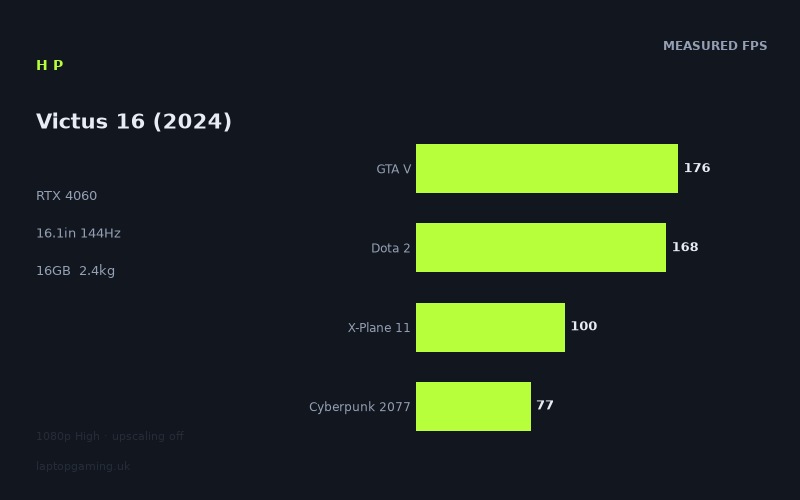
Frame rates
1920×1080, High preset, upscaling off.
Measured on this machine. Source: Notebookcheck, 2024-05-17.
Not scored: incomplete benchmark suite
Every scored laptop on this site is averaged over the same 5 games, and this one is short of Baldur's Gate 3. A mean over 4 games is not comparable to a mean over 5, so we publish the figures we have and leave the score blank rather than rank it against machines tested on a different set. The numbers below are real - the suite is just incomplete.
How these numbers were produced
Frame rates here are not measured by us, and we label how each one was arrived at. A figure marked measured comes from a published run on that exact machine. A figure marked representative is derived from the GPU and its power limit (TGP) and cross-referenced against published reviews - a sound estimate of what that configuration delivers, but not a measurement of that specific laptop. Unless stated otherwise, numbers are 1920x1080, High preset, upscaling off. Where a laptop ships in several power configurations we use the wattage of the exact SKU listed, because a 140W RTX 5070 and a 115W one are not the same product.
In use
The short version
The HP Victus 16 (2024) is a straightforward 1080p gaming laptop built around an RTX 4060, a Core i7-14700HX, 16GB of memory and a 144Hz IPS display. Notebookcheck’s measured figures show that it can deliver genuinely high frame rates in a useful range of games, from 205fps in Strange Brigade to 156fps in The Finals, while remaining comfortably playable in heavier titles such as Cyberpunk 2077 at 77fps and Dragon’s Dogma 2 at 63fps.
That is the good news. The more complicated part is that the Victus is not a laptop whose performance can be summarised simply as “RTX 4060 equals 144Hz gaming”. Its results are very good in the lighter and older games that can run far beyond the display’s refresh ceiling, but the newer and more demanding games sit well below 144fps at the stated 1920x1080 High preset with upscaling off. That distinction matters. A buyer focused on competitive games, older AAA releases, racing games and less punishing engines can make excellent use of the panel. A buyer expecting every new blockbuster to run at 144fps on High settings cannot.
The measured four-game scoring-suite average is 130fps across GTA V, Dota 2, X-Plane 11 and Cyberpunk 2077. That is a useful indication of the Victus’s broad capability, but it is not a complete basis for a formal ranking because there is no Baldur’s Gate 3 result for this machine. Every scored laptop is averaged over the same five games, so this incomplete set cannot be ranked fairly against laptops with a full result set.
There is also an important comparison result that should prevent buyers from assuming that the badge on the GPU tells the whole story. Against the Dell G15, another RTX 4060 laptop from the same generation, the Victus averages an identical result across three shared games. Against the MSI GE78HX, which has an RTX 4080 specified at 105W, the Victus is only 1fps behind on the three shared games. That does not mean that an RTX 4060 is inherently equivalent to an RTX 4080. It means that the shared 1080p games are able to compress the differences between systems, particularly where lighter titles become CPU-bound rather than purely GPU-bound.
The Victus therefore makes the most sense for someone who wants a conventional 16.1in gaming laptop with a fast Full HD screen, strong results in a broad selection of games and a Core i7 processor that is unlikely to be the obvious weak point in these results. It is less compelling for someone seeking a compact travel machine, because it weighs 2.367kg, or for someone choosing purely on value, because no confirmed UK price is available. Without that price, it is not possible to say whether the specification is a bargain, appropriately priced or poor value beside its rivals.
Buy it for measured 1080p performance that ranges from high-refresh-rate capable to sensibly playable in demanding games, not because the RTX 4060 name alone promises a uniform experience. The benchmark spread is the story here: this is a capable machine, but the games themselves determine whether its 144Hz panel is being fully exploited.
Performance
What the benchmark data actually says
Notebookcheck measured the HP Victus 16 at 1920x1080 using the High preset with upscaling off. That is a valuable test condition because it avoids treating frame-generation or upscaling results as if they were directly comparable with native-resolution rendering. The figures therefore show what this particular configuration can do without leaning on those additional rendering tools.
At the top of the chart, Strange Brigade reaches 205fps, The Witcher 3 reaches 182fps, GTA V reaches 176fps, Dota 2 reaches 168fps and The Finals reaches 156fps. All of those results are above the panel’s 144Hz refresh rate. That does not mean a 144Hz panel can display every one of those rendered frames as separate refreshes, but it does mean the laptop has enough performance in these games to keep the display fed at its maximum refresh capability according to the measured results.
That group tells a buyer something useful about the Victus. It is not struggling to drive its own native resolution in less punishing or better-scaling games. There is enough headroom in these results that the 144Hz panel is more than decorative. Dota 2 at 168fps is particularly relevant for players who want consistently responsive high-refresh-rate play from a laptop display, while GTA V at 176fps and The Finals at 156fps show that the result is not confined to one genre or one engine.
The middle of the results is still good, but it is where the difference between “high frame rate” and “panel-saturating frame rate” becomes clearer. X-Plane 11 records 100fps, Final Fantasy XV records 98fps, Palworld records 92fps and EA Sports WRC records 85fps. Those are not weak outcomes, particularly given that the figures use the High preset and no upscaling. But they are not 144fps outcomes. A buyer whose main priority is seeing the display operate at its maximum refresh rate in every game should pay close attention to this group, because it includes games from very different categories.
X-Plane 11 is especially useful because flight simulation performance often exposes limits that do not resemble a conventional graphics benchmark. Its 100fps result is strong in isolation, but it also shows why a laptop cannot be judged from one easy-to-run shooter or esports title. Games can react very differently to the combination of processor, graphics hardware, memory and engine behaviour. The Victus’s Core i7-14700HX and RTX 4060 do not produce one fixed level of gaming performance. They produce a range, and that range is substantial.
The lower end of the measured spread is led by Cyberpunk 2077 at 77fps and Dragon’s Dogma 2 at 63fps. These figures remain comfortably within the territory of playable gaming, but they are far from the 144Hz target implied by the display. This is exactly why a sensible buying decision should begin with the games a person actually plays. Someone spending most of their time in Dota 2, The Finals or GTA V will see a very different experience from someone whose main game is Dragon’s Dogma 2.
The 63fps result in Dragon’s Dogma 2 is not evidence that the Victus is a bad gaming laptop. It is evidence that some current games are demanding enough that an RTX 4060 laptop at 1920x1080 High settings will not automatically deliver high-refresh-rate results. Equally, the 77fps result in Cyberpunk 2077 should not be treated as a failure because the same machine reaches 205fps in Strange Brigade. Those games place different demands on the system. The relevant question is not whether one result is “the real” performance figure. Both are real, and together they describe the practical range a buyer should expect.
The scoring-suite average needs context
The Victus records a 130fps mean across the four available scoring-suite games: GTA V at 176fps, Dota 2 at 168fps, X-Plane 11 at 100fps and Cyberpunk 2077 at 77fps. This is a broad and informative spread because it includes a very high result, another high result, a solid three-figure result and a demanding modern title that sits substantially lower.
The mean is useful as a shorthand, but the individual figures are more important than the mean for a buyer. A 130fps average does not mean the machine produces roughly 130fps in every game. The difference between 176fps in GTA V and 77fps in Cyberpunk 2077 is too large for that interpretation. The average is best understood as a summary of mixed workloads, not a promise of uniform performance.
It is also important not to turn this partial suite into a ranking that it cannot support. There is no Baldur’s Gate 3 measurement for the Victus. Because every scored laptop is normally averaged over the same five games, a four-game mean cannot be placed fairly into that wider scored group. It would be tempting to use 130fps as though it were directly comparable with every complete five-game average, but that would misrepresent the available evidence. The correct conclusion is simpler: the Victus has a strong partial scoring-suite result, but no complete score-based ranking should be claimed from it.
What the GPU power limit means here
The fact sheet does not provide a verified GPU power limit for this HP Victus 16 configuration. That means there is no basis for stating a wattage, comparing its power setting with another RTX 4060 laptop’s setting, or claiming that HP has configured the GPU aggressively or conservatively. Buyers should be wary of reviews that treat every RTX 4060 laptop as identical, but the answer is not to replace one assumption with another unsupported assumption.
What can be said is that laptop GPU names are not complete performance descriptions. The measured figures are the evidence for this Victus configuration. Its RTX 4060 produces 205fps in Strange Brigade, 182fps in The Witcher 3, 176fps in GTA V, 168fps in Dota 2 and 156fps in The Finals. It also produces 77fps in Cyberpunk 2077 and 63fps in Dragon’s Dogma 2. Those results show a machine with plenty of capability at 1080p, but they also show that the GPU is not an all-purpose route to 144fps at High settings.
The rival data reinforces that point. The MSI GE78HX is listed with an RTX 4080 at 105W, yet the Victus trails it by only 1fps across three shared games. That narrow gap should not be read as a general performance verdict on the GPUs, and it certainly should not be used to claim that the Victus has a similar graphics ceiling in all workloads. It shows that shared 1080p tests can make systems with very different graphics hardware look much closer than their labels suggest. In lighter titles, the processor or the game engine can become the limiting factor before the more powerful GPU has the opportunity to establish a large lead.
This is what CPU-bound behaviour means in practical terms. If a game is limited by processor-side work at 1080p, fitting a stronger GPU does not necessarily create an equally large frame-rate increase. The RTX 4060 Victus can therefore appear very close to a more powerful machine in selected shared games even though the hardware categories differ. The same effect can also make two RTX 4060 machines look tied. It does not make their cooling, power configuration or broader behaviour identical; it only means the measured games did not separate them substantially.
For the buyer, the safe lesson is to prioritise the game-specific figures over assumptions about GPU branding. The Victus’s actual results make a credible case for Full HD gaming. The missing power-limit figure means there is no responsible basis for claiming more than that.
Where the performance is comfortable, and where compromises may be needed
The clearest high-refresh-rate choices among the measured games are Strange Brigade, The Witcher 3, GTA V, Dota 2 and The Finals. Each exceeds 144fps in Notebookcheck’s figures. For these games, the 144Hz panel is appropriate rather than aspirational. The Victus has measured performance above the display’s refresh rate at the stated settings.
The next group is better described as smooth rather than fully 144Hz-driven. X-Plane 11 at 100fps, Final Fantasy XV at 98fps, Palworld at 92fps and EA Sports WRC at 85fps should not be dismissed merely because they fall short of the panel maximum. They are all materially above the lowest end of the chart. However, a buyer must be realistic: the screen’s 144Hz specification does not turn these measured results into 144fps results.
Cyberpunk 2077 and Dragon’s Dogma 2 are the clearest examples of titles where expectations should be set by the benchmark data rather than by the screen specification. At 77fps and 63fps respectively, they show that the Victus can run demanding games at the supplied settings, but not at the same level as the lighter games. Anyone who treats High settings, native 1920x1080 resolution and upscaling-off testing as their preferred baseline should regard these figures as the more cautious side of the Victus’s gaming story.
There is no need to pretend that one category is more legitimate than the other. A laptop that plays one game at 205fps and another at 63fps can still be a good purchase if that matches the owner’s library. The weakness comes only when a buyer pays for a 144Hz screen expecting every title to reach 144fps without adjustment. The measurements do not support that expectation.
The screen
The Victus uses a 16.1in IPS display with a 1920x1080 resolution and a 144Hz refresh rate. This is a practical pairing with the measured performance. Full HD is substantially easier for the RTX 4060 to drive than a higher-resolution panel would be, and the results show that the laptop can reach or exceed 144fps in several games without upscaling.
The screen’s strongest fit is with the high-frame-rate side of the benchmark list. Strange Brigade at 205fps, The Witcher 3 at 182fps, GTA V at 176fps, Dota 2 at 168fps and The Finals at 156fps all give the 144Hz refresh rate a real purpose. Buyers interested in games where motion responsiveness and fluidity are priorities are not buying display headroom that the system never reaches.
At the same time, the display does not make the Victus universally high-refresh-rate capable. The 100fps result in X-Plane 11, 98fps in Final Fantasy XV, 92fps in Palworld and 85fps in EA Sports WRC demonstrate that many games will operate below the panel maximum. The results in Cyberpunk 2077 and Dragon’s Dogma 2 make that divide even clearer.
That is not an argument against a 144Hz screen. A refresh rate is a ceiling, not a guarantee. The important point is that HP has paired the RTX 4060 with a resolution that the GPU can drive effectively in a meaningful number of games. A 1920x1080 screen is a sensible performance-first choice for this benchmark profile. If the machine had a higher-resolution panel, the same native-resolution results would not apply, and the path to very high frame rates would be less direct.
The IPS panel type is also a useful specification for buyers who do not want to treat the machine as a games-only device. However, the supplied information does not include measured brightness, colour coverage, contrast, response time or any assessment of the panel’s quality beyond its IPS type, resolution and refresh rate. It would be wrong to infer professional colour-work suitability, outdoor usability or exceptional motion clarity from the available facts. The screen can be described accurately as a 16.1in Full HD 144Hz IPS panel; anything more specific would need evidence that is not provided here.
For gaming, the central conclusion is uncomplicated. The screen is well matched to the Victus in fast-running games and is not wasted in the measured titles that exceed 144fps. In demanding releases, it becomes a display with headroom rather than one that is fully saturated. That is normal for this class of hardware, but it should be part of the buying decision rather than an afterthought.
Build, size and portability
The HP Victus 16 weighs 2.367kg. That places it firmly in the category of a laptop that can be moved, rather than one that disappears into a bag without consequence. It is suitable for carrying between rooms, taking to university, moving between home and work, or transporting for occasional travel. It is not the kind of specification that suggests an effortless all-day portable machine.
The 16.1in display explains part of that trade-off. A larger screen gives the Victus more room for gaming, browsing, study and general use than a smaller laptop display, while its 1920x1080 resolution keeps the GPU’s target manageable. But a 16.1in gaming system with a 2.367kg weight should be approached as a desktop-replacement-leaning laptop rather than as an ultraportable.
The supplied facts do not include dimensions, so no claim can be made about the Victus’s thickness, footprint or how much bag space it occupies beyond what can reasonably be inferred from the 16.1in screen size and stated weight. The same restraint applies to build materials, chassis rigidity, keyboard feel, trackpad quality, port selection, upgrade access and cooling design. None of those details are provided here, and they should not be filled in with generic assumptions about the Victus range.
Its 83Wh battery is a substantial specification on paper, but capacity alone is not battery life. There are no measured battery-life results in the fact sheet, so it would be misleading to promise a number of hours for work, video playback or gaming. Gaming laptops can vary significantly in real-world endurance depending on the task and power settings, and the available information does not establish how this particular Victus behaves away from mains power.
The sensible purchasing assumption is therefore that the Victus is most at home as a machine that spends much of its time on a desk, where its RTX 4060 can be used for the kind of 1080p gaming shown in the benchmark data. Its 2.367kg weight does not prevent travel, but it does mean portability is a compromise rather than a defining strength. Buyers who need a laptop to be carried frequently should consider whether a 16.1in, 2.367kg system suits their routine before being persuaded by the frame-rate figures alone.
How it compares
Against the MSI Thin GF63
Against the MSI Thin GF63 with an RTX 4050, the HP Victus 16 averages 50fps ahead across four shared games. That is the largest positive comparison in the supplied rival group, and it gives the Victus a clear performance advantage over the lower-tier GPU machine in the games available for comparison.
The useful conclusion is not merely that the RTX 4060 is faster than the RTX 4050 in this comparison. It is that the Victus has a large enough shared-game lead to matter in practical use. A 50fps average difference is not the sort of result that can be dismissed as normal run-to-run variation or a near tie. It indicates that the Victus occupies a clearly stronger performance position against this particular MSI Thin GF63 result set.
That said, no confirmed UK price is available for either machine in the supplied information. The Victus’s performance lead therefore cannot automatically be converted into a buying recommendation on value. If the price gap were small, the Victus’s lead would be compelling. If the price gap were large, the decision would need more scrutiny. The benchmark comparison establishes the performance difference; it does not establish which machine offers the better deal.
Against the Dell G15
The Dell G15 is the most revealing close rival because it also uses an RTX 4060. Across three shared games, the Victus averages a 0fps difference. In other words, the available shared-game results are tied.
That is a real result, not an error to be explained away. At 1080p, lighter titles in a shared set can become CPU-bound, which compresses genuine GPU differences between laptops. Two machines with the same GPU category can also be close because the benchmark conditions do not expose a meaningful difference between them. The tie does not prove that every aspect of the Victus and Dell is identical, nor does it prove that they will remain tied in every game. It proves only that the available three-game shared comparison does not separate them.
This is precisely where buyers should avoid over-reading specifications. An RTX 4060 laptop is not automatically faster because it has a newer processor name, a different chassis or a more aggressive-looking design. The Victus has no shared-game performance advantage over the Dell G15 in the supplied figures. If these were the only two machines under consideration, the decision would need to turn on price once confirmed, screen specifications, size, weight, battery evidence and other verified features rather than imagined benchmark superiority.
Against the MSI GE78HX
The MSI GE78HX is listed with an RTX 4080 at 105W, yet the Victus averages only 1fps behind across three shared games. This is the result most likely to be misunderstood, because it looks counterintuitive if the comparison is reduced to GPU labels.
The explanation given by the data context is important: at 1080p, the lighter titles in the shared set are CPU-bound and compress genuine GPU gaps. A stronger GPU cannot necessarily demonstrate its full advantage when another part of the system or the game engine is setting the pace. The Victus’s near tie should therefore be treated as evidence about these three shared tests, not as a declaration that an RTX 4060 is generally interchangeable with an RTX 4080 at 105W.
For a prospective Victus buyer, this result is still encouraging. It shows that the Victus is not embarrassed in every cross-class comparison. In certain 1080p games, its measured output is close enough to a much more powerful GPU configuration that the difference is effectively negligible. But it is equally important to keep the conclusion narrow. Demanding GPU-limited games are where a higher-tier GPU is more likely to have room to establish a larger advantage, and the supplied three-game comparison does not tell us how wide that gap would be here.
Against the Asus ROG Strix Scar 17
Against the Asus ROG Strix Scar 17 with an RTX 4090, the Victus averages 51fps behind across three shared games. This is the largest negative gap among the listed rivals and is the clearest reminder that the Victus is not a substitute for a top-tier gaming laptop.
The 51fps deficit is substantial. While the Victus can reach high frame rates in several games and can run demanding titles at the supplied settings, the Scar 17 comparison shows the level of extra performance available from a system built around an RTX 4090. Buyers who want the highest possible headroom, especially for more demanding games or for a longer performance runway, should not expect the RTX 4060 Victus to occupy the same category.
Again, there is no confirmed UK price for either system in the supplied information. That matters enormously. A 51fps lead is valuable, but whether it is worth paying for depends on the price difference, which is not available here. The correct judgement is performance-based: the Scar 17 is clearly ahead in the shared results. The value judgement must wait for confirmed UK pricing.
What the rival spread tells us
The rival group is useful because it covers a range rather than presenting only one conveniently chosen comparison. The Victus is well ahead of the RTX 4050 MSI Thin GF63, tied with the RTX 4060 Dell G15, nearly level with the RTX 4080-equipped MSI GE78HX in a limited shared set, and clearly behind the RTX 4090 Asus ROG Strix Scar 17.
Those outcomes are not contradictory. They show why laptop performance should be discussed using measured games and test conditions rather than GPU branding alone. The Victus has a meaningful advantage over a lower-tier GPU rival, no measurable advantage over a similarly specified RTX 4060 rival in the available games, and a substantial deficit against the highest-tier GPU rival. The near tie with the RTX 4080 MSI is a reminder that 1080p shared-game comparisons can be constrained by factors beyond raw graphics horsepower.
For buyers, that means the Victus should be judged as a solid middle-to-upper 1080p gaming option rather than a miracle giant-killer or a weak compromise. It has evidence of strong performance, but it does not erase the benefit of higher-tier graphics hardware where that hardware is allowed to stretch its legs.
Who it’s for
The HP Victus 16 (2024) is for the buyer who wants a large-screen Full HD gaming laptop and who values measured performance in a broad range of games. It is particularly suitable for someone whose library includes games closer to the high end of the Victus’s benchmark chart: Strange Brigade, The Witcher 3, GTA V, Dota 2 and The Finals. In those titles, Notebookcheck’s figures show performance above the 144Hz screen refresh rate.
It also suits someone who understands that a 144Hz laptop display is useful even when every game does not reach 144fps. The Victus produces 100fps in X-Plane 11, 98fps in Final Fantasy XV, 92fps in Palworld and 85fps in EA Sports WRC. Those results are below the screen maximum but still demonstrate capable native Full HD gaming at the stated High preset with upscaling off.
It is a reasonable fit for a buyer who wants to play demanding modern games without claiming that every setting must always be maximised for the display’s full refresh rate. Cyberpunk 2077 at 77fps and Dragon’s Dogma 2 at 63fps show that the Victus can handle difficult workloads, while also making clear that demanding games are where expectations should be moderated.
The Core i7-14700HX, 16GB of memory and 512GB SSD make this a conventional modern gaming configuration rather than an entry-level pairing around an otherwise capable GPU. However, the supplied information does not include storage expansion details, memory upgrade information or any broader productivity measurements. Buyers needing a particular storage capacity, upgrade path or workstation capability should verify those details before purchase rather than assuming them from the specification list.
The Victus is less suitable for someone who needs a genuinely light, frequently carried laptop. At 2.367kg, it is transportable but not especially portable. It is also not the obvious choice for someone who expects long untethered use based solely on battery capacity. The 83Wh battery tells us the capacity, but there is no measured battery-life figure to support a more confident claim.
It is not for the buyer who wants RTX 4090-class gaming performance. The Asus ROG Strix Scar 17 is 51fps ahead on average across three shared games, and that is a material performance difference. Nor is it automatically the answer for someone cross-shopping the Dell G15 merely because the Victus has the same RTX 4060 and Core i7 branding. The shared-game comparison is tied, so the eventual decision between those machines should depend on confirmed price and verified practical differences.
Finally, it is not possible to make a final value recommendation without a confirmed UK price. That is not a minor omission. Price determines whether the Victus’s strong 1080p results represent a sensible purchase, a premium-priced alternative to an equally fast rival, or a machine that should be avoided despite good performance. The benchmark evidence supports the Victus as a capable 16.1in RTX 4060 gaming laptop. The missing price means the value case remains open.
For the right buyer, that is enough to make it worth shortlisting: choose it for measured Full HD performance, a 144Hz IPS screen that is genuinely used in several games, and a balanced specification built around the Core i7-14700HX. Do not choose it on the assumption that every modern game will run at 144fps, that its battery life is known, that its dimensions or build details are established, or that it is good value before its UK price is confirmed.