Review
Razer Blade 16 Early review
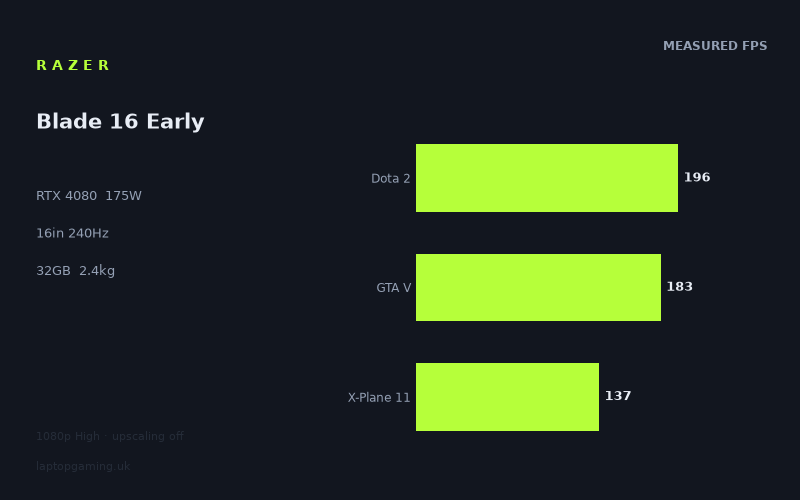
Frame rates
1920×1080, High preset, upscaling off.
Measured on this machine. Source: Notebookcheck, 2023-02-07.
Not scored: incomplete benchmark suite
Every scored laptop on this site is averaged over the same 5 games, and this one is short of Cyberpunk 2077, Baldur's Gate 3. A mean over 3 games is not comparable to a mean over 5, so we publish the figures we have and leave the score blank rather than rank it against machines tested on a different set. The numbers below are real - the suite is just incomplete.
How these numbers were produced
Frame rates here are not measured by us, and we label how each one was arrived at. A figure marked measured comes from a published run on that exact machine. A figure marked representative is derived from the GPU and its power limit (TGP) and cross-referenced against published reviews - a sound estimate of what that configuration delivers, but not a measurement of that specific laptop. Unless stated otherwise, numbers are 1920x1080, High preset, upscaling off. Where a laptop ships in several power configurations we use the wattage of the exact SKU listed, because a 140W RTX 5070 and a 115W one are not the same product.
In use
The short version
The Razer Blade 16 Early is a very fast RTX 4080 laptop on the evidence available, but its appeal depends heavily on what you want from a gaming machine. Its Core i9-13950HX, RTX 4080 running at a specified 175W, 32GB of memory and 2560x1600 240Hz IPS screen describe an uncompromising high-performance configuration. Notebookcheck’s 1080p High-preset figures support that impression: this machine is exceptionally quick in older, lighter and well-optimised games, remains strong in demanding current releases, and still has enough performance to make a high-refresh panel meaningful in a sizeable part of the library.
That does not mean it can simply run every modern game at the panel’s full refresh rate. The benchmark data shows a wide spread between titles. The Witcher 3 reaches 354fps and Strange Brigade reaches 351fps, while F1 24 manages 251fps. At the other end, Borderlands 4 records 58fps, Resident Evil Requiem reaches 67fps, Assassin’s Creed Shadows reaches 69fps, Black Myth: Wukong reaches 71fps, and several other recent releases sit well below the screen’s 240Hz ceiling even at the lower 1920x1080 test resolution. The Blade 16 has the hardware for serious gaming, but a 240Hz screen should be understood as useful headroom rather than a promise that every new blockbuster will run at 240fps.
The important positive is that the laptop’s lower results are not poor results in isolation. Games such as Star Wars Outlaws and The Outer Worlds 2 both record 74fps, Crimson Desert reaches 76fps, Anno 117: Pax Romana records 80fps, Marvel Rivals reaches 88fps and Doom: The Dark Ages reaches 95fps. These are meaningful frame rates for demanding games at the published settings, especially given that upscaling was disabled. The figures do, however, make clear that buyers should expect to adjust settings, accept lower refresh behaviour, or use available upscaling technologies in the most demanding games if they intend to use the screen at its full 2560x1600 resolution.
The Blade 16 Early is therefore best viewed as a high-end gaming laptop for someone who wants a fast 16in machine with strong frame rates across a broad range of games, rather than someone buying purely because an RTX 4080 badge implies unrestricted performance in every future release. The specified 175W GPU power limit matters here. This is not a low-power RTX 4080 implementation being placed in a thin-and-light chassis with limited room to perform. On paper, the GPU has a generous power allowance, and the benchmark data broadly looks like that: very high results in games that can expose CPU and GPU throughput, and strong figures in heavier games where the graphics workload becomes more decisive.
There is also a more awkward conclusion. The comparison data shows that this RTX 4080 Blade can be effectively level with certain RTX 4090 laptops in the shared games available, including the Schenker Key 17 Pro and the RTX 4090 version of the Razer Blade 16 Early. That is an excellent result for this machine, but it should not be misread as proof that the RTX 4080 and RTX 4090 are interchangeable. The shared comparison set is limited, and the games concerned are at 1080p, where lighter titles can become CPU-bound and compress a genuine GPU advantage. The Asus ROG Strix Scar 17, another RTX 4090 system, is 27fps ahead across the shared games, demonstrating that the faster GPU can still create a material performance lead in the right circumstances.
There is no confirmed UK price for this configuration, so a value judgement cannot responsibly be made. That matters because the Blade 16 is a product category where pricing can change the verdict substantially. A fast RTX 4080 laptop can be compelling when positioned sensibly against rival high-end machines, but much less persuasive if its price moves too close to stronger RTX 4090 hardware. The frame-rate evidence says the machine has the performance credentials. The missing price means it is not possible to say whether those credentials translate into good value in the UK.
Performance
A high-power RTX 4080, with results that justify taking it seriously
The most useful starting point is the GPU configuration. This Blade 16 uses an RTX 4080 with a specified 175W power limit. GPU names alone do not tell the whole story in gaming laptops because the same chip can be configured with different power limits. A lower-power implementation may not sustain the same performance as a higher-power one, particularly in games that are predominantly graphics-limited. The 175W figure therefore matters before any benchmark is considered: it establishes that this is intended as a full-performance RTX 4080 configuration rather than a constrained one.
Notebookcheck’s results support that reading. The machine achieves 354fps in The Witcher 3 and 351fps in Strange Brigade. Those are extraordinarily high figures, and they show the platform has substantial performance overhead in games where the workload is not heavily limiting the GPU. F1 24 reaches 251fps, which is also above the screen’s stated 240Hz refresh rate. In those titles, the Blade 16 has enough measured performance to exploit the panel’s high refresh capability rather than merely treating it as a specification-sheet feature.
The next tier remains extremely fast. Dota 2 records 196fps, as does Shadow of the Tomb Raider. GTA V reaches 183fps, F1 25 reaches 172fps, Mafia Definitive Edition reaches 171fps, and both Borderlands 3 and Final Fantasy XV record 158fps. Control follows closely at 157fps, while Ghostwire Tokyo reaches 154fps. These are not marginally playable results. They represent a machine that can deliver high-refresh gaming in many established games and in games whose engine, rendering approach or CPU demand allows frame rates to climb.
It is important, though, not to treat the highest results as the normal experience across every genre and every release date. The published testing uses 1920x1080, the High preset and upscaling disabled. That is a useful common basis for comparing laptops, but it is lower than the Blade 16’s native 2560x1600 display resolution. The benchmark data therefore establishes what the hardware can do at 1080p High without upscaling; it does not provide a measured native-resolution result for these games. Moving to 2560x1600 increases the rendering demand, so the precise native-resolution outcome cannot be stated from the available figures.
This distinction is especially important for buyers attracted by the 240Hz display. In The Witcher 3, Strange Brigade and F1 24, the measured 1080p numbers are enough to exceed 240fps. That is a clear indication that the panel’s refresh ceiling can be useful in those games at the tested settings. Dota 2 and Shadow of the Tomb Raider, at 196fps, fall short of 240fps but remain close enough that the display’s high refresh potential is still relevant. GTA V at 183fps, F1 25 at 172fps and Mafia Definitive Edition at 171fps similarly make a fast screen worthwhile, even though they do not reach its maximum stated refresh rate in the recorded run.
By the time the results move into the 150fps range, the Blade remains quick but the difference between a 240Hz panel and a more conventional high-refresh display becomes less about hitting a particular maximum and more about allowing the game to present as many frames as the system can produce. Borderlands 3 and Final Fantasy XV each reach 158fps. Control reaches 157fps and Ghostwire Tokyo reaches 154fps. Metro Exodus records 145fps, Dying Light 2 reaches 141fps, and X-Plane 11 records 137fps. Far Cry 6 reaches 134fps. These are all strong measured outcomes, but none supports a claim that the machine will hold the panel’s full refresh rate in those particular games.
The middle of the results is where the machine becomes more revealing
The most informative figures are often not the spectacular outliers, but the games that sit between obvious esports-style workloads and the newest punishing releases. Watch Dogs Legion records 121fps, Battlefield 6 reaches 115fps and Cyberpunk 2077 1.6 records 114fps. These results show the Blade 16 still operating comfortably above basic playability expectations at the tested settings, but they also show that the 240Hz display is not the realistic performance target for every demanding game. In these cases, the panel offers flexibility and headroom, rather than a refresh rate the GPU is demonstrably saturating.
Cyberpunk 2077 1.6 is particularly useful as a reference point because it is a demanding title and still reaches 114fps in the published run. That is a strong result for 1080p High with upscaling off. It also helps explain why the machine should not be dismissed simply because later games fall much lower. Laptop performance is not a single fixed quantity. Different games place different demands on graphics hardware, the CPU, memory, game engine and rendering features. A laptop that produces well over 100fps in Cyberpunk 2077 1.6 can still return much lower figures in a newer title with a different workload.
Doom: The Dark Ages records 95fps and Marvel Rivals reaches 88fps. Anno 117: Pax Romana follows at 80fps, then Crimson Desert at 76fps. Star Wars Outlaws and The Outer Worlds 2 both record 74fps, Death Stranding 2 reaches 72fps, and Black Myth: Wukong reaches 71fps. Assassin’s Creed Shadows reaches 69fps and Resident Evil Requiem records 67fps. These are the games that should shape a buyer’s expectations of the Blade 16 in demanding current software. The laptop is capable, but it is not invulnerable to the rapid increase in graphical workload seen in recent releases.
Borderlands 4 is the lowest listed result at 58fps. That number should not be isolated and used to declare the Blade 16 weak. It should instead be read alongside the rest of the spread. The same laptop records 145fps in Metro Exodus, 141fps in Dying Light 2, 121fps in Watch Dogs Legion, 115fps in Battlefield 6 and 114fps in Cyberpunk 2077 1.6. The variation does not suggest an inconsistent machine; it shows that game demands differ sharply. The relevant takeaway is that buyers whose main interest is in the newest and most graphically ambitious games should not buy this laptop expecting uniform results at the display’s native resolution with high settings and no help from upscaling.
Conversely, buyers who play a mixture of competitive games, older AAA releases, driving games, action games and less punishing current titles have a much stronger case. Dota 2 at 196fps, F1 24 at 251fps, F1 25 at 172fps, GTA V at 183fps and Shadow of the Tomb Raider at 196fps all indicate that there is plenty of performance available for games that reward high refresh. Even the 154fps to 171fps group is well matched to a fast panel. The machine is not merely capable of high frame rates in one unusually easy game; it produces them repeatedly across a broad part of the results list.
What the benchmark spread says about real use
The benchmark spread is wide enough that prospective owners should think in categories rather than averages alone. At the top are games where the Blade 16 can meet or exceed the display’s 240Hz refresh rate in the recorded 1080p testing: The Witcher 3, Strange Brigade and F1 24. Just beneath that are games where it produces an extremely high frame rate without reaching 240fps: Dota 2, Shadow of the Tomb Raider, GTA V, F1 25 and Mafia Definitive Edition. These are the games in which the screen’s high refresh specification has obvious practical relevance.
Then comes a substantial group from Borderlands 3 at 158fps through Far Cry 6 at 134fps. This is still a very strong range. The display has more than enough refresh capacity to show every frame the system produces, and the experience should not be limited by the panel’s stated maximum. But it is a mistake to call these 240Hz results. The numbers do not say that, and the distinction matters when comparing machines marketed around very high-refresh screens.
The final group, beginning around Watch Dogs Legion and extending to Borderlands 4, is where the display specification becomes less important than graphics settings, game optimisation and the buyer’s tolerance for changing configuration. A 240Hz panel remains a premium feature, but it cannot manufacture frames the hardware does not produce. In these games, the Blade 16’s advantage is that it still delivers results ranging from 121fps down to 58fps at the stated test settings rather than collapsing into an unusable range. Yet the evidence is clear that the newest and most demanding releases are more likely to require compromise if the goal is to chase very high frame rates.
The fact that upscaling was disabled is significant. It keeps the benchmark data clean and directly comparable, because the frame-rate numbers reflect the stated resolution and High preset without an upscaling mode changing the rendering burden. At the same time, it means the figures do not represent every option available within games that support such technologies. It would be wrong to claim a specific benefit without measured data, but it is fair to say that the published results describe a no-upscaling baseline rather than the maximum possible frame rate a player might obtain after changing settings.
The CPU is also relevant to interpreting the highest figures. The Blade 16 uses a Core i9-13950HX, and the very high results in games such as The Witcher 3, Strange Brigade and F1 24 occur at 1080p. At that resolution, particularly in lighter titles, CPU limitations can increasingly influence the result. This is not a criticism of the processor. It explains why apparently large differences in GPU class do not always become equally large differences in frame rate. The comparison results against RTX 4090 rivals make this especially clear: in some shared 1080p games, the RTX 4080 Blade is essentially level despite the nominally faster GPU in the rival machine.
The published mean across the three available scoring-suite games is 172fps. That is a strong headline for the games included, but it must be handled carefully. The scoring suite is incomplete because there are no figures for Cyberpunk 2077 or Baldur’s Gate 3. Every fully scored laptop is averaged over the same five games, so this partial result cannot be used to rank the Blade 16 against laptops with complete scores. The partial mean is useful as a concise description of performance in Dota 2, GTA V and X-Plane 11, but it is not enough to establish a fair overall league-table position.
The screen
A sharp, fast specification, but the benchmark resolution matters
The Blade 16 Early has a 16in IPS screen with a 2560x1600 resolution and 240Hz refresh rate. As a specification, that is a strong pairing for a high-end gaming laptop. The resolution gives the machine a visibly denser desktop and gaming target than a 1920x1080 panel, while the 240Hz refresh rate is built for games where frame rates can rise well beyond the level associated with ordinary gaming displays. The IPS panel type is also part of the published specification, although there is no supplied information on brightness, contrast, colour coverage, response behaviour or other display characteristics. Those qualities should therefore not be assumed.
The key issue is the relationship between the display and the benchmark conditions. Notebookcheck’s frame rates were measured at 1920x1080, High preset and with upscaling off. The Blade’s screen is 2560x1600. The published figures are therefore not native-panel measurements. They are still extremely useful because they show comparative gaming performance under a consistent workload, but they cannot tell us exactly what frame rate each game will produce at 2560x1600.
This is not a small technical footnote. A buyer choosing a 2560x1600 laptop is likely to want to use its native resolution, especially in slower-paced games where image sharpness can matter as much as frame rate. At the same time, 2560x1600 asks more of the GPU than the benchmark resolution. The Blade 16’s 175W RTX 4080 gives it a strong foundation, but the data does not justify attaching a native-resolution frame-rate number to any game in the list. The correct conclusion is simply that native-resolution performance will need to be judged with further measured figures, not guessed from the 1080p results.
Where 240Hz looks useful
At the tested resolution, the 240Hz panel is clearly justified in a limited but meaningful set of games. The Witcher 3 at 354fps and Strange Brigade at 351fps both exceed the panel’s stated refresh rate. F1 24 at 251fps also exceeds it. In those games, the GPU is capable of producing more frames than the screen can display at its maximum refresh. That is exactly the situation in which a 240Hz panel has a direct performance purpose.
Dota 2 and Shadow of the Tomb Raider both reach 196fps. While neither reaches 240fps, both sit high enough that a 240Hz screen remains relevant. GTA V at 183fps, F1 25 at 172fps and Mafia Definitive Edition at 171fps offer the same general conclusion. The Blade 16 may not maximise the refresh rate in every one of these titles, but it produces enough frames that a fast panel is more than decorative.
For Borderlands 3, Final Fantasy XV, Control and Ghostwire Tokyo, the measured figures range from 158fps to 154fps. Metro Exodus reaches 145fps and Dying Light 2 reaches 141fps. In this band, the display still has ample capacity above the game’s measured output. A 240Hz panel does not require a game to run exactly at 240fps before it is useful; it means the panel is not becoming the ceiling at lower high-refresh results. Still, buyers should be realistic. These figures are good, but they are not evidence of full-refresh performance.
At 121fps in Watch Dogs Legion, 115fps in Battlefield 6 and 114fps in Cyberpunk 2077 1.6, the Blade remains well suited to a responsive high-refresh screen, but the panel’s maximum becomes increasingly aspirational rather than regularly achievable. In Doom: The Dark Ages at 95fps and Marvel Rivals at 88fps, the laptop has enough output for fluid gameplay according to the published data, but the gap to 240Hz is substantial. The same applies to the newer demanding titles below that range.
Where the display has more headroom than the game can use
Anno 117: Pax Romana at 80fps, Crimson Desert at 76fps, Star Wars Outlaws at 74fps, The Outer Worlds 2 at 74fps, Death Stranding 2 at 72fps, Black Myth: Wukong at 71fps, Assassin’s Creed Shadows at 69fps, Resident Evil Requiem at 67fps and Borderlands 4 at 58fps are not results that meaningfully approach the display’s 240Hz ceiling in the recorded test. That does not make the screen a poor fit for those games. A quality high-refresh panel can still display the available frames without imposing a lower refresh cap. It does mean, however, that the display specification should not be the central reason to buy this configuration if those demanding titles are the main priority.
The better way to think about the panel is as a flexible high-end display. In games where the system can run extremely quickly, it has the refresh capacity to keep up. In games where the GPU is more heavily loaded, it has enough room that the display is unlikely to be the limitation. What it cannot do is eliminate the difference between a 354fps game and a 58fps game. The benchmark spread is a reminder that display refresh and game performance are related but separate parts of the purchase decision.
The 16in size is also worth considering in relation to the resolution. A 2560x1600 screen gives more desktop space and a higher-resolution target than the 1920x1080 benchmark setting, but no supplied evidence describes scaling behaviour, image quality at non-native resolutions, or panel calibration. Buyers should not assume that every resolution choice will look identical or that every game will be best played at the same setting. The available evidence supports the performance discussion; it does not supply a full display review.
Build, size and portability
The confirmed physical figure is a weight of 2.423kg. That places the Blade 16 firmly in the substantial-performance-laptop category rather than the lightweight ultraportable category. It is not an absurdly large desktop-replacement weight on the information available, but neither is it a machine that disappears into a bag or becomes effortless to carry every day. The hardware specification helps explain the trade-off: a Core i9-13950HX and a 175W RTX 4080 are components selected for performance, and performance hardware needs to be assessed differently from a lower-power thin-and-light configuration.
For someone travelling occasionally between home, university, work or a second location, 2.423kg may be a reasonable compromise for the performance shown in the benchmark data. The Blade can potentially serve as a single machine for serious gaming without being permanently fixed to one desk. For someone carrying a laptop throughout the day, however, the weight should be treated seriously. The machine itself is only part of what is carried; the available fact sheet does not provide charger weight, dimensions or battery-life information, so the total travelling burden and unplugged practicality cannot be quantified here.
There is no supplied information on chassis material, port selection, keyboard, trackpad, webcam, speakers, cooling noise, operating temperatures, upgrade access or internal layout. Those are all areas that often matter in a premium gaming laptop, especially when a high-power GPU is involved. It would be easy to fill those gaps with assumptions based on the Razer Blade name or on other machines in the category, but that would not be evidence-based. The available facts establish the screen size, weight and performance-oriented internal hardware, not the finer details of the physical design.
What can be said is that the 16in display and 2.423kg weight point towards a machine intended to balance desk use with some mobility, rather than an ultra-light travel-first laptop. That balance will suit buyers who want a single portable gaming system and can accept a meaningful carry weight. It will be less suitable for buyers whose first concern is low bag weight, all-day unplugged use or minimal bulk. There is no battery measurement in the fact sheet, so it would be irresponsible to claim that the Blade is good or bad away from mains power.
The absence of dimensions also matters. Weight tells us something about carrying effort, but not about footprint, thickness or bag compatibility. A buyer with a particular backpack, desk depth or travel requirement should check the relevant dimensions before buying rather than relying on a general impression from the 16in label. The same applies to cooling behaviour. The 175W GPU limit indicates performance intent, but there are no temperature or noise figures available to show how the machine behaves under sustained load.
In practical terms, the Blade 16 should be approached as a performance laptop that happens to be portable, not as a lightweight laptop that happens to game. That distinction is supported by the component choice and the measured performance. It is a more sensible fit for a buyer who will often use it at a desk, perhaps move it between locations, and wants a built-in screen capable of high-refresh gaming. It is a less obvious fit for someone who values the lowest possible carrying weight above everything else.
How it compares
Against the Lenovo Yoga Pro 9 16IMH9 RTX
The clearest performance gap in the supplied rival set is against the Lenovo Yoga Pro 9 16IMH9 RTX with an RTX 4050 running at 100W. Across five shared games, the Razer Blade 16 is ahead by 109fps on average. That is a very large advantage, and it aligns with the broad difference in GPU class and specified power limit. The Blade has an RTX 4080 at 175W; the Lenovo has an RTX 4050 at 100W. The benchmark comparison indicates that these should not be viewed as close alternatives for buyers whose main concern is gaming frame rate.
The Lenovo may have priorities not captured by this limited comparison, but the available data is unequivocal on the gaming side. The Blade’s frame-rate lead is large enough that it affects the type of performance target a buyer can reasonably expect. A machine capable of the Blade’s results in titles such as F1 24, Dota 2, GTA V, Cyberpunk 2077 1.6 and the rest of the listed suite is operating in a different performance bracket from a lower-power RTX 4050 system.
There is no confirmed UK price for the Lenovo, so this is not a value comparison. It is also not a claim that every buyer should choose the Blade. The Yoga may suit a different sort of user. But if the decision is driven by game performance and high-refresh use, the shared-game result makes the Blade 16 the much stronger option.
Against the Schenker Key 17 Pro and the RTX 4090 Blade 16
The more surprising comparisons are against the Schenker Key 17 Pro, equipped with an RTX 4090 at 175W, and the RTX 4090 version of the Razer Blade 16 Early. Against the Schenker, the RTX 4080 Blade averages a difference of 0fps across three shared games. Against the RTX 4090 Blade 16, it is only 1fps behind across the same number of shared games. On the face of it, those are near-identical results.
They should be treated as real measurements, not dismissed, but they need explanation. The shared game set is small, and the testing is at 1920x1080. At that resolution, lighter games can be CPU-bound. When a game is constrained more by processor performance or by the game engine than by GPU throughput, moving from an RTX 4080 to an RTX 4090 may not create a proportionate frame-rate increase. The GPU gap can be compressed because the graphics chip is not the only limit.
This is precisely why a near-zero comparison result does not prove that the RTX 4090 offers no advantage. It proves only that, in the shared games and published conditions, the Razer RTX 4080 performs effectively the same as these particular RTX 4090 rivals. Buyers should not extrapolate that equality to every game, every resolution or every graphics setting. At the Blade’s native 2560x1600 resolution, GPU demand would be greater than in the recorded 1080p benchmarks, but there are no supplied shared native-resolution figures to quantify what happens there.
There is also no confirmed UK price for either the Schenker Key 17 Pro or the RTX 4090 Razer Blade 16 Early. That leaves a significant part of the buying decision unresolved. If one of those RTX 4090 machines were close in price, a buyer might reasonably want more evidence from demanding GPU-limited games before choosing the RTX 4080 Blade. If the RTX 4080 machine were materially cheaper, the near-level shared results would become highly persuasive. Without confirmed prices, neither conclusion can be made.
Against the Asus ROG Strix Scar 17
The Asus ROG Strix Scar 17 provides the counterweight to the near-level RTX 4090 comparisons. It also uses an RTX 4090, and the Razer Blade 16 trails it by 27fps across three shared games. That is a meaningful lead for the Asus. It shows that RTX 4090 systems can pull away from this RTX 4080 Blade in the shared benchmark evidence, rather than merely matching it.
The Asus has a listed UK price of £4,866. That is a very high price, and it should not automatically be interpreted as a sensible alternative simply because it is faster in the supplied comparison. The question is not whether the Scar 17 is ahead in frame rate; the data says it is. The question is whether its price, physical characteristics and the buyer’s priorities justify choosing it. The fact sheet does not provide the Razer’s UK price, so it is impossible to calculate whether the 27fps shared-game advantage represents a worthwhile premium over this Blade configuration.
The Scar comparison is nevertheless valuable because it keeps the Blade’s strong performance in perspective. The Razer is powerful enough to sit level with certain RTX 4090 machines in a limited 1080p shared set, but it is not the unequivocal fastest laptop among the rivals named here. Buyers who simply want the highest possible frame rates should take the Scar’s advantage seriously. Buyers who care about the Blade’s particular screen size, weight or form factor may judge the trade-off differently, but the performance lead belongs to the Asus in the supplied shared data.
Why these comparisons cannot produce a full ranking
The Blade 16’s scoring-suite data is incomplete. There are figures for Dota 2, GTA V and X-Plane 11, producing a partial mean of 172fps, but there are no figures for Cyberpunk 2077 or Baldur’s Gate 3. Because fully scored laptops are averaged across the same five games, the Blade cannot be fairly ranked against them using only three results. A partial mean is not interchangeable with a complete one, particularly when game performance varies as widely as it does here.
The rival comparisons are still useful because they are based on games both machines hold, with preference given to the scoring suite. They answer a narrower question: how far ahead or behind is this Blade in the games available for each direct matchup? That is enough to establish the 109fps lead over the Lenovo, the effectively level outcomes against the Schenker and RTX 4090 Blade, and the 27fps deficit to the Asus. It is not enough to create a definitive overall ranking across all gaming laptops.
Who it’s for
The Razer Blade 16 Early makes the strongest case for buyers who want a genuinely high-end gaming laptop with a 16in 2560x1600 240Hz screen and performance that covers both high-refresh titles and demanding single-player releases. It is particularly suitable for someone whose library includes games such as Dota 2, F1 24, F1 25, GTA V, Shadow of the Tomb Raider, Borderlands 3, Control and Ghostwire Tokyo. Notebookcheck’s numbers show that the laptop can deliver very high frame rates in that kind of mix at the published 1080p High settings with upscaling off.
It also suits a buyer who understands the difference between a high-refresh screen and a guarantee of 240fps. The Blade has enough performance for the panel to make sense, especially in the faster results near or above its refresh rate. But the same buyer must be comfortable with the fact that modern demanding games such as Star Wars Outlaws, The Outer Worlds 2, Black Myth: Wukong, Assassin’s Creed Shadows, Resident Evil Requiem and Borderlands 4 produce much lower published figures. This is a machine for someone who values flexibility: high frame rates where games allow them, strong performance elsewhere, and the option to tune settings according to the game.
The Blade is also a sensible candidate for someone who needs some portability but does not expect an ultra-light machine. At 2.423kg, it is substantial but still a laptop rather than a fixed desktop system. A buyer moving between home and another regular location may find that balance attractive. Someone carrying it all day should take the weight more seriously and should seek further information on dimensions, charger weight and battery life, none of which are supplied here.
It is less suitable for a buyer whose main priority is the absolute highest performance available. The Asus ROG Strix Scar 17 is ahead by 27fps across the shared games, and that is a material result. The Blade is fast, but the comparison data does not establish it as the fastest option. Likewise, a buyer considering RTX 4090 machines should not assume the near-level figures against the Schenker Key 17 Pro and RTX 4090 Blade tell the entire story. Those results are impressive, but they are based on a limited shared set at 1080p, where CPU-bound behaviour can narrow GPU differences.
It is also not the right choice for someone who mainly wants a lightweight everyday laptop that can occasionally run games. The 2.423kg weight and high-performance component selection point in the other direction. The Blade’s strengths are its gaming credentials, not evidence of low-weight mobility or long battery operation. There is no battery figure in the fact sheet, and no claim should be made about how it performs away from mains power.
Buyers focused primarily on the newest, heaviest releases should be especially disciplined. The measured figures are still respectable in most cases, but they do not support an expectation of maximum-refresh native-resolution gaming without compromise. Borderlands 4 at 58fps, Resident Evil Requiem at 67fps, Assassin’s Creed Shadows at 69fps, Black Myth: Wukong at 71fps and Death Stranding 2 at 72fps show that even a 175W RTX 4080 has limits in demanding recent software. If those games are the core reason for buying, compare native-resolution measurements and price carefully before committing.
Finally, nobody should buy this particular configuration on value grounds until a confirmed UK price is available. The performance evidence is strong enough to justify serious consideration. The missing price prevents the final judgement. If the Blade is positioned sensibly against RTX 4090 alternatives, its near-level shared results against some of them could make it a very convincing high-end choice. If it is priced too close to faster hardware, the Asus comparison becomes more important. Until the UK price is confirmed, the most honest verdict is that the Razer Blade 16 Early is a powerful, well-specified gaming laptop with impressive measured 1080p performance, but its value remains unproven.