Review
Asus ZenBook Pro Duo UX582 review
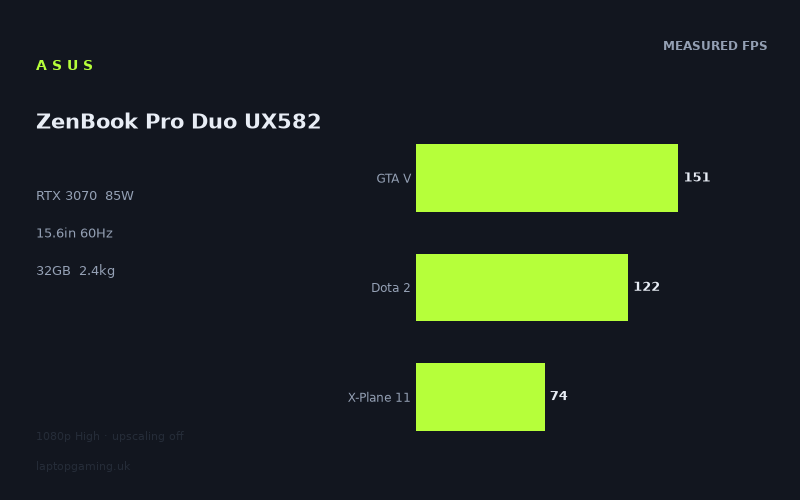
Frame rates
1920×1080, High preset, upscaling off.
Measured on this machine. Source: Notebookcheck, 2021-06-02.
Not scored: incomplete benchmark suite
Every scored laptop on this site is averaged over the same 5 games, and this one is short of Cyberpunk 2077, Baldur's Gate 3. A mean over 5 games is not comparable to a mean over 5, so we publish the figures we have and leave the score blank rather than rank it against machines tested on a different set. The numbers below are real - the suite is just incomplete.
How these numbers were produced
Frame rates here are not measured by us, and we label how each one was arrived at. A figure marked measured comes from a published run on that exact machine. A figure marked representative is derived from the GPU and its power limit (TGP) and cross-referenced against published reviews - a sound estimate of what that configuration delivers, but not a measurement of that specific laptop. Unless stated otherwise, numbers are 1920x1080, High preset, upscaling off. Where a laptop ships in several power configurations we use the wattage of the exact SKU listed, because a 140W RTX 5070 and a 115W one are not the same product.
In use
The short version
The Asus ZenBook Pro Duo UX582 (LR-1BH2) is an unusual gaming proposition: a 15.6in 3840x2160 OLED laptop with a 60Hz panel, 32GB of memory, a 1TB SSD, a Core i7-10870H and an RTX 3070 limited to 85W. The benchmark data shows that it is capable at 1920x1080 on the High preset with upscaling off, but its measured gaming performance needs to be read alongside that relatively modest GPU power limit and its very high-resolution display.
Notebookcheck’s figures are good in the lighter and older games. Strange Brigade reaches 172fps, The Witcher 3 reaches 170fps, GTA V reaches 151fps and Dota 2 reaches 122fps. Those are all comfortably beyond the screen’s 60Hz refresh rate at the stated 1920x1080 High settings. In other words, the laptop has enough measured performance for a 60Hz gaming experience in every game listed here when judged at the benchmark settings.
The more demanding results are less extravagant, but still solid at 1920x1080 High. Final Fantasy XV is measured at 83fps, X-Plane 11 at 74fps and Cyberpunk 2077 1.0 at 73fps. They remain above 60fps in the published data, but the margin is much narrower than it is in Strange Brigade or GTA V. That matters because a machine which can produce well beyond 60fps in a light title can still feel very different when a more demanding game reduces the spare performance available above the panel refresh limit.
The central limitation is not that the RTX 3070 is incapable of gaming. The figures make clear that it is not. The issue is that this is an 85W implementation inside a laptop built around a 3840x2160 display. The benchmark data was collected at 1920x1080, not at the panel’s native resolution. There is no measured native-resolution gaming result in the supplied data, so there is no basis for claiming that these frame rates will carry over to 3840x2160.
That makes the UX582 a better fit for someone who values its high-resolution OLED screen and wants credible 1080p High gaming performance than for someone buying primarily for maximum frame rate or for confirmed native-4K gaming. Its display specification is ambitious; the published gaming data is practical rather than extravagant. The two can coexist, but prospective buyers should understand that they describe different uses of the machine.
The 32GB memory allocation is generous on paper, and the 1TB SSD means this configuration is not presented as a stripped-back version with minimal memory or storage. However, the supplied information does not include storage performance measurements, display-quality measurements, battery-life figures, noise figures or temperatures. Those are important omissions if those areas are decisive for you, and they should not be filled in with assumptions.
There is no confirmed UK price for this exact configuration. That means an overall value judgement cannot be computed here, because price is part of that calculation. It does not mean there is a problem with the machine or with its benchmark coverage: the benchmark suite is complete and the laptop ranks normally on frame-rate performance. It simply means that performance can be assessed, while value cannot be pinned down without a confirmed UK price.
Performance
What the published results show
Notebookcheck measured the Asus ZenBook Pro Duo UX582 at 1920x1080, using the High preset with upscaling off. This is an important baseline. It avoids presenting frame rates enhanced by upscaling, and it gives a clear view of what the RTX 3070 and Core i7-10870H combination produces in this specific machine at a widely used gaming resolution.
The mean across the five scoring-suite games is 120fps. That is a useful broad indicator, but it should not be mistaken for the result a buyer will see in every game. The individual results range from Dota 2 at 122fps up to Strange Brigade at 172fps among the very fast titles, while Final Fantasy XV and X-Plane 11 sit much closer to the 60Hz screen limit. Cyberpunk 2077 1.0, which is outside the scoring suite, is measured at 73fps.
The wide spread is the point. The UX582 is not a machine that performs at one simple, fixed level across every kind of game. It can run far beyond the display refresh rate in several titles, yet in more demanding games it has substantially less room above 60fps. Buyers looking only at the 120fps mean could come away expecting a consistently high-refresh experience. That would not reflect the actual game-by-game results.
Strange Brigade is measured at 172fps. At the stated 1920x1080 High setting, that is far in excess of what the 60Hz panel can present as refreshed frames. The result demonstrates substantial performance headroom in this game, but it does not turn the UX582 into a high-refresh laptop. The display remains limited to 60Hz, so the relevance of such a high measured figure is primarily that performance is not the bottleneck in this particular title at the benchmark settings.
The Witcher 3 follows closely at 170fps. Again, this is a strong result relative to the panel refresh rate. It indicates that the machine can run this game at 1920x1080 High with a large margin above 60fps in Notebookcheck’s measurement. For someone whose gaming includes titles with this sort of demand, the GPU is not being asked to struggle merely to meet the display’s ceiling.
GTA V is measured at 151fps. This is another result well beyond 60fps, and it reinforces the same conclusion: at 1920x1080 High, the UX582 has ample performance for some established games. It also matters because GTA V is part of the scoring suite, so it contributes to the published 120fps mean rather than being an isolated favourable result outside the main comparison set.
Dota 2 reaches 122fps. That is lower than Strange Brigade, The Witcher 3 and GTA V, but it is still more than the panel’s refresh rate. The number is a useful reminder that not every lighter-looking or established game necessarily produces the same extremely high result on every laptop. It is still a comfortable figure for this 60Hz display at the measured settings, but it narrows the gap between the frame rate being generated and the refresh rate being displayed.
Final Fantasy XV is measured at 83fps. This is where the character of the UX582 changes. It remains above 60fps at 1920x1080 High with upscaling off, which is a positive result for this panel, but it no longer has the huge surplus seen in Strange Brigade or The Witcher 3. A result of 83fps is not weak in isolation. It is simply much closer to the screen’s 60Hz limit, making it a better guide to the sort of margin available in more demanding titles.
X-Plane 11 reaches 74fps. That remains above the panel refresh rate in the published figure, but it is among the results that should temper expectations. There is a meaningful difference between a game measured at 172fps and one measured at 74fps, even though both exceed a 60Hz screen. The former has a great deal of spare performance at the benchmark settings; the latter meets the panel’s target with a comparatively narrow margin.
Cyberpunk 2077 1.0 is measured at 73fps. Like X-Plane 11, it is above 60fps but not by an enormous amount. It is particularly useful as a practical counterweight to the three very high results. The UX582 is not shown here as a laptop that produces triple-digit performance in every demanding game. Instead, the benchmark data suggests two distinct outcomes: very high frame rates in some games, and results in the seventies or eighties in others.
What the 85W GPU limit means in practice
The RTX 3070 name alone does not tell the full performance story. This particular ZenBook Pro Duo UX582 uses an 85W GPU power limit. That is the figure relevant to this exact laptop, and it is why the published results should be evaluated as results from an 85W RTX 3070 rather than treated as a universal guide to every RTX 3070 laptop.
Power limits matter because laptops carrying the same GPU name can produce different benchmark outcomes. The supplied rival list illustrates that principle clearly. The UX582 is not simply placed above every RTX 3060 system and below every RTX 3080 Ti system in a neat, predictable order. It matches two RTX 3060 rivals on their shared games, substantially outpaces one RTX 3050 Ti rival, and trails a much higher-powered RTX 3080 Ti machine. The model name is only one part of the context; the laptop’s overall configuration and the shared benchmark set determine the actual comparison.
In this Asus, the 85W limit does not prevent useful 1080p High performance. All seven published game results exceed 60fps. That is the clearest practical conclusion supported by the data. If the target is a 60Hz screen at 1920x1080 and High settings with upscaling off, the machine’s measured performance is sufficient across the listed games.
What the 85W limit does appear to prevent is an assumption of limitless headroom. The UX582 has enough performance to run some games far past 60fps, but not enough published evidence to treat its 3840x2160 OLED panel as a native-resolution gaming display in the same games. That is not a criticism of the panel itself. It is a warning against combining a 1080p benchmark chart with a 4K display specification and assuming one proves the other.
The difference is especially relevant for buyers who see “RTX 3070” and “3840x2160” together and expect those labels to guarantee a particular native-resolution result. They do not. Notebookcheck’s numbers here are specifically 1920x1080, High preset, upscaling off. They show what was measured, and they do not show 3840x2160 performance.
For a 60Hz laptop, the practical target is different from that of a machine with a much faster panel. Once the measured figure is above 60fps, the screen cannot refresh beyond 60Hz. That does not make higher benchmark results meaningless: they indicate headroom and can matter when game demand varies. But it does mean that the distinction between 170fps and 151fps is less directly visible on this display than the distinction between 73fps and 60fps could be in a demanding scene.
That is why the slower published results deserve more attention than the headline mean. The 120fps scoring-suite mean looks strong, and it is strong as a 1080p High average. Yet Final Fantasy XV at 83fps and X-Plane 11 at 74fps show that the machine is closer to its 60Hz target in certain games than the average alone suggests. Cyberpunk 2077 1.0 at 73fps points in the same direction.
Comfortable for the panel, but only at the measured settings
Every listed result is above the screen’s 60Hz refresh rate. Strange Brigade at 172fps, The Witcher 3 at 170fps, GTA V at 151fps and Dota 2 at 122fps are comfortably above it. Final Fantasy XV at 83fps, X-Plane 11 at 74fps and Cyberpunk 2077 1.0 at 73fps also clear it. If a buyer’s question is narrowly whether the UX582 can meet a 60fps target in these measured games at 1920x1080 High without upscaling, the answer from the published figures is yes.
That conclusion should be kept narrow. It applies to the named games, the named settings and the named resolution. It is not a guarantee for every game, every later release, every graphics setting, or the panel’s native 3840x2160 resolution. The fact sheet does not include those measurements, and a review should not replace absent benchmark data with confidence.
There is also a meaningful difference between “above 60fps” and “comfortably above 60fps”. Strange Brigade, The Witcher 3 and GTA V have large measured margins. Dota 2 is also well clear of the refresh rate. Final Fantasy XV, X-Plane 11 and Cyberpunk 2077 1.0 are above it, but their margins are materially smaller. If consistency around the 60Hz ceiling matters more than exceptionally high numbers in lighter games, those latter results are the ones to examine closely.
The UX582 therefore makes more sense as a laptop aimed at a capped, 60Hz-class gaming target than as one aimed at extracting the highest possible frame rates. Its screen specification sets that expectation. A machine with a 60Hz display cannot show a 120fps, 151fps, 170fps or 172fps refresh rate in the way a faster-refresh display could. The benefit is instead that the laptop has headroom in those games at the published settings.
Conversely, the 73fps and 74fps results have a closer relationship to the display’s capabilities. They are still above 60fps, so the data does not show the laptop falling short of its panel refresh rate in those titles at 1920x1080 High. But they offer less excess performance if game conditions become more demanding than the benchmark run. The supplied figures do not quantify such changes, so they should not be turned into an invented minimum or a prediction.
The screen
The Asus ZenBook Pro Duo UX582 has a 15.6in OLED panel with a 3840x2160 resolution and a 60Hz refresh rate. Those are defining specifications because they pull the laptop in two different directions. The 3840x2160 resolution is a high-resolution display specification, while the gaming benchmark data is supplied at 1920x1080. The 60Hz refresh rate also means the display is not designed around presenting the very high frame-rate figures achieved in several of the published games.
It is important not to overstate what “OLED” establishes on its own. The supplied data identifies the panel type, resolution, size and refresh rate, but does not provide measurements for brightness, colour, contrast, response behaviour or any other display characteristic. There is therefore no measured basis here for declaring it excellent or poor in those areas. The firm conclusions are limited to its 15.6in size, 3840x2160 resolution, OLED panel type and 60Hz refresh rate.
For gaming, the key mismatch is simple: the panel has a 3840x2160 native resolution, but Notebookcheck’s frame rates were measured at 1920x1080. A buyer should not read Strange Brigade at 172fps, The Witcher 3 at 170fps or GTA V at 151fps as native-4K claims. They are not. They are 1080p High figures with upscaling off.
Neither should the lower figures be presented as native-4K results. Final Fantasy XV at 83fps, X-Plane 11 at 74fps and Cyberpunk 2077 1.0 at 73fps are also 1920x1080 High measurements. There is no native-resolution frame-rate figure in the fact sheet for any of the listed games, so the question of how closely the RTX 3070 at 85W can drive this panel at 3840x2160 remains unanswered by the available data.
That distinction is not minor. Resolution is part of the workload in gaming. The benchmark chart tells us that the UX582 can clear the 60Hz target in the measured titles at 1920x1080 High with upscaling off. It does not tell us whether it can do the same at the panel’s native resolution. Any review that implied otherwise would be using a display specification as a substitute for benchmark evidence.
The 60Hz refresh rate is easier to judge because it can be compared directly with the published frame rates. In every game listed, the measured figure exceeds 60fps. The screen is therefore not being asked to display more refreshed frames than it can support in the benchmark interpretation. In the faster games, the GPU is producing substantially more frames than the panel can refresh. In the more demanding games, the GPU remains above the panel rate but with less room to spare.
This creates a clear buying trade-off. If your priority is a 60Hz gaming target and you value a 3840x2160 OLED display for uses not covered by these gaming figures, the specification is coherent. If your priority is to see the full benefit of frame rates such as 122fps, 151fps, 170fps or 172fps on the internal screen, the 60Hz panel is the limiting part of the package.
The 15.6in screen size also matters to expectations. It positions this as a conventional larger laptop display rather than a small ultraportable panel, but the machine is not especially light at 2.4kg. The screen, component list and weight together suggest that this is a substantial portable computer rather than a light machine chosen mainly for minimal carrying burden. The data does not include dimensions, so no claim should be made about its footprint or thickness.
Build, size and portability
The portable specification available here is concise: the ZenBook Pro Duo UX582 weighs 2.4kg and includes a 92Wh battery. Those facts are enough to place it broadly as a substantial laptop rather than a lightweight one, but not enough to make claims about battery endurance, chassis rigidity, keyboard quality, port selection, cooling noise or surface temperatures.
A 2.4kg weight is not an incidental number when considering a 15.6in machine. It means the UX582 should be evaluated as something a buyer may transport when needed, rather than as a laptop whose main attraction is very low weight. That does not make it unsuitable for travel, but it does mean weight should be part of the buying decision rather than ignored because the word “ZenBook” appears in the name.
The 92Wh battery is a capacity figure, not a battery-life result. It would be incorrect to turn it into an estimate of hours away from mains power, because no such measured figure is supplied. Gaming runtime is especially not something that can be inferred responsibly from battery capacity alone. Buyers needing a proven all-day machine, a proven gaming-on-battery result or evidence of battery behaviour under particular workloads will need data that is not present here.
Likewise, the fact sheet does not provide dimensions. The laptop has a 15.6in screen and weighs 2.4kg, but there is no stated width, depth or thickness. It is therefore possible to say that it is not a featherweight machine, while it is not possible to make a precise claim about the amount of bag space it takes up.
The component allocation is more generous than minimal. This configuration includes 32GB of memory and a 1TB SSD alongside the Core i7-10870H and RTX 3070. That gives the machine a high-spec component list on paper. But the review should separate capacity from measured behaviour: there is no storage benchmark in the supplied data, no memory benchmark and no processor benchmark. The gaming figures remain the evidence for gaming performance, rather than the memory or storage capacities by themselves.
For someone considering this machine as a mixed-use system, the broad configuration is attractive in a straightforward way: 32GB memory, 1TB storage and a 3840x2160 OLED display are not the specifications of a basic, entry-level laptop. Yet gaming buyers should avoid letting that broader specification obscure the GPU’s 85W limit and the 60Hz panel. The UX582 is a balanced but unusual package, not a conventional high-refresh gaming laptop with a 4K label attached.
There are no supplied figures for fan noise or operating temperature. That matters particularly because the GPU limit is 85W, but the correct conclusion is not to guess whether the machine is quiet or loud, cool or hot. The power figure helps explain why this RTX 3070 should be treated as a specific laptop implementation; it does not provide a thermal or acoustic result.
How it compares
The supplied comparison set is deliberately broad rather than limited to one neighbouring laptop. It includes the two closest results, the machine that the UX582 beats by the largest margin and the machine that beats it by the largest margin. All comparisons are based only on games held in common, with preference for the scoring suite. That matters because these are not claims drawn from unrelated games or mismatched settings.
Against the MSI Prestige 15
Against the MSI Prestige 15 with an RTX 3050 Ti at 105W, the ZenBook Pro Duo UX582 averages 54fps more across four shared games. This is the largest advantage in the supplied rival set. It is a substantial performance gap, and it makes the Asus the clearly stronger gaming machine in this direct shared-game comparison.
The comparison is also a useful reminder that GPU tier still matters even when the rival has a higher stated power limit. The Prestige 15 uses an RTX 3050 Ti at 105W, while the Asus uses an RTX 3070 at 85W. The UX582’s 54fps shared-game advantage shows that the Asus’s measured gaming position is far ahead of that particular rival despite the difference in stated power limits.
That does not mean every RTX 3070 laptop automatically has the same lead over every RTX 3050 Ti laptop. It means this ZenBook Pro Duo UX582, in this shared set of four games, is measured well ahead of this MSI Prestige 15. The comparison should stay that specific.
Against the Razer Blade 15 Base Edition 2021
Against the Razer Blade 15 Base Edition 2021 with an RTX 3060 at 95W, the UX582 averages +0fps across five shared games. That is effectively a tie in the supplied comparison. It is not evidence that the laptops are identical in every respect, nor that their GPUs are technically interchangeable. It is evidence that, in the five games held in common, neither establishes a meaningful average frame-rate lead.
A near-zero difference is a real result, not a missing result. At 1920x1080, lighter titles in the shared set can become CPU-bound, which compresses genuine GPU differences. That is particularly relevant when comparing laptops from the same GPU generation using a mixture of game workloads. A GPU with a different name or power limit may not show its expected separation if the shared games are constrained elsewhere.
For a buyer choosing only on these shared-game averages, the UX582 does not have a performance advantage over the Razer Blade 15 Base Edition 2021. The Asus may still appeal because of its own display, memory, storage or other specification details, but those are separate decisions. On the supplied shared gaming result, this is level.
Against the Lenovo Legion 5
Against the Lenovo Legion 5 with an RTX 3060, the UX582 averages -0fps across five shared games. In practical terms, that is also a tie. The formatting of the result preserves the direction of the tiny difference, but there is no meaningful average separation to argue from in this shared-game set.
The explanation is the same as with the Razer comparison: at 1920x1080, lighter titles in the shared set can be CPU-bound, compressing genuine GPU gaps. That does not invalidate the comparison. It explains why two machines carrying different GPU labels may sit together when the actual evidence is restricted to the games both were measured in.
For the buyer, this means the UX582 should not be selected over the Legion 5 on an expectation of a clear shared-game frame-rate lead. The benchmark evidence does not support that claim. The decision would instead need to rest on the rest of the specification and on factors for which measurements are available elsewhere, rather than on an assumed RTX 3070 advantage.
Against the MSI Raider GE77 HX
Against the MSI Raider GE77 HX with an RTX 3080 Ti at 175W, the ZenBook Pro Duo UX582 averages 49fps fewer across five shared games. This is the largest deficit in the supplied rival set, and it is a substantial one. It shows what happens when the UX582’s 85W RTX 3070 is compared with a machine carrying an RTX 3080 Ti at 175W.
This is the comparison that most clearly defines what the UX582 is not. It is not the machine to buy for the highest gaming performance regardless of size, power limit or panel refresh rate. The Raider’s shared-game lead is too large to describe as a minor variation between similar laptops. The UX582’s strength is that it clears 60fps in all its listed 1080p High results, not that it matches the most powerful rival in this group.
The Raider comparison also puts the UX582’s 120fps scoring-suite mean in perspective. A mean can look high while still sitting well behind a more aggressively powered gaming machine in shared-game comparisons. The average is useful, but buyers should use it alongside the 85W GPU limit, the 60Hz display and the 49fps shared-game deficit to the Raider.
Who it’s for
The ZenBook Pro Duo UX582 is for a buyer who wants a 15.6in 3840x2160 OLED laptop with 32GB of memory and 1TB of SSD storage, while still having measured gaming performance that clears 60fps in the listed games at 1920x1080 High with upscaling off. That is the most accurate description of its appeal.
It suits someone happy to treat 60fps as the relevant internal-display target. Notebookcheck’s data shows that every game listed exceeds the 60Hz panel rate at the benchmark settings. In Strange Brigade, The Witcher 3, GTA V and Dota 2, the machine has a large performance margin. In Final Fantasy XV, X-Plane 11 and Cyberpunk 2077 1.0, it still clears 60fps but with less spare performance.
It also suits a buyer who understands that the laptop’s gaming evidence is for 1920x1080, not 3840x2160. If you are content to judge gaming from the measured 1080p High data and do not require confirmed native-resolution results, the UX582 has a coherent case. It is not being sold here as a proven 4K gaming laptop, because the supplied figures do not establish that.
The machine makes less sense for someone who wants a high-refresh gaming experience from the internal display. The panel is 60Hz. Even though several measured results are well above 60fps, the display cannot refresh at 122Hz, 151Hz, 170Hz or 172Hz. Buyers who regard those frame rates as something they specifically want to see on the laptop’s own panel should look for a machine with a faster screen.
It is also not the right choice for someone who wants the strongest result against high-powered gaming rivals. The MSI Raider GE77 HX is ahead by 49fps on average across five shared games, and its RTX 3080 Ti is specified at 175W compared with the Asus RTX 3070’s 85W. The data presents a clear performance hierarchy there.
Buyers deciding between this Asus and the MSI Prestige 15 should note the opposite result. The UX582 is ahead by 54fps on average across four shared games. If gaming frame rate is the deciding factor between those two named machines, the Asus has the strong evidence-backed advantage.
Buyers choosing between the UX582 and either the Razer Blade 15 Base Edition 2021 or Lenovo Legion 5 should be more cautious about expecting an automatic Asus win from the RTX 3070 badge. The shared-game averages are effectively level: +0fps against the Razer and -0fps against the Lenovo, both across five shared games. At 1080p, CPU-bound lighter titles can compress GPU gaps, so the near-zero outcomes are plausible and should be taken seriously.
Finally, this is not a laptop to buy on the basis of assumed battery life, noise, temperatures, storage speed or native-4K gaming. The supplied fact sheet does not include those results. The honest case for the UX582 is narrower but still useful: it is a 2.4kg, 15.6in 3840x2160 OLED laptop with a 60Hz panel, 32GB memory, 1TB SSD, Core i7-10870H and 85W RTX 3070, delivering published 1080p High frame rates from 73fps to 172fps across the listed games. For the buyer whose priorities align with that combination, it is a credible option. For the buyer seeking confirmed 4K gaming, high-refresh internal display gaming or maximum performance against heavily powered rivals, another type of laptop is the more sensible direction.