Review
HP Victus 16-e0179ng review
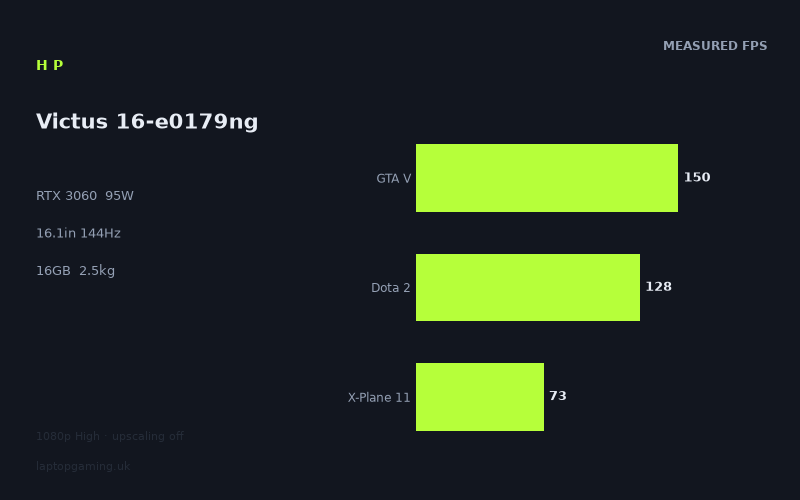
Frame rates
1920×1080, High preset, upscaling off.
Measured on this machine. Source: Notebookcheck, 2021-09-28.
Not scored: incomplete benchmark suite
Every scored laptop on this site is averaged over the same 5 games, and this one is short of Cyberpunk 2077, Baldur's Gate 3. A mean over 5 games is not comparable to a mean over 5, so we publish the figures we have and leave the score blank rather than rank it against machines tested on a different set. The numbers below are real - the suite is just incomplete.
How these numbers were produced
Frame rates here are not measured by us, and we label how each one was arrived at. A figure marked measured comes from a published run on that exact machine. A figure marked representative is derived from the GPU and its power limit (TGP) and cross-referenced against published reviews - a sound estimate of what that configuration delivers, but not a measurement of that specific laptop. Unless stated otherwise, numbers are 1920x1080, High preset, upscaling off. Where a laptop ships in several power configurations we use the wattage of the exact SKU listed, because a 140W RTX 5070 and a 115W one are not the same product.
In use
The short version
The HP Victus 16-e0179ng is a straightforward proposition: a Ryzen 7 5800H, 16GB of memory, a 1TB SSD and an RTX 3060 running at a 95W GPU power limit, paired with a 16.1in 1920x1080 IPS display capable of 144Hz. The published benchmark data shows that this is a properly capable Full HD gaming laptop rather than a machine that merely carries a gaming GPU name. In the lighter and better-optimised games measured by Notebookcheck, it gets close to or beyond what the 144Hz screen can display. In more demanding games, it remains comfortably playable at the stated High preset, but it does not deliver a consistent 144fps experience across the whole set.
That distinction matters. The Victus is well suited to someone who wants high-refresh competitive gaming in games such as FIFA 21, Star Wars Squadrons, GTA V, Doom Eternal and Strange Brigade, while also wanting enough performance for more demanding single-player games at 1920x1080. It is less convincing for a buyer who expects every modern game to run near the screen’s maximum refresh rate without lowering settings or using upscaling. The figures do not support that expectation. Deathloop reaches 72fps, Crysis Remastered reaches 61fps, and several other games sit between those results and the high-refresh leaders.
The important positive is consistency at the intended resolution. There is no sign in the benchmark data that this RTX 3060 configuration is unable to cope with Full HD gaming. Even the slowest measured result, Crysis Remastered at 61fps, is above the conventional 60fps threshold at the High preset with upscaling off. That does not mean every game will feel equally smooth, because 61fps and 194fps are obviously very different experiences on a 144Hz panel. It does mean the machine’s hardware is sensibly matched to its screen resolution.
The less convenient part of the verdict is value. The exact UK price of this configuration is not confirmed, so no value score can be calculated. That is not a criticism of the machine itself, and the benchmark suite is complete, but it means a purchase recommendation has to be conditional: the performance is credible, while whether it is a good buy depends on a price that is not available here.
At 2.473kg, the Victus is not a featherweight laptop for constant carrying. It is a machine that can move between rooms, go to university, travel occasionally or be packed for a trip, but it is likely to make more sense as a home-based gaming laptop than as something carried all day. Its 70Wh battery is a meaningful specification, but there is no battery-life measurement in the available data, so it would be irresponsible to turn that capacity figure into a claim about unplugged gaming or working time.
Buy the Victus 16-e0179ng if your priority is Full HD gaming with a useful 144Hz display, and if you are happy to treat 144fps as an attainable result in selected games rather than a guarantee for everything. It is especially sensible for a player whose regular games resemble the faster end of Notebookcheck’s results. Be more cautious if your library is built around the demanding end of the list, if you want a significantly lighter machine, or if you are shopping specifically for the highest frame rates available from this GPU generation.
Performance
A 95W RTX 3060 aimed at Full HD rather than headline chasing
The RTX 3060 in this Victus has a 95W GPU power limit. That matters because an RTX 3060 label alone does not describe the whole performance picture. The published comparison data includes another RTX 3060 laptop, the Asus TUF Gaming F17, also specified at 95W. Across the shared games, the Victus trails it by only 1fps on average. That is effectively the same result in practical terms, and it provides useful context for this particular Victus configuration: the measured numbers are not an anomaly, nor do they suggest that HP’s 95W implementation is being dramatically held back relative to another laptop with the same GPU and stated power limit.
A 95W limit also frames expectations correctly. This is not the kind of configuration that should be judged against much more aggressively powered hardware as though all GPUs with similar names are interchangeable. The MSI Raider GE77 HX uses an RTX 3080 Ti at 175W and is ahead by 55fps on average across the shared games. That is a substantial gap, and it is exactly why a buyer should look beyond the GPU family name. The Victus is built around a mid-range Full HD target. The Raider comparison shows what a considerably more powerful GPU configuration can do, not a small discrepancy that could be erased with a driver update or a minor setting change.
The complete Notebookcheck set has a mean of 114fps across the scoring-suite games: GTA V, Strange Brigade, Dota 2, Final Fantasy XV and X-Plane 11. That is a good result for a 1920x1080 gaming laptop, but it needs interpretation. A mean is useful as a broad indicator, not as a promise of identical performance from one game to the next. GTA V runs at 150fps and Strange Brigade at 146fps, while Final Fantasy XV reaches 75fps and X-Plane 11 reaches 73fps. Dota 2 sits between those groups at 128fps. The mean is pulled upwards by the faster games. Anyone buying this laptop for the full range of modern games should concentrate on the spread as well as the average.
That spread is not a fault in the data. It is the realistic picture of gaming performance. Game engines, rendering techniques, scene complexity and CPU demands differ. The same laptop can produce very high figures in one title and a much lower result in another even when the resolution and preset are held at 1920x1080 High with upscaling off. The Victus has enough performance for the display resolution, but it is not equally overpowered for every game.
The games that make the 144Hz panel worthwhile
At the fast end, FIFA 21 reaches 194fps. This is the clearest example of the Victus delivering more frames than the 144Hz panel can show in a single second. A screen refreshing at 144Hz cannot display all 194 distinct frames, but the result still matters. It shows substantial performance headroom at the stated settings and indicates that the laptop is not merely scraping past a 60fps target in this title. For someone who plays FIFA 21 regularly, the GPU has more than enough measured performance at Full HD High.
Star Wars Squadrons follows at 178fps. Again, that is beyond the display’s 144Hz refresh rate. It is another result that supports the pairing of RTX 3060 hardware with a 144Hz Full HD IPS screen. The Victus will not turn every game into a 144fps experience, but the screen is not wasted in titles that perform in this range. A lower-refresh panel would have left some of this measured performance unused; the 144Hz panel gives the machine room to show it.
GTA V records 150fps. This is only modestly above the panel refresh rate, but it still crosses that important line. In practice, the significance is not that a player should expect a fixed 150fps at every moment in every possible scene; the available figure is a benchmark result, not a guarantee for every setting combination or gameplay situation. Its value is that GTA V belongs to the group of games where the Victus can meet the display’s maximum refresh capability under the measured conditions.
Doom Eternal reaches 149fps, which places it in the same high-refresh category as GTA V. The gap between 149fps and 150fps is not important to a buying decision. The useful point is that Doom Eternal also clears 144fps at the measured Full HD High setting without upscaling. That is a strong fit for a fast panel. The Victus has the performance to make a high-refresh display feel purposeful here rather than aspirational.
Strange Brigade reaches 146fps. This is very close to the panel’s 144Hz ceiling and slightly above it. It is also one of the games included in the scoring suite, making it particularly useful in the overall performance picture. Together with GTA V, it helps lift the five-game mean to 114fps, but it should not be used to imply that every scoring-suite game is similarly fast. Final Fantasy XV and X-Plane 11 show why that would be misleading.
Monster Hunter Stories 2 reaches 143fps. This is effectively at the panel limit, though it sits just below 144fps in the reported result. It is the sort of figure that makes the distinction between a strict specification reading and practical use clear. The laptop does not technically reach the display’s maximum refresh rate in the measurement, but it comes extremely close. It belongs with the high-refresh performers rather than with the games that run around 60fps or 70fps.
The Witcher 3 reaches 135fps. That is below the 144Hz target, but still comfortably above 120fps. The screen’s refresh rate remains useful here, because 135fps is far beyond ordinary 60Hz output. This is a good example of a result that should not be described as failing to use the display simply because it does not land on a neat 144fps. It does not fully saturate the panel in the published figure, but it is close enough that the gaming experience should still benefit from a high-refresh screen.
Dota 2 produces 128fps. As a scoring-suite result, it contributes to the overall 114fps mean, and it also illustrates that even relatively fast games do not necessarily run at the full screen refresh rate. It remains a strong result at 1920x1080 High with upscaling off. For a player focused on Dota 2, the Victus should offer frame rates well beyond 60fps, though the available figure does not establish a consistent 144fps result.
Comfortably playable results, but not full-refresh results
Far Cry 5 reaches 109fps. That is a healthy Full HD result and more than enough for smooth gaming, but it is well short of 144fps. This is where the Victus’s positioning becomes clearest. It is not a laptop that needs settings reductions to make Far Cry 5 playable at the benchmarked quality level. It is a laptop that can run the game above 100fps. But a buyer selecting a 144Hz panel specifically to see 144fps in every title will need to adjust expectations.
Outriders reaches 100fps. Again, that is a solid outcome for the High preset with upscaling disabled. It is also a useful dividing line in the results. The Victus has enough GPU performance to reach three-figure frame rates in Outriders, but not enough under the measured conditions to turn it into a near-144fps game. A player who values visual settings and does not insist on chasing the screen’s ceiling should be satisfied by this result. A player whose priority is maximum competitive responsiveness may want to make settings compromises in titles that run in this range, though the available data does not show the effect of doing so.
Hunt Showdown records 93fps. This is below 100fps, but it remains well above 60fps. It is another reminder that the RTX 3060 at 95W is a good match for Full HD gaming without being an automatic high-refresh solution in every demanding title. There is a substantial difference between 93fps and the 178fps seen in Star Wars Squadrons, and this is why broad claims such as “the Victus is a 144fps laptop” would be too simplistic.
Mafia Definitive Edition reaches 86fps. This is still a respectable measured result at the specified settings. It should not be treated as poor performance simply because faster titles hit 144fps or more. The more relevant question is whether the machine is playing the game at a useful frame rate without requiring upscaling or a lower preset. At 86fps, the answer is yes. What it does not do is exploit the full refresh potential of the 144Hz screen.
Final Fantasy XV reaches 75fps. As one of the scoring-suite games, it is important because it prevents the mean result from becoming an overly flattering shorthand. The Victus averages 114fps across the five scoring-suite titles, but Final Fantasy XV is much closer to the lower end of the results than the high end. A buyer who plays demanding role-playing games should look at figures like this as carefully as they look at FIFA 21 or Doom Eternal. At 75fps, the game is still above 60fps at Full HD High with upscaling off. It is playable, but it is not a showcase for a 144Hz display.
X-Plane 11 reaches 73fps. This is another scoring-suite result and another warning against treating averages as guarantees. It is only slightly below Final Fantasy XV, and its result is much lower than GTA V, Strange Brigade and Dota 2. The range within the scoring suite alone is wide. That makes the Victus a better choice for someone who understands that game performance is title-dependent than for someone who wants a single number that defines every game they play.
Deathloop runs at 72fps. It is close to X-Plane 11 and Final Fantasy XV, reinforcing the pattern. The Victus does not collapse in these more demanding games. It remains above 60fps at the measured setting. But the gap from the high-refresh leaders is large enough that settings, game choice and expectations will shape the experience far more than the GPU name alone suggests.
Crysis Remastered is the slowest measured game at 61fps. This figure is useful precisely because it is not glamorous. It shows the floor of the supplied benchmark set. The laptop remains just above 60fps at Full HD High without upscaling, which is a credible result for a demanding game. At the same time, it makes clear that the 144Hz panel has considerably more refresh capacity than the GPU can use in every title. The screen is a feature the Victus can exploit strongly in lighter games and partially in many others; it is not a performance guarantee.
What the range of results means in practical buying terms
The measured range runs from 61fps in Crysis Remastered to 194fps in FIFA 21. That is a very large spread, and it is more valuable than a single average because it tells a prospective owner what kind of laptop this is. The Victus is not limited to esports-style games. It has the performance to run every listed title at more than 60fps under the published settings. Equally, it is not so powerful that demanding games become a trivial workload at Full HD High.
The broad pattern divides into several useful groups. FIFA 21, Star Wars Squadrons, GTA V, Doom Eternal and Strange Brigade are at or above the screen’s 144Hz refresh rate. Monster Hunter Stories 2 is essentially at that level, while The Witcher 3 and Dota 2 are close enough to make the high-refresh panel worthwhile even if they do not reach 144fps in the supplied figures. Far Cry 5 and Outriders remain above 100fps, which is still strong performance but clearly below the maximum screen refresh. Hunt Showdown, Mafia Definitive Edition, Final Fantasy XV, X-Plane 11 and Deathloop form a middle-to-lower range of 72fps to 93fps. Crysis Remastered sits at 61fps.
That is the honest performance case for the Victus. It is a capable Full HD machine with a meaningful high-refresh upside, not a universal maximum-settings, maximum-refresh machine. Buyers who understand this will probably be pleased with the balance. Buyers who want the fastest possible results in demanding games should not assume that every RTX 3060 laptop is interchangeable with a higher-powered RTX 3080 Ti system, because the shared-game comparison against the Raider makes the difference unmistakable.
The Ryzen 7 5800H, 16GB of memory and 1TB SSD are sensible supporting specifications for the gaming hardware, but the available evidence is the gaming data rather than separate CPU, memory or storage measurements. There is no published frame-rate evidence here that points to a general failure of the supporting platform. The machine reaches very high figures in several titles, and its results are essentially level with the other 95W RTX 3060 comparison laptop. That is as far as the supplied figures allow the analysis to go.
The screen
The Victus uses a 16.1in IPS display with a 1920x1080 resolution and a 144Hz refresh rate. This is a gaming-focused combination. Full HD is a sensible resolution for an RTX 3060 at 95W because it keeps the pixel workload aligned with the GPU performance demonstrated in the benchmark data. A higher resolution would require more graphics performance for the same settings and games, while a lower refresh screen would make less use of the strong results in the faster titles.
The 144Hz figure should be seen as capability, not a fixed performance target. In FIFA 21 at 194fps and Star Wars Squadrons at 178fps, the laptop has more measured frame rate than the screen can refresh. GTA V at 150fps, Doom Eternal at 149fps and Strange Brigade at 146fps also meet or exceed the panel’s refresh rate. These are not marginal results; they show that the display specification is justified by the GPU performance in a meaningful section of the measured library.
Monster Hunter Stories 2 at 143fps is effectively at the display limit, while The Witcher 3 at 135fps and Dota 2 at 128fps remain close enough that a 144Hz panel is still a better match than a basic 60Hz screen. The Victus therefore has several games where the display can show a clear benefit from the GPU’s output.
The rest of the benchmark list is more restrained. Far Cry 5 at 109fps, Outriders at 100fps, Hunt Showdown at 93fps and Mafia Definitive Edition at 86fps do not reach 144fps, though all are above 60fps. Final Fantasy XV, X-Plane 11 and Deathloop sit in the 72fps to 75fps region, and Crysis Remastered reaches 61fps. In these games, the panel’s refresh ceiling is not the limiting factor; the GPU performance at the selected settings is. The 144Hz screen still does not become a drawback, but buyers should not confuse a screen refresh specification with a promise that every game will render at that rate.
The IPS panel type is worth noting because it identifies the display technology, but no brightness, contrast, colour coverage, response-time or outdoor-visibility measurements are included in the fact sheet. There is therefore no basis for claiming that this panel is especially vivid, especially accurate, exceptionally fast or suitable for colour-critical work. The defensible assessment is narrower: it is a 16.1in IPS Full HD 144Hz panel, and the benchmark data shows that the Victus can make strong use of its refresh rate in a number of games.
For a buyer deciding between visual quality and frame rate, the supplied benchmarks are useful because they were measured at the High preset with upscaling off. The figures are not dependent on an upscaling mode to look strong in faster games. At the same time, no alternative preset results are provided, so there is no evidence here for exact gains from reducing graphical settings. It would be reasonable to expect settings changes to alter frame rate, but it would not be responsible to attach invented numbers to that expectation.
Build, size and portability
The confirmed physical figure is a weight of 2.473kg. That places the Victus firmly in the substantial gaming-laptop category rather than the ultraportable category. It is not an impossible machine to carry, but it is unlikely to disappear unnoticed in a bag. Someone moving it occasionally between home, work, university accommodation or a gaming event may find the compromise acceptable. Someone carrying it every day alongside books, accessories and other equipment should take the weight seriously before buying.
The 16.1in screen also tells us something about intended use. This is not a compact machine built around the smallest possible footprint. A display of this size gives more room than a very small gaming laptop, and the Full HD resolution helps the RTX 3060 keep frame rates high. But the available fact sheet does not include the chassis dimensions, thickness or power-adapter weight. Those details matter to portability, so it would be wrong to claim that it fits easily into a particular bag size or occupies a particular amount of desk space.
The most sensible reading is that the Victus is portable in the ordinary laptop sense, rather than portable in the lightweight travel-machine sense. Its 2.473kg weight is compatible with carrying when necessary. It is less appealing for someone who wants to walk long distances with it every day. This is especially relevant because gaming laptops are often transported with a charger, yet no charger weight is supplied here. The laptop weight alone already makes clear that portability is a compromise rather than its defining strength.
The battery capacity is 70Wh. That is useful information, but capacity is not the same thing as measured battery life. No runtime figures are available for web use, video playback, productivity work or gaming. Gaming on battery can also behave differently from gaming while plugged in, and the supplied benchmark figures do not establish battery-powered performance. The correct conclusion is simply that the Victus has a 70Wh battery and that no published endurance claim should be inferred from this review.
No information is supplied on keyboard quality, trackpad behaviour, speakers, webcam, port selection, upgrade access, cooling noise, fan behaviour, temperatures or chassis materials. Those are important ownership factors, particularly in a gaming laptop, but this review is based on attributable specifications and Notebookcheck’s measured frame rates. It would be easy to fill these gaps with assumptions based on the Victus name or on other HP laptops, but that would undermine the point of a sourced review. Prospective buyers should check independent information on those areas if they are important to their use.
For desk-based gaming, the available hardware specification is sensible. The 16.1in Full HD screen, 144Hz refresh rate, RTX 3060 and 1TB SSD point towards a machine intended to spend much of its time plugged in and used for games. For mixed work and gaming, the Ryzen 7 5800H and 16GB memory are reasonable specifications on paper, but there are no productivity measurements in the supplied material. For frequent travel, the 2.473kg weight is the key caution.
How it compares
Against the MSI Prestige 15
The MSI Prestige 15 is the comparison that the Victus beats by the greatest published margin. The Prestige 15 uses an RTX 3050 Ti at 105W, while the HP uses an RTX 3060 at 95W. Across the four shared games, the Victus averages 53fps more. That is a large difference, and it matters much more than the superficial fact that the Prestige’s listed GPU power limit is higher.
This comparison is a useful warning against buying on wattage alone. The Prestige’s RTX 3050 Ti is specified at 105W, but the Victus’s RTX 3060 produces a substantial shared-game advantage despite its 95W limit. GPU model and the measured outcome matter. The 53fps average lead is large enough to change how the laptops should be considered. The Victus is the clearly stronger gaming choice on the shared-game evidence.
There is no confirmed UK price for the MSI Prestige 15 in the supplied comparison data, so this is not a value judgement. The comparison is only about gaming performance. If the buyer’s priority is frame rate at 1920x1080, the Victus has a major advantage over the Prestige in the shared results.
Against the Asus ROG Zephyrus G15
The Asus ROG Zephyrus G15 has an RTX 3080, yet the Victus averages exactly the same frame rate across the three shared games. On the face of it, that sounds surprising. It should not be misread as proof that the RTX 3060 is generally equivalent to an RTX 3080, or that the Victus will match the Zephyrus G15 in every game. The comparison covers only three shared games, and the supplied context explains why near-zero differences can occur: at 1920x1080, lighter titles in the shared set can become CPU-bound and compress genuine GPU gaps.
That explanation is important. When a game is limited more by the CPU or another part of the system than by raw GPU throughput, a more powerful graphics chip may not pull far ahead in the reported frame-rate result. At Full HD, this is especially possible in lighter titles. The zero-fps average difference is therefore a real published result, but it is not a reason to treat these two GPU classes as interchangeable.
For a prospective Victus buyer, the encouraging part is that the HP can stand level with the Zephyrus G15 in this narrow shared-game sample. The caution is that this result does not erase the wider hardware difference implied by an RTX 3080 configuration. The Victus’s own benchmark list remains the better guide to what it can do: it is capable of very high frame rates in suitable games, while more demanding titles settle much lower.
There is no confirmed UK price for the Zephyrus G15 in the supplied information, so no sensible value comparison can be made. The only firm conclusion is that the shared-game result is level, and that the likely CPU-bound nature of lighter Full HD titles explains why the apparent GPU gap does not emerge in that narrow comparison.
Against the Asus TUF Gaming F17
The Asus TUF Gaming F17 is the closest like-for-like performance reference. It also has an RTX 3060 at a 95W GPU power limit. Across five shared games, the Victus is behind by 1fps on average. That is a near-zero difference and should be treated as such. It is not evidence that one laptop is meaningfully faster in gaming than the other.
This is the comparison that best validates the Victus’s performance position. The HP’s results are in line with another laptop using the same GPU and stated power limit. A buyer choosing between these machines should not expect the available shared-game figures to settle the decision. Other factors not included in this fact sheet, such as price, size, display characteristics beyond resolution and refresh rate, connectivity, cooling behaviour and keyboard preferences, would matter more. Those factors cannot be evaluated here because the required data is not supplied.
The 1fps deficit also demonstrates why careful benchmarking matters. It would be easy to convert a tiny difference into a claim that one machine “wins”, but the shared data does not support a meaningful practical distinction. The Victus and the TUF Gaming F17 are effectively performance peers on the figures provided.
Against the MSI Raider GE77 HX
The MSI Raider GE77 HX is the machine that beats the Victus by the largest margin. It uses an RTX 3080 Ti at 175W, and it leads the Victus by 55fps on average across five shared games. Unlike the near-zero Zephyrus G15 comparison, this is not a compressed result that can be brushed aside. It is a substantial performance advantage.
The Raider comparison defines the Victus’s ceiling more clearly than any marketing label could. The HP is not a substitute for a high-power RTX 3080 Ti laptop if the buyer’s objective is the highest possible frame rates. The 55fps shared-game difference is large enough to affect whether demanding games sit around 60fps, 70fps, 90fps or much higher, depending on the title. The exact per-game comparison figures are not supplied, so it would be wrong to allocate that margin to individual games. The average alone is enough to establish that the Raider occupies a clearly higher performance tier.
This does not make the Victus a poor Full HD gaming laptop. Its own results remain good, especially at the fast end of the list. It simply means the Victus should be bought for its intended class of performance rather than as an alternative to a much more powerful 175W RTX 3080 Ti system. The two machines have different performance ambitions according to the data.
Who it’s for
The HP Victus 16-e0179ng is for a buyer who wants a competent Full HD gaming laptop with enough performance to handle a varied game library at the High preset without relying on upscaling in the published tests. It is particularly appropriate for someone who plays a mix of competitive, older, lighter or well-optimised games alongside more demanding releases. The benchmark spread supports that use very well. In FIFA 21, Star Wars Squadrons, GTA V, Doom Eternal and Strange Brigade, the machine can meet or exceed the 144Hz screen refresh rate. In Monster Hunter Stories 2, The Witcher 3 and Dota 2, it remains close to that high-refresh territory.
It is also for someone who sees 60fps as a baseline rather than as an aspirational result. The most demanding result listed is Crysis Remastered at 61fps, with Deathloop at 72fps, X-Plane 11 at 73fps and Final Fantasy XV at 75fps. Those are not results for a buyer who wants 144fps in every game, but they do show that the machine maintains playable performance across the supplied set at Full HD High and with upscaling off.
The Victus makes particular sense for a player who values the relationship between its resolution and graphics hardware. The 1920x1080 display is realistic for an RTX 3060 at 95W. The GPU can drive the 144Hz panel properly in a number of games, and it remains capable when games become more demanding. There is a better balance here than there would be if the same GPU were expected to feed a substantially higher-resolution display at the same settings, though no higher-resolution benchmark comparison is provided.
It is also a reasonable choice for someone who primarily games at a desk but needs a laptop rather than a fixed desktop system. At 2.473kg, it can be transported, but the weight does not suggest an all-day carry machine. The 16.1in display gives it a more substantial gaming orientation. The 70Wh battery may be useful away from a socket, but there is no runtime data, so buyers who spend long periods away from mains power should not assume it meets their needs without further evidence.
Someone should buy something else if they want the greatest possible frame rates from this generation of hardware. The MSI Raider GE77 HX comparison is decisive on that point: the RTX 3080 Ti at 175W is ahead by 55fps on average across the shared games. A buyer pursuing high-refresh performance in demanding titles, rather than merely in lighter games, needs to look at machines in that higher-performance category.
Someone should also look elsewhere if a consistent 144fps target is non-negotiable. The Victus can achieve that level in several measured games, but not in Far Cry 5, Outriders, Hunt Showdown, Mafia Definitive Edition, Final Fantasy XV, X-Plane 11, Deathloop or Crysis Remastered under the stated test conditions. Its 144Hz screen is a meaningful asset, not a universal promise. Buyers who understand that will see the panel as a useful ceiling for faster games. Buyers who interpret it as a minimum expected frame rate will be disappointed.
It is not the best fit for a buyer who needs a very light travel laptop. The 2.473kg weight is the clearest reason. There is no dimensions figure, no charger weight and no battery-life measurement supplied, so the data cannot establish whether it is convenient for frequent travel. What it can establish is that this is a substantial machine, and that should shape the purchase decision.
Finally, someone should delay a decision if value is the deciding factor. Without a confirmed UK price for this exact Victus configuration, there is no evidence-based way to say whether its performance comes at a sensible cost. The frame-rate evidence is clear enough to describe the machine’s gaming ability: it is a capable RTX 3060 laptop, effectively level with the similarly specified Asus TUF Gaming F17, substantially ahead of the RTX 3050 Ti MSI Prestige 15, level with the RTX 3080 Zephyrus G15 in a narrow and likely CPU-limited shared-game sample, and well behind the much more powerful RTX 3080 Ti Raider. Whether that package is worth buying depends on the price available when you find it.