Review
Medion Erazer Beast X20 review
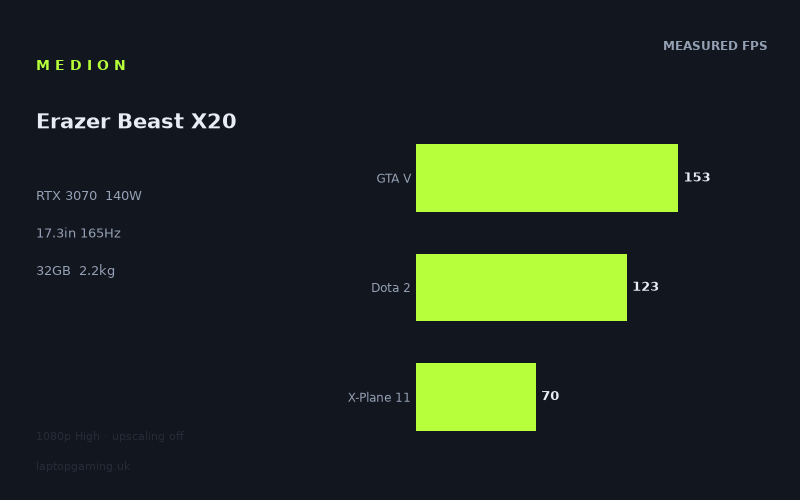
Frame rates
1920×1080, High preset, upscaling off.
Measured on this machine. Source: Notebookcheck, 2021-07-10.
Not scored: incomplete benchmark suite
Every scored laptop on this site is averaged over the same 5 games, and this one is short of Cyberpunk 2077, Baldur's Gate 3. A mean over 5 games is not comparable to a mean over 5, so we publish the figures we have and leave the score blank rather than rank it against machines tested on a different set. The numbers below are real - the suite is just incomplete.
How these numbers were produced
Frame rates here are not measured by us, and we label how each one was arrived at. A figure marked measured comes from a published run on that exact machine. A figure marked representative is derived from the GPU and its power limit (TGP) and cross-referenced against published reviews - a sound estimate of what that configuration delivers, but not a measurement of that specific laptop. Unless stated otherwise, numbers are 1920x1080, High preset, upscaling off. Where a laptop ships in several power configurations we use the wattage of the exact SKU listed, because a 140W RTX 5070 and a 115W one are not the same product.
In use
The short version
The Medion Erazer Beast X20 is a very capable high-refresh gaming laptop on the evidence that matters most: its published game results. Its RTX 3070 runs at a 140W GPU power limit, paired with a Core i7-10870H and 32GB of memory, and Notebookcheck’s benchmark data shows a machine that is comfortably quick at 1920x1080 on the High preset with upscaling disabled. The measured figures range from 70fps in X-Plane 11 to 192fps in Strange Brigade, with a 126fps mean across the scoring-suite games.
That is enough performance for the X20 to make good use of its 165Hz screen in lighter and better-scaling games, while still delivering clearly smooth results in the more demanding titles. It is not a laptop that reaches the panel’s maximum refresh rate in every game, nor should it be judged as one. The more important result is that its lower figures are still well above the level where a modern game feels constrained by basic performance. X-Plane 11 is the notable exception in the measured list, at 70fps, and it is a reminder that a powerful graphics chip does not remove every CPU-heavy or simulation-heavy limitation.
The display specification is ambitious for the hardware: a 17.3in IPS panel at 2560x1440 and 165Hz. The published frame rates are at 1920x1080 rather than the panel’s native resolution, so they should not be presented as native-resolution results. Still, they establish an important baseline. If the laptop can deliver 180fps in The Witcher 3, 153fps in GTA V and 140fps in Hitman 3 at the benchmark settings, it has the headroom for high-refresh play where the game and settings allow it. The more demanding results, including 92fps in Final Fantasy XV and 70fps in X-Plane 11, show where chasing the full panel refresh rate is less realistic without changing settings or resolution.
This is not an automatic buying recommendation because there is no confirmed UK price for this exact configuration. That means no overall score can be calculated: value accounts for part of that assessment, and it cannot be judged responsibly without a price. The benchmark suite is complete and the X20 ranks normally on the frame-rate leaderboard; the missing score is about unavailable pricing, not a performance problem.
For a buyer who wants a large-screen RTX 3070 laptop, values strong 1080p results, and is prepared to treat 2560x1440 as a resolution to balance against settings rather than a guaranteed maximum-detail target, the Beast X20 has a convincing case. It is particularly attractive for players whose library includes games such as Strange Brigade, The Witcher 3, GTA V, Dota 2, Far Cry 5 and Dirt 5, where the measured results are already well into high-refresh territory. It is less straightforward for someone buying solely for uncompromised native-resolution gaming at 165Hz, or for someone whose main games resemble X-Plane 11 more than the faster titles in the list.
Performance
What the benchmark data says
Notebookcheck measured the Medion Erazer Beast X20 at 1920x1080, using the High preset with upscaling disabled. That is a useful test condition because it avoids treating an upscaling mode as if it were raw graphics performance. The figures represent the machine’s output without that additional assistance, and they show a strong spread across a varied group of games.
- Strange Brigade: 192fps
- The Witcher 3: 180fps
- GTA V: 153fps
- Hitman 3: 140fps
- Gears Tactics: 127fps
- Days Gone: 123fps
- Dota 2: 123fps
- Yakuza Like a Dragon: 113fps
- Far Cry 5: 110fps
- Outriders: 108fps
- Dirt 5: 105fps
- Final Fantasy XV: 92fps
- X-Plane 11: 70fps
The scoring-suite mean is 126fps. That headline is useful, but it should not obscure the individual results. A mean tells us that the machine is consistently capable across the selected games; it does not mean every game behaves like the average. The X20 has games that run close to, at, or above the 165Hz display refresh rate, games that sit in a very good triple-digit range without reaching 165fps, and one measured simulation result that is substantially lower than the rest.
At the fast end, Strange Brigade reaches 192fps and therefore exceeds the panel’s 165Hz refresh rate at the published settings. The Witcher 3 follows at 180fps, also above the screen refresh rate. GTA V reaches 153fps, which is just short of the panel maximum but still plainly a high-refresh result. Hitman 3 records 140fps, another figure that fits a fast panel well even though it does not fully saturate 165Hz. These are not marginal results that happen to pass a target by a small amount. They indicate that the RTX 3070 has meaningful performance headroom in these games at the tested resolution and preset.
Gears Tactics, Days Gone and Dota 2 form the next group, at 127fps, 123fps and 123fps respectively. This is where the Beast X20 looks most broadly useful. A result in this region will not turn the 165Hz panel into a permanently maxed-out display, but it gives the machine a high frame-rate character rather than merely a conventional 60fps character. These games are all comfortably beyond the basic standard expected from a gaming laptop, and the 165Hz display has room to show their extra output.
Yakuza Like a Dragon, Far Cry 5, Outriders and Dirt 5 land at 113fps, 110fps, 108fps and 105fps. That is a tightly packed middle range. It is also a better representation of what many buyers should expect from a powerful RTX 3070 laptop than the very highest figures are. The X20 is fast, but it is not universally a 165fps machine at the published settings. In this group, the practical story is smooth high-refresh gaming rather than a fixed promise of matching the panel’s maximum refresh rate.
Final Fantasy XV, at 92fps, remains a good result but marks a more obvious move away from the panel’s ceiling. It should be read as evidence that the configuration still has solid performance in a demanding game, not as evidence that every title will feel identical to the 180fps result in The Witcher 3. The final result, X-Plane 11 at 70fps, is the clearest warning against treating the average as a guarantee. Flight simulation workloads can behave very differently from the faster games in the benchmark list, and this machine’s result shows that a Core i7-10870H and RTX 3070 combination can still encounter a substantially lower performance ceiling in that kind of game.
The significance of the 140W GPU power limit
The RTX 3070 designation alone does not tell the whole performance story in gaming laptops. The Medion’s graphics chip has a 140W GPU power limit, and that is an important part of why its published results are strong. Laptop GPUs with the same name can be configured differently, and the power limit affects how much room the GPU has to sustain performance. Here, the 140W figure is not an abstract specification-table detail: it sits behind a set of results that includes 192fps in Strange Brigade, 180fps in The Witcher 3, 153fps in GTA V and 140fps in Hitman 3.
It is still important not to turn the 140W rating into a claim that the X20 will always beat every other RTX 3070 laptop. The comparison data does not support that. Against the Gigabyte A7 X1, also equipped with an RTX 3070, the Medion averages +0fps across the shared games. That is not a typo and it is not a result to dismiss because it is inconvenient. It demonstrates that the GPU name, power limit, game workload, processor behaviour and the particular shared game selection all matter. A 140W RTX 3070 is capable hardware, but specifications alone do not produce a guaranteed ranking in every matchup.
What the 140W configuration does establish is that the X20 should not be treated as a low-power interpretation of the RTX 3070. The benchmark data supports the opposite conclusion. It produces a 126fps mean across the scoring-suite games, has a broad collection of results above 100fps, and reaches or surpasses 165Hz in the lighter and better-scaling examples. For a laptop intended to drive a 2560x1440, 165Hz display, that is the right kind of performance profile. It does not remove the need to make settings choices in heavier games, but it gives the machine the performance base to make those choices meaningful.
The 140W figure also matters when comparing the X20 with laptops that have more expensive-looking GPU labels. The Medion’s RTX 3070 is not automatically outclassed simply because another machine uses an RTX 3080. Against the Medion Erazer Beast X25 with an RTX 3080 at 130W, the X20 averages -0fps across the shared games. In the benchmark set used for that comparison, there is effectively no separation. That does not prove that the RTX 3070 and RTX 3080 are identical in every laptop or every game. It does show that, for these measured shared titles, the Beast X20’s GPU configuration is not giving away practical frame-rate performance to that specific RTX 3080 rival.
The contrasting result against the MSI Raider GE77 HX makes the power discussion more useful. That machine has an RTX 3080 Ti at 175W and averages -43fps for the Medion across the shared games. Here, the Medion is clearly behind. The Raider’s higher-tier GPU and 175W rating produce a substantial advantage in the available comparison data. This is the appropriate way to understand power limits: not as a shortcut that replaces benchmarks, but as a key part of explaining why machines with related GPU names can be close in one matchup and decisively different in another.
Where the 165Hz panel is genuinely useful
The Beast X20’s screen refresh rate is 165Hz. The benchmark data shows several distinct levels of suitability for that panel. Strange Brigade at 192fps and The Witcher 3 at 180fps are the clearest matches. At the published 1920x1080 High setting, both results exceed 165Hz. A player concentrating on those games can expect the panel’s high refresh capability to be relevant rather than decorative.
GTA V at 153fps and Hitman 3 at 140fps are also well suited to a 165Hz screen. Neither reaches the panel maximum in the reported result, but both are far closer to it than to conventional lower-refresh targets. In practical buying terms, these are the kinds of figures that justify selecting a fast panel over a basic display. The X20 has enough performance to make the screen specification feel proportionate in these games.
The 127fps, 123fps and 123fps results in Gears Tactics, Days Gone and Dota 2 should not be described as failures to use the screen. A 165Hz display does not become pointless whenever a game is below 165fps. Instead, these figures show that the machine can output well beyond a standard frame-rate level, even if it does not permanently meet the panel’s ceiling. The same is true of Yakuza Like a Dragon at 113fps, Far Cry 5 at 110fps, Outriders at 108fps and Dirt 5 at 105fps. The screen has more refresh capacity than these measured results require, but the laptop is still supplying a high frame rate.
Final Fantasy XV at 92fps and X-Plane 11 at 70fps are where the screen’s 165Hz specification becomes less central to the buying experience. These results are not poor in isolation. They are simply far enough below 165fps that buying the X20 specifically to maximise the refresh rate in every game would be the wrong expectation. The display remains a quality match for the machine’s strongest titles, but the game-specific benchmark spread must guide expectations.
Why the spread is so wide
The difference between 192fps in Strange Brigade and 70fps in X-Plane 11 is not evidence that the test data is inconsistent. It is the point of using a broad benchmark list. Games have different graphics workloads, engines, CPU demands and scaling behaviour. The Beast X20 does not run every game in the same way because the games themselves do not ask the hardware to do the same work.
Strange Brigade, The Witcher 3, GTA V and Hitman 3 show the X20 at its most convincing. Their results demonstrate what the RTX 3070 at 140W can achieve when a game allows the configuration to run freely at the tested settings. The cluster around 100fps in Yakuza Like a Dragon, Far Cry 5, Outriders and Dirt 5 shows a different but still very strong result: these games are demanding enough to prevent the laptop from reaching the display limit, yet not demanding enough to make the machine feel underpowered.
X-Plane 11 is the outlier at 70fps, and it deserves to remain an outlier in the analysis rather than being averaged away. A buyer focused on flight simulation should take that result more seriously than the 126fps mean. A buyer focused on the games at the fast end of the list should give more weight to the results that resemble their own library. This is why a long benchmark list is more useful than a single average. The average gives a summary; the individual figures tell a buyer whether the summary applies to them.
The shared-game rival comparisons provide another explanation for apparently surprising results. The Beast X20 averages +0fps against the Gigabyte A7 X1 and -0fps against the Medion Erazer Beast X25. At 1080p, the lighter titles in the shared set can become CPU-bound and compress genuine GPU gaps. A near-zero difference is therefore a real result, not a reason to assume the comparison is meaningless. It says that in those particular shared games, at the benchmark conditions used, the available graphics performance is not the only factor controlling the final frame rate.
That CPU-bound behaviour is especially relevant to buyers who see an RTX 3080 or RTX 3080 Ti label and assume it must create a fixed advantage in every title. The Beast X25 comparison shows why that assumption is unsafe. The Raider GE77 HX comparison shows the other side: where the higher-tier, 175W RTX 3080 Ti can stretch its legs in the shared set, the gap is large. The lesson is not that hardware specifications do not matter. It is that game benchmarks are needed to show where and when they matter.
The screen
A high-spec display paired with a strong, but not unlimited, GPU
The Medion Erazer Beast X20 uses a 17.3in IPS display with a 2560x1440 resolution and 165Hz refresh rate. That is a desirable combination for a gaming laptop intended to serve both fast games and more visually demanding single-player titles. The panel is large, the resolution is higher than the benchmark resolution, and the refresh rate gives the machine room to show the high frame rates recorded in several games.
The important qualification is that Notebookcheck’s published gaming figures are at 1920x1080, not at the screen’s native 2560x1440. It would be misleading to describe 192fps in Strange Brigade or 180fps in The Witcher 3 as native 2560x1440 results. They are not. They show what the machine achieved at the stated benchmark resolution and High preset with upscaling disabled.
That distinction matters more on this machine than it would on a laptop with a 1920x1080 panel. The X20’s screen gives the buyer a choice: use the native 2560x1440 resolution where image detail is the priority, or use 1920x1080 where higher frame rates are more important. The fact sheet does not provide native-resolution benchmark figures, so there is no basis for assigning a specific frame rate to either mode beyond the published 1920x1080 results. The right conclusion is not that native resolution will be unsuitable, nor that it will always maintain 165Hz. The available data simply cannot settle that question game by game.
What can be said confidently is that the 165Hz refresh rate is not wasted at 1920x1080. Strange Brigade and The Witcher 3 exceed it, while GTA V and Hitman 3 come close enough to make the fast panel meaningful. The X20 is not one of those machines where a high-refresh screen sits above a GPU that rarely reaches beyond a modest frame rate. Its strongest measured results actively support the panel specification.
The middle of the benchmark table gives a more balanced picture. Gears Tactics at 127fps, Days Gone at 123fps, Dota 2 at 123fps, Yakuza Like a Dragon at 113fps, Far Cry 5 at 110fps, Outriders at 108fps and Dirt 5 at 105fps do not fill every one of the panel’s 165Hz opportunities. They still make use of a fast screen far more effectively than results limited to basic frame-rate territory. This is a good match for someone who values a responsive, high-frame-rate presentation but does not demand that every game numerically reach the refresh limit.
For Final Fantasy XV and X-Plane 11, the display should be seen differently. At 92fps and 70fps, respectively, the primary advantage is not that the laptop reaches 165Hz but that the screen is capable of displaying more than the game is producing without becoming the limitation. Again, the X20’s display is not the bottleneck in the published results. The game workload is.
IPS and the limits of the available evidence
The panel type is IPS. That is all the fact sheet establishes about panel characteristics beyond size, resolution and refresh rate. There are no supplied figures for brightness, contrast, colour coverage, response times, backlight behaviour or outdoor usability. Those are important screen considerations, particularly on a 17.3in gaming laptop, but they cannot be filled in with assumptions.
It would therefore be wrong to claim that the panel is especially bright, colour-accurate, fast in pixel response, or suitable for a particular kind of content work. The safe and useful assessment is narrower. The X20 has a large IPS display with a 2560x1440 resolution and 165Hz refresh rate, and its published 1920x1080 gaming results are sufficiently high in many games to justify the high-refresh specification.
The screen is best understood as a flexible target rather than a promise of one fixed experience. It can support a player who prioritises high frame rates in games such as Strange Brigade, The Witcher 3, GTA V and Hitman 3. It can also support a player who prefers the additional desktop space and image detail implied by 2560x1440, provided they accept that the supplied benchmark data does not tell us exactly how every game performs at that resolution. That flexibility is a strength, but it requires sensible expectations from the buyer.
Build, size and portability
The Medion Erazer Beast X20 weighs 2.246kg. That places it firmly in the category of a substantial gaming laptop rather than an ultra-light portable. It is not an unreasonable weight for a machine with a 17.3in display, 91Wh battery, Core i7-10870H, 32GB of memory and RTX 3070 at 140W, but it should shape the buying decision.
This is most naturally a laptop for a desk, a regular gaming position, or movement between established locations. It can be transported, but the specification does not suggest a machine bought primarily because it disappears into a bag. A buyer travelling frequently with a laptop all day should take 2.246kg seriously before deciding that a 17.3in gaming model is the right format. A buyer moving the laptop between rooms, taking it to occasional events, or carrying it between home and another fixed location may find the trade-off much more reasonable.
The fact sheet does not provide chassis dimensions, so there is no basis for claiming that it is thin, compact, unusually deep, especially wide, or easy to fit into a particular bag. The screen size alone tells us that this is a larger-format laptop, but it does not substitute for actual physical dimensions. Similarly, there are no supplied measurements for temperatures or fan noise. The 140W GPU power limit is relevant to performance, but it cannot be used as evidence of a particular cooling result without published thermal or acoustic figures.
The 91Wh battery is a substantial specification on paper, but the fact sheet does not provide measured battery life. It would be irresponsible to turn battery capacity into a claimed number of hours. Gaming laptops can behave very differently depending on workload, display settings and power mode, and no battery result is available here. Buyers who need a laptop for long unplugged use should not assume that a 91Wh battery alone answers that requirement.
The same caution applies to build quality, keyboard feel, trackpad quality, ports, upgrade access, speakers and webcam performance. None of these details are in the supplied information. The X20 can be assessed confidently as a 2.246kg, 17.3in gaming laptop with a 91Wh battery and strong published gaming performance. It cannot be honestly assessed as a premium-feeling, quiet, cool-running, travel-friendly or upgrade-friendly laptop without evidence.
That may sound restrained, but it is the sensible way to buy a gaming laptop. Performance is only one part of the ownership experience, and the available data makes a strong case on performance. It does not justify inventing confidence in the areas where measurements and specifications have not been supplied.
How it compares
Against the MSI Prestige 15
The MSI Prestige 15 uses an RTX 3050 Ti at 105W. Across the shared games, the Medion Erazer Beast X20 averages +56fps. This is the largest positive gap in the listed comparisons and it is substantial enough to define the relationship between the two machines.
The difference is not merely that the Beast X20 has a higher RTX model number. The Medion also has a 140W GPU power limit, compared with 105W for the Prestige 15’s RTX 3050 Ti. The published shared-game comparison shows the practical consequence: the Beast X20 is in a materially higher gaming-performance class on the data available.
For someone choosing between these two machines mainly for gaming, the Medion’s advantage is clear. A +56fps average across the shared games changes the type of screen a laptop can sensibly support and the sort of performance expectations a buyer can have. The X20’s 165Hz, 2560x1440 display is paired with results that include many triple-digit figures. The Prestige comparison establishes that the Medion is not only faster in a technical sense; it has considerably more room for high-refresh gaming.
There is no confirmed UK price for either exact configuration in the fact sheet, so this is not a value comparison. It is a performance comparison only. On that basis, the Beast X20 is decisively ahead.
Against the Gigabyte A7 X1
The Gigabyte A7 X1 also uses an RTX 3070. Across the shared games, the Beast X20 averages +0fps. This is a genuine near-zero result, and it deserves interpretation rather than repetition.
At 1080p, lighter titles in the shared set can be CPU-bound and compress genuine GPU gaps. That means a small or non-existent average difference does not prove that every component of the two laptops is identical, nor does it prove that their GPUs will behave identically in every game, at every setting or at every resolution. It does mean that for the available shared games, under the comparison conditions, neither machine establishes a frame-rate lead over the other.
For a buyer selecting purely on the evidence given here, there is no gaming-performance reason to choose the Medion over the Gigabyte or vice versa. Other factors would need to decide the purchase, but the supplied facts do not include enough information about pricing, dimensions, battery life, noise, temperatures or other usability details to make that decision. The proper conclusion is simple: the X20 and A7 X1 are effectively level in their shared measured games.
Against the Medion Erazer Beast X25
The Medion Erazer Beast X25 uses an RTX 3080 at 130W. Despite the higher RTX designation, the Beast X20 averages -0fps across the shared games. The comparison uses a larger shared set than the Gigabyte matchup, and the outcome is again effectively level.
This is a useful corrective to simplistic GPU shopping. The RTX 3080 label might lead a buyer to expect an automatic, visible gaming lead over the RTX 3070-equipped X20. The shared-game benchmark data does not show one. In these games, at the stated comparison conditions, the Beast X20’s RTX 3070 at 140W keeps pace with the Beast X25’s RTX 3080 at 130W.
The explanation should not be overstated. The available information does not prove that the Beast X20 will match the Beast X25 in every untested game, at native 2560x1440, or in workloads outside the shared set. It does prove something valuable: a buyer should not pay attention to GPU naming alone and assume that the X25 is necessarily faster in the games that matter to them. The measured shared result says there is no practical frame-rate separation here.
Again, no price comparison is possible from the supplied information. If pricing eventually differs, it may change the purchase decision. Without it, the performance conclusion stands on its own: the X20 does not trail the Beast X25 in the shared benchmark data.
Against the MSI Raider GE77 HX
The MSI Raider GE77 HX is the machine that most clearly outperforms the Beast X20 in the listed rivals. It uses an RTX 3080 Ti at 175W, and the Medion averages -43fps across the shared games.
This is a large enough difference that it should not be explained away as benchmark noise or a quirk of one light game. The Raider’s RTX 3080 Ti and 175W GPU power limit represent a substantially more powerful gaming proposition in the available comparison. Where the Beast X20 has a 126fps scoring-suite mean and many strong triple-digit results, the Raider has a clear performance advantage in the shared titles.
That does not make the Beast X20 slow. It simply places it correctly in the hierarchy. The Medion can match an RTX 3070 rival and an RTX 3080 at 130W in the shared data, while it cannot match the much more powerful RTX 3080 Ti at 175W in the Raider. This is exactly the kind of distinction buyers need before treating every high-end gaming laptop as interchangeable.
There is no confirmed UK price for the exact Raider configuration in the fact sheet, so there is no basis for saying whether its extra performance is worth paying for. The evidence supports only the performance conclusion: if the priority is the highest available frame rate among these named machines, the Raider is ahead. If the question is whether the Beast X20 is still powerful in its own right, the Medion’s benchmark list answers yes.
Who it’s for
Buy the Beast X20 if your priority is strong high-refresh gaming
The Medion Erazer Beast X20 suits a buyer who wants high frame rates from a large-screen gaming laptop and is willing to use the available performance intelligently. The strongest match is someone playing games that resemble Strange Brigade, The Witcher 3, GTA V and Hitman 3 at the benchmark settings. Those results of 192fps, 180fps, 153fps and 140fps make a convincing argument for the 165Hz screen.
It also suits a player whose library contains a broad mix of titles rather than only the most demanding simulation-style workloads. Gears Tactics, Days Gone, Dota 2, Yakuza Like a Dragon, Far Cry 5, Outriders and Dirt 5 all sit from 105fps to 127fps in the published results. That is a consistently strong middle range. It gives the X20 the kind of all-round gaming performance that makes a large, high-refresh display worthwhile across many genres.
The laptop also makes sense for someone who understands the value of a 140W RTX 3070 configuration. The Beast X20 is not relying on a GPU badge without evidence behind it. Its benchmark results are strong, it is level with the Gigabyte A7 X1 in the shared games, and it is also effectively level with the RTX 3080-equipped Medion Erazer Beast X25 in their shared games. Buyers who care about published performance rather than specification-table assumptions should find that reassuring.
The 32GB memory configuration is another clear fit for buyers who do not want a minimal-memory gaming setup. The fact sheet does not provide application benchmarks beyond games, so it should not be sold as proof of a particular professional-work performance level. But for a buyer who wants a gaming laptop configured with 32GB rather than a lower capacity, it is a meaningful part of the package.
Finally, the X20 is suited to someone who expects to use the machine mostly in places where its 2.246kg weight is acceptable. It is best treated as a powerful large-format laptop that can move when needed, not as a machine selected chiefly for effortless daily carrying. The 17.3in screen and RTX 3070 at 140W are strengths that make more sense for desk use and regular plugged-in gaming than for constant travel.
Buy something else if you need native-resolution certainty
A buyer who wants guaranteed 2560x1440 performance at the display’s 165Hz refresh rate should not buy the Beast X20 based on these figures alone. The published data is at 1920x1080. There are no supplied native-resolution results, and it would be wrong to infer them numerically. The X20 plainly has strong 1080p performance, but the evidence does not prove that every measured title will run at native resolution while maintaining 165Hz.
This is especially important for buyers whose priorities are image detail first and frame rate second. The screen’s 2560x1440 resolution is appealing, but the benchmark evidence does not show what the performance trade-off will be for each game. Someone unwilling to adjust settings, resolution or expectations in more demanding titles should seek measured native-resolution data before committing.
Buy something else if your main game resembles X-Plane 11
X-Plane 11 records 70fps, the lowest result in the list. That is not a reason to reject the X20 for all gaming, but it is a very relevant result for a buyer focused on that type of workload. The machine’s 126fps scoring-suite mean and its 192fps Strange Brigade result should not override the actual figure in the game most similar to the one a buyer intends to play.
A flight-simulation-focused buyer should therefore place more weight on the 70fps X-Plane 11 result than on the faster results elsewhere. The X20 remains capable, but the published data does not support portraying it as a machine that will always exploit 165Hz in simulation-heavy gaming.
Buy something else if maximum performance is the only goal
The MSI Raider GE77 HX is ahead by 43fps on average across the shared games. A buyer who simply wants the highest frame rates among the named laptops should recognise that the Beast X20 is not the top-performance option in that comparison. The Raider’s RTX 3080 Ti at 175W produces a clear lead.
There is no confirmed UK price for either exact configuration in the supplied information, so this is not an instruction to spend more on the Raider. It is a straightforward performance distinction. The Beast X20 is strong, but it is not the highest-performing machine in every comparison.
Buy something else if low weight or battery evidence is essential
The X20 weighs 2.246kg and has a 17.3in display. Buyers looking for a small, light machine for constant commuting or frequent all-day carrying should look carefully at whether that format fits their routine. The fact sheet provides no dimensions and no measured battery-life figure, so it cannot support a claim that the X20 is especially portable or long-lasting away from mains power.
The 91Wh battery capacity is worth noting, but capacity is not battery life. Anyone whose purchase depends on a proven unplugged runtime should choose based on published battery measurements rather than infer one from the battery specification.
Overall, the Medion Erazer Beast X20 is a strong gaming laptop whose best evidence is its benchmark spread. The RTX 3070 at 140W delivers high frame rates in many games, makes meaningful use of the 165Hz display in the fastest titles, and remains competitive with specific RTX 3070 and RTX 3080 rivals in the available shared-game data. Its limits are equally clear: the figures are at 1920x1080 rather than native 2560x1440, X-Plane 11 is much lower than the rest of the list, and a 175W RTX 3080 Ti rival is substantially faster. For the right buyer, those are not deal-breakers. They are the information needed to buy the machine for what it demonstrably does well.