Details
Product prices and availability are accurate as of the date/time indicated and are subject to change. Any price and availability information displayed on Amazon.co.uk at the time of purchase will apply to the purchase of this product.Review
MSI Stealth 16 AI review
Frame rates
1920×1080, High preset, upscaling off.
Measured on this machine. Source: Notebookcheck, 2026-10-03.
Not scored: incomplete benchmark suite
Every scored laptop on this site is averaged over the same 5 games, and this one is short of Baldur's Gate 3. A mean over 4 games is not comparable to a mean over 5, so we publish the figures we have and leave the score blank rather than rank it against machines tested on a different set. The numbers below are real - the suite is just incomplete.
How these numbers were produced
Frame rates here are not measured by us, and we label how each one was arrived at. A figure marked measured comes from a published run on that exact machine. A figure marked representative is derived from the GPU and its power limit (TGP) and cross-referenced against published reviews - a sound estimate of what that configuration delivers, but not a measurement of that specific laptop. Unless stated otherwise, numbers are 1920x1080, High preset, upscaling off. Where a laptop ships in several power configurations we use the wattage of the exact SKU listed, because a 140W RTX 5070 and a 115W one are not the same product.
In use
The short version
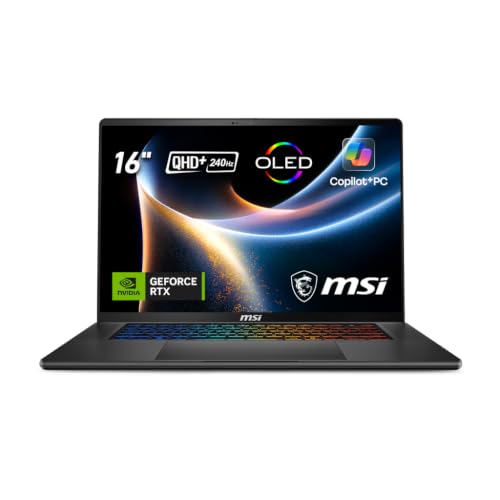
The MSI Stealth 16 AI is a powerful but expensive 16in gaming laptop built around an RTX 5070 Ti running at a 125W GPU power limit, a Core Ultra 9 386H, 32GB of memory and a 1TB SSD. Its measured results are good: Notebookcheck recorded 238fps in F1 24, 150fps in Final Fantasy XV, 148fps in Dota 2, 132fps in GTA V, 131fps in Cyberpunk 2077, 85fps in X-Plane 11 and 71fps in Black Myth: Wukong. Those are credible figures for a machine intended to play demanding games well rather than merely claim a high-end GPU badge.
The complication is price. At £2,799, the Stealth 16 AI asks for a substantial premium, yet its benchmark position is not as simple as “pay more, get more”. It is effectively tied with the Asus ROG Zephyrus G16 2025 5070 Ti in the shared results, despite the MSI’s higher stated GPU power limit, and it is also effectively tied with the Gigabyte Gaming A16’s RTX 5070 in the available shared games. That does not mean the RTX 5070 Ti is no better than an RTX 5070 in every situation. It means the measured 1080p High results available here do not establish a meaningful gap between these specific laptops.
There is a more obvious advantage over the MSI Cyborg 15 with RTX 5050 hardware: the Stealth averages 30fps more across the four games they share. But the Cyborg 15 costs £1,029, while the Stealth costs £2,799. The MSI Stealth 16 AI is unquestionably the faster machine in that comparison, but its asking price is not justified by a simple frame-rate-per-pound argument. It is a purchase for someone who specifically wants the stronger GPU configuration, 32GB of memory, 1TB of storage, a 16in 2560x1600 240Hz display and a relatively manageable 2.033kg weight in one machine.
The measured data also says something important about expectations. The 240Hz panel is not a promise that modern games will run at 240fps. F1 24 comes close, at 238fps, but the other measured games do not. Final Fantasy XV reaches 150fps, Dota 2 reaches 148fps, GTA V reaches 132fps and Cyberpunk 2077 reaches 131fps. Those are all high frame rates and should suit players who value fluid movement and responsive input, but they are still well below the display’s maximum refresh rate. X-Plane 11 at 85fps and Black Myth: Wukong at 71fps make the point more sharply: demanding or unusually CPU-sensitive games can produce a completely different experience from lighter racing, esports and older blockbuster titles.
Buy the Stealth 16 AI if the appeal is a strong all-round specification in a 2.033kg 16in machine, and if you understand that the available performance figures were measured at 1920x1080 on the High preset with upscaling disabled. That last condition matters. The laptop’s own screen is 2560x1600, so the published figures are not native-resolution frame rates for its display. They are useful, attributable evidence of the laptop’s performance, but they should not be treated as a guarantee of what every game will deliver at 2560x1600.
Do not buy it merely because it has a 240Hz panel, because the benchmark data does not support the idea that it will fill that panel in every modern game. Do not buy it expecting it to challenge the fastest RTX 5090 gaming laptops either. The Schenker XMG Neo 16 A25 is 70fps ahead on average across the four games both machines hold, which is a large separation even before considering that the Stealth is already positioned at £2,799. The Stealth 16 AI is a high-performance portable gaming laptop, not a no-compromise desktop replacement.
There is also no overall rating to print here. The benchmark suite is incomplete because there is no Baldur’s Gate 3 result. Every fully scored laptop is averaged across the same five games, so it would be misleading to rank this MSI against machines with a complete set of results. The useful conclusion is narrower and more honest: the published figures show a laptop that is fast at 1080p High, especially in F1 24 and the mid-demand games, but whose price and shared-game comparisons leave little room for assuming it is an automatic value choice.
Performance
What the measured figures show
Notebookcheck’s benchmark data was recorded at 1920x1080, using the High preset with upscaling turned off. That is a valuable test condition because it avoids presenting reconstructed or upscaled frame rates as though they were straightforward native rendering results. It also gives a consistent basis for comparing the Stealth 16 AI with the listed rivals where shared-game figures exist. But it is not the same as testing the laptop’s 2560x1600 screen at its native resolution, and it is not evidence for performance in settings presets other than High.
The four-game scoring-suite mean is 124fps across Dota 2, GTA V, Cyberpunk 2077 and X-Plane 11. That headline is useful only if it is read alongside the individual results. The average contains a very wide spread: Dota 2 is measured at 148fps, GTA V at 132fps, Cyberpunk 2077 at 131fps and X-Plane 11 at 85fps. An average can suggest a broadly fast machine, which this is, but it cannot tell a prospective buyer whether the games they actually play sit nearer Dota 2 or nearer X-Plane 11.
Dota 2 at 148fps is a strong result. On the Stealth’s 240Hz display, it does not fully use the available refresh ceiling, but it is high enough to make the panel’s fast refresh meaningful. The result also needs context when comparing laptops: at 1080p, lighter games can become limited more by the CPU and the game engine than by raw GPU horsepower. That is why a shared-game comparison can compress apparent GPU differences. A result around this level should not be used as proof that another laptop with a different GPU is equal in every game or at every resolution.
GTA V at 132fps and Cyberpunk 2077 at 131fps are almost identical results, although the games themselves place different demands on a system. The key buyer-facing conclusion is that the Stealth produces comfortably high triple-digit figures in both under the published test conditions. Neither figure reaches 240fps, so the panel has more headroom than the GPU is delivering in these particular tests. That is not a flaw in the display. It is simply the reality of pairing a 240Hz screen with current games: the screen can show very high frame rates when the game and settings permit them, but it cannot create them.
X-Plane 11 is the outlier in the scoring suite at 85fps. It remains a respectable result, but it is a different class of outcome from the 131fps to 148fps results in the other three games. This is exactly why prospective buyers should resist making a purchase from the mean alone. Someone whose main interests are flight simulation will care much more about the 85fps result than the 124fps four-game mean. Someone playing Dota 2, GTA V and Cyberpunk 2077 will have a substantially different experience from the same laptop at the same published settings.
Outside the scoring suite, F1 24 is the standout at 238fps. That is the closest any listed game comes to the display’s 240Hz refresh rate. It demonstrates that the Stealth 16 AI can deliver extremely high frame rates in a suitable game at 1920x1080 High without upscaling. It is also the clearest case for the 240Hz panel. A measured 238fps is just short of the panel’s stated refresh limit, so this is the title in which the screen’s specification is most directly matched by the benchmark result.
Final Fantasy XV reaches 150fps. Again, that does not fill the 240Hz panel, but it is a strong frame rate and sits close to the Dota 2 result. For a buyer moving from a more modest gaming laptop, this is the kind of result likely to make the Stealth feel convincingly fast. It also reinforces the broader pattern: games that are less punishing than Black Myth: Wukong or X-Plane 11 can run at rates that make a high-refresh display worthwhile, even if they do not reach its maximum.
Black Myth: Wukong, at 71fps, is the clearest warning against reading the RTX 5070 Ti name or the 125W power limit as a guarantee of exceptionally high performance in every modern game. At the tested settings it is playable by the standard implied by the measured figure, but it is far from 240fps and well below the Stealth’s stronger results elsewhere. This is not an unusual contradiction. Games vary considerably in how they use GPU resources, CPU performance and their own rendering technology. The spread from 238fps in F1 24 to 71fps in Black Myth: Wukong is precisely why a responsible review should present the individual figures rather than hide behind a single average.
What the 125W GPU power limit means in practice
The RTX 5070 Ti in this MSI is specified at a 125W GPU power limit. That matters because laptop GPU names are not complete descriptions of performance. The power available to the GPU can influence how much sustained performance a particular implementation can deliver, especially in GPU-limited games. A higher stated power limit is not, however, a universal promise of a proportionately higher frame rate. Cooling design, CPU behaviour, game engine limits, resolution and graphics settings all affect the final result.
The most useful evidence here is the comparison with the Asus ROG Zephyrus G16 2025 5070 Ti, which uses the same GPU model at 120W. Across the three shared games, the Stealth 16 AI averages only 1fps more. That is effectively a tie in the available data. It would be a mistake to turn that into a claim that the additional stated power limit has no value at all; the shared set is limited, and the measurements are at 1080p High. It would be equally mistaken to assume the MSI’s 125W figure automatically makes it materially faster than every 120W RTX 5070 Ti laptop.
The right conclusion is that the available shared-game results do not show a meaningful practical advantage for the MSI over that Asus. At 1080p, particularly in lighter titles, CPU limits can compress genuine GPU gaps. Once a game is waiting on the processor or its own engine rather than the graphics hardware, giving the GPU more available power may not create a visible increase in frame rate. That is not a criticism unique to the Stealth. It is a limitation of using relatively light 1080p tests to separate closely specified high-end laptops.
The comparison with the Gigabyte Gaming A16 is even more striking on paper. That machine uses an RTX 5070 at 85W, while the Stealth has an RTX 5070 Ti at 125W. Yet the MSI averages 1fps behind across the four shared games. The result should not be interpreted as proof that an 85W RTX 5070 is generally faster than a 125W RTX 5070 Ti. It does establish that, in these specific shared games at the published settings, the Stealth does not open a measurable lead. A buyer deciding between these machines needs more than GPU names and power limits; they need game-specific data at the resolution and settings they intend to use.
That is the practical lesson of the power limit. The 125W configuration gives the Stealth a credible basis for strong performance, and the MSI’s own individual results are good. But the power figure is a capability descriptor, not a performance result. Notebookcheck’s measured numbers are the more useful evidence, and those numbers show both the machine’s strengths and the limits of what can be inferred from its specification.
The benchmark spread matters more than the mean
The difference between 238fps in F1 24 and 71fps in Black Myth: Wukong is substantial. So is the gap between the 148fps Dota 2 result and the 85fps X-Plane 11 result. These differences are not noise around one single level of performance. They show that the Stealth’s experience will vary widely with the game being played.
For competitive or relatively light games, the laptop can produce frame rates that are well into high-refresh territory. F1 24 is the clearest example, and Dota 2 also sits at a level where a 240Hz display has obvious potential value even though the measured result does not reach the panel maximum. Players who spend most of their time in those types of games can reasonably prioritise the Stealth’s 240Hz display, assuming they accept that the published figures are at 1920x1080 rather than 2560x1600.
For graphically heavy games, the results are still useful but less extravagant. Cyberpunk 2077 at 131fps is strong at the stated settings, but Black Myth: Wukong at 71fps shows the other side of modern PC gaming: some titles can absorb a great deal more graphics performance. A buyer focused on the most demanding releases should not use the F1 24 result as their expectation for everything else. The Black Myth: Wukong result is the better warning label.
For simulation players, X-Plane 11’s 85fps is especially important. It is not a poor result in isolation. But it is well below the results in the other scoring-suite games, and it means the Stealth’s 240Hz display is not the central story for this kind of workload. If the primary use is simulation rather than racing or competitive gaming, the individual simulation result should carry more weight than the screen’s refresh rate or the overall average.
The four-game mean of 124fps therefore describes the Stealth as generally fast, but it is not a target buyers should expect in every game. It is an arithmetic summary of results ranging from 85fps to 148fps in that suite. The broader seven-game set ranges from 71fps to 238fps. That is a laptop with strong performance, but not a laptop with one predictable performance level.
What cannot be concluded from the available data
There is no published native-resolution benchmark figure here for 2560x1600. The screen has substantially more pixels than the 1920x1080 benchmark setting, so it would be irresponsible to present the 1080p figures as native-screen performance. The Stealth may still be capable of good results at its own resolution, but the fact sheet does not provide the numbers required to quantify that claim.
There are also no battery-life measurements, temperature figures or noise figures in the available information. The laptop has a 90Wh battery, but capacity is not the same thing as measured runtime. It would not be credible to estimate gaming endurance, general-use endurance, fan noise or surface temperatures from the battery capacity and GPU power limit alone.
Likewise, the published results do not establish performance under every graphics setting, every game update or every user-selected configuration. They establish something precise: on the specified date, Notebookcheck measured the listed frame rates at 1920x1080 High with upscaling off. That is enough to make a useful buying judgement, but not enough to substitute speculation for evidence.
The screen
The Stealth 16 AI has a 16in 2560x1600 display with a 240Hz refresh rate. Those are attractive specifications for a premium gaming laptop. The 16in size offers more screen space than a smaller gaming notebook, while the 2560x1600 resolution provides a taller shape than a conventional 1920x1080 panel. The 240Hz refresh rate is clearly aimed at players who care about motion clarity and responsiveness in games capable of sustaining high frame rates.
There is an important limitation to keep in view: the panel type is not provided in the fact sheet. No claim should be made here about contrast, colour coverage, brightness, response times, viewing angles or whether the display uses any particular panel technology. The resolution and refresh rate are known; the wider image-quality characteristics are not.
The screen’s refresh rate is also more ambitious than the benchmark figures in most of the measured games. At 238fps, F1 24 comes very close to making full use of the 240Hz panel. This is the strongest evidence that the display specification is not merely decorative. In the right game at the tested 1920x1080 High setting, the Stealth can deliver frame rates close to the panel’s limit without upscaling.
Final Fantasy XV at 150fps and Dota 2 at 148fps are also good matches for a high-refresh display, even though they fall well short of 240fps. A 240Hz panel does not only benefit games that reach 240fps exactly; it provides headroom above lower-refresh displays and can accommodate variable frame rates. What cannot be claimed from the supplied information is how the panel behaves in those circumstances, because there is no display-response or variable-refresh measurement in the fact sheet.
GTA V at 132fps and Cyberpunk 2077 at 131fps remain high-frame-rate results, but they reinforce the distinction between having a 240Hz screen and being able to drive every game at 240fps. The MSI has enough performance to make these titles feel like high-refresh experiences under the published conditions, but the panel ceiling remains well above the measured output. A buyer whose only aim is to lock modern games to the maximum refresh rate should be cautious about treating the panel specification as a performance promise.
X-Plane 11 at 85fps and Black Myth: Wukong at 71fps are further from the display maximum. Those results do not make the screen inappropriate; they simply show that the 240Hz figure is not the relevant performance metric for every type of game. In these titles, the question is not whether the GPU can saturate the panel. It plainly does not in the published test. The question is whether the measured result is sufficient for the player’s own expectations and preferred settings.
The bigger unresolved question is native resolution. The built-in panel is 2560x1600, but every available game result is measured at 1920x1080. A buyer who intends to use the panel at its full resolution should consider the Notebookcheck data evidence of the laptop’s 1080p High performance, not evidence of 2560x1600 High performance. The difference matters particularly for the titles already below 100fps at 1080p, such as X-Plane 11 and Black Myth: Wukong. There is no supplied benchmark data that allows a precise native-resolution prediction.
For buyers who are content to choose settings according to the game, the screen specification is still a positive. It offers high resolution for desktop work and a high refresh ceiling for games that can exploit it. For buyers who want one fixed native-resolution, maximum-refresh experience across every new demanding game, the benchmark data does not support that expectation.
Build, size and portability
The Stealth 16 AI weighs 2.033kg. That places it in a more portable category than the largest desktop-replacement gaming laptops, but it is still a substantial 16in machine rather than an ultra-light travel laptop. The weight is best understood as a compromise: enough hardware is present to support an RTX 5070 Ti at a 125W GPU power limit, 32GB of memory, a 1TB SSD and a 90Wh battery, while the overall machine remains close enough to 2kg to be regularly moved between home, university, office or travel locations.
For a buyer who intends to keep the laptop permanently on one desk, the 2.033kg figure is unlikely to be decisive. In that scenario, the performance data and price are more important. But for someone who needs a machine that can travel often, the weight has practical value. It is not a claim that the laptop will disappear into a bag; it will not. It is a claim that this is not an obviously immovable high-power chassis based on the supplied weight alone.
No dimensions are provided in the fact sheet. That means there is no evidence for claims about footprint, thickness, bag fit or desk depth. It would be possible for two 16in laptops with similar weight to differ significantly in how much space they occupy, so weight should not be treated as a complete portability measurement.
There is also no information supplied about chassis materials, keyboard layout, touchpad size, port selection, webcam, speakers or upgrade access. These are often important to a buyer spending £2,799, particularly if the machine will be used for work as well as gaming. The specification confirms 32GB of memory and a 1TB SSD, which are sensible capacities for a premium system, but it does not establish whether either component is user-upgradeable or how the laptop is equipped around them.
The 90Wh battery is another example of where precision matters. It is a large stated capacity, but there is no measured battery life figure. Gaming battery life, video playback time, office runtime and idle consumption all depend on conditions not supplied here. The responsible conclusion is simply that the machine has a 90Wh battery, not that it will last for any specific period away from mains power.
Portability also has a performance dimension. A laptop at 2.033kg with a 125W GPU power limit is designed to bring serious gaming hardware into a package that can be moved, not to replace a small lightweight notebook. Someone who wants the lowest carrying weight should look elsewhere. Someone who wants a full 16in screen, 32GB of memory and RTX 5070 Ti-class hardware without stepping into an unspecified larger and heavier category may find the MSI’s balance appealing.
It is worth keeping this balance in proportion to the price. At £2,799, the Stealth is not being bought simply because it is portable. Buyers should want its particular combination of 16in 2560x1600 240Hz screen, 2.033kg weight, 90Wh battery capacity, 32GB of memory, 1TB SSD and strong measured 1080p performance. If portability is the only requirement, the supplied data does not make a case that this is the most economical route. If gaming performance is the only requirement, the rival data also suggests looking carefully at alternatives.
How it compares
Against the MSI Cyborg 15 with RTX 5050
The MSI Cyborg 15 is the clearest lower-cost comparison because it has a confirmed UK price of £1,029. Across the four shared games, the Stealth 16 AI averages 30fps more. That is a meaningful performance advantage. It is not a fractional difference lost in normal benchmark variation, and it supports the view that the Stealth is a stronger gaming machine.
But the price gap is also enormous: £2,799 versus £1,029. The Stealth’s extra performance comes alongside 32GB of memory, a 1TB SSD, a 16in 2560x1600 240Hz screen, a 90Wh battery and a 2.033kg weight, while the supplied information does not give the Cyborg’s equivalent specification. It would therefore be wrong to reduce the choice solely to the 30fps shared-game gap. Even so, the figures make the value problem impossible to ignore. The Stealth is faster, but it costs far more.
The practical buyer split is straightforward. The Cyborg 15 is the alternative for someone with a firm budget ceiling who wants substantially lower upfront cost and accepts lower game performance. The Stealth is for someone who can afford the premium and wants the stronger specification and higher measured frame rates. Neither result means the other machine is irrational; they are aimed at very different spending levels.
What the Stealth cannot claim is to be a budget-conscious upgrade from the Cyborg. Its premium is too large for that. The 30fps shared-game advantage is real, but buyers should decide whether their own games and use case make that advantage worth moving from £1,029 to £2,799.
Against the Asus ROG Zephyrus G16 2025 5070 Ti
The Asus ROG Zephyrus G16 2025 uses the same RTX 5070 Ti GPU, with a 120W power limit rather than the MSI’s 125W figure. Across the three shared games, the Stealth averages 1fps more. In practical terms, the available benchmark data shows no meaningful separation.
This is the comparison that most clearly demonstrates why GPU naming and power limits cannot be treated as a complete buying guide. The MSI has the higher stated GPU power limit, yet the shared figures do not show a useful performance lead. The likely explanation supplied by the benchmark context is that 1080p lighter titles can be CPU-bound, compressing genuine GPU differences. That means the result is real, but it is not a full verdict on every game, resolution or graphical workload.
There is no confirmed UK price for the Asus, so no direct price comparison can be made. That absence matters. If the Asus is priced lower, its effectively tied shared-game performance would make it a serious alternative. If it is priced similarly, the decision would need to turn on specification details not provided here, including the display, memory, storage, dimensions and connectivity. If it is priced higher, the MSI’s comparable performance would become more attractive. Without a confirmed UK price, none of those conclusions can be asserted.
For now, the honest verdict is that the MSI does not establish a measurable gaming-performance advantage over this similarly equipped Asus in the available shared games. Buyers choosing between them should not pay extra for the MSI on the assumption that its 125W RTX 5070 Ti will automatically be decisively quicker.
Against the Gigabyte Gaming A16 with RTX 5070
The Gigabyte Gaming A16 uses an RTX 5070 at 85W. On specification alone, many buyers would expect the Stealth’s RTX 5070 Ti at 125W to be clearly ahead. The shared-game evidence does not show that. Across four shared games, the Stealth averages 1fps behind.
That is not a meaningful performance loss in the usual buying sense, but it is highly relevant to the Stealth’s positioning. At the published 1080p High settings, the MSI fails to produce a discernible lead over a lower-tier GPU configuration in the available comparison. The explanation is not that all RTX 5070 laptops are necessarily equal to all RTX 5070 Ti laptops. The explanation is that benchmark outcomes depend on the full laptop design and the game workload, while 1080p lighter titles can become CPU-bound and compress GPU gaps.
There is no confirmed UK price for the Gigabyte, so it is impossible to make a direct value judgement against the MSI. Still, this is a rival that prospective buyers should take seriously if its local price is lower. A £2,799 laptop must do more than carry an appealing GPU name. In the shared measurements, the Stealth does not demonstrate a meaningful advantage over the Gigabyte.
This comparison is also a reminder to prioritise the games you actually play. If the shared set resembles your library, the MSI’s premium needs justification through its screen, memory, storage, battery capacity, weight or unlisted features rather than a claimed frame-rate lead. If your games are more GPU-limited than the shared set, the available data cannot tell us whether the relationship would change.
Against the Schenker XMG Neo 16 A25 with RTX 5090
The Schenker XMG Neo 16 A25 is the performance ceiling in this comparison group. It uses an RTX 5090 and averages 70fps more than the MSI across the four shared games. Unlike the near-zero gaps against the Asus and Gigabyte, this is a large separation. The Stealth is not competing at the very top end of laptop gaming performance.
That does not make the MSI’s own frame rates weak. They are not. The Stealth reaches 238fps in F1 24, 150fps in Final Fantasy XV and high triple-digit results in Dota 2, GTA V and Cyberpunk 2077 under the stated test conditions. But if a buyer’s priority is extracting the highest possible performance from the latest demanding games, the Schenker’s shared-game lead shows what a higher class of GPU can deliver.
There is no confirmed UK price for the Schenker, so the comparison cannot become a straightforward value calculation. The RTX 5090 machine may cost far more, and there may be major differences in size, weight, cooling or specification that are not listed here. The point is not that every Stealth buyer should buy the Schenker. The point is that buyers paying £2,799 should be clear about the category they are entering: this MSI is premium, but it is not the published-performance leader among the cited rivals.
For portability-minded buyers, the Stealth’s 2.033kg weight may still be a reason to prefer it, though no weight figure is supplied for the Schenker in this comparison. For buyers who mainly want maximum frame rates, the 70fps shared-game advantage is much more important than the Stealth’s slim-sounding product name.
Who it’s for
The MSI Stealth 16 AI is for the buyer who wants a premium 16in gaming laptop with a strong core specification and can afford £2,799 without treating it as a frame-rate-per-pound purchase. The combination of RTX 5070 Ti graphics at a 125W power limit, Core Ultra 9 386H processor, 32GB of memory, 1TB SSD, 2560x1600 240Hz screen, 90Wh battery and 2.033kg weight is coherent. It is built around the idea of carrying capable gaming hardware more easily than a traditional heavyweight desktop replacement while retaining a large, high-refresh display.
It is particularly suitable for players whose game library includes titles resembling F1 24, Final Fantasy XV, Dota 2, GTA V and Cyberpunk 2077 at the tested settings. The measured results in those games range from 131fps to 238fps. That is enough performance to make high-refresh gaming a realistic part of the experience, especially in F1 24, which reaches 238fps. Dota 2 at 148fps and Final Fantasy XV at 150fps also make a good case for the 240Hz panel, even without fully saturating it.
It also suits someone who values 32GB of memory and a 1TB SSD as part of the initial specification. The fact sheet does not provide upgrade information, so this should not be read as a claim about future expansion. It is simply a recognition that the supplied starting configuration is more generous than a bare-minimum gaming specification and better aligned with a buyer expecting to keep a premium machine for substantial work and gaming use.
The Stealth is less suitable for the shopper whose main priority is value. The MSI Cyborg 15 comparison is the obvious warning: the Stealth is 30fps faster across four shared games, but the Cyborg’s confirmed price is £1,029 against the Stealth’s £2,799. The MSI offers more performance and a higher-end overall specification, but it is not remotely close on entry cost. Buyers who want competent gaming for the lowest outlay should start with cheaper alternatives, not work backwards from this model.
It is also not the right choice for someone who assumes an RTX 5070 Ti at 125W must decisively outperform every lower GPU tier. The Gigabyte Gaming A16’s RTX 5070 at 85W is effectively tied in the shared games, with the Stealth averaging 1fps behind. The Asus ROG Zephyrus G16 2025 with an RTX 5070 Ti at 120W is also effectively tied, with the MSI averaging 1fps ahead. These results do not erase the MSI’s strengths, but they do mean buyers should compare actual measurements rather than specifications in isolation.
Players whose priority is the most demanding games should consider the Black Myth: Wukong result carefully. At 71fps, it is well below the laptop’s 240Hz refresh rate and well below its results in F1 24 or Final Fantasy XV. This is still a useful result, but it is not evidence that the Stealth can offer ultra-high-refresh performance in every visually intensive game. Buyers who want the biggest possible headroom for the hardest workloads should look toward machines that establish a clearer lead, such as the Schenker XMG Neo 16 A25, which is 70fps ahead on average in their four shared games.
Simulation-focused buyers should likewise give disproportionate attention to X-Plane 11 at 85fps rather than to the 124fps four-game mean. The Stealth is not slow in that title, but the result is materially lower than its Dota 2, GTA V and Cyberpunk 2077 results. A simulation player should buy according to simulation data, not an average inflated by games that behave very differently.
Buy something else if you need verified battery endurance, verified noise levels, verified temperatures, chassis dimensions or detailed screen-quality measurements. None of those measurements is present in the fact sheet. The 90Wh battery capacity, 2.033kg weight and 16in screen reveal part of the portability picture, but not all of it. At £2,799, it is reasonable to demand that those unanswered questions are checked before purchase rather than guessed at.
Buy something else if your goal is guaranteed native 2560x1600 gaming performance at the panel’s 240Hz maximum. The available figures are all at 1920x1080 High with upscaling off. F1 24 at 238fps comes close to the refresh ceiling at that benchmark resolution, but no supplied result establishes the same outcome at 2560x1600. The gap between benchmark resolution and panel resolution is too important to ignore.
For the right buyer, then, the MSI Stealth 16 AI is a capable premium gaming laptop with a genuinely strong 1080p High benchmark record and an attractive portable-performance specification. For the wrong buyer, it is an expensive machine whose GPU label and 240Hz display can encourage unrealistic assumptions. The evidence supports buying it for its balanced configuration, 2.033kg weight and strong measured results in the games that favour it. The evidence does not support buying it on the belief that it dominates similarly positioned RTX 5070 Ti systems, that it clearly beats every RTX 5070 laptop, or that it will turn every demanding game into a 240fps experience.