Review
MSI GP66 Leopard review
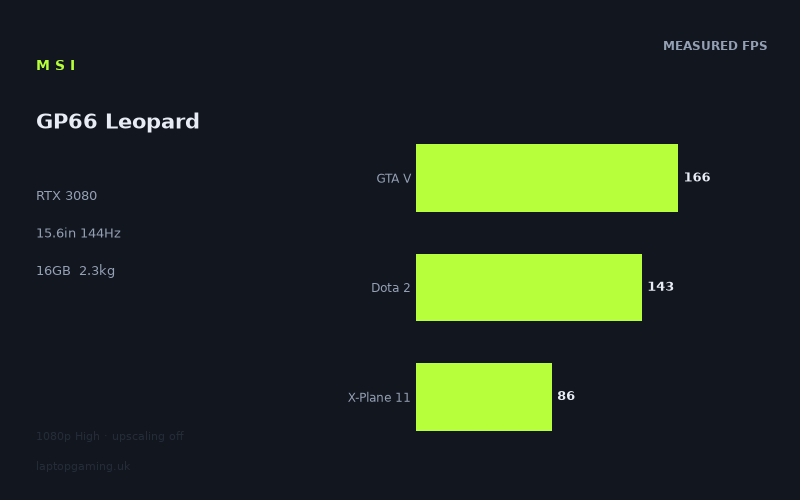
Frame rates
1920×1080, High preset, upscaling off.
Measured on this machine. Source: Notebookcheck, 2021-12-15.
Not scored: incomplete benchmark suite
Every scored laptop on this site is averaged over the same 5 games, and this one is short of Cyberpunk 2077, Baldur's Gate 3. A mean over 4 games is not comparable to a mean over 5, so we publish the figures we have and leave the score blank rather than rank it against machines tested on a different set. The numbers below are real - the suite is just incomplete.
How these numbers were produced
Frame rates here are not measured by us, and we label how each one was arrived at. A figure marked measured comes from a published run on that exact machine. A figure marked representative is derived from the GPU and its power limit (TGP) and cross-referenced against published reviews - a sound estimate of what that configuration delivers, but not a measurement of that specific laptop. Unless stated otherwise, numbers are 1920x1080, High preset, upscaling off. Where a laptop ships in several power configurations we use the wattage of the exact SKU listed, because a 140W RTX 5070 and a 115W one are not the same product.
In use
The short version
The MSI GP66 Leopard is a powerful-looking configuration on paper: an RTX 3080, a Core i7-11800H, 16GB of memory and a 15.6in 1920x1080 IPS display with a 144Hz refresh rate. The published benchmark data supports the idea that this is a very fast Full HD gaming laptop, but it also shows why the RTX 3080 badge alone is not enough to judge it.
Notebookcheck’s measured figures at 1920x1080 on the High preset, with upscaling disabled, range from 86fps in X-Plane 11 to 223fps in Strange Brigade. That is a broad spread, and it matters. In some games the GP66 can run comfortably beyond the panel’s 144Hz refresh rate. In others it is below that figure, sometimes well below it. Anyone expecting an RTX 3080 laptop to hold a 144fps-class result in every game at a High preset will need to look more closely at the actual title being played rather than the GPU name on the specification sheet.
The 154fps mean across the available scoring-suite games is encouraging, especially for a 1920x1080 laptop. It indicates that the GP66 has enough performance for fast-paced games where a high-refresh display can be useful. Strange Brigade, GTA V and Dota 2 all support that argument. Yet the same dataset also includes X-Plane 11 at 86fps, Far Cry 5 at 119fps and New World at 97fps. This is not a machine with one universal performance story. It is a laptop that can be exceptionally quick in lighter or more CPU-sensitive games, while still being limited by demanding game engines and workloads that do not turn into effortless 144fps experiences simply because an RTX 3080 is installed.
The missing detail is the GPU power limit. The fact sheet identifies the graphics processor as an RTX 3080, but it does not confirm the power limit used in this GP66 Leopard. That is an important omission because the GPU model name does not tell us everything about how a laptop performs. We should not assign the machine a power figure that has not been published, and we should not pretend that the RTX 3080 label alone explains every result. The benchmark figures are more useful than an assumption here: this GP66 trades almost exactly with two very different laptops in the shared-game comparisons, including another RTX 3080 machine listed at 100W and a Dell G16 with an RTX 3060 listed at 130W.
That result does not mean that all RTX 3080 laptops are interchangeable with RTX 3060 machines. It means that at 1920x1080, in the shared games available here, the benchmark spread is compressed. The supplied comparison notes explain why: lighter titles in the shared set can become CPU-bound at Full HD, reducing the visible distance between GPUs that would otherwise be expected to sit further apart. That is precisely why frame-rate evidence matters more than a simple GPU hierarchy.
There is no confirmed UK price for this MSI GP66 Leopard configuration. That prevents a proper value verdict. The performance data can tell us whether the laptop is quick; it cannot tell us whether it is a sensible purchase at a particular retail price when there is no confirmed price to assess. If it is found at a competitive level against similarly specified machines, the measured results make it a credible choice for Full HD gaming. If it is priced close to a more capable alternative, the lack of a clear advantage over some rivals would become much harder to ignore.
This laptop therefore makes most sense for someone who wants a 15.6in Full HD gaming machine and plays a mixture of esports-style titles, older games and conventional single-player releases, rather than someone shopping purely by the RTX 3080 name. It is also a more natural fit for a buyer who values a 144Hz panel but understands that the panel refresh rate is a capability, not a promise that every game will run at 144fps or beyond.
Performance
What the published figures show
All frame rates discussed here come from Notebookcheck’s measurements at 1920x1080, using the High preset with upscaling disabled. That test setup is useful for this laptop because it matches the GP66 Leopard’s native display resolution. There is no need to translate results from a higher-resolution panel or guess how much performance would be lost by driving more pixels. These are directly relevant Full HD figures for a Full HD machine.
Strange Brigade is the standout result at 223fps. That is far beyond the GP66 Leopard’s 144Hz panel refresh rate. For a game with this kind of measured headroom, the laptop has enough performance to keep the display supplied with frames at a pace the panel can make use of, even though the game is rendering more frames than the display can refresh. The important practical point is not that every one of those frames will be individually visible on a 144Hz panel; it is that the measured result suggests plentiful performance margin for this title at the stated settings.
The Witcher 3 follows at 196fps. Again, that is above the screen’s 144Hz refresh rate. The GP66 Leopard is not merely reaching the panel limit in this result; it is exceeding it. This is the kind of figure that makes a Full HD high-refresh screen a reasonable match for the hardware. There is enough speed in the benchmark data to avoid the situation where a laptop is fitted with a fast display but cannot approach its refresh rate in the games a buyer cares about.
GTA V records 166fps. That is another result above 144fps, although with less margin than Strange Brigade or The Witcher 3. It remains an important result because GTA V is part of the scoring suite used for the site’s comparison framework. While the GP66 cannot be formally ranked from the available partial suite, the GTA V figure still contributes to the broader picture: this laptop can exceed its panel refresh rate in at least one of the common comparison games, and it can do so at the High preset without upscaling.
Dota 2 comes in at 143fps. This is effectively at the level of the 144Hz screen, but it is technically below the panel’s quoted refresh rate. It is tempting to round that result into a clean “144fps” conclusion, but that would conceal what the published figure actually says. The more accurate reading is that Dota 2 is extremely close to the display’s maximum refresh rate under the stated test conditions. This is still a strong outcome for the laptop, but it is not evidence of a sustained result beyond the panel’s refresh figure in this particular game.
Far Cry 5 produces 119fps. That is a fast result in isolation, but it is below the 144Hz panel refresh rate. It demonstrates the difference between “high frame rate” and “full use of a 144Hz screen”. A result of 119fps should still look like a high-frame-rate gaming experience relative to a lower-refresh target, but the benchmark data does not support the claim that the GP66 Leopard fully drives its 144Hz display in Far Cry 5 at these settings.
New World is lower again at 97fps. The GP66 is still close to a three-figure result, but it is much further from the panel’s refresh limit than in Strange Brigade, The Witcher 3, GTA V or Dota 2. This is an especially useful reminder that a laptop should not be bought on the expectation that one excellent benchmark will repeat across every genre and every engine. New World’s figure shows that the same hardware can produce a much more conventional result when the game is more demanding.
X-Plane 11 records 86fps. That is the lowest figure in the supplied set and it is well below the 144Hz display’s capability. It also sits inside the scoring suite, making it particularly important when assessing the GP66’s overall benchmark profile. The laptop’s mean across the available scoring-suite games is 154fps, but X-Plane 11 shows that the average does not describe every experience. Anyone whose main interest is flight simulation should pay more attention to this 86fps figure than to the 223fps Strange Brigade result. The best benchmark for a purchase decision is the one most relevant to the games actually played.
The benchmark spread matters more than the headline GPU name
The range from 86fps to 223fps is the central performance story of the GP66 Leopard. The difference between those results is too large to dismiss as ordinary run-to-run variation or as a minor difference in game optimisation. It tells us that the laptop is capable of extremely high throughput in some titles but is not universally operating at the same level across the test set.
That is not unusual for gaming laptops, especially at 1920x1080. Full HD can shift the limiting factor away from graphics hardware in lighter titles. When a game is no longer chiefly constrained by the GPU, stronger graphics hardware cannot necessarily create an equally large rise in frame rate. Processor performance, game engine behaviour and the nature of the workload become more influential. The supplied rival notes make that point directly: at 1080p, lighter titles in the shared set are CPU-bound and compress genuine GPU gaps.
The GP66 Leopard’s Core i7-11800H therefore matters alongside the RTX 3080. The fact sheet does not provide processor benchmarks, clock speeds or thermal data, so there is no basis for claiming how the Core i7-11800H performs in isolation. But it is part of the configuration being used for the measured game results, and the compressed rival comparisons at Full HD show why the complete platform matters. A gaming laptop is not simply a graphics card with a screen attached. The processor, memory, display resolution and game engine can all affect the result seen on screen.
The 16GB memory allocation is similarly part of the published configuration, but the fact sheet does not state its speed, memory arrangement or upgrade options. There is therefore no basis for a detailed memory analysis. It would be wrong to claim that the system memory is responsible for a particular result, either positively or negatively. The responsible conclusion is narrower: the Notebookcheck figures were achieved by the GP66 Leopard with its listed Core i7-11800H, RTX 3080 and 16GB of memory.
The available scoring-suite mean is 154fps across Strange Brigade, GTA V, Dota 2 and X-Plane 11. This is a useful snapshot, but it must be read carefully. It combines very high results in Strange Brigade and GTA V with a near-panel-limit figure in Dota 2 and a much lower X-Plane 11 result. A mean can provide a shorthand for the machine’s general pace, yet it cannot replace the individual games. In this case, the component figures are too varied for the mean to be treated as a promise of broadly uniform performance.
There is no formal site ranking for this GP66 Leopard because the scoring suite is incomplete. We do not have a figure for Final Fantasy XV. Every laptop that receives a complete site comparison result is averaged over the same set of games, and this machine cannot be placed fairly beside systems with a complete dataset when one result is missing. That limitation is worth stating clearly rather than hiding behind an approximate position. The GP66’s available figures are useful, but they are not sufficient for a full like-for-like ranking.
GPU power limit: what cannot be concluded
The RTX 3080 name is not accompanied by a confirmed GPU power limit in the fact sheet. That means there is no published basis here for saying whether the GP66 Leopard’s RTX 3080 is configured at a lower, middle or higher power setting. It would be especially misleading to infer a power figure from the laptop’s results alone, because frame rates are influenced by more than the graphics processor.
This missing specification matters when comparing the GP66 to the Razer Blade Pro 17 2021 and the Dell G16. The Razer is listed with an RTX 3080 at 100W, while the Dell is listed with an RTX 3060 at 130W. The GP66 averages +0fps against each across four shared games. Those near-zero results should not be read as proof that the GP66 has the same GPU power configuration as either rival. They should be read as evidence that, in the games shared by the datasets at 1920x1080, the measured output is effectively level.
The comparison notes give the likely explanation for why the gap is so small in the shared set: Full HD lighter titles can be CPU-bound, compressing GPU differences that might be more visible in a heavier graphics workload. This is a useful caution for shoppers. If a buyer sees RTX 3080, RTX 3060 and RTX 3080 Ti labels and assumes the benchmark order must be large and fixed, the actual shared-game data here says otherwise. The GPU hierarchy may be real in a broader sense, but the frame-rate advantage visible to the player depends on the game and test conditions.
The Asus ROG Strix Scar 17 SE, equipped with an RTX 3080 Ti at 150W, is the rival that beats the GP66 by the largest amount in the supplied comparison set. The GP66 averages -24fps across four shared games. That is a meaningful disadvantage in the available comparison, and unlike the near-zero results against the Razer and Dell, it demonstrates a clearer separation. Yet it is still only an average across shared games, not a full benchmark catalogue and not proof that every game will show the same difference.
At the other end of the spread, the GP66 averages +68fps against the MSI Prestige 15 with an RTX 3050 Ti at 105W across three shared games. This is the largest advantage attributed to the GP66 in the supplied rival data. It supports the argument that the GP66 is in a materially stronger performance class than that Prestige configuration for the games both machines have been measured in. It does not tell us everything about their respective displays, portability, price or intended use, but it does provide a clear gaming-performance distinction.
The screen
The MSI GP66 Leopard uses a 15.6in IPS display with a 1920x1080 resolution and 144Hz refresh rate. On the evidence available, this is a sensible screen specification for the laptop’s measured performance. A Full HD panel avoids the extra rendering burden of a higher-resolution display, while 144Hz gives the machine somewhere useful to put its fastest frame-rate results.
The panel resolution is directly aligned with the Notebookcheck benchmark conditions. All supplied figures were measured at 1920x1080, so the results represent native-resolution gaming for this display. This is preferable to relying on a benchmark conducted at a different resolution and attempting to estimate how the machine might behave on its own screen. The GP66’s numbers are already in the form most relevant to a buyer using the laptop normally.
The refresh rate is most fully exploited in Strange Brigade, The Witcher 3 and GTA V. Those measured results exceed 144fps. In these games, the laptop has performance beyond the panel’s refresh ceiling at the stated settings. A 144Hz display is therefore not an ornamental specification for the GP66 Leopard. There are real measured examples where the machine can reach and exceed that class of output.
Dota 2 is very close to the panel’s maximum refresh rate at 143fps. That is close enough to make the 144Hz screen highly relevant, while still requiring accuracy in the wording: the measured result is below 144fps rather than beyond it. Buyers focused on games like Dota 2 should see this as a strong match between display and measured performance, but should not turn it into an unsupported claim of a locked 144fps result.
Far Cry 5, New World and X-Plane 11 show the other side of the relationship. At 119fps, 97fps and 86fps respectively, the GP66 Leopard does not fully utilise the panel’s maximum refresh rate under the stated benchmark conditions. That does not make the 144Hz display pointless. A higher refresh display can still be appropriate when the frame rate is below its ceiling. It does mean, however, that a buyer should not assume the screen’s refresh specification translates into an identical frame rate in every game.
The panel technology is IPS, but the fact sheet does not include brightness, contrast, colour coverage, response-time measurements, adaptive-sync information, backlight behaviour or any panel-quality assessment. Those are important display characteristics, particularly for a gaming machine with a 144Hz screen, but they cannot be filled in from the available specifications. It would be irresponsible to call the display vivid, fast, colour-accurate or dim without measurements to support any of those descriptions.
Likewise, there is no information here about whether the display is well suited to outdoor use, photo editing, video work or competitive gaming beyond its basic resolution, panel type and refresh rate. The 144Hz figure establishes the display’s stated refresh capability. The IPS label establishes its panel technology. Neither fact alone proves a particular level of image quality or motion clarity.
For the buyer, the practical conclusion is straightforward. The display specification is well matched to the better part of the benchmark set, especially the games above or around 144fps. It is less fully exploited in the more demanding titles, where the GP66 remains below the panel’s refresh limit. The Full HD resolution is an advantage for someone who prioritises frame rate over a higher pixel count, because the measured results show that the machine can make meaningful use of a 144Hz panel in several games.
Build, size and portability
The GP66 Leopard weighs 2.305kg. That places it in a category where portability is possible but should not be mistaken for effortless. A 2.305kg laptop can be moved between rooms, taken to work, carried to university or transported for travel, but it is not a weight figure that suggests the same casual convenience as a substantially lighter machine.
The key distinction is between “portable” and “light”. The MSI can be carried, because it is a laptop rather than a desktop system, but 2.305kg is still a meaningful amount of weight for a device intended to be taken around regularly. Buyers who expect to carry it every day should account for the laptop itself rather than focusing only on its screen size or gaming hardware. The fact sheet does not provide charger weight, so there is no supported total carry-weight figure available.
The 15.6in screen size is a more compact format than the 17in Razer Blade Pro 17 2021 and the 17in Asus ROG Strix Scar 17 SE named in the comparison list, based on their product names. That does not automatically tell us the exact footprint of each chassis, because no dimensions are supplied for the GP66 or those rivals. It does, however, establish that the GP66 uses a smaller display class than those two machines.
No dimensions are provided for the GP66 Leopard. There is therefore no basis for claiming that it is thin, thick, narrow, wide, backpack-friendly or desk-bound. Similarly, the fact sheet does not provide information about the chassis materials, keyboard layout, trackpad, ports, speakers, webcam, cooling system or serviceability. Those are all parts of the ownership experience, but they are not covered by the available evidence.
The battery is rated at 65Wh. Capacity is useful context, but it is not a battery-life measurement. The fact sheet does not include browsing endurance, video playback endurance, idle drain, gaming battery performance or charging time. There is no honest route from a 65Wh capacity figure to a claimed number of hours of use. Gaming performance on battery is also not documented here, so buyers should not assume that the plugged-in benchmark results will be duplicated away from mains power.
For a buyer using the GP66 mostly on a desk, the 2.305kg weight and 65Wh battery capacity are likely to be less important than the Full HD 144Hz screen and the benchmark results. For a buyer who needs a laptop to spend long periods in a bag, the missing dimensions, charger weight and battery-life measurements become more significant. The available data supports calling this a transportable gaming laptop; it does not support calling it an especially convenient travel machine.
The laptop’s performance profile also suggests a desk-first interpretation. The published figures are strong at Full HD and use the High preset with upscaling disabled, but they are benchmark figures rather than a statement about use away from mains power. A buyer choosing this machine primarily for gaming should regard the supplied numbers as relevant to the measured configuration and test conditions, not as a guarantee of identical behaviour in every place or power mode.
How it compares
Against the MSI Prestige 15
The MSI Prestige 15 is the machine the GP66 Leopard beats by the largest supplied margin. The GP66 averages +68fps across three shared games against the Prestige 15 configuration with an RTX 3050 Ti at 105W. That is a substantial difference in the data available, and it is the clearest evidence that the GP66 is aimed at a much higher level of gaming performance.
The two laptops share the MSI name, but the comparison should not be reduced to branding. The measured frame-rate difference is the useful part of the evidence. Across the games both machines hold, the GP66 delivers a much higher average. For someone choosing between these two specific systems primarily for gaming, the GP66 has the stronger case from the available data.
There is no confirmed UK price for either the GP66 Leopard or the listed Prestige 15 configuration. That means the performance advantage cannot be converted into a value conclusion. If the price difference were very large, the buying decision could become more complicated. If the prices were close, the GP66’s benchmark lead would be highly persuasive for gaming. Without prices, the responsible conclusion is limited to performance: the GP66 is decisively faster in the shared results.
Against the Razer Blade Pro 17 2021
The Razer Blade Pro 17 2021 QHD Touch is listed with an RTX 3080 at 100W and a price of GBP 4,148. Across four shared games, the GP66 Leopard averages +0fps against it. That is not a typo and it should not be exaggerated into a dramatic victory or defeat for either machine. The supplied comparison result is effectively level.
The result is notable because both machines carry RTX 3080 graphics, yet the available data does not show a meaningful separation in the shared games. The Razer’s 100W GPU figure is known; the GP66 Leopard’s power limit is not confirmed. It would therefore be wrong to use the comparison as a way of assigning a power limit to the MSI. What can be said is simpler: at Full HD in the shared benchmark set, the published figures do not establish an average frame-rate advantage for either laptop.
The Razer’s QHD Touch description also signals a different display proposition from the GP66’s 15.6in 1920x1080 144Hz IPS panel, but the fact sheet does not give enough display measurements to decide which is better for a particular user. Higher resolution, touch capability, screen size and refresh rate involve different priorities. The GP66’s advantage is that its own benchmark figures are already measured at its native 1920x1080 resolution. The Razer’s listed price is GBP 4,148, but there is no GP66 price available for a direct value comparison.
Against the Dell G16
The Dell G16 is listed with an RTX 3060 at 130W. Across four shared games, the GP66 Leopard averages +0fps against it. On a simplistic GPU-name reading, that result may look surprising. In the actual supplied comparison, however, it is the correct conclusion: the shared-game average is level.
The explanation supplied with the rival data is important. At 1920x1080, lighter games in the shared set can become CPU-bound and compress genuine GPU gaps. That means the Dell’s level result should not be used to argue that the RTX 3060 and RTX 3080 are universally equal. Nor should it be used to dismiss the GP66’s performance. It is evidence about these systems in these shared games at this resolution.
For a buyer deciding between the GP66 and Dell G16, this is exactly the point where wider evidence would matter. The shared average does not give the MSI a performance lead. The fact sheet provides no Dell price and no GP66 price, so value cannot decide the question either. A buyer would need to look at the games they play, the screens offered by each configuration and the retail prices available at the time. Based solely on the shared frame-rate data, there is no average performance reason to prefer one over the other.
Against the Asus ROG Strix Scar 17 SE
The Asus ROG Strix Scar 17 SE is the strongest rival in the supplied set. It has an RTX 3080 Ti at 150W and beats the GP66 Leopard by an average of 24fps across four shared games. This is the comparison that most clearly places a ceiling above the GP66’s available performance.
That does not make the GP66 slow. The MSI still records 223fps in Strange Brigade, 196fps in The Witcher 3 and 166fps in GTA V. But the Scar’s shared-game advantage demonstrates that there are laptops from the same GPU generation with more performance available. Buyers chasing the highest attainable frame rates from this group should not assume the GP66 is the top option simply because it carries an RTX 3080.
The Asus uses a 17in format in its name, while the GP66 is a 15.6in laptop. The fact sheet does not provide weights for the Asus or chassis dimensions for either machine, so no portability conclusion can be drawn from that difference alone. There is also no confirmed UK price for the Asus. The useful conclusion is performance-focused: the GP66 is behind the Scar in the shared results, and the average gap is large enough to matter for buyers whose priority is maximum frame rate.
Who it’s for
The GP66 Leopard is for the buyer who wants a Full HD gaming laptop with a 144Hz screen and can make use of strong performance in games such as Strange Brigade, The Witcher 3 and GTA V. The measured figures in those titles are above the display’s refresh rate, showing that the machine has genuine high-frame-rate capability rather than merely a high-refresh specification on paper.
It is also a sensible fit for someone whose game library includes Dota 2. The 143fps result is extremely close to the display’s 144Hz capability. That does not prove a fixed 144fps outcome in all circumstances, but it does show a close alignment between this game’s measured output and the panel refresh rate under Notebookcheck’s test conditions.
It is for buyers who understand that a 15.6in 1920x1080 display is a performance-oriented choice. The benchmark data is measured at the screen’s native resolution, and the GP66’s best results show why that resolution makes sense for the hardware. A buyer who wants a laptop to prioritise frame rate over a higher pixel count has a clearer argument for the GP66 than a buyer whose main priority is a larger or higher-resolution display.
It is for someone who can accept a 2.305kg laptop as portable enough. That weight is manageable for occasional travel and movement between locations, but it is not a compelling choice for a buyer who wants the lightest possible machine. The lack of dimensions and battery-life data means the GP66 should not be selected specifically for compactness or all-day unplugged use.
It is not the right choice for a buyer who expects every demanding game to operate at the panel’s 144Hz ceiling using the stated High preset with upscaling disabled. Far Cry 5 at 119fps, New World at 97fps and X-Plane 11 at 86fps show that expectation would be too broad. The GP66 can be extremely fast, but the figures do not support a universal 144fps claim.
It is not the obvious choice for a buyer focused mainly on X-Plane 11. The 86fps result may still be acceptable for some players, but it is the lowest figure in the supplied data and well below the 144Hz panel refresh rate. Someone shopping around flight simulation performance should treat that result as more important than the machine’s faster outcomes in other genres.
It is not the best pick for a buyer who simply wants the highest performance among the listed rivals. The Asus ROG Strix Scar 17 SE leads the GP66 by an average of 24fps across four shared games. There may be reasons to prefer the smaller MSI format, but the available shared-game evidence favours the Asus for outright speed.
It is also not automatically the best choice over the Razer Blade Pro 17 2021 or Dell G16. The GP66 averages +0fps against both in the available four-game comparisons. Since the GP66 price is not confirmed and the Dell price is also not confirmed, there is no value argument available from the fact sheet. Against the Razer, priced at GBP 4,148, the MSI might prove more attractive if found for substantially less, but that is a conditional judgement rather than a conclusion supported by a confirmed GP66 price.
Finally, it is not a machine that can be formally placed in the site’s complete benchmark ranking. The available scoring suite lacks a Final Fantasy XV figure, so the GP66 cannot be compared fairly with laptops averaged across the full common set. That does not invalidate the frame rates we do have. It simply means the honest assessment is based on the published game-by-game results and the supplied shared-game rival comparisons, rather than an artificial overall placement.
The MSI GP66 Leopard’s strongest case is therefore specific rather than generic. It is a 15.6in Full HD, 144Hz RTX 3080 laptop that can exceed its panel refresh rate in several measured games, comes close in Dota 2, and remains fast but below 144fps in more demanding titles such as Far Cry 5, New World and X-Plane 11. Its 2.305kg weight makes it transportable rather than lightweight. Its 65Wh battery tells us capacity, not endurance. Its price is unconfirmed, so value remains unresolved. Buy it for the measured Full HD performance profile, not for assumptions attached to the RTX 3080 label.