Review
Asus TUF Dash F15 review
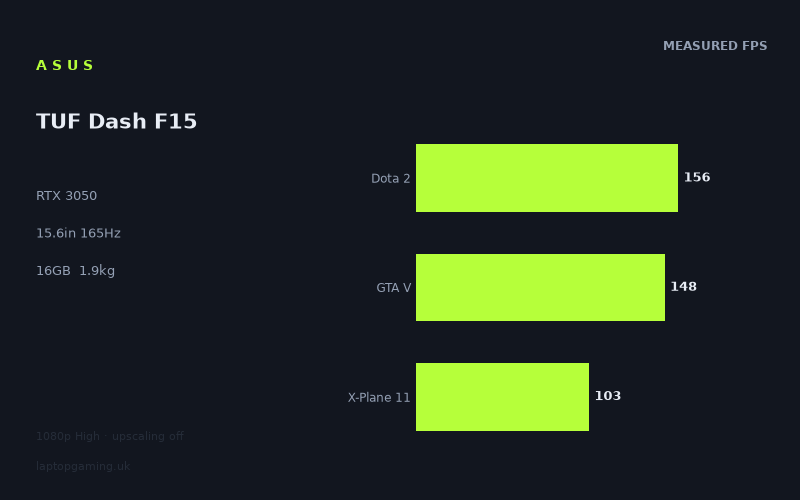
Frame rates
1920×1080, High preset, upscaling off.
Measured on this machine. Source: Notebookcheck, 2022-08-08.
Not scored: incomplete benchmark suite
Every scored laptop on this site is averaged over the same 5 games, and this one is short of Cyberpunk 2077, Baldur's Gate 3. A mean over 5 games is not comparable to a mean over 5, so we publish the figures we have and leave the score blank rather than rank it against machines tested on a different set. The numbers below are real - the suite is just incomplete.
How these numbers were produced
Frame rates here are not measured by us, and we label how each one was arrived at. A figure marked measured comes from a published run on that exact machine. A figure marked representative is derived from the GPU and its power limit (TGP) and cross-referenced against published reviews - a sound estimate of what that configuration delivers, but not a measurement of that specific laptop. Unless stated otherwise, numbers are 1920x1080, High preset, upscaling off. Where a laptop ships in several power configurations we use the wattage of the exact SKU listed, because a 140W RTX 5070 and a 115W one are not the same product.
In use
The short version
The Asus TUF Dash F15 (FX517ZC) is a gaming laptop whose published results make most sense when it is treated as a machine for high-refresh 1080p gaming, despite having a 2560x1440, 165Hz IPS display. Notebookcheck’s measured figures at 1920x1080, High settings and with upscaling off show a system that can move quickly in lighter and older games, stays broadly comfortable in several demanding titles, and begins to run out of room in the heaviest modern games.
That distinction matters. The RTX 3050 and Core i7-12650H combination produces 156fps in Dota 2 and 148fps in GTA V under the stated test conditions. Those are strong results for games where response and motion clarity matter, and they sit close enough to the panel’s 165Hz refresh rate to make the display specification feel relevant. Strange Brigade at 108fps, X-Plane 11 at 103fps and The Witcher 3 at 99fps remain clearly playable figures, but they are a different proposition: the panel can refresh more often than the game is delivering new frames.
The difficult games expose the limit of the configuration much more clearly. Final Fantasy XV is measured at 51fps, while Cyberpunk 2077 1.6 is measured at 44fps. Neither result is a disaster in isolation, but neither is a natural fit for a 165Hz panel at High settings. Buyers expecting the display refresh rate to describe the performance they will receive in every game will be disappointed. The screen is capable of a great deal more than the benchmark data shows the RTX 3050 delivering in the toughest titles.
The five-game scoring-suite mean is 113fps. That is a useful summary, but it should not be mistaken for a promise that a newly installed game will run at anything close to that figure. The individual results range from the very fast Dota 2 and GTA V measurements to the far lower Final Fantasy XV result. The machine’s gaming character is therefore defined by variation between games rather than by a single average. It can look very quick in one title and much more conventional in another without either result contradicting the published data.
There is no confirmed UK price for this exact configuration, so a price-dependent value judgement cannot be made. That is not a criticism of the laptop or its benchmark position; the benchmark suite is complete and it can be compared normally on frame rates. It simply means the evidence does not support a statement on whether the package is cheap, expensive or fairly priced in the UK.
The strongest case for the TUF Dash F15 is a buyer who wants a relatively light 15.6in gaming laptop, values a high-refresh IPS panel, and mainly plays games with the sort of performance profile represented by Dota 2, GTA V, Strange Brigade, X-Plane 11 and The Witcher 3. The 1.945kg listed weight and 76Wh battery capacity are useful ingredients for a laptop that may need to move between rooms, workspaces or journeys, although the fact sheet does not provide battery-life measurements or physical dimensions.
It is less convincing for someone buying specifically for demanding games at the panel’s native 2560x1440 resolution. The available frame rates are all measured at 1920x1080 rather than 2560x1440, and the heavier games are already well below the screen’s refresh rate at that benchmark resolution. There is no published result here that demonstrates the laptop driving Cyberpunk 2077 1.6, Final Fantasy XV, or any of the other listed games at 2560x1440. A buyer should therefore regard the display resolution as available headroom for appropriate games and settings, not as a performance claim established by these measurements.
The most important limitation is not that the laptop is slow in every context. It plainly is not. Rather, the data says it is selective. It rewards owners whose game library includes lighter titles and games that scale well on this hardware, but it asks for more compromise in demanding releases. That is a reasonable trade-off when it matches the way a laptop will actually be used. It is the wrong trade-off for a buyer who wants consistently high settings, consistently high frame rates and full use of a 165Hz QHD panel across the newest graphically intensive games.
Performance
What Notebookcheck’s measured figures show
Notebookcheck measured the Asus TUF Dash F15 at 1920x1080, using the High preset with upscaling off. That test setup is important enough to state plainly because it defines every frame-rate claim in this review. These are not results at the laptop’s 2560x1440 panel resolution, they are not results with upscaling enabled, and they are not a claim about every graphics option a game may offer. They are directly attributable numbers from one consistent published scenario.
- Dota 2: 156fps
- GTA V: 148fps
- Strange Brigade: 108fps
- X-Plane 11: 103fps
- The Witcher 3: 99fps
- Final Fantasy XV: 51fps
- Cyberpunk 2077 1.6: 44fps
The scoring-suite mean across Dota 2, GTA V, Strange Brigade, X-Plane 11 and Final Fantasy XV is 113fps. It is a healthy-looking average, but the more useful reading is the sequence of results around it. Dota 2 and GTA V are well ahead of the mean. Strange Brigade and X-Plane 11 remain above it only in the sense that they are near the centre of the machine’s performance range. The Witcher 3 is just below the scoring-suite mean. Final Fantasy XV sits much lower, and Cyberpunk 2077 1.6 is lower again.
This spread tells a buyer much more than a headline mean can. A laptop that delivered roughly the same rate in every listed game would be easy to describe but less revealing about real use. The TUF Dash F15 is not that laptop. It is capable of very high output in Dota 2 and GTA V, solid output in Strange Brigade, X-Plane 11 and The Witcher 3, and far more limited output in Final Fantasy XV and Cyberpunk 2077 1.6. Choosing it should therefore begin with the games someone actually intends to play, rather than with the idea that an RTX 3050 label alone predicts a fixed level of experience.
Dota 2 at 156fps is the clearest demonstration of the laptop approaching its display’s intended high-refresh use. The 165Hz panel can refresh more often than the measured rate, but the result is close enough that this is plainly a fast gaming outcome rather than a standard 60Hz-class one. Anyone whose priority is a game of this kind has a credible reason to value the 165Hz screen on this model. There is no need to invent a higher figure or assume that it will hit the refresh ceiling; the published figure is already strong.
GTA V at 148fps makes a similarly persuasive case. Again, it does not match the panel’s 165Hz figure, but it is substantially higher than the results seen in the more demanding part of the benchmark list. It supports the view that the TUF Dash F15 can make good use of a high-refresh display in suitable games. It also reinforces a recurring theme in the data: this laptop’s best results are not marginally better than its difficult-game results. They are fundamentally different operating territories.
Strange Brigade at 108fps and X-Plane 11 at 103fps sit in a useful middle ground. Neither one fully exploits a 165Hz display in the direct sense of producing a matching measured frame rate, but both are comfortably above the sort of figure associated with basic 60Hz gaming. For players of these games, the laptop is not merely adequate at the stated settings. The numbers suggest a responsive, high-frame-rate result without making an unsupported claim that every scene or every workload will behave identically.
The Witcher 3 at 99fps belongs in that same middle territory, though it is below the X-Plane 11 and Strange Brigade results. The meaningful conclusion is not that 99fps is somehow a problem; it remains a strong measured output at 1920x1080 High with upscaling off. The more relevant point is that it does not turn the laptop into a full 165fps machine. The display has more refresh capacity than this particular measured result can use. That is not unusual for a gaming laptop, but it should shape expectations for buyers who are focused specifically on maxing out the refresh rate.
Final Fantasy XV at 51fps is where the case changes. It is markedly removed from the fast figures in Dota 2 and GTA V, and it pulls the five-game mean down despite those strong results. This is the result to keep in mind when someone treats a single average as an all-purpose description of performance. The laptop can average 113fps across the scoring suite while still delivering 51fps in one of those scoring-suite games. Both facts are true, and the gap between them is the point.
Cyberpunk 2077 1.6 at 44fps is the lowest published figure in the supplied set. It confirms that the TUF Dash F15 is not a laptop to buy on the assumption that high settings at 1080p automatically mean high-refresh results in every demanding game. At the stated settings, it is below the Final Fantasy XV result and far below the figures achieved in Dota 2 and GTA V. A buyer for whom Cyberpunk 2077 1.6 represents the kind of game they play most often should treat this number as more important than the five-game mean.
The meaning of the GPU power limit
The fact sheet identifies the GPU as an RTX 3050, but it does not provide a GPU power-limit figure for this particular Asus configuration. That means it would be wrong to attach a wattage to the TUF Dash F15, or to claim that a particular power setting explains its result. GPU power limits can matter greatly when comparing nominally similar graphics chips, but the required figure for this laptop is not present in the published information supplied here.
What can be said from the benchmark data is narrower and more useful. The RTX 3050 in this system is capable of 156fps in Dota 2 and 148fps in GTA V under Notebookcheck’s stated conditions. It also produces 108fps in Strange Brigade, 103fps in X-Plane 11 and 99fps in The Witcher 3. At the other end, it records 51fps in Final Fantasy XV and 44fps in Cyberpunk 2077 1.6. Those figures define the realised performance of this laptop more reliably than an assumed power figure would.
The rival results underline why this caution matters. The MSI Prestige 15 is listed with an RTX 3050 Ti at 105W, while the Schenker XMG Focus 15 is listed with an RTX 3050 Ti at 75W. The Razer Blade 15 Advanced Model Early is listed with an RTX 3080 Ti at 95W, and the MSI Raider GE77 HX with an RTX 3080 Ti at 175W. The same GPU family label is not enough to predict a fixed ranking, and even a higher-tier GPU name is not enough to predict a large lead in every shared 1080p game. The comparisons must be read from the shared-game data rather than guessed from names.
That is especially relevant because the supplied comparison note explains that lighter titles in the shared set can become CPU-bound at 1080p, compressing genuine GPU gaps. In plain terms, a faster GPU cannot necessarily show its full advantage when other parts of the system or the game’s workload become the limiting factor. This does not mean the GPU difference is imaginary. It means the benchmark situation can conceal part of it, particularly in lighter games at 1920x1080.
High refresh is game-dependent here
The TUF Dash F15’s 165Hz panel should not be treated as a guarantee of 165fps. A refresh rate states how frequently the display can update; the measured frame rate states what the tested game delivered in the defined benchmark. For this laptop, Dota 2 at 156fps comes closest to the panel figure. GTA V at 148fps also makes substantial use of the available refresh capacity. Those are the titles in the published set where the combination of screen and performance looks most coherent.
Strange Brigade at 108fps, X-Plane 11 at 103fps and The Witcher 3 at 99fps still give the high-refresh display meaningful work to do, but there is a clear gap between those measured figures and 165Hz. That should not be framed as failure. A 165Hz panel does not become pointless whenever a game is below 165fps. It does mean, however, that someone paying attention to the panel specification should be realistic: the screen is more capable than the machine’s measured output in these games at the stated settings.
Final Fantasy XV and Cyberpunk 2077 1.6 are further away again. Their results make the 165Hz specification primarily a benefit for other games, other settings, or desktop use rather than something demonstrated by these particular High-preset benchmarks. There are no measured alternative settings in the fact sheet, so there is no basis for promising that lowering detail, changing resolution or enabling an option will produce a particular outcome. The responsible conclusion is simply that the published 1080p High figures do not show these games using the panel anywhere near its full refresh capability.
There is also a resolution issue that should not be hidden. The display is 2560x1440, but every supplied gaming figure is measured at 1920x1080. The laptop’s best demonstrated case is therefore high-refresh gaming at the benchmark resolution, not native-resolution gaming. Buyers who want a QHD screen because they specifically want QHD game rendering need additional measurement before reaching a confident conclusion. The current data does not prove poor QHD performance, but it does not prove strong QHD performance either.
The screen
The TUF Dash F15 has a 15.6in IPS display with a 2560x1440 resolution and a 165Hz refresh rate. On specification alone, that is an ambitious screen for an RTX 3050 laptop: it combines a relatively high native resolution with a refresh rate that asks for very high frame rates if it is to be fully exploited in games. The performance figures make that tension central to the buying decision.
The panel’s 165Hz refresh rate is easiest to justify through the Dota 2 and GTA V results. Notebookcheck’s 156fps figure in Dota 2 is close to the display refresh specification, while GTA V at 148fps remains firmly in high-refresh territory. For these games, the screen is not just a number on a specification sheet. The benchmark data indicates that the laptop can supply a large amount of frame-rate output at 1920x1080 High with upscaling off.
The case is more mixed in Strange Brigade, X-Plane 11 and The Witcher 3. Their 108fps, 103fps and 99fps figures are all substantial, but none reaches the refresh rate. A buyer should think of the 165Hz panel here as a display with capacity beyond the measured output, rather than as a target the laptop is shown to meet. That distinction is important because it prevents an unrealistic expectation that every game listed will feel like Dota 2.
The heavy-game results make the gap wider still. Final Fantasy XV at 51fps and Cyberpunk 2077 1.6 at 44fps are not figures that make a 165Hz panel the defining part of the experience. The display remains a 165Hz display, but the benchmark data establishes that the GPU is not delivering a matching level of performance in these games under the stated conditions. Anyone choosing the laptop largely because they want very high refresh in demanding current games should look elsewhere unless they have benchmark evidence for their own games and preferred settings.
The panel resolution needs equally careful treatment. A 2560x1440 screen has a higher native resolution than the 1920x1080 benchmark setting. It would be tempting to assume a frame rate at the higher resolution, or to turn the existing results into a QHD estimate. That would not be attributable and should not be done. No 2560x1440 frame rates are included in the fact sheet. The only defensible statement is that the laptop has a QHD panel while the cited performance data is 1080p data.
That does not make the screen specification irrelevant. It means the display gives the owner options that the benchmark results do not quantify. The issue is whether those options match the buyer’s priorities. Someone who wants a 15.6in IPS panel with 2560x1440 resolution and 165Hz refresh for a mixture of lighter games, general use and selectively chosen titles can see a sensible combination here. Someone who expects native 2560x1440, High settings and high-refresh output in games like Cyberpunk 2077 1.6 does not have supporting evidence from the published measurements.
The IPS panel type is also part of the specification, but the fact sheet contains no measured brightness, contrast, colour coverage, response-time or panel-uniformity results. It would therefore be inappropriate to claim that the screen is bright, colour-accurate, fast in pixel response, well calibrated or especially good outdoors. The usable facts are its 15.6in size, IPS panel type, 2560x1440 resolution and 165Hz refresh rate. Those are meaningful, but they do not amount to a complete image-quality assessment.
In practical buying terms, the screen is best viewed as a feature with more potential than the GPU can demonstrate in every game. It is well matched to the laptop’s strongest published results, partly matched to its middle results, and poorly matched to its lowest results if the goal is to use all of the available refresh rate. That is not an unusual compromise in a gaming laptop, but it is particularly visible here because the difference between 156fps in Dota 2 and 44fps in Cyberpunk 2077 1.6 is so large.
Build, size and portability
The supplied specification gives the Asus TUF Dash F15 a weight of 1.945kg, a 15.6in display and a 76Wh battery. Those facts support a limited but useful portability assessment. The laptop is not being presented here as a machine that should remain permanently in one place, because its listed mass is a relevant consideration for owners who need to move it. Equally, the fact sheet provides no dimensions, no charger weight and no battery-life measurement, so there is no basis for claiming that it is especially thin, compact, easy to pack, or capable of a particular amount of untethered use.
The 15.6in format is a familiar size for a gaming laptop because it leaves room for a reasonably large display without moving into the larger class represented by models with more expansive screens. The fact sheet does not provide chassis measurements, so it is not possible to judge the footprint beyond the screen size. It would be wrong to infer the width, depth or thickness from the display diagonal alone.
At 1.945kg, the TUF Dash F15 is a machine whose listed weight should be considered alongside its gaming role. A buyer planning to use it both at a desk and away from one has a concrete figure to consider. A buyer who expects to carry it frequently should also remember that a laptop’s quoted mass is not necessarily the whole travelling load, particularly when power equipment and other items are involved. The supplied information does not state the weight of any charger or accessory, so no total carried weight can be given.
The 76Wh battery capacity is another specification that should not be turned into an invented runtime. Battery capacity tells us the battery size in watt-hours; it does not establish how long the laptop lasts in gaming, streaming, browsing, office work or idle use. The fact sheet includes no battery-life measurement. There is therefore no evidence for a claim that the TUF Dash F15 has good, poor or average endurance.
For gaming use, the most relevant point is that the published frame-rate measurements are performance measurements, not battery measurements. Notebookcheck’s figures identify performance at 1920x1080 High with upscaling off, but they do not say whether the laptop was connected to mains power or how performance changes away from it. A prospective owner should not assume that the listed gaming numbers describe every power state or every usage situation.
There is also no supplied information on materials, keyboard feel, touchpad quality, port selection, webcam, speaker quality, cooling-system design, fan noise or surface temperatures. Those omissions matter because they are often decisive in the daily experience of a laptop. Rather than filling the gap with generic assumptions about the TUF name or the RTX 3050 category, the sensible approach is to separate what is known from what is not.
- Known: a 15.6in IPS display, 2560x1440 resolution, 165Hz refresh rate, 1.945kg weight and 76Wh battery capacity.
- Known: strong 1080p High benchmark figures in some games and much lower results in others.
- Not established by the supplied data: physical dimensions, battery runtime, noise, temperatures, port selection, keyboard quality, speakers and build materials.
That leaves a straightforward portability conclusion. The TUF Dash F15 has a listed weight and battery capacity that make portability part of its specification, but not enough measured mobility information to declare it a travel-first machine. It is safer to call it a 15.6in gaming laptop with a 1.945kg listed mass than to make broader claims about everyday carrying comfort or battery life.
How it compares
The comparison set is useful because it does not merely place the Asus beside one nearly identical machine. It includes the closest results, a machine the TUF Dash F15 leads by the largest shared-game margin, and a machine that leads it by the largest shared-game margin. All of these comparisons use games held in common, preferring scoring-suite games. That matters: a comparison based on different games would not answer the same question.
Against the MSI Prestige 15
Against the MSI Prestige 15 with its RTX 3050 Ti at 105W, the Asus TUF Dash F15 averages 61fps ahead across four shared games. This is the TUF Dash F15’s largest lead in the supplied rival set, and it is substantial enough that it should not be dismissed as normal benchmark variation or a trivial title-by-title quirk.
The important lesson is that the GPU name alone does not settle the comparison. The MSI is listed with an RTX 3050 Ti, while the Asus is listed with an RTX 3050, yet the shared-game average favours the Asus by 61fps. The supplied information does not allow a full technical explanation for every part of that gap, and it would be wrong to invent one. What it does establish is that buyers should not assume the Ti suffix makes the Prestige the faster gaming machine in this shared-game comparison.
The MSI’s listed 105W figure is specific to the MSI, not to the Asus. It cannot be used to assign a power limit to the TUF Dash F15. Still, the result makes the broader purchasing point very clearly: compare measured outputs where possible. The Asus has demonstrably stronger shared-game performance than this particular rival, despite the apparent advantage implied by the rival’s GPU label.
Against the Schenker XMG Focus 15
The Schenker XMG Focus 15, equipped with an RTX 3050 Ti at 75W, is much closer. The Asus TUF Dash F15 averages 1fps ahead across five shared games. That is effectively a near-level result in the context given, and the supplied comparison note explains why such closeness can occur. At 1080p, lighter titles in the shared set can be CPU-bound and compress genuine GPU gaps.
This is not a reason to pretend that the machines are identical or that their GPUs have the same potential in every situation. It is a warning against over-reading a shared-game average. A 1fps advantage across the selected games says the two laptops are practically inseparable in that particular comparison. It does not prove that every game, every resolution, every setting and every workload will remain equally close.
For a buyer comparing only the frame rates available here, there is no compelling gaming-performance reason to choose the Asus over the Schenker on the basis of that 1fps average alone. Other factors would need evidence from specifications or measurements not included in this fact sheet. The correct verdict is not that one machine clearly wins. It is that the published shared-game data does not separate them meaningfully.
Against the Razer Blade 15 Advanced Model Early
The Razer Blade 15 Advanced Model Early is the most striking near-equality in the supplied set. It is listed with an RTX 3080 Ti at 95W, yet the Asus TUF Dash F15 averages 0fps difference across five shared games. This is a real result in the shared 1080p data, not an error to be smoothed away because the GPU labels appear far apart.
It would be a mistake, however, to turn that shared-game average into a sweeping claim that an RTX 3050 equals an RTX 3080 Ti. The comparison note specifically identifies the reason such compression can occur: lighter titles at 1080p can be CPU-bound, limiting the extent to which a faster GPU can express an advantage. The shared set therefore produces a near-zero difference even though the graphics specifications look very different.
The useful conclusion is methodological. A buyer should not look at the 0fps shared-game average and conclude that the Asus will match the Razer in every demanding game or at the TUF Dash F15’s native 2560x1440 resolution. Neither claim is established. Equally, a buyer should not ignore the result merely because it is surprising. In the games both machines hold under the comparison method used, the published figures are tied.
This result also supports a cautious reading of the TUF Dash F15’s strong Dota 2 and GTA V outcomes. In lighter or more CPU-limited circumstances at 1080p, a laptop does not need the largest GPU name to produce a competitive frame rate. That is good news for a buyer whose game library resembles the shared set. It is not a universal performance guarantee.
Against the MSI Raider GE77 HX
The MSI Raider GE77 HX shows the other side of the comparison. It is listed with an RTX 3080 Ti at 175W, and the Asus TUF Dash F15 averages 56fps behind across five shared games. This is the largest deficit in the supplied rival set, and unlike the near-zero comparisons with the Schenker and Razer, it makes a clear performance separation.
The Raider result demonstrates that GPU differences can become visible in the shared 1080p data despite the compression effect in lighter titles. The exact reasons for each game’s result are not supplied, but the average gap is large enough to establish that this MSI is in a different performance class across the five shared games used for comparison. A buyer who wants the strongest available frame-rate headroom from this group should not expect the Asus to match the Raider.
The listed 175W figure belongs to the Raider, and the fact sheet does not provide an equivalent Asus figure. It would therefore be inappropriate to calculate or imply a power difference between them. The evidence needed for the buying decision is simpler: the Raider has the higher shared-game average by 56fps. The Asus can still be the more appropriate machine for a buyer whose needs are met by its own figures, but it is not the performance leader in this comparison.
What the rival spread means
Taken together, the rivals prevent a simplistic conclusion. The Asus is far ahead of the MSI Prestige 15 in the available shared games, effectively tied with the Schenker XMG Focus 15, tied with the Razer Blade 15 Advanced Model Early in another shared 1080p set, and well behind the MSI Raider GE77 HX. That is not inconsistency in the data. It is evidence that laptop gaming performance must be read in context: game selection, resolution, shared benchmarks and system configuration all matter.
For the Asus buyer, the practical takeaway is that this laptop can be highly competitive where the shared workload limits the benefit of faster graphics hardware, but it does not have unlimited performance reserves. The Raider comparison demonstrates that clearly. The Prestige comparison demonstrates equally clearly that an apparently stronger GPU name does not guarantee better gaming output. The Schenker and Razer comparisons show that near-zero results can be genuine at 1080p when lighter titles are CPU-bound.
Who it’s for
The Asus TUF Dash F15 is for the buyer whose priorities fit the evidence rather than the broadest possible idea of gaming performance. Its best audience is someone who values the 15.6in, 2560x1440, 165Hz IPS display, is comfortable using the benchmark resolution where appropriate, and spends substantial time in games that resemble Dota 2, GTA V, Strange Brigade, X-Plane 11 or The Witcher 3.
Dota 2 players have the clearest performance case. Notebookcheck’s 156fps result at 1920x1080 High with upscaling off comes close to the panel’s 165Hz refresh rate. GTA V players have a similarly persuasive 148fps figure. Those games show the laptop operating in the way a high-refresh gaming display invites: with a high measured frame rate that makes the 165Hz specification feel purposeful rather than excessive.
It is also a sensible candidate for buyers whose expectations are closer to the 99fps to 108fps region represented by The Witcher 3, X-Plane 11 and Strange Brigade. These are not panel-maxing results, but they are substantial outcomes in the benchmark conditions. A player who regards high-refresh capability as useful without insisting that every game must reach 165fps can make a coherent case for the TUF Dash F15.
The listed 1.945kg weight may also appeal to a buyer who needs a gaming laptop that can be moved rather than treated solely as a stationary replacement for a desktop system. The 76Wh battery capacity is worth noting for that kind of buyer, but no endurance claim should be attached to it without a battery-life measurement. The available data supports mobility as a consideration, not a conclusion about unplugged runtime.
The laptop is not for the buyer whose main goal is demanding-game performance at High settings with very high frame rates. Final Fantasy XV at 51fps and Cyberpunk 2077 1.6 at 44fps are the relevant figures. These results do not make the laptop unusable for those games; they simply do not support an expectation of 165Hz-class output under Notebookcheck’s stated conditions. If those are representative of the games someone buys most often, the display’s refresh rate should not be the deciding attraction.
It is also not the obvious choice for someone who insists on native 2560x1440 gaming performance in the games listed. The panel is 2560x1440, but the available benchmarks are 1920x1080 measurements. Without QHD figures, there is no attributable basis for saying how the laptop performs at its native resolution. A buyer who sees QHD gaming as non-negotiable should seek measurements at that resolution before choosing this configuration.
Buyers who want the largest performance margin against the specific rivals listed should also look away from the Asus and towards the MSI Raider GE77 HX’s published advantage. The Raider is 56fps ahead across five shared games. That does not make the TUF Dash F15 a poor performer in every context, but it does establish that the Asus is not the machine for someone who wants the strongest shared-game results from this rival group.
Conversely, buyers tempted by a GPU label alone should be careful. The TUF Dash F15 is 61fps ahead of the MSI Prestige 15 across four shared games despite the Prestige’s RTX 3050 Ti at 105W. It is 1fps ahead of the Schenker XMG Focus 15 across five shared games despite that laptop’s RTX 3050 Ti at 75W. It is level with the Razer Blade 15 Advanced Model Early across five shared games despite the Razer’s RTX 3080 Ti at 95W. These are not arguments that specifications do not matter. They are arguments that published frame-rate evidence matters more when deciding between specific laptops.
Ultimately, the Asus TUF Dash F15 is a selective recommendation. Buy it for high 1080p frame rates in the games where Notebookcheck’s measurements show it excelling, for a 15.6in IPS panel with 2560x1440 and 165Hz specifications, and for a listed weight of 1.945kg if that suits the intended use. Do not buy it on the assumption that the RTX 3050 will fill a 165Hz panel in every demanding game, or that a QHD panel automatically means proven QHD gaming performance. The measured data supports enthusiasm in the right games and restraint in the wrong ones.