Review
Lenovo Legion Pro 7 review
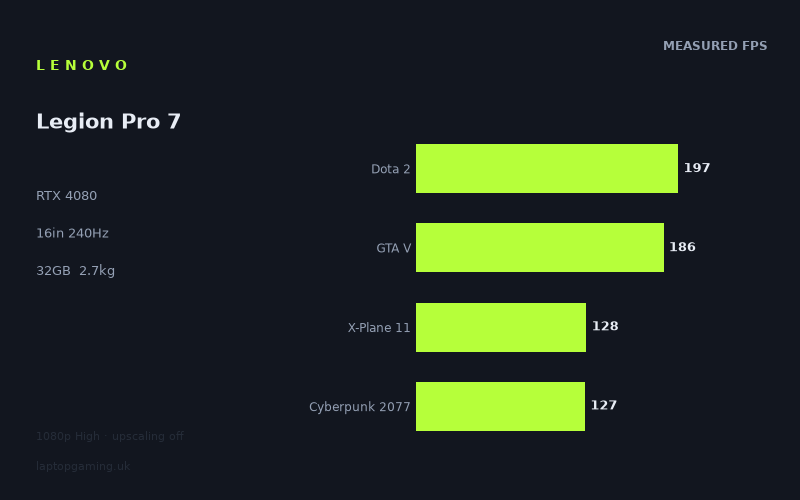
Frame rates
1920×1080, High preset, upscaling off.
Measured on this machine. Source: Notebookcheck, 2024-03-27.
Not scored: incomplete benchmark suite
Every scored laptop on this site is averaged over the same 5 games, and this one is short of Baldur's Gate 3. A mean over 4 games is not comparable to a mean over 5, so we publish the figures we have and leave the score blank rather than rank it against machines tested on a different set. The numbers below are real - the suite is just incomplete.
How these numbers were produced
Frame rates here are not measured by us, and we label how each one was arrived at. A figure marked measured comes from a published run on that exact machine. A figure marked representative is derived from the GPU and its power limit (TGP) and cross-referenced against published reviews - a sound estimate of what that configuration delivers, but not a measurement of that specific laptop. Unless stated otherwise, numbers are 1920x1080, High preset, upscaling off. Where a laptop ships in several power configurations we use the wattage of the exact SKU listed, because a 140W RTX 5070 and a 115W one are not the same product.
In use
The short version
The Lenovo Legion Pro 7 configuration listed here combines an RTX 4080, a Core i9-14900HX, 32GB of memory and a 2TB SSD with a 16in 2560x1600 IPS display running at 240Hz. On paper, that is a serious desktop-replacement specification. The published game data broadly supports that impression, but it also shows why the headline parts list is not enough on its own.
Notebookcheck’s measured figures at 1920x1080, High settings and with upscaling disabled range from 108fps in Horizon Forbidden West to 377fps in Strange Brigade. That is a very wide spread, and it matters more than any single average. In lighter or older games, this Legion can produce frame rates that exceed its 240Hz panel refresh rate. In several newer and heavier games, it is well below that ceiling even at the lower 1920x1080 test resolution. That does not make the machine slow; figures such as 127fps in Cyberpunk 2077, 114fps in Avatar Frontiers of Pandora and 108fps in Horizon Forbidden West are substantial results. It does mean that the 240Hz screen should be understood as headroom for the right games, rather than a promise of 240fps across every modern release.
The most useful way to view this laptop is as a high-performance machine for someone who values strong frame rates across a broad selection of games, wants a 16in 2560x1600 display rather than a conventional 1920x1080 panel, and does not expect a machine weighing 2.656kg to behave like an ultraportable. The measured data is particularly encouraging for games where very high refresh rates are achievable: Strange Brigade reaches 377fps, The Witcher 3 reaches 342fps, Last Epoch reaches 229fps, Alone in the Dark reaches 214fps, Assassin’s Creed Mirage reaches 199fps, Dota 2 reaches 197fps and GTA V reaches 186fps.
There are two important qualifications. First, the benchmarks were run at 1920x1080, while the Legion Pro 7’s panel is 2560x1600. The data therefore establishes performance at the benchmark setting, not native-resolution performance. It would be wrong to present the 1080p figures as though they were measured at 2560x1600. Secondly, no UK price is confirmed for this configuration. That prevents a proper value judgement. The hardware and the published performance can be assessed, but whether it is a sensible purchase rather than merely a capable one depends heavily on the eventual UK price.
Buy it if the eventual price is competitive for an RTX 4080 laptop, you want a powerful 16in machine with 32GB of memory and 2TB of storage, and your priorities include high frame rates in both lighter and demanding games. Do not buy it purely because the screen says 240Hz. The benchmark data says that refresh rate is fully exploited in some games, approached in others and left unused in the most demanding titles in this set. That is normal for a broad gaming library, but it needs to be part of the buying decision.
Performance
What the published results show
Notebookcheck measured the Legion Pro 7 at 1920x1080 using High settings with upscaling disabled. That testing condition is important because it gives the results a clear common basis: these are not selectively lowered settings, and they are not frame rates assisted by upscaling. The numbers are therefore useful for comparing the laptop’s behaviour across the games listed, but they should not be read as a native 2560x1600 result.
The top end of the spread is extremely fast. Strange Brigade records 377fps, while The Witcher 3 records 342fps. Those are both beyond the display’s 240Hz refresh rate. In those titles, the screen’s refresh ceiling, rather than a shortage of measured frame rate, becomes the obvious limit on how many distinct frames can be displayed each second. This is precisely the sort of result that makes a 240Hz panel meaningful: there is enough measured performance to support very high-refresh play in suitable games.
Last Epoch reaches 229fps. That is just below the display’s 240Hz refresh rate, but it is still one of the strongest results in the set. It suggests that the panel’s maximum refresh is not outlandishly ambitious for the machine; it is within reach in at least some games at the tested settings. Alone in the Dark reaches 214fps, Assassin’s Creed Mirage reaches 199fps, Dota 2 reaches 197fps and GTA V reaches 186fps. These are all high frame rates, but they also demonstrate a more realistic expectation for the screen: many games can benefit from a high-refresh display without necessarily reaching its full 240Hz ceiling.
Further down the list, Final Fantasy XV records 173fps and Skull & Bones records 135fps. X-Plane 11 records 128fps, while Cyberpunk 2077 records 127fps. Avatar Frontiers of Pandora reaches 114fps and Horizon Forbidden West reaches 108fps. None of those results support a claim that this system will maintain 240fps in every game. They do support the more useful claim that, under Notebookcheck’s 1080p High test conditions without upscaling, the Legion Pro 7 remains above 100fps in every listed title.
That floor matters. A range from 108fps to 377fps is not uniform performance, but it is a strong range. The difference between the best and worst result is substantial enough that prospective buyers should think about their own game library rather than relying on an average alone. Someone spending most of their time in Strange Brigade, The Witcher 3, Last Epoch, Dota 2 or GTA V has a very different experience to someone concentrating on Horizon Forbidden West, Avatar Frontiers of Pandora or Cyberpunk 2077. The same laptop is involved in each case; the workload is not.
The scoring-suite figures
Four of the published results belong to the scoring suite: Dota 2 at 197fps, GTA V at 186fps, X-Plane 11 at 128fps and Cyberpunk 2077 at 127fps. Their mean is 160fps. That provides a useful snapshot of the Legion Pro 7 across a mixture of lighter and more demanding games, but it must not be treated as a complete ranking result.
The scoring suite is incomplete because there is no published figure here for Baldur’s Gate 3. Every scored laptop is averaged over the same five games, so this Legion Pro 7 cannot honestly be ranked against machines with a complete five-game scoring-suite average. A partial suite can still inform comparison where shared-game figures are available, and the rival data below does exactly that. It cannot support a neat overall league-table conclusion.
The mean of 160fps is also less informative than the individual figures behind it. Dota 2 at 197fps and GTA V at 186fps pull the mean upwards, while X-Plane 11 at 128fps and Cyberpunk 2077 at 127fps show the machine in workloads that sit much farther from the panel’s maximum refresh rate. A buyer interested in competitive or comparatively light games may look at the 197fps and 186fps results and see ample headroom. A buyer whose main concern is demanding modern action games should pay closer attention to the 127fps, 114fps and 108fps end of the list.
That is not a criticism of the machine for failing to produce the same result in every game. It is a criticism of the common habit of treating one high average as a complete answer. The benchmark data is much more valuable when read title by title. The Legion Pro 7 is fast in all the listed games, but it is not equally fast in all of them, and the difference determines whether the display’s 240Hz specification is central to the experience or merely generous overhead.
Game-by-game interpretation
Strange Brigade at 377fps is the clearest example of the laptop having more measured performance than its 240Hz panel can present as distinct refreshes. For a buyer who plays this game, the result shows a very large margin at the tested settings. It also demonstrates that the Legion Pro 7 is not simply tuned around a 100fps target. There are titles in which the hardware can run far beyond that level.
The Witcher 3 at 342fps tells a similar story. It is another result above the screen’s refresh rate, and comfortably so. If these two games were representative of every game a buyer played, the 240Hz screen would look entirely sensible. They are not representative of every game in the test list, which is why they should be read as evidence of the laptop’s best-case high-refresh behaviour rather than evidence that every modern title will run in the same way.
Last Epoch at 229fps is a particularly useful middle case. It falls short of 240fps, but not by much. The distinction matters because it shows the display is close to being fully fed by the measured result, rather than being dramatically beyond the machine’s reach. For players of Last Epoch, the Legion Pro 7’s display specification is relevant, even though the benchmark number does not quite meet its maximum refresh rate.
Alone in the Dark at 214fps remains firmly in high-refresh territory. It is below both Last Epoch and the 240Hz maximum, but the result is still much closer to the top end of the display’s capability than to a conventional lower-refresh experience. The same applies to Assassin’s Creed Mirage at 199fps. Neither result should be rewritten as “240fps gaming”, because that is not what Notebookcheck measured. Both are nevertheless strong evidence that the laptop can run some substantial games at frame rates where a 240Hz panel is more than decorative.
Dota 2 at 197fps is important because it belongs to the shared scoring suite and because it is a game where high frame rate is likely to be a key interest for buyers considering a 240Hz laptop. The Legion is not measured at 240fps here, but 197fps is close enough to make the high-refresh panel relevant. At the same time, it is a reminder that even a title often associated with very high frame rates does not automatically deliver the panel maximum under this particular test condition.
GTA V at 186fps is another strong scoring-suite result. It sits below Dota 2 but remains far ahead of the more demanding X-Plane 11 and Cyberpunk 2077 measurements. A prospective owner who plays GTA V can reasonably view the screen as a worthwhile pairing, while still recognising that the published figure is not the same as native 2560x1600 performance.
Final Fantasy XV at 173fps continues the gradual descent from the titles that nearly reach or exceed 240fps. It remains a high result, but the gap between 173fps and the panel’s refresh rate is now large enough that the screen’s full specification is not being reached in the benchmark. This is the point where “high refresh” is the right description, rather than “maximum-refresh operation”.
Skull & Bones at 135fps moves the Legion Pro 7 into a different part of the performance range. The measured figure is still well above 100fps, but it is no longer close to 240fps. It gives the buyer a better sense of what to expect from the system in heavier work: strong output, substantial smoothness potential, but not a result that makes the panel’s maximum refresh rate the main story.
X-Plane 11 at 128fps and Cyberpunk 2077 at 127fps are nearly identical in the published data. Because both are scoring-suite games, they are particularly useful when considering the Legion’s partial-suite mean and the shared-game rival comparisons. They also show that 240Hz should not be treated as a performance target that the RTX 4080 configuration simply reaches by default. In these games, the measured output is only a little over half of the panel’s maximum refresh rate.
Avatar Frontiers of Pandora at 114fps and Horizon Forbidden West at 108fps are the lowest published figures in this set. They are still above 100fps under the stated test conditions, which is a meaningful result. But they are nowhere near the display’s 240Hz maximum. For a buyer whose main games resemble these heavier titles, the Legion Pro 7’s case rests on delivering well over 100fps in the published test rather than on delivering the full refresh rate of its screen.
What the spread between games means
The gap from 377fps in Strange Brigade to 108fps in Horizon Forbidden West is too large to dismiss as normal measurement variation. The games place different demands on the laptop, and the results show that clearly. This is why it is unhelpful to describe the Legion Pro 7 simply as either a “240fps laptop” or a “100fps laptop”. Both labels would hide more than they reveal.
For lighter titles and games where the measured result is close to or above the display maximum, the laptop has headroom. The screen can be used as intended at very high refresh rates, subject to the benchmark settings and the individual game. For the middle of the spread, from 173fps through 214fps, the machine still produces high-refresh results, but the 240Hz specification is aspirational rather than matched by the published number. For the heaviest part of the list, from 108fps through 135fps, the screen has abundant refresh-rate capacity that the benchmarked games do not fully use at the test conditions.
This distinction should guide configuration decisions that are not covered by the fact sheet as well. The published results are all High preset, 1920x1080 and with upscaling off. They do not show the result of changing settings, enabling upscaling or moving to the panel’s 2560x1600 native resolution. It would be speculation to provide frame-rate estimates for any of those scenarios. What can be said is simpler: the published measurements demonstrate a large performance spread before any of those variables are changed. Buyers should therefore expect game choice to remain important.
GPU power limit: an important unknown here
The listed specification identifies the GPU as an RTX 4080, but it does not provide a GPU power limit for this Lenovo configuration. That omission matters because it means the measured results should be treated as the results of this specific tested laptop, not as a universal statement about every RTX 4080 laptop or as proof of a particular power setting.
It would be wrong to assign a wattage to the Legion Pro 7 when none is supplied. It would also be wrong to use the rival machines’ stated figures as though they were Lenovo specifications. The Schenker XMG Apex 15 is listed with an RTX 4050 at 140W, the MSI Titan GT77 HX with an RTX 4090 at 150W, and the Razer Blade 18 RTX with an RTX 4070 at 140W. Those figures describe those rivals, not this Legion.
As a result, the correct conclusion is evidence-based but limited. The Legion Pro 7 delivers the measured frame rates listed above in Notebookcheck’s test conditions. Its RTX 4080 designation alone does not tell us why it matches some rival shared-game averages and trails another, nor does the absent Lenovo power-limit figure allow a precise explanation. The benchmark data is strong enough to judge practical output. It is not complete enough to attribute every relative result to GPU power configuration.
This is especially relevant when comparing the Legion with machines carrying different RTX labels. An RTX 4090 machine does not automatically produce a visibly higher shared-game average in the limited comparisons provided, and an RTX 4070 machine can return a near-identical shared-game result. The supplied comparison notes explain that lighter titles at 1080p can be CPU-bound and compress genuine GPU gaps. That is exactly why GPU name alone is an incomplete guide and why the published game results deserve more weight than a badge on a specification sheet.
The screen
The Legion Pro 7 has a 16in IPS panel with a 2560x1600 resolution and a 240Hz refresh rate. This is a display specification that aims well beyond basic 1920x1080 gaming. The extra vertical resolution is also part of the package: the panel is 2560x1600, not 2560x1440. That makes it important not to blur the distinction between the display’s native resolution and Notebookcheck’s 1920x1080 benchmark setting.
The frame-rate data shows that the panel is not wasted, but it is not uniformly saturated either. Strange Brigade at 377fps and The Witcher 3 at 342fps exceed 240fps. Last Epoch at 229fps comes close. Alone in the Dark at 214fps, Assassin’s Creed Mirage at 199fps, Dota 2 at 197fps and GTA V at 186fps provide substantial high-refresh output without reaching the display’s maximum specification.
At the lower end of the measured range, the case for the 240Hz panel changes. Final Fantasy XV at 173fps and Skull & Bones at 135fps are still well suited to a screen capable of high refresh, but they do not make a case for expecting 240fps. X-Plane 11 at 128fps, Cyberpunk 2077 at 127fps, Avatar Frontiers of Pandora at 114fps and Horizon Forbidden West at 108fps are further from the panel ceiling again. In those games, the screen’s refresh capacity is more future-facing headroom than something filled by the published benchmark.
The key limitation is resolution. The benchmark data is at 1920x1080, while the panel is 2560x1600. There is no published 2560x1600 frame-rate set in the fact sheet. Therefore, there is no basis for claiming that Strange Brigade, The Witcher 3, Cyberpunk 2077, Avatar Frontiers of Pandora or any other listed game reaches the same number at the panel’s native resolution. The only defensible statement is that the 1080p High, no-upscaling measurements range from 108fps to 377fps.
That does not reduce the value of the data. It clarifies its role. The figures show the Legion’s performance potential in a standardised lower-resolution test. The screen specification shows the display the buyer will actually receive. The missing link is native-resolution measurement, so buyers who consider 2560x1600 performance their primary concern should not substitute assumptions for data.
The IPS panel type is also specified, but no measurements for brightness, colour coverage, response behaviour or contrast are provided here. There is therefore no evidence-based basis to make claims about image quality beyond the stated panel type, size, resolution and refresh rate. The 240Hz figure is a meaningful advantage for the games where the measured frame rate is high enough, but the fact sheet does not support broader claims about panel quality.
Build, size and portability
The hard portability figure available is weight: 2.656kg. That places the Legion Pro 7 firmly on the substantial side for a 16in gaming laptop. It is not a configuration that should be approached as a lightweight machine for effortless daily travel. Its likely role is better understood as a powerful system that can be moved when necessary, rather than one selected primarily to minimise carrying weight.
That conclusion follows from the listed mass, not from any claim about handling the machine. There are no chassis dimensions in the fact sheet, so no width, depth or thickness should be assumed. There is also no battery-life information, no charger weight, no noise measurement and no temperature data. Those omissions matter because portability is not only about the mass of the laptop itself. Without those figures, a full travel-use assessment would go beyond the available evidence.
What can be said is that 2.656kg is a meaningful trade-off against the machine’s performance-oriented specification. This is a laptop with an RTX 4080, Core i9-14900HX, 32GB of memory, 2TB SSD storage, a 16in 2560x1600 IPS screen and a 240Hz refresh rate. The specification points towards a system intended to prioritise performance and capability. The listed weight reinforces that impression.
The 16in screen size is a more balanced part of the design. It is smaller than the 18in Razer Blade 18 rival named in the comparison data, while still providing a 2560x1600 resolution and 240Hz refresh rate. However, the fact sheet does not provide the Razer’s weight or the Legion’s dimensions, so this should not be turned into a claim that the Lenovo is definitively more portable in practice. The screen-size difference is known; the complete physical comparison is not.
For buyers planning to keep the laptop largely in one place, the 2.656kg figure is unlikely to be the central concern. In that use case, the performance range, display specification, memory and storage capacity are likely to matter more. For buyers who expect to carry the machine frequently, the mass should be considered before purchase, particularly because no information is available here to offset it with evidence about battery life, charger mass or physical dimensions.
How it compares
The available rival data is deliberately a spread rather than a narrow list of adjacent systems. It includes the two closest shared-game outcomes, the machine the Legion beats by the largest stated margin, and the machine that beats it by the largest stated margin. These comparisons only cover games both machines hold and prefer scoring-suite games where possible. They are useful, but they are not a replacement for a complete five-game scoring-suite rank because the Legion lacks a Baldur’s Gate 3 result.
Against the Schenker XMG Apex 15
The Legion Pro 7 averages 115fps ahead of the Schenker XMG Apex 15 across five shared games. This is the largest positive margin in the supplied rival list, and it is a decisive difference in the context of the published figures. The Schenker is listed with an RTX 4050 at 140W, while the Lenovo is listed with an RTX 4080. No confirmed UK price is provided for either machine in this comparison, so performance is the only supported basis for the judgement.
The practical conclusion is straightforward: on the shared-game evidence supplied, the Legion Pro 7 is in a clearly stronger performance class than the XMG Apex 15. A 115fps average advantage is not a tiny benchmark fluctuation or a result to be explained away by 1080p compression in lighter games. It is the largest supplied gap and points to a materially different level of output across the shared set.
That does not automatically make the Lenovo the better purchase for every buyer, because neither UK price is confirmed. If the machines eventually sit at very different prices, value could change. But where performance is the priority, the supplied comparison leaves little ambiguity: the Legion has the much stronger shared-game result.
Against the MSI Titan GT77 HX
The MSI Titan GT77 HX is listed with an RTX 4090 at 150W. Across three shared games, the Legion Pro 7 averages +0fps against it. That is a real result, not an invitation to claim that the RTX 4080 and RTX 4090 are generally equivalent.
The supplied comparison notes explain why a near-zero difference can occur: at 1080p, lighter titles in the shared set can be CPU-bound and compress genuine GPU gaps. That is the appropriate interpretation here. The Legion’s +0fps shared-game outcome means that, in this limited three-game 1080p comparison, the benchmark averages are effectively level. It does not demonstrate that the two machines will perform identically in every game, at every setting or at the Legion’s 2560x1600 screen resolution.
This is an important warning against paying too much attention to GPU labels without examining the tests. The MSI has the RTX 4090 designation and a listed 150W figure, yet the supplied shared-game average does not show a lead over the Legion. The explanation is not that labels are meaningless. It is that a short shared set at 1080p can hide wider differences, especially where lighter titles constrain the result in ways that reduce the visible GPU separation.
No confirmed UK price is given for the MSI Titan GT77 HX or the Legion Pro 7. That rules out a value conclusion. The evidence only supports this narrower verdict: in the three shared games supplied, the Legion matches the MSI’s average, but that result should not be stretched into a general claim of equal performance.
Against the Razer Blade 18 RTX
The Razer Blade 18 RTX is listed with an RTX 4070 at 140W. Across three shared games, the Legion Pro 7 also averages +0fps against it. Again, that is a genuine near-zero result, and again it needs interpretation rather than repetition.
The Legion’s RTX 4080 does not show a shared-game average advantage over the RTX 4070 Razer in this limited comparison. At first glance, that may appear surprising. The supplied note provides the relevant context: lighter titles at 1080p can be CPU-bound and compress real GPU differences. Where a shared game is limited in that way, a more powerful GPU may not translate into a proportionally larger measured frame rate.
The result does not mean the two laptops are interchangeable. The Lenovo has a specified 16in 2560x1600 240Hz IPS display, 32GB of memory and a 2TB SSD, while the Razer’s stated information here is limited to its RTX 4070 at 140W and its 18in name. Nor does the supplied three-game average establish an all-game performance tie. It establishes only that the available shared-game comparison is level.
For a buyer choosing between these machines, the lesson is to resist simplistic conclusions. The Legion is not proven superior simply because it carries an RTX 4080, and the Razer is not proven equivalent simply because the shared average is +0fps. The sample is limited, the games are at 1080p, and the note explicitly warns that CPU-bound lighter titles can compress the GPU gap. No confirmed UK price is available for either system, so price cannot resolve the decision from the supplied data.
Against the Asus ROG Strix Scar 17
The Asus ROG Strix Scar 17 is the machine that beats the Legion Pro 7 by the largest stated margin in the rival list. The Lenovo averages 29fps behind it across three shared games. The Asus is listed with an RTX 4090, although no power figure is supplied here for that model and no confirmed UK price is given.
A 29fps deficit is large enough to matter. It is not a level result such as the +0fps comparisons with the MSI Titan GT77 HX and Razer Blade 18 RTX. On the available shared-game evidence, the Asus has the stronger result. That does not prove a 29fps advantage in every game or at every resolution, because the comparison covers only three shared games. It does mean that the Legion should not be presented as the fastest machine in this rival group.
The contrast between the Asus result and the MSI result is instructive. Both rivals are identified as RTX 4090 machines, yet one is level with the Legion over the supplied shared games while the other is 29fps ahead. The data does not give enough information to explain every reason for that difference. The Lenovo’s own GPU power limit is not supplied, and the comparison sets are limited. What it does show is that a GPU label is not a complete performance ranking.
For a buyer whose main goal is extracting the highest available shared-game performance among these named machines, the Asus has the evidence-based advantage. For a buyer deciding between them in the real market, price would be essential, but no confirmed UK price is provided for either. The correct judgement is therefore performance-specific rather than value-specific: the Asus leads in the supplied comparison; the Legion remains strong but is behind.
What the rival spread says overall
The Legion Pro 7 sits in an interesting position. It is dramatically ahead of the RTX 4050 Schenker XMG Apex 15 by 115fps across five shared games. It is level with the RTX 4090 MSI Titan GT77 HX across three shared games. It is also level with the RTX 4070 Razer Blade 18 RTX across three shared games. It trails the RTX 4090 Asus ROG Strix Scar 17 by 29fps across three shared games.
Those results are not contradictory once their limits are respected. The comparisons cover different shared-game sets, the Legion lacks a complete five-game scoring-suite result, and the supplied note warns that 1080p lighter titles can be CPU-bound. The correct reading is not that the Legion has a fixed place relative to every GPU class. The correct reading is that its measured performance is very strong, but shared-game outcomes depend heavily on the games included.
This is why the Legion should not be ranked through a partial score or presented as universally equal to the MSI or Razer. It should also not be dismissed because the Asus leads it. The evidence instead supports a more useful purchasing conclusion: the Legion is clearly ahead of the lower-tier RTX 4050 rival, competitive enough to produce level averages against two very different named systems in limited shared sets, and demonstrably behind the Asus in another limited shared set.
Who it’s for
The Lenovo Legion Pro 7 is for the buyer who wants a powerful 16in gaming laptop and understands that its appeal is the combination of broad measured performance, a 2560x1600 240Hz IPS panel, 32GB of memory and a 2TB SSD. It suits someone who plays a mixed library rather than one game exclusively, because the benchmark results show useful strength across everything listed: from 377fps in Strange Brigade to 108fps in Horizon Forbidden West.
It is especially suited to buyers who play games where the high-refresh display can be used well. Strange Brigade at 377fps and The Witcher 3 at 342fps exceed the 240Hz refresh rate. Last Epoch at 229fps comes close, while Alone in the Dark at 214fps, Assassin’s Creed Mirage at 199fps, Dota 2 at 197fps and GTA V at 186fps all provide high frame rates that make the panel specification relevant. A buyer interested in those kinds of results has a clear reason to consider this configuration.
It also suits buyers who are comfortable with a substantial laptop. At 2.656kg, the Legion is better treated as a performance-first machine than a lightweight everyday portable. It may still be moved between locations, but the listed weight should be accepted as part of the deal. The available information does not include dimensions, battery life, charger weight, temperatures or noise figures, so buyers for whom regular travel, quiet operation or long unplugged use are decisive should seek those measurements before committing.
It is not the right choice for someone who expects the native 2560x1600 panel to run every modern game at 240fps. The available numbers do not show that. They show 1080p High performance without upscaling, and the heaviest titles in the list sit between 108fps and 135fps. That is still strong performance, but it is not evidence for an all-game 240fps claim.
It is also not automatically the right choice for the buyer who simply wants the highest shared-game performance among the named rivals. The Asus ROG Strix Scar 17 leads the Legion by 29fps across three shared games. If that buyer’s decision is purely about the strongest available benchmark result and the eventual price difference is acceptable, the Asus has the supplied performance advantage. Conversely, the Legion’s +0fps averages against the MSI Titan GT77 HX and Razer Blade 18 RTX should not be used to declare it universally equal to either machine, because those are limited three-game 1080p comparisons where CPU-bound titles can compress GPU gaps.
The Schenker XMG Apex 15 is the clearest alternative to reject if the priority is performance and the supplied shared-game data is the basis for the decision. The Legion’s 115fps average lead across five shared games is substantial. Price could still change the recommendation, but no confirmed UK price is available for either laptop, so it cannot be assessed here.
Most importantly, this is not a machine to buy without a confirmed UK price. The Legion Pro 7 has a compelling specification and strong Notebookcheck benchmark data, but value cannot be inferred from performance alone. An RTX 4080, Core i9-14900HX, 32GB of memory, 2TB SSD, 16in 2560x1600 IPS display and 240Hz refresh rate describe what the buyer receives. They do not tell us whether the asking price is sensible. Until that price is confirmed, the correct verdict is conditional: a strong performance-focused 16in gaming laptop with impressive 1080p benchmark results, a genuinely useful high-refresh screen in the right games, and clear limits that should not be hidden behind the RTX 4080 label.