Review
Asus ROG Strix G18 2025 review
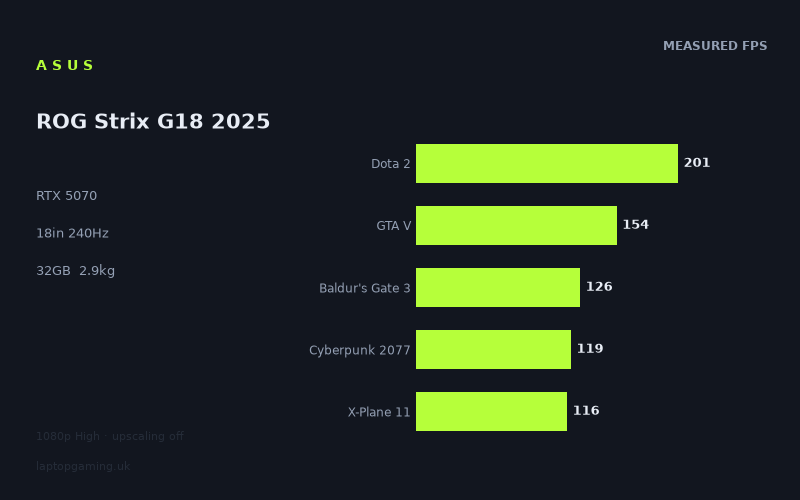
Frame rates
1920×1080, High preset, upscaling off. Averages 143fps across the 5 core benchmark games.
Measured on this machine. Source: Notebookcheck, 2025-08-08.
Not scored: no confirmed UK price
We have the full benchmark suite for this machine, so it ranks on the frame rate leaderboard like any other. What we don't have is a UK listing for this exact configuration - it's sold as a European review unit, or only in specifications that differ from the one tested. Since 30% of our score is value for money, scoring it would mean pretending price is no object, which would flatter it against every laptop you can actually buy. The frame rates below are real and comparable; there is just no buying recommendation to make yet.
How these numbers were produced
Frame rates here are not measured by us, and we label how each one was arrived at. A figure marked measured comes from a published run on that exact machine. A figure marked representative is derived from the GPU and its power limit (TGP) and cross-referenced against published reviews - a sound estimate of what that configuration delivers, but not a measurement of that specific laptop. Unless stated otherwise, numbers are 1920x1080, High preset, upscaling off. Where a laptop ships in several power configurations we use the wattage of the exact SKU listed, because a 140W RTX 5070 and a 115W one are not the same product.
In use
The short version
The Asus ROG Strix G18 2025 is a large-format gaming laptop built around an RTX 5070, a Ryzen 9 9955HX, 32GB of memory and a 1024GB SSD. Its defining attraction is not subtle portability: it is an 18in 2560x1600 IPS display with a 240Hz refresh rate, backed by measured gaming performance that is consistently strong at 1920x1080 on the High preset with upscaling off.
Notebookcheck’s benchmark data shows a machine that is very capable in lighter and older games, where the display’s high refresh rate can be put to convincing use, but much less able to reach that same refresh target in demanding modern titles. Strange Brigade reaches 300fps, F1 24 reaches 247fps and Dota 2 reaches 201fps. Those are results that make a 240Hz screen meaningful. At the other end of the spread, Assassin’s Creed Shadows records 64fps. Cyberpunk 2077 reaches 119fps, Baldur’s Gate 3 126fps and X-Plane 11 116fps: all comfortably playable figures, but nowhere near the panel’s maximum refresh rate.
The important qualification is resolution. Every frame-rate figure here was measured by Notebookcheck at 1920x1080, High preset, with upscaling off. The Strix G18’s own screen is 2560x1600. The benchmark data therefore demonstrates what this configuration can do at 1080p, not what it will necessarily deliver at the panel’s native resolution. That distinction matters more on an 18in 2560x1600 laptop than it would on a lower-resolution display, because the screen presents a higher rendering target than the benchmark setting.
There is no confirmed UK price for this exact configuration, so there is no value judgement to make yet. That is not a reflection on the machine or its benchmark position: the benchmark suite is complete and the laptop ranks normally on the frame-rate leaderboard. Value simply cannot be assessed without a confirmed price.
As a performance proposition, this is a sensible choice for someone who wants a very large screen, 32GB of memory and high-refresh 1080p gaming performance from an RTX 5070 laptop. It is less persuasive for a buyer whose priority is playing every demanding new game at 2560x1600 while keeping the visual settings high and chasing the panel’s full refresh rate. The measured figures do not support that expectation. They do support a more realistic one: a strong gaming laptop with a broad performance range, excellent results in the games that are easier for this GPU configuration to drive, and more conventional frame rates in the demanding titles that define its limits.
Performance
What the benchmark data says
The most useful starting point is the mean across the five scoring-suite games: 143fps. That is a healthy average for the specified 1920x1080 High test, but it should not be mistaken for a guaranteed experience in every game. The individual results span from 201fps in Dota 2 to 116fps in X-Plane 11 within that scoring suite. The wider published list extends from 300fps in Strange Brigade to 64fps in Assassin’s Creed Shadows. This is a laptop whose average is useful, but whose spread across games is more useful still.
Notebookcheck measured 300fps in Strange Brigade. That is beyond the screen’s 240Hz refresh rate. At this point, the Strix G18 has more performance than the panel can display as distinct refreshes at its maximum refresh setting. The result still indicates substantial headroom at the published 1080p High configuration, but it does not mean the display can present every one of those 300 frames independently. What it does mean is that Strange Brigade is not where an RTX 5070-equipped Strix G18 will feel constrained by the published benchmark setting.
F1 24 is similarly strong at 247fps. That is also above 240Hz, so the measured result can drive the panel to its maximum refresh rate at the benchmarked settings. For buyers interested in games where high frame rates are a major part of the appeal, this is precisely the sort of result that justifies the specification of a 240Hz screen. It also shows why it would be wrong to dismiss the display as excessive simply because some of the laptop’s harder tests run far below its ceiling. The screen is not wasted in every game; it is clearly useful in the right games.
Dota 2 reaches 201fps. That falls short of 240Hz but remains very close to the panel’s maximum refresh capability. It is also the highest result among the five scoring-suite games. It suggests that the Strix G18 can offer a high-refresh experience in Dota 2 without requiring the benchmark to use upscaling. That last point is significant because all the supplied figures are from testing with upscaling off. The measured performance is not being presented as the result of a reconstructed lower-resolution image.
F1 25 records 198fps. Like Dota 2, it does not fully reach 240Hz, but it remains in a range where a high-refresh display has obvious relevance. The difference between 198fps and 240Hz should be treated honestly: it is not full-refresh performance. Still, it is a far stronger match for the panel than a result near 100fps or lower. If a buyer’s library includes games that perform like F1 24, F1 25, Dota 2 or Strange Brigade in these published tests, the display specification is an asset rather than a marketing number.
GTA V reaches 154fps. That is a strong result, and it is above the five-game mean of 143fps, but it does not approach the 240Hz cap in the same way as the best results. This is a useful middle-ground figure. It shows the Strix G18 delivering well beyond a basic 60Hz target while also illustrating why the laptop should not be described as a universal 240fps machine. The screen has room above the measured result, but the GPU does not fill that room in every title.
Final Fantasy XV records 141fps. That is just below the five-game mean and broadly represents the kind of result that makes a 240Hz panel desirable without allowing it to be fully exploited. At 141fps, the laptop is producing a high frame rate by normal gaming-laptop standards, but there is a substantial gap to the screen’s maximum refresh rate. Buyers should be clear about what they are paying for in a display like this. It provides headroom and can be fully used in some games, but the benchmark data does not show the RTX 5070 configuration delivering 240fps as a routine outcome across the published game list.
Baldur’s Gate 3 reaches 126fps. Again, this is a solid result at 1920x1080 High with upscaling off. It is below the five-game mean of 143fps, yet it remains well above the results associated with the most demanding end of the published selection. It also sits close enough to Cyberpunk 2077 and X-Plane 11 to establish a meaningful performance band for games where the Strix G18 is capable but not approaching its display’s refresh limit.
Cyberpunk 2077 records 119fps. That is a good frame-rate result under the supplied benchmark conditions, particularly because the figure is presented without upscaling. It is not, however, evidence that this laptop can run Cyberpunk 2077 at 240fps on its 2560x1600 display. The measured number is at 1920x1080, and it is less than half of the screen’s maximum refresh rate. The distinction is not pedantry. It is the difference between buying this laptop for smooth high-frame-rate play and buying it because you expect the panel to be saturated in every demanding game.
X-Plane 11 reaches 116fps. This is one of the lower scoring-suite results, but it remains close to Cyberpunk 2077’s 119fps. That grouping matters because it shows the 143fps five-game mean is not being driven solely by the extraordinary Dota 2 result. There is a substantial middle of the benchmark data, with several games landing around the region represented by 116fps, 119fps, 126fps and 141fps. For a prospective buyer, that is likely to be more representative of the laptop’s realistic high-setting experience than the 300fps peak in Strange Brigade.
Assassin’s Creed Shadows is the most demanding result in the supplied list at 64fps. The figure remains above 60fps at the published 1080p High setting with upscaling off, but it is nowhere close to the 240Hz panel maximum. It is the clearest reminder that the Strix G18’s screen specification and its GPU performance are not interchangeable. A 240Hz screen does not make every game a 240fps game, and an RTX 5070 does not remove the performance cost of demanding modern titles. In this game, the laptop is delivering a conventional gaming result rather than a high-refresh showcase.
The 240Hz question
The Strix G18’s 240Hz display is best viewed as a capability ceiling rather than a performance promise. The published benchmark figures show several clear categories of outcome.
- Above the panel’s maximum refresh rate: Strange Brigade at 300fps and F1 24 at 247fps.
- Close to the panel’s maximum refresh rate: Dota 2 at 201fps and F1 25 at 198fps.
- High frame rates, but well short of 240Hz: GTA V at 154fps, Final Fantasy XV at 141fps, Baldur’s Gate 3 at 126fps, Cyberpunk 2077 at 119fps and X-Plane 11 at 116fps.
- Comfortable but not high-refresh-panel-limited performance: Assassin’s Creed Shadows at 64fps.
This spread is exactly why buyers should avoid relying on an average alone. The mean of 143fps across the scoring-suite games is useful as a broad indicator, but it does not describe the actual experience in Strange Brigade, where the panel is the limiting factor, and it does not describe Assassin’s Creed Shadows, where the GPU is much more clearly the limiting factor at the published settings.
The practical conclusion is straightforward. If you are buying the Strix G18 primarily for competitive or lighter games that can resemble Dota 2, F1 24, F1 25 or Strange Brigade in their performance demands, the 240Hz display is a meaningful part of the package. If you are buying it principally for demanding games that resemble Cyberpunk 2077, X-Plane 11 or Assassin’s Creed Shadows in these results, the display still provides a good maximum capability, but the benchmark data suggests that you will spend more time below its full refresh rate.
That is not a criticism unique to this machine. It is simply the honest reading of the numbers. The problem comes when a high-refresh display is used to imply a level of performance that the measured data does not establish. Here, the data supports high-refresh gaming in selected titles and strong gaming performance in a wider group, but not an across-the-board 240fps claim.
What the GPU power limit means here
The supplied fact sheet does not provide an RTX 5070 GPU power limit for this configuration. That means there is no reliable basis for stating a wattage, describing the laptop as high-power or low-power, or attributing its benchmark results to a particular GPU power setting. Any such claim would go beyond the published information available here.
What can be said is that the measured output places this Strix G18 very close to several specific RTX 5070 and RTX 5070 Ti rivals when the comparison is restricted to games both machines have been measured in. The laptop is only 1fps behind the Asus ROG Zephyrus G14 across their shared games, 1fps ahead of the Lenovo Legion Pro 5 16IAX10 across their shared games, 1fps behind the MSI Crosshair 16 HX AI across their shared games, 1fps behind the Alienware 16X Aurora across their shared games and 2fps behind the Acer Predator Helios Neo 16S AI across their shared games.
Those results show that the Strix G18 is operating in a very tightly grouped set of machines in the available comparisons. They do not reveal why. The shared-game averages are outcome data, not a full explanation of configuration behaviour. Without a stated GPU power limit, and without further supplied information about the other hardware settings, the responsible conclusion is that the Strix G18’s observed gaming performance is closely matched to these rivals, not that a particular power setting explains the result.
That limitation is important for prospective owners because “RTX 5070” is not by itself a complete performance description. The Notebookcheck figures are more valuable than the GPU name alone because they show actual measured output in a known test format. But the fact sheet does not provide the missing power-limit figure, so it would be misleading to pretend that the published data proves a particular power configuration.
Why the results vary so much
The benchmark list itself demonstrates that performance varies substantially by game under the same published 1920x1080 High, upscaling-off test conditions. Strange Brigade at 300fps and Assassin’s Creed Shadows at 64fps are not minor variations around a common result. They are fundamentally different performance outcomes from the same laptop configuration.
The safe conclusion is not to assign a specific technical cause that is absent from the fact sheet. There is no supplied per-game GPU utilisation data, processor utilisation data, power data or detailed settings breakdown beyond 1920x1080, High preset and upscaling off. What the data establishes is the result: some games allow the Strix G18 to reach or exceed its screen’s refresh ceiling, while others place it well below that ceiling.
For buying purposes, this means game selection matters. A buyer interested in the titles at the top of the list has a very different reason to choose the Strix G18 from a buyer interested mainly in the titles at the bottom. The first buyer is choosing an 18in machine that can turn its 240Hz panel into a visible performance advantage. The second buyer is choosing a laptop that still reaches 64fps in the toughest published result, but whose display refresh capability is not the central story of the experience.
The screen
The screen is an 18in IPS panel with a 2560x1600 resolution and a 240Hz refresh rate. That is the defining physical specification of the Strix G18. The 18in format offers a notably large gaming canvas compared with the smaller machines in the comparison list, while the 2560x1600 resolution gives the display a higher pixel count than the published 1920x1080 benchmark setting.
The panel’s 240Hz refresh rate is ambitious relative to the broad benchmark spread. It is fully justified by the results in Strange Brigade and F1 24, where Notebookcheck recorded 300fps and 247fps respectively. It remains highly relevant to Dota 2 at 201fps and F1 25 at 198fps. In those cases, the panel has enough refresh capacity to show the high frame-rate output without becoming the immediate ceiling at lower refresh settings.
For GTA V at 154fps, Final Fantasy XV at 141fps, Baldur’s Gate 3 at 126fps, Cyberpunk 2077 at 119fps and X-Plane 11 at 116fps, the 240Hz specification remains a premium feature with unused headroom. That is not inherently a problem. A display does not need to be fully saturated to be worthwhile. But buyers should understand that these results do not turn the laptop into a 240fps machine in the games concerned.
Assassin’s Creed Shadows at 64fps is the clearest case where the display’s maximum refresh rate is far beyond the measured performance level. At the benchmarked settings, the Strix G18’s relevant strength in that title is that it clears 60fps without upscaling, not that it can exploit a 240Hz panel.
The larger issue is the relationship between the screen’s native resolution and the benchmark resolution. Notebookcheck’s figures are at 1920x1080. The built-in panel is 2560x1600. The supplied data does not include native-resolution frame rates, so there is no basis for publishing a native 2560x1600 performance claim. A buyer who intends to run games at the screen’s native resolution should treat the 1080p figures as a useful lower-resolution reference point, not as a direct prediction of native-resolution output.
This does not make the screen a mismatch. It makes the screen flexible. At 1080p, the laptop can produce extremely high frame rates in some games. At 2560x1600, the display offers a higher-resolution option, but the benchmark data supplied here does not quantify the frame-rate trade-off. If native-resolution performance is the deciding factor in your purchase, this review cannot fill that gap with invented figures.
The IPS panel type is also confirmed, but the fact sheet does not provide brightness, contrast, colour coverage, response-time or HDR measurements. As a result, it would be wrong to make claims about image quality beyond the stated panel technology, resolution and refresh rate. The screen can be described as large, high-resolution and high-refresh; it cannot responsibly be described as bright, colour-accurate, fast in pixel-response terms or strong for HDR from the available information.
For gaming, the clearest argument for this display is scale combined with headroom. The 18in size and 240Hz refresh rate make sense for the buyer who wants a large desktop-replacement-style panel and who plays a mixture of games. The benchmark data shows that some games will make serious use of the refresh rate, while others will make more use of the panel’s size and resolution than its maximum refresh ceiling.
Build, size and portability
The confirmed weight is 2.88kg. That places the Strix G18 firmly in the large-laptop category in practical terms. An 18in gaming machine with that weight is best considered a system intended to spend substantial time on a desk, table or other stable surface rather than a machine chosen primarily for effortless daily transport.
This is not an argument that it cannot be moved. It plainly can be carried from place to place. It is an argument about purchasing priorities. A buyer who wants the largest display in this specification group may consider 2.88kg a reasonable trade for an 18in panel. A buyer who expects to carry a laptop frequently may see the same weight as a reason to look at a smaller model, especially when the closest comparison list includes the Asus ROG Zephyrus G14.
No dimensions are provided in the fact sheet, so there is no basis for claiming a particular footprint, thickness or bag compatibility. The 18in screen size and 2.88kg weight are enough to establish the basic use case, but they do not support a detailed physical-size comparison.
The laptop has a 90Wh battery. That is a capacity figure, not a battery-life result. There are no supplied measured battery-runtime figures, so it would be misleading to state how long the Strix G18 lasts away from mains power, whether gaming or doing lighter work. Buyers who require proven battery life should seek a measured runtime rather than infer one from the 90Wh capacity alone.
The 32GB memory allocation is a substantial specification for a gaming laptop, and the 1024GB SSD provides the stated storage capacity. However, the available information does not include memory speed, storage performance, upgradeability, port selection, keyboard details, cooling measurements, fan-noise data or chassis-material information. Those omissions matter because a desktop-replacement laptop should not be judged only by its frame-rate figures. They simply cannot be filled in responsibly here.
The sensible way to frame the Strix G18 is as a large, powerful-looking-on-paper gaming system whose confirmed physical story is straightforward: 18in display, 2.88kg weight and 90Wh battery. It should suit buyers who value screen size and are prepared for a laptop that is not light. It is not the obvious choice for someone shopping around minimum carry weight or verified long battery endurance.
How it compares
The comparison data is unusually close. Across the available shared-game averages, the Strix G18 sits within a very narrow range of every listed rival. That makes it difficult to argue that this Asus has a decisive gaming-performance advantage over the alternatives, but it also means it is not meaningfully outclassed by them in the supplied comparisons.
Asus ROG Zephyrus G14 with RTX 5070 Ti
Against the Asus ROG Zephyrus G14 with an RTX 5070 Ti, priced at £2,900, the Strix G18 averages 1fps lower across 10 shared games. That is a remarkably small gap considering the different GPU labels. The key point is not that the Strix G18 “beats” the Zephyrus or that the Zephyrus “wins” decisively; neither claim would be supported by a 1fps shared-game average difference. The useful conclusion is that the measured gaming output is effectively very close in the available comparison.
The more meaningful distinction is likely to be the confirmed screen size and weight position of the Strix G18: it offers an 18in panel and weighs 2.88kg. The fact sheet does not provide the Zephyrus G14’s dimensions or weight here, so no numerical portability comparison should be made. Still, the G14 name and the Strix G18’s stated 18in screen make clear that these are aimed at different preferences in physical scale. The Strix G18 is the choice for the buyer who specifically wants a large display, while the shared-game data suggests there is no major frame-rate penalty in the numbers provided.
Lenovo Legion Pro 5 16IAX10 with RTX 5070
Against the Lenovo Legion Pro 5 16IAX10 with an RTX 5070, priced at £2,173, the Strix G18 averages 1fps ahead across 9 shared games. Again, this is too small a difference to support a strong performance claim. The two machines are closely matched in the available data.
For a buyer deciding between them, the Strix G18’s confirmed differentiator is its 18in 2560x1600 240Hz IPS screen. The Lenovo’s detailed screen specification is not supplied here, so this should not be treated as a direct panel-quality comparison. It is simply a statement of what the Asus definitively offers. If the Lenovo’s confirmed price is relevant to your decision, it is a real reference point at £2,173, but the Strix G18 cannot be judged for value until its exact UK price is confirmed.
MSI Crosshair 16 HX AI with RTX 5070
Against the MSI Crosshair 16 HX AI with an RTX 5070, which has no confirmed UK price, the Strix G18 averages 1fps lower across 9 shared games. That is another virtual tie in practical performance terms. Neither machine has a meaningful measured advantage from this average alone.
This comparison is particularly useful because both machines are identified with an RTX 5070. It demonstrates why GPU naming alone should not be used as a substitute for benchmark evidence. The shared-game figures are extremely close, and without a confirmed UK price for either exact configuration, there is no responsible value conclusion to draw between them.
Alienware 16X Aurora with RTX 5070
The Alienware 16X Aurora with an RTX 5070 is priced at £2,569. The Strix G18 averages 1fps lower across 6 shared games. The number of shared games is smaller than in the comparisons with the Zephyrus G14, Legion Pro 5 16IAX10 and MSI Crosshair 16 HX AI, so the comparison should be treated as narrower in coverage. Even so, the gap remains extremely small.
The Strix G18’s 18in display is its clear stated attraction against a machine identified as the Alienware 16X Aurora. But screen size alone is not a complete buying decision, and the supplied facts do not include a direct feature-by-feature comparison. The measured evidence says only that gaming performance is close over the shared titles, with the Alienware holding a 1fps average advantage.
Acer Predator Helios Neo 16S AI with RTX 5070 Ti
The Acer Predator Helios Neo 16S AI with an RTX 5070 Ti costs £2,679. The Strix G18 averages 2fps lower across 5 shared games. This is the largest deficit in the listed comparison group, but it remains small. It would be excessive to portray the Acer as a dramatically faster option on the evidence provided.
The narrower shared-game sample matters here. Five shared games can identify broad proximity, but it should not be stretched into a universal conclusion about every game. What it does show is that the Strix G18 is close enough to an RTX 5070 Ti rival that a buyer should not assume the GPU label alone settles the question.
The comparison verdict
The Strix G18 is surrounded by rivals that are extremely close in shared-game performance. It is 1fps behind, 1fps ahead, 1fps behind, 1fps behind and 2fps behind across the listed comparisons. The available evidence supports a conclusion of broad performance parity rather than a clear hierarchy.
That makes the Strix G18’s large 18in 2560x1600 240Hz IPS display more important to its identity than a tiny average frame-rate difference. It also makes confirmed price essential. The Lenovo, Alienware, Acer and Zephyrus all have stated UK prices in the supplied comparison data, while the Strix G18 does not. Until that changes, the Asus can be judged as a performance and specification choice, but not as a value choice.
Who it’s for
The Asus ROG Strix G18 2025 is for the buyer who wants a genuinely large gaming-laptop display and is prepared to accept a 2.88kg system in exchange. The 18in 2560x1600 IPS panel is the centrepiece, and the 240Hz refresh rate is backed up by the measured results in Strange Brigade, F1 24, Dota 2 and F1 25. If those kinds of games are important to you, the screen is not an indulgent specification: Notebookcheck’s figures show that the hardware can make meaningful use of it.
It is also for the buyer who values the specified 32GB memory capacity and 1024GB SSD capacity alongside the Ryzen 9 9955HX and RTX 5070. The benchmark data shows strong 1080p High performance without upscaling in a wide range of games. Even the lower results remain at 119fps in Cyberpunk 2077, 116fps in X-Plane 11 and 64fps in Assassin’s Creed Shadows. That is a broad enough range to make the laptop suitable for someone with a mixed library rather than only a narrow focus on esports-style titles.
It is particularly suited to a buyer who understands the role of the 240Hz screen. This is not a machine that reaches 240fps in every published title, and it should not be bought on that expectation. It is a machine that can exceed or approach 240fps in selected games while delivering lower but still strong results in others. That is a much more credible and useful reason to buy it.
It is not the best fit for someone whose primary requirement is low carry weight. At 2.88kg, the Strix G18 is a substantial laptop. The available facts do not provide dimensions, but the combination of 18in screen size and stated weight makes its likely role clear: this is better viewed as a large mobile gaming system than as an easy everyday travel companion.
It is also not the right purchase for a buyer who needs verified battery runtime. The 90Wh battery capacity is known, but no measured battery life is supplied. Capacity alone cannot answer whether the laptop meets a particular away-from-mains requirement.
Buy something else if your main goal is guaranteed native 2560x1600 gaming performance in the most demanding games. The supplied frame rates are at 1920x1080, not at the screen’s native resolution. The laptop may still be suitable for that use, but the data here does not prove it, and a purchase of this size and likely cost should not rest on assumptions.
Buy something else if you are choosing purely on value today. There is no confirmed UK price for this exact Strix G18 configuration. The Lenovo Legion Pro 5 16IAX10 is listed at £2,173, the Alienware 16X Aurora at £2,569, the Acer Predator Helios Neo 16S AI at £2,679 and the Asus ROG Zephyrus G14 at £2,900, but those prices cannot tell us whether the Strix G18 is expensive, competitive or a bargain until its own UK price is confirmed.
The final judgement is therefore conditional but positive. On published measurements, the Asus ROG Strix G18 2025 is a strong 1080p High gaming laptop with a particularly appealing large, high-refresh display. It is closely matched by its listed rivals in shared-game performance, so it should be chosen for its 18in screen, 240Hz capability, 32GB memory and willingness to accept a 2.88kg chassis, not because the current data proves a decisive frame-rate lead. Once a confirmed UK price is available, the remaining question will be whether those strengths are being offered at a sensible cost.