Review
HP Omen 15-ga0931nr review
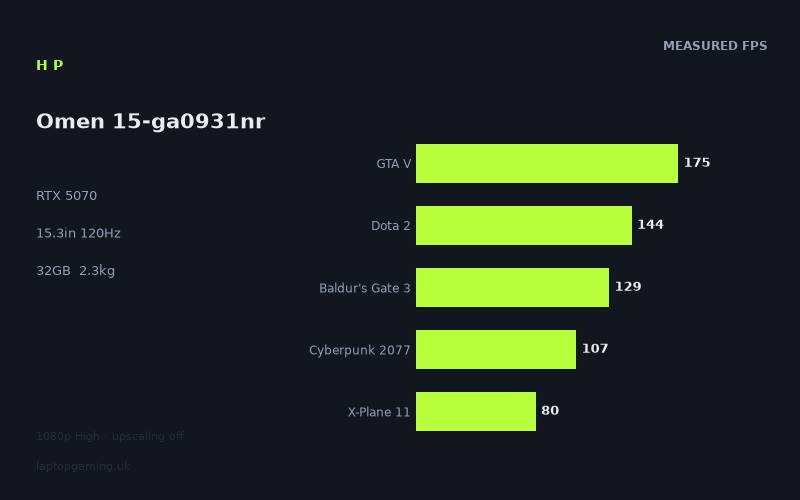
Frame rates
1920×1080, High preset, upscaling off. Averages 127fps across the 5 core benchmark games.
Measured on this machine. Source: Notebookcheck, 2026-10-14.
Not scored: no confirmed UK price
We have the full benchmark suite for this machine, so it ranks on the frame rate leaderboard like any other. What we don't have is a UK listing for this exact configuration - it's sold as a European review unit, or only in specifications that differ from the one tested. Since 30% of our score is value for money, scoring it would mean pretending price is no object, which would flatter it against every laptop you can actually buy. The frame rates below are real and comparable; there is just no buying recommendation to make yet.
How these numbers were produced
Frame rates here are not measured by us, and we label how each one was arrived at. A figure marked measured comes from a published run on that exact machine. A figure marked representative is derived from the GPU and its power limit (TGP) and cross-referenced against published reviews - a sound estimate of what that configuration delivers, but not a measurement of that specific laptop. Unless stated otherwise, numbers are 1920x1080, High preset, upscaling off. Where a laptop ships in several power configurations we use the wattage of the exact SKU listed, because a 140W RTX 5070 and a 115W one are not the same product.
In use
The short version
The HP Omen 15-ga0931nr is a well-specified 15.3in gaming laptop whose published results show a strong but uneven real-world gaming profile. Its RTX 5070, Core Ultra 9 386H and 32GB of memory produce excellent measured results in several lighter or better-scaling games, but the same machine is appreciably less convincing in the most demanding titles in the available set. That is not unusual for a laptop GPU, but it matters here because the display is a 2880x1800, 120Hz panel rather than a conventional 1920x1080 screen.
Notebookcheck’s figures, measured at 1920x1080 on the High preset with upscaling off, range from 265fps in Strange Brigade to 72fps in Assassin’s Creed Black Flag Resynced. The five-game scoring-suite mean is 127fps. That mean is useful as a summary, but the spread is more important than the single figure: this is a laptop that can greatly exceed its panel’s 120Hz refresh rate in some games at the benchmark settings, meet it closely in others, and fall well short in several more demanding or less GPU-friendly titles.
The key attraction is not that every game will run at a uniform frame rate. It plainly will not. The attraction is that the Omen can deliver very high frame rates in competitive, older and comparatively light games while still retaining respectable results in games such as Cyberpunk 2077 and X-Plane 11. The compromise is that the 2880x1800 panel is much more demanding than the 1920x1080 benchmark resolution, so the published numbers should not be read as a promise of matching native-resolution performance.
This configuration also has 8GB of VRAM, 32GB of system memory and a 1024GB SSD. Those are sensible supporting specifications for a gaming machine, particularly the 32GB memory allocation, but the benchmark data is the evidence that matters most here. The laptop’s measured output is good enough to make it a credible choice for buyers who value a sharp screen and play a mix of fast multiplayer games, established games and more demanding single-player releases. It is less clearly suited to someone who expects every demanding game to sit at 120fps on the panel without reducing settings, changing resolution or using upscaling.
There is no confirmed UK price for this exact configuration, so its value cannot be calculated. That is a pricing limitation, not a comment on the laptop’s performance or specification.
Buyers should also be careful not to fill gaps in the specification with assumptions. The available information gives the GPU model, but not a GPU power limit. It gives the panel size, resolution and refresh rate, but not the panel type. It gives the 2.271kg weight and 70Wh battery capacity, but not dimensions, battery-life measurements, temperatures or noise figures. Those omissions do not make the Omen a poor choice; they simply mean that a purchasing decision should be based on the evidence available rather than on imagined characteristics.
Performance
The benchmark picture is strong, but not flat
The RTX 5070 is the headline component, but the measured results show why a GPU name alone is not enough to describe a gaming laptop. Notebookcheck’s data at 1920x1080, High settings and with upscaling disabled gives the HP Omen 15-ga0931nr a five-game scoring-suite mean of 127fps. That is a strong average, but it contains games with markedly different demands and bottlenecks.
At the upper end, Strange Brigade reaches 265fps and F1 24 reaches 220fps. GTA V follows at 175fps, while Dota 2 records 144fps. These are not merely playable results: at the stated benchmark settings, they are high-refresh-rate figures. On a 120Hz panel, there is ample benchmark headroom in Strange Brigade, F1 24 and GTA V, while Dota 2 also exceeds the screen refresh rate. That matters to players who prioritise rapid input response and fluid motion in games where high frame rates are realistic.
Baldur’s Gate 3 records 129fps, which is also above the 120Hz refresh rate at the tested 1920x1080 High settings. Final Fantasy XV is close behind at 125fps. These results are more interesting than the headline 265fps result from Strange Brigade because they sit near the practical threshold set by the screen. At the benchmark resolution, both can make meaningful use of a 120Hz display. They do not offer the massive surplus seen in Strange Brigade, but they show that the Omen is not dependent on only the lightest games to approach the panel’s refresh ceiling.
Then the picture changes. Cyberpunk 2077 records 107fps, X-Plane 11 records 80fps, and Assassin’s Creed Black Flag Resynced records 72fps. These are still usable figures in isolation, but they are not 120fps figures at the benchmark settings. The difference is important because a buyer choosing a 120Hz 2880x1800 display is likely to care about the relationship between screen capability and game performance. The Omen can reach or exceed 120fps in a substantial part of this set at 1920x1080 High, but it does not do so universally.
That is the central performance conclusion. The laptop is not a machine that needs to apologise for its results: 107fps in Cyberpunk 2077, 80fps in X-Plane 11 and 72fps in Assassin’s Creed Black Flag Resynced are meaningful outputs with upscaling off. But neither should the 127fps average be mistaken for a minimum, a native-resolution result, or a guarantee of 120fps in every game. The individual results are the more useful buying guide.
What the scoring-suite mean does and does not tell you
The scoring-suite mean of 127fps is based on GTA V, Dota 2, Baldur’s Gate 3, Cyberpunk 2077 and X-Plane 11. Those games span a useful range of behaviour. GTA V reaches 175fps and Dota 2 reaches 144fps, pulling the mean upward. Baldur’s Gate 3 at 129fps sits close to the overall result. Cyberpunk 2077 at 107fps and X-Plane 11 at 80fps pull in the other direction.
That makes the average broadly representative of a mixed game library, but not representative of every game in the library. A player whose time is mostly spent in Dota 2, GTA V, F1 24 and Strange Brigade will experience the Omen as a high-frame-rate laptop at the benchmark settings. A player whose priority is Cyberpunk 2077, X-Plane 11 and similarly demanding games should focus less on the mean and more on the lower results. The difference between 265fps and 72fps is not a small variation around an otherwise fixed level of performance. It is the distinction between a machine that has considerable headroom in certain games and one that will need more careful settings choices in others.
The benchmark conditions matter just as much. These figures are all at 1920x1080, High settings and with upscaling off. That makes the results cleanly comparable within this machine’s published set, because each title is operating under the same broad conditions. It does not make them a direct forecast for 2880x1800 gaming. The panel has a higher resolution than the benchmark. Anyone buying the Omen specifically for native-resolution gaming should treat the available results as a starting point, not as native-panel figures.
Upscaling is also disabled in the benchmark data. That is useful because it shows the machine’s measured performance without that variable, but it means the data cannot tell us what frame rates the laptop might reach with upscaling enabled. It would be wrong to invent those figures. The relevant point is simply that the listed results were achieved without upscaling, and any use of upscaling would be a different test condition from the one reported here.
The strongest results
Strange Brigade at 265fps is the standout number. It is more than twice the 120Hz panel refresh rate at the measured settings. This does not mean that every game will behave similarly, and it does not change the physical refresh limit of the screen, but it confirms that the Omen has substantial performance headroom in a game that responds well to the configuration. For players who play titles with comparable demands, the laptop has room for high frame rates rather than merely scraping past a chosen target.
F1 24 at 220fps tells a similar story. Again, this is comfortably beyond 120fps at 1920x1080 High with upscaling off. It supports the view that the Omen is capable of properly high-refresh gameplay in suitable games, not merely high average results created by one unusually favourable title.
GTA V at 175fps is particularly useful because it is part of the scoring suite. The result contributes to the 127fps mean rather than sitting outside it as an additional result. At the benchmark settings it offers a considerable margin above the panel refresh rate. A buyer playing GTA V does not need to infer performance from a generic GPU tier; the published measurement is directly useful.
Dota 2 at 144fps is another result with practical value. It exceeds 120fps at the measured settings, though by a smaller margin than GTA V, F1 24 or Strange Brigade. That does not weaken the result. It identifies Dota 2 as one of the games in which the Omen can make use of its 120Hz display at 1920x1080 High. It also illustrates why looking at the entire set is better than relying on an average: 144fps and 265fps are both high results, but they offer very different amounts of headroom above the panel refresh rate.
The games that sit near the screen’s refresh rate
Baldur’s Gate 3 at 129fps and Final Fantasy XV at 125fps are close to the 120Hz threshold. At the measured settings, both are above it. For a buyer who wants to know whether the Omen is capable of running more than just esports-oriented games at a frame rate suited to the panel, the answer is yes in these titles.
However, “above 120fps at 1920x1080 High” is the right conclusion. It should not become “120fps at 2880x1800”, because the benchmark data does not establish that. Nor does it mean that every part of every game will remain at the same level. The published figures are the measured figures for the stated benchmark conditions, and that is the limit of what can responsibly be claimed.
These near-refresh-rate results are arguably more valuable for a prospective owner than a huge number in a lighter game. They show where the laptop is close enough to the display’s capability that resolution, settings and upscaling choices may become central to the experience. A buyer who is happy to use the benchmark resolution or make sensible adjustments has evidence that the Omen can operate near the 120Hz target in these games. A buyer who insists on native 2880x1800 resolution, High settings and no upscaling does not have published frame-rate evidence here and should not assume the same outcome.
The demanding end of the set
Cyberpunk 2077 at 107fps is a good result, but it is not a 120fps result. That distinction is worth making plainly rather than treating anything above 100fps as equivalent. On a 120Hz display, 107fps is close enough to the refresh rate to remain a strong performance figure, but it does not fully meet the screen’s maximum refresh under the stated benchmark conditions.
More importantly, Cyberpunk 2077 demonstrates the Omen’s limits more clearly than Strange Brigade does. It is the better reference point for a buyer interested in graphically demanding games. The result says that the Omen can deliver a high frame rate at 1920x1080 High with upscaling off, but it also says there is no large margin before the 120Hz target. Moving to the laptop’s 2880x1800 panel resolution, changing settings, or enabling upscaling would create different conditions, and the fact sheet provides no measured result for that combination.
X-Plane 11 at 80fps is the lowest scoring-suite result. That makes it especially important in understanding the 127fps mean. A mean can look comfortably above the panel’s 120Hz refresh rate while one of its constituent games is substantially below it. Anyone whose purchasing decision centres on X-Plane 11 should use 80fps as the meaningful number rather than the five-game mean.
Assassin’s Creed Black Flag Resynced records 72fps, the lowest published result in the full list. It is not part of the scoring suite, so it does not contribute to the 127fps mean, but it should not be ignored. It reinforces the central point that game-to-game variation is large. The Omen can produce 265fps in Strange Brigade and 72fps in Assassin’s Creed Black Flag Resynced under the stated benchmark conditions. A single average cannot explain that spread away.
The sensible interpretation is not that one figure is “right” and the other is somehow unrepresentative. Both are measured results. They describe a laptop whose performance is highly game-dependent. That is normal in gaming laptops, but it has concrete buying consequences: buyers should match the machine to the games they actually play, especially when the display has a 120Hz ceiling and a resolution above the benchmark resolution.
GPU power limit: what cannot be concluded from the specification
The Omen’s GPU is identified as an RTX 5070, but the available fact sheet does not state its GPU power limit. That missing detail matters because the GPU model name does not, on its own, establish how a laptop implementation is configured. It would be a mistake to assume that every RTX 5070 laptop behaves identically, or to assign a power limit based on the Omen name, the 15.3in chassis or results from another system.
The correct way to assess this machine from the available evidence is to use its measured frame rates. Notebookcheck’s numbers show what this particular configuration achieved in the listed games at 1920x1080 High with upscaling off. They are more useful than speculation about an unstated power limit. The Omen delivers 175fps in GTA V, 144fps in Dota 2, 129fps in Baldur’s Gate 3, 107fps in Cyberpunk 2077 and 80fps in X-Plane 11. Those results are the practical evidence of where the machine sits in the supplied benchmark set.
The missing power-limit figure also makes the rival comparisons more interesting. The two RTX 5090 rivals that are broadly level with the Omen in shared-game averages cannot be understood simply by reading “RTX 5090” and assuming a fixed performance result. One listed RTX 5090 runs at 120W, another at 160W, and the Omen’s limit is not given. The benchmark comparisons are therefore more valuable than a hierarchy based on GPU labels alone.
CPU, memory and storage in context
The Core Ultra 9 386H is paired with 32GB of memory. The fact sheet does not provide processor benchmarks, memory speed, storage benchmarks or application results, so there is no basis for claiming a particular productivity performance level. What can be said is that this is not a configuration that appears under-equipped in system memory relative to the supplied gaming hardware. The 32GB allocation is materially more reassuring for a buyer considering a laptop as a broader machine rather than as a GPU attached to a screen.
It is also relevant to the comparative data that lighter shared games at 1920x1080 can be CPU-bound. The supplied comparison guidance explicitly notes that these lighter titles can compress genuine GPU gaps. This helps explain why an RTX 5070 Omen can be essentially level with certain RTX 5090 laptops in the shared-game averages. It does not prove that the RTX 5070 is equivalent to an RTX 5090 in all workloads, nor does it erase the large gap to the Schenker XMG Neo 16 A25. It means the benchmark context matters.
The 1024GB SSD is a useful capacity figure, but no drive performance data is supplied. There is no published evidence here about loading times, sustained transfers or expansion options. Buyers needing a particular storage layout should confirm those details separately rather than inferring them from the capacity alone.
The screen
A 2880x1800, 120Hz display changes the buying decision
The HP Omen 15-ga0931nr has a 15.3in display with a 2880x1800 resolution and 120Hz refresh rate. Those specifications create a clear tension with the available performance data: the screen is higher resolution than the 1920x1080 benchmark, while its refresh rate is high enough that the difference between 72fps, 80fps, 107fps, 125fps and 175fps remains meaningful.
The refresh rate is easy to understand from the measured results. Strange Brigade at 265fps, F1 24 at 220fps, GTA V at 175fps and Dota 2 at 144fps all exceed 120fps at the tested settings. Baldur’s Gate 3 at 129fps and Final Fantasy XV at 125fps also exceed it, although with less spare performance. In these games, at 1920x1080 High with upscaling off, the Omen has benchmark evidence of reaching or surpassing the screen’s refresh ceiling.
Cyberpunk 2077 at 107fps sits below that ceiling but remains close to it. X-Plane 11 at 80fps and Assassin’s Creed Black Flag Resynced at 72fps sit further away. The panel is therefore not wasted, but neither is it fully exploited in every game. The best way to describe it is as a display that the Omen can drive very effectively in parts of the benchmark set, while more demanding games will not automatically reach 120fps even at the lower tested resolution.
The resolution needs more caution. The figures are not native 2880x1800 results. A buyer interested in the sharpness and workspace offered by the panel should not mentally substitute the panel resolution for the benchmark resolution. The available data does not support that substitution. There are no measured frame rates supplied for Strange Brigade, F1 24, GTA V, Dota 2, Baldur’s Gate 3, Final Fantasy XV, Cyberpunk 2077, X-Plane 11 or Assassin’s Creed Black Flag Resynced at 2880x1800.
That does not diminish the panel specification. It means the screen should be treated as a flexible asset rather than an automatic instruction to run every game at native resolution. A buyer who values the 2880x1800 desktop experience, but is prepared to choose in-game settings and resolution according to each title, has a coherent case for this machine. A buyer who regards native-resolution, High-settings, 120fps gaming as a non-negotiable requirement does not have sufficient published evidence to make that assumption.
No panel-type claim without panel-type evidence
The fact sheet does not identify the panel type, and there are no published measurements here for brightness, contrast, colour coverage, response behaviour or display latency. None of those characteristics should be guessed from the Omen branding, the resolution, the refresh rate or the laptop’s price position relative to other machines.
That is particularly relevant for buyers whose use extends beyond gaming. A 2880x1800 resolution and 15.3in size tell us that the panel has a particular physical format and pixel count, but not how it performs for colour-critical work, outdoor use or dark-scene viewing. Similarly, 120Hz tells us the maximum refresh rate, but not every aspect of motion performance. The published gaming data gives a good indication of whether the GPU can supply high frame rates in selected games; it does not replace display testing.
Who will get the most from this screen
The most natural fit is a player who values both a high-resolution laptop display and high-refresh gaming in a varied library. The Omen offers benchmark evidence for very high frame rates in Strange Brigade, F1 24, GTA V and Dota 2, while Baldur’s Gate 3 and Final Fantasy XV also reach above 120fps at the benchmark settings. That is enough to make the 120Hz panel a meaningful specification rather than an aspirational one.
It is less ideal for someone who wants the screen’s full 2880x1800 resolution to be the fixed setting for every game while also demanding 120fps. The fact sheet does not contain the results needed to support that expectation. The gap between the panel resolution and the benchmark resolution should be considered before purchase, especially for people primarily interested in Cyberpunk 2077, X-Plane 11 or Assassin’s Creed Black Flag Resynced.
Build, size and portability
The Omen is a 15.3in laptop weighing 2.271kg. That places it firmly in the category of a machine intended to be moved when necessary, rather than treated as a lightweight travel-first computer. The available weight is enough to establish that portability involves a trade-off: this is a substantial gaming laptop, but it is not so large in screen size that it belongs only on a permanent desk.
For a buyer moving between home, university, work or occasional travel, 2.271kg is a figure to take seriously rather than dismiss as a small specification-table detail. The machine may be portable, but carrying a laptop of this weight regularly is different from carrying a lighter device. The 15.3in display also indicates that this is not designed around the smallest possible footprint. The trade is obvious from the specification: more screen space and gaming hardware in exchange for a machine that should be considered a deliberate carry.
There are no dimensions supplied. That means there is no responsible basis for claiming that the Omen is thin, compact, backpack-friendly, unusually deep or especially easy to fit into a particular bag. The weight is the only physical portability measurement available, and it should be treated as such.
The 70Wh battery capacity is also provided, but there are no battery-life measurements. Capacity alone cannot tell a buyer how long the laptop will last in gaming, browsing, video playback, office work or any other use. It would be misleading to convert 70Wh into an endurance claim. Buyers who need long unplugged use should seek measured battery data before making this their default travel machine.
The same restraint applies to chassis quality, keyboard behaviour, touchpad quality, ports, upgrade access, cooling, temperatures and fan noise. None are described in the supplied facts. The benchmark performance suggests that the machine can deliver strong gaming output, but it does not prove how quietly or comfortably it does so. A gaming laptop is more than its average frame rate, and these are areas where the current evidence is incomplete.
That does not leave portability analysis empty. The Omen’s actual identity is fairly clear: a 15.3in, 2.271kg gaming laptop with a 70Wh battery, 32GB of memory and a 1024GB SSD. It looks better suited to a buyer who has a primary place to use it and occasionally moves it than to someone whose central requirement is all-day untethered mobility. That is an inference from the stated screen size, weight and battery capacity, not a claim of measured battery life.
How it compares
Against the MSI Cyborg 15
The MSI Cyborg 15 is the clearest lower-tier comparison in the supplied rival group. It uses an RTX 5050 and is listed at GBP 1,029. Across five shared games, the HP Omen averages 39fps more. That is a substantial performance difference, not a near tie created by benchmark noise or a single light game.
The Omen’s advantage matters because it is measured across five shared games rather than inferred from the GPU names. A 39fps average lead can affect whether a game is merely playable, whether it approaches a high-refresh target, or whether there is room to preserve settings. The exact per-game difference is not supplied, so it would be wrong to assign a particular gain to GTA V, Dota 2, Baldur’s Gate 3, Cyberpunk 2077 or X-Plane 11 individually. But the five-game average is enough to establish that the Omen is meaningfully ahead in this comparison.
That makes the Cyborg 15 a machine for buyers who are prepared to trade performance for a known GBP 1,029 price. The Omen is the better performance proposition between the two according to the shared-game figures. Whether it is the better purchase cannot be calculated without a confirmed UK price for this exact Omen configuration, but the performance hierarchy is not ambiguous.
Against the Asus ROG Zephyrus G16
The Asus ROG Zephyrus G16 is fitted with an RTX 5090 at 120W. Across four shared games, the HP Omen averages 1fps more. That is effectively a tie in the available comparison rather than evidence that the RTX 5070 Omen is broadly faster than every RTX 5090 laptop.
The supplied comparison note explains why such a result can occur: at 1920x1080, lighter titles in the shared set can be CPU-bound and compress genuine GPU gaps. This is exactly the sort of situation in which a GPU label can mislead. The Omen’s 1fps advantage across four games should be understood as a near-zero shared-game result at the stated resolution and conditions, not as a declaration that its RTX 5070 outruns a 120W RTX 5090 in every game, at every resolution or in every chassis.
It is still a useful result. It says the Omen is not automatically outclassed in the shared 1920x1080 data simply because another laptop has RTX 5090 branding. For buyers focused on the games represented by the shared set, the difference is not meaningful enough to decide the purchase on frame rate alone. Other factors would need evidence that is not supplied here.
Against the Razer Blade 16 2025 RTX
The Razer Blade 16 2025 RTX has an RTX 5090 at 160W. Across five shared games, the HP Omen again averages 1fps more. As with the Zephyrus G16 comparison, that is a real published result but not a licence to make sweeping claims about GPU equivalence.
The fact that the Razer comparison spans five shared games makes it a slightly broader comparison than the four-game Zephyrus result, but the conclusion is the same: the Omen and this Razer are essentially level in the specified shared 1920x1080 set. The 1fps margin has no practical significance in itself. What matters is that a lower GPU label has not prevented the Omen from matching this RTX 5090 machine within the supplied games and conditions.
The 160W figure also underlines why laptop GPU comparisons require context. The Razer’s stated GPU power figure differs from the Zephyrus G16’s 120W figure, while the Omen’s GPU power limit is not supplied. Yet the shared-game averages place the Omen 1fps ahead of both. The sensible response is to trust the measured comparison for these particular games, while refusing to extrapolate it beyond what it proves.
Against the Schenker XMG Neo 16 A25
The Schenker XMG Neo 16 A25 is the rival that most clearly exposes the limits of the Omen’s performance position. It uses an RTX 5090, and the HP Omen averages 74fps fewer across five shared games. Unlike the 1fps differences against the Zephyrus G16 and Razer Blade 16 2025 RTX, this is a large separation.
A 74fps shared-game deficit confirms that the Omen should not be presented as a universal RTX 5090 alternative. In some shared 1920x1080 comparisons, it is effectively tied with RTX 5090 laptops because lighter titles can compress GPU differences. Against the Schenker, the larger performance advantage remains visible. This is why it is essential to discuss the full rival spread rather than choosing only the comparisons that flatter the HP.
The Schenker is the obvious comparison for a buyer whose overriding goal is maximum shared-game performance. The Omen cannot match it in the published five-game comparison. That does not invalidate the Omen’s 127fps scoring-suite mean or its excellent results in Strange Brigade and F1 24. It simply identifies a more powerful alternative within the supplied rival group for buyers willing to choose on performance above all else.
What the rival spread really says
The rival data creates a more nuanced picture than a simple GPU hierarchy. The Omen is 39fps ahead of the RTX 5050 MSI Cyborg 15 across five shared games. It is effectively level with the RTX 5090 Asus ROG Zephyrus G16 across four shared games and the RTX 5090 Razer Blade 16 2025 RTX across five shared games. It is 74fps behind the RTX 5090 Schenker XMG Neo 16 A25 across five shared games.
Those outcomes are not contradictory. They show that gaming-laptop performance depends on the game set and test conditions, particularly at 1920x1080 where lighter titles may be CPU-bound. They also show why buyers should avoid buying solely from the GPU badge. The HP Omen’s actual benchmark profile is more competitive than “RTX 5070 versus RTX 5090” might suggest in some comparisons, while the Schenker result confirms that the badge difference can still correspond to a very large real-world performance gap.
For this Omen, the right conclusion is that it is a strong upper-middle performance option rather than an unquestioned maximum-performance machine. It clearly outperforms the listed RTX 5050 rival, can match particular RTX 5090 systems in the supplied shared data, and remains substantially behind the strongest listed RTX 5090 rival. That is a credible, useful position, provided the buyer’s expectations match the games and display resolution involved.
Who it’s for
Buy it if your priorities match its measured strengths
The HP Omen 15-ga0931nr makes the most sense for a buyer who wants a 15.3in gaming laptop with a 2880x1800, 120Hz screen and strong 1920x1080 High-preset results across a mixed library. It is particularly attractive for players of Strange Brigade, F1 24, GTA V and Dota 2, where Notebookcheck’s figures show 265fps, 220fps, 175fps and 144fps respectively. These are the games in which the laptop has clear high-refresh potential at the benchmark settings.
It also suits players who want reasonable evidence of performance in games that sit closer to the display’s 120Hz target. Baldur’s Gate 3 at 129fps and Final Fantasy XV at 125fps show that the Omen can exceed 120fps outside the very highest results in the list, at least at 1920x1080 High with upscaling disabled.
It is a reasonable fit for buyers who play demanding games but do not require every title to reach 120fps. Cyberpunk 2077 at 107fps is a strong result, while X-Plane 11 at 80fps and Assassin’s Creed Black Flag Resynced at 72fps demonstrate that the machine remains usable where its performance is lower. The buyer needs to be content with variation rather than expecting a fixed experience across every game.
The 32GB memory and 1024GB SSD also make this configuration more appealing to someone who does not want an obviously stripped-back specification around the GPU. There is no published evidence for productivity performance, storage speed or upgradeability, but the stated memory and storage capacities are practical starting points for a broader-use laptop.
Finally, it suits a buyer who sees portability as occasional rather than constant. At 2.271kg, it is a machine that can be transported, but it should not be chosen on the assumption that it behaves like a lightweight travel laptop. The 70Wh battery capacity is known, but battery-life results are not, so regular unplugged use should not be treated as a proven strength.
Buy something else if native-resolution certainty is essential
Buyers should look elsewhere, or wait for native-resolution benchmark evidence, if their central requirement is confirmed 2880x1800 performance at High settings in demanding games. The supplied figures are all measured at 1920x1080. The Omen’s display is 2880x1800. That mismatch does not mean the laptop performs poorly at its native resolution; it means there is no measured data here to prove a specific result.
It is also not the right choice for a buyer who treats 120fps as a hard minimum in every game. The available results make that clear. Cyberpunk 2077 is 107fps, X-Plane 11 is 80fps and Assassin’s Creed Black Flag Resynced is 72fps under the stated benchmark conditions. The laptop reaches or exceeds 120fps in much of the set, but not all of it.
Someone whose priority is the highest possible performance among the listed rivals should consider the Schenker XMG Neo 16 A25. The Omen is 74fps behind it across five shared games. That is the comparison to use when maximum shared-game frame rate is the deciding factor.
Buyers who require verified quiet operation, verified low temperatures, a specific panel technology, measured battery endurance, compact dimensions, particular ports or confirmed upgrade access should also avoid making an immediate decision from this fact sheet alone. None of those details are supplied. A strong benchmark chart cannot answer every ownership question.
The final judgement
The HP Omen 15-ga0931nr earns its case through its measured gaming results rather than through a simplistic GPU label. It is clearly ahead of the listed RTX 5050 MSI Cyborg 15, effectively tied with two listed RTX 5090 laptops in their shared 1920x1080 results, and decisively behind the highest-performing listed RTX 5090 rival. That is a more interesting position than a conventional specification-sheet reading would suggest.
Its own benchmark spread is the deciding detail. The Omen is excellent in Strange Brigade, F1 24, GTA V and Dota 2; it is close to the screen’s 120Hz limit in Baldur’s Gate 3 and Final Fantasy XV; it remains strong but below 120fps in Cyberpunk 2077; and it is less suited to a fixed 120fps expectation in X-Plane 11 and Assassin’s Creed Black Flag Resynced.
For the right buyer, that is a compelling profile: a substantial 15.3in gaming laptop with a high-resolution 120Hz display, 32GB of memory, 1024GB of storage and benchmark evidence of very high frame rates where game demands allow it. For the wrong buyer, the same facts are a warning: the panel is more demanding than the benchmark resolution, the lower results are real, and several ownership details remain unmeasured. Choose it for the measured strengths, not for assumptions beyond the data.