Review
Acer Predator Helios 16 review
Frame rates
1920×1080, High preset, upscaling off.
Measured on this machine. Source: Notebookcheck, 2023-07-18.
Not scored: incomplete benchmark suite
Every scored laptop on this site is averaged over the same 5 games, and this one is short of Cyberpunk 2077, Baldur's Gate 3. A mean over 3 games is not comparable to a mean over 5, so we publish the figures we have and leave the score blank rather than rank it against machines tested on a different set. The numbers below are real - the suite is just incomplete.
How these numbers were produced
Frame rates here are not measured by us, and we label how each one was arrived at. A figure marked measured comes from a published run on that exact machine. A figure marked representative is derived from the GPU and its power limit (TGP) and cross-referenced against published reviews - a sound estimate of what that configuration delivers, but not a measurement of that specific laptop. Unless stated otherwise, numbers are 1920x1080, High preset, upscaling off. Where a laptop ships in several power configurations we use the wattage of the exact SKU listed, because a 140W RTX 5070 and a 115W one are not the same product.
In use
The short version
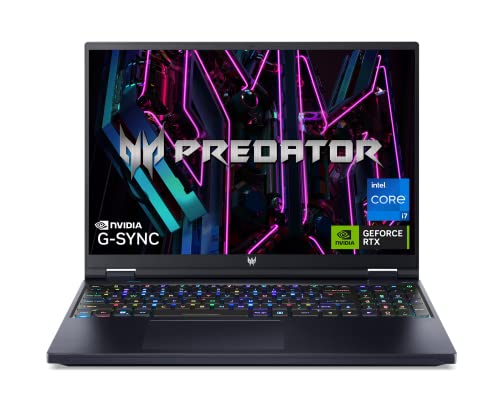
The Acer Predator Helios 16 in this configuration is the clearest illustration in our data of why the GPU model number on the box is the least useful part of a gaming laptop's specification. It carries an RTX 4060 configured at 140W — the top end of what that GPU is ever given — paired with a Core i7-13700HX, 16GB of memory, a 1TB SSD and a 16in 2560x1600 IPS panel running at 240Hz. Our record puts the UK price at £790.
What that combination produces, according to Notebookcheck's measurements, is a machine that finishes level with an Asus TUF Gaming A17 carrying an RTX 4070, also at 140W, across four shared games. A 4060 given as much power as a 4070 performs like a 4070. That is not a surprising result once you understand how these products are configured, but it is rarely demonstrated this cleanly, with both power limits known and both machines measured on the same software.
The rest of the comparison set brackets that tie usefully. Against an MSI Thin GF63 with an RTX 4050 the Helios 16 is 54fps ahead across three shared games. Against an Asus ROG Strix Scar 17 with an RTX 4090 it is 57fps behind across three. Those are enormous margins in both directions, and they establish that the benchmark separates hardware decisively when the hardware genuinely differs — which is what makes the tie against the 4070 machine worth taking seriously rather than dismissing.
The raw figures are strong for the tier. The three scoring-suite games we hold average 142fps: GTA V at 172fps, Dota 2 at 159fps and X-Plane 11 at 95fps. The wider set runs from Strange Brigade at 215fps down to Returnal at 73fps, and nothing measured falls below that. A floor of 73fps across a twelve-game set at 1080p on High with upscaling off is a genuinely comfortable result.
Two caveats matter, and both are about the screen rather than the silicon. The panel is 2560x1600 at 240Hz, and every frame rate above was measured at 1920x1080. The native panel carries roughly twice the pixels, so the numbers in this review overstate what the machine does on its own display in the demanding titles. And no measured game reaches 240fps, even at 1080p — the refresh rate is far beyond anything this GPU will feed it in the games we hold.
There is no score on this page. Our scoring suite is five games and we hold three of them here — GTA V, Dota 2 and X-Plane 11. We have no Baldur's Gate 3 figure, and while our record does hold a Cyberpunk 2077 result, it is from the game's 1.6 build rather than the version the current suite uses, so it cannot stand in. A three-game average ranked against every other machine's five-game average would corrupt the leaderboard, so we publish none.
Buy it if the £790 in our record holds up at the point of sale, because at that price the performance on offer is difficult to argue with. Look elsewhere if you intend to run demanding games at the panel's native resolution, or if the 240Hz figure is a substantial part of what you think you are paying for.
Performance
140W on an RTX 4060 is the whole story
Nvidia does not sell laptop manufacturers a finished graphics card. It sells silicon with a configurable power limit, and the manufacturer chooses where in that band to run it depending on how much heat the chassis can move, how much fan noise is acceptable and what the machine is meant to cost. The consequence, which governs everything in this review, is that the performance range within a single GPU model routinely exceeds the performance gap between adjacent models.
Our record puts this machine's RTX 4060 at 140W. That is not a middling configuration or a respectable one — it is the aggressive end, the sort of figure normally attached to a tier above. Acer has taken a mid-range GPU and given it as much power as the chassis can support.
The chassis supports it because there is enough of it. 2.575kg in a 16in shell is a proper gaming laptop rather than a thin-and-light making compromises, and it carries a 90Wh battery, which implies a machine built without much concern for weight. Cooling capacity is a function of volume — fan diameter, heat pipe cross-section, exhaust area — and this machine has the volume to justify the number on the specification sheet. The 140W figure is internally consistent with everything else we know about the hardware, which is not always true of power limits in our data.
The payoff appears directly in the comparison section, where a 140W RTX 4060 ties a 140W RTX 4070 across four games. That is the configuration band doing exactly what it does: when two GPUs a tier apart are given the same power, the tier gap largely evaporates. The corollary is the one buyers keep getting wrong in the other direction — a 4070 in a thin chassis, configured conservatively, can lose to a machine like this one.
Working through the measured spread
Twelve games, all at 1920x1080 on the High preset with upscaling off, running from 215fps down to 73fps. That is a spread of under three to one, which is narrow by the standards of our data and tells you something in itself: this machine has no collapse point in the games measured. There is no title in the set where it falls apart.
The top — Strange Brigade at 215fps, F1 22 at 196fps, The Witcher 3 at 181fps — is where a healthy modern GPU with plenty of power lands. Strange Brigade is a Vulkan title that has been a benchmark staple for years because it scales cleanly and puts little unusual load on the processor; a result of that order confirms the power delivery and cooling are doing their job. F1 22 at 196fps is a well-optimised racing title. The Witcher 3 at 181fps is the most interesting of the three, because it is a large open-world game and a figure that high shows the machine has real headroom in anything that is not from the very heaviest end of its era.
The upper middle — GTA V at 172fps, Dota 2 at 159fps, Shadow of the Tomb Raider at 141fps — includes two of our three scoring-suite results, and both need reading carefully. GTA V leans heavily on single-thread processor performance and stopped being GPU-limited on hardware of this class some time ago; 172fps there is substantially a statement about the Core i7-13700HX rather than the RTX 4060. Dota 2 at 159fps is the same phenomenon more acutely — Dota 2 does not trouble any RTX 40-series card, and the figure reflects how fast the processor can feed it.
This matters for the comparison section, so it is worth stating plainly now: two of the three scoring games we hold for this machine are limited by the processor rather than the graphics card at 1080p. Any comparison built on those games will compress genuine GPU differences, and that is precisely what happens below.
The lower middle — Cyberpunk 2077 1.6 at 115fps, Tiny Tina's Wonderlands at 115fps, Final Fantasy XV at 100fps, X-Plane 11 at 95fps — is where the GPU is doing more of the work, with one exception. X-Plane 11's simulation loop is famously processor-heavy and famously indifferent to graphics hardware, so 95fps there is not a comment on the 4060. The Cyberpunk figure at 115fps is a genuinely strong result for this GPU tier, and it is frustrating that it comes from the 1.6 build rather than the version our scoring suite uses.
The bottom — God of War at 89fps and Returnal at 73fps — is where a 140W RTX 4060 finally has to work, and both results are good. Returnal is a demanding title and 73fps at 1080p High with upscaling off is well clear of the point where the experience suffers. A twelve-game set with a floor of 73fps is an unusually flat performance profile, and it means a buyer can be reasonably confident the machine will not surprise them unpleasantly in anything from that era.
The two missing games, and why there is no score
Our scoring suite is five games, chosen so that every machine in our data can be ranked on identical software. For this laptop we hold three: GTA V at 172fps, Dota 2 at 159fps and X-Plane 11 at 95fps, averaging 142fps. We do not hold Baldur's Gate 3, and we do not hold a current-build Cyberpunk 2077 result.
The Cyberpunk situation is worth explaining rather than glossing, because the record does contain a Cyberpunk number. It is a 1.6-build measurement at 115fps. Cyberpunk 2077 has changed substantially across its major updates, in ways that affect how it uses graphics hardware, and a figure from one build cannot be dropped into an average built from another without introducing exactly the kind of quiet error our scoring exists to avoid. So it sits in the results table, where it is genuinely useful context, and stays out of the suite average.
The practical effect of the two absences is worse than the count suggests. Both missing games are among the more GPU-bound titles in the suite, and both of the games we do hold from the top of the table are processor-bound. Our three-game average is therefore weighted towards the component this machine's specification is not selling you on, and it will understate a well-powered GPU. That is the single most important caveat to carry into the comparisons below.
What the numbers mean in practice
Stripped of comparison, the picture is straightforward and good. Every game measured runs above 73fps at 1080p on High with no upscaling. Nine of the twelve run above 95fps. Six run above 140fps. If your library is anything from before the 2023 crop of heavy releases — which is to say most of what people actually play — this machine produces frame rates well past the point of diminishing returns.
The important qualification is the panel, dealt with properly below. These are 1080p numbers on a machine whose screen is 2560x1600. The processor-bound results at the top of the table will lose relatively little at native resolution, because the GPU has spare capacity there. The GPU-bound results at the bottom will lose a great deal.
The screen
2560x1600 on a 16in panel
The panel is a 16in IPS unit at 2560x1600 — a 16:10 ratio — refreshing at 240Hz. As a display it is well specified for the class, and considerably better than the price in our record would suggest. The resolution is right for the diagonal: 1080p across 16in is visibly coarse, and 4K on a laptop panel costs an enormous amount of GPU performance for a difference few people can resolve at normal viewing distance. 1600p is the sensible middle and the 16:10 shape is a real improvement over 16:9 for everything that is not a game.
The problem is arithmetic. Every frame rate in this review was measured at 1920x1080. The panel's native resolution carries roughly twice as many pixels. That is not a small correction and it does not apply evenly. The titles at the top of the table — GTA V, Dota 2, The Witcher 3 — are limited by the processor at 1080p and have GPU capacity in reserve, so they will lose relatively little when the resolution rises. The titles at the bottom — Returnal, God of War, Tiny Tina's Wonderlands — were already GPU-limited, and a doubling of pixel count lands squarely on them.
We hold no native-resolution measurements and we will not estimate them. What can be stated with confidence is the direction and the shape: the machine's flat performance profile at 1080p will not stay flat at 1600p. The spread will widen, the processor-bound games will remain comfortable, and the demanding ones will need either reduced settings or DLSS. That is entirely normal for a 4060-class GPU paired with a 1600p panel, and it is the standard trade of this generation — the upscaling technology exists because manufacturers fit panels their GPUs cannot natively drive in the hardest games.
None of this makes the panel a mistake. A high-resolution screen is a permanent asset for desktop work, text, media and older games, and DLSS on this GPU generation is good enough that using it is not a meaningful sacrifice. It simply means that a buyer reading 73fps for Returnal should not expect that figure on the screen in front of them.
240Hz against what the GPU produces
This is the specification with the widest gap between promise and delivery. Not one of the twelve measured games reaches 240fps at 1080p. The fastest, Strange Brigade at 215fps, comes closest and still falls short. At the panel's native 1600p the gap becomes enormous.
A 240Hz panel exists to serve competitive players running light games at low settings, where a mid-range GPU genuinely can produce frames at that rate. That is a real use case and this panel supports it. But it is not what the measured data describes, and a buyer should not assume the refresh rate translates into anything they will see in the titles above.
What the panel does deliver at these frame rates is worth stating fairly, because it is not nothing. A high-refresh display lowers the persistence blur and input latency floor at any frame rate, not only above its own number. A game running at 141fps on a 240Hz panel with variable refresh is smoother and more responsive than the same 141fps on a slower panel, where it would tear or be capped. Most of these results sit comfortably in that band and the panel is doing real work there. It is simply doing less work than the headline number implies.
If anything, 240Hz on a machine with this GPU is evidence about the price. A 2560x1600 240Hz panel is an expensive component, and its presence in a machine our record prices at £790 is one of several things about this configuration that reward checking before you commit.
IPS, and what our record does not hold
Our record identifies the panel as IPS, which rules out the poor off-axis behaviour of TN and rules out OLED, with its structurally superior contrast. Beyond the panel technology we hold nothing: no brightness measurement, no colour gamut coverage, no pixel response time.
The response time gap is the one that matters most here. A 240Hz panel with slow pixels produces visible smearing that undermines the entire reason for the refresh rate, and 240Hz IPS panels of this era varied considerably in that respect. We are not going to guess. Anyone for whom motion clarity is the point of buying a 240Hz display should treat it as an open question and seek measurements.
Build, size and portability
2.575kg, and what it buys
At 2.575kg in a 16in footprint this is a substantial machine but not an immobile one. It will fit a normal backpack and a normal desk, and it can commute occasionally without being a burden — a different proposition from the 17in and 18in machines of this generation, which move between rooms rather than between places. It is not a laptop you carry every day without noticing, and the power adapter, which is not in our record, will add meaningfully to that. A machine feeding a 140W GPU and an HX-class processor needs a serious brick.
The weight is not a cost to be tolerated — it is the reason the machine performs as it does. There is a direct chain from chassis volume to cooling capacity to sustained power limit to frame rate, and the 140W configuration that lets this RTX 4060 tie a 140W RTX 4070 exists because there is 2.575kg of machine to dissipate the heat into. A buyer who wants both this level of GPU power and a light chassis is asking for something that did not exist in this generation at any price. The Helios 16 has made the trade in the right direction for a machine whose purpose is playing games.
The 90Wh battery
90Wh is a large battery, close to the practical ceiling that aviation rules impose on lithium cells in cabin baggage. Acer has fitted about as much capacity as it is permitted to, and on a machine at this price that is a genuine and slightly unexpected generosity.
Our record holds no measured runtime, so we will not state one. What capacity means structurally is this: no laptop of this class runs its GPU near its plugged-in power limit on battery, because no battery could sustain that draw usefully, so unplugged gaming will be a substantially reduced experience regardless. Where 90Wh genuinely helps is everything else — browsing, video, documents, the ordinary work a 16in laptop with a good screen is well suited to. A large battery on a machine that idles efficiently is a real quality-of-life feature and it is worth having.
Memory and storage
16GB of memory and a 1TB SSD are the category standard for this generation — adequate rather than generous, and the memory is the specification most likely to feel constrained first as games get heavier. Whether it can be expanded is not established by our record, and it is worth confirming, because on a machine of this size the answer is usually yes and it is the cheapest meaningful upgrade available.
1TB fills faster than people expect; two or three large modern installs and the drive is under pressure. Whether there is a second drive bay is again not something we hold, and we are not going to assert it.
How it compares
Four rivals from the same GPU generation, compared only on games both machines hold, with the scoring suite preferred. None has a confirmed UK price in our record, so all four comparisons are about performance alone — which is a real limitation, and one that cuts unusually sharply here, because this machine's most striking characteristic is its price.
MSI Thin GF63 (RTX 4050) — 54fps ahead across three games
The control result, and a wide one. The GF63 carries an RTX 4050, a tier below, and loses by an average of 54fps across three shared games. That is not a rounding error or a matter of game selection; it is a decisive, consistent separation.
Its value is in what it proves about the instrument. Any argument that these shared games are simply too processor-bound to distinguish graphics hardware dies here — they distinguish these two machines emphatically. That matters because two of the three shared games are almost certainly among the processor-bound titles identified above, and even so a 54fps gap appears. The compression is real but partial.
It also tells a buyer something practical. Against the entry tier of this generation, the Helios 16 is not marginally better, it is substantially better, and a 140W RTX 4060 is worth seeking out over a 4050 at any configuration.
Medion Erazer Scout E20 (RTX 4050 at 100W) — level across three games
This is the result that looks wrong and is not. The Scout E20 carries an RTX 4050 configured at 100W — a full tier below this machine's GPU and 40 watts short of its power limit — and across three shared games there is no measurable difference between them.
Set against the 54fps margin over the other 4050 machine in this set, the explanation almost has to be the games. Different rivals share different subsets of the measured game list, and the three games shared with the Scout E20 will not be the same three shared with the GF63. If the E20 overlap is weighted towards GTA V, Dota 2 and X-Plane 11 — the processor-bound end — then both machines are hitting a ceiling that has nothing to do with their graphics cards, and a tie is precisely what should happen. Two competent processors feeding two GPUs with spare capacity produce the same numbers.
What this result does not support is the conclusion that a 140W RTX 4060 performs like a 100W RTX 4050 in general. That conclusion is contradicted by the same machine's 54fps win over another 4050, and by the 115fps Cyberpunk and 73fps Returnal results, which are the sort of figures a starved GPU does not produce. The tie is a statement about a narrow, unfavourable overlap of games, not about the hardware.
It is also a good illustration of why we restrict comparisons to shared titles rather than comparing overall averages. The restriction is what makes the comparison honest; it also means the number of shared games, and which ones they are, changes what the comparison can tell you. Three games is a thin base, and this one should be weighted accordingly.
Asus TUF Gaming A17 (RTX 4070 at 140W) — level across four games
The most informative comparison in the set, and the one that justifies the machine. The TUF A17 carries an RTX 4070 configured at 140W — a tier above this machine's GPU at an identical power limit — and across four shared games there is no measurable gap.
Both power limits are known here, which is rare and valuable. It means the comparison is not an inference about cooling or configuration; it is a direct measurement of two GPUs a tier apart, given the same power, on the same software. And they land in the same place.
Some of that is the suite composition — four shared games at 1080p, several of them processor-bound, will compress GPU differences. But not all of it, because those same characteristics did not stop a 54fps gap opening against a 4050. The honest reading is that at equal power, the gap between an RTX 4060 and an RTX 4070 is small enough that a 1080p test set largely absorbs it. Whether it would stay absorbed at 1600p or in more GPU-bound titles is a fair question our data cannot answer, and the likely answer is that the 4070 would edge ahead. It would not edge ahead by a tier's worth.
For a buyer this is the single most useful fact on the page. If the choice is between this machine and a 4070 laptop that costs meaningfully more, the frame rate argument for the 4070 is weak in the games we can compare. If the choice is between this machine and a 4070 laptop in a thin chassis with an unknown or low power limit, the argument for the 4070 is weaker still.
Asus ROG Strix Scar 17 (RTX 4090) — 57fps behind across three games
The Scar 17 carries an RTX 4090 and beats this machine by an average of 57fps across three shared games. Our record holds no power limit for the Scar 17's GPU, so we cannot say how it is configured, and we are not going to invent a figure for an empty field.
The sample is three games, which is thin, and worth noting for the same reason it was worth noting above. But a 57fps average gap is far too large to be an artefact of which three titles were chosen, and it is the second wide margin in this comparison set.
That is the point worth drawing out. This set contains two ties and two very large gaps, measured on the same kind of shared-game basis. An instrument that produces a 54fps win at one end and a 57fps loss at the other is not a blunt one. When it returns no difference between this machine and a 140W RTX 4070, that is a finding rather than a failure — and when it returns no difference against a 100W RTX 4050, the explanation lies in which three games happened to overlap, not in the instrument's resolution.
The practical meaning of the Scar 17 comparison is about expectations. This is a mid-tier GPU, generously configured, in a mid-priced chassis. The flagship machines of its generation are far ahead, and the measurements say so unambiguously. Nothing about a 140W 4060 makes it a 4090 substitute.
Reading the four together
Decisive win against one 4050. Dead heat against another 4050 on a narrow, unfavourable overlap. Dead heat against a 4070 at matched power. Decisive loss against a 4090. The coherent story running through all four is that power limit and test-set composition explain the results better than GPU model numbers do, which is the general lesson of this generation and rarely on such clear display.
The price, and the caution attached to it
Our record puts this configuration at £790. For a 16in machine with a Core i7-13700HX, an RTX 4060 at 140W, 16GB, a 1TB SSD, a 90Wh battery and a 2560x1600 240Hz panel, that is a striking figure — low enough that it changes the entire assessment, and low enough that it should be verified rather than assumed.
We are reporting the price our record holds, not endorsing it. It reads like an end-of-line or clearance figure for a 2023 machine rather than a standing retail price, and a 240Hz 1600p panel alone is an expensive component to find in a laptop at that number. Prices in this category move weekly and configurations that look identical often differ in panel, memory or storage. Anyone acting on this review should confirm that the machine on offer is this configuration at this price.
If it is, the value case is strong and does not need much argument. A machine that ties a 140W RTX 4070 laptop across four games, holds a floor of 73fps across a twelve-game set at 1080p, and carries a high-resolution high-refresh panel and a large battery, at that price, is a straightforwardly good purchase. The performance analysis above stands on its own; the price is what converts it into a recommendation.
Who it's for
The case for buying it
This machine suits someone who wants gaming performance rather than a specification to quote. The central evidence is the TUF A17 comparison: a 140W RTX 4060 matching a 140W RTX 4070 across four games. If your shortlist is organised by GPU model number, this laptop is the argument for reorganising it by power limit instead.
It suits someone with a broad library rather than a bleeding-edge one. The performance profile is unusually flat — 215fps at the top, 73fps at the bottom, nothing in between that stands out as a weak spot. That consistency is worth more day to day than a high peak, because it means the machine rarely surprises you.
And it suits someone who wants a good screen for non-gaming work. A 2560x1600 16:10 panel is a genuinely pleasant thing to write, browse and watch on, and combined with a 90Wh battery this is a more capable general-purpose laptop than most gaming machines at its size.
The case against
Do not buy it expecting the frame rates in this review at the panel's native resolution. Those are 1080p figures; the screen carries roughly twice the pixels, and the demanding titles at the bottom of the table will absorb most of that cost. DLSS is the answer and it is a good one, but it should be a decision rather than a discovery.
Do not buy it for the 240Hz panel. Nothing measured reaches that rate even at 1080p, and at native resolution the gap is enormous. The refresh rate serves competitive players running light titles at reduced settings — a real use case, but not the one the benchmark data describes.
Do not buy it if you want a machine you carry daily. 2.575kg plus a substantial adapter is manageable rather than pleasant, and there are lighter laptops in this generation — though, as the comparison data shows, lighter usually means a lower power limit and lower frame rates.
Do not buy it if you need the heaviest recent releases at high settings and native resolution. This is a well-fed mid-range GPU from the RTX 40 generation, and it should be judged against that generation rather than against later flagships. Within its own class it is doing very well; outside it, the 57fps deficit to a 4090 machine shows where the ceiling is.
What would change the analysis
Three gaps in our record would sharpen this considerably. A Baldur's Gate 3 figure and a current-build Cyberpunk 2077 figure would let us score the machine and, more usefully, would add two GPU-bound titles to a scoring set currently dominated by processor-bound ones — which is exactly where a 140W configuration should shine. Native 1600p measurements would let buyers judge the panel rather than reason around it. And a confirmed price on any of the four rivals would turn a set of performance comparisons into value comparisons, which is what someone with a budget actually needs.
Until then: a generously configured mid-range GPU in a chassis built to feed it, a better screen than the price implies, a flat and comfortable performance profile at 1080p, and a price in our record that is the single thing most worth verifying before you buy.