Review
HP Victus 16-e0145ng review
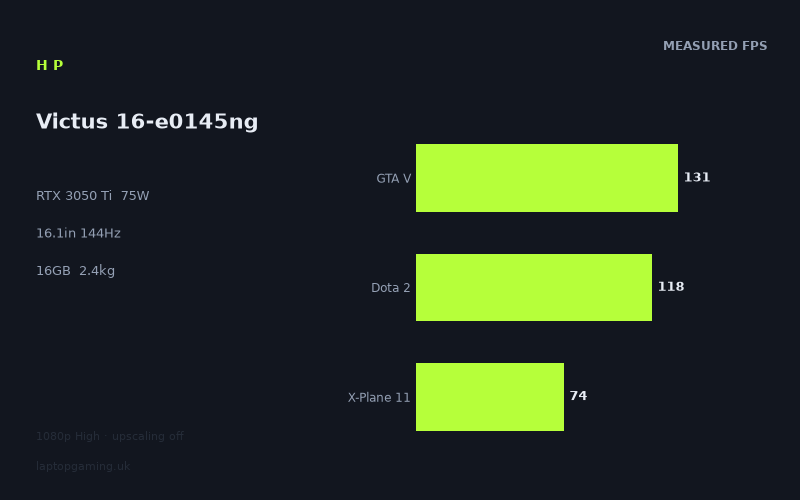
Frame rates
1920×1080, High preset, upscaling off.
Measured on this machine. Source: Notebookcheck, 2022-05-20.
Not scored: incomplete benchmark suite
Every scored laptop on this site is averaged over the same 5 games, and this one is short of Cyberpunk 2077, Baldur's Gate 3. A mean over 5 games is not comparable to a mean over 5, so we publish the figures we have and leave the score blank rather than rank it against machines tested on a different set. The numbers below are real - the suite is just incomplete.
How these numbers were produced
Frame rates here are not measured by us, and we label how each one was arrived at. A figure marked measured comes from a published run on that exact machine. A figure marked representative is derived from the GPU and its power limit (TGP) and cross-referenced against published reviews - a sound estimate of what that configuration delivers, but not a measurement of that specific laptop. Unless stated otherwise, numbers are 1920x1080, High preset, upscaling off. Where a laptop ships in several power configurations we use the wattage of the exact SKU listed, because a 140W RTX 5070 and a 115W one are not the same product.
In use
The short version
The HP Victus 16-e0145ng is a straightforward budget gaming laptop proposition: an RTX 3050 Ti running at a 75W GPU power limit, a Ryzen 5 5600H, 16GB of memory and a 16.1in 1920x1080 IPS display with a 144Hz refresh rate, priced at £537. At that price, the benchmark data makes a compelling case for it as a machine for 1080p gaming at High settings, provided expectations are set correctly.
Notebookcheck’s measured figures show this Victus can produce very high frame rates in lighter and older games, including GTA V at 131fps, Back 4 Blood at 124fps, Dota 2 at 118fps, Strange Brigade at 114fps, Rainbow Six Extraction at 112fps, Farming Simulator 22 at 105fps and The Witcher 3 at 104fps. That is substantial performance for a laptop at this price, and it means the 144Hz panel is not merely decorative in every game. There are titles here where the machine gets close enough to the screen’s maximum refresh rate for fast movement to look noticeably smoother than it would at 60Hz.
The more important point is that the Victus does not rely entirely on lightweight esports fare to look good. Alan Wake Remastered is measured at 95fps, Ghostwire Tokyo at 90fps, Vampire Bloodhunt at 86fps, Forza Horizon 5 at 84fps and Guardians of the Galaxy at 82fps. Those are useful results because they show that this is not just a laptop for old games or undemanding competitive titles. At 1920x1080, High settings and with upscaling disabled, it has enough performance for a broad range of games to feel comfortably playable.
There are limits, and they matter. Riders Republic and Tiny Tina’s Wonderlands are both measured at 69fps. Elden Ring reaches 60fps, Halo Infinite reaches 59fps, Final Fantasy XV reaches 55fps and God of War reaches 50fps. Dying Light 2 is the clear warning sign at 40fps. These are not results that make the Victus unusable, but they are a reminder that an RTX 3050 Ti at 75W is a value-oriented 1080p GPU configuration, not a machine intended to run every demanding game at High settings while keeping a 144Hz display fully fed.
The five scoring-suite games average 98fps: GTA V, Dota 2, Strange Brigade, X-Plane 11 and Final Fantasy XV. That average is healthy, but it should not be mistaken for a promise that every current game will run close to 100fps. The individual figures range from GTA V at 131fps to Final Fantasy XV at 55fps within that suite alone. The spread is the point. This laptop can be very quick in some games and merely adequate in others, even before moving to the heavier titles such as Dying Light 2.
For a buyer with £537 to spend, that unevenness is acceptable because the better results are genuinely strong and the weaker ones are still clearly identified by the published data. This is a particularly sensible choice for someone playing a mixture of esports games, older AAA releases, driving games, co-operative shooters and large existing game libraries at 1080p. It is less convincing for someone buying specifically for the heaviest recent games at High settings, for someone who expects to see 144fps in everything, or for someone who wants portability to be a priority.
The 2.4kg weight makes the Victus a laptop that can travel when necessary, rather than an especially convenient machine to carry every day. The 70Wh battery capacity is specified, but there is no battery-life measurement in the supplied data, so it would be irresponsible to turn that capacity into an endurance claim. Likewise, the specification confirms an IPS panel, a 144Hz refresh rate and 1920x1080 resolution, but it does not provide measured brightness, colour coverage, contrast or response-time results. The screen should therefore be judged primarily as a sensibly matched gaming display, not assumed to be an exceptional creator panel or outdoor-use display.
The strongest conclusion is simple: the HP Victus 16-e0145ng is excellent value for 1080p gaming at £537. It does not eliminate the compromises of a 75W RTX 3050 Ti, but the price leaves room for those compromises. The frame-rate data shows a machine that is capable of very good gaming performance in a wide range of titles, while also making clear where settings discipline will be required.
Performance
A 75W RTX 3050 Ti with realistic limits
The key performance specification is not merely that this is an RTX 3050 Ti laptop. It is an RTX 3050 Ti operating with a 75W GPU power limit. That figure is essential context when looking at the frame rates. Laptop GPUs with the same product name can be configured differently, and the power limit is part of what determines how much performance is available in sustained gaming workloads. The Victus should therefore be assessed as a 75W RTX 3050 Ti implementation, not treated as interchangeable with every other RTX 3050 Ti laptop.
In practice, the published figures show that this configuration is well suited to 1920x1080 gaming at the tested High preset with upscaling turned off. It is not a configuration that consistently supplies the full 144fps required to match the display’s refresh rate, but it delivers enough performance to make a 144Hz panel worthwhile in a meaningful selection of games.
GTA V is measured at 131fps. That is the highest result in the supplied data and is close to the display’s 144Hz ceiling. Back 4 Blood follows at 124fps, Dota 2 at 118fps, Strange Brigade at 114fps and Rainbow Six Extraction at 112fps. Farming Simulator 22 reaches 105fps, while The Witcher 3 is measured at 104fps. These results establish the Victus as more than a basic 60fps laptop for the right games. In titles with this level of demand, it can take tangible advantage of the 144Hz panel.
That does not mean every one of those games is necessarily locked to the screen refresh rate, and it would be wrong to imply that 131fps is the same thing as 144fps. The useful point is that these figures are far beyond 60fps and well into the territory where the screen’s higher refresh capability has a practical role. A player focusing on Dota 2, Rainbow Six Extraction, Back 4 Blood or GTA V will get a different experience from this screen than they would from a 60Hz panel, because the measured performance is high enough to make the extra refresh headroom relevant.
Strange Brigade at 114fps and Farming Simulator 22 at 105fps deserve attention for another reason. They demonstrate that the Victus does not need every game to be an esports title before it can exceed 100fps. The result is still game-dependent, but there is a useful band of software where the laptop combines High settings, native 1080p resolution and clearly high frame rates without relying on upscaling.
The broad middle: good 1080p results without full 144Hz performance
The middle of the results is arguably the most valuable part of the benchmark list for a buyer considering a £537 laptop. This is where games that are more demanding than GTA V or Dota 2 still run well, yet do not reach the display’s maximum refresh rate.
Alan Wake Remastered is measured at 95fps, Ghostwire Tokyo at 90fps and Vampire Bloodhunt at 86fps. Forza Horizon 5 reaches 84fps, while Guardians of the Galaxy is measured at 82fps. These are strong results for the price and configuration, especially because they are measured at 1920x1080, High settings and with upscaling off. A buyer can look at these figures and reasonably expect a more fluid experience than a 60fps target in these particular games, even though there is still unused headroom in the 144Hz panel.
Forza Horizon 5 at 84fps is particularly relevant for anyone who wants the Victus for racing games. It does not match the display’s maximum refresh rate, but 84fps is plainly beyond the 60fps baseline that many buyers consider acceptable for a smooth driving game. The same general reading applies to Guardians of the Galaxy at 82fps and Ghostwire Tokyo at 90fps. The GPU is not delivering the sort of output that makes the 144Hz label central to the experience, but it is delivering performance that is comfortably above basic console-style frame-rate expectations.
The distinction matters when setting expectations. A 144Hz display does not require every game to reach 144fps before it has value. It means the panel is capable of showing higher frame rates where the GPU can produce them. The Victus has a mixed relationship with that ceiling: some games approach it, several occupy a comfortable middle ground, and the heaviest games sit well below it. That is a more honest description than calling this either a 144fps gaming machine or a 60fps-only machine.
The machine’s mean across the five scoring-suite games is 98fps. That result is useful as an overview, but the individual numbers should take priority when deciding whether the laptop suits a particular game library. The suite includes GTA V at 131fps, Dota 2 at 118fps, Strange Brigade at 114fps, X-Plane 11 at 74fps and Final Fantasy XV at 55fps. Those are markedly different outcomes. A player whose regular games resemble the first three will experience a very different laptop from someone whose main game resembles Final Fantasy XV.
Where the performance becomes more constrained
At the lower end of the list, the Victus remains playable in many cases, but it becomes increasingly difficult to describe the 144Hz display as something the GPU can exploit fully at the tested settings. Riders Republic and Tiny Tina’s Wonderlands both record 69fps. These are still above 60fps, and for many players that will be a perfectly reasonable result at High settings. However, they are nowhere near the panel’s 144Hz limit, so a buyer choosing this laptop primarily because of the refresh-rate figure should recognise that the display is providing headroom rather than a guarantee.
Elden Ring is measured at 60fps. Halo Infinite is at 59fps, Final Fantasy XV at 55fps and God of War at 50fps. These figures are where the practical meaning of the 75W RTX 3050 Ti becomes clearest. In the tested configuration, there are games where the laptop is operating around the conventional 60fps region rather than the high-refresh region. That is not a flaw unique to the Victus, but it is a real limitation of this level of hardware.
God of War at 50fps is especially useful evidence because it sits between the comfortable middle tier and the genuinely demanding end of the list. It is not an indication that the laptop cannot run the game, but it does indicate that High settings without upscaling can ask more of the GPU than it can provide at a consistently high frame rate. Buyers who put visual settings first may be content with that result. Buyers who put responsiveness first may need to accept settings changes in games of comparable demand. The fact sheet does not provide lower-preset or upscaled results, so there is no basis for stating what frame rate would result from those changes.
Dying Light 2 is measured at 40fps, making it the clearest example of a game where the tested High preset is difficult for the Victus. This result should not be buried beneath the much stronger figures elsewhere in the list. A laptop review that highlights 131fps in GTA V but ignores 40fps in Dying Light 2 would not be useful to someone spending real money. The correct conclusion is that the Victus is capable of high frame rates in many games, but demanding titles can require compromises if the goal is to move beyond the result measured at High settings with upscaling disabled.
There is no published result here for ray tracing, alternative presets, alternative resolutions or upscaling modes. Those omissions matter. The available evidence is specifically for 1920x1080, High settings and upscaling off. It is tempting to assume that enabling an upscaling mode or reducing graphical settings would improve difficult games, but the supplied benchmark data does not quantify that improvement. The safest advice is therefore to buy this laptop for the measured High-preset experience, not for a hypothetical performance mode that has not been measured.
Understanding the spread between games
The large spread from GTA V at 131fps to Dying Light 2 at 40fps is not a contradiction. It is the central performance story of this laptop. Different games place different demands on the CPU, GPU and the game engine, and the Victus is being measured across a broad selection of titles rather than a single narrow benchmark category. The Ryzen 5 5600H and 16GB of memory form the rest of the specified core configuration, but the results still vary substantially from game to game.
At 1080p, lighter games in the shared comparisons can also become CPU-bound, which compresses apparent GPU differences between laptops. That point is directly relevant when looking at the rival results later in this review, but it also helps explain why a 75W RTX 3050 Ti can post figures above 100fps in some games while falling much lower in others. A title that runs at 118fps in Dota 2 is not necessarily evidence that every game will behave like Dota 2; it is evidence that Dota 2, under this test configuration, does not expose the same limits as a more demanding title.
The practical lesson for buyers is to think in categories rather than seeking a single all-purpose frame-rate label. The Victus is well placed for games represented by GTA V, Back 4 Blood, Dota 2, Strange Brigade, Rainbow Six Extraction, Farming Simulator 22 and The Witcher 3. It is also capable in games represented by Alan Wake Remastered, Ghostwire Tokyo, Vampire Bloodhunt, Forza Horizon 5 and Guardians of the Galaxy. It is more limited in games represented by Riders Republic, Tiny Tina’s Wonderlands, Elden Ring, Halo Infinite, Final Fantasy XV, God of War and Dying Light 2.
That distinction is more useful than declaring the laptop simply “fast” or “slow”. At £537, the Victus does not need to dominate the most difficult games at High settings to make sense. It needs to offer credible 1080p gaming across a wide enough range of games to justify its price, and Notebookcheck’s measurements indicate that it does.
The screen
The Victus has a 16.1in IPS screen with a 1920x1080 resolution and a 144Hz refresh rate. From a gaming perspective, that is a sensible specification for the hardware. The RTX 3050 Ti at 75W is being asked to drive 1920x1080 rather than a higher-resolution panel, and the measured figures show why that matters. The laptop can often deliver frame rates above 60fps at the tested High preset, and in a selection of games it gets close to the 144Hz ceiling.
The 144Hz refresh rate is best understood as useful headroom rather than a target the Victus reaches universally. GTA V at 131fps is the closest listed result to that ceiling. Back 4 Blood at 124fps, Dota 2 at 118fps, Strange Brigade at 114fps and Rainbow Six Extraction at 112fps also make substantial use of a high-refresh display. In those games, the panel specification matches the GPU performance well.
Farming Simulator 22 at 105fps and The Witcher 3 at 104fps also sit in a range where a 144Hz screen has a clear purpose. The GPU is not reaching the maximum refresh rate, but it is producing considerably more than 60fps. There is enough frame-rate output for the display to show smoother motion than a conventional 60Hz panel could present.
The fit becomes less direct in the middle and lower parts of the benchmark list. Alan Wake Remastered at 95fps, Ghostwire Tokyo at 90fps, Vampire Bloodhunt at 86fps, Forza Horizon 5 at 84fps and Guardians of the Galaxy at 82fps are all useful gaming results, but they leave plenty of unused refresh-rate capacity. Riders Republic and Tiny Tina’s Wonderlands at 69fps, followed by Elden Ring at 60fps, Halo Infinite at 59fps, Final Fantasy XV at 55fps, God of War at 50fps and Dying Light 2 at 40fps, underline that the screen’s 144Hz capability is not a substitute for GPU performance in demanding games.
That does not make the screen mismatched. A lower-refresh display would impose a ceiling in the games where the Victus is quick, while a higher-resolution display would place greater demands on a GPU that already reaches 40fps in Dying Light 2 at the tested 1080p High setting. The 1920x1080 and 144Hz combination is therefore appropriate for the benchmark profile: it gives the laptop a chance to show its best results without pretending that every game will reach 144fps.
The IPS panel type is another positive on the specification sheet, but the supplied information does not include measurements for brightness, contrast, colour coverage, response times or any other image-quality characteristic. There is no basis here for claiming that the screen is bright, colour-accurate, fast in pixel response or especially good for creative work. Equally, there is no supplied measurement suggesting the opposite. The responsible conclusion is that it is an IPS 144Hz 1080p panel whose gaming relevance is supported by the frame-rate figures, while its wider display quality remains unconfirmed by this fact sheet.
For buyers who mainly want a laptop for gaming, the resolution is likely to be the more important consideration than panel size alone. At 1920x1080, the RTX 3050 Ti can deliver results such as 131fps in GTA V, 124fps in Back 4 Blood and 112fps in Rainbow Six Extraction. Those numbers are more valuable than a more ambitious display specification that the GPU could not drive effectively. This is a screen built around practical gaming performance rather than headline resolution.
Build, size and portability
The supplied specification lists the Victus at 2.4kg. That puts it firmly in the category of a gaming laptop that can be moved, but should not be chosen primarily for effortless daily portability. A 2.4kg laptop is likely to make more sense as a machine used mainly at a desk, in a bedroom, in student accommodation or in one regular location, with occasional travel rather than constant commuting.
This matters because the Victus is otherwise an attractively priced all-in-one gaming machine. At £537, it is easy to imagine it serving as a single computer for work, study and gaming. The weight does not prevent that, but it changes the nature of the purchase. Someone carrying a laptop every day may care as much about mass as frame rate, and 2.4kg is a meaningful amount to put in a bag alongside a charger and other daily essentials. The fact sheet does not specify the charger weight, so there is no basis for quoting a total carry weight.
No chassis dimensions are supplied. That means there is no confirmed width, depth or thickness to assess, and it would be wrong to describe the Victus as slim, compact or bulky based only on the screen size and weight. The 16.1in display indicates a larger class of laptop than a small ultraportable, but the exact footprint is not available in the provided data.
The 70Wh battery is a useful specification to know, but battery capacity is not battery life. There is no measured web-browsing endurance, video-playback result, idle result or gaming battery result in the fact sheet. Buyers should not assume that 70Wh translates into a particular number of hours, especially because gaming performance and battery use are separate questions. This review can confirm the capacity, not make an endurance claim.
Likewise, there are no supplied measurements or details for noise, temperatures, keyboard quality, trackpad quality, port selection, webcam, speakers, storage capacity, upgrade access or chassis materials. Those factors may matter to a buyer, particularly because a £537 gaming laptop is often bought as an everyday computer rather than as a second machine. They are simply outside the evidence available here.
What can be said with confidence is that the weight and display size position the Victus as a conventional gaming laptop rather than a lightweight travel machine. The 16.1in display provides a larger viewing area than a smaller laptop class, while the 2.4kg weight means the machine is better suited to being transported occasionally than constantly carried. If the intended use is mostly plugged in at a regular desk, that trade-off is much easier to accept. If the intended use is daily travel, a buyer should put real weight on the 2.4kg figure rather than focusing only on the £537 price.
How it compares
The rival data is useful because it shows that GPU names, GPU power limits and prices do not always produce the simple hierarchy a buyer might expect. The comparison figures are averages across games both machines hold, with preference given to the scoring suite. They should therefore be read as shared-game comparisons, not as a claim that every title behaves identically.
Against the MSI Prestige 15
The MSI Prestige 15 is listed with an RTX 3050 Ti at 105W, yet the HP Victus 16-e0145ng averages +41fps against it across four shared games. No confirmed UK price is available for the MSI Prestige 15, so this is a performance comparison rather than a value comparison.
On the face of it, this is the most surprising comparison. The MSI has the same named GPU and a higher listed 105W GPU power limit, while the Victus is specified at 75W. Yet the shared-game average favours the Victus heavily. The sensible response is not to assume that GPU power limit alone determines every result. Laptop performance comes from the complete configuration and from the games included in the shared set. The published comparison data is clear: across the four common games, the Victus is substantially ahead.
This is a useful warning against shopping solely by the GPU label or power figure. A buyer considering an RTX 3050 Ti laptop should seek measured game results for the specific machine rather than treating a higher stated GPU power limit as an automatic guarantee of a better gaming experience. In this case, Notebookcheck’s comparative numbers favour the Victus decisively.
Against the Asus V16
The Asus V16 has an RTX 3050 and a listed UK price of £900. Across five shared games, the HP Victus averages +0fps. That is a real result, not an error to be rounded into a victory for either laptop.
The near-zero difference matters because it demonstrates how compressed laptop GPU comparisons can become at 1080p in lighter shared titles. The supplied comparison context notes that lighter games in the shared set can be CPU-bound at 1080p, compressing genuine GPU gaps. In other words, the RTX 3050 Ti label in the Victus does not automatically create a visible average advantage over the RTX 3050 in every shared-game test set.
For a buyer, the price gap is more striking than the shared performance difference. The Victus costs £537 and the Asus V16 is listed at £900, while the shared-game average is level. That makes the Victus the more persuasive gaming-value choice on the evidence available. It does not prove that the machines are identical in every game, because the benchmark list only gives the shared-game average, but it does show that paying £900 does not produce a measurable shared-game advantage in this comparison.
Against the MSI GF65 Thin
The MSI GF65 Thin is equipped with an RTX 3060 at 130W and is listed at £1,723. Across five shared games, the Victus averages -1fps against it. Again, the near-zero shared-game result is meaningful. The Victus is effectively level in this particular comparison despite the MSI’s RTX 3060 name and 130W GPU power limit.
This should not be overinterpreted as evidence that a 75W RTX 3050 Ti is universally equal to a 130W RTX 3060. The shared game selection matters, and at 1080p lighter titles can become CPU-bound and compress genuine GPU differences. It would be irresponsible to claim that the Victus has erased all advantage from the MSI’s higher-tier GPU configuration. The correct reading is narrower and more useful: in the five shared games used here, the published average differs by only 1fps.
The pricing makes that narrow result especially important. At £537, the Victus is a radically different purchase proposition from a £1,723 laptop. The MSI may have qualities not listed in this fact sheet, but they cannot be assumed. On the performance evidence supplied, the Victus is not being embarrassed in the shared-game comparison. That strengthens the case for the HP as a value-led choice for buyers whose budgets are nowhere near £1,723.
Against the MSI Raider GE77 HX
The MSI Raider GE77 HX is the machine that beats the Victus by the largest listed margin. It has an RTX 3080 Ti at 175W and averages +71fps against the Victus across five shared games. No confirmed UK price is available for the Raider GE77 HX.
This is the comparison that places the Victus’s limitations in context. The Raider is equipped with a much more ambitious GPU configuration, and the shared-game figures show a very large advantage. Buyers who want the highest possible frame rates, who want more scope for demanding games, or who want a better chance of exploiting a high-refresh display across a wider range of titles should understand that the Victus is not competing in that class.
At the same time, the Raider comparison does not weaken the Victus’s value case at £537. It clarifies it. The HP is a budget gaming laptop with a 75W RTX 3050 Ti; the Raider is a machine with an RTX 3080 Ti at 175W. They are not substitutes for the same buyer unless price is irrelevant. The Victus makes sense because it offers strong measured 1080p performance at a low listed price, not because it can match a much more powerful configuration.
Who it’s for
The HP Victus 16-e0145ng is for the buyer who wants a genuinely capable 1080p gaming laptop for £537 and is prepared to judge performance game by game rather than expecting one frame-rate outcome everywhere. It is a particularly good fit for someone whose library includes GTA V, Back 4 Blood, Dota 2, Strange Brigade, Rainbow Six Extraction, Farming Simulator 22 or The Witcher 3. The measured figures in those games range from 104fps to 131fps, which makes this machine capable of delivering a high-refresh experience rather than merely supporting one on paper.
It also suits a player whose interests sit in the substantial middle ground represented by Alan Wake Remastered at 95fps, Ghostwire Tokyo at 90fps, Vampire Bloodhunt at 86fps, Forza Horizon 5 at 84fps and Guardians of the Galaxy at 82fps. These are the results that make the Victus appealing as an all-round 1080p machine. It is not only for games that are easy to run, and it is not limited to a 60fps experience in every more demanding title.
It is a sensible choice for someone who wants to buy now rather than spend far more chasing theoretical specification advantages. The Asus V16 costs £900 and averages +0fps against the Victus across five shared games. The MSI GF65 Thin costs £1,723 and averages only 1fps ahead across five shared games. Those comparisons have important limits, but they still reinforce the basic buying argument: at £537, the HP provides a lot of measured gaming performance for the money.
The Victus is also for a buyer who uses their laptop mostly in a regular place. The 2.4kg weight is reasonable for occasional transport, moving between rooms, travelling to a friend’s house or taking away when necessary. It is less appealing for a buyer who wants the lightest possible machine for constant daily carriage. The fact sheet provides no dimensions, so exact bag fit cannot be assessed, but the weight alone is enough to establish that portability is not this laptop’s central strength.
It is for someone who can live with the idea that High settings are a starting point rather than an unbreakable rule. The benchmark data at High settings and with upscaling off shows Elden Ring at 60fps, Halo Infinite at 59fps, Final Fantasy XV at 55fps, God of War at 50fps and Dying Light 2 at 40fps. A buyer who is comfortable adjusting expectations in more demanding games can still get good use from the Victus. A buyer who insists on High settings and very high frame rates in every current game should look elsewhere.
This is not the right laptop for a buyer who sees the 144Hz display and expects 144fps as a universal outcome. No listed result reaches 144fps. GTA V reaches 131fps, which is close, and several games sit above 100fps, but the panel’s refresh rate is a capability of the display rather than a promise from the GPU. The Victus is best for someone who appreciates a high-refresh screen in the games where the hardware can make use of it, while accepting that the same screen will have unused headroom in other titles.
It is not the right choice for someone focused primarily on the heaviest games represented here. Dying Light 2 at 40fps is the clearest evidence. God of War at 50fps, Final Fantasy XV at 55fps and Halo Infinite at 59fps add to the picture. If those kinds of games are the main reason for buying a gaming laptop, and if the buyer wants high frame rates at the tested High preset without upscaling, a more powerful GPU configuration is the safer route.
It is also not the right choice for someone who needs verified information about battery life, display colour quality, brightness, noise, temperatures, keyboard feel, ports or storage. None of those areas is covered by the supplied measurements and specifications. The 70Wh battery capacity is known, but runtime is not. The panel is IPS, 16.1in, 1920x1080 and 144Hz, but its measured visual characteristics are not provided. Buyers for whom those details are decisive should seek evidence that specifically covers them.
Finally, it is not a replacement for a far more powerful machine such as the MSI Raider GE77 HX. The Raider’s RTX 3080 Ti at 175W averages 71fps ahead across five shared games. That is a major gap, and it is exactly what a buyer should expect from a substantially more ambitious GPU configuration. The Victus wins its argument differently: not by being the fastest laptop in every comparison, but by delivering credible 1080p High-preset performance from a 75W RTX 3050 Ti at a price of £537.
For the right buyer, that is enough. The HP Victus 16-e0145ng offers strong results in a broad group of games, useful high-refresh capability in the titles where it can approach the panel’s limit, 16GB of memory, a Ryzen 5 5600H and an unusually low listed price. Its weaknesses are clear rather than hidden: a 2.4kg weight, no confirmed battery-life figure, no detailed panel-quality measurements, and demanding games that fall well below the display’s refresh rate. If those compromises fit the intended use, the benchmark data supports it as one of the most convincing budget 1080p gaming choices at £537.