Review
MSI Vector 16 HX review
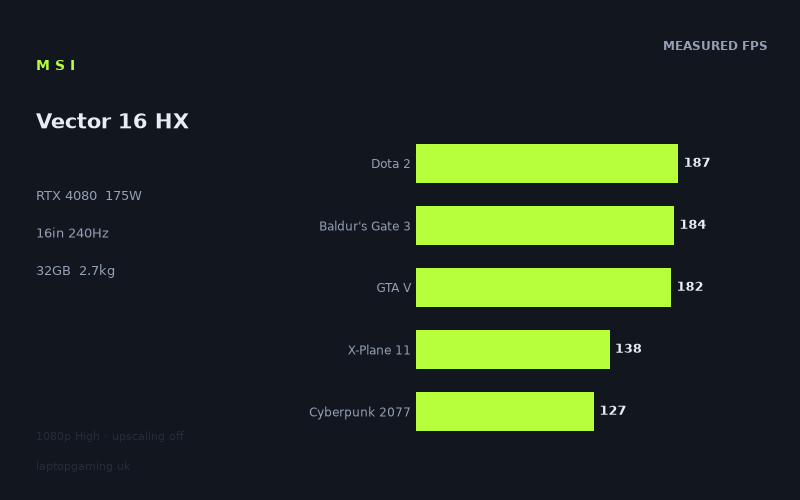
Frame rates
1920×1080, High preset, upscaling off. Averages 163fps across the 5 core benchmark games.
Measured on this machine. Source: Notebookcheck, 2024-02-03.
Not scored: no confirmed UK price
We have the full benchmark suite for this machine, so it ranks on the frame rate leaderboard like any other. What we don't have is a UK listing for this exact configuration - it's sold as a European review unit, or only in specifications that differ from the one tested. Since 30% of our score is value for money, scoring it would mean pretending price is no object, which would flatter it against every laptop you can actually buy. The frame rates below are real and comparable; there is just no buying recommendation to make yet.
How these numbers were produced
Frame rates here are not measured by us, and we label how each one was arrived at. A figure marked measured comes from a published run on that exact machine. A figure marked representative is derived from the GPU and its power limit (TGP) and cross-referenced against published reviews - a sound estimate of what that configuration delivers, but not a measurement of that specific laptop. Unless stated otherwise, numbers are 1920x1080, High preset, upscaling off. Where a laptop ships in several power configurations we use the wattage of the exact SKU listed, because a 140W RTX 5070 and a 115W one are not the same product.
In use
The short version
The MSI Vector 16 HX is a performance-first gaming laptop built around a Core i9-14900HX and an RTX 4080 running at a stated 175W GPU power limit. The benchmark data gives it the sort of 1080p High-preset performance expected from a large, mains-powered machine rather than a slim portable: it produces very high frame rates in several games, remains well above 120fps in every measured title, and averages 164fps across the five-game scoring suite.
That makes it a strong fit for someone who wants a 16in laptop for fast competitive games, demanding single-player titles, and general high-refresh gaming while plugged in. The 240Hz screen is not merely decorative in the lighter games: The Witcher 3 reaches 385fps, Strange Brigade reaches 378fps, and F1 22 reaches 297fps in Notebookcheck's 1920x1080 High-preset figures with upscaling disabled. Those results give the panel plenty to work with in games that can generate very high frame rates.
The important qualification is that the Vector 16 HX has a 2560x1600 display, while the available game figures are at 1920x1080. The published numbers demonstrate substantial performance at 1080p, but they do not establish what frame rate it will produce at the panel's native resolution. Native 2560x1600 gaming asks more of the GPU than the measured setting, and there is no supplied benchmark data for that mode. Buyers should therefore treat the 1080p results as a clear indication of the machine's lower-resolution high-refresh potential, not as a promise that every game will run at the screen's full refresh rate at native resolution.
The GPU configuration is a major part of the appeal. An RTX 4080 paired with a 175W power limit is not a low-power implementation intended to fit into an ultra-thin chassis. The benchmark spread supports that reading: the Vector is close to the Lenovo Legion Pro 7 with the same class of GPU, effectively level with the MSI Titan GT77 HX in the limited shared-game comparison despite that machine using an RTX 4090 at 150W, and substantially ahead of the RTX 4050-equipped MSI Thin GF63 across their shared games.
It is not a laptop for people who primarily need to travel light. At 2.657kg before considering a charger or other accessories, it belongs in the category of machines that can be moved between a desk, a university room, an office and home, but are not especially pleasant to carry around all day. The 90Wh battery is a substantial capacity on paper, but no measured battery-life result is supplied here, so there is no basis for claiming how long it lasts away from mains power.
There is no confirmed UK price for this exact configuration, so its value cannot be assessed here. That is the only missing piece in an otherwise complete performance picture. The game benchmark suite is available and the laptop can be placed normally on the frame-rate leaderboard; without a confirmed price, however, there is no credible way to say whether the performance is good buying value or merely expensive performance.
Buy the Vector 16 HX if the priority is a high-powered RTX 4080 laptop with 32GB of memory, a large 16in 240Hz IPS display and benchmark results that show strong 1080p gaming headroom. Look elsewhere if portability is central, if the main aim is native-resolution performance data rather than 1080p figures, or if you need a confirmed purchase price before deciding whether a configuration makes sense.
Performance
A 175W RTX 4080 with results to match
The central performance specification is the RTX 4080 running at a 175W GPU power limit. That figure matters because laptop GPU names do not tell the whole story. The same GPU tier can appear in machines designed around very different power allowances, cooling arrangements and chassis priorities. Here, the stated limit places the Vector 16 HX at the performance-oriented end of the RTX 4080 category rather than the constrained end.
The benchmark data is consistent with that. Notebookcheck measured the Vector 16 HX at 1920x1080 using the High preset with upscaling turned off. This is a useful setting because it shows conventional rendered performance without leaning on an upscaling mode to increase the reported frame rate. The results are not limited to one especially favourable game. The laptop produces 385fps in The Witcher 3, 378fps in Strange Brigade, 297fps in F1 22, 213fps in Tiny Tina's Wonderlands, 187fps in Dota 2, 184fps in Baldur's Gate 3, 182fps in GTA V, 179fps in Final Fantasy XV, 167fps in Far Cry 5, 138fps in X-Plane 11 and 127fps in Cyberpunk 2077.
The average across the five scoring-suite games is 164fps. That is a useful summary figure, but it should not be mistaken for a likely result in every game. The individual data points span from 127fps in Cyberpunk 2077 to 187fps in Dota 2 within that scoring suite. The difference is meaningful because a gaming laptop is not bought to run an average game. It is bought to run the particular mix of games its owner actually plays.
For competitive or older games that can reach high frame rates, the Vector's results are emphatically strong. The Witcher 3 at 385fps and Strange Brigade at 378fps are both far beyond the screen's 240Hz refresh rate in this measured mode. F1 22 at 297fps also clears 240fps. In those games, the display refresh rate becomes the practical ceiling for what can be shown as distinct refreshes per second. A higher rendered frame rate can still matter for frame delivery and input response, but the panel itself refreshes at 240Hz rather than at 297Hz, 378Hz or 385Hz.
Tiny Tina's Wonderlands, at 213fps, does not quite reach the screen's maximum refresh rate in the measured configuration, but it remains close enough that the 240Hz panel is not wildly mismatched to the game. The same is true in a broader sense for the group clustered from 167fps to 187fps: Dota 2, Baldur's Gate 3, GTA V, Final Fantasy XV and Far Cry 5. None reaches 240fps in Notebookcheck's figures, but all exceed 160fps. That is still a high frame-rate experience rather than a situation in which the display is waiting on a 60fps-class game.
The more demanding end of the suite shows why it is important not to reduce the Vector 16 HX to its headline results in The Witcher 3 or Strange Brigade. X-Plane 11 reaches 138fps and Cyberpunk 2077 reaches 127fps. Those are still high numbers for the measured settings, yet they sit a long way below 240fps. The screen is capable of displaying up to 240 refreshes per second, but the measured figures show that the GPU and system cannot be assumed to supply that rate in every title even at 1920x1080 High with upscaling off.
This is not a weakness unique to the Vector. It is simply what the spread of the numbers says. A laptop can be extremely fast overall and still be unable to turn every demanding game into a 240fps game. The sensible reading is that the 240Hz panel is fully exploitable in some titles, partially exploitable in many others, and an aspirational upper limit in the heaviest measured games. That is a much more useful conclusion than treating the display specification as a universal performance guarantee.
Reading the individual frame rates properly
The Witcher 3 result of 385fps is the highest figure in the supplied data. At the measured 1920x1080 High setting, it shows that the Vector has more than enough performance for a 240Hz screen in this title. There is substantial headroom above the panel refresh rate. A buyer whose games behave more like this result than Cyberpunk 2077 will see the chief advantage of the high-refresh display: the system is not merely capable of high settings, but capable of very high frame delivery.
Strange Brigade follows closely at 378fps. The narrow difference between 385fps and 378fps is less important than the shared conclusion: both titles run well above 240fps in the published test. They are evidence that the platform can deliver exceptionally high frame rates when the game and test conditions allow it. They should not, however, be used to infer that all games will behave similarly. Cyberpunk 2077 at 127fps is the immediate counterexample in the same benchmark set.
F1 22 at 297fps remains comfortably above the screen refresh rate. It is particularly useful as a middle point between the extremely high results in The Witcher 3 and Strange Brigade and the more moderate figures elsewhere. The Vector is not only capable of exceeding 240fps in the easiest-looking result. It also does so in another game with a materially lower but still very high figure.
Tiny Tina's Wonderlands at 213fps is one of the most informative results for a prospective owner of a 240Hz laptop. It falls short of 240fps, but not by much. In practical buying terms, that means the machine has enough performance to take significant advantage of the panel's high refresh rate without claiming that it can pin the display at its maximum in this game. This is where a high-refresh panel is useful without becoming a rigid target. A machine producing 213fps is still delivering substantially more frames than a conventional 60Hz display can show as individual refreshes.
The scoring-suite titles demonstrate a more varied middle range. Dota 2 records 187fps, Baldur's Gate 3 records 184fps, and GTA V records 182fps. These are close together despite being different games, and they help explain the 164fps five-game mean. They indicate that, within the shared suite, the Vector is generally operating in a high-frame-rate range rather than relying entirely on a few extreme results to lift the average.
Final Fantasy XV comes in at 179fps and Far Cry 5 at 167fps. Again, these results sit below 240fps but well above 120fps. Buyers should not see them as evidence that the panel is excessive. A 240Hz display remains capable of showing the frame output from these games at a much higher refresh rate than a 60Hz screen. At the same time, they are a reminder that 240Hz is a ceiling rather than a target the Vector reaches automatically.
X-Plane 11 at 138fps and Cyberpunk 2077 at 127fps are the lower end of the data, but “lower” needs context. Both remain above 120fps at the stated 1080p High setting with no upscaling. That is strong performance by ordinary gaming-laptop standards. The point is not that these games run poorly; the point is that they do not support an assumption that an RTX 4080 at 175W will run every title at 240fps.
Cyberpunk 2077 is especially valuable in keeping the review grounded. A 385fps headline result can make any system look as though frame rate is effectively unlimited. The 127fps Cyberpunk 2077 figure demonstrates the reality: the same laptop can be far more constrained by one game than another. That difference is why buyers should match their expectations to the games they play rather than buy on the basis of an average or a single favourable title.
Why the results vary so much
The supplied results range from 127fps to 385fps, which is a very wide spread under the same broad 1920x1080 High-preset, no-upscaling test conditions. That spread does not mean that the laptop is inconsistent. It means the games place different demands on the system. A frame-rate list is not a league table of the laptop changing from good to bad; it is a record of how different workloads respond to the same hardware.
The rival comparison provides an additional clue about how to interpret the figures. At 1080p, lighter titles in the shared set can be CPU-bound and compress genuine GPU gaps. That is why near-zero results against systems with apparently different graphics hardware should be treated as meaningful results rather than as proof that the GPUs are interchangeable. When a game is limited elsewhere in the system, adding more GPU capability does not necessarily produce a correspondingly large frame-rate gain.
The Vector's Core i9-14900HX is therefore relevant to the 1080p data even though the laptop's main gaming headline is the RTX 4080. At this resolution and preset, some games in a shared set may not scale cleanly with GPU tier. The numbers against the Legion Pro 7 and Titan GT77 HX show exactly this kind of compression: the Vector is only 1fps behind each in the supplied shared-game comparisons. That does not erase the specification difference between an RTX 4080 and an RTX 4090. It says that, in those particular overlapping games and settings, the resulting averages are almost identical.
This matters when comparing laptops from a shopping shortlist. A buyer who plays games resembling the shared 1080p titles may find that the practical difference between certain high-end machines is very small. A buyer who plans to prioritise higher resolutions or more graphically demanding workloads should not assume that the same compressed differences will continue, because no such measurements are supplied here. The benchmark data can support a confident conclusion about the tested configuration; it cannot fill in missing results for other settings.
The 175W GPU power limit should therefore be read as an indicator of the Vector's performance intent, while the actual game figures show the outcome under the published test method. It is a high-power RTX 4080 implementation that produces extremely high frame rates in several games and strong results even in the lower-scoring titles. The numbers do not support a claim that it is universally a 240fps machine, but they do support the view that it is comfortably a high-refresh 1080p gaming laptop.
What the benchmark setting does and does not prove
All supplied results use 1920x1080, the High preset and upscaling off. This is essential context rather than a footnote. The Vector 16 HX has a 2560x1600 screen, so the benchmark resolution is lower than the panel's native resolution. The frame rates are directly useful for buyers who intend to play at 1920x1080, use settings intended to maximise refresh rate, or simply want a consistent point of comparison with other benchmarked laptops. They are not native-resolution results.
Upscaling being off is also important. The listed figures are not boosted by an upscaling setting in the published test. That makes them clean figures for comparing the machines under the same stated approach, but it does not mean that upscaling cannot be used by an owner. It only means there is no supplied upscaling-on result to quote or use in a performance prediction.
No conclusions should be drawn here about ray tracing, alternate presets, frame generation, native 2560x1600 performance or performance on battery, because none of those measurements is in the fact sheet. The absence of those figures does not detract from the usefulness of the published 1080p results. It simply defines their limits. A trustworthy review should distinguish between what has been measured and what would be speculation.
For this laptop, what has been measured is enough to establish its place as a serious gaming system. Every supplied title is above 120fps. Several are above 180fps. Three are above the 240Hz panel refresh rate. The five-game scoring-suite mean is 164fps. Those are substantial results, and they are more valuable than vague claims about “desktop replacement” performance because they show exactly where the high-refresh story is strongest and where it begins to taper away.
The screen
A 16in 2560x1600 IPS panel with a 240Hz ceiling
The Vector 16 HX uses a 16in IPS display with a 2560x1600 resolution and a 240Hz refresh rate. On specification alone, that is a display intended to balance workspace, sharpness and gaming responsiveness. The 2560x1600 format offers more vertical pixels than a 2560x1440 panel, while the 240Hz refresh rate is aimed at users who care about frame rate rather than treating 60Hz as sufficient.
The IPS panel type is also part of the specification, but there are no supplied measurements for brightness, contrast, colour coverage, response time, backlight behaviour or outdoor visibility. It would be wrong to infer those characteristics from the IPS label alone. IPS describes the panel technology, not a complete picture of image quality. Buyers who need verified colour work capability, measured display response or brightness figures will need information that is not present in this benchmark and specification set.
What can be assessed properly is the relationship between the 240Hz refresh rate and the measured game performance. At 1920x1080 High with upscaling off, The Witcher 3 at 385fps, Strange Brigade at 378fps and F1 22 at 297fps all exceed 240fps. In those titles, the display can be driven to its maximum refresh rate by the laptop's measured output.
That is the clearest case for a 240Hz screen. It is not just a specification intended for esports games with very low graphical demands. The published data shows three titles running beyond the panel ceiling under the test conditions. Anyone who values a very high-refresh experience in games that run in this range has a system whose GPU performance is aligned with the display.
The next group of results shows a less absolute but still convincing match. Tiny Tina's Wonderlands runs at 213fps, while Dota 2, Baldur's Gate 3, GTA V, Final Fantasy XV and Far Cry 5 sit between 167fps and 187fps. These games do not reach 240fps, but they are all high enough to benefit from a panel that refreshes more than 120 times per second. The Vector is not wasting the screen in these titles; it is simply not saturating it.
X-Plane 11 at 138fps and Cyberpunk 2077 at 127fps show the lower end of the measured range. Here, the 240Hz panel has clear spare capacity, but that does not make it a poor choice. A high-refresh screen does not require a game to run at its maximum refresh rate to be useful. It means the panel is capable of showing high frame rates where available, while leaving room for games that fall below the maximum. The key is not to confuse the capability of the display with a guarantee of 240fps.
The native-resolution caveat
The most important display caveat is straightforward: the screen is 2560x1600, but the benchmark figures are at 1920x1080. There are no native 2560x1600 frame rates in the supplied data. It is therefore not possible to say which of these games will reach 240fps at the panel's native resolution, which will remain above 160fps, or how much each title will fall from its 1080p result.
This distinction matters more on a laptop such as the Vector than it would on a machine with a 1920x1080 display. At 1080p, the data supports strong claims about high-refresh performance. At 2560x1600, the same claims would need measurements that are not available here. Buyers who regard native resolution as non-negotiable should not buy on the assumption that the 1080p figures transfer directly.
There is still a rational case for this display specification. The 2560x1600 resolution gives the machine a higher-resolution panel for non-gaming use and for games where image detail is prioritised, while the 240Hz refresh rate gives it a high ceiling for titles where frame rate matters more. The available data demonstrates the latter at 1080p. It does not quantify the former, so the review should not pretend otherwise.
The practical implication is that the screen makes the most obvious sense for a mixed user: someone who wants the 16in 2560x1600 panel for general work and media, but also wants the option of chasing very high frame rates in games that can deliver them. A buyer focused solely on matching native resolution with fully proven 240fps gaming would need native-resolution benchmark evidence, not inference.
Build, size and portability
2.657kg is transportable, not lightweight
The Vector 16 HX weighs 2.657kg. That figure places it firmly in the substantial gaming-laptop category. It is not so heavy that it must remain permanently in one room, but it is heavy enough that portability should be understood as occasional transport rather than effortless everyday carrying.
For a buyer who moves between a desk at home and another fixed location, 2.657kg is manageable in the sense that the laptop can go with them. For a buyer who walks long distances with a laptop every day, carries it alongside books or work equipment, or wants something that disappears into a bag, it is a materially different proposition from a lighter machine. The gaming performance and 175W GPU power limit make sense in a laptop of this class, but they come with a usage pattern that is desk-led.
No chassis dimensions are supplied, so there is no reliable basis for describing the Vector as thin, deep, compact or unusually large for a 16in model. The 16in screen and 2.657kg weight give a general indication of its class, but they do not substitute for actual dimensions. Buyers with a tight bag compartment, desk shelf or travel case should check the physical measurements separately rather than relying on an assumption drawn from the screen size.
The same caution applies to charger size and travel weight. The fact sheet provides the laptop weight but no charger weight. A high-performance laptop with a 175W GPU power limit is likely to be used on mains power for gaming, yet there is no supplied charger specification to quantify what the complete travel load would be. The only defensible statement is that the laptop itself weighs 2.657kg.
Battery capacity is not battery-life evidence
The Vector 16 HX has a 90Wh battery. That is an important specification because it tells buyers the battery capacity, but capacity is not the same thing as measured endurance. There is no supplied figure for web use, video playback, idle time, office work, gaming on battery or any other battery scenario.
As a result, there is no basis for saying the Vector will last a particular length of time away from a socket. It would also be unsafe to infer battery life from the 90Wh figure alone, because endurance depends on workload, display settings, power mode and other factors for which no measurements are given.
The sensible expectation is not a numerical one but a usage one: this is a machine whose strongest benchmark story is tied to high-performance gaming, and those performance figures should be treated as mains-powered gaming data unless a source states otherwise. Anyone choosing between this and a lighter laptop primarily for battery use should seek battery measurements before deciding. The supplied information establishes capacity, not endurance.
What the hardware mix suggests about use
The 32GB memory allocation suits the overall class of the machine. It avoids the impression of a high-end GPU paired with a stripped-back memory configuration. The Core i9-14900HX, RTX 4080 at 175W and 32GB memory make a coherent specification for a buyer who expects to run modern games, maintain background applications and use the laptop for demanding general workloads as well as play.
There are no storage details in the supplied information, so this review cannot comment on capacity, drive count, upgrade options or loading performance. Likewise, there are no measurements for keyboard quality, trackpad quality, port selection, speakers, webcam, chassis temperatures or fan noise. Those omissions matter because they influence daily ownership, but the available evidence is concentrated on specifications and game performance. It is better to leave those questions open than to fill them with generic assumptions about gaming laptops.
What is clear is that the Vector is not configured as a compromise machine intended to be primarily portable. The screen is high refresh, the CPU is an HX-series Core i9, the GPU is an RTX 4080 with a 175W power limit, and the weight is 2.657kg. The combined picture is a laptop for users who want serious performance in a movable form factor, not an ultraportable with some gaming capability added on.
How it compares
Against the MSI Thin GF63: a large performance gulf
The MSI Thin GF63 is the machine the Vector 16 HX beats by the largest amount in the supplied rival set. It uses an RTX 4050, and the Vector averages 87fps ahead across five shared games. That is not a marginal advantage or a result that needs careful interpretation to make it seem meaningful. It is a large performance gap across a meaningful shared-game sample.
The comparison illustrates the difference between an RTX 4080 at a 175W power limit and a lower-tier RTX 4050 system. The specific game-by-game figures are not supplied for this pairing, so the review should not invent which title contributed the most. The average difference alone is enough to establish that the Vector is in a substantially higher performance class across the games they share.
For a buyer considering a thinner or cheaper-looking RTX 4050 option against the Vector, this is the most relevant performance warning. GPU naming tiers matter, but the shared-game result makes the practical gap visible: 87fps on average is the difference between two laptops that should not be treated as substitutes merely because both are gaming machines.
That does not make the Thin GF63 unsuitable in every circumstance. A buyer may have priorities the comparison does not measure, such as weight, size or availability. But if the purpose of the purchase is maximum frame rate in the shared 1080p game set, the Vector has a decisive advantage. There is no need to overcomplicate that conclusion.
Against the Lenovo Legion Pro 7: effectively level in the shared set
The Lenovo Legion Pro 7 is one of the closest rivals in the supplied comparison. It also uses an RTX 4080, and the Vector 16 HX averages only 1fps behind across four shared games. That is an effectively level result within the evidence available.
The useful lesson is not that the two machines are guaranteed to behave identically in every title. The comparison covers four shared games, not every game a buyer may play. It does show that, under the common benchmark conditions and across that overlap, there is no meaningful frame-rate separation to base a purchase decision on.
This is where the other specifications and confirmed purchase terms would normally become decisive. If two high-performance RTX 4080 laptops are separated by only 1fps in the games both have results for, a buyer should not choose one over the other on the assumption that one is clearly faster. The benchmark evidence does not support that claim.
At 1080p, lighter games in the shared set can be CPU-bound and compress genuine GPU gaps. In this case both systems use the same GPU class, so a close result is unsurprising, but the broader point remains useful: the shared average records the output in those games and settings, not a universal ranking for every possible workload. The Vector has no performance case to fear against the Legion Pro 7 in this particular comparison; it is essentially tied.
Against the MSI Titan GT77 HX: the RTX 4090 label does not create a visible lead here
The MSI Titan GT77 HX uses an RTX 4090 at 150W. Despite the higher GPU tier in its specification, the Vector 16 HX averages only 1fps behind across three shared games. This is another near-zero result, and it should be explained rather than treated as an anomaly.
The benchmark conditions are 1920x1080 High with upscaling off. At 1080p, lighter titles in the shared set can be CPU-bound, which can compress genuine GPU differences. That means an RTX 4090 does not automatically translate into a large lead in every 1080p game benchmark. The result does not say that an RTX 4080 and RTX 4090 are the same GPU. It says that, across these three overlapping measured games, the Vector's average is effectively the same as that of the Titan.
The power limits also matter to the comparison. The Vector is listed with a 175W GPU power limit, while the Titan's RTX 4090 is listed at 150W. Those are not identical configurations, and the shared-game result demonstrates why buyers should look beyond the GPU name alone. A higher-tier GPU operating under a different power allowance does not guarantee a proportionally higher result in every title.
There are only three shared games in this comparison, so it would be overreaching to claim that the Vector generally matches the Titan GT77 HX across all gaming. The careful conclusion is narrower and still impressive: in the available overlapping 1080p data, the Vector is only 1fps behind on average. For buyers focused on those test conditions, that is evidence of very strong performance from the MSI's RTX 4080 configuration.
Against the Asus ROG Strix Scar 17: the clearer RTX 4090 advantage
The Asus ROG Strix Scar 17 is the rival that beats the Vector by the largest amount in the supplied comparison. It uses an RTX 4090 and averages 30fps ahead across three shared games. Unlike the near-zero gaps to the Legion Pro 7 and Titan GT77 HX, this is a clear performance lead.
The comparison is important because it prevents an overly simple reading of the Titan result. The Vector can be effectively level with one RTX 4090 machine in a restricted shared-game set and still trail another RTX 4090 machine by 30fps across a different three-game overlap. This is why GPU tier, GPU power limit, game selection and benchmark conditions all need to be considered together.
The Scar 17 result confirms that there are circumstances in the supplied benchmark ecosystem where a higher-tier RTX 4090 system produces a substantial advantage over the Vector. Buyers seeking the highest possible frame rates, rather than merely very high frame rates, should take that result seriously. A 30fps average lead is large enough to affect whether a game is nearer a panel's 240Hz ceiling or sits further below it.
At the same time, the comparison is limited to three shared games. It does not tell us the Vector's exact deficit in every title, at native 2560x1600, with another preset, or with upscaling enabled. It tells us something precise and useful: in the three games both laptops hold for this comparison, the Scar 17 is ahead by 30fps on average. That is enough to establish it as the stronger performer in this rival spread, while not justifying claims beyond the data.
What the rival spread says about the Vector's position
The four rivals give the Vector 16 HX a useful position in its generation. It is dramatically ahead of the RTX 4050 MSI Thin GF63, effectively tied with the RTX 4080 Lenovo Legion Pro 7, effectively tied with the RTX 4090 MSI Titan GT77 HX in their small shared set, and clearly behind the RTX 4090 Asus ROG Strix Scar 17 in its shared set.
That is not a contradictory picture. It is the expected reality of laptop benchmarking: a machine's place changes according to the game overlap, GPU implementation and test conditions. The Vector's 175W RTX 4080 is powerful enough to make it a serious contender among high-end laptops rather than merely a step above mid-range systems. It does not eliminate every advantage held by RTX 4090 rivals, as the Scar 17 comparison shows.
For a buyer, the practical conclusion is straightforward. The Vector is not the machine to choose if the only acceptable outcome is beating every RTX 4090 system. The data does not support that. It is a machine to consider if the aim is to obtain very strong high-refresh 1080p performance from an RTX 4080 laptop that can stand close to some far more imposing specifications in selected shared benchmarks.
Who it's for
Buy it for high-refresh gaming with realistic expectations
The Vector 16 HX makes most sense for players who want a high-powered gaming laptop and intend to use it primarily at a desk or in other mains-powered settings. The RTX 4080 at 175W, Core i9-14900HX and 32GB memory create a specification aimed at demanding use, while the measured figures show that this is not power that exists only on paper.
It is especially well suited to players whose library includes games that can take advantage of a 240Hz screen at 1080p. The Witcher 3 at 385fps, Strange Brigade at 378fps and F1 22 at 297fps all clear the display's 240Hz refresh rate in Notebookcheck's test. That is the strongest use case for this laptop: a buyer who values exceptionally high frame rates and understands that the screen is capable of being fully driven in the right titles.
It also suits players with a mixed library. Tiny Tina's Wonderlands at 213fps, Dota 2 at 187fps, Baldur's Gate 3 at 184fps, GTA V at 182fps, Final Fantasy XV at 179fps and Far Cry 5 at 167fps show that the system remains in a high-frame-rate range even when it does not reach 240fps. For someone moving between competitive games, open-world games, strategy games and racing games, that range is more useful than a single headline number.
The Vector is a good fit for buyers who understand that 240Hz is a maximum capability rather than a guarantee. The lower supplied results of 138fps in X-Plane 11 and 127fps in Cyberpunk 2077 remain strong, but they demonstrate that demanding games can sit far below the panel refresh rate. A sensible owner will value the screen's headroom without expecting every game to lock to 240fps.
It is also a sensible choice for someone comparing high-end GPUs by actual measured output rather than by badge alone. The 1fps average deficit to the Lenovo Legion Pro 7 across four shared games and the 1fps average deficit to the MSI Titan GT77 HX across three shared games show that the Vector can be highly competitive in common 1080p benchmark conditions. The 87fps average advantage over the MSI Thin GF63 makes the step up from lower-tier gaming hardware unmistakable.
Buy something else if portability is the main requirement
At 2.657kg, the Vector is not aimed at buyers who want a genuinely light laptop. It can be transported, but it is not the natural choice for someone who carries a computer all day or wants the least burdensome travel setup. The supplied weight alone is enough to make that judgement. A lighter machine may be the better answer even if it cannot match the Vector's frame rates.
Buyers who need verified battery endurance should also look for additional evidence before committing. The 90Wh battery capacity is known, but there is no measured battery-life result. It would be irresponsible to claim that the laptop lasts well, lasts poorly or lasts for any particular period away from mains power. If battery use is central to the purchase, capacity alone is not enough.
Likewise, this is not the right laptop to buy solely on the assumption that its native 2560x1600 screen will receive the same frame rates as the 1920x1080 benchmark figures. The available results are strong, but they are not native-resolution results. A buyer who insists on gaming at 2560x1600 should seek measurements at that resolution rather than treating the 1080p list as a direct forecast.
Those who want the outright highest result among the specific rivals should consider the Asus ROG Strix Scar 17, which is 30fps ahead on average across three shared games. That does not automatically make it the better purchase in every respect, because no price, portability or broader ownership comparison is supplied here. It does make it the clearest choice of these rivals for buyers whose only priority is the higher shared-game frame-rate average.
The final buying case
The MSI Vector 16 HX is a credible high-end gaming laptop because the published numbers support the specification. Its RTX 4080 at 175W is not merely attached to a premium-looking parts list: it delivers 385fps in The Witcher 3, 378fps in Strange Brigade, 297fps in F1 22 and a 164fps mean across the five scoring-suite games at 1920x1080 High with upscaling off.
Its limitations are equally clear. It weighs 2.657kg, there is no measured battery-life figure, and no native 2560x1600 gaming data is available in the supplied set. It also cannot be presented as the fastest machine against every rival, because the RTX 4090 Asus ROG Strix Scar 17 is ahead by 30fps across its shared games.
For the right buyer, those limitations do not undermine the appeal. If the goal is a powerful 16in gaming laptop with a 240Hz IPS screen, 32GB memory, a Core i9-14900HX and benchmark results that range from strong to exceptional at 1080p, the Vector 16 HX is an easy machine to take seriously. It is best viewed as a high-refresh, desk-led RTX 4080 laptop with genuine performance depth, not as a lightweight travel machine or a universally proven native-resolution 240fps system.