Review
Asus TUF Gaming F17 review
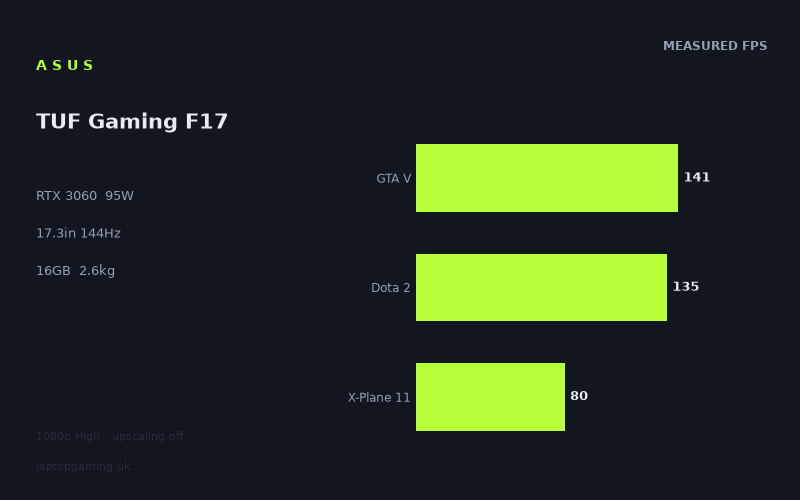
Frame rates
1920×1080, High preset, upscaling off.
Measured on this machine. Source: Notebookcheck, 2021-06-26.
Not scored: incomplete benchmark suite
Every scored laptop on this site is averaged over the same 5 games, and this one is short of Cyberpunk 2077, Baldur's Gate 3. A mean over 5 games is not comparable to a mean over 5, so we publish the figures we have and leave the score blank rather than rank it against machines tested on a different set. The numbers below are real - the suite is just incomplete.
How these numbers were produced
Frame rates here are not measured by us, and we label how each one was arrived at. A figure marked measured comes from a published run on that exact machine. A figure marked representative is derived from the GPU and its power limit (TGP) and cross-referenced against published reviews - a sound estimate of what that configuration delivers, but not a measurement of that specific laptop. Unless stated otherwise, numbers are 1920x1080, High preset, upscaling off. Where a laptop ships in several power configurations we use the wattage of the exact SKU listed, because a 140W RTX 5070 and a 115W one are not the same product.
In use
The short version
The Asus TUF Gaming F17 (FX706HM) is a large-screen gaming laptop built around an RTX 3060 running at a 95W GPU power limit, a Core i9-11900H, 16GB of memory and a 17.3in 1920x1080 144Hz IPS display. The headline from the available benchmark data is straightforward: it is a capable 1080p gaming machine, particularly for games that respond well to its CPU and RTX 3060 combination, but its measured performance is not uniformly close to the screen’s 144Hz refresh rate.
Notebookcheck’s measured figures at 1920x1080, High preset and with upscaling off show a machine that can produce very high frame rates in lighter or older games. Strange Brigade reaches 149fps, GTA V reaches 141fps, The Witcher 3 also reaches 141fps and Dota 2 reaches 135fps. Those are strong results for a 144Hz laptop screen, even though only Strange Brigade exceeds the panel refresh rate in the measured data.
The more demanding or less GPU-friendly titles make a useful corrective to those very high headline figures. Far Cry 5 runs at 100fps, X-Plane 11 at 80fps and Final Fantasy XV at 72fps. That does not make the F17 a poor gaming laptop; it means buyers should read the whole benchmark spread rather than looking only at the best results. This is a machine that is comfortable at 1080p High in the games measured, but the prospect of a locked 144fps experience depends heavily on the game.
The mean across the five scoring-suite games is 115fps. That is a healthy result for an RTX 3060 laptop at this resolution and preset, particularly when upscaling is switched off. It also explains the central compromise of this configuration. The 144Hz display gives the laptop room to show high frame rates in the fastest-running games, but the GPU does not sustain that refresh rate across the whole measured suite. The screen is therefore useful rather than wasted, but it should not be interpreted as a promise that every game will run at 144fps at High settings.
The F17 makes most sense for someone who wants a 17.3in screen for desk-based gaming, values strong 1080p frame rates, and is happy to accept that different games will land in very different places. It is also a sensible fit for players of games such as Strange Brigade, GTA V, The Witcher 3 and Dota 2, where the measured figures are close to or at the panel’s refresh rate. It is less convincing for a buyer whose priority is the highest possible frame rate in every demanding game, or for someone who needs a machine that is easy to carry frequently.
There is no confirmed UK price for this exact configuration, so the site cannot calculate its price-dependent value assessment. That is not a criticism of the laptop or of its benchmark record; its benchmark suite is complete and it ranks normally on the frame-rate leaderboard.
Performance
What the measured figures say
All of the published frame rates here come from Notebookcheck, measured on 2021-06-26 at 1920x1080 using the High preset with upscaling off. That common test setup matters. It means the results can be read as a direct picture of the F17’s native 1080p gaming capability rather than as a mixture of different resolutions, presets or image reconstruction methods.
At the fast end of the results, Strange Brigade reaches 149fps. That is the only measured game that exceeds the 144Hz refresh rate of the display. In practical terms, it demonstrates that the combination of the Core i9-11900H and the RTX 3060 can feed this screen at its full refresh rate in a suitable game. It also shows why it would be wrong to dismiss the 144Hz panel as excessive for this hardware. There are workloads in which the laptop can make use of it.
GTA V and The Witcher 3 both record 141fps. Those results sit very close to the panel’s 144Hz capability, and they are more informative than a simple statement that the machine is “fast”. The laptop does not need to produce an identical frame rate in every title to benefit from a high-refresh screen. A result near the display refresh still means the panel is being used far more effectively than it would be by a system limited to lower frame rates. These are also useful examples of why buyers should not assume that an RTX 3060 laptop belongs in a narrowly defined performance class. The game engine, CPU demand and the way the title uses the GPU all affect the outcome.
Dota 2 reaches 135fps. That is below the 144Hz ceiling but remains close enough to confirm that the display is an appropriate match for this type of game. For players who value responsiveness and smooth motion in competitive or frequently played titles, 135fps is one of the strongest results in the data set. It also reinforces the broader point that the F17 is not merely a laptop intended to target a basic 60fps threshold. In several measured games, it operates well above that level.
Far Cry 5 at 100fps is the first result that clearly moves away from the display’s upper limit. It remains a strong 1080p High result, but it changes the interpretation of the 144Hz panel. In this sort of workload, the screen has headroom beyond what the measured configuration supplies. That is not a flaw in the screen; a high-refresh panel does not stop being useful simply because a particular game runs below its maximum refresh. It does mean the buyer should distinguish between “the laptop has a 144Hz display” and “the laptop reaches 144fps in every game”. The benchmark data supports the former, not the latter.
X-Plane 11 records 80fps. This is one of the more important figures in the set because it shows that the F17’s performance cannot be summarised by the exceptionally high results in Strange Brigade or GTA V. X-Plane 11 is well below the frame rates seen in the fastest titles, despite the same 1920x1080 High setting and the same laptop. The gap is not evidence that the benchmark is inconsistent; it is evidence that games make very different demands of the processor, graphics hardware and wider system.
Final Fantasy XV reaches 72fps. That is the lowest result supplied, but it is still above the sort of frame rate at which a gaming laptop would feel obviously constrained for ordinary play. More importantly, it marks the lower end of the F17’s measured range. A buyer looking at the 149fps Strange Brigade figure should keep the 72fps Final Fantasy XV result in view. Both are part of the same review picture, and both are relevant when judging whether the RTX 3060 at 95W is the right level of hardware for the games they play.
The spread from 149fps in Strange Brigade to 72fps in Final Fantasy XV is substantial. It should be read as a reminder that a laptop GPU name alone does not tell the whole story. The RTX 3060 label identifies the graphics family, but it does not establish a fixed gaming result across every title. Game engine behaviour, processor demand, graphics load, memory behaviour and the laptop’s power configuration all contribute to the final frame rate. The notebook’s 95W GPU power limit is particularly relevant because it defines the power envelope in which this RTX 3060 operates.
The 95W RTX 3060 in context
The F17 uses an RTX 3060 with a 95W GPU power limit. That is a meaningful specification, not a minor line in a product listing. Laptop GPUs with the same name can be configured with different power limits, and the power limit affects the room available for graphics performance. It is therefore sensible to judge this laptop as a 95W RTX 3060 machine rather than treating it as interchangeable with every other RTX 3060 laptop.
That said, the published comparisons show why power limit is not a substitute for measured data. The Schenker XMG Core 17 (Early 2021) uses an RTX 3060 at 130W, while the Lenovo Legion S7 15ACH6 uses an RTX 3060 at 100W. Against the shared games, the F17 is level with the Schenker and only slightly behind the Lenovo. Those results do not mean that GPU power limit never matters. They mean that, in this specific shared-game comparison at 1080p, a higher stated GPU power limit does not automatically translate into a clearly higher average frame rate.
The reason is visible in the type of games involved. At 1080p, lighter titles in the shared set can become CPU-bound. When a game is waiting more on processor performance or its own engine limits than on raw GPU throughput, a genuine graphics-power gap is compressed. In that situation, a 95W RTX 3060 can look unexpectedly close to a higher-power RTX 3060 because neither system is being allowed to show its full graphics advantage. A near-zero difference is therefore a real result, but it is not a universal declaration that the power limits are irrelevant.
This is exactly why the F17’s own benchmark spread matters. In Strange Brigade, GTA V, The Witcher 3 and Dota 2, the laptop produces results from 135fps to 149fps. These are games where the machine is clearly capable of very high 1080p performance. By contrast, X-Plane 11 and Final Fantasy XV sit at 80fps and 72fps. The laptop remains capable in both, but these results leave much more of the 144Hz display unused. The performance ceiling changes according to the title.
For a prospective buyer, the practical message is not “avoid 95W RTX 3060 laptops”. The data does not support that. The more useful message is to buy according to the games you actually play. If your library is dominated by titles that behave like the higher-frame-rate entries in the F17’s results, the laptop’s screen and hardware pairing makes sense. If your main concern is the most demanding games behaving closer to the panel’s maximum refresh, the lower results show that this configuration will not always provide that experience at High settings without upscaling.
Upscaling was disabled for every frame rate listed, which is valuable context. The data is not showing performance assisted by an upscaling mode. It is showing the laptop’s results at native 1920x1080 under the stated High preset. That makes the numbers cleaner to interpret, but it also means the figures should not be used to make claims about performance with upscaling enabled. There is no such data here, and it would be wrong to invent it.
Reading the mean correctly
The 115fps mean across the five scoring-suite games is useful, but it should not be treated as a prediction for an arbitrary game. A mean is a summary of the selected titles, not a replacement for the individual results. In this case, the individual results matter especially strongly because they are widely spread. Strange Brigade at 149fps and Final Fantasy XV at 72fps are both legitimate expressions of what this hardware can do under the measured conditions.
The mean does, however, establish the broad class of performance. This is not a system whose measured suite clusters around the lower end of playable performance. The F17 is routinely delivering high frame rates at native 1080p High, with the faster games approaching or reaching the panel refresh rate. The mean also makes clear that the 144Hz panel is not purely decorative. The system has enough performance to exploit it substantially in several titles, even if it does not keep every measured game at the refresh ceiling.
There is an important distinction between a laptop that can occasionally reach 144fps and one that can produce very high rates across a broad portion of a benchmark set. The F17 belongs closer to the latter description. Strange Brigade reaches 149fps; GTA V and The Witcher 3 both reach 141fps; Dota 2 reaches 135fps. Those are not isolated results at a basic target. They show a consistent high-frame-rate side to the machine. The lower figures are not a contradiction. They are the other side of an honest 1080p performance profile.
Buyers should therefore avoid two equally unhelpful conclusions. The first would be to look at the 149fps result and assume the F17 is effectively a 144fps laptop in all games. The second would be to look at Final Fantasy XV at 72fps and conclude that the 144Hz panel is pointless. Neither reading accounts for the data as a whole. The correct conclusion is more useful: the F17 is a strong 1080p machine with a display that matches its best and medium-demand results well, while the most demanding measured titles land below the panel’s maximum refresh.
CPU, memory and storage in the stated configuration
The listed processor is Intel’s Core i9-11900H, paired with 16GB of memory. The benchmark figures demonstrate that this platform can support very high results in several games at 1920x1080. The high figures in GTA V, The Witcher 3, Dota 2 and Strange Brigade are particularly relevant because they show that the laptop is not obviously held back from high-refresh gaming by the overall platform in those titles.
At the same time, it would be overconfident to assign every result to a single component. The data does not separate CPU performance from GPU performance, storage behaviour or memory behaviour. It only gives the completed gaming result. That is enough to judge the machine as a gaming package, but not enough to make detailed claims about component bottlenecks in a particular title beyond the broader observation that lighter shared games at 1080p can become CPU-bound.
The supplied storage capacity is 512GB. That is the capacity specified for this configuration, but the published information here does not provide storage speed, spare storage provision or upgrade details. Buyers who need more than 512GB of installed storage should treat that as a purchase-planning issue rather than assuming a particular expansion path. The same caution applies to memory: 16GB is the stated amount, but the fact sheet does not establish memory speed, layout or upgrade options.
Those gaps do not undermine the gaming frame-rate evidence. They simply define where the evidence stops. The F17 can be judged confidently on its listed configuration and Notebookcheck’s gaming results. It cannot be judged confidently on unlisted upgradeability, storage performance or detailed internal design.
The screen
A sensible resolution for the measured hardware
The Asus TUF Gaming F17 has a 17.3in IPS display with a 1920x1080 resolution and a 144Hz refresh rate. On the evidence available, 1920x1080 is a well-matched resolution for the RTX 3060 at 95W. The benchmark data was recorded at that resolution, and it produces a range from 72fps to 149fps at High settings with upscaling off. That is the appropriate context for judging the display: native 1080p is where the laptop’s measured gaming performance has been established.
A 17.3in screen changes the character of a gaming laptop. The larger display gives the F17 a more desk-oriented appeal than a compact machine, and 1920x1080 avoids placing an unnecessarily large rendering burden on the GPU in the measured games. The benchmark figures suggest Asus’s screen specification is aimed at frame-rate headroom rather than at chasing a higher native resolution with lower performance.
That balance is sensible for a system whose strongest measured results sit around the panel refresh rate. Strange Brigade at 149fps makes direct use of the full 144Hz class of display. GTA V and The Witcher 3 at 141fps come very close, while Dota 2 at 135fps remains well suited to a fast panel. The F17’s screen is therefore not asking the GPU to do something completely beyond its reach. In several games, the GPU and display are closely matched.
The lower results matter just as much. Far Cry 5 at 100fps, X-Plane 11 at 80fps and Final Fantasy XV at 72fps all sit below 144fps. In these games, the panel’s refresh headroom exceeds the measured frame output. Again, that is normal for a gaming laptop across a varied set of titles. The display can still present those frame rates, but buyers should not buy this model on the assumption that its 144Hz label means a constant 144fps at High settings.
What 144Hz means in this machine
The F17’s 144Hz display is best understood as an upper limit that the system can approach in favourable games, rather than a fixed performance target that the laptop meets everywhere. The measured data provides clear examples of both cases. Strange Brigade exceeds the panel refresh rate at 149fps. GTA V and The Witcher 3 are near it at 141fps. Dota 2 is close at 135fps. These are the figures that justify the inclusion of a 144Hz panel.
Far Cry 5, X-Plane 11 and Final Fantasy XV show the other side. The GPU does not deliver a 144fps result in those titles under the stated High preset without upscaling. That is not an unusual finding, and it is more valuable than a vague claim that the laptop is “great for gaming”. A buyer can see where this system sits. It offers strong native 1080p gaming, often at high frame rates, but its display ceiling remains above the measured output in some games.
For players focused on games that benefit from sustained high frame rates, the F17 has evidence in its favour. Dota 2 at 135fps is especially relevant to that use case, while GTA V and The Witcher 3 at 141fps demonstrate that high-refresh gaming is not limited to a single benchmark. For players whose main games resemble X-Plane 11 or Final Fantasy XV in their demands, the display still provides a capable 1080p platform, but the purchase case is less about reaching its maximum refresh and more about having a responsive panel with room above the measured rate.
What the panel specification does and does not tell us
The panel is listed as IPS. That tells us the display technology, but the supplied facts do not include brightness, colour coverage, contrast, response measurements or any assessment of motion behaviour. It would be inappropriate to claim that the screen is colour-accurate, bright enough for a particular environment, especially fast in pixel response, or suitable for colour-critical work. Those are all matters that need measurements not included here.
What can be said is narrower and more useful. The F17 has an IPS panel at 1920x1080 and 144Hz, and the measured gaming results show that the laptop can make meaningful use of that refresh rate in several games. The screen specification is therefore coherent with the benchmark profile. It is not a low-refresh display paired with hardware capable of far higher frame rates, nor is it a high-resolution panel that the measured GPU configuration struggles to drive at its native resolution.
The absence of display-quality measurements should matter to buyers whose priorities extend beyond gaming frame rate. If colour work, media viewing in bright spaces or fine-grained panel quality is central to the purchase, this fact sheet does not provide enough evidence to recommend the F17 specifically for those purposes. The display’s gaming fit is established; its wider image-quality characteristics are not.
Build, size and portability
A 17.3in machine with a 2.65kg weight
The F17 weighs 2.65kg and uses a 17.3in display. Those facts point towards a laptop that is better considered a portable desktop replacement than a machine for effortless daily carrying. It can be moved, and it remains a laptop rather than a fixed desktop, but 2.65kg is a meaningful weight for anyone taking it to work, lectures, shared accommodation or regular events.
That does not make the weight unreasonable for this category. A 17.3in gaming system necessarily occupies a different role from a smaller laptop. The larger screen can be a real advantage for gaming at a desk, for using multiple windows, or for anyone who simply prefers a more expansive display. The trade-off is that the F17 is unlikely to be the right choice for a buyer who prioritises minimal bag weight and a compact footprint above all else.
The supplied specification does not provide the laptop’s physical dimensions, so there is no basis for claiming a particular thickness, width or depth. It would also be wrong to infer those details from the 17.3in display and 2.65kg weight alone. Weight is enough to establish the broad portability story: this is not a lightweight travel-first laptop. Dimensions, chassis materials and detailed build quality require information that is not included here.
The battery specification
The F17 is listed with a 90Wh battery. That is a substantial battery capacity on paper, but battery capacity is not battery life. The supplied data contains no measured runtime for gaming, web use, video playback or any other workload. It would therefore be misleading to turn the 90Wh figure into a claim about how long the laptop lasts away from mains power.
For gaming purchasing, the safer assumption is simply that the benchmark figures are performance data for the stated laptop configuration, not a promise of the same behaviour under every mobile-use condition. The fact sheet does not include battery gaming measurements, power-mode details or unplugged performance results. Anyone buying primarily for extended use away from a socket needs additional battery evidence before treating the F17 as a mobile-first choice.
The 90Wh capacity is nevertheless relevant to the machine’s overall identity. Combined with the 17.3in screen and 2.65kg weight, it reinforces the idea of a sizeable laptop intended to deliver a full gaming experience rather than to minimise every aspect of size and mass. Whether that is attractive depends on how the laptop will be used. For a desk, a larger display and substantial battery capacity can be sensible. For frequent commuting, the weight remains the more immediate practical consideration.
What cannot be concluded about the chassis
There is no supplied information on chassis material, keyboard feel, trackpad quality, port selection, cooling noise, surface temperatures, webcam quality or internal access. None of these should be guessed from the TUF name, the screen size or the hardware specification. Gaming laptops can differ widely in these areas even when the processor and GPU appear similar.
This is particularly worth stating because cooling and power behaviour are often discussed as if they can be read directly from a GPU power limit. The 95W RTX 3060 figure tells us the GPU power limit. It does not tell us noise levels, temperatures, fan behaviour, or how the chassis feels during a long session. Those would require measurements that are not included in the fact sheet.
The available evidence therefore supports a clear portability judgement but not a detailed build judgement. At 2.65kg, this is a sizeable gaming laptop best suited to users who move it occasionally rather than constantly. Beyond that, a responsible review should stop rather than inventing a verdict on physical quality.
How it compares
Against the MSI Prestige 15
Against the MSI Prestige 15 with an RTX 3050 Ti at 105W, the Asus TUF Gaming F17 averages 53fps ahead across four shared games. This is the largest positive gap among the listed comparisons, and it is the clearest evidence that the F17’s RTX 3060 configuration belongs above that rival in gaming performance.
The comparison is useful because the MSI’s GPU power limit is 105W, while the F17’s RTX 3060 is set to 95W. It demonstrates why the GPU model remains important. The MSI has a stated power limit above the F17’s, but it uses an RTX 3050 Ti rather than an RTX 3060. Across the shared game set, the F17’s advantage is substantial. A buyer considering these two systems for gaming should not assume that the MSI’s higher stated wattage is enough to erase the difference between the GPU classes.
The 53fps shared-game advantage also supports the F17’s case as a laptop intended for high-frame-rate 1080p gaming. It aligns with the F17’s own individual results, where several games are near the 144Hz display limit. The comparison does not establish a result for every game or every setting, but it does provide a strong measured reason to favour the Asus over the Prestige 15 when gaming performance is the priority.
That does not automatically settle every buying decision. The fact sheet does not provide equivalent information about screen characteristics, weight, battery runtime, build design or connectivity for the MSI. But on the stated shared gaming comparison, the F17 is decisively ahead. Someone choosing between these two primarily for frame rates has clear evidence in favour of the Asus.
Against the Schenker XMG Core 17 (Early 2021)
The Schenker XMG Core 17 (Early 2021) is one of the most revealing comparisons because it also uses an RTX 3060, but at a 130W GPU power limit. Across five shared games, the Asus TUF Gaming F17 averages +0fps against it. That is a genuine near-tie in the available benchmark data.
At first glance, that may look surprising. The Schenker has an RTX 3060 with a considerably higher stated power limit than the F17’s 95W configuration. The temptation would be to conclude either that the F17 is somehow matching a higher-power GPU in all circumstances, or that the power limit does not matter. Neither conclusion is justified by the data.
The more grounded explanation is the one supported by the comparison conditions: at 1080p, lighter titles in the shared set can be CPU-bound and compress genuine GPU gaps. When a game’s performance is constrained elsewhere, giving one laptop more GPU power does not necessarily create a large visible frame-rate lead. The near-zero average is therefore real, but it needs interpretation. It shows the F17 performs extremely closely in these shared games, not that every RTX 3060 power configuration will behave identically in every workload.
This comparison is encouraging for the F17 because it shows that the 95W RTX 3060 is not automatically outclassed by a 130W version in the titles both machines hold. It also fits the F17’s own high results in several games. When games are light enough at 1080p to run at very high rates, there may be limited room for a higher-power GPU to pull away.
For buyers, the practical lesson is to avoid shopping solely by TGP. A 130W RTX 3060 is an important specification, but the measured shared-game result is still level. If your games behave like the shared set, the F17’s gaming performance may be closer to that higher-power machine than the wattage figures alone imply. If your interest is in workloads that expose GPU limits more severely, this particular comparison does not provide enough detail to promise the same outcome.
Against the Lenovo Legion S7 15ACH6
The Lenovo Legion S7 15ACH6 uses an RTX 3060 at 100W. Across five shared games, the F17 averages 1fps behind it. This is the closest negative comparison and, in practical terms, it is effectively a tie in the available shared-game data.
The GPU power limits are also close: 95W for the Asus and 100W for the Lenovo. The 1fps average difference is therefore not evidence of a meaningful performance gulf. It is evidence that these systems sit very close together in the games both hold under the comparison method used here.
It is important not to overstate a tiny difference simply because it has a direction. The Lenovo is technically ahead in the shared average, but the data does not support describing the F17 as materially slower in that comparison. The gap is best treated as a near-zero result. As with the Schenker comparison, lighter titles at 1080p can become CPU-bound and compress genuine GPU differences, so close averages should be understood in context rather than converted into sweeping claims.
For an Asus buyer, this is good news. The F17’s 95W RTX 3060 is close to a 100W RTX 3060 laptop in the shared games, despite the difference in stated power limit. For a Lenovo buyer, it is also a reminder that a modest wattage advantage does not necessarily create a clearly superior gaming experience in every title. The deciding factors between these machines may therefore lie outside the provided gaming data, but those factors are not available in this fact sheet and should not be invented.
Against the MSI Raider GE77 HX
The MSI Raider GE77 HX represents the opposite end of the listed comparison spread. It uses an RTX 3080 Ti at 175W, and the F17 averages 54fps behind it across five shared games. This is the largest deficit among the rivals and the clearest indication of the performance level available from a much more powerful GPU configuration.
The result is not surprising, but it is still useful to quantify through attributable benchmark data rather than vague assumptions. The Raider’s RTX 3080 Ti at 175W sits in a different performance class from the F17’s RTX 3060 at 95W, and the 54fps shared-game gap shows that the difference is meaningful in actual measured results.
This comparison helps define what the F17 is not. It is not the laptop for a buyer pursuing the highest possible frame rates across demanding games without compromise. Its 115fps mean across the scoring suite is strong, and its best results are excellent for a 144Hz 1080p screen, but the Raider comparison shows there is a substantial level of performance above it.
That does not make the F17 a poor choice for its intended role. The Raider comparison is valuable precisely because it prevents false expectations. A buyer choosing the Asus should do so because its measured 1080p results meet their needs, not because they expect it to behave like a 175W RTX 3080 Ti machine. If the aim is to play at high settings on a 1920x1080 screen with strong results across a varied suite, the F17 has a credible case. If the aim is maximum headroom regardless of class, the measured comparison points elsewhere.
Who it’s for
Buy the F17 if your priorities match its evidence
The Asus TUF Gaming F17 is best suited to a buyer who wants a large 17.3in 1080p gaming display and spends most of their gaming time at a desk or in a relatively fixed location. At 2.65kg, it is portable in the literal sense but not especially travel-friendly. The larger-screen format is the selling point for someone who values viewing space more than minimum carrying weight.
It is also a sensible choice for someone who wants strong native 1080p High performance without relying on upscaling in the benchmarked games. Notebookcheck’s figures show 149fps in Strange Brigade, 141fps in GTA V, 141fps in The Witcher 3, 135fps in Dota 2, 100fps in Far Cry 5, 80fps in X-Plane 11 and 72fps in Final Fantasy XV. This is a broad enough range to support a confident conclusion: the laptop is capable of playing all of the measured titles well at the stated settings, but different games will make different use of its 144Hz screen.
Players of the faster-running measured games are particularly well served. Strange Brigade reaches 149fps, while GTA V and The Witcher 3 both reach 141fps. Dota 2 reaches 135fps. If those figures resemble the kind of performance you want from a laptop screen, the F17 offers a coherent hardware combination. The 144Hz panel is not merely an aspirational feature in these games; the measured system can get close to or exceed it.
The F17 is also a good candidate for buyers comparing RTX 3060 laptops but worried that its 95W GPU power limit automatically makes it uncompetitive. The shared-game comparisons do not support that fear. It is level with the 130W RTX 3060 Schenker XMG Core 17 (Early 2021) across five shared games and only 1fps behind the 100W RTX 3060 Lenovo Legion S7 15ACH6 across five shared games. Those are close results, and they are more useful than an assumption based on power figures alone.
Finally, it suits someone who understands the difference between a high-refresh display and a universal high-refresh result. The F17 has a 144Hz panel and can drive it very effectively in some measured titles. It does not maintain that rate in every game. A buyer content with that honest trade-off is likely to find the configuration well judged for native 1080p gaming.
Buy something else if portability is central
Anyone who carries a laptop every day should think carefully before choosing a 2.65kg, 17.3in gaming machine. The F17’s size class is likely to be a benefit when it is set up on a desk and a burden when it is repeatedly packed, carried and unpacked. The supplied facts do not include dimensions, so it is not possible to be precise about its footprint, but the weight and display size are enough to make the general point.
A buyer whose first priority is a lighter machine should look elsewhere rather than trying to rationalise the F17 into a travel-first role. The frame-rate data is good, but it does not change the physical reality of a 2.65kg laptop. Similarly, the 90Wh battery capacity should not be treated as proof of a particular unplugged runtime, because no battery-life measurements are supplied.
Buy something else if every game must target the panel maximum
The F17 is not the right purchase for someone who expects 144fps at High settings in every demanding title. The measured data itself rules out that assumption. Strange Brigade reaches 149fps, but Final Fantasy XV reaches 72fps and X-Plane 11 reaches 80fps. Far Cry 5 reaches 100fps. The machine is capable, but it is not delivering a uniform 144fps result across the benchmark set.
This matters especially for buyers who view a 144Hz display as a strict minimum performance requirement rather than as useful headroom. If the goal is to keep demanding games much closer to the screen refresh rate, the MSI Raider GE77 HX comparison demonstrates that there are materially faster GPU configurations. Its RTX 3080 Ti at 175W puts the F17 54fps behind across five shared games. The Asus is not competing in that class.
There is no need to reject the F17 merely because it does not match a far more powerful machine. The more useful decision is to match expectations to the measured results. If 72fps to 100fps in the more demanding entries is acceptable and the strongest titles approaching 144Hz are appealing, the F17 remains a strong fit. If anything below the panel maximum is unacceptable, it is the wrong category of hardware.
The final judgement
The Asus TUF Gaming F17 (FX706HM) is a credible large-screen RTX 3060 gaming laptop whose measured performance is stronger than a simple reading of its 95W GPU power limit might suggest. It delivers a 115fps mean across the five scoring-suite games, reaches 149fps in Strange Brigade, and comes close to the 144Hz panel limit in GTA V, The Witcher 3 and Dota 2. It also remains comfortably capable in the more demanding measured titles, although X-Plane 11 at 80fps and Final Fantasy XV at 72fps show that its performance is not universally high-refresh.
The core strength is balance: 1920x1080 is an appropriate native resolution for the measured RTX 3060 performance, and the 144Hz IPS screen has enough headroom to reward the fastest results. The main limitations are equally clear. The laptop is heavy at 2.65kg, the larger 17.3in format is not ideal for frequent travel, and the benchmark data does not support claims of a constant 144fps experience.
For desk-based players who want a 17.3in 1080p screen and strong attributable gaming results, the F17 deserves serious consideration. For frequent travellers, buyers needing verified battery runtime, or players chasing the highest frame rates in every demanding game, the available evidence points towards a different type of laptop.