Review
Razer Blade 16 2025 RTX review
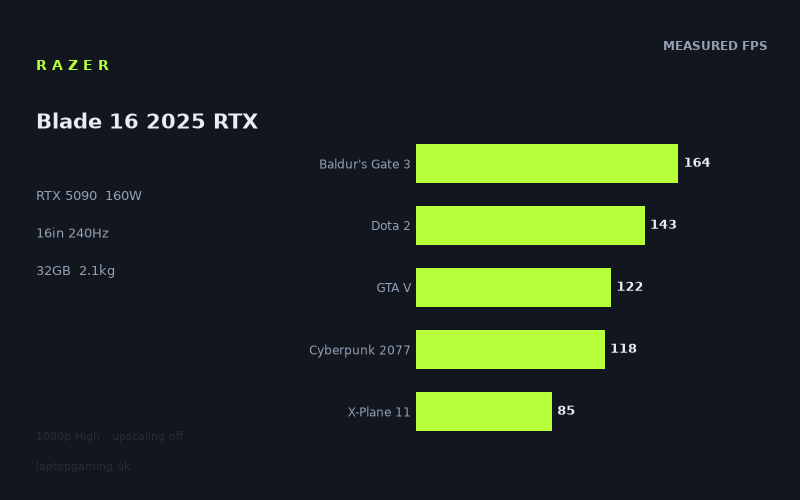
Frame rates
1920×1080, High preset, upscaling off. Averages 126fps across the 5 core benchmark games.
Measured on this machine. Source: Notebookcheck, 2025-03-28.
Not scored: no confirmed UK price
We have the full benchmark suite for this machine, so it ranks on the frame rate leaderboard like any other. What we don't have is a UK listing for this exact configuration - it's sold as a European review unit, or only in specifications that differ from the one tested. Since 30% of our score is value for money, scoring it would mean pretending price is no object, which would flatter it against every laptop you can actually buy. The frame rates below are real and comparable; there is just no buying recommendation to make yet.
How these numbers were produced
Frame rates here are not measured by us, and we label how each one was arrived at. A figure marked measured comes from a published run on that exact machine. A figure marked representative is derived from the GPU and its power limit (TGP) and cross-referenced against published reviews - a sound estimate of what that configuration delivers, but not a measurement of that specific laptop. Unless stated otherwise, numbers are 1920x1080, High preset, upscaling off. Where a laptop ships in several power configurations we use the wattage of the exact SKU listed, because a 140W RTX 5070 and a 115W one are not the same product.
In use
The short version
The Razer Blade 16 2025 RTX is a difficult laptop to judge in the way that matters most to a buyer: there is no confirmed UK price for this exact configuration. That means it has no overall value result on Laptop Gaming. This is not a missing performance result or a problem with the benchmark suite; the measured game data is complete and the laptop ranks normally on the frame-rate leaderboard. It simply cannot receive a value-inclusive result while price, which accounts for 30% of that calculation, is unconfirmed.
What the available data does show is a laptop with an RTX 5090 running at a 160W GPU power limit, 24GB of VRAM, a Ryzen AI 9 HX 370 processor, 32GB of memory and a 2048GB SSD. On paper, that is a very high-end specification. In the measured results, however, the important point is not merely that it produces high frame rates. It is that its performance varies sharply by game, and that its 160W RTX 5090 does not establish a large lead over several much less imposing-looking rivals in the shared-game comparisons.
At 1920x1080 on the High preset with upscaling disabled, Notebookcheck recorded 322fps in Strange Brigade and 236fps in F1 24. Those are the results that make the Blade 16’s 240Hz screen look sensible in the benchmark data. But the same test conditions produced 164fps in Baldur’s Gate 3, 143fps in Dota 2, 122fps in GTA V, 118fps in Cyberpunk 2077, 95fps in Alan Wake 2 and 85fps in X-Plane 11. The machine is plainly fast, but it is not a laptop that can be described honestly as a 240fps machine across this test list.
The mean across the five scoring-suite games is 126fps. That is a strong figure in isolation, but the surrounding results matter. The Blade 16 is only 5fps ahead of the Asus ROG Zephyrus G14 2025 with an RTX 5080 limited to 120W across the games shared by both machines. It is also 5fps ahead of the RTX 5070 Ti version of the same G14, 5fps ahead of the HP Omen 17z-db100 with an RTX 5070, and 6fps ahead of the Lenovo Legion 7 with an RTX 5060 at 115W. More strikingly, it is 2fps behind the MSI Crosshair 18 HX AI with an RTX 5070 across their shared games.
That does not make the Blade 16 a bad gaming laptop. It does mean that the RTX 5090 badge and 160W power limit should not be treated as an automatic reason to buy it. The measured figures support a more cautious conclusion: this is a high-specification machine capable of excellent results in the lighter games in the set, but its lead is narrow or absent against the listed rivals when the comparison is restricted to titles both machines have been measured in.
It will suit a buyer who specifically wants this combination of a 16in 2560x1600 OLED panel, 240Hz refresh rate, 24GB of VRAM, 32GB of memory and 2048GB of SSD storage, and who accepts that a UK value judgement must wait for a confirmed price. It is less convincing for somebody who assumes that an RTX 5090 at 160W must substantially outperform RTX 5070, RTX 5070 Ti or RTX 5080 alternatives. The benchmark data does not show that kind of separation.
Performance
All frame rates discussed here come from Notebookcheck’s measurements dated 2025-03-28. The tests were run at 1920x1080, using the High preset with upscaling off. That context is essential. These figures are useful for comparing the Blade 16 with machines tested under the same conditions, and they establish what the laptop can do in this particular test suite. They are not native-resolution measurements for the Blade 16’s 2560x1600 screen, and they do not tell us what frame rates to expect after changing the preset or enabling upscaling.
At the top end of the results, Strange Brigade reaches 322fps. This is the one measured game in which the Blade 16 exceeds its screen’s 240Hz refresh rate. For a player concentrating on this title under these test conditions, the panel has enough refresh headroom to display a frame rate beyond 240fps. The result also demonstrates that the system can deliver exceptionally high throughput where the game and settings allow it.
F1 24 follows at 236fps. That is extremely close to the panel’s 240Hz refresh rate, but it is not the same as meeting it. The distinction matters because this review should not turn a near match into a claim that the Blade 16 drives the display at its maximum refresh in F1 24. It nearly does so at 1920x1080 High with upscaling disabled. Whether it would do so at the screen’s 2560x1600 native resolution is not established by the available figures.
The next group is substantially lower. Baldur’s Gate 3 records 164fps, Dota 2 reaches 143fps and GTA V returns 122fps. These are still high measured frame rates, but they sit well below 240fps. That is the more representative story for the screen’s refresh rate in this set. The Blade 16 can feed a high-refresh display convincingly in these games, but it does not reach the panel’s maximum measured refresh in them. A buyer choosing the 240Hz specification specifically for a consistent 240fps experience should not assume that the GPU will deliver that result in every game simply because it does so in Strange Brigade.
Cyberpunk 2077 measures 118fps, only slightly below GTA V in this test. That result is important because it sits near the scoring-suite mean of 126fps rather than near the exceptional 322fps result in Strange Brigade. A machine’s headline GPU tier can make it tempting to focus on the highest result, but the wider spread is more informative. The Blade 16’s performance range runs from 85fps in X-Plane 11 to 322fps in Strange Brigade. It is therefore not meaningful to describe it with a single frame-rate expectation.
Alan Wake 2 comes in at 95fps, while X-Plane 11 records 85fps. Neither result is poor in the abstract, but both are much lower than the panel’s 240Hz capability. They are also a useful correction to the assumption that the most expensive-looking component list must make every game frame-rate limited only by the display. In these measured conditions, the Blade 16 is nowhere near 240fps in Alan Wake 2 or X-Plane 11. The available data does not say why each title lands where it does, and it would be wrong to assign a specific cause without supporting measurements. What can be said is that games place different demands on a system, and the benchmark spread shows that clearly.
Final Fantasy XV lands between those groups at 147fps. This result is above Dota 2’s 143fps and below Baldur’s Gate 3’s 164fps. It reinforces the point that the Blade 16 has plenty of performance for high frame rates in many titles without turning its 240Hz panel into a universally saturated display. There is a meaningful gap between 147fps and 240Hz, even though 147fps is a strong result under the stated conditions.
The five scoring-suite games are Baldur’s Gate 3, Dota 2, GTA V, Cyberpunk 2077 and X-Plane 11. Their mean is 126fps. This is a more useful starting point than either the 322fps high point or the 85fps low point because it covers games with markedly different measured outcomes. But it should still be read as a summary rather than a promise. A mean of 126fps does not mean the Blade 16 runs every scoring-suite title at roughly that level. It does not: X-Plane 11 is at 85fps, while Baldur’s Gate 3 is at 164fps.
The GPU power limit is particularly important here. The RTX 5090 in this Blade 16 is configured for 160W. A GPU power limit defines the power ceiling available to the graphics processor; it is not a guaranteed minimum frame rate and it is not a substitute for actual game measurements. The 160W figure tells us that this is not an RTX 5090 configuration restricted to the 120W limit used by the RTX 5080 Asus ROG Zephyrus G14 2025 rival. It gives the Blade 16 a higher stated GPU power limit than that particular G14. Yet the shared-game comparison puts the Blade only 5fps ahead on average across nine shared games.
That comparison is one of the most useful checks on what the 160W specification means in practice. It does not mean the extra stated power limit is irrelevant. It means that the measured benefit, across that nine-game overlap, is small rather than decisive. Buyers should judge the configuration by that outcome, not by the assumption that a 160W RTX 5090 must establish a large average lead over a 120W RTX 5080.
The same caution applies when comparing the Blade 16 with the Asus ROG Zephyrus G14 2025 RTX 5070 Ti model, which has a 110W RTX 5070 Ti. The Blade 16 is again only 5fps ahead across nine shared games. Against the Lenovo Legion 7, which has an RTX 5060 at 115W, the Blade is 6fps ahead across nine shared games. These are not comparisons that make the Blade 16’s result look weak in every individual title; the shared-game averages do not tell us individual game-by-game gaps. They do show, however, that its benchmark advantage over these specific alternatives is modest over the shared test lists.
The MSI Crosshair 18 HX AI comparison is more difficult still for Razer. The Crosshair has an RTX 5070 and costs GBP 2,095, while the Blade 16 is 2fps behind it across eight shared games. There is no confirmed UK price for the Blade configuration reviewed here, so there is no valid direct value verdict between the pair. But performance alone is enough to make the result notable. The Blade 16’s RTX 5090 at 160W does not lead that RTX 5070 MSI in the games both have been measured in.
None of this means that component labels are useless. The Blade 16’s 24GB of VRAM, 32GB of memory and Ryzen AI 9 HX 370 form part of an evidently high-end platform. It does mean that published performance should carry more weight than an expectation based on the GPU name alone. The laptop’s measured results are strong in several games, exceptional in Strange Brigade and nearly sufficient to meet 240Hz in F1 24. But the same data also contains 118fps in Cyberpunk 2077, 95fps in Alan Wake 2 and 85fps in X-Plane 11. A sensible purchasing decision has to hold both sides of that picture together.
There is also a practical consequence for settings decisions. Since these numbers use the High preset with upscaling disabled, they provide a clean baseline for this particular benchmark method. They do not establish how much performance would change with a different preset, at 2560x1600, or with upscaling enabled. Buyers wanting a specific frame-rate target at the native panel resolution should not treat the 1920x1080 figures as a promise. The honest conclusion is narrower: at the specified test settings, the Blade 16 ranges from 85fps to 322fps across the measured games, with a 126fps mean across the five scoring-suite titles.
The screen
The Blade 16 has a 16in OLED screen with a 2560x1600 resolution and a 240Hz refresh rate. This is an ambitious display specification because it combines a resolution above the 1920x1080 benchmark setting with a refresh rate that only the very highest measured frame rates can fully exploit. The panel is not the limiting factor in Strange Brigade, where Notebookcheck recorded 322fps. It is almost fully matched by F1 24 at 236fps. In the rest of the measured list, however, the frame rates sit below 240fps.
This is not an argument against a 240Hz screen. A high-refresh panel can still be appropriate when a game runs below its maximum refresh rate. The important point is simply that the specification should be bought for what it is, rather than for an assumption that every game will reach 240fps. The Blade 16’s own benchmark data makes that distinction unusually clear. Strange Brigade exceeds 240fps. F1 24 is close at 236fps. Baldur’s Gate 3 at 164fps, Final Fantasy XV at 147fps, Dota 2 at 143fps, GTA V at 122fps, Cyberpunk 2077 at 118fps, Alan Wake 2 at 95fps and X-Plane 11 at 85fps are all below the panel maximum.
The difference between the screen resolution and the benchmark resolution deserves equal attention. The Blade 16’s panel is 2560x1600, while the supplied measurements are at 1920x1080. We do not have Notebookcheck figures for the listed games at 2560x1600 on this machine, so there is no basis for claiming native-resolution frame rates. It would be misleading to present the 322fps Strange Brigade result, or the 236fps F1 24 result, as if either were measured at the laptop’s own panel resolution. They were not.
For a buyer, this means the screen and the benchmark table should be considered as two linked but distinct parts of the purchase. The screen offers a 16in OLED panel at 2560x1600 and 240Hz. The measured game performance tells us how the laptop performs at 1920x1080 High with upscaling off. The data confirms that the Blade 16 can generate very high frame rates in some titles under that test method. It does not confirm that the same games will match 240Hz at 2560x1600.
The most attractive use case for the 240Hz panel, based on the measurements, is a player whose chosen games resemble the upper end of the list under the benchmark conditions. Strange Brigade is comfortably beyond the refresh limit. F1 24 is close enough that the distinction between 236fps and 240Hz matters more than any claim of effortless headroom. In both cases, the high-refresh specification has a direct relationship with the published results.
For the middle of the list, the screen remains a premium specification rather than a demonstrated 240fps target. Baldur’s Gate 3 at 164fps and Final Fantasy XV at 147fps are strong results, but neither reaches the panel maximum. Dota 2 at 143fps and GTA V at 122fps tell the same story. These games can make use of a high-refresh screen in the broad sense that their measured frame rates are well above lower frame-rate territory, but the available data does not support saying that the Blade 16 drives them at 240fps.
The lower portion of the table matters even more for buyers whose priority is demanding games rather than headline frame rates. Cyberpunk 2077 at 118fps, Alan Wake 2 at 95fps and X-Plane 11 at 85fps are all well short of 240fps at 1920x1080 High with upscaling disabled. A purchaser who sees “RTX 5090” and “240Hz” beside one another may expect an uncomplicated match between the two. The numbers show otherwise. The panel has the capacity for 240Hz, but capacity is not the same thing as a measured 240fps result in every title.
The OLED designation is also part of the specification, but the available fact sheet does not provide display measurements beyond panel type, size, resolution and refresh rate. There are no supplied figures for brightness, colour coverage, response behaviour or any other display characteristic. It would therefore be inappropriate to make claims about those aspects. The sound conclusion is limited to what is known: this is a 16in 2560x1600 OLED panel with a 240Hz refresh rate, paired with game results that range widely at a lower 1920x1080 test resolution.
That combination makes the screen best understood as a display with considerable headroom in the easiest-running measured titles and less direct evidence of full utilisation in the rest. It is a strong specification for somebody who values both resolution and refresh rate, but the benchmark evidence asks buyers to be realistic about the latter. The Blade 16 can exceed 240fps in Strange Brigade and come close in F1 24. It does not do so in the other listed games, and we do not have the native-resolution results required to extend any 1920x1080 claim to 2560x1600.
Build, size and portability
The Blade 16 weighs 2.09kg and has a 16in screen. That is the full physical information supplied here, so there is no basis for claims about chassis dimensions, thickness, materials, keyboard layout, port selection, charger size, cooling-system design or build quality. Those details can make a substantial difference to everyday ownership, but they are not part of the available specification and should not be invented to make a review feel more complete.
What can be said is that 2.09kg is the laptop-only weight stated for this configuration. It matters because this is not just a gaming specification built around an RTX 5090, 24GB of VRAM, 32GB of memory and a 2048GB SSD; it is also paired with a 16in 2560x1600 OLED screen. Buyers deciding whether it suits their routine should treat 2.09kg as a concrete part of the proposition, not an incidental line in the specification list.
The fact sheet lists a 90Wh battery. It does not provide a measured battery-life result. As a result, it would be wrong to estimate how long the Blade 16 lasts away from mains power, to compare its endurance with another laptop, or to suggest that the 90Wh figure guarantees a particular use pattern. Battery capacity tells us the stated size of the battery, not the measured runtime. Anyone for whom unplugged use is a deciding factor will need battery-life evidence that is not included here.
The lack of supplied dimensions also limits portability conclusions. A 2.09kg weight figure lets a buyer account for the laptop itself, but it does not tell us the footprint of the chassis or the total carrying burden once charging equipment is included. There is no charger weight in the fact sheet, so a review cannot honestly turn the laptop-only figure into a travel-weight claim. Equally, there is no basis for describing it as compact, bulky, thin or thick.
Still, the specification points to a specific kind of buyer rather than an all-purpose portability story. This is a 16in laptop with a 90Wh battery, a 2.09kg stated weight and a high-end gaming configuration. It is likely to appeal to somebody who wants the capability of an RTX 5090, 24GB of VRAM and 32GB of memory in a machine that remains a single 16in notebook rather than a larger-screen alternative. That is a description of the supplied specifications, not a claim that it is effortless to carry or that it has a particular battery runtime.
The storage allocation is also worth considering in ownership terms. The Blade 16 includes a 2048GB SSD. That is a substantial stated capacity, but the fact sheet does not say how the storage is configured, whether there are additional slots, or what upgrade options exist. The safe conclusion is simply that the reviewed configuration is supplied with 2048GB of SSD storage. A buyer who needs a particular expansion path should not assume one from capacity alone.
The same restraint applies to memory. The supplied machine has 32GB of memory. That is useful information for choosing between configurations, particularly alongside the Ryzen AI 9 HX 370 and RTX 5090, but the fact sheet does not state memory speed, memory layout or upgradeability. There is no need to fill those gaps with generic claims. The practical point is that the Blade 16 arrives with 32GB, while any wider statement about servicing or future expansion would need evidence not provided here.
For buyers comparing machines on physical practicality, the Blade 16 should therefore be judged on the limited but important confirmed facts: 16in screen, 2.09kg weight and 90Wh battery capacity. It is reasonable to say that these are the relevant known figures. It is not reasonable to claim a measured battery life, to describe the body as especially slim, or to pretend that this review has information about daily handling. The performance data is much more complete than the portability data, and the review should reflect that imbalance.
How it compares
The closest rivals in the Laptop Gaming database produce a notable comparison set because they do not all occupy the same apparent GPU tier as the Blade 16. The Razer has an RTX 5090 at 160W. The listed alternatives include RTX 5070, RTX 5070 Ti, RTX 5080 and RTX 5060 configurations, with stated GPU power limits where supplied. On component names alone, the Blade might be expected to stand clearly above them. The shared-game averages do not show a clear performance gulf.
MSI Crosshair 18 HX AI
The MSI Crosshair 18 HX AI has an RTX 5070 and a confirmed UK price of GBP 2,095. Across eight games measured on both machines, the Blade 16 averages 2fps behind it. This is the most awkward comparison for Razer because the direction of the result is not merely a small lead that fails to justify a large specification gap; it is a small deficit in the shared-game average.
There are limits to what can be concluded. The comparison covers eight shared games, not the whole set of results for either laptop, and we do not have the individual shared-game frame rates in this fact sheet. It would be wrong to claim that the MSI wins every title, or that the Razer is slower in every situation. But it is entirely fair to say that the Blade 16 does not establish a shared-game advantage over this particular RTX 5070 rival. It trails by 2fps on average across the overlap.
The price situation prevents a direct value verdict. The MSI is GBP 2,095, while the Razer’s UK price is not confirmed. There is no honest way to calculate a price premium or to decide whether the Razer is worth more than the MSI. What the evidence does allow is a performance warning: buyers considering the Blade principally because of its RTX 5090 should examine this result closely. The available shared-game data does not show the expected separation from the MSI’s RTX 5070.
Asus ROG Zephyrus G14 2025 with RTX 5080
The Asus ROG Zephyrus G14 2025 uses an RTX 5080 with a 120W GPU power limit and has a confirmed UK price of GBP 3,811. Across nine shared games, the Blade 16 averages 5fps ahead. This is a lead for Razer, but it is a narrow one. The Blade has the higher stated GPU power limit at 160W against 120W and the higher-numbered RTX 5090 GPU, yet the measured shared-game gap is only 5fps.
This comparison is a useful antidote to simple specification shopping. A buyer can see the Blade’s RTX 5090 and 160W limit, then see the G14’s RTX 5080 at 120W, and reasonably expect Razer to be faster. It is faster in the supplied nine-game average. But the size of the advantage is small enough that it should not be treated as decisive without considering the rest of each machine’s specification and, crucially, the final UK price of the Blade.
The G14’s GBP 3,811 price is known, but the Blade’s is not. That makes it impossible to say which is better value. It would be especially inappropriate to guess that the Blade will cost more or less, then build a buying recommendation on that guess. The sound comparison is therefore performance-only: the Razer is 5fps ahead on average across the nine games shared with this RTX 5080 G14.
Asus ROG Zephyrus G14 2025 with RTX 5070 Ti
The RTX 5070 Ti version of the Asus ROG Zephyrus G14 2025 has a 110W GPU power limit and no confirmed UK price. The Blade 16 averages 5fps ahead across nine shared games. Again, Razer leads, but only narrowly. The contrast between an RTX 5090 at 160W and an RTX 5070 Ti at 110W looks substantial in the specification list. The published shared-game frame-rate difference is not substantial in the same way.
That does not prove the two machines are interchangeable. The Blade 16 has 24GB of VRAM, 32GB of memory, a 2048GB SSD, a 16in 2560x1600 OLED screen and a 240Hz refresh rate in the stated configuration. The fact sheet does not provide the corresponding full specification for this G14, so no broader equivalence claim should be made. But for a buyer focused on the shared-game benchmark result, the relevant figure is simple: 5fps average advantage for the Blade across nine games.
Since neither machine has a confirmed UK price in this comparison, value cannot be settled here. The result instead tells a buyer to avoid paying for the Blade solely on the belief that its GPU class guarantees a large gaming lead. It does not, at least in the available shared-game average.
HP Omen 17z-db100
The HP Omen 17z-db100 is another RTX 5070 alternative with no confirmed UK price. The Blade 16 averages 5fps ahead across nine shared games. As with the RTX 5070 Ti G14, this is a Razer win on the stated metric, but not an overwhelming one. The Blade’s 160W RTX 5090 configuration is only modestly ahead in the comparison that can actually be made from published measurements.
The absence of an HP price means this cannot become a value comparison. It also means that buyers should not try to turn the performance gap into a purchasing conclusion without more information. A 5fps average difference can matter to someone choosing between otherwise identical systems, but these are not otherwise identical systems and the supplied facts do not fill in every difference. The correct reading is narrower: Razer is faster by 5fps on average across the nine games both laptops have in common.
Lenovo Legion 7
The Lenovo Legion 7 has an RTX 5060 at 115W and no confirmed UK price. The Blade 16 is 6fps ahead across nine shared games. This is the largest stated lead among the nine-game comparisons, but it remains a 6fps lead rather than a dramatic gulf. It is another example of why the Blade’s actual benchmark position is more interesting than its headline specification.
The RTX 5060 at 115W is a clearly different configuration from an RTX 5090 at 160W. Yet the supplied shared-game average leaves the Razer only modestly ahead. Without individual game results for the overlap, it would be wrong to state where that lead appears or whether one machine is more consistent than the other. Without either UK price, it would also be wrong to describe either as better value. The reliable conclusion is limited but significant: the Blade’s lead over this listed RTX 5060 rival is 6fps across nine common games.
Across the rival set as a whole, the Blade 16’s comparative position is therefore mixed. It is behind the MSI Crosshair 18 HX AI by 2fps across eight shared games. It is ahead of the RTX 5080 Asus ROG Zephyrus G14 by 5fps across nine games, ahead of the RTX 5070 Ti G14 by 5fps across nine games, ahead of the HP Omen 17z-db100 by 5fps across nine games and ahead of the Lenovo Legion 7 by 6fps across nine games. These are narrow margins around a group of machines with lower-numbered GPUs.
That does not negate the Blade 16’s own strong frame rates. It does change the buying argument. The case for this Razer is not “buy it because its RTX 5090 makes the rivals irrelevant”. The data does not support that. The case, if its eventual UK price makes sense, is for a buyer who wants its particular combination of 24GB VRAM, 32GB memory, 2048GB SSD, 16in OLED display, 2560x1600 resolution, 240Hz refresh rate and 2.09kg weight, while accepting that the published gaming advantage over these named alternatives is slim.
Who it’s for
The Blade 16 is for the buyer who wants a premium 16in gaming configuration with a 2560x1600 OLED panel, 240Hz refresh rate, RTX 5090 at 160W, 24GB of VRAM, Ryzen AI 9 HX 370 processor, 32GB of memory and 2048GB of SSD storage. That is a substantial specification, and the measured results confirm that it can produce very high frame rates in selected games. Strange Brigade at 322fps and F1 24 at 236fps are the clearest examples. A player whose priorities align with that end of the benchmark list has evidence that the hardware can make meaningful use of a high-refresh panel at the 1920x1080 High test setting with upscaling disabled.
It is also for someone who understands that the 240Hz screen is a capability rather than a universal frame-rate promise. The data is strongest for a buyer who values high refresh but does not require every measured game to reach 240fps. Baldur’s Gate 3 at 164fps, Final Fantasy XV at 147fps, Dota 2 at 143fps and GTA V at 122fps remain high results, yet they demonstrate that the display maximum is not the normal outcome across the list. Cyberpunk 2077, Alan Wake 2 and X-Plane 11 reinforce that point at 118fps, 95fps and 85fps respectively.
It may also suit a buyer who places importance on VRAM capacity. The configuration includes 24GB of VRAM, which is a confirmed part of the specification. This review does not have game-specific VRAM usage figures, so it cannot claim a particular benefit in the measured titles. But a buyer selecting systems based on the stated memory allocation can reasonably recognise that 24GB is part of what distinguishes this configuration from a bare GPU-name comparison.
The 32GB system memory and 2048GB SSD will matter to buyers who do not want to start with a lower-capacity configuration. Again, the supplied data does not provide upgrade information or storage performance measurements, so the recommendation should not go beyond the stated capacities. The Blade is for someone who wants those capacities included in the reviewed specification, not for someone being promised a particular upgrade path or a particular level of SSD performance that has not been documented here.
The 2.09kg weight and 90Wh battery capacity make it relevant to a buyer looking for a 16in machine rather than a larger display size, but this is an area where the evidence is incomplete. There is no battery-life measurement, no dimensions and no charger information. It is therefore not the right choice for someone who needs a proven all-day battery result, needs a confirmed travel weight including charging equipment, or needs a machine within a specific physical footprint. Those requirements need measurements that are not available in this fact sheet.
Just as importantly, the Blade 16 is not the obvious choice for someone who is buying purely for the largest possible shared-game performance lead over the listed rivals. The MSI Crosshair 18 HX AI is 2fps ahead across eight shared games despite using an RTX 5070. The Blade is only 5fps ahead of the RTX 5080 Asus ROG Zephyrus G14 across nine shared games, 5fps ahead of the RTX 5070 Ti G14, 5fps ahead of the HP Omen 17z-db100 and 6fps ahead of the Lenovo Legion 7. Those margins are too narrow to support an argument that the Razer’s GPU specification alone settles the comparison.
Buy something else if your main goal is established value. The Blade 16 has no confirmed UK price, so it cannot be judged on value yet. That is not a criticism of its hardware; it is a practical limitation on any responsible buying recommendation. The MSI Crosshair 18 HX AI has a known price of GBP 2,095, and the RTX 5080 Asus ROG Zephyrus G14 has a known price of GBP 3,811. The Blade may eventually be competitively priced, or it may not. The available facts do not permit either conclusion.
Buy something else if your priority is a machine with published evidence of native 2560x1600 game performance in these titles. The Blade’s screen is 2560x1600, but the supplied frame rates are at 1920x1080. There is nothing wrong with that benchmark method; it is a consistent basis for comparison. But it does not answer the specific question of how this laptop performs at its own panel resolution. A buyer who will play exclusively at 2560x1600 should wait for relevant measurements rather than infer them from 1920x1080 data.
Buy something else if 240fps in demanding games is the non-negotiable target. The Blade reaches 322fps in Strange Brigade and 236fps in F1 24, but the remaining measured results are lower. It records 164fps in Baldur’s Gate 3, 147fps in Final Fantasy XV, 143fps in Dota 2, 122fps in GTA V, 118fps in Cyberpunk 2077, 95fps in Alan Wake 2 and 85fps in X-Plane 11. The 240Hz panel is real, but the benchmark results do not show a consistent 240fps outcome.
Buy something else if battery runtime, thermals or noise are central to the decision. The fact sheet provides a 90Wh battery capacity but no runtime figure. It provides no temperature or noise figures. Those omissions do not imply poor results; they simply mean there is no evidence here on which to make a recommendation. A serious buyer should not let a review substitute speculation for measurements.
The final position is straightforward. The Razer Blade 16 2025 RTX is a high-specification 16in gaming laptop with a 160W RTX 5090, 24GB of VRAM, 32GB of memory, 2048GB of SSD storage and a 2560x1600 240Hz OLED screen. Its measured results are excellent in the fastest titles in the list, strong across much of the scoring suite and considerably lower in the most demanding measured results. Its comparative performance is much closer to the listed RTX 5070, RTX 5070 Ti, RTX 5080 and RTX 5060 rivals than the component names might suggest. Until a confirmed UK price exists, that is the honest buying case: impressive hardware and strong published frame rates, but no verified value verdict and no evidence of a decisive performance advantage over its nearest database rivals.