Review
MSI GE66 Raider review
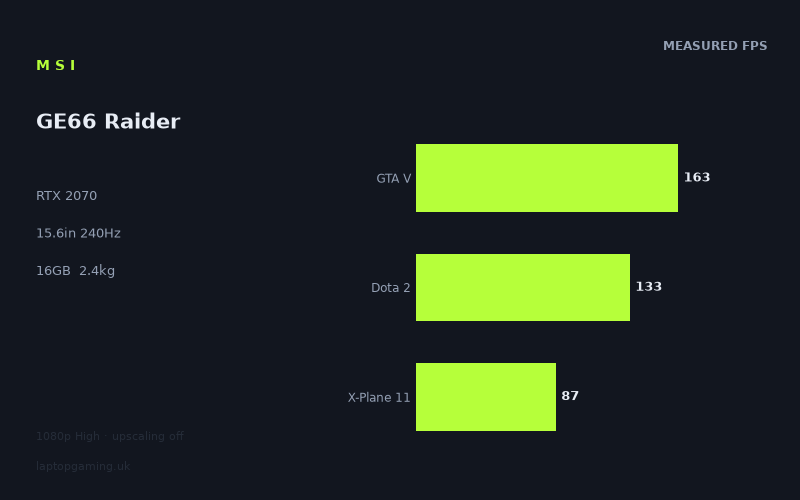
Frame rates
1920×1080, High preset, upscaling off.
Measured on this machine. Source: Notebookcheck, 2020-07-23.
Not scored: incomplete benchmark suite
Every scored laptop on this site is averaged over the same 5 games, and this one is short of Cyberpunk 2077, Baldur's Gate 3. A mean over 4 games is not comparable to a mean over 5, so we publish the figures we have and leave the score blank rather than rank it against machines tested on a different set. The numbers below are real - the suite is just incomplete.
How these numbers were produced
Frame rates here are not measured by us, and we label how each one was arrived at. A figure marked measured comes from a published run on that exact machine. A figure marked representative is derived from the GPU and its power limit (TGP) and cross-referenced against published reviews - a sound estimate of what that configuration delivers, but not a measurement of that specific laptop. Unless stated otherwise, numbers are 1920x1080, High preset, upscaling off. Where a laptop ships in several power configurations we use the wattage of the exact SKU listed, because a 140W RTX 5070 and a 115W one are not the same product.
In use
The short version
The MSI GE66 Raider (10SFS) is a high-frame-rate 1080p gaming laptop built around an RTX 2070, a Core i9-10980HK, 16GB of memory and a 240Hz IPS display. Notebookcheck’s measured figures show that it is very quick in a broad range of games at 1920x1080 on the High preset with upscaling off. The important qualification is that “very quick” is not the same as “able to fill a 240Hz panel in every game”. It can do that in a small group of lighter or especially well-suited titles, but most of the measured results sit below the display’s refresh ceiling.
That does not make the 240Hz panel pointless. It means the display is best treated as a ceiling rather than a performance promise. FIFA 20 reaches 267fps, while Dirt Rally 2.0 and F1 2019 both reach 178fps and Doom Eternal reaches 176fps. Those are properly high frame rates. But the more demanding end of the data is very different: Metro Exodus reaches 83fps, Control reaches 81fps and Red Dead Redemption 2 reaches 73fps. The GE66 has enough performance for smooth-looking 1080p High gaming across the supplied results, but not enough headroom to make 240fps a realistic expectation in every major game.
The strongest argument for this MSI is therefore specific. It suits a buyer who wants a 15.6in 1080p machine with an unusually fast panel and who mainly plays games that can exploit high refresh rates, while still wanting credible results in more demanding titles. It also makes sense for someone who values the Core i9-10980HK, 1TB SSD and 16GB memory configuration alongside gaming performance. The benchmark data is especially encouraging for competitive or faster-moving games such as FIFA 20, Fortnite, Apex Legends, Battlefield V, Call of Duty Modern Warfare 2019 and Doom Eternal.
It is less convincing as a purchase based solely on the panel specification. A 240Hz display is an ambitious match for this level of measured performance at the High preset. Many games land in the 90fps to 150fps region rather than near 240fps. That is still a strong range for a 1080p laptop, but it changes the buying case: this is not a machine whose GPU performance automatically validates every part of the screen specification in every game.
There is also no confirmed UK price in the supplied information. That prevents a proper value judgement. The specifications and frame-rate data can establish what the GE66 Raider delivers, but they cannot establish whether it is competitively priced against other machines. A laptop with these results could be sensible at one price and hard to defend at another. Until a confirmed UK price is available, the right conclusion is about performance and fit, not value.
The other limitation is the GPU power limit. The supplied information identifies the GPU as an RTX 2070, but does not state its wattage or power limit. That means it would be wrong to attribute the results to a particular RTX 2070 power configuration, or to claim that the GE66 is extracting a given level of performance from the chip. The measured figures are useful in their own right; the missing power-limit figure simply means that the explanation has to stay with the published results rather than speculate about how MSI configured the GPU.
If your priority is a 240Hz 1080p IPS screen for games that routinely run well above 120fps, the GE66 Raider has a clear case. If your priority is to play the heaviest measured games as close as possible to 240fps at the supplied settings, the data says that expectation is too high. If portability is the priority, the 2.428kg weight deserves serious consideration before buying. And if the price is the deciding factor, there is not enough UK pricing information here to make the call.
Performance
What Notebookcheck’s numbers show
Notebookcheck measured the MSI GE66 Raider at 1920x1080, using the High preset with upscaling off. Those conditions matter. The results are not a claim about every graphics mode, every resolution or every optional feature a game may offer. They are a useful like-for-like view of this machine at the resolution of its built-in screen, with a relatively demanding preset and without upscaling changing the result.
The top end of the list is impressive. FIFA 20 records 267fps, the only supplied result above the 240Hz panel refresh rate. Dirt Rally 2.0 and F1 2019 both produce 178fps. Doom Eternal is close behind at 176fps, GTA V reaches 163fps and The Witcher 3 reaches 161fps. Fortnite reaches 156fps, Battlefield V 152fps, while Apex Legends and Gears Tactics each reach 144fps. That is a substantial group of games at or above 144fps, which is the performance territory where a fast display is doing meaningful work even if the full 240Hz ceiling is not reached.
The results also show that the GE66 is not dependent on a single unusually favourable title. Its strong results appear across racing games, sports games, shooters, action games and strategy titles. F1 2019 at 178fps, Doom Eternal at 176fps, Fortnite at 156fps, Battlefield V at 152fps, Apex Legends at 144fps and Gears Tactics at 144fps do not represent one narrow genre. A buyer whose library moves between these types of games has evidence that the laptop can sustain high frame rates in varied workloads at the stated settings.
Below that first group, the machine remains fast but increasingly falls short of the display’s maximum refresh rate. Darksiders III reaches 141fps, Call of Duty Modern Warfare 2019 reaches 134fps and Dota 2 reaches 133fps. Monster Hunter World reaches 130fps. The Division 2 reaches 124fps, while Escape from Tarkov and Rage 2 both reach 121fps. GRID 2019, Just Cause 4 and Kingdom Come: Deliverance each record 119fps. Shadow of the Tomb Raider reaches 118fps, Star Wars Jedi Fallen Order 114fps and Hunt Showdown 113fps.
That middle band is arguably the most useful part of the data for a prospective buyer. It tells you that the GE66 Raider is often operating in a range where the 240Hz panel can still show more temporal detail than a conventional lower-refresh display, but it cannot display a newly rendered frame on every one of its refresh cycles. In practical buying terms, this is a laptop designed for high refresh gaming, but it is not a laptop that turns every High-preset game into a 240fps game.
Far Cry New Dawn reaches 104fps and Ghost Recon Breakpoint reaches 101fps. Need for Speed Heat is just below that at 97fps. Borderlands 3 reaches 92fps, Final Fantasy XV 91fps, and Anno 1800, Assassin’s Creed Odyssey and Hitman 2 each reach 90fps. X-Plane 11 reaches 87fps. This portion of the results is still well above the low frame rates that would make a gaming laptop difficult to recommend for 1080p High use, but it is a clear reminder that the panel and GPU are not equally matched in every game.
The final group establishes the floor of the supplied data. Metro Exodus records 83fps, Control reaches 81fps and Red Dead Redemption 2 reaches 73fps. These are not poor results in isolation: the laptop is still producing playable-looking frame rates at the stated resolution and preset. But they are a long way from 240fps. A buyer primarily interested in these more demanding games should evaluate the GE66 as a laptop delivering roughly this class of result at 1080p High, rather than buying it on the assumption that the 240Hz label means equivalent frame rates in every title.
The spread matters more than a single average
The supplied scoring-suite mean is 118fps across GTA V, Dota 2, Final Fantasy XV and X-Plane 11. That is useful as a compact summary of the data, but it is not enough on its own to describe the machine. The difference between GTA V at 163fps and X-Plane 11 at 87fps is large, despite both appearing in that limited group. A buyer who only looks at the 118fps mean could miss the fact that game choice has a substantial effect on the outcome.
The wider results make that clear. FIFA 20 at 267fps is more than three times the Red Dead Redemption 2 result of 73fps. Dirt Rally 2.0 at 178fps is far removed from Control at 81fps. Even games clustered around the middle of the table differ enough to affect how the 240Hz display will be used: Call of Duty Modern Warfare 2019 reaches 134fps, while Borderlands 3 reaches 92fps; The Division 2 reaches 124fps, while Assassin’s Creed Odyssey reaches 90fps.
This is why the GE66 should not be reduced to a simple “high-refresh” label. It is a high-refresh-capable system in suitable games, not a system that delivers the same class of frame rate regardless of game engine or workload. Buyers who spend most of their time in FIFA 20, Dirt Rally 2.0, F1 2019, Doom Eternal, GTA V, Fortnite, Battlefield V or Apex Legends have a much stronger reason to pay for the 240Hz panel than buyers whose regular games resemble Metro Exodus, Control or Red Dead Redemption 2 at the supplied settings.
The middle of the table is also broad enough to prevent an overly simple division between “esports games” and “demanding games”. Dota 2 reaches 133fps, which is high but not close to 240fps. Gears Tactics reaches 144fps. Monster Hunter World reaches 130fps. Escape from Tarkov reaches 121fps. These results reinforce the point that the display will be used differently from title to title. The notebook is fast, but the panel’s maximum refresh rate is aspirational in many of the measured games rather than routinely saturated.
The RTX 2070 and the missing power-limit detail
The GE66 Raider uses an RTX 2070, but the supplied fact sheet does not provide a GPU wattage or power limit. That omission matters because it is not safe to assume that every laptop carrying the same GPU name will behave identically. The correct way to assess this machine is therefore through Notebookcheck’s published figures, not through an assumed position based on the RTX 2070 badge alone.
Those figures place the GE66 firmly in high-frame-rate 1080p territory. It reaches at least 100fps in FIFA 20, Dirt Rally 2.0, F1 2019, Doom Eternal, GTA V, The Witcher 3, Fortnite, Battlefield V, Apex Legends, Gears Tactics, Darksiders III, Call of Duty Modern Warfare 2019, Dota 2, Monster Hunter World, The Division 2, Escape from Tarkov, Rage 2, GRID 2019, Just Cause 4, Kingdom Come: Deliverance, Shadow of the Tomb Raider, Star Wars Jedi Fallen Order, Hunt Showdown, Far Cry New Dawn and Ghost Recon Breakpoint.
That is a long and varied list, and it is the best evidence for the MSI’s core appeal. At the same time, it would be misleading to say that every game reaches 100fps. Need for Speed Heat, Borderlands 3, Final Fantasy XV, Anno 1800, Assassin’s Creed Odyssey, Hitman 2, X-Plane 11, Metro Exodus, Control and Red Dead Redemption 2 do not. The distinction is important because it tells a buyer what compromises, if any, might be needed in a particular game to pursue higher frame rates. The benchmark data does not say which individual settings should be changed, so no specific setting recommendation can be made here. It does show where the supplied High preset is already producing enough performance to make such a choice optional, and where a buyer should not assume the panel will be fully exploited.
Upscaling was off for every listed result. That makes the frame-rate figures straightforward to interpret: they are not being lifted by an upscaling mode under the stated test conditions. It also means there is no supplied evidence for how this MSI would perform with upscaling enabled. The published numbers should be treated as the baseline for the exact settings used, rather than a ceiling or prediction for settings that were not measured.
Where the 240Hz display is genuinely useful
A 240Hz display has a refresh ceiling of 240 frames per second. On the supplied data, FIFA 20 at 267fps exceeds that ceiling. The panel cannot refresh more often than its stated 240Hz rate, so this is the clearest example of the GPU having more than enough performance to feed the display at its maximum rate under the stated conditions.
No other listed result reaches 240fps. Dirt Rally 2.0 and F1 2019 at 178fps, plus Doom Eternal at 176fps, are the nearest group. Those numbers are still much closer to the panel’s capability than the results around 90fps or 80fps, and they support the idea that the display is not merely decorative for the right games. GTA V at 163fps, The Witcher 3 at 161fps and Fortnite at 156fps also provide a strong high-refresh experience on paper, even though they do not reach the panel ceiling.
Battlefield V at 152fps, Apex Legends and Gears Tactics at 144fps, Darksiders III at 141fps, Call of Duty Modern Warfare 2019 at 134fps and Dota 2 at 133fps form another useful group. These results do not justify a claim that the GE66 is a 240fps machine in those games. They do justify describing it as a machine capable of producing well above 100fps in them at 1080p High with upscaling off.
Once the results fall to around 100fps and below, the case for the panel changes. Far Cry New Dawn at 104fps and Ghost Recon Breakpoint at 101fps are still above 100fps, but there is considerable unused refresh capacity. Need for Speed Heat at 97fps, Borderlands 3 at 92fps, Final Fantasy XV at 91fps, Anno 1800 at 90fps, Assassin’s Creed Odyssey at 90fps and Hitman 2 at 90fps are a further step away. Metro Exodus, Control and Red Dead Redemption 2 are further still. The panel remains the machine’s display, but the GPU is not delivering enough frames in these titles to make the 240Hz specification the defining part of the experience at the measured settings.
The screen
The GE66 Raider has a 15.6in IPS screen with a 1920x1080 resolution and a 240Hz refresh rate. The supplied data supports a focused assessment of those specifications: 1080p is the resolution at which Notebookcheck measured every listed game, and the panel’s 240Hz refresh rate is high enough that the laptop will not be display-limited by a conventional low refresh ceiling in the fastest results.
The 1920x1080 resolution is also central to the performance story. These are 1080p figures, not results at a higher resolution. Buyers should not read FIFA 20 at 267fps or Doom Eternal at 176fps as a general statement about performance at every resolution. The results establish that the RTX 2070 and Core i9-10980HK combination can produce these figures at the laptop’s native stated resolution under the stated High-preset, upscaling-off conditions.
The IPS panel type is stated, but the fact sheet does not provide measurements for brightness, contrast, colour coverage, response behaviour, backlight behaviour or viewing characteristics. It would therefore be wrong to call the panel bright, dim, colour-accurate, slow or fast beyond its stated 240Hz refresh rate. The useful conclusion is limited but still meaningful: this is a 15.6in IPS 1080p 240Hz display, and the gaming data shows that the hardware can make substantial use of its refresh capability in selected games.
FIFA 20 is the standout match for the screen. Its 267fps result exceeds 240fps, meaning the laptop has enough measured performance to reach the panel’s stated refresh ceiling under the supplied conditions. Dirt Rally 2.0, F1 2019 and Doom Eternal are the next strongest matches, at 178fps, 178fps and 176fps respectively. These games cannot be described as reaching 240fps, but the results are plainly in high-refresh territory.
GTA V at 163fps, The Witcher 3 at 161fps, Fortnite at 156fps and Battlefield V at 152fps continue that pattern. They are not marginal results. They are high enough that the decision to use a 240Hz panel makes more sense than it would on a laptop that spent most of its time around 60fps. Apex Legends and Gears Tactics at 144fps are another practical threshold in the data, although the panel itself remains capable of more than those results.
The weaker matches are just as important. X-Plane 11 at 87fps, Metro Exodus at 83fps, Control at 81fps and Red Dead Redemption 2 at 73fps do not come close to exploiting a 240Hz ceiling at the tested preset. The screen is still a 240Hz panel in those games, but the frame-rate results do not support buying the laptop specifically because you expect every title to run at anything like its maximum refresh rate.
There is no stated support in the fact sheet for an alternative screen resolution, an alternative refresh option, or any display feature beyond IPS, 1920x1080 and 240Hz. A buyer should make the decision on those confirmed specifications. The display is clearly configured for high-frame-rate 1080p gaming. The benchmark data says the laptop can often deliver that, but the degree to which it does so is game-dependent.
Build, size and portability
The supplied weight is 2.428kg. That is the only physical measurement provided, so it is the only one that can be assessed confidently. No dimensions are supplied, and there is no published battery-life figure, chassis-material description, port list, noise result or temperature result in the fact sheet. It would be irresponsible to invent a view on any of those areas.
The weight matters because it is part of the trade-off in choosing a performance-focused 15.6in gaming laptop. A buyer who expects to move the machine frequently should consider 2.428kg as part of the purchase, rather than treating the laptop only as an RTX 2070 and 240Hz specification. The benchmark figures make the performance case; the weight is the confirmed portability constraint available here.
There is not enough information to make a precise statement about how easily the GE66 Raider fits into a particular bag, whether it is compact for its class, or how much room it occupies on a desk. Those conclusions require dimensions that have not been supplied. Likewise, there is no basis for claiming a particular build quality, hinge behaviour, keyboard feel, trackpad quality, cooling-system design or upgrade access. The model name and gaming-oriented specifications do not substitute for measured or documented physical details.
What can be said is that the machine combines its 2.428kg weight with a 15.6in 1080p 240Hz IPS display, an RTX 2070, a Core i9-10980HK, 16GB of memory and a 1TB SSD. That is the complete confirmed configuration context. It is reasonable to view it as a laptop selected primarily for gaming performance and display refresh capability, but it is not reasonable to claim more about its physical experience than the fact sheet supports.
The absence of battery, noise and thermal figures also matters for different kinds of buyer. Someone choosing a laptop mainly for desk-based gaming can put most of the emphasis on the notebook’s measured game performance. Someone who expects long periods away from mains power, needs a quiet environment, or is especially concerned about external temperatures does not have enough evidence in this fact sheet to make a fully informed choice. Those are not minor omissions, and they should not be disguised by repeating the gaming results.
How it compares
Against the Acer Aspire 17 with RTX 2050 at 35W
Across four shared games, the MSI GE66 Raider averages 44fps more than the Acer Aspire 17 with an RTX 2050 at 35W. That is the largest positive gap among the listed comparisons, and it is large enough to support a straightforward conclusion: on the supplied shared-game comparison, the GE66 is substantially faster.
The Acer has no confirmed UK price in the supplied information, so the comparison cannot become a value verdict. It can only establish the performance spread. A 44fps average advantage across the shared games is not a near-tie, and it reinforces the case for the GE66 as a performance-first option rather than a machine chosen only for its screen specification.
The GPU names and power information should also be handled carefully. The Acer is identified as an RTX 2050 at 35W. The MSI is identified as an RTX 2070, but the GE66 power limit is not supplied. The measured shared-game lead is the evidence that matters here. There is no need to infer an undisclosed MSI wattage to recognise that the GE66 is meaningfully ahead in this comparison.
Against the Gigabyte Aero 17 HDR XB with RTX 2070
The Gigabyte Aero 17 HDR XB also uses an RTX 2070. Across four shared games, the GE66 Raider averages only 2fps more. That is effectively a near-zero result in the context of the supplied comparison. It should not be exaggerated into a meaningful MSI performance win simply because the number has a positive sign.
The supplied comparison notes explain why very small differences can be genuine rather than suspicious: at 1080p, lighter titles in the shared set can be CPU-bound and compress genuine GPU gaps. In other words, a closely matched shared-game result does not prove that every internal configuration detail is identical, and it does not prove that two machines will produce the same result in every game. It does show that, on the specific shared titles used here, there is little separating them.
For a buyer choosing only on the supplied performance evidence, the GE66 does not establish a decisive advantage over the Aero 17 HDR XB. Other characteristics might separate them, but no such details are supplied here, and neither machine has a confirmed UK price in the available information. The right reading is not that the MSI is definitively superior; it is that its shared-game performance is essentially level.
Against the MSI Creator 17 with RTX 2080
Against the MSI Creator 17 with an RTX 2080, the GE66 Raider averages 1fps more across three shared games. Again, this is a near-zero difference. It would be a mistake to treat it as evidence that the GE66 is categorically faster than every RTX 2080 laptop, or that the GPU name alone determines the result.
The comparison covers three shared games rather than four, so it is especially important not to overgeneralise. On those shared results, the machines are effectively tied. The supplied explanation about 1080p and lighter, CPU-bound shared titles is relevant here as well: a compressed gap can mask wider differences in games or settings not represented by the comparison.
The practical implication is that the GE66 Raider’s measured 1080p High results are competitive with this particular Creator 17 in the limited shared set. That is a useful finding, but it is not a universal hierarchy between RTX 2070 and RTX 2080 systems. Neither machine has a confirmed UK price in the supplied data, so there is no basis for deciding which one represents better value.
Against the MSI GT76 Titan DT with RTX 2080
The MSI GT76 Titan DT, equipped with an RTX 2080, is the strongest listed rival in the shared-game comparison. Across four shared games, the GE66 Raider averages 16fps less. This is a meaningful deficit, unlike the 2fps and 1fps near-ties against the Aero 17 HDR XB and Creator 17.
That result does not erase the GE66’s strong standalone data. The GE66 still produces 267fps in FIFA 20, 178fps in Dirt Rally 2.0 and F1 2019, 176fps in Doom Eternal, and a long run of results above 100fps. But the Titan comparison gives useful context: if the objective is simply to obtain higher shared-game frame rates, the GT76 Titan DT is ahead in the supplied evidence.
As with every rival here, there is no confirmed UK price. The GT76’s frame-rate advantage cannot be weighed against a price difference, and it cannot be weighed against unlisted practical factors such as battery life, noise, dimensions or display quality. The data permits one clean conclusion: the GE66 trails this particular RTX 2080 rival by 16fps on average across their four shared games.
What the rival spread tells us
The rival list is useful because it shows the GE66 Raider in more than one context. It is substantially ahead of the Acer Aspire 17 with RTX 2050 at 35W, essentially level with the Gigabyte Aero 17 HDR XB with RTX 2070, essentially level with the MSI Creator 17 with RTX 2080 in the limited three-game overlap, and behind the MSI GT76 Titan DT with RTX 2080.
That spread is more informative than relying on the GPU label alone. The GE66’s RTX 2070 should not be read as an automatic guarantee that it sits neatly below every RTX 2080 machine or above every machine with the same GPU name. The published shared-game results are the evidence, and they show both close matches and a clear deficit depending on the rival.
There is no complete scoring-suite ranking available for the GE66 Raider because the supplied data has no figure for Strange Brigade. Every scored laptop is averaged over the same five games, so a partial set cannot be ranked fairly against them. That limitation should be treated as a reason not to force the MSI into a league-table position. The direct shared-game comparisons above are the appropriate evidence available here.
Who it’s for
The GE66 Raider is for the buyer who wants high-frame-rate 1080p gaming and can point to games in the supplied results that suit its 240Hz IPS display. FIFA 20 players have the clearest case, with 267fps measured at 1920x1080 High with upscaling off. Dirt Rally 2.0, F1 2019 and Doom Eternal players also have a strong case, with 178fps, 178fps and 176fps respectively. GTA V, The Witcher 3, Fortnite and Battlefield V remain convincing at 163fps, 161fps, 156fps and 152fps.
It is also suitable for someone whose gaming sits in the broad 110fps to 144fps range represented by Apex Legends, Gears Tactics, Darksiders III, Call of Duty Modern Warfare 2019, Dota 2, Monster Hunter World, The Division 2, Escape from Tarkov, Rage 2, GRID 2019, Just Cause 4, Kingdom Come: Deliverance, Shadow of the Tomb Raider, Star Wars Jedi Fallen Order and Hunt Showdown. The exact figures vary, but this is a substantial part of the data set and demonstrates that the machine is not reliant on only a few exceptional games.
The 16GB memory and 1TB SSD are part of the confirmed configuration, so a buyer who wants those specifications without immediately relying on unspecified storage or memory upgrades has a defined starting point. The Core i9-10980HK is also part of the package. The fact sheet does not provide application benchmarks, so it should not be described as a proven content-creation or productivity performer here, but it is a confirmed component for buyers who care about the CPU specification alongside the GPU.
It is not the best fit for a buyer who interprets 240Hz as a guarantee of 240fps in demanding games at the supplied High preset. Notebookcheck’s data does not support that expectation. Metro Exodus at 83fps, Control at 81fps and Red Dead Redemption 2 at 73fps make the point most clearly. Borderlands 3 at 92fps, Final Fantasy XV at 91fps and the 90fps results in Anno 1800, Assassin’s Creed Odyssey and Hitman 2 reinforce it.
It is also not the right choice for someone who needs a judgement on battery life, fan noise, temperatures, dimensions, ports, keyboard quality, chassis construction or display image quality beyond resolution, IPS panel type and refresh rate. The supplied information does not contain those facts. A purchase decision centred on any of them should wait for attributable evidence rather than filling the gaps with assumptions.
Buyers who put absolute frame-rate performance above everything else should note the GT76 Titan DT comparison. The GE66 trails that RTX 2080 machine by 16fps on average across four shared games. That does not mean the Titan is automatically the better purchase, because there are no confirmed UK prices and no comparable practical information here. It does mean that the GE66 is not the outright performance leader in this rival group.
Buyers considering the Aero 17 HDR XB or Creator 17 should not assume the GE66 has a clear performance edge. Its 2fps shared-game advantage over the Aero and 1fps advantage over the Creator are near-zero results. At 1080p, lighter titles in the shared set can be CPU-bound and compress genuine GPU gaps, so the sensible conclusion is that these comparisons are close, not that the MSI has conclusively surpassed those rivals in every workload.
Finally, this is not a laptop that can be called good or bad value from the supplied information. Its UK price is not confirmed, and neither are the UK prices of the listed rivals. The responsible buying recommendation is therefore conditional. Choose the GE66 Raider if its eventual price is acceptable to you, if a 2.428kg laptop suits your intended use, and if your games resemble the part of the benchmark list where it produces high frame rates. Look elsewhere if you need confirmed portability, battery, thermal or noise information, if you expect 240fps in the most demanding measured games at High settings, or if you need the strongest available shared-game performance rather than the well-rounded but variable results shown here.