Review
Schenker XMG Neo 17 (Early 2021, RTX 3070, 5800H) review
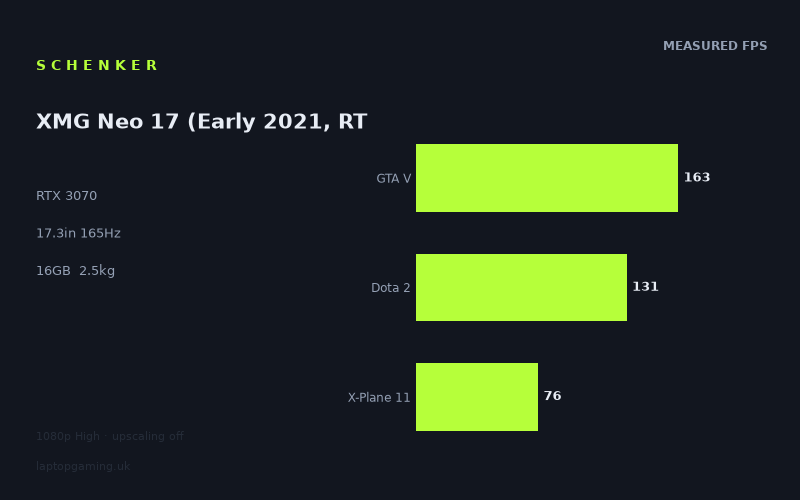
Frame rates
1920×1080, High preset, upscaling off.
Measured on this machine. Source: Notebookcheck, 2021-01-31.
Not scored: incomplete benchmark suite
Every scored laptop on this site is averaged over the same 5 games, and this one is short of Cyberpunk 2077, Baldur's Gate 3. A mean over 3 games is not comparable to a mean over 5, so we publish the figures we have and leave the score blank rather than rank it against machines tested on a different set. The numbers below are real - the suite is just incomplete.
How these numbers were produced
Frame rates here are not measured by us, and we label how each one was arrived at. A figure marked measured comes from a published run on that exact machine. A figure marked representative is derived from the GPU and its power limit (TGP) and cross-referenced against published reviews - a sound estimate of what that configuration delivers, but not a measurement of that specific laptop. Unless stated otherwise, numbers are 1920x1080, High preset, upscaling off. Where a laptop ships in several power configurations we use the wattage of the exact SKU listed, because a 140W RTX 5070 and a 115W one are not the same product.
In use
The short version
The Schenker XMG Neo 17 is a serious gaming laptop built around a strong pairing of an RTX 3070 and Ryzen 7 5800H, with a large 17.3in IPS display running at 2560x1440 and 165Hz. The measured game figures are very good at 1920x1080 on the High preset with upscaling disabled: lighter and older games can run at or beyond the display’s 165Hz refresh rate, while demanding modern games generally sit below that point but remain comfortably playable.
Notebookcheck’s benchmark data shows a machine with a wide performance range rather than one simple answer. Star Wars Squadrons reaches 278fps, FIFA 21 reaches 214fps and The Witcher 3 reaches 187fps. Those are figures that can exploit a 165Hz panel well, at least at the measured 1920x1080 settings. GTA V at 163fps and Battlefield V at 162fps are effectively on the edge of the screen’s refresh ceiling. Apex Legends at 144fps is still quick enough to make good use of a high-refresh display, even if it does not fully match 165Hz.
The more demanding part of the game list tells the more useful story for somebody buying this machine now. Borderlands 3 reaches 105fps, Immortals Fenyx Rising 101fps, Control 97fps, Metro Exodus 97fps and Need for Speed Heat 96fps. Crysis Remastered records 87fps, Call of Duty Black Ops Cold War 83fps, Cyberpunk 2077 1.0 82fps and Watch Dogs Legion 81fps. Assassin’s Creed Valhalla reaches 77fps and X-Plane 11 reaches 76fps. These are healthy High-preset results at 1920x1080, but they are not results that would make a 165Hz panel fully meaningful in every large, graphically intensive game.
That distinction matters because the Neo 17’s panel is not a conventional 1920x1080 display. It is a 2560x1440 screen. The published figures are useful as a view of the laptop’s underlying gaming ability, but they do not tell us the frame rate at the panel’s native resolution. Rendering at 2560x1440 requires more work than rendering at 1920x1080, so it would be wrong to treat the measured figures as native-resolution results. There is no supplied 2560x1440 benchmark set here, and that absence should affect buying expectations.
The basic verdict is therefore conditional. This is a strong choice for someone who wants a large, high-refresh IPS gaming laptop and is comfortable adjusting settings according to the game. It makes most sense for players of competitive games, older big-budget games and less punishing titles, where the 165Hz display can be used properly. It also suits someone who values a 17.3in screen for strategy games, simulators and general desktop space, while accepting that the most demanding releases are likely to need compromises if smooth high-refresh native-resolution play is the aim.
It is less convincing for someone who expects every modern game to run near 165fps at 2560x1440 with High settings and no upscaling. The supplied data does not support that expectation. Even at the measured 1920x1080 High settings, several demanding games are below 100fps. That does not make the XMG Neo 17 slow; it means the display specification is more ambitious than the performance figures can fully exploit across the entire game library.
Price is also important, and it cannot be judged here because no confirmed UK price has been supplied. That prevents a firm value verdict. A laptop with this screen, RTX 3070, Ryzen 7 5800H, 16GB of memory and 500GB SSD storage could be attractive at the right price, but the same specification can look much less compelling if it is priced too close to newer or faster alternatives. The frame rates are strong enough to justify interest. Whether they justify the asking price depends entirely on a price we do not have.
Performance
A fast result, but not a single-speed laptop
Notebookcheck’s numbers show that the XMG Neo 17 is capable of very high frame rates, but performance varies sharply by game. That is normal for a gaming laptop: each title places different demands on the processor, graphics card, memory and game engine. The useful point is not simply that the laptop can post a high maximum figure. It is whether the faster figures are representative of the games a buyer actually plays, and whether the slower figures remain good enough for the screen and intended use.
At the top of the table, Star Wars Squadrons reaches 278fps. That is far beyond the panel’s 165Hz refresh rate at the measured 1920x1080 High settings. FIFA 21 reaches 214fps and The Witcher 3 reaches 187fps, also above 165fps. In these games, the RTX 3070 and Ryzen 7 5800H combination is clearly capable of supplying frames quickly enough that the display, rather than the laptop, becomes the limiting factor at the quoted settings.
GTA V reaches 163fps and Battlefield V reaches 162fps. Those are only just below the panel’s 165Hz refresh rate. In practical terms, these are high-refresh results. The difference between 163fps or 162fps and 165Hz is not an argument against the screen; it shows that the laptop is operating close to the point where the display can show every frame delivered. They are also a reminder that a few frames either way should not be over-interpreted. Performance is not a fixed promise for every scene, map or game update.
Apex Legends reaches 144fps. That does not fill a 165Hz display, but it is still a strong fit for a fast panel. A game running at 144fps can benefit from the responsiveness and motion clarity associated with a high-refresh display even without reaching the full 165Hz ceiling. For players who care about fast multiplayer games, this is one of the more encouraging figures in the list.
The next group is more representative of what to expect from graphically heavier games. Dota 2 reaches 131fps and The Division 2 also reaches 131fps. Far Cry New Dawn records 112fps, while Borderlands 3 manages 105fps. These are well above conventional 60Hz gaming territory and should make a good case for the 165Hz screen, but they are not close enough to the display ceiling to make 165Hz the defining part of the experience. The benefit is smoother presentation than a 60Hz panel, rather than a perfect one-frame-per-refresh match.
Immortals Fenyx Rising reaches 101fps. Star Wars Jedi Fallen Order reaches 98fps. Control and Metro Exodus each reach 97fps, while Need for Speed Heat reaches 96fps. That is a remarkably tight cluster, and it illustrates an important point about this laptop’s realistic performance tier. In demanding games at the measured settings, the Neo 17 often lands around the region where high-refresh gaming remains clearly smoother than 60fps, but where settings decisions still matter.
For a buyer who mainly wants a machine capable of playing big-budget games smoothly, that is good news. A measured result around this area is not a marginal result. It provides enough performance headroom for a responsive experience at 1920x1080 High without requiring upscaling in the supplied benchmark configuration. However, it is not the same as saying the laptop is effortlessly overpowered for every current game. The display’s 165Hz capability is more than the laptop can use in many of these titles.
Crysis Remastered reaches 87fps. Call of Duty Black Ops Cold War records 83fps, Cyberpunk 2077 1.0 82fps and Watch Dogs Legion 81fps. Anno 1800 reaches 78fps, Assassin’s Creed Valhalla 77fps and X-Plane 11 76fps. These results remain playable, but they change the recommended approach. In this part of the list, the sensible aim is consistent smoothness rather than chasing the 165Hz maximum.
Cyberpunk 2077 1.0 at 82fps is especially useful as a reference point because it is a demanding modern game. An 82fps result at 1920x1080 High with upscaling disabled is a respectable outcome, but it does not support an assumption that the Neo 17 can run every demanding game at a very high frame rate with every quality option left untouched. Watch Dogs Legion at 81fps and Assassin’s Creed Valhalla at 77fps point in the same direction: the laptop has plenty of performance, but the most demanding games remain demanding.
What the benchmark spread means
The range from 278fps in Star Wars Squadrons to 76fps in X-Plane 11 is large. It should not be read as inconsistency in the laptop. It reflects the very different workloads involved. Some games respond strongly to available graphics performance, while others can be limited more heavily by processor performance, engine design, simulation load or the specific visual effects used by the title.
The Ryzen 7 5800H is therefore relevant even in a review centred on gaming. At 1920x1080, especially in lighter games and high-frame-rate esports-style titles, the processor can become more important because the graphics card has less rendering work per frame than it would at 2560x1440. This is one reason that smaller performance gaps between laptops can appear in lighter shared titles. A faster graphics card does not automatically create a proportionally faster result if the game is being held back elsewhere.
That matters when looking at the very high Star Wars Squadrons, FIFA 21, The Witcher 3, GTA V and Battlefield V results. These games show that the Neo 17 can deliver the sort of frame rates needed for a 165Hz display. They do not prove that every game will scale in the same way. The lower results from Cyberpunk 2077 1.0, Watch Dogs Legion, Assassin’s Creed Valhalla, Anno 1800 and X-Plane 11 are not anomalies. They are the other half of the picture.
The benchmark data also includes a mean of 123fps across GTA V, Dota 2 and X-Plane 11. That is a useful summary of those three titles, but it should not be mistaken for an all-game average. The supplied scoring suite is incomplete because there are no figures for Final Fantasy XV or Strange Brigade. Since scored laptops are normally averaged over the same five games, this partial result cannot be ranked fairly against other machines. The absence of a score is the honest outcome here, not a weakness in the analysis.
More importantly, the three available scoring-suite titles are themselves a mixed workload. GTA V reaches 163fps, Dota 2 reaches 131fps and X-Plane 11 reaches 76fps. A mean of 123fps across those three results does not mean a buyer should expect 123fps in every game. It means that a very fast result, a strong result and a more demanding simulation result average to that figure. Anybody buying for flight simulation should pay more attention to the X-Plane 11 result than to GTA V. Somebody mainly playing older action games should do the reverse.
GPU power limit: what we can and cannot say
The RTX 3070 name alone does not tell the whole story in laptop gaming. Mobile GPUs can be configured with different power limits, and those limits can materially affect performance. Unfortunately, no GPU power limit has been supplied for this XMG Neo 17. It would be wrong to invent one, and it would be wrong to describe this as a particular wattage version of the RTX 3070 without evidence.
What the published frame rates do show is the performance achieved by this specific machine in Notebookcheck’s measured configuration. That is more useful than guessing from a model name. The Neo 17 delivers 278fps in Star Wars Squadrons, 214fps in FIFA 21, 187fps in The Witcher 3, 163fps in GTA V and 162fps in Battlefield V. It also delivers 82fps in Cyberpunk 2077 1.0, 81fps in Watch Dogs Legion and 77fps in Assassin’s Creed Valhalla. Those figures are the practical result to judge, regardless of any unconfirmed power figure.
The lack of a confirmed GPU power limit does, however, limit the precision of comparison. An RTX 3070 laptop should not automatically be assumed to perform like every other RTX 3070 laptop. Cooling design, power settings, processor behaviour and display configuration can all affect results. The right conclusion is not that the Neo 17 must be slower or faster than another RTX 3070 system. The right conclusion is that its own measured results are strong, while model-name comparisons alone are insufficient.
Settings, resolution and sensible expectations
All of the supplied frame rates use 1920x1080, the High preset and upscaling disabled. That is a clean and useful test condition because it avoids confusing results with different quality settings or reconstruction technologies. It also means the data is directly comparable across the game list. But it is not the screen’s native 2560x1440 resolution.
A buyer should therefore separate two questions. The first is whether the XMG Neo 17 is fast at 1920x1080 High. The answer is clearly yes. The second is whether it can run every measured game at 2560x1440 High and still approach 165fps. The supplied figures cannot answer that, because there are no 2560x1440 measurements. It would be irresponsible to turn the 1920x1080 data into invented native-resolution predictions.
There is still a useful practical conclusion. Games that are already far above 165fps at 1920x1080, including Star Wars Squadrons, FIFA 21 and The Witcher 3, have the most obvious performance headroom. Games around the panel limit, such as GTA V and Battlefield V, are less certain at the native resolution because there is little measured headroom above 165fps. Games around 76fps to 105fps at 1920x1080 High are the clearest warning against assuming native-resolution high-refresh performance without settings adjustments.
This does not undermine the value of a 2560x1440 display. A higher-resolution panel can be useful for desktop work, strategy games, older games and any title where the player prefers image detail over maximum frame rate. It simply means the screen should be treated as flexible rather than as a guarantee that every game will run at 165fps at native resolution.
The screen
The XMG Neo 17 has a 17.3in IPS display with a 2560x1440 resolution and 165Hz refresh rate. On paper, that is an appealing specification for a gaming laptop. The panel is large enough to make the higher resolution useful, and the 165Hz refresh rate gives the machine scope to feel substantially smoother than a conventional 60Hz laptop when the game can produce enough frames.
The IPS panel type is also important. It is a sensible match for a laptop intended to cover a mixture of gaming and general use. The supplied information does not include brightness, contrast, colour coverage, response times, backlight behaviour or adaptive-sync support, so those qualities cannot be assessed here. There is no basis for claiming that the panel is especially bright, especially colour-accurate or especially fast in pixel response. The specification tells us its size, resolution, refresh rate and panel technology, no more.
The 165Hz refresh rate is genuinely useful in the games where the XMG Neo 17 has the measured performance to feed it. Star Wars Squadrons at 278fps is well beyond the refresh rate. FIFA 21 at 214fps and The Witcher 3 at 187fps also exceed it. In those cases, the display is not an indulgence that the hardware cannot use. It is directly relevant to the measured performance.
GTA V at 163fps and Battlefield V at 162fps are close enough to 165Hz that the screen remains an excellent fit. Apex Legends at 144fps does not fully saturate the refresh rate, but it remains a strong match for a fast display. Dota 2 and The Division 2 at 131fps are likewise well suited to a panel above 60Hz, even though they do not reach the maximum refresh rate.
The picture changes with the more demanding games. Borderlands 3 at 105fps, Immortals Fenyx Rising at 101fps, Control and Metro Exodus at 97fps, and Need for Speed Heat at 96fps all sit in a range where a 165Hz screen can still provide a smoother experience than 60Hz, but where the panel is not being fully exploited. Crysis Remastered at 87fps, Call of Duty Black Ops Cold War at 83fps, Cyberpunk 2077 1.0 at 82fps, Watch Dogs Legion at 81fps, Anno 1800 at 78fps, Assassin’s Creed Valhalla at 77fps and X-Plane 11 at 76fps reinforce that point.
This is why the display should be viewed as a strength with conditions. It gives the laptop room to excel in fast, less demanding and competitive games. It also gives buyers a large 2560x1440 workspace. But the 165Hz figure should not be taken as a universal frame-rate target that the RTX 3070 will meet at the native resolution in every graphically intensive release.
There is another reason to be careful: the measured results are at 1920x1080. Running a game below a screen’s native resolution can be a valid performance choice, but the supplied information does not tell us how scaling is handled, how it looks on this panel, or whether a buyer would prefer lower settings at 2560x1440 instead. Those are subjective decisions as well as technical ones. The benchmark data establishes the performance at 1920x1080 High with upscaling off; it does not establish the preferred image-quality compromise for every owner.
For competitive players, the screen is most convincing in games such as Apex Legends, FIFA 21 and Star Wars Squadrons, where the measured figures are already high. For players of single-player titles such as Control, Metro Exodus, Cyberpunk 2077 1.0 and Assassin’s Creed Valhalla, the panel is best thought of as a high-quality target with flexibility rather than an instruction to maximise every visual setting and demand 165fps.
Build, size and portability
The XMG Neo 17 weighs 2.516kg. That is the central portability figure, and it places this firmly in the large gaming-laptop category rather than the lightweight all-purpose category. A 17.3in screen already signals that the machine is intended to provide a more expansive gaming and desktop experience than a compact laptop. The weight supports the same conclusion.
At 2.516kg, this is a laptop that can be moved between rooms, taken to a workplace, carried to university or transported for travel when needed. But it is not the sort of machine to choose if low carrying weight is the priority. Buyers who travel daily with their laptop should take the weight seriously rather than treating it as a minor line in a specification table.
No dimensions have been supplied, so the exact footprint and thickness cannot be assessed. It would be wrong to claim that the XMG Neo 17 is slim, bulky, compact for a 17.3in model or unusually deep without those measurements. The screen size and weight tell us that it is a substantial machine, but not exactly how much bag space it needs.
The 62Wh battery is also a known limitation in the available information. Battery capacity is not the same thing as battery life, and no measured runtime has been provided. There is no basis for claiming a number of hours for web use, video playback, office work or gaming. Gaming laptop battery life can vary greatly depending on display settings, workload, power mode and whether the dedicated graphics card is active. The only safe conclusion is that the battery is rated at 62Wh; how long it lasts in practice is not confirmed here.
That uncertainty matters because a 17.3in, 2560x1440, 165Hz gaming laptop is likely to be used in several different ways. Some buyers will keep it mainly on a desk and want a large display without needing a separate monitor. Others will take it between home and work, or between accommodation and campus. The 2.516kg weight makes the first use case more natural than the second, although it does not prevent occasional travel.
The 500GB SSD is another point that deserves practical attention. It is enough to get started, but it is not a vast amount of storage for somebody who keeps many modern games installed at once. The supplied information does not state whether the storage can be expanded or whether there are spare internal slots, so upgrade options cannot be assumed. A buyer with a large game library should consider the listed capacity carefully and confirm expansion details before purchase.
The 16GB memory configuration is a sensible baseline for a gaming laptop of this class. The data provided does not state the memory speed, configuration or upgradeability, so there is no basis for claims about dual-channel operation, capacity headroom or future expansion. What can be said is that the measured frame rates were achieved with 16GB installed, so these results are not dependent on an unusually large memory allocation.
No noise measurements or temperature measurements have been supplied. That means the cooling system cannot be judged on acoustics or thermals. It would be misleading to describe the Neo 17 as quiet, loud, cool-running or hot-running. Buyers who are particularly sensitive to fan noise should look for a source with measured acoustic data before making a decision.
How it compares
The comparison data is deliberately narrow: it uses games held in common and prefers the scoring-suite titles where possible. That is the right approach. Comparing two laptops using different games, settings or resolutions can create a false impression of precision. The shared-game averages here are useful, but they must be read in context, especially where the result is effectively level.
Against the MSI Prestige 15
Against the MSI Prestige 15 with an RTX 3050 Ti at 105W, the XMG Neo 17 averages 60fps ahead across three shared games. That is a meaningful gap. It is the largest advantage listed for the XMG Neo 17 among these rivals, and it supports the view that the RTX 3070 configuration is capable of substantially stronger gaming performance than this RTX 3050 Ti alternative in the shared workload.
The point is not merely that the XMG Neo 17 has a higher-tier graphics card name. The shared-game result is large enough to affect how the machines suit a high-refresh screen. A 60fps average advantage can be the difference between a machine that is simply playable and one that makes stronger use of a fast display. The Neo 17’s 17.3in 2560x1440 165Hz panel is ambitious, and its measured results give it much more chance of supporting that panel well than the Prestige 15’s shared-game position suggests.
There is no confirmed UK price for the MSI Prestige 15, so a value comparison cannot be made. It would be wrong to call the XMG Neo 17 better value or worse value without knowing what either laptop costs in the UK. On performance alone, however, the XMG Neo 17 has the clear advantage.
Against the HP Victus 15 fa0020nr
Against the HP Victus 15 fa0020nr with an RTX 3050 Ti at 75W, the XMG Neo 17 averages 0fps ahead across three shared games. That is an unusual result when viewed only through graphics-card branding, but the correct response is not to dismiss the data. A near-zero difference is still a real result within the shared test set.
The reason supplied for these compressed gaps is important: at 1920x1080, lighter titles in the shared set can become CPU-bound and reduce the visible difference between genuinely different graphics configurations. If the processor or game engine is the limiting factor, extra graphics capability cannot always translate into more frames. The result does not establish that the RTX 3070 and RTX 3050 Ti perform identically in every game. It establishes that these two laptops are effectively level in the particular shared three-game comparison.
The broader XMG Neo 17 game list provides the necessary context. This laptop reaches 278fps in Star Wars Squadrons, 214fps in FIFA 21, 187fps in The Witcher 3, 163fps in GTA V and 162fps in Battlefield V. It also records demanding-game results from 76fps in X-Plane 11 to 105fps in Borderlands 3. The shared comparison tells us that the selected games do not reveal a gap; it should not be stretched into a universal conclusion about all workloads.
Again, there is no confirmed UK price for the HP Victus 15 fa0020nr. Without prices, the performance tie in the shared games cannot become a value verdict. Buyers should instead see it as a warning not to assume that GPU labels alone predict every 1920x1080 result.
Against the MSI Katana GF76
Against the MSI Katana GF76 with an RTX 3060 at 85W, the XMG Neo 17 averages 0fps behind across three shared games. This is another effectively level result. The XMG Neo 17 is not shown to have a practical advantage in that narrow shared set, but neither is it shown to be meaningfully slower.
As with the HP comparison, the explanation lies in the nature of the shared 1920x1080 games. Lighter titles can be limited by processor performance rather than graphics performance, compressing the difference between machines that may have more separation in graphics-heavy workloads. This is exactly why one benchmark average should not be treated as a complete description of gaming performance.
The Katana GF76 comparison is useful for a buyer considering similarly large gaming laptops. It says that the XMG Neo 17 does not automatically dominate an RTX 3060 laptop in every shared title merely because it has an RTX 3070. The machine’s own broader results remain good, but the comparison argues for checking game-specific figures rather than buying entirely on GPU tier.
There is no confirmed UK price for the MSI Katana GF76 either. If the Katana were substantially cheaper, an effectively level shared-game result could make it attractive. If it were similarly priced, the XMG Neo 17’s 17.3in 2560x1440 165Hz IPS display might be more compelling. But those are conditional possibilities, not a price-based conclusion.
Against the MSI Raider GE77 HX
The MSI Raider GE77 HX with an RTX 3080 Ti at 175W is the strongest rival in this set. The XMG Neo 17 averages 37fps behind it across three shared games. Unlike the near-zero comparisons, this is a clear difference. It shows what a more powerful, higher-power graphics configuration can achieve in the same general GPU generation when the shared workload exposes the available performance.
For buyers who want the highest possible frame rates from a large gaming laptop, the Raider is the better performance reference in this comparison. A 37fps shared-game gap is substantial enough to affect how often a laptop can approach or exceed a 165Hz target. That is particularly relevant given the XMG Neo 17’s own 165Hz screen. The Neo 17 can use that refresh rate very well in certain titles, but the Raider-class result indicates there is more performance available elsewhere for buyers prepared to choose a more powerful option.
That does not make the XMG Neo 17 a poor performer. Its figures remain strong: 144fps in Apex Legends, 131fps in Dota 2 and The Division 2, 112fps in Far Cry New Dawn, 105fps in Borderlands 3 and around the high-70fps to high-90fps range in several demanding games. The comparison simply places it correctly. It is not the top-end performance option among the listed machines.
There is no confirmed UK price for the MSI Raider GE77 HX, so there is no basis for saying whether its performance lead is worth paying for. The XMG Neo 17 may be the more sensible purchase if it is available at a materially lower price, but that is impossible to establish without verified UK pricing.
Who it’s for
The XMG Neo 17 is for the buyer who wants a large-screen gaming laptop with a fast IPS panel and strong measured 1920x1080 High-preset performance. It is especially suitable for players who mix competitive games with demanding single-player titles and who understand that different games will call for different settings priorities.
It is a good fit for someone who plays Star Wars Squadrons, FIFA 21, The Witcher 3, GTA V, Battlefield V or Apex Legends and values high frame rates. The measured figures in those games range from 144fps to 278fps, with several results at or above the 165Hz display refresh rate. For that sort of library, the screen and hardware are well matched.
It also suits a player who wants demanding games to run smoothly without necessarily requiring the maximum refresh rate. Borderlands 3 at 105fps, Immortals Fenyx Rising at 101fps, Control at 97fps, Metro Exodus at 97fps, Cyberpunk 2077 1.0 at 82fps and Assassin’s Creed Valhalla at 77fps show that the laptop has meaningful performance in heavier titles. The right expectation is smooth high-settings gaming at the measured resolution, not a guarantee of 165fps in every demanding game.
The 17.3in 2560x1440 panel also makes sense for someone who wants a laptop that can spend much of its life on a desk without an external monitor. The large screen should be attractive for strategy games, simulation titles, general multitasking and media use, although no claims can be made about colour accuracy, brightness or response time beyond the supplied IPS, resolution and refresh information.
The XMG Neo 17 is less suitable for a buyer whose highest priority is low weight. At 2.516kg, it is portable in the literal sense but not especially travel-friendly by gaming-laptop standards. Someone carrying a laptop every day should consider whether a 17.3in machine of this weight matches their routine.
It is also not the obvious choice for someone who wants confirmed long battery life. The battery is rated at 62Wh, but no runtime measurements have been supplied. Buyers who regularly work away from mains power should seek battery testing before committing.
Storage-conscious buyers should also pause at the 500GB SSD. It is adequate for a focused game library, but buyers who install many large games may find it restrictive. Since no upgrade information has been supplied, expansion should be confirmed before purchase rather than assumed.
Finally, this is not the laptop to buy on the belief that an RTX 3070 badge alone guarantees a particular level of performance. The available data is much more useful than that badge. It shows excellent results in lighter and competitive games, strong results in many demanding games, and a clear limit in the most intensive titles where the frame rates sit well below the 165Hz display maximum. It also shows that some shared-game comparisons with RTX 3050 Ti and RTX 3060 laptops can be effectively level at 1920x1080, while a higher-power RTX 3080 Ti laptop can pull clearly ahead.
With no confirmed UK price, the final buying decision has to remain open. The Schenker XMG Neo 17 has the performance and display specification to be a compelling large gaming laptop, particularly for buyers who value its 17.3in 2560x1440 165Hz IPS screen and who play a mix of high-frame-rate and demanding games. But it should be bought for its measured strengths, not for an assumption that every game will run at the panel’s full refresh rate or that it is automatically better value than every rival carrying a lower-tier GPU name.