Review
Eurocom RX315 review
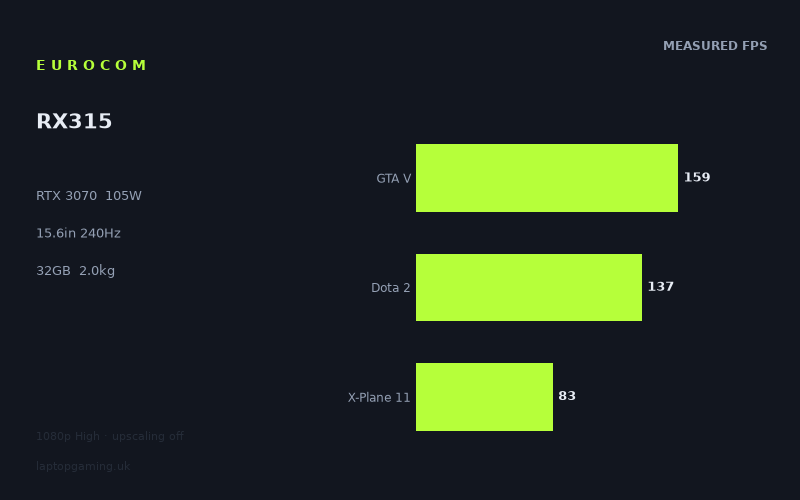
Frame rates
1920×1080, High preset, upscaling off.
Measured on this machine. Source: Notebookcheck, 2022-03-09.
Not scored: incomplete benchmark suite
Every scored laptop on this site is averaged over the same 5 games, and this one is short of Cyberpunk 2077, Baldur's Gate 3. A mean over 5 games is not comparable to a mean over 5, so we publish the figures we have and leave the score blank rather than rank it against machines tested on a different set. The numbers below are real - the suite is just incomplete.
How these numbers were produced
Frame rates here are not measured by us, and we label how each one was arrived at. A figure marked measured comes from a published run on that exact machine. A figure marked representative is derived from the GPU and its power limit (TGP) and cross-referenced against published reviews - a sound estimate of what that configuration delivers, but not a measurement of that specific laptop. Unless stated otherwise, numbers are 1920x1080, High preset, upscaling off. Where a laptop ships in several power configurations we use the wattage of the exact SKU listed, because a 140W RTX 5070 and a 115W one are not the same product.
In use
The short version
The Eurocom RX315 is a performance-first 15.6in gaming laptop built around an RTX 3070 running at a 105W GPU power limit, a Core i7-11800H and 32GB of memory. The published benchmark data is strong for a 1920x1080 machine: Notebookcheck’s measured figures range from 83fps in X-Plane 11 to 193fps in Strange Brigade, while the mean across the five-game scoring suite is 132fps.
That makes the RX315 a convincing fit for somebody who wants high-refresh 1080p gaming without needing every game to run at the panel’s full 240Hz refresh rate. It is fast enough to make good use of a 240Hz screen in the least demanding titles, although none of the measured games reaches 240fps. More importantly, the machine is comfortably beyond the point where 1080p High settings become a compromise in the majority of the supplied results. GTA V reaches 159fps, Dota 2 manages 137fps, Far Cry 5 records 114fps and Final Fantasy XV reaches 90fps. Those are very different games with very different demands, but they all point to the same conclusion: the RTX 3070 has enough performance here to make 1080p gaming feel appropriately high-end rather than merely adequate.
The important qualification is that the RX315 is not a universal 240fps laptop. Strange Brigade at 193fps and The Witcher 3 at 178fps are fast results, but they remain below the screen’s maximum refresh rate. The heavier end of the measured set is much further away. Final Fantasy XV at 90fps and X-Plane 11 at 83fps show why a 240Hz badge should not be mistaken for a promise that every game will operate at 240fps at High settings with upscaling disabled. The panel gives the machine headroom; the benchmark data does not suggest that the GPU can fill that headroom in every title.
There is also no confirmed UK price for this exact Eurocom RX315 configuration. That means a price-dependent value assessment cannot be calculated, because value accounts for 30% of the site’s calculation. It is not a warning about the laptop’s benchmark position or the completeness of its test data: the benchmark suite is complete and the RX315 ranks normally on the frame-rate leaderboard. It simply means that performance can be judged, while value cannot be responsibly judged without a confirmed price.
If the RX315 is available at a sensible level relative to comparable RTX 3070 machines, its performance case is clear. It is especially appealing for players who care about fast, responsive 1080p gaming, use competitive games alongside more demanding single-player titles, and want 32GB of memory without having to treat it as an upgrade project. It is less compelling for someone buying specifically for the heaviest games at the panel’s maximum refresh rate, for someone who wants a known UK price before making a shortlist, or for someone whose priority is the highest possible performance regardless of weight and portability.
Performance
What the benchmark data says
Notebookcheck measured the Eurocom RX315 at 1920x1080 using the High preset, with upscaling disabled. That is the most useful context for every figure here. These are not low-setting competitive results, and they are not assisted by upscaling. They show the RTX 3070 and Core i7-11800H operating in the laptop’s native display resolution under a reasonably demanding graphics preset.
The strongest result is Strange Brigade at 193fps. That is the closest the RX315 gets to the 240Hz screen limit in the supplied games, and it is a genuinely high frame rate. A game running at that level can benefit from a 240Hz panel even though it does not quite reach the panel’s maximum refresh. The gap between 193fps and 240fps still matters if the aim is literal full-refresh operation, but it should not obscure the larger point: this is performance well beyond conventional 60Hz or 120Hz targets.
The Witcher 3 follows at 178fps. Again, that is not a 240fps result, but it is very fast for a High-preset 1080p result with upscaling off. It reinforces the impression that the RX315 has considerable headroom in games which are not at the most demanding end of the supplied set. For a buyer moving from a machine that is built around a 60Hz or 120Hz screen, results in this range are the kind that make a high-refresh panel feel meaningful rather than decorative.
GTA V records 159fps. This is one of the five scoring-suite results contributing to the 132fps mean. It is well above 120fps and comfortably beyond the performance level at which a 240Hz panel becomes irrelevant. It is not enough to claim that the machine will always hold 240fps in similar games, because the supplied data does not say that. It does show that the RX315 can deliver a high-refresh experience in a well-established open-world game at 1080p High settings.
Dota 2 reaches 137fps, another scoring-suite result. That is a useful result for the audience most likely to care about a 240Hz 1080p screen. Competitive games benefit from high and consistent frame rates, but the measured figure is still materially below 240fps. The RX315 therefore has the performance to make Dota 2 feel fast on this panel, yet the data does not support treating the display’s headline refresh rate as a frame-rate guarantee. A 137fps result is good evidence of strong gaming capability; it is not evidence of 240fps operation.
Far Cry 5 measures 114fps. This is where the RX315’s balance becomes clearer. A result above 100fps is still strong at 1080p High, and it should suit a player who values smoothness over a fixed full-refresh target. However, 114fps is not close to 240fps, and it is below the 132fps mean from the scoring suite. Far Cry 5 demonstrates why it is better to look at the full benchmark spread than to focus only on the leading Strange Brigade figure. The RX315 is powerful, but its results remain game-dependent.
Final Fantasy XV records 90fps. That is the point in the supplied data where the machine moves from clearly high-refresh territory into a more conventional, though still strong, performance range. Ninety frames per second at 1920x1080 High with upscaling off is not a poor outcome. It is, however, far from the panel’s 240Hz ceiling. A buyer whose library contains games with similar demands should think of the RX315 as a laptop that can run them well at 1080p High, not as one that will make the 240Hz specification the defining part of the experience.
X-Plane 11 is the slowest listed result at 83fps. That does not undermine the RX315’s overall gaming position, but it is a useful reminder that GPU specifications alone do not tell the whole story. Different games stress the system in different ways, and the RX315’s 83fps result is 110fps behind its 193fps Strange Brigade result. That is a wide spread. Anyone assessing this laptop should plan around the games they actually play, rather than assuming that the 132fps scoring-suite mean will describe every title equally well.
The five scoring-suite games produce a mean of 132fps. That is a useful summary figure, but it must be read alongside the individual results. A 132fps mean is not the same thing as every scoring-suite title sitting around 132fps, and it certainly is not an indication that the machine can fill a 240Hz panel across the board. The published figures show both very high results and materially lower ones. The mean tells you that the overall 1080p High performance level is strong; the individual games tell you where that strength will be most visible.
The 105W RTX 3070 in practice
The RTX 3070 in the RX315 has a 105W GPU power limit. That figure matters because laptop GPU names do not, by themselves, establish a complete performance expectation. The same RTX 3070 name can appear in machines with different power limits, and the RX315 should therefore be judged as a 105W RTX 3070 implementation rather than against a generic idea of what an RTX 3070 ought to do.
In this case, the measured figures show a machine that is well suited to 1920x1080 High settings. The result is not merely one or two favourable game outcomes. Strange Brigade at 193fps, The Witcher 3 at 178fps, GTA V at 159fps and Dota 2 at 137fps establish a clear upper and middle range for the laptop. Far Cry 5 at 114fps, Final Fantasy XV at 90fps and X-Plane 11 at 83fps then establish the more demanding end of the range. Taken together, they show that the 105W GPU is capable of high frame rates at the laptop’s native resolution, but not of eliminating the normal gap between lighter and heavier game engines.
The benchmark spread is particularly important because the RX315 combines a 105W GPU limit with a 240Hz screen. It would be easy to see those two specifications and assume that they are perfectly matched in every game. The measured figures show a more nuanced reality. The display has more refresh capacity than the machine can use in the listed games at High settings with upscaling off. That is not unusual or inherently negative. A 240Hz panel remains useful below 240fps, particularly when frame rates are in the 137fps, 159fps, 178fps or 193fps range. But the panel’s maximum is an upper limit, not a level that the RX315 reaches in the supplied benchmark results.
The machine’s performance should therefore be understood in layers. At the top end, it is producing results that suit high-refresh 1080p gaming extremely well. In the middle, it is delivering well over 100fps in GTA V, Dota 2 and Far Cry 5. At the more demanding end, it remains around 90fps in Final Fantasy XV and above 80fps in X-Plane 11. That is a capable range for a gaming laptop with a 15.6in 1080p display. The limitation is not that the RX315 lacks gaming performance; it is that a 240Hz screen sets an exceptionally high target, and the benchmark data shows that even a strong RTX 3070 laptop will not automatically meet it.
There is no supplied thermal or noise data, so it would be irresponsible to infer how the RX315 reaches these figures, how loud it is under load, or what temperatures it records. The 105W power limit tells us how the GPU is configured; Notebookcheck’s frame rates tell us the performance outcome in the listed games. They do not provide enough evidence to make claims about fan behaviour, chassis heat or sustained acoustic comfort.
Where the frame-rate spread comes from
The RX315’s results span from 83fps to 193fps. That difference is not a contradiction in the data. It reflects the fact that games do not ask the same things of the CPU and GPU. Some titles allow this hardware combination to reach very high frame rates at 1080p High, while others remain much heavier even at the same resolution and broadly comparable settings.
Strange Brigade and The Witcher 3 sit at the fast end of the published results. GTA V and Dota 2 follow closely enough to make the laptop feel convincingly high-refresh in games that resemble them in demand. Far Cry 5 is lower but remains above 100fps. Final Fantasy XV and X-Plane 11 show the other side of the machine: titles where the available performance is still good, but where the 240Hz screen has substantially more capacity than the game is using.
This is why the 132fps mean should be treated as a useful centre point rather than a buying promise. A player whose time is mainly spent in the faster-running part of the benchmark spread may see the RX315 as a high-refresh machine first and foremost. A player whose priority is simulation or visually heavier games should see it as a strong 1080p High laptop that may operate well below the panel maximum. Both readings are supported by the same data.
The Core i7-11800H and 32GB of memory are also relevant to the laptop’s overall configuration, though the supplied figures do not isolate their contribution in each game. What can be said is that the RX315 pairs its RTX 3070 with a gaming-class Core i7 processor and 32GB of memory rather than presenting the GPU as the only significant component. That is a sensible balance on paper for a machine intended to target high frame rates at 1920x1080. What cannot be said from the supplied information is whether a particular game is limited by the CPU, GPU, memory or any other component on this exact system.
The screen
The Eurocom RX315 has a 15.6in IPS display with a 1920x1080 resolution and a 240Hz refresh rate. On specification alone, this is a screen designed for fast gaming rather than for chasing a higher pixel count. The choice of 1920x1080 is important because it aligns directly with the benchmark resolution. Notebookcheck’s figures were measured at 1920x1080, so there is no need to guess how the machine might translate its performance from a lower test resolution to a higher native panel resolution. The published numbers are directly relevant to the display fitted here.
The 240Hz refresh rate is the headline feature. It gives the RX315 a high ceiling for games capable of delivering very high frame rates. Yet the performance data makes it clear that the display should be seen as providing headroom rather than as something the laptop fully exploits in every game. None of the measured results reaches 240fps. Strange Brigade comes closest at 193fps, followed by The Witcher 3 at 178fps, GTA V at 159fps and Dota 2 at 137fps.
That still leaves plenty of reason for a 240Hz panel to be useful. A game does not need to reach exactly 240fps before a 240Hz display has any point. The RX315’s faster results are high enough that a screen with a much lower refresh rate would impose a tighter ceiling. But a buyer should be realistic about the relationship between panel and GPU. The machine’s screen is more ambitious than the measured performance in the listed games. That is preferable to the opposite arrangement, where a laptop produces frame rates beyond what its panel can display, but it means the display specification should not be treated as a literal expected frame rate.
For the games near the top of the list, the match is strong. Strange Brigade at 193fps and The Witcher 3 at 178fps give the 240Hz panel substantial work to do. GTA V at 159fps and Dota 2 at 137fps remain well within the territory where a high-refresh display is relevant. Even Far Cry 5 at 114fps is above the level associated with a basic 60Hz experience. The lower Final Fantasy XV and X-Plane 11 outcomes are where the relationship changes: 90fps and 83fps should still look smooth on a 240Hz screen, but the panel’s maximum refresh is no longer the key performance story.
The 1920x1080 resolution is also the practical choice for this RTX 3070 configuration. The published data shows that 1080p High with upscaling disabled produces a wide but generally strong range of frame rates. There is no supplied 2560x1440 or 3840x2160 data, so there is no basis for claims about how the RX315 would perform at those resolutions. Buyers looking specifically for a higher-resolution gaming display should not assume that this machine’s 1080p figures transfer directly upward. The relevant evidence here is specifically for the native 1920x1080 panel.
The IPS panel type is another positive specification, but the fact sheet does not include brightness, contrast, colour coverage, response-time measurements or any assessment of backlight behaviour. It would therefore be wrong to call the display colour-accurate, bright, fast in pixel response or suitable for a specific professional workflow. What is established is the panel technology, size, resolution and refresh rate. For gaming, the most meaningful supplied fact is the combination of 1920x1080 and 240Hz, supported by frame-rate data that ranges from 83fps to 193fps.
The screen makes most sense for a buyer who values responsiveness and frame rate more than resolution. It is a sensible partner for the RX315’s measured performance because it avoids asking the GPU to drive more pixels than the supplied benchmark configuration. The caveat is simple: buy it for high-refresh potential, not because you expect a universal 240fps result. The data does not support that expectation.
Build, size and portability
The RX315 weighs 2.003kg. That is the most useful portability figure supplied for this machine, and it places the laptop’s physical role in context. This is not a machine that can be discussed as weightless or effortless to carry, but neither is it defined by the kind of weight associated with the most extreme desktop-replacement designs. It is a 15.6in gaming laptop with a 2.003kg quoted weight, which suggests a machine that can be moved between locations while still being bought primarily for performance at a desk.
The key word is moved, not carried without thought. A 2.003kg laptop is a meaningful item in a bag, especially once any other equipment is added, but the supplied information does not include charger weight, chassis dimensions or thickness. Those omissions matter. Without them, there is no responsible basis for claiming that the RX315 is slim, bulky, compact, oversized, backpack-friendly or awkward to transport. The weight is known; the full physical package is not.
Its 15.6in screen establishes the general class of the machine. It is smaller than the very largest gaming-laptop formats, while still being large enough to accommodate a 1920x1080 240Hz panel and a 105W RTX 3070 configuration. The RX315 is therefore easier to frame as a portable gaming system than as a fixed replacement for a desktop, but that does not mean it is necessarily a travel-first laptop. The 2.003kg weight suggests a compromise: enough performance hardware to achieve strong 1080p results, contained in a machine that is not specified as ultralight.
The 71Wh battery is another specification that needs careful interpretation. Battery capacity is given, but battery-life measurements are not. It would be wrong to convert 71Wh into an expected number of hours for web use, video playback, office work or gaming. Those outcomes depend on workload and settings, and no measured battery-life data is provided. The correct conclusion is simply that the RX315 includes a 71Wh battery. Buyers who need a firm unplugged-use expectation should seek measured battery results before treating this as a commuter or travel machine.
Gaming away from mains power is an especially poor area for assumptions. The published gaming figures were measured at 1920x1080 High with upscaling off, but the fact sheet does not say anything about performance on battery power. There is no evidence here to say whether the RX315 maintains its listed gaming performance away from the mains, and no battery-life figure to say how long any workload would last. The responsible buying position is to regard its 71Wh battery as a capacity specification, not as a tested endurance result.
There is also no supplied information about materials, keyboard quality, trackpad quality, port selection, upgrade access, webcam, speakers or chassis rigidity. Those are significant purchasing factors for a laptop at any price, but they cannot be filled in with assumptions. The evidence available is enough to describe the RX315 as a 15.6in, 2.003kg gaming laptop with a 71Wh battery, 32GB of memory, a Core i7-11800H and an RTX 3070 at 105W. It is not enough to make a detailed physical-quality judgement.
For a buyer choosing between portability and gaming performance, the RX315’s known specifications point towards a middle ground. It is not presented by the facts as a tiny machine, because it has a 15.6in display and weighs 2.003kg. It is not presented as a huge machine either, because no dimensions are supplied and the weight does not establish that. The sensible interpretation is that it should be judged as a performance-oriented laptop that remains movable, rather than as a laptop selected mainly for minimal carrying weight.
How it compares
The most useful rival comparisons are the shared-game averages supplied for machines from the same GPU generation. These comparisons matter because they avoid the misleading practice of comparing unrelated benchmark results from different game sets. The figures below are based only on games both machines hold, with preference for the scoring suite. They show not just whether the RX315 is faster or slower, but how much that difference amounts to in the available shared data.
Against the MSI Prestige 15
The RX315 averages 64fps ahead of the MSI Prestige 15 across four shared games. The Prestige 15 uses an RTX 3050 Ti at 105W, while the Eurocom uses an RTX 3070 at 105W. This is the widest positive comparison in the supplied rival set, and it makes the RX315’s position clear: it is not merely a small step above a lower-tier GPU machine.
A 64fps average advantage across the shared games is large enough to change how a buyer should think about the two laptops. The Eurocom’s own results already show performance between 83fps and 193fps across the listed games. Against the Prestige 15, the available comparison says that the RX315’s gaming advantage is substantial rather than marginal. If gaming performance is the central purchase priority, this is the rival where the Eurocom makes the clearest case for choosing more GPU capability.
That does not tell us everything about the Prestige 15, because no confirmed UK price is given and no physical or battery comparison is supplied. It does, however, answer the core gaming question. The Eurocom RX315 is decisively quicker in the available shared-game comparison. A buyer considering the Prestige 15 for reasons outside gaming would need other evidence. A buyer choosing primarily on measured 1080p gaming frame rates should favour the RX315.
Against the Razer Blade 14 Ryzen 9
The most surprising close comparison is the Razer Blade 14 Ryzen 9, which has an RTX 3070 Ti at 100W. Across five shared games, the RX315 averages only 1fps behind it. On the available benchmark evidence, these machines are effectively level in gaming performance.
That near-zero difference is meaningful, but it should not be misunderstood. It does not prove that every aspect of the two systems is identical, and it does not prove that their GPUs are equivalent in every workload. It means that in the five shared games used for this comparison, the measured average difference is only 1fps. At 1920x1080, lighter titles in a shared game set can become CPU-bound and compress genuine GPU differences. In other words, when frame rates are already high, the CPU and game engine can limit the extent to which a GPU difference appears in the final average.
The practical buying conclusion is that the RX315 does not need to apologise for its position beside the Blade 14 in the available gaming data. The Razer’s RTX 3070 Ti name might suggest a clear advantage at a glance, but the shared-game average does not show one. The RX315’s 105W RTX 3070 is only 1fps behind across the five common games. A buyer should therefore look beyond GPU branding and examine the actual configuration, display, weight, price when available, and other features for which evidence exists.
There is no confirmed UK price for the Blade 14 Ryzen 9 in the supplied information, so this cannot become a value comparison. Nor is there enough information to make a portability comparison despite the difference in screen class implied by the names. The frame-rate conclusion is narrower and more useful: on this shared set at 1080p, the RX315 is essentially tied.
Against the Lenovo Legion 5 Pro 16ACH6H
The Lenovo Legion 5 Pro 16ACH6H, identified as 82JQ001PGE, also sits just 1fps ahead of the RX315 across five shared games. It uses an RTX 3070, the same GPU class as the Eurocom. This is another near-tie, and it reinforces the point that the RX315’s 105W configuration is competitive where the shared benchmark data is concerned.
As with the Razer comparison, the 1fps gap should be explained rather than exaggerated. At 1080p, lighter titles in the shared set can become CPU-bound and compress genuine GPU gaps. That makes a very small average difference a real result, but not a licence to claim that every internal configuration detail is irrelevant. The measured shared-game outcome is effectively level. For a buyer focused on these games and settings, there is no meaningful performance reason to choose one over the other on the basis of a 1fps average alone.
The Eurocom’s 132fps scoring-suite mean gives further context. It is operating at a high overall level at 1920x1080 High settings, and its near-parity with another RTX 3070 laptop is exactly what the comparison data suggests. What the data does not establish is whether the Lenovo has a different display quality, a different physical design, different battery behaviour, different cooling characteristics or a different price. Those factors may matter in a real purchase, but they are outside the supplied facts.
If the choice is strictly between these two machines on shared-game performance, treat them as a draw. If the choice includes price, portability, display preference or build details, more verified information is required. The RX315’s case is not that it overwhelms the Legion 5 Pro; it is that it stays level with it where the measured games overlap.
Against the MSI Raider GE77 HX
The MSI Raider GE77 HX is the machine that beats the RX315 by the largest margin in the supplied rival set. It uses an RTX 3080 Ti at 175W and averages 37fps ahead across five shared games. This is a substantial difference, and unlike the comparisons against the Razer and Lenovo, it is not something that can be dismissed as a rounding-level result.
The hardware context supports the measured outcome. The Raider’s RTX 3080 Ti has a 175W GPU power limit, compared with 105W for the RX315’s RTX 3070. The frame-rate comparison then shows the practical effect in the shared games: the Raider is ahead by 37fps on average. A buyer whose priority is extracting the highest gaming performance from this generation of laptops should not expect the Eurocom RX315 to match that machine.
That does not make the RX315 weak. Its own figures remain strong, particularly in Strange Brigade, The Witcher 3, GTA V and Dota 2. It means that there is a visible performance tier above it in the supplied comparison group. The Raider is the appropriate reference point for someone who sees 83fps in X-Plane 11 or 90fps in Final Fantasy XV and wants more headroom in demanding titles. The Eurocom is the more modestly powered option in this specific comparison, and the benchmark difference reflects that.
There is no confirmed UK price for the MSI Raider GE77 HX either, so it is not possible to say whether the extra performance is worth its cost. The data also does not provide a weight comparison, battery comparison or screen comparison. The only firm conclusion is performance: across the five common games, the Raider is materially faster.
What the rival spread tells us
The RX315 occupies a sensible middle position in the supplied generation-matched comparisons. It is far ahead of the RTX 3050 Ti-equipped MSI Prestige 15, essentially tied with the RTX 3070 Ti-equipped Razer Blade 14 Ryzen 9, essentially tied with the RTX 3070-equipped Lenovo Legion 5 Pro, and clearly behind the RTX 3080 Ti-equipped MSI Raider GE77 HX.
That spread is more informative than a single nearest-rival comparison. It shows that the RX315 is not an entry-level implementation whose RTX 3070 label fails to translate into real gaming results. Its 64fps advantage over the Prestige 15 confirms the separation from a lower GPU tier. Its 1fps deficits to the Razer and Lenovo show that it remains highly competitive with close alternatives in the shared set. Its 37fps deficit to the Raider shows where more GPU power and a higher power limit can create a meaningful advantage.
The 105W GPU power limit is central to understanding that position. It is enough to support a 132fps scoring-suite mean at 1920x1080 High with upscaling off, and enough to keep the RX315 level with the closest listed rivals. It is not enough to erase the advantage of a 175W RTX 3080 Ti system. That is a straightforward and credible performance story, supported by the published figures rather than by GPU naming alone.
Who it’s for
The Eurocom RX315 is for the player who wants a serious 1080p gaming laptop with a fast panel and evidence of strong real-world frame rates. The best fit is somebody whose library includes a mix of competitive, older, mainstream and demanding games, and who is comfortable with the fact that the frame rate will vary significantly by title. The supplied results give that buyer a useful range: 193fps in Strange Brigade, 178fps in The Witcher 3, 159fps in GTA V, 137fps in Dota 2, 114fps in Far Cry 5, 90fps in Final Fantasy XV and 83fps in X-Plane 11.
It is particularly well suited to someone who sees 1080p as the target resolution rather than as a compromise. The laptop’s screen is 1920x1080, and the benchmark data is measured at exactly that resolution. There is no uncertainty about whether the quoted frame rates refer to a lower-resolution test mode. The RX315’s strongest argument is direct and practical: at its native resolution, with High settings and no upscaling, it delivers a strong overall result.
It also suits someone who wants a 240Hz panel for games capable of taking advantage of high frame rates, while understanding that “240Hz” is not the same as “240fps”. Strange Brigade at 193fps, The Witcher 3 at 178fps, GTA V at 159fps and Dota 2 at 137fps all make a high-refresh display worthwhile. None reaches 240fps. A sensible buyer will value the headroom without expecting the display maximum to be met in every game.
The 32GB memory configuration is attractive for someone who does not want to begin ownership by worrying about whether the system has enough memory for their intended use. The supplied information does not provide memory-speed details, upgrade information or application benchmarks, so there is no basis for stronger claims. But 32GB is the stated configuration, and it is part of a machine that is clearly aimed above basic gaming-laptop specifications.
The RX315 is also a good performance choice for someone comparing it with nearby GPU-generation rivals and finding the Razer Blade 14 Ryzen 9 or Lenovo Legion 5 Pro on a shortlist. The shared-game comparisons show only a 1fps average deficit to each across five games. That does not settle a purchase without prices or broader specification details, but it means the Eurocom should be treated as a genuine performance peer in those comparisons, not as a slower fallback option.
Buy something else if your first priority is maximum frame rate in the most demanding games. The MSI Raider GE77 HX is 37fps ahead across five shared games, and its RTX 3080 Ti runs at 175W rather than 105W. The RX315 is strong, but it is not the fastest machine in this group. A buyer who wants the largest possible margin above 90fps or 83fps in the heavier listed games should look towards the higher-performing alternative rather than assuming that an RTX 3070 at 105W will provide the same headroom.
Buy something else if you require a confirmed UK price before deciding whether a laptop represents sensible value. There is no confirmed UK price for this exact RX315 configuration. That is not a flaw in its performance record, but it is a genuine purchasing limitation. Without the price, it is not possible to say whether the RX315 is competitively positioned against the Razer, Lenovo, MSI Prestige 15 or MSI Raider GE77 HX. A buyer with a fixed budget should not fill that gap with guesswork.
Buy something else if you need verified battery life, verified low weight, precise dimensions, or detailed evidence about build quality. The RX315’s weight is 2.003kg and its battery capacity is 71Wh, but no battery-life results, dimensions, thickness, charger weight, acoustics, temperatures or build assessments are supplied. Those omissions do not prove a problem. They simply mean that the evidence is insufficient for buyers whose decision depends heavily on travel use, quiet operation, or physical design.
It is also not the obvious choice for someone buying a laptop chiefly for high-resolution gaming. The display is 1920x1080, and all of the relevant frame-rate evidence is at 1920x1080. That is exactly what this machine is built to do. Buyers who want a higher-resolution panel should look for a machine with that screen and with benchmark data at its native resolution, rather than trying to extrapolate from the RX315’s 1080p results.
Ultimately, the Eurocom RX315 is easy to understand when judged on what is actually known. It is a 2.003kg, 15.6in gaming laptop with a 240Hz IPS 1920x1080 display, a Core i7-11800H, 32GB of memory and an RTX 3070 configured at 105W. Notebookcheck’s measured results show very strong 1080p High performance, with a 132fps mean across the five-game scoring suite and individual results ranging from 83fps to 193fps. It substantially outpaces the listed RTX 3050 Ti rival, runs essentially level with the closest RTX 3070 and RTX 3070 Ti alternatives in the shared data, and gives up meaningful ground to the much more powerful RTX 3080 Ti machine.
That is a strong performance foundation. The unanswered questions are price, battery endurance, physical dimensions, noise, temperatures and broader build details. If those unknowns are acceptable and the buyer’s target is fast 1080p gaming rather than universal 240fps or maximum performance at any cost, the RX315’s published frame-rate data gives it a credible and well-supported case.