Review
Lenovo Legion 7 16ACHg6 review
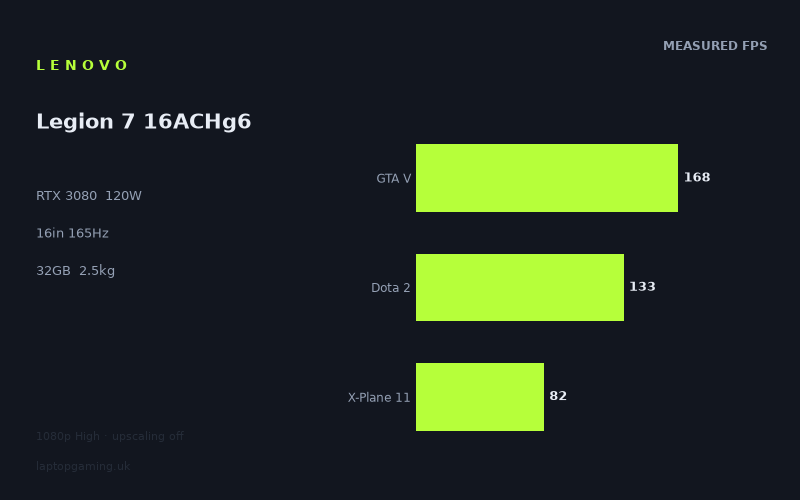
Frame rates
1920×1080, High preset, upscaling off.
Measured on this machine. Source: Notebookcheck, 2021-06-13.
Not scored: incomplete benchmark suite
Every scored laptop on this site is averaged over the same 5 games, and this one is short of Cyberpunk 2077, Baldur's Gate 3. A mean over 5 games is not comparable to a mean over 5, so we publish the figures we have and leave the score blank rather than rank it against machines tested on a different set. The numbers below are real - the suite is just incomplete.
How these numbers were produced
Frame rates here are not measured by us, and we label how each one was arrived at. A figure marked measured comes from a published run on that exact machine. A figure marked representative is derived from the GPU and its power limit (TGP) and cross-referenced against published reviews - a sound estimate of what that configuration delivers, but not a measurement of that specific laptop. Unless stated otherwise, numbers are 1920x1080, High preset, upscaling off. Where a laptop ships in several power configurations we use the wattage of the exact SKU listed, because a 140W RTX 5070 and a 115W one are not the same product.
In use
The short version
The Lenovo Legion 7 16ACHg6 is a strong older-generation gaming laptop configuration built around an RTX 3080 running at a 120W GPU power limit, a Ryzen 9 5900HX, 32GB of memory and a 16in 2560x1600 165Hz IPS display. The central question is not whether it can play modern games at 1080p: Notebookcheck’s measured figures make that clear. It can. The more useful question is how well its measured performance fits the high-resolution, high-refresh panel Lenovo paired with it.
At 1920x1080 using the High preset with upscaling disabled, the benchmark data is consistently strong. The machine reaches 222fps in Strange Brigade, 206fps in The Witcher 3 and 168fps in GTA V. Those are results that can make real use of a 165Hz panel, particularly in titles where high frame rates matter more than outright visual complexity. It is also quick in a broader group of demanding games, returning 148fps in Hitman 3, 140fps in Days Gone, 138fps in Yakuza Like a Dragon, 133fps in Dota 2, 122fps in Outriders, 121fps in Far Cry 5, 117fps in Dirt 5 and 106fps in Final Fantasy XV.
The limitation is simply that the laptop’s display is not a 1080p display. It is a 2560x1600 panel. The published numbers are useful because they show the available performance at the specified benchmark settings, but they do not prove that every game will reach the same result at the screen’s native resolution. A laptop capable of 165fps at 1920x1080 in a lighter title may be capable of less at 2560x1600, while a game already below 165fps at 1080p is plainly not demonstrated to reach the panel’s maximum refresh rate at native resolution. That distinction matters more here than it would on a conventional 1080p gaming laptop.
This is therefore a machine for someone who values a fast 16in 16:10 screen and wants substantial performance headroom at 1080p, but who is realistic about the relationship between a 165Hz display and the games being played. It is particularly well suited to lighter or older games, competitive titles, games where settings can be adjusted without much concern, and players who would rather have a strong frame-rate base than chase maximum image-quality settings in every demanding release. It is less convincing for somebody whose main goal is to run every demanding game at native 2560x1600 while keeping frame rates close to 165fps.
The 120W RTX 3080 is the key part of the configuration. It is not a low-power implementation, but it is also not the highest-power version of this class of GPU represented by the comparison data. The rival results show why power limits deserve attention: this Legion is effectively level with some machines carrying nominally higher-tier GPUs at lower power limits, while it loses ground to the MSI Raider GE77 HX, whose RTX 3080 Ti has a 175W GPU power limit. The GPU name alone does not tell the whole story.
There is no confirmed UK price for this exact configuration, so a value assessment cannot be calculated. That is solely because value depends on price; the benchmark suite is complete and the Legion ranks normally on the frame-rate leaderboard. It would be irresponsible to guess what this version costs in the UK or to call it good or poor value without a confirmed price.
Performance
What the measured data says
Notebookcheck measured the Legion 7 16ACHg6 at 1920x1080, using the High preset with upscaling disabled. That is an important and comparatively clean benchmark condition. There is no upscaling result obscuring the underlying performance, and the High preset is demanding enough to show where the RTX 3080 configuration is strong without turning the exercise into an examination of one unusually punishing maximum-quality setting. The figures are from 2021-06-13, and they should be read as published benchmark data for this specific machine configuration rather than as a promise of performance in every patch level, every game version or every user-selected mode.
Across the five scoring-suite games, the mean is 142fps. That is a high average, but an average is only useful if the individual results are examined. The Legion’s results are not clustered tightly around 142fps. Instead, they range from 222fps in Strange Brigade to 82fps in X-Plane 11. That broad spread does not indicate a problem with the laptop. It shows that different games place very different demands on the same hardware. A gaming laptop is never simply “a 142fps machine”; it is a machine that behaves differently depending on the game engine, the balance of CPU and GPU load, the scene being rendered and the settings chosen.
The fastest published result is Strange Brigade at 222fps. At the stated 1080p High settings, that is comfortably beyond the 165Hz refresh rate of the display. In practical terms, this is one of the titles where the panel’s fast refresh capability has room to matter. The benchmark figure does not mean that every moment of play must remain at that level, because the supplied result is an average measurement rather than a complete frame-time record, but it establishes that the Legion has considerable performance headroom in this game under the stated conditions.
The Witcher 3 follows at 206fps. Again, that is above 165fps at 1920x1080 High with no upscaling. For a single-player game, the importance of crossing the panel’s maximum refresh rate is a matter of preference rather than necessity, but the result is still meaningful. It shows that the laptop is not merely adequate in older or less demanding games; it has enough measured throughput to support a high-refresh experience at the benchmark resolution. It also gives the owner room to choose between higher resolution, higher image-quality settings, frame-rate limits or simply a large performance margin, depending on which trade-off suits the game.
GTA V records 168fps, which is only just above the panel’s 165Hz refresh rate. This is a useful result precisely because it is close rather than dramatically higher. It suggests that at 1080p High, the Legion can essentially meet the display’s maximum refresh capability in the published benchmark. It does not establish that 168fps will be maintained at native 2560x1600, and it does not establish that every in-game scenario will sit at that figure. What it does show is that the configuration is in the right performance range for high-refresh play in GTA V under the measured conditions.
Hitman 3 reaches 148fps. That is below 165fps, but it remains a very strong result. It is easy to make the mistake of treating anything under a panel’s maximum refresh rate as disappointing. That would be an unhelpful reading of the data. A result of 148fps is still substantially high, and it places the Legion close enough to the display’s refresh ceiling that a player who prioritises image quality, stability or native resolution has a meaningful amount of performance to work with. The important point is not that the machine misses 165fps by a particular margin; it is that the benchmark does not demonstrate a locked 165fps experience in this game even before moving to the panel’s native resolution.
Days Gone returns 140fps, while Yakuza Like a Dragon reaches 138fps. These two figures sit close to the scoring-suite mean and demonstrate the Legion’s general strength in games that are neither especially light nor among the most difficult entries in the data set. Neither result fills a 165Hz display at the benchmark settings, but both are high enough that the machine should be viewed as a high-frame-rate laptop rather than one aimed merely at a conventional 60Hz experience. The difference between 140fps and 138fps is not especially meaningful as a purchasing decision in isolation. What matters is that both games land in the same broad performance class: fast, but not proven to be 165Hz-class at 1080p High.
Dota 2 is measured at 133fps. This is another result that benefits from context. Dota 2 is not behaving like Strange Brigade or The Witcher 3 in the data, despite being the sort of game many buyers may associate with exceptionally high frame rates. The measured figure remains high, but it is not at the panel ceiling. This is a reminder that game performance is not determined by genre labels alone. The exact benchmark scene, CPU workload and engine behaviour matter. It also means prospective buyers should avoid assuming that a fast GPU badge automatically guarantees maximum-refresh performance in every competitive or esports-adjacent game.
Outriders reaches 122fps and Far Cry 5 reaches 121fps. These are effectively adjacent results, and they occupy an important middle ground in the Legion’s performance profile. Both are substantially above 60fps, both are clearly in high-refresh territory compared with ordinary displays, and neither is close enough to 165fps at 1080p High to justify assuming the internal 2560x1600 panel can be driven at its maximum refresh rate without compromises. These are the games where the Legion’s specification makes most sense as a flexible platform: use the panel’s native resolution and accept a lower frame rate, use 1080p-style settings for more speed, or adjust game settings according to whether responsiveness or image quality matters most.
Dirt 5 produces 117fps. That is another solid triple-digit figure, but it is also a useful indication of the difference between “fast” and “panel-limited”. A 165Hz display is not wasted when a game runs at 117fps. The screen is still capable of presenting more frames than a 60Hz panel, and the machine still has a high measured result. But it would be wrong to use the presence of a 165Hz panel as evidence that every measured game will exploit all of that refresh range. Dirt 5 belongs in the group where the Legion is evidently powerful, yet the display has more headroom than the benchmark result uses.
Final Fantasy XV records 106fps. That is the lowest of the five scoring-suite results apart from X-Plane 11, and it is the clearest indication that the 142fps scoring-suite mean should not be treated as a guaranteed expectation. The laptop has a strong result here, but it is materially different from the 222fps produced in Strange Brigade. A buyer who spends most of their time in titles with performance characteristics closer to Final Fantasy XV should buy on the basis of around this kind of result, not on the basis of the top end of the chart.
X-Plane 11 is measured at 82fps, the lowest result in the supplied set. This is the game that most strongly demonstrates the title-to-title variability of the Legion’s performance. An 82fps result is not poor in a vacuum, but it is a long way from the machine’s results in Strange Brigade, The Witcher 3 or GTA V. For a buyer whose primary interest is flight simulation, this single figure deserves more attention than the headline average. It shows that a strong RTX 3080 configuration and a Ryzen 9 5900HX do not turn every demanding workload into a high-refresh result. The laptop may still provide a good experience at the stated benchmark conditions, but the data does not support describing it as a 165fps machine in X-Plane 11.
The meaning of the 120W GPU power limit
The RTX 3080 name is only one part of the performance story. This Legion uses a 120W GPU power limit. That number is not just a specification-table detail: it helps explain how the machine should be positioned against similarly named GPUs in other laptops. The comparison group includes machines with an RTX 3050 Ti at 105W, an RTX 3070 Ti at 110W, an RTX 3080 Ti at 105W and an RTX 3080 Ti at 175W. The measured comparison results show that GPU tier and GPU power limit interact in ways that cannot be reduced to product naming.
The Legion is not automatically slower than every laptop carrying an RTX 3080 Ti. Against the Gigabyte Aero 16 YE5, which has an RTX 3080 Ti at 105W, the Legion averages the same frame rate across five shared games. That is a significant practical result. It means that a buyer looking only at the GPU label could expect the Aero to be clearly ahead, yet the shared-game data does not show that. The 120W RTX 3080 in the Legion is able to match the lower-power RTX 3080 Ti configuration in the games compared.
Similarly, the Legion averages 1fps ahead of the Razer Blade 15 OLED (Early 2022), which has an RTX 3070 Ti at 110W, across five shared games. A single frame per second is not a meaningful performance advantage for a purchaser deciding between laptops. The useful conclusion is not that the Legion decisively beats the Blade. It is that these machines are effectively tied in the shared benchmark set, despite using different GPU labels and power limits. At 1080p, lighter titles in the shared set can become CPU-bound, which compresses genuine GPU differences. In other words, the near-zero gap is a real benchmark result, but it should not be misread as proof that the GPUs are interchangeable under every resolution and every workload.
The MSI Raider GE77 HX provides the opposite comparison. Its RTX 3080 Ti has a 175W GPU power limit, and the Legion averages 27fps behind it across five shared games. This is the clearest evidence in the supplied data that more GPU power headroom can translate into a substantial measured advantage. The Raider’s result does not make the Legion slow; the Legion’s own figures remain strong. But it does show that this 120W RTX 3080 is not the final word in same-generation performance. Someone seeking the highest possible frame rates from this era of hardware should not assume that every RTX 3080 or RTX 3080 Ti laptop is comparable.
The practical conclusion is straightforward. The Legion’s 120W limit places it in a useful middle position. It has enough available GPU power to produce very high 1080p figures and to match lower-power systems carrying higher-tier GPU names in the shared-game comparison. It does not have the performance shown by the 175W RTX 3080 Ti Raider. That is not a criticism of the Lenovo configuration so much as a warning against shopping by GPU model name alone. The power limit is part of what a buyer is actually purchasing.
Understanding the spread across games
The 222fps-to-82fps range is central to this review. A headline average can make a laptop look more predictable than it really is. Here, the Legion is capable of extremely high results in Strange Brigade and The Witcher 3, nearly reaches the 165Hz ceiling in GTA V, stays close in Hitman 3, Days Gone and Yakuza Like a Dragon, remains strongly above 100fps in several more demanding games, and then falls to 82fps in X-Plane 11. That pattern is normal for a gaming laptop, but it changes the advice given to different buyers.
A buyer who mainly plays games resembling Strange Brigade, The Witcher 3 or GTA V at the stated benchmark conditions can reasonably expect the Legion’s display to be more relevant than it would be on a slower machine. There is enough measured performance to reach or exceed 165fps in the first two examples and to essentially meet it in GTA V. In those cases, the machine is not merely producing acceptable results; it is demonstrating the kind of frame rates for which a 165Hz panel was selected.
A buyer whose library resembles Hitman 3, Days Gone, Yakuza Like a Dragon, Dota 2, Outriders, Far Cry 5 or Dirt 5 should take a more balanced view. The machine is fast in all of these examples, but the benchmark data is below 165fps. That does not make the panel inappropriate. Rather, it means the display is offering headroom instead of a target the system is proved to hit. This is useful when frame rates vary, when settings are reduced, or when a game is less demanding than the benchmark scene. It is not evidence of guaranteed full-refresh operation.
Final Fantasy XV and X-Plane 11 require the most caution. At 106fps and 82fps respectively, they show that some games will use a substantially smaller portion of the display’s 165Hz capability. Anyone purchasing specifically for simulator use, or for games known to place heavy demands on the system in similar ways, should prioritise the lower end of the data rather than taking comfort from the fastest result. The Legion is still capable, but the evidence supports a high-frame-rate expectation in some games and a lower, though still playable, expectation in others.
The benchmark figures also make it clear why an adjustable approach to settings is sensible. The supplied data uses High settings and disables upscaling, but users do not have to regard those conditions as fixed rules. The published results demonstrate a baseline at those settings. They do not quantify what would happen with different settings or with upscaling, so no numerical claim should be made about either. What can be said is that the existing 1080p High results give a buyer options. In titles above 165fps, image quality or resolution may be a more appealing use of available performance. In titles around 120fps, a buyer may prefer to preserve speed. In the lower-performing titles, maintaining a higher visual setting may be preferable to pursuing an arbitrary refresh-rate target.
The screen
A high-spec panel with a performance caveat
The Legion 7 16ACHg6 has a 16in IPS screen with a 2560x1600 resolution and a 165Hz refresh rate. On paper, that is a notably ambitious display specification for a gaming laptop. The 16:10 resolution provides more vertical pixels than a conventional 1920x1080 panel, and the 165Hz refresh rate gives the system room to display very high frame rates where the hardware and game permit them. The IPS panel type is part of the stated specification, but no brightness, colour, response-time, contrast or calibration measurements are supplied here, so no claim should be made about its image quality beyond the basic panel type, resolution and refresh rate.
The key issue is that the frame-rate measurements are at 1920x1080, not 2560x1600. This is not a small footnote. The Legion’s own screen has a higher native resolution than the benchmark resolution, so the provided figures should be treated as a view of performance at the test setting rather than as native-panel results. It would be misleading to take the 222fps in Strange Brigade or 206fps in The Witcher 3 and state that the laptop delivers those figures at native 2560x1600. The fact sheet does not provide those measurements.
That said, the 1080p results are still highly informative. They tell us which games have enough performance at the benchmark resolution to challenge the display’s 165Hz ceiling and which do not. Strange Brigade at 222fps and The Witcher 3 at 206fps are comfortably above the panel refresh rate at 1080p. GTA V at 168fps is effectively at it. These are the games in which the Legion has the clearest measured case for pairing its hardware with a 165Hz display.
Hitman 3 at 148fps is close but below the refresh limit. Days Gone at 140fps, Yakuza Like a Dragon at 138fps and Dota 2 at 133fps are all strong results, but they are not 165fps results. Outriders at 122fps, Far Cry 5 at 121fps, Dirt 5 at 117fps and Final Fantasy XV at 106fps make the point more clearly: the laptop can render these games quickly at the stated settings, yet the display has unused refresh capacity. X-Plane 11 at 82fps sits further away still.
This should not be interpreted as a mismatch between screen and GPU. A 165Hz screen is not only valuable at exactly 165fps. It offers a high ceiling for games that can reach it and room for varying performance below it. More importantly, it avoids forcing the buyer to choose a machine based on the lowest-performing title in the benchmark set. The Legion can be a very fast laptop in some games and a merely strong one in others, while the panel remains capable of accommodating both outcomes.
The more important purchasing decision is whether the buyer values native 2560x1600 resolution more than the prospect of consistently chasing the maximum refresh rate. The available evidence suggests that the system has the strongest case for 165Hz gaming at 1080p in the lightest and fastest titles in the data. At the native screen resolution, no benchmark figures are provided, so a buyer should assume neither universal 165fps performance nor universal inability to use the native panel. The honest conclusion is that the display gives the user a high-resolution, high-refresh option, while the benchmark data establishes excellent 1080p performance rather than native-resolution certainty.
How to read the 165Hz specification
There is a tendency to treat refresh rate as a direct performance promise. It is not. The panel refresh rate describes what the screen can display; the frame-rate figures describe what the laptop produced in specific games at specific settings. Those are related but separate facts. This Legion has a 165Hz display, and Notebookcheck’s figures show that it exceeds that rate in Strange Brigade and The Witcher 3, while GTA V is essentially at the limit. In every other supplied game, the measured result is lower than 165fps.
That makes the screen best understood as a ceiling rather than a guarantee. It has the capacity for extremely high frame rates in the games where the Legion can deliver them. It also gives the system room when frame rates change from scene to scene, although the fact sheet does not include frame-time or minimum-frame-rate data and therefore cannot establish how consistent the experience is. For games around the 120fps to 148fps range, the panel is still well matched to a machine capable of more than a basic 60fps target, even if its maximum refresh rate is not fully used by the published average.
For buyers who insist on native-resolution gaming and want every title to approach 165fps, this is not the data to support that expectation. The panel resolution is higher than the test resolution, and several games are below 165fps before that higher resolution is considered. For buyers who are comfortable choosing settings per game, the screen is more attractive. It provides resolution for games where presentation matters, refresh headroom for the fastest titles and a spacious 16in format without requiring the user to treat one benchmark mode as the only valid way to play.
Build, size and portability
The stated weight is 2.496kg. That places this Lenovo firmly in the substantial gaming-laptop category rather than the lightweight portable category. It is not sensible to describe a 2.496kg machine as effortless to carry, especially when its intended use includes a 16in screen, high-refresh panel and RTX 3080-class graphics. The specification points towards a laptop that can be moved between places, but not one chosen primarily to minimise the burden of travelling every day.
There are no dimensions in the supplied facts, so it is not possible to make a precise claim about footprint, thickness, bag compatibility or how much desk space the machine requires. Weight is the only physical measurement available, and it should be treated as such. A prospective owner comparing it with another laptop should check the dimensions separately rather than assuming that all 16in gaming laptops occupy similar space.
The practical implication of 2.496kg depends on use. For a laptop that will normally sit on a desk, be moved around a home, travel occasionally or go between a fixed work area and a gaming setup, the weight is likely to be an acceptable trade-off for the specification. For someone carrying it through a long day of commuting, moving constantly between classes, or prioritising the least possible load in a backpack, this is a more difficult proposition. The laptop’s performance credentials are much more compelling than its portability credentials.
The 80Wh battery is a meaningful capacity figure, but no measured battery-life result is supplied. It would therefore be wrong to state how long the Legion lasts away from mains power, whether it is suitable for a particular working day, or how gaming affects endurance. The safe conclusion is simply that it has an 80Wh battery and that buyers who need a laptop for extended untethered use should seek battery measurements before deciding. Gaming performance figures do not answer battery-life questions.
Likewise, the fact sheet does not include noise figures, temperatures, keyboard details, trackpad measurements, chassis materials, port selection, upgradeability or internal layout. Those omissions matter because a laptop with strong benchmark figures can still be a poor fit if a buyer’s priorities are quiet operation, particular connectivity, easy maintenance or a specific typing experience. None of those qualities should be assumed from the Legion name, the RTX 3080 or the weight. The available evidence supports a performance-led assessment, not a complete physical-design verdict.
What can be said with confidence is that the laptop’s 2.496kg weight matches the general character of the specification. A 16in 165Hz display, 32GB of memory, 1TB SSD storage, a Ryzen 9 5900HX and a 120W RTX 3080 point towards a machine intended to do serious work while connected to power and to provide a full gaming experience away from a desktop, rather than a machine designed around minimal mass. It is portable in the literal sense that it is a laptop, but its strengths are more likely to matter at a destination than during the journey.
How it compares
Against the MSI Prestige 15
The MSI Prestige 15 is the most clearly slower rival in the supplied same-generation comparison set. It has an RTX 3050 Ti at 105W, and the Legion averages 68fps ahead across four shared games. That is a large difference, and it is not the sort of gap that needs elaborate interpretation. Across the games both machines hold in common, the Lenovo provides substantially greater measured gaming performance.
The comparison is useful because it illustrates the distance between a 120W RTX 3080 configuration and a 105W RTX 3050 Ti configuration. The Legion’s own figures already establish that it is a triple-digit performer in most of the supplied games, with results ranging from 82fps to 222fps. The 68fps shared-game advantage over the Prestige reinforces that this is not a marginal upgrade for somebody focused on gaming. It is a different performance class.
That does not automatically make the Prestige 15 a bad laptop, because the supplied comparison does not include its weight, screen, battery, price or any other characteristics beyond GPU and power limit. It does mean that a buyer choosing between these two specifically for gaming should not regard them as close alternatives. The Lenovo’s advantage is clear in the available shared-game data.
Against the Razer Blade 15 OLED (Early 2022)
The Razer Blade 15 OLED (Early 2022) has an RTX 3070 Ti at 110W. Across five shared games, the Legion averages 1fps ahead. This is effectively a tie. It would be misleading to present a 1fps average gap as a practical victory for Lenovo, and it would be equally misleading to say the Razer is meaningfully behind. The benchmark data says that these two machines perform at almost the same level in the games used for the comparison.
The explanation matters. At 1080p, the lighter titles in the shared set can be CPU-bound, and that compresses genuine GPU gaps. The near-zero difference is therefore not an error and should not be dismissed. It is a real outcome from the available shared-game data. But it does not prove that the RTX 3080 at 120W and RTX 3070 Ti at 110W will remain tied in every game, at every resolution or at every quality setting. It shows that in this particular 1080p comparison set, neither laptop establishes a meaningful overall lead.
For a buyer deciding between them, gaming performance alone would not settle the choice on the evidence available here. The Legion has 32GB of memory, 1TB SSD storage, a 16in 2560x1600 165Hz IPS display and a 2.496kg weight, but the fact sheet does not provide equivalent full specifications for the Razer. The sensible conclusion is narrowly focused: do not assume the RTX 3080 badge makes this Legion clearly faster than the RTX 3070 Ti Blade in the shared games. It does not.
Against the Gigabyte Aero 16 YE5
The Gigabyte Aero 16 YE5 has an RTX 3080 Ti at 105W. Across five shared games, the Legion averages the same frame rate. This is arguably the most instructive comparison in the group because it challenges the instinct to rank laptops purely by GPU model name. An RTX 3080 Ti sounds like it should sit above an RTX 3080. Yet the shared-game results show no average frame-rate advantage for the Aero in this comparison.
The GPU power limits provide the crucial context. The Aero’s RTX 3080 Ti is listed at 105W, while the Legion’s RTX 3080 is listed at 120W. The benchmark result does not allow a simple formula to be drawn between those figures, and it would be wrong to claim that a given number of watts always produces a given number of frames. But the practical evidence is clear: the Lenovo’s configuration is able to match this lower-power RTX 3080 Ti laptop across the five games compared.
Again, the shared set is measured at 1080p, where lighter titles can be CPU-bound and reduce visible GPU separation. That means the tie should not be converted into a broad claim that the two systems are identical. It is a tie in the available shared-game benchmark data, not a declaration that every game or resolution will behave the same way. Still, for a buyer considering an RTX 3080 Ti model simply because of its name, this comparison is a valuable corrective. The power limit and the actual measured frame rates matter more than the badge alone.
Against the MSI Raider GE77 HX
The MSI Raider GE77 HX is the machine that beats the Legion by the largest margin in the listed same-generation rivals. It has an RTX 3080 Ti at 175W, and the Legion averages 27fps behind it across five shared games. This is a meaningful deficit, unlike the near-zero differences against the Razer Blade 15 OLED and Gigabyte Aero 16 YE5.
The Raider comparison establishes the ceiling that the Legion does not reach within this group. A 175W RTX 3080 Ti configuration is able to pull clear of the 120W RTX 3080 Lenovo in the shared-game data. For buyers who want the highest frame rates available from these listed systems, particularly those who intend to use high-refresh displays aggressively, the Raider’s lead is significant evidence in its favour.
However, it is important not to overstate the result. The Legion is 27fps behind on the shared-game average, but its own benchmark figures remain strong. It still reaches 222fps in Strange Brigade, 206fps in The Witcher 3, 168fps in GTA V and triple-digit results in all but X-Plane 11 among the supplied games. The Raider is faster in the comparison, but the Lenovo is not reduced to a low-performance option by that fact. The decision is about priorities: maximum available performance versus a configuration that remains highly capable but does not match the highest-power rival.
What the rival spread really tells us
Taken together, the rivals give a more useful view of the Legion than a single nearest competitor would. It is far ahead of the RTX 3050 Ti MSI Prestige 15, effectively tied with the RTX 3070 Ti Razer Blade 15 OLED, effectively tied with the lower-power RTX 3080 Ti Gigabyte Aero 16 YE5, and clearly behind the higher-power RTX 3080 Ti MSI Raider GE77 HX.
That spread shows that the Legion is not defined simply by the RTX 3080 label. It sits above a lower-tier GPU configuration by a wide margin. It keeps pace with two machines that could appear superior or inferior if judged only by their GPU names. It then loses to a much higher-power implementation. The result is a sensible, evidence-led position: this Legion is a strong performer in its generation, but it is not the maximum-performance version of that generation’s hardware.
The shared-game comparisons also reinforce the importance of benchmark resolution. At 1080p, lighter shared titles can become CPU-bound and compress genuine GPU differences. This is why the 1fps gap to the Blade and the zero gap to the Aero should be read as real but narrow results rather than proof that all three machines will remain inseparable in all circumstances. The Raider’s 27fps lead is large enough that it remains meaningful despite that compression. The Prestige’s 68fps deficit is larger still and clearly marks a different gaming-performance tier.
Who it’s for
Buy it if you want a capable high-refresh gaming platform
The Legion 7 16ACHg6 makes sense for a buyer who wants a substantial gaming laptop with strong published 1080p performance and a high-spec 16in display. The measured results support that description. Strange Brigade at 222fps, The Witcher 3 at 206fps and GTA V at 168fps show that the machine can reach or effectively reach its 165Hz screen refresh rate in some games at the benchmark settings. Hitman 3 at 148fps, Days Gone at 140fps, Yakuza Like a Dragon at 138fps and Dota 2 at 133fps show that it remains quick in a wider range of titles even when it does not fully use the panel’s refresh ceiling.
It is especially suitable for someone who plays a mixed library and is prepared to choose settings according to the game. The machine has enough measured headroom in the fastest titles to make high-refresh gaming genuinely relevant. In the games around 106fps to 122fps, it still offers strong performance while leaving the buyer to decide whether resolution, visual settings or frame rate is most important. In X-Plane 11, the 82fps result is lower but still demonstrates that the laptop is not restricted to basic frame-rate territory.
It also suits the buyer who understands the value of a 120W RTX 3080 implementation. The comparison data shows that this configuration is not automatically outclassed by lower-power RTX 3080 Ti or RTX 3070 Ti laptops. It matches the Gigabyte Aero 16 YE5 across five shared games and is effectively tied with the Razer Blade 15 OLED (Early 2022). A shopper looking at used or older-generation machines should pay attention to that evidence rather than assuming product names establish the full hierarchy.
The 32GB memory and 1TB SSD storage are generous parts of the specified configuration, although no storage performance or upgradeability information is supplied. For someone who wants a machine configured with substantial memory and storage from the outset, these stated specifications are attractive. The Ryzen 9 5900HX is also part of a configuration that produces the published results, though the fact sheet does not isolate CPU performance and therefore does not support separate productivity claims.
The laptop is best suited to desk-first use with occasional transport. At 2.496kg, it is not a machine for the buyer who wants the least possible carry weight. But for someone who wants a single system that can live mostly at a desk, be moved when required and provide high gaming performance when plugged in, the weight is an understandable part of the trade-off.
Buy something else if native-resolution maximum-refresh gaming is the priority
A buyer should look elsewhere if the requirement is simple and strict: run demanding games at native 2560x1600 and stay close to 165fps without meaningful compromise. The available benchmark data does not establish that outcome. It is measured at 1920x1080, while the Legion’s screen is 2560x1600. Several games are already below 165fps at the lower benchmark resolution, including Hitman 3, Days Gone, Yakuza Like a Dragon, Dota 2, Outriders, Far Cry 5, Dirt 5, Final Fantasy XV and X-Plane 11.
That does not mean the native panel is unsuitable for those games. It means the data does not support a promise of maximum-refresh native-resolution performance. Buyers who regard 165fps as essential in demanding games should focus on systems with stronger published results at the resolution they intend to use, or accept that settings choices will be part of the ownership experience.
The MSI Raider GE77 HX is the relevant listed alternative for a buyer pursuing more same-generation performance. Its RTX 3080 Ti runs at a 175W GPU power limit and it averages 27fps ahead of the Legion across five shared games. That does not automatically make it the better laptop in every respect, because the supplied facts do not cover its full design, display, weight or price. But it is the clear performance alternative in this comparison group for someone who wants more frame-rate headroom than the Legion provides.
A buyer should also consider another machine if portability is the dominant requirement. The Legion weighs 2.496kg. That is manageable for some owners, but it is not light. Anyone regularly carrying a laptop for long periods should not dismiss that figure as a minor detail. The fact sheet does not provide the weights of the listed rivals, so no direct portability ranking can be made, but the Lenovo should be approached as a substantial machine.
Those needing proven all-day battery endurance should also choose based on further evidence rather than on this specification alone. The Legion has an 80Wh battery, but there is no measured battery-life figure here. Likewise, buyers with strict requirements around fan noise, thermals, display brightness, colour performance, ports, keyboard quality or upgrade access should seek measurements and specifications covering those points. The benchmark data is strong, but it does not answer questions it was not designed to answer.
The sensible conclusion
The Lenovo Legion 7 16ACHg6 is a persuasive performance machine when judged on the published data that is actually available. Its RTX 3080 at 120W, Ryzen 9 5900HX and 32GB memory produce excellent 1080p High results with upscaling disabled. It is capable of exceeding the 165Hz panel refresh rate in Strange Brigade and The Witcher 3, essentially reaches it in GTA V, and delivers strong triple-digit figures in most of the remaining games. Its weakest supplied result, 82fps in X-Plane 11, is a reminder that game choice matters more than a headline average.
The display is ambitious and useful, but it should be judged honestly. It is a 2560x1600 165Hz IPS panel, while the measured frame rates are 1080p figures. The Legion has the performance to make high refresh worthwhile in several games, yet the evidence does not support claiming universal native-resolution 165fps gaming. Buyers who want flexibility between resolution, settings and frame rate will get the most from the specification.
Against its listed rivals, the Legion is well positioned. It is vastly ahead of the RTX 3050 Ti MSI Prestige 15, effectively tied with the RTX 3070 Ti Razer Blade 15 OLED and the lower-power RTX 3080 Ti Gigabyte Aero 16 YE5, then clearly behind the 175W RTX 3080 Ti MSI Raider GE77 HX. That is exactly the sort of result that makes power limits worth taking seriously. The Legion’s 120W RTX 3080 performs like a strong implementation, but it does not overcome the advantage of the Raider’s much higher-power configuration.
For the right buyer, this is a serious gaming laptop rather than a nostalgic specification. Its published figures remain strong across a broad set of games, and its high-refresh 16in screen gives it a more ambitious target than a basic 1080p machine. Just buy it for what the data shows: excellent 1080p performance, meaningful high-refresh capability in selected games, a substantial 2.496kg chassis and no confirmed UK price from which to judge value.