Review
Gigabyte G5 KE review
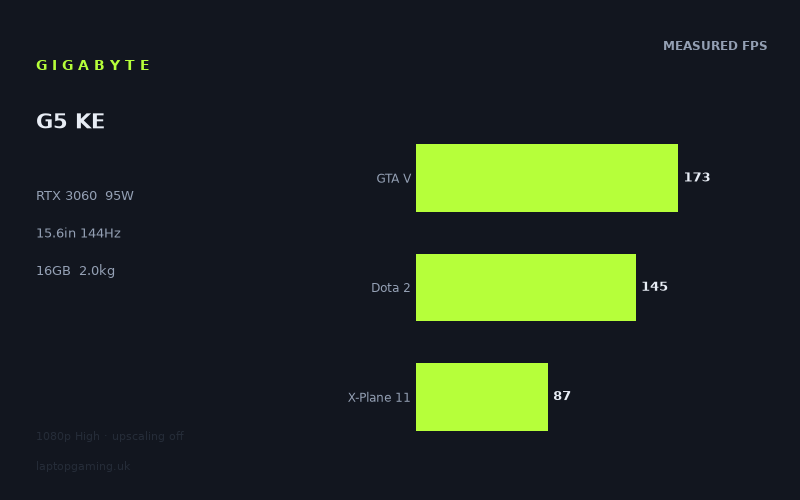
Frame rates
1920×1080, High preset, upscaling off.
Measured on this machine. Source: Notebookcheck, 2023-04-24.
Not scored: incomplete benchmark suite
Every scored laptop on this site is averaged over the same 5 games, and this one is short of Cyberpunk 2077, Baldur's Gate 3. A mean over 5 games is not comparable to a mean over 5, so we publish the figures we have and leave the score blank rather than rank it against machines tested on a different set. The numbers below are real - the suite is just incomplete.
How these numbers were produced
Frame rates here are not measured by us, and we label how each one was arrived at. A figure marked measured comes from a published run on that exact machine. A figure marked representative is derived from the GPU and its power limit (TGP) and cross-referenced against published reviews - a sound estimate of what that configuration delivers, but not a measurement of that specific laptop. Unless stated otherwise, numbers are 1920x1080, High preset, upscaling off. Where a laptop ships in several power configurations we use the wattage of the exact SKU listed, because a 140W RTX 5070 and a 115W one are not the same product.
In use
The short version
The Gigabyte G5 KE is a straightforward Full HD gaming laptop built around an RTX 3060 running at a 95W GPU power limit, a Core i5-12500H, 16GB of memory and a 144Hz IPS display. On the published Notebookcheck benchmark data, it is a capable 1080p machine rather than an automatic answer for every game at the screen’s maximum refresh rate. Its stronger results are genuinely fast: F1 2021 reached 178fps, Strange Brigade managed 175fps, GTA V recorded 173fps and The Witcher 3 hit 169fps. Those are the games where the 144Hz panel can be put to meaningful use without immediately lowering image-quality settings.
The more demanding end of the benchmark list tells the more useful story for a buyer choosing a laptop now. Cyberpunk 2077 1.6 returned 72fps at 1920x1080 on the High preset with upscaling off. Final Fantasy XV reached 90fps and X-Plane 11 recorded 87fps. Those are still playable results, but they are nowhere near filling a 144Hz display. The G5 KE therefore makes most sense for someone who wants a responsive Full HD panel for lighter, older or particularly well-scaling games, while accepting that newer and heavier titles will generally run well below the screen’s advertised maximum refresh rate at the tested settings.
The five-game scoring-suite mean is 134fps. That is a healthy aggregate result, but it should not be mistaken for a guarantee that every game will run at 134fps, or that the laptop will deliver 144fps in the games where that matters most. The measured spread is wide, from 178fps in F1 2021 down to 72fps in Cyberpunk 2077 1.6. The average is useful as a broad guide to the machine’s class, while the individual figures are more useful for deciding whether it suits the games you actually play.
There is no overall score for this exact configuration because there is no confirmed UK price. That is simply a limitation of the available pricing information: the benchmark suite is complete and the machine ranks normally on the frame-rate leaderboard, but value cannot be judged without a confirmed price. It would be wrong to guess at what this configuration costs or to declare it good or poor value in the UK without that figure.
Buy the G5 KE if your priority is measured Full HD gaming performance, you are comfortable treating 144Hz as headroom rather than a promise in every title, and the games you care about resemble the faster part of this benchmark list more than the slowest part. It is particularly credible for a buyer who plays F1 2021, Strange Brigade, GTA V, Dota 2, Far Cry 5 or The Witcher 3 and wants high frame rates at the tested 1920x1080 High setting without relying on upscaling.
Do not buy it purely because the screen says 144Hz. That panel specification is attractive, but Cyberpunk 2077 1.6, Final Fantasy XV and X-Plane 11 show clearly that the GPU configuration does not make 144fps the normal outcome in demanding games at the stated settings. Also look elsewhere if portability hinges on a known battery-life figure, because the specification gives a 54Wh battery capacity but no measured battery-life result. The available data supports a judgement on gaming performance; it does not support a claim about how long the machine lasts away from mains power.
Performance
What the measured figures say
Notebookcheck measured the Gigabyte G5 KE at 1920x1080, using the High preset with upscaling off. That test condition matters. These are native-resolution, high-detail figures rather than results boosted by an upscaling mode. For buyers who want a clean baseline before deciding whether they need to change settings in a particular game, that is a useful way to assess the RTX 3060 at its 95W power limit.
At the top of the list, the G5 KE is fast enough to make its 144Hz display relevant. F1 2021 reached 178fps, which is above the panel’s refresh rate. Strange Brigade was close behind at 175fps, GTA V recorded 173fps and The Witcher 3 reached 169fps. In all of those titles, the laptop has enough measured performance at the stated settings to exceed 144fps. That does not mean every moment of every game is proven to remain above that level, because the supplied results are benchmark figures rather than complete frame-time histories. It does mean that these games are in the right performance territory for the panel.
F1 22 also performed strongly at 153fps. That is below 144Hz only in the sense that it is not a result below 144fps at all: it is comfortably above the screen refresh rate. Anyone focused on the F1 games has unusually encouraging evidence here. The difference between F1 2021 at 178fps and F1 22 at 153fps is a useful reminder that game choice matters even within a related series. The G5 KE still has the performance for a high-refresh experience in both measured F1 titles, but the newer entry leaves less surplus above the panel limit.
Dota 2 reached 145fps. That is effectively aligned with the 144Hz panel on the reported figure. It is not a result that justifies promising a permanently locked 144fps experience, since only the published benchmark result is available, but it is exactly the sort of number that makes the display specification sensible. For a player who values response and smoothness in Dota 2, the combination of a 145fps measured result and a 144Hz panel is much more persuasive than a machine whose frame rate sits well below the display refresh.
Far Cry 5 recorded 129fps. That is a strong Full HD result, and it should look responsive on a 144Hz screen, but it is also a reminder that “fast” and “at panel maximum” are different claims. At 129fps, the game is below 144fps on the published number. There is no reason to describe that as inadequate: 129fps is plainly a high frame rate. The useful distinction is that the G5 KE appears able to get close to the display ceiling in Far Cry 5 rather than demonstrably exceed it at the tested setting.
The middle and lower end of the results should carry more weight for buyers interested in demanding modern games. Final Fantasy XV returned 90fps and X-Plane 11 managed 87fps. Both figures are well above the point where smooth play is normally the concern, but neither is close to using a 144Hz display fully. If those games are central to your buying decision, the G5 KE should be viewed as a machine that can run them well at the tested 1080p High settings, not as one that turns them into high-refresh showcase titles.
Cyberpunk 2077 1.6 is the most demanding result provided, at 72fps. That is the clearest evidence against treating the RTX 3060 label or the 144Hz screen as shorthand for 144fps gaming. The machine produced a playable figure at 1920x1080 High with upscaling off, which is valuable in itself. But the difference in character between 72fps and the 178fps reported in F1 2021 is substantial. A buyer who spends most of their time in the most graphically demanding games should expect to make choices between detail settings, frame rate and use of available upscaling options. The benchmark itself was run with upscaling off, so it provides no basis for stating what performance any upscaling setting would deliver.
The five-game scoring-suite mean of 134fps summarises the G5 KE well only if it is read alongside the individual results. Strange Brigade, GTA V and Dota 2 are part of that suite and are relatively high-frame-rate results here. Final Fantasy XV and X-Plane 11 pull the set in a different direction, at 90fps and 87fps. The resulting 134fps mean says the laptop is broadly quick at the measured Full HD High settings, but it cannot erase the fact that some games are much more demanding than others. For a real buying decision, the lowest relevant result is often more useful than the average.
What a 95W RTX 3060 means in practice
The RTX 3060 in this Gigabyte is specified at a 95W GPU power limit. That figure is important because laptop GPU names alone do not tell the full performance story. The benchmark data should be read as the performance of this particular RTX 3060 implementation, paired with the Core i5-12500H, 16GB of memory and the tested configuration. It would be a mistake to assume that every laptop carrying the same GPU name will produce the same results, just as it would be a mistake to assume that the GPU name makes the 95W figure irrelevant.
In this case, the practical evidence is encouraging at Full HD. The G5 KE reaches 178fps in F1 2021, 175fps in Strange Brigade, 173fps in GTA V and 169fps in The Witcher 3. Those results show that the 95W RTX 3060 is not merely adequate for the laptop’s 1920x1080 display. In favourable games, it has enough performance to pass the 144Hz refresh rate. The panel is therefore not an obviously mismatched specification for the GPU, provided the buyer understands which kind of games allow that combination to shine.
At the same time, the 95W configuration does not remove the normal limits of a mid-range Full HD gaming laptop. Cyberpunk 2077 1.6 at 72fps, Final Fantasy XV at 90fps and X-Plane 11 at 87fps show where the ceiling arrives at the tested High preset with upscaling disabled. The machine remains capable, but it is no longer operating in the same high-refresh bracket as its results in F1 2021 or GTA V. This is why the GPU power limit matters in practical terms: it is part of the specific performance package a buyer is getting, not a detail to ignore once the GPU badge has been read.
The data also argues against making simplistic conclusions from a single game. Looking only at Cyberpunk 2077 1.6 would make the G5 KE appear like a 72fps laptop. Looking only at F1 2021 would make it appear like a 178fps laptop. Both statements describe a real published result, but neither describes the machine as a whole. The 134fps mean across the five scoring-suite games is a useful broad marker, while the full list reveals how much the experience depends on the title.
There is a sensible way to set expectations. At 1920x1080 on High with upscaling off, the G5 KE is convincingly suited to high frame rates in the lighter and better-running games in the supplied list. It is suited to strong but sub-144fps results in games such as Far Cry 5, Final Fantasy XV and X-Plane 11. It is suited to playable rather than maximum-refresh performance in Cyberpunk 2077 1.6. That is a more accurate conclusion than either calling it a 144Hz gaming machine without qualification or dismissing it because one demanding game does not reach the panel ceiling.
The spread between games matters more than the headline average
The benchmark spread is not a flaw in the G5 KE alone. It reflects the fact that games load a laptop in different ways, and the supplied results make that especially clear. F1 2021, Strange Brigade, GTA V and The Witcher 3 all sit at 169fps or above. F1 22 and Dota 2 remain at 153fps and 145fps. Far Cry 5 lands at 129fps. Then Final Fantasy XV and X-Plane 11 fall to 90fps and 87fps, before Cyberpunk 2077 1.6 reaches 72fps.
For the buyer, this means there is no single honest answer to “how fast is it?” The honest answer is a range of outcomes under a stated test condition. If your regular games are closer to Dota 2 and GTA V than Cyberpunk 2077 1.6, the G5 KE’s 144Hz screen is a meaningful part of the specification. If you are buying mainly for the more demanding end of current game design, the display offers future headroom and a smoother desktop or lighter-game experience, but the published figures do not show the GPU keeping every heavy game at 144fps.
The panel resolution also shapes this outcome. This is a 1920x1080 laptop rather than a higher-resolution model, and the measurements are at that native Full HD resolution. That gives the RTX 3060 a realistic target. The results would be less attractive if the machine had to drive a higher pixel count, but there is no need to speculate about unmeasured resolutions. The available data shows the G5 KE doing what it is intended to do: drive a 1080p panel at high settings with a mixture of very high, high and merely playable frame rates depending on the game.
The key is to buy it for its measured class, not for an imagined one. This is not supported by the figures as a laptop that turns every high-detail game into a 144fps experience. It is supported as a laptop whose Full HD performance can be excellent in a sizeable part of the supplied list, and solid in the demanding titles where 144fps is not realistic at the tested settings. That distinction should guide the purchase more than the refresh-rate number printed beside the display.
The screen
The Gigabyte G5 KE has a 15.6in IPS display with a 1920x1080 resolution and a 144Hz refresh rate. On paper, that is a sensible gaming-oriented specification. Full HD is the resolution at which the published frame rates were measured, so there is no disconnect between the panel’s native pixel count and the benchmark conditions. The question is not whether the GPU is being asked to drive an unnecessarily high resolution. The question is how often the RTX 3060 at 95W can get close to, meet or exceed the 144Hz ceiling in real games.
The answer varies sharply by title. F1 2021 at 178fps, Strange Brigade at 175fps, GTA V at 173fps, The Witcher 3 at 169fps and F1 22 at 153fps all exceed 144fps in the published results. Dota 2 at 145fps is effectively at the screen’s maximum refresh rate on the benchmark figure. These are the results that justify the 144Hz specification most directly. In those games, the display is not wasted: the measured output is sufficient to feed it at or above its refresh rate at 1920x1080 High with upscaling off.
Far Cry 5 at 129fps is a useful borderline case. It does not hit 144fps on the published number, but it is close enough to make a high-refresh screen relevant rather than decorative. A 144Hz panel does not stop being useful simply because a game is below 144fps; it just cannot display more unique frames per second than the game provides. The point is that 129fps is a strong match for a fast screen, even if it is not evidence of a fully saturated 144Hz result.
Final Fantasy XV at 90fps and X-Plane 11 at 87fps sit in a different category. These are comfortably below the panel maximum. A buyer should not choose the G5 KE expecting these games, at the stated settings, to use the screen in the same way as F1 2021 or GTA V. They should choose it knowing that a 144Hz panel still gives room for faster games, while heavier titles will run at their own measured pace. That is not an unusual compromise in this class; it is simply visible in the numbers.
Cyberpunk 2077 1.6 at 72fps is the clearest example of the limit. At that figure, the laptop is delivering half the panel’s refresh rate on the benchmark result. It remains an acceptable frame rate for many players, but the display’s 144Hz capability does not alter the game’s measured performance. Anyone buying primarily for games of that weight should regard the screen as a quality-of-life feature for other workloads and lighter titles, not as proof that demanding games will run at 144fps on High with upscaling off.
The IPS panel type is also worth noting, though only within the limits of the specification. IPS identifies the panel technology, but there are no supplied measurements for brightness, contrast, colour coverage, response times, backlight behaviour or outdoor visibility. It would be wrong to turn “IPS” into a blanket claim that the display is excellent for colour-critical work, particularly bright, or especially responsive. What can be said is that it is an IPS 15.6in Full HD panel with a 144Hz refresh rate, and the published game figures show where that refresh rate is genuinely useful.
For gaming use, the Full HD resolution is the right fit for the available evidence. The G5 KE can exceed 144fps in several measured games without upscaling. A higher-resolution screen would ask more of the GPU, but no higher-resolution results are provided and no conclusions should be drawn about them. The buyer should assess this machine as a native-1080p laptop. On that basis, the display and GPU are broadly well paired, provided expectations are anchored to game-by-game results rather than the most flattering figure in the list.
Build, size and portability
The Gigabyte G5 KE weighs 1.99kg. For a 15.6in gaming laptop with an RTX 3060, that places the focus on transportable gaming rather than on being a machine you forget is in a bag. It is light enough that moving it between rooms, taking it to work, university or a regular gaming location is not an absurd use case. At the same time, 1.99kg is still a meaningful amount of kit before considering any charger or other accessories. It should be thought of as portable in the practical sense, not as an ultra-light laptop.
The supplied specification does not include dimensions, so there is no basis for claiming that the G5 KE is thin, compact, deep or easy to fit into a particular bag. Weight alone is useful, but it does not tell the full story of portability. Two laptops at the same weight can occupy very different amounts of space. A buyer for whom bag fit is decisive should check the exact dimensions from a reliable retailer or manufacturer listing for the configuration being considered, rather than relying on an assumption based on the 15.6in screen size.
Its 15.6in display gives the machine a familiar gaming-laptop format: large enough for Full HD gaming without needing an external display, while remaining more manageable than a larger desktop-replacement design. That is a statement about the screen size itself, not a claim about physical chassis dimensions. The practical appeal is clear for someone who wants one system for a desk and occasional travel, especially when the main activity is gaming at the laptop’s native 1920x1080 resolution.
The battery capacity is 54Wh. Capacity is not battery life. There is no measured battery-runtime figure in the supplied information, and battery life depends heavily on workload, display settings, power modes and whether the laptop is gaming or doing lighter tasks. It would be misleading to translate 54Wh into a number of hours. For a buyer, the safe conclusion is simply that the G5 KE has a 54Wh battery and that there is no published runtime figure here to support stronger claims.
That limitation matters because gaming laptops are often used in more than one way. A buyer may want something for gaming near mains power and lighter work away from it. The benchmark data gives a detailed picture of the first use case at 1920x1080 High, but not of the second. If long untethered use is a deciding factor, the G5 KE needs further battery-life evidence before it can be recommended confidently for that role. The performance figures alone cannot answer it.
The internal configuration includes 16GB of memory and a 512GB SSD. These are practical baseline specifications rather than headline features. The 16GB memory figure is part of the tested configuration behind the published frame rates, which is more useful than treating it as an abstract checklist item. The 512GB SSD is the stated storage capacity, but there is no supplied information on usable space, SSD speed, extra drive bays, upgrade access or memory upgrade options. Buyers who need a larger game library or specific upgrade flexibility should verify those details separately.
There are also no supplied measurements for temperatures or fan noise. That means the G5 KE cannot be described responsibly as cool, hot, quiet or loud. The GPU power limit and the high frame-rate results do not provide enough information to infer acoustic or thermal behaviour. A buyer who is sensitive to fan noise or who plans to use the laptop in a quiet shared space should seek dedicated noise and temperature measurements rather than assume that the 1.99kg weight or 95W GPU power limit predicts the answer.
In portability terms, then, the honest picture is narrow but useful. The G5 KE is a 1.99kg, 15.6in gaming laptop with a 54Wh battery, 16GB of memory and a 512GB SSD. It is likely to suit someone who can carry a substantial but not extreme laptop and who mainly values gaming performance at a desk or near power. It is not possible from the provided information to judge its exact footprint, battery endurance, noise, heat or upgradeability. Those are omissions to investigate, not grounds to invent a positive or negative conclusion.
How it compares
The rival comparisons are useful because they cover a spread of laptops from the same GPU generation rather than only one superficially similar machine. They are based only on games both laptops hold, with preference for the scoring suite. That shared-game approach matters: it avoids pretending that two machines can be compared directly when they have not been measured in the same titles. It also means that each comparison should be read as a specific benchmark-set result, not as a universal law about every game.
Against the MSI Prestige 15
Against the MSI Prestige 15 with an RTX 3050 Ti at 105W, the Gigabyte G5 KE averages 70fps ahead across four shared games. This is the clearest and largest advantage in the supplied rival set. The G5 KE’s RTX 3060 at 95W may have a lower stated power limit than the Prestige 15’s RTX 3050 Ti at 105W, but the shared-game results favour the Gigabyte heavily. That is exactly why buyers should not reduce laptop performance to a wattage figure alone.
A 70fps average lead across four shared games is substantial enough to affect the kind of display experience a buyer can expect. The G5 KE already shows several results above 144fps in the wider benchmark list, including F1 2021 at 178fps, Strange Brigade at 175fps and GTA V at 173fps. The Prestige comparison supports the view that the Gigabyte belongs in a distinctly stronger gaming tier than that RTX 3050 Ti rival, at least in the four titles the two have in common.
This does not mean the MSI Prestige 15 is automatically unsuitable for every buyer. The supplied data only establishes the gaming-performance gap across the shared games, and gives no basis for broader claims about its screen, weight, battery or price. But for someone buying specifically for frame rate, the G5 KE has a decisive published advantage. The absence of confirmed UK prices for both machines means no value judgement can be made between them.
Against the Schenker XMG Fusion 15
The comparison with the Schenker XMG Fusion 15 (Mid 22) is more surprising at first glance. That machine uses an RTX 3070 at 145W, while the Gigabyte G5 KE uses an RTX 3060 at 95W. Yet across five shared games, the G5 KE averages a near-zero difference: the reported average is -0fps. In practical terms, the shared-set result is a tie.
That does not prove that an RTX 3060 at 95W is interchangeable with an RTX 3070 at 145W in every game, every setting or every resolution. The comparison is limited to the five shared games. The supplied context explains why this can happen: at 1080p, the lighter titles in the shared set are CPU-bound and compress genuine GPU gaps. In other words, when a game is not primarily limited by the GPU in that scenario, giving one machine more GPU capability does not necessarily produce a large frame-rate lead.
This is an important lesson for buyers who compare specifications rather than measured results. A higher GPU tier and a higher power limit can matter greatly in the right workload, but they do not guarantee a visible advantage in every Full HD benchmark. The G5 KE’s near-zero shared-game average against the XMG Fusion 15 is a real result, not an error to be explained away. It shows that the Gigabyte can keep pace in that specific 1080p shared set.
It would still be wrong to turn the tie into a claim that the two laptops offer identical gaming performance. The figures do not show every game, and the supplied comparison does not provide individual shared-game results. What it does show is that a buyer playing games similar to that shared set should not assume the RTX 3070 at 145W will automatically be faster at Full HD. A buyer focused on a broader range of demanding games should look for title-specific evidence rather than rely on either laptop’s badge.
Against the Acer Predator Triton 300 SE
The Acer Predator Triton 300 SE is the closest specification match in the supplied comparison: it also has an RTX 3060 at 95W. Across five shared games, the reported average difference is again -0fps. This is the least surprising tie in the rival group. When two systems use the same listed GPU and the same listed GPU power limit, a near-zero result across the shared set is a credible outcome.
Even here, the right interpretation is not that all details are irrelevant. The G5 KE has a Core i5-12500H, 16GB of memory and a 512GB SSD in the stated configuration, but the supplied comparison does not list corresponding specifications for the Acer beyond its GPU and power limit. Nor does it provide display, weight, battery, noise or price differences that would let a buyer choose on overall ownership experience. On gaming performance in the five shared games, though, there is no meaningful average separation in the provided data.
The tie also reinforces the importance of the tested resolution. At 1080p, the lighter titles in a shared set can be CPU-bound and can compress genuine GPU gaps. Here the GPUs and power limits already match, so there is even less reason to expect a major average divergence from the information supplied. Buyers choosing between these two should not expect the frame-rate data in this shared set to settle the decision; they need to compare the rest of the specification and, crucially, confirmed UK pricing if it becomes available.
Against the MSI Raider GE77 HX
The MSI Raider GE77 HX with an RTX 3080 Ti at 175W is the rival that beats the G5 KE by the largest margin in the supplied group. Across five shared games, the Gigabyte averages 35fps behind. That is a meaningful deficit. It establishes that the G5 KE’s strong Full HD results do not make it comparable with every larger, higher-powered machine from the same generation.
The specifications explain why this comparison should not be treated as a surprise. The Raider has an RTX 3080 Ti at 175W, while the G5 KE has an RTX 3060 at 95W. The benchmark result shows a 35fps average advantage for the Raider across their five shared games. The Gigabyte remains competitive enough to deliver a 134fps mean across its own five-game scoring suite, but the Raider’s shared-game lead is evidence that more GPU class and more stated GPU power can translate into a noticeable performance advantage.
There is still an important qualification. The gap is 35fps across five shared games, not a guaranteed 35fps in every title. The same 1080p CPU-bound effect applies to lighter titles in the shared set, compressing genuine GPU gaps. That means the Raider’s advantage in the comparison may not capture every situation where its higher-powered RTX 3080 Ti could pull further ahead. Equally, the supplied information does not allow a claim about what happens at settings or resolutions that were not measured.
For a buyer whose priority is extracting the highest possible frame rates from demanding games, the Raider comparison is a warning not to overstate the G5 KE. The Gigabyte is strong for its configuration, but it is not the highest-performance option in this generation spread. For a buyer who wants good Full HD results in a 1.99kg laptop, the more relevant point is that the G5 KE remains much closer to the XMG Fusion 15 and Predator Triton 300 SE in their shared sets than it is to the performance level represented by the Raider.
What the rival spread actually tells us
Taken together, the comparisons place the G5 KE in a useful middle position. It is far ahead of the MSI Prestige 15 with the RTX 3050 Ti at 105W, averaging 70fps more across four shared games. It is level on the reported shared-game average with both the Schenker XMG Fusion 15 with an RTX 3070 at 145W and the Acer Predator Triton 300 SE with an RTX 3060 at 95W. It is behind the MSI Raider GE77 HX with its RTX 3080 Ti at 175W by 35fps across five shared games.
That is a better guide than a simplistic ranking based only on GPU names. It shows a major gain over the lower RTX 3050 Ti rival, parity in a particular Full HD shared set with two closer rivals, and a clear loss to the much more powerful RTX 3080 Ti machine. It also shows why 1080p benchmark context matters. The near-zero comparisons are not evidence that all GPUs perform identically; the supplied context says that CPU-bound lighter games can compress genuine GPU gaps at this resolution.
None of the rival machines has a confirmed UK price in the supplied information, including the G5 KE. That prevents a responsible value comparison. A 35fps lead matters differently at one price than another, but the facts here do not establish those prices. The correct conclusion is performance-only: the G5 KE offers a strong measured Full HD position against some rivals, but it is not the fastest option in the supplied generation spread.
Who it’s for
The Gigabyte G5 KE is for the buyer who wants a 15.6in Full HD gaming laptop with a measured performance profile that is often fast enough to justify a 144Hz display. If your regular games include F1 2021, Strange Brigade, GTA V, The Witcher 3, F1 22 or Dota 2, the published results are particularly encouraging. Those games recorded 178fps, 175fps, 173fps, 169fps, 153fps and 145fps respectively at 1920x1080 High with upscaling off. That is the strongest case for the laptop.
It is also for a buyer who values native-resolution results. The test configuration did not use upscaling, so the numbers show what the G5 KE can do at the panel’s 1920x1080 resolution without leaning on that additional option. There is value in that clarity. If a game runs at 169fps or 153fps in the published data without upscaling, the machine does not need a settings workaround to make the 144Hz panel relevant in that title.
It is a credible choice for players who understand that gaming performance is title-dependent. Far Cry 5 at 129fps is still very fast, despite being below 144fps. Final Fantasy XV at 90fps and X-Plane 11 at 87fps are solid results, despite not being high-refresh outcomes. Cyberpunk 2077 1.6 at 72fps is playable at the tested setting, despite being far below the screen ceiling. A sensible buyer sees these as different use cases, not as contradictory verdicts.
The 1.99kg weight also makes it a reasonable fit for someone who moves their gaming laptop regularly rather than leaving it permanently in one place. It is not supported by the facts as an ultra-portable machine, and there are no dimensions to confirm how compact it is, but the weight is compatible with a laptop that can travel when needed. The 54Wh battery should not be treated as proof of long battery life, because no runtime has been provided.
The G5 KE is less suitable for the buyer whose main aim is to run the most demanding games at or near 144fps on High settings with upscaling off. Cyberpunk 2077 1.6 at 72fps is the direct evidence. The laptop can run that game at the stated test conditions, but the result is not in the same class as its F1 2021 or Strange Brigade numbers. If maximum-refresh performance in heavy games is your non-negotiable priority, a higher-performance machine is the more appropriate direction, and the MSI Raider GE77 HX comparison shows that the G5 KE is 35fps behind across five shared games.
It is also not the right choice for someone who wants to buy solely on confirmed value. There is no confirmed UK price for this exact configuration, so there is no factual basis for deciding whether the G5 KE is a bargain, fairly priced or overpriced. The lack of a price does not undermine the benchmark data, but it does prevent the final value judgement that should normally accompany a laptop recommendation. Wait for a confirmed price before deciding whether its measured performance is worth the asking figure.
Buy something else if your primary concern is battery endurance away from the mains. The G5 KE has a 54Wh battery, but capacity alone does not provide a runtime. Without battery-life measurements, a review cannot honestly say whether it suits all-day study, long travel or extended work sessions without charging. That is an area where further evidence is required rather than a feature that can be inferred from the gaming specifications.
Buy something else if fan noise, temperatures, chassis dimensions or internal upgrade options are decisive criteria and you are not willing to verify them separately. None of those details is supplied here. The G5 KE may still meet your needs in those areas, but the available facts do not establish it. A careful purchase should not turn missing information into an assumption.
For the right buyer, though, the G5 KE is easy to understand. It is a 1.99kg Full HD gaming laptop with a 144Hz IPS screen, a Core i5-12500H, 16GB of memory, a 512GB SSD and an RTX 3060 at 95W. Notebookcheck’s figures show excellent results in several games, high but sub-144fps performance in others, and a 72fps result in Cyberpunk 2077 1.6 at the tested settings. It beats the RTX 3050 Ti MSI Prestige 15 convincingly in their shared games, matches the reported shared-game average of the Schenker XMG Fusion 15 and Acer Predator Triton 300 SE, and trails the RTX 3080 Ti MSI Raider GE77 HX.
That is not a universal recommendation, and it should not be presented as one. It is a strong Full HD gaming proposition for a buyer whose game library falls towards the faster side of the supplied results and who accepts that demanding titles will not automatically reach 144fps. Once a confirmed UK price is available, the value question can be answered. Until then, the proper verdict is based on the evidence available: the Gigabyte G5 KE has a solid, sometimes very fast, but clearly game-dependent 1080p performance profile.