Review
Asus ROG Zephyrus G14 2024 review
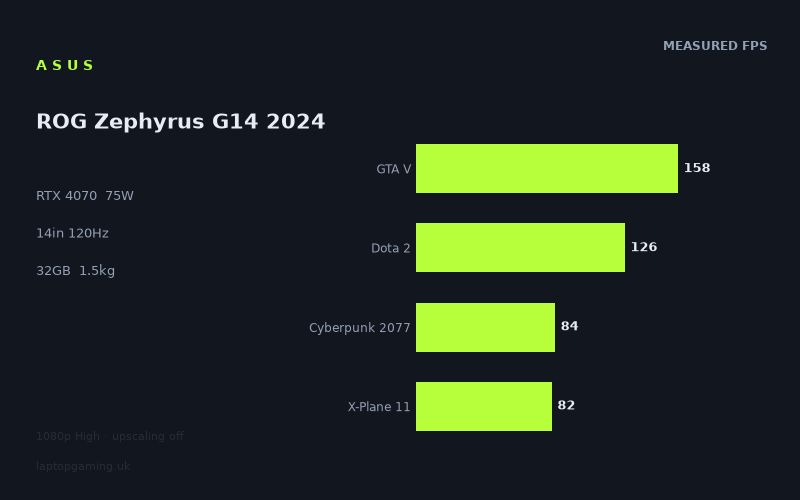
Frame rates
1920×1080, High preset, upscaling off.
Measured on this machine. Source: Notebookcheck, 2024-02-08.
Not scored: incomplete benchmark suite
Every scored laptop on this site is averaged over the same 5 games, and this one is short of Baldur's Gate 3. A mean over 4 games is not comparable to a mean over 5, so we publish the figures we have and leave the score blank rather than rank it against machines tested on a different set. The numbers below are real - the suite is just incomplete.
How these numbers were produced
Frame rates here are not measured by us, and we label how each one was arrived at. A figure marked measured comes from a published run on that exact machine. A figure marked representative is derived from the GPU and its power limit (TGP) and cross-referenced against published reviews - a sound estimate of what that configuration delivers, but not a measurement of that specific laptop. Unless stated otherwise, numbers are 1920x1080, High preset, upscaling off. Where a laptop ships in several power configurations we use the wattage of the exact SKU listed, because a 140W RTX 5070 and a 115W one are not the same product.
In use
The short version
The 2024 Zephyrus G14 is a 1.478kg laptop with an RTX 4070 inside it, and almost every judgement worth making about the machine follows from those two numbers sitting next to each other. Asus has put an upper-mid-tier GPU of its generation into a 14in chassis that weighs less than a kilogramme and a half. The way it made that work is the 75W power limit, and that figure — not the GPU's name — is what actually determines how the machine performs.
Notebookcheck's measurements, taken on 8 February 2024 at 1920x1080 with High presets and upscaling switched off, describe the outcome plainly. At the top of the list, 220fps in F1 2021 and 213fps in Strange Brigade. Through the middle, 158fps in GTA V, 153fps in F1 23, 126fps in Dota 2. At the bottom, 84fps in Cyberpunk 2077, 67fps in Star Wars Jedi Survivor and 65fps in Avatar: Frontiers of Pandora. Across the four games of our scoring suite we hold figures for, the mean is 112fps.
The panel is the other half of the pitch, and it is a good one: 14in, 2880x1800, 120Hz, OLED. That is a considerably more ambitious display than a machine of this size normally carries, and — unusually for a gaming laptop — the refresh rate and the GPU are reasonably well matched. Seven of the thirteen measured titles clear 120fps at 1080p. Plenty of gaming laptops ship far faster panels that their GPUs cannot come close to saturating; this one at least sets a target the hardware can hit in more than half the games measured.
There is no score on this page, and the reason is procedural rather than damning. Our scoring suite is five games, and we hold four of them for this machine — there is no Baldur's Gate 3 figure in our record. Every scored laptop is averaged across the identical five, so a partial set cannot honestly be ranked against a complete one. We also have no confirmed UK price for this exact configuration, which would independently block a value judgement. Neither of those is a criticism of the laptop. They are gaps in what we can currently prove.
Buy it if a 14in machine that weighs under 1.5kg is the actual requirement and you accept that the heaviest titles in the measured list will want either reduced settings or upscaling. Buy something else if you want the frame rates an RTX 4070 produces when it is allowed to draw the power it can take, because this one is not allowed to, and the comparison figures below show what that costs and — more interestingly — what it does not.
Performance
What 75W actually means
Mobile GPUs sharing a name do not share a performance level. The same silicon is configured across a wide power band by whoever designs the chassis, and the spread between the lowest and highest configurations of a given part is large enough to swallow an entire tier. The model number tells you which chip is fitted, what features it supports and which driver path it follows. The power limit tells you how hard that chip is permitted to work, and it is set by how much heat the cooling system can remove and how much fan noise the designer is willing to sign off.
75W is a low setting for this GPU. It sits nearer the bottom of the configurable range than the top. That is not a defect or a cost-cutting exercise, it is the direct arithmetic consequence of a 14in, 1.478kg chassis. A machine this small has very little internal volume for heatsink mass, very little surface area to exhaust through, and space only for small fans. There is a hard physical ceiling on the heat it can shift continuously, and 75W is where Asus has drawn it. Any 14in laptop advertising a substantially higher sustained figure for a GPU of this class is either quoting a short-duration boost number or accepting noise and throttling that its buyers will notice within a week.
So the honest framing is this: you are not buying an RTX 4070's full performance. You are buying an RTX 4070's architecture and feature set, running at a fraction of the power the same part receives in a thicker machine. What that produces is still genuinely substantial — the measured figures below are not the numbers of a compromised laptop — but the gap between this and a well-fed version of the same GPU is real, and pretending otherwise would be doing the reader a disservice.
The important nuance, and the thing the benchmark spread demonstrates better than any argument, is that a low power ceiling does not cost the same amount in every game. In titles where the graphics card is the limiting component, it costs a lot. In titles where the processor, the game engine or driver overhead is setting the pace, it costs close to nothing, because the GPU was never the thing being waited on. Read the list from the bottom up rather than the top down and the shape of this machine becomes obvious.
The measured spread, top to bottom
Notebookcheck's figures, all at 1920x1080, High preset, upscaling off, measured 8 February 2024:
- F1 2021 — 220fps
- Strange Brigade — 213fps
- The Witcher 3 — 203fps
- F1 22 — 166fps
- GTA V — 158fps (scoring suite)
- F1 23 — 153fps
- Dota 2 — 126fps (scoring suite)
- Far Cry 5 — 110fps
- Final Fantasy XV — 103fps
- Cyberpunk 2077 — 84fps (scoring suite)
- X-Plane 11 — 82fps (scoring suite)
- Star Wars Jedi Survivor — 67fps
- Avatar: Frontiers of Pandora — 65fps
The range is 220fps down to 65fps. The fastest title in the list runs more than three times as quickly as the slowest, and that ratio is the single most informative thing in the table. It is not a statement about the laptop's consistency; it is a statement about how differently thirteen games load a graphics card. Understanding which end of that list a given game belongs to matters far more than the mean, because you do not play the mean.
The top of the list, and what it is not telling you
F1 2021 at 220fps, Strange Brigade at 213fps and The Witcher 3 at 203fps are the three fastest results measured. They are also the three least useful for judging the GPU.
Strange Brigade is a well-optimised shooter that has been used as a benchmark for years precisely because it scales cleanly and runs fast; at 1080p on a machine of this class it is not asking the graphics card a difficult question. F1 2021 is an older racing title running at a resolution that leaves the GPU with headroom to spare. The Witcher 3 at 203fps is a game that has been comprehensively optimised over its lifetime and, at 1080p on High, is comfortably within what this hardware can produce.
What those three numbers tell you is that the machine is not bottlenecked anywhere unexpected, that the processor and memory configuration are keeping up, and that light and moderately-demanding games will run far beyond the panel's ability to display them. That is worth knowing. It is not, however, evidence about how the 75W limit behaves, because at those frame rates the GPU is not the component under strain. If you play mostly esports titles, well-optimised older releases and racing games at 1080p, this laptop's power limit is close to irrelevant to your experience.
The F1 sequence is quietly instructive on its own. F1 2021 at 220fps, F1 22 at 166fps and F1 23 at 153fps are three iterations of the same franchise on related engines, and each newer release costs frames. Between the 2021 and 2023 entries the machine loses 67fps — a 30 per cent reduction across two years of the same series. That is a useful, concrete illustration of how quickly the requirements of new releases climb even within a single franchise, and it is a warning worth heeding when reading any benchmark set that leans on older titles. A laptop that looks comfortable across a table of 2019–2021 games can be a good deal less comfortable in 2026 releases.
The scoring suite, and the figure we are missing
Four of the thirteen measured titles belong to our scoring suite: GTA V at 158fps, Dota 2 at 126fps, Cyberpunk 2077 at 84fps and X-Plane 11 at 82fps. The mean across those four is 112fps.
That mean is a reasonable single-number summary, but it deserves an immediate caveat, because the four figures behind it are not clustered. They run from 158fps down to 82fps — the fastest is nearly twice the slowest. A mean drawn from a spread that wide describes none of its members particularly well. GTA V and Dota 2 sit well above it; Cyberpunk 2077 and X-Plane 11 sit well below. If your library looks like the first pair, the machine will feel faster than 112fps suggests. If it looks like the second, it will feel slower, and no averaging can reconcile those two experiences.
The suite is five games. We do not hold a Baldur's Gate 3 figure for this machine, so we have four of the five, and that is why there is no score on this page. This matters more than it might appear. Every scored laptop on this site is averaged over the identical five titles, and the comparability of those averages is the entire point of using a fixed set. Substituting a four-game mean for a five-game one and presenting the result on the same leaderboard would quietly make this machine's number mean something different from everyone else's — and it would be impossible for a reader to tell from the outside. So we do not do it.
What we can say is that nothing in the four figures we do hold suggests the machine would rank strangely once the fifth arrives. It is a coherent set for an RTX 4070 running at a low power limit, and it is the absence of a data point, not the presence of a problem, that keeps the score column empty.
The bottom of the list, where the ceiling becomes visible
Avatar: Frontiers of Pandora at 65fps and Star Wars Jedi Survivor at 67fps are the two slowest results, and they are the two that describe what a 75W RTX 4070 is genuinely capable of when a game actually leans on it. Cyberpunk 2077 at 84fps and X-Plane 11 at 82fps sit just above them. These four are where the power limit is doing the deciding.
Both 65fps and 67fps are perfectly playable numbers. Neither is anywhere near the panel's 120Hz. At 1080p — which is well below this display's native resolution, a point the screen section returns to — the heaviest titles in the measured set are producing roughly half of what the panel can show. That is not a failure. It is the expected behaviour of an upper-mid GPU held to 75W in demanding, modern, open-world games, and it is the honest answer to "what does the power limit cost".
The practical consequence is straightforward and worth stating plainly. For the demanding end of your library, this machine's comfortable operating mode involves either turning settings down from High or turning upscaling on. Notebookcheck's figures are measured with upscaling explicitly off, which is the right methodology for a comparison — it isolates the hardware rather than the reconstruction quality of whichever upscaler a given game ships. But it is not how most people will actually run a 14in laptop with a 2880x1800 panel in a game like Avatar. Switching upscaling on will lift these numbers meaningfully. We have no measurements of by how much, so we will not put a figure on it, but the direction is certain and the mechanism is well understood.
X-Plane 11 at 82fps deserves a footnote, because it is the least game-like entry in the suite. Flight simulators lean hard on the processor and on data streaming, and their frame rates are frequently limited by something other than raw graphics throughput. An 82fps result there alongside 84fps in Cyberpunk 2077 is a coincidence of numbers, not a statement that the two workloads are equivalent.
The processor's contribution
The Ryzen 9 8945HS is a high-end mobile processor, and in this machine it is doing more work than the specification sheet implies. At 1080p — the resolution every figure here was measured at — the processor becomes the limiting component in exactly the lighter titles that top the list. The 220fps in F1 2021 and the 203fps in The Witcher 3 are not purely GPU results; at those frame rates the whole system is contributing, and a weaker processor would pull them down regardless of what the graphics card could manage.
This is also the mechanism behind one of the more counter-intuitive comparison results further down this page, so it is worth fixing in mind now: at 1080p, a fast processor can partly conceal a low GPU power limit. It does so specifically in games that were not going to saturate the graphics card anyway. It does nothing at all for Avatar or Jedi Survivor. That asymmetry — big help at the top of the list, no help at the bottom — is the single most useful idea for reading the rest of this review.
32GB of memory is a genuinely generous allocation for a 14in laptop, and it is one of the more quietly valuable things on the specification sheet. Gaming rarely needs it. The kind of work a portable RTX 4070 machine tends to get used for between gaming sessions — compiling, virtual machines, video editing, large datasets, many browser tabs alongside all of the above — frequently does. On a machine whose entire proposition is that it travels with you and does everything, 32GB is the difference between a laptop that copes and one that starts swapping. It also removes the most common reason people find themselves opening a laptop up eighteen months after buying it.
The resolution gap, which is wider here than usual
Every frame rate on this page was measured at 1920x1080. The panel is 2880x1800. Those are not the same workload, and on this machine the difference is unusually large: 2880x1800 is two and a half times as many pixels as 1920x1080.
We do not hold native-resolution measurements for this laptop, so we will not print a native-resolution number — not an estimate, not a scaled figure, not a range. What can be said with confidence is the direction and rough severity. Running these games at the panel's native resolution will produce materially lower frame rates than the figures above, and the shortfall will be largest in exactly the titles that are already slowest, because those are the ones where the GPU is the constraint and adding pixels adds directly to its load. The lighter titles at the top of the list, which are partly processor-bound at 1080p, will lose proportionally less.
This is not an argument against the panel, and the screen section makes the case for it. It is an argument for being clear-eyed about what you are buying: a display whose resolution exceeds what the GPU can natively drive in demanding games, on a machine where upscaling is therefore not an optional extra but a core part of the intended operating mode. That is a defensible design — a high-resolution OLED is far better for everything that is not a game, and modern upscaling from a lower internal resolution to a dense native panel is a genuinely good experience — but it is a design that only makes sense if you understand it going in.
The screen
2880x1800 OLED at 14in
This is the best-specified component on the machine, and it is not close. A 14in 2880x1800 OLED is a display specification that would headline a premium ultrabook, and it is doing so here on a laptop that also contains an RTX 4070.
The pixel density is the immediate benefit. Packing 2880x1800 into 14in produces a very fine dot pitch, and at the viewing distance a 14in laptop actually gets used at, that means text and interface elements are rendered without visible pixel structure. For a machine whose whole point is that it goes with you and gets used for work as readily as for games, that is not a luxury — it is most of what you will be looking at, most of the time.
OLED brings the characteristics of the technology with it: emissive pixels, so black is the absence of light rather than a backlight leaking through, and effectively per-pixel contrast. In games with dark scenes — and the bottom of the measured list is populated by exactly that sort of game — the difference against a conventional backlit panel is not subtle. It also brings OLED's known trade-offs, which we should name rather than skate past: the technology's susceptibility to burn-in from genuinely static elements over long periods, and full-screen brightness behaviour that differs from a backlit panel. Our record holds no brightness measurement, no contrast measurement and no colour-gamut measurement for this display, so we are not going to quote any. The panel type and resolution are what we can verify.
120Hz, and whether the GPU can feed it
120Hz is a lower refresh rate than the figures gaming laptops routinely advertise, and on this machine it is the more sensible choice. High-resolution OLED panels at very high refresh rates are expensive and power-hungry, and a refresh rate the GPU cannot approach is a specification-sheet ornament rather than a feature.
Against the measured figures, 120Hz is a target this machine hits reasonably often. Seven of the thirteen titles measured at 1080p exceed it: F1 2021 (220fps), Strange Brigade (213fps), The Witcher 3 (203fps), F1 22 (166fps), GTA V (158fps), F1 23 (153fps) and Dota 2 (126fps). Six do not: Far Cry 5 (110fps), Final Fantasy XV (103fps), Cyberpunk 2077 (84fps), X-Plane 11 (82fps), Jedi Survivor (67fps) and Avatar (65fps).
A little over half the measured library saturating the panel is a genuinely good ratio for a gaming laptop, and it is a much better one than most machines carrying much faster panels manage. It is also, to be scrupulous, a ratio measured at 1080p rather than at the panel's native resolution — so the honest version is that this GPU can saturate this panel's refresh rate in more than half the measured titles when it is not also being asked to fill all of the panel's pixels. Those are two separate demands and this machine can comfortably meet one of them at a time.
What that means in practice is a machine with two sensible modes. In lighter and older titles, run at native resolution and enjoy a fast, dense, high-contrast display. In the demanding titles at the bottom of the list, accept upscaling or reduced settings and let the panel show you a well-reconstructed image at a good frame rate. The 120Hz ceiling is not what will be holding you back in the second case; the 75W power limit is.
Build, size and portability
1.478kg is the entire argument
The weight is the product. Everything else on this page is a consequence of Asus deciding that a gaming laptop with a real GPU should weigh under a kilogramme and a half, and then engineering backwards from that constraint.
1.478kg puts this in genuine ultrabook territory. It is a weight you carry in a bag every day without thinking about it, take to a coffee shop without planning, and put in hand luggage without recalculating. That is a categorically different relationship with a laptop from the one you have with a large desktop-replacement machine, which you move deliberately between places where it lives. The 14in footprint compounds the effect: it fits on the folding table of a train seat, on a hot-desk shared with other things, and in bags a bigger machine will not go into.
We hold no dimensional measurements beyond the 14in screen size and the weight, so this is as specific as we can honestly be about the chassis. But weight and screen size are the two figures that actually govern how a laptop gets used, and both point the same way: this is a machine designed to be carried constantly and gamed on wherever it lands, rather than one designed to be optimal at a desk.
The cost of that decision is the 75W power limit, and the value of the trade depends entirely on whether you will actually use the portability. If the machine will spend its life on a desk, you have paid the thermal penalty and collected nothing for it — a larger chassis with the same GPU at a higher power limit will be faster for the same money, and the comparison section quantifies the sort of margins involved. If the machine will genuinely travel, the calculation reverses completely, because the alternatives that are faster are also the alternatives you would leave at home.
The 73Wh battery
73Wh is a large battery for a 14in laptop. Chassis this size frequently ship with considerably less, and the decision to spend internal volume on cells rather than on cooling or on being thinner is consistent with the rest of the design: this is a machine meant to be away from a socket.
Our record holds no battery-life measurement for this configuration, so we are not going to state a runtime. Anyone quoting one for a laptop with an OLED panel and a discrete GPU without saying precisely what the machine was doing is guessing anyway, because the variance between idle-with-the-GPU-asleep and gaming-on-battery is enormous — larger, on this class of hardware, than the difference between one laptop and another.
What we will say is that 73Wh in a 14in chassis alongside a 2880x1800 OLED is a sensible pairing, since a high-resolution emissive panel is a meaningful consumer of power and a small battery behind one would be a poor combination. And a general warning that applies to every gaming laptop and this one no less: sustained gaming on battery will not deliver the frame rates on this page. Those figures describe a machine on mains power. Portable gaming laptops are portable machines that game; they are not machines that game portably at full performance, and no 73Wh battery changes that.
How it compares
Our comparison method is worth a sentence before the numbers, because it constrains what the numbers can be read to mean. Rivals are drawn from the same GPU generation only, and each margin is computed across games both machines actually hold, preferring our scoring suite where at least three of its titles are shared. The four machines below are deliberately a spread rather than the four most similar: the two closest results, the machine this one beats by the widest margin, and the machine that beats it by the widest margin. Comparing only against near-neighbours makes every laptop look identical to every other, which is both useless and false.
One limitation to be clear about: we know how many games each comparison is drawn from, and we have not identified which ones in each case. A four-game margin and a three-game margin are not equally robust, and neither is as robust as a full-suite comparison would be. Read the margins as directional evidence rather than as precise deltas.
The four, from the widest win to the widest loss:
- MSI Thin GF63 — RTX 4050, no confirmed UK price. This machine averages +33fps across 4 shared games.
- Acer Nitro 14 — RTX 4060 at 110W, no confirmed UK price. This machine averages +1fps across 4 shared games.
- MSI Katana A15 AI — RTX 4070 at 105W, no confirmed UK price. This machine averages -0fps across 4 shared games.
- Asus ROG Strix Scar 17 — RTX 4090, no confirmed UK price. This machine averages -77fps across 3 shared games.
None of the four carries a confirmed UK price in our record, so every comparison here is about performance rather than value. That is a real limitation — a 33fps advantage over a cheaper machine is a different proposition from a 33fps advantage over a dearer one — and it is worth holding in mind throughout.
MSI Katana A15 AI — the same GPU with 30W more, and level
This is the most informative comparison on the page. The Katana A15 AI carries the same RTX 4070, configured at 105W against this machine's 75W. That is 40 per cent more power for identical silicon. Across four shared games, the margin is -0fps: level to within a rounding error, fractionally on the wrong side of zero.
That result invites a wrong conclusion — that the power limit does not matter — and the wrong conclusion is worth dismantling, because it is exactly the sort of thing a benchmark table can be made to appear to say.
The mechanism is resolution. Every one of these figures is measured at 1920x1080, and at 1080p a meaningful share of the shared titles is not GPU-limited at all. In games where the processor, the engine or driver overhead is setting the pace, both machines produce whatever the rest of the system can deliver, and the graphics card's power budget is simply not the variable being measured. Add a few results like that into a four-game mean and a genuine hardware difference is compressed toward zero. The margin is a real measurement of these two machines across those four games. It is not a measurement of what 30W is worth.
The proof that this is compression rather than genuine parity sits in the same table. The -77fps against the Strix Scar 17 shows that this benchmark set separates machines decisively when the underlying gap is large enough to survive a 1080p test. A methodology that flattened everything would have flattened that too. It did not. So when the same methodology reports two RTX 4070s as level, the sensible reading is that the difference between them is smaller than the compression effect, not that it is zero — and that at 1080p, in these particular titles, whatever advantage the Katana's extra 30W confers is being spent on frames the shared games were never going to demand.
Where would the 30W show up? At the bottom of the list, in Avatar, Jedi Survivor and Cyberpunk 2077, where this machine is producing 65, 67 and 84fps and the GPU is unambiguously the constraint. And at higher resolutions, where the graphics card's load rises and the processor's relative influence falls. We do not hold figures that isolate either case for these two machines, so we are not going to invent a margin for them. But a reader deciding between a 14in 75W machine and a larger 105W one on the strength of a level 1080p result would be making a decision on the least demanding evidence available.
The genuinely useful takeaway is the one about the chassis rather than the GPU. On the lighter half of a library at 1080p, this machine matches a bigger laptop with a substantially better-fed version of the same graphics card, while weighing 1.478kg. That is a real achievement, and it is what you are actually paying for.
Acer Nitro 14 — a 110W RTX 4060, and 1fps behind
The Nitro 14 is a tier below on the GPU — an RTX 4060 — but configured at 110W, which is 35W more than this machine's 4070 receives. Across four shared games, this machine averages +1fps ahead.
That is a more pointed result than the Katana comparison. A better graphics card at a much lower power limit is level with a lesser one at a much higher limit. Part of that is the same 1080p compression at work — the same caveats apply, and a four-game mean in this range is not a precise instrument. But part of it is a genuine observation about mobile GPU configuration: a well-fed part from a lower tier can pull level with a starved part from a higher one, and the gap between tiers is smaller than the gap between power configurations more often than buyers expect.
This is the comparison that most directly undermines shopping by GPU name. Someone comparing a laptop with a 4070 against a laptop with a 4060 and assuming the first is straightforwardly faster would, on this evidence at 1080p, be wrong by about 1fps. The specification sheets suggest a clear win. The measurements say the two are level.
It also, incidentally, tells you what the Nitro 14 is doing right: taking a mid-tier GPU and giving it enough power to perform to its potential is a perfectly sound way to build a laptop, and cheaper than fitting a higher tier and starving it. Whether it is the better buy depends on price and weight, and we hold neither a confirmed UK price for it nor a weight figure to set against 1.478kg. On frame rates alone at 1080p, there is nothing to choose between them.
MSI Thin GF63 — an RTX 4050, and 33fps behind
The Thin GF63 carries an RTX 4050. Our record holds no power limit for it, so we will not characterise how hard it is run. Across four shared games this machine averages +33fps ahead, and that is the widest margin it posts in its favour.
33fps is a real and meaningful advantage — roughly a third of this machine's four-game scoring-suite mean of 112fps — and it is the clearest evidence on the page that the 75W limit has not reduced this GPU to a lower tier. A properly compressed comparison produces margins near zero, as the two above did. This one does not. When the underlying hardware gap is large enough to survive a 1080p test, this benchmark set reports it, and against an RTX 4050 the gap survives comfortably.
It is worth noting what 33fps is not, though. It is smaller than the margins that separate GPU tiers in larger laptops, where both machines are free to draw the power their silicon can use. Two tiers of separation would ordinarily be worth considerably more than a third. That the margin here is 33fps rather than something far wider is the clearest single quantification on this page of what the 75W ceiling costs — not enough to drop the machine into a lower tier, but enough to narrow the distance to one appreciably.
Asus ROG Strix Scar 17 — an RTX 4090, and 77fps ahead
The widest margin in the table runs the other way. The Strix Scar 17 carries an RTX 4090 and averages 77fps ahead of this machine across three shared games. Our record holds no power limit for that machine, so we cannot say how hard its GPU is run and will not speculate.
Two things are worth drawing from this. The first is the obvious one: the top of this GPU generation, in a much larger chassis, is far beyond what a 14in machine can do, and no amount of engineering closes that gap. If your requirement is maximum frames, a 1.478kg laptop is not the answer and never was.
The second is methodological, and it is the reason this comparison earns its place. 77fps is a very large margin, and its existence is what makes the near-zero results elsewhere in the table trustworthy. If the comparison method were simply flattening everything, it would have flattened this one too, and it emphatically has not. The benchmark can separate machines. So when it reports two RTX 4070s as level, that is the method working on a comparison where the true difference is genuinely small at this resolution, not the method failing.
Note also that this margin is drawn from three shared games against four for the others. Three is the minimum we accept for a comparison, and a three-game mean is the least robust figure in the table. Given the size of the margin, the conclusion is not in doubt — a difference of 77fps does not arise from sampling noise — but it is worth flagging rather than presenting all four margins as equally solid.
Reading all four together
Line them up and the picture is coherent. Against a machine with a lower-tier GPU: comfortably ahead, by 33fps. Against machines with equivalent or near-equivalent GPUs given considerably more power: level, at 1080p, in the games they share. Against the top of the generation in a large chassis: a long way behind.
That is precisely the profile you would predict for an upper-mid GPU held to a low power limit in a very small laptop, and the fact that the measurements match the prediction is itself reassuring — nothing here suggests a machine behaving oddly, throttling unexpectedly, or being misconfigured.
The practical translation for a buyer is this. At 1080p, in the lighter half of a typical library, this laptop gives up essentially nothing to substantially larger machines with the same or nearly the same GPU. In the demanding half — the 65fps and 67fps end of the measured list — the power limit is doing real damage that the comparison figures, drawn at 1080p, systematically understate. Anyone whose library sits mostly at the light end is getting a genuine bargain in weight terms. Anyone whose library sits at the heavy end is paying for portability in frames, and the comparison table is not the place where that bill is visible.
Why there's no score
Two separate things would prevent one, and both apply.
The first is the incomplete suite. Our scoring suite is five games and we hold four of them; there is no Baldur's Gate 3 figure in our record for this machine. Every scored laptop is averaged over the identical five, and that identity is the whole reason the averages can be compared at all. A four-game mean placed on the same leaderboard would be a different measurement wearing the same label.
The second is the absence of a confirmed UK price for this exact configuration. Value is a substantial component of how this site judges a machine, and it cannot be computed without knowing what the machine costs. We will not estimate one, and we will not use a figure from a different configuration, because a Zephyrus G14 is sold in several and the differences between them are exactly the sort of thing a price is supposed to reflect.
Neither absence reflects on the laptop. The frame rates we do hold are unambiguous and the specification is fully documented. What is missing is a data point and a price, and when either arrives the machine will be scored like any other.
Who it's for
This machine suits a specific person very well, and the specificity is the point rather than a weakness.
- Someone who carries a laptop daily and wants to game on it. 1.478kg in a 14in chassis with an RTX 4070 is a combination very few machines offer. If you commute, travel, work in more than one place, or simply resent the weight of a gaming laptop, this is the category of machine built for you and one of the strongest examples of it.
- Someone whose library sits at the lighter end. Seven of the thirteen measured titles exceed the panel's 120Hz at 1080p. Esports, racing games, well-optimised older releases and the enormous back catalogue that has been optimised over years all run far beyond what the display can show.
- Someone who wants one machine for work and games. The 2880x1800 OLED and 32GB of memory are the two specifications here that have nothing to do with gaming, and both are unusually strong. A dense, high-contrast panel and generous memory make this a better work laptop than most gaming machines and a far better gaming laptop than most work machines.
- Someone comfortable with upscaling. If turning on modern upscaling in demanding titles is something you already do without a second thought, the 75W limit and the high-resolution panel stop being a tension and start being a sensible pairing.
- Someone who values battery capacity. 73Wh is a lot for a 14in machine, and it is consistent with a design meant to spend time away from a socket — though we hold no runtime measurement and will not quote one.
Who should buy something else
- Anyone who wants maximum frame rates. The 77fps margin to the Strix Scar 17 is the number that settles this. A 14in chassis cannot approach the top of its GPU generation, and no engineering will change the thermal arithmetic.
- Anyone whose machine will live on a desk. If it will not be carried, the 75W limit is a penalty paid for a benefit never collected. A larger chassis with the same GPU at a higher power limit is the better buy, and the Katana A15 AI comparison shows the sort of configuration to look for.
- Anyone playing mostly the demanding end. 65fps in Avatar and 67fps in Jedi Survivor at 1080p, on a machine with a 2880x1800 panel, means settings compromises or upscaling in exactly the games you care about. Playable, but not the experience the display's specification implies.
- Anyone who wants native-resolution gaming. The panel has two and a half times the pixels of the resolution these figures were measured at. Demanding titles at native resolution are not what this GPU at this power limit is for.
- Anyone who needs a score to decide. We do not have one, for the reasons above. If a ranked, comparable number is what you are shopping on, a fully scored machine is the safer purchase until our record for this one is complete.
The bottom line
The Zephyrus G14 2024 is a coherent machine that knows exactly what it is trading away. The 75W power limit is the price of 1.478kg, and the measured figures show that price being paid at the demanding end of the library and almost nowhere else. At 1080p in the lighter half of the measured set, it is level with substantially larger laptops carrying the same or nearly the same GPU at 30 to 35W more, and that is a genuine engineering achievement rather than a benchmark quirk — though the 1080p resolution does flatter it, and the honest reader should hold both facts at once.
The display is the standout component, and it is ambitious enough to outrun the GPU at native resolution in demanding games. The memory allocation is generous. The battery is large for the class. The comparison spread is exactly what an upper-mid GPU at a low power limit should produce: clearly ahead of a lower tier, level with better-fed equivalents on light workloads, and a long way behind the top of the generation.
We cannot score it yet — one suite game missing, no confirmed UK price — and we would rather say so than publish a number that means something different from every other number on the site. What we can say is that the case for this machine rests entirely on whether you will use the portability. If you will, very little else in its generation offers this much performance at this weight. If you will not, you are paying a thermal penalty for a benefit you will never collect, and the money is better spent on a larger chassis.