Review
MSI Stealth 16 Mercedes-AMG Motorsport review
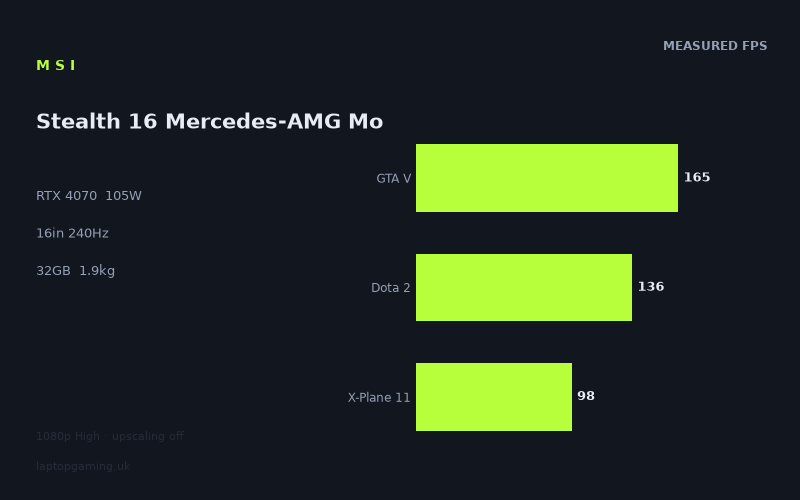
Frame rates
1920×1080, High preset, upscaling off.
Measured on this machine. Source: Notebookcheck, 2023-11-29.
Not scored: incomplete benchmark suite
Every scored laptop on this site is averaged over the same 5 games, and this one is short of Cyberpunk 2077, Baldur's Gate 3. A mean over 3 games is not comparable to a mean over 5, so we publish the figures we have and leave the score blank rather than rank it against machines tested on a different set. The numbers below are real - the suite is just incomplete.
How these numbers were produced
Frame rates here are not measured by us, and we label how each one was arrived at. A figure marked measured comes from a published run on that exact machine. A figure marked representative is derived from the GPU and its power limit (TGP) and cross-referenced against published reviews - a sound estimate of what that configuration delivers, but not a measurement of that specific laptop. Unless stated otherwise, numbers are 1920x1080, High preset, upscaling off. Where a laptop ships in several power configurations we use the wattage of the exact SKU listed, because a 140W RTX 5070 and a 115W one are not the same product.
In use
The short version
The MSI Stealth 16 Mercedes-AMG Motorsport is a strikingly specified gaming laptop on paper: an RTX 4070 running at a 105W GPU power limit, a Core i9-13900H, 32GB of memory, a 16in 3840x2400 OLED display and a 240Hz refresh rate, all in a machine listed at 1.9kg. That is a serious set of ingredients, particularly for someone who wants a comparatively light 16in laptop rather than a much heavier desktop-replacement design.
The benchmark data, measured by Notebookcheck at 1920x1080 using the High preset with upscaling disabled, shows that this is a capable 1080p gaming machine. It reaches 220fps in Strange Brigade, 205fps in The Witcher 3, 165fps in GTA V and 152fps in Counter-Strike 2. Those are properly high frame rates, and they make clear that the Stealth 16 is not short of performance in lighter or older games.
The more demanding end of the results matters just as much. The same configuration records 101fps in Final Fantasy XV, 98fps in X-Plane 11, 85fps in EA Sports WRC and 65fps in Alan Wake 2. Those are still playable-looking figures at the tested 1920x1080 High setting, but they also show why the machine should not be treated as a 240fps laptop merely because its screen refreshes at 240Hz. The panel has far more refresh capacity than the measured figures can consistently use in demanding games.
The central buying decision is therefore not whether the RTX 4070 can game. It plainly can. The question is whether this particular balance of components suits what you intend to play and how you intend to use the display. The Stealth 16 makes most sense for somebody who values the 1.9kg weight, wants 32GB of memory as part of the standard specification, likes the idea of a 16in 3840x2400 OLED panel, and plays a mixture of esports, older games and demanding modern releases rather than expecting every title to run near the screen’s 240Hz ceiling.
It is less convincing for the buyer whose priority is extracting the highest possible frame rate from an RTX 4070. The comparison data is revealing here. Against the Acer Predator Triton Neo 16, another RTX 4070 machine with a 110W GPU power limit, the MSI averages +0fps across the shared games. Against the Razer Blade 14 RTX, also using an RTX 4070, it averages -0fps across the shared games. In other words, the available shared-game data shows effectively no separation between these RTX 4070 systems. That may be reassuring if you want the Stealth 16’s particular screen and weight, but it means the MSI does not establish a performance advantage over its closest rivals.
The lack of a confirmed UK price is a major limitation when judging value. There is no sensible way to call a laptop good value, poor value or sensibly positioned without knowing what it costs in the UK. The Acer Predator Triton Neo 16 is listed at GBP 2,355, while the Asus ROG Strix Scar 17 is listed at GBP 4,866, but the MSI’s own UK price is not confirmed. That makes a direct value verdict impossible rather than merely difficult.
There is also no complete comparable scoring result for this laptop. The supplied scoring-suite figures cover GTA V, Dota 2 and X-Plane 11, where the MSI has a 133fps mean. We do not have its figures for Cyberpunk 2077 or Baldur’s Gate 3. Because scored laptops are averaged across the same five games, this partial set cannot be ranked fairly against them. The 133fps figure is useful as a summary of those three games, but it is not a substitute for a complete like-for-like result.
Buy the Stealth 16 Mercedes-AMG Motorsport if the combination of a 16in OLED screen, 240Hz refresh rate, 32GB of memory and 1.9kg weight is what you are shopping for, and if its eventual UK price is sensible against RTX 4070 alternatives. Do not buy it on the assumption that the 240Hz panel means 240fps gaming in every major release. The measured figures do not support that expectation. Likewise, do not buy it simply because the Mercedes-AMG Motorsport edition name implies a performance lead over other RTX 4070 laptops: the closest comparison data shows no meaningful frame-rate advantage.
Performance
What the measured figures say
Notebookcheck’s figures were recorded at 1920x1080, using the High preset and with upscaling disabled. That matters because it gives the RTX 4070 a defined workload. These are not native-resolution measurements for the 3840x2400 screen, and they are not results produced with upscaling helping the machine reach a higher frame rate. They show conventional 1080p High performance without that extra variable.
The results are as follows:
- Strange Brigade: 220fps
- The Witcher 3: 205fps
- GTA V: 165fps
- Counter-Strike 2: 152fps
- Dota 2: 136fps
- Final Fantasy XV: 101fps
- X-Plane 11: 98fps
- EA Sports WRC: 85fps
- Alan Wake 2: 65fps
That is a broad spread, from 220fps in Strange Brigade to 65fps in Alan Wake 2. It would be a mistake to reduce this laptop to one average and assume every game behaves in the same way. The individual figures tell the useful story: there are games where the Stealth 16 is operating at a level that suits a very high-refresh display, games where it is comfortably above 100fps, and games where the result is much closer to the traditional expectation of a smooth 60fps-class experience than to the 240Hz maximum of the panel.
Strange Brigade at 220fps is the clearest example of the Stealth 16 approaching the display’s refresh ceiling. The Witcher 3 at 205fps is similarly high. These are the results that make the 240Hz screen feel relevant, even though neither result reaches 240fps. If these are representative of the games you play, the machine has enough measured performance to make a high-refresh panel more than a paper specification. Fast movement and rapid input can be presented at frame rates far above the usual 60fps level.
GTA V at 165fps remains a strong result. It is below the figures in Strange Brigade and The Witcher 3, but it is still a frame rate well suited to a fast panel. Counter-Strike 2 at 152fps is also a substantial result for a competitive game. It does not fill every refresh opportunity offered by a 240Hz screen, but it is clearly operating in the high-frame-rate territory buyers of a 240Hz laptop will care about.
Dota 2 at 136fps reinforces the same point. The MSI can produce a high frame rate in this sort of game, but the measured result is not close to 240fps. Anyone buying specifically for a 240Hz display should be realistic about that distinction. A high-refresh screen is not a guarantee that every game will run at its maximum refresh rate, even when the game is generally regarded as less demanding than the heaviest releases in the benchmark list.
Final Fantasy XV at 101fps is an important transition point in the set. It remains above 100fps, which is a good result at 1920x1080 High with upscaling disabled, but it is markedly removed from the 205fps and 220fps results seen elsewhere. X-Plane 11 is similar at 98fps. These figures are not weak; they are simply reminders that “RTX 4070 laptop” does not describe a fixed gaming experience. The game itself remains a major part of the result.
EA Sports WRC at 85fps and Alan Wake 2 at 65fps are the figures that should prevent overconfident buying assumptions. The Stealth 16 can run these games at the benchmarked 1080p High setting without upscaling, but neither result has much to do with the screen’s 240Hz maximum. Alan Wake 2, in particular, sits at 65fps in the available data. That is a far more relevant expectation for a demanding title than the 220fps result from Strange Brigade.
There is no contradiction in these results. The laptop is not alternately fast and slow in any simple sense. Different games place different demands on a system, and the benchmark data shows the practical consequence. At one end, the Core i9-13900H and RTX 4070 combination produces more than 200fps. At the other, a demanding game brings the result down to 65fps even at 1920x1080 High with upscaling switched off. The useful conclusion is that the Stealth 16 has a strong 1080p performance base, but not a universal 240fps one.
The 105W RTX 4070 in context
The GPU is an RTX 4070 with a 105W power limit. That specific limit is part of the machine’s identity, because laptop RTX 4070 systems are not all configured in exactly the same way. The comparison set includes an Acer Predator Triton Neo 16 with an RTX 4070 at 110W, a Razer Blade 14 RTX with an RTX 4070, an MSI Thin GF63 with an RTX 4050, and an Asus ROG Strix Scar 17 with an RTX 4090.
The most useful comparison is the Acer, because its RTX 4070 has a 110W GPU power limit, close to the MSI’s 105W. Across three shared games, the Stealth 16 averages +0fps against the Acer. That is a real result, not missing data and not a reason to force a winner. The shared-game figures indicate no effective performance separation between them.
It would be easy to look at 105W and 110W and expect the Acer to be visibly ahead. The benchmark comparison says otherwise in the shared set. At 1920x1080, lighter titles can become limited by factors other than the GPU, including the CPU side of the system, and that compresses genuine GPU differences. In practical terms, a small difference in GPU power limits does not necessarily produce a visible difference in the measured results when the shared games are already running at high frame rates.
The Razer Blade 14 RTX produces the same broad message. The Stealth 16 averages -0fps against it across three shared games. Again, that is effectively a tie. The minus sign merely indicates the direction of a difference that rounds to zero in the supplied comparison. It should not be presented as a meaningful defeat for the MSI, just as the +0fps result against the Acer should not be presented as a meaningful win.
This is particularly relevant to anyone shopping within the RTX 4070 category. The Stealth 16’s 105W specification should not be read as a promise that it will outrun similarly equipped alternatives. Nor should it be assumed to be compromised simply because another RTX 4070 machine is listed with a 110W limit. In the shared-game comparisons provided, the measured outcome is essentially level.
That does not mean GPU power limits never matter. It means the available figures show their practical effect only in the specific games and settings compared. This site’s approach is to follow attributable frame-rate data rather than make broad claims from specifications alone. Here, the specification gives useful context, but the benchmark comparisons are more important: the MSI performs at the same effective level as the closest RTX 4070 rivals in the shared 1080p High tests.
The contrast with the RTX 4050-equipped MSI Thin GF63 is more pronounced. The Stealth 16 averages +45fps across three shared games. That is the largest positive comparison in the supplied rival set, and it gives the clearest indication of what the RTX 4070-class configuration is buying over a lower-tier GPU in this generation. A difference of that size is more meaningful than the effectively level results against the Acer and Razer RTX 4070 machines.
At the other end, the Asus ROG Strix Scar 17 with an RTX 4090 averages +66fps against the Stealth 16 across three shared games. That is the largest deficit in the comparison group. The MSI is not intended to match that level of gaming hardware, and the shared-game result makes the gap plain. A buyer seeking the highest frame rates available from this generation should not try to rationalise that difference away. The Scar 17 is materially faster in the shared data.
Equally, the Scar 17’s listed price is GBP 4,866, while the Stealth 16’s UK price is not confirmed. Those facts are important together. The Asus has the strongest shared-game performance advantage, but it also occupies a known premium price point. Without a confirmed price for the MSI, the performance gap can be described but the value trade-off cannot be settled.
The scoring-suite figures and what they can, and cannot, prove
The MSI has measured scoring-suite figures for GTA V, Dota 2 and X-Plane 11. They are 165fps, 136fps and 98fps respectively, producing a 133fps mean across those three games. This is a useful snapshot because the three games cover noticeably different results. GTA V is the strongest of the group, Dota 2 remains high, and X-Plane 11 is below 100fps.
The 133fps mean should not be treated as the laptop’s overall gaming result. It applies only to the three scoring-suite games for which figures are available. There are no supplied results for Cyberpunk 2077 or Baldur’s Gate 3. Because every fully scored laptop is averaged over the same five games, a partial three-game mean cannot be ranked against a complete five-game average.
This matters because a machine can look stronger or weaker depending on which games are included. The Stealth 16’s available data includes 220fps in Strange Brigade and 205fps in The Witcher 3, but it also includes 85fps in EA Sports WRC and 65fps in Alan Wake 2. Selecting only its best figures would overstate the experience. Selecting only its hardest result would understate it. The incomplete scoring suite means the honest position is simple: there is not enough like-for-like data to place this laptop in a complete score-based ranking.
That is not a criticism of the frame-rate measurements that do exist. Notebookcheck’s numbers still give prospective buyers a good deal to work with. They show a laptop that is very fast in several games, strong in a number of others, and more limited in the most demanding examples. They also show that it sits effectively level with the nearest RTX 4070 rivals in the shared games, clearly ahead of the RTX 4050 rival, and clearly behind the RTX 4090 rival.
The screen
A 3840x2400 OLED display with a 240Hz refresh rate
The Stealth 16 Mercedes-AMG Motorsport has a 16in OLED display with a 3840x2400 resolution and a 240Hz refresh rate. This is an unusually ambitious display specification for a 1.9kg gaming laptop. The resolution is substantially above the 1920x1080 benchmark resolution, while the 240Hz refresh rate sets a high target for games that can produce very high frame rates.
It is important not to confuse the laptop’s screen specification with its measured gaming output. All of the available frame rates were measured at 1920x1080 on the High preset with upscaling off. We do not have frame-rate figures for gaming at the panel’s native 3840x2400 resolution. As a result, it would be wrong to claim that the RTX 4070 at 105W can drive these games at native resolution at any particular frame rate.
That missing information matters more here than it would on a 1920x1080 laptop. The display has a 3840x2400 resolution, while the benchmark data is at 1920x1080. The figures demonstrate performance at the tested setting; they do not demonstrate native-panel performance. A buyer considering this machine primarily for native-resolution gaming should treat that distinction as central, not as a footnote.
The 240Hz refresh rate is best understood as headroom. In Strange Brigade, the measured 220fps figure comes closest to using that headroom. The Witcher 3 at 205fps also makes compelling use of a fast panel. GTA V at 165fps, Counter-Strike 2 at 152fps and Dota 2 at 136fps are all high enough to benefit from a refresh rate above 60Hz, even though they do not reach 240fps in the supplied results.
Final Fantasy XV at 101fps and X-Plane 11 at 98fps offer a different sort of fit. These are still high frame rates by ordinary gaming-laptop standards, but the gap between the measured output and the display’s maximum refresh rate is obvious. EA Sports WRC at 85fps and Alan Wake 2 at 65fps sit further from the 240Hz ceiling again. The display can refresh at 240Hz; the demanding games in the test list do not consistently provide the frames needed to fill it.
That does not make the 240Hz panel pointless. It means buyers should match expectations to their games. Someone spending most of their time in Strange Brigade, The Witcher 3, GTA V, Counter-Strike 2 or Dota 2 has evidence that the Stealth 16 can produce high frame rates at the tested 1080p High setting. Someone focused on Alan Wake 2 or EA Sports WRC should expect a very different performance profile from the same hardware.
Native resolution is the unanswered question
The screen’s 3840x2400 resolution is a major part of the appeal, but it is also where the available data stops. There are no native-resolution figures in the fact sheet, no alternative preset figures, and no figures with upscaling enabled. We therefore cannot say which of the measured games will be comfortable at 3840x2400, whether any will approach 240fps there, or what compromises might be required in demanding titles.
This uncertainty should affect the buying decision. If your priority is a laptop screen that can display a 3840x2400 image for uses beyond the benchmarked gaming scenario, the specification is clear: this is a 16in 3840x2400 OLED panel. If your priority is playing the latest demanding games at that native resolution, the supplied information does not provide the evidence needed to promise a particular result.
The disciplined conclusion is that the RTX 4070 configuration is proven here at 1920x1080 High with upscaling off, not at 3840x2400. That is not a small distinction. It is the difference between reporting measured performance and assuming performance from a specification sheet.
Build, size and portability
The available physical specification gives one clear portability figure: the MSI weighs 1.9kg. For a machine with a 16in display, 32GB of memory, a Core i9-13900H and an RTX 4070, that is the key number for anyone deciding whether this is a laptop to move regularly or one that will mostly remain on a desk.
A 1.9kg gaming laptop occupies a different category from the very largest performance-first systems. The Asus ROG Strix Scar 17 is the machine in this comparison group associated with the RTX 4090 performance lead, while the MSI is the model built around an RTX 4070 and a 16in screen. The benchmark data shows the Scar 17 is faster across the shared games, but the MSI’s listed weight makes clear that it is pursuing a different balance of performance and portability.
That balance will suit buyers who need a large, high-resolution display but do not want the machine’s entire identity to be maximum gaming output. The 16in panel is substantial enough to make screen quality and workspace relevant to the purchase, while the 1.9kg weight is low enough to make regular movement a realistic part of the ownership case. The hardware selection is not simply “as much GPU as possible”; it is a blend of a powerful CPU, 32GB of memory, an RTX 4070, OLED display technology and comparatively restrained weight.
There are limits to what can responsibly be said about the chassis from the supplied facts. We do not have dimensions, thickness, port information, battery-life figures, charging information, keyboard details, webcam details, temperature figures or noise measurements. We cannot say how much desk space it occupies, how easy it is to fit into a particular bag, whether it runs quietly, or how it behaves away from mains power. Those are meaningful omissions for a machine whose appeal partly rests on being 1.9kg.
The Mercedes-AMG Motorsport branding should also not be allowed to substitute for evidence about build quality or practicality. The name identifies this edition, but the supplied information does not provide measurements or observations that would support claims about materials, rigidity, keyboard feel, trackpad quality or long-term durability. Prospective buyers should treat the branding as an edition identifier rather than as proof of a performance or usability advantage.
What the data does support is a straightforward position. If you want a 16in gaming laptop that weighs 1.9kg and carries an RTX 4070, Core i9-13900H, 32GB of memory and a 3840x2400 240Hz OLED display, the Stealth 16’s specification is unusually focused. If you need confirmation of battery life, ports, acoustics, temperatures or dimensions before buying, this fact sheet does not provide it.
How it compares
Against the MSI Thin GF63 with RTX 4050
The MSI Thin GF63 is the clearest performance step down in the comparison set. It uses an RTX 4050, and the Stealth 16 averages +45fps across three shared games. That is a substantial advantage for the Stealth 16 and the most convincing evidence in the rival list that the RTX 4070 configuration has a meaningful gaming-performance benefit over a lower-tier GPU.
There is no confirmed UK price for the MSI Thin GF63, so this cannot become a value verdict. A lower-priced RTX 4050 laptop may still be the sensible choice for a buyer with a fixed budget, but the supplied frame-rate comparison makes the performance sacrifice clear. The Stealth 16 is not just slightly ahead in the shared games; it has a +45fps average advantage.
That comparison is useful for buyers deciding whether an RTX 4050-class machine is enough. If your focus is games that already run at very high frame rates, a lower-tier option may still be adequate for your needs. But the Stealth 16’s own results show a wide range across games, with demanding titles such as EA Sports WRC at 85fps and Alan Wake 2 at 65fps. In that context, starting from a faster GPU class provides more performance margin in the shared-game data.
Against the Acer Predator Triton Neo 16
The Acer Predator Triton Neo 16 is the closest technical comparison listed: an RTX 4070 with a 110W GPU power limit, priced at GBP 2,355. The Stealth 16’s RTX 4070 has a 105W GPU power limit. Across three shared games, the MSI averages +0fps.
The correct reading is that the machines are level in the available shared-game performance data. It is not evidence that the MSI is faster, and it is not evidence that the Acer’s extra listed GPU power limit translates into a meaningful lead. At 1920x1080, lighter games in a shared set can become CPU-bound and compress genuine GPU gaps. When frame rates are already high, small configuration differences can be hidden by the limits of the game workload rather than exposed by it.
For a buyer choosing between these two, performance is therefore not the obvious differentiator on the provided data. The decision instead turns on the MSI’s known specification — 1.9kg, 16in 3840x2400 OLED, 240Hz, Core i9-13900H and 32GB memory — against the Acer’s known GBP 2,355 price and 110W RTX 4070 specification. Since the MSI’s UK price is not confirmed, a final value judgement has to wait.
Against the Razer Blade 14 RTX
The Razer Blade 14 RTX is another RTX 4070 rival without a confirmed UK price. Across three shared games, the Stealth 16 averages -0fps. In practice, that is another tie. The MSI is neither meaningfully behind nor meaningfully ahead in the supplied comparison.
This is useful because it stops the Stealth 16 being judged solely as a 16in model. The available shared-game evidence says its RTX 4070 performance is effectively matched by the Razer rival. That means a buyer should not assume that choosing the MSI’s 16in format automatically means accepting a gaming-performance penalty, at least not in these shared 1080p High measurements.
At the same time, no confirmed UK price is available for either machine in the supplied facts. A close performance result without confirmed pricing cannot tell us which is the better purchase. It only tells us that gaming speed, in the games both machines hold, is not where the decision will be won.
Against the Asus ROG Strix Scar 17
The Asus ROG Strix Scar 17 represents the high-performance end of this rival group. It uses an RTX 4090 and is listed at GBP 4,866. Across three shared games, it averages +66fps over the Stealth 16.
That is the meaningful performance gap in the other direction. The MSI’s results are strong, but the Scar 17 is decisively faster in the shared data. Buyers whose main objective is the highest frame rates should recognise that the RTX 4090 machine occupies a different performance tier in this comparison.
The price context is equally important. GBP 4,866 is a very high listed price, and the Stealth 16’s UK price is not confirmed. It would be irresponsible to say that the MSI is better value simply because it is slower, or to say that the Asus is worth its premium simply because it is faster. The available facts establish the performance difference and the Asus price; they do not establish the MSI price needed to make the financial argument.
Who it’s for
The MSI Stealth 16 Mercedes-AMG Motorsport is for the buyer who wants a specific blend of gaming performance, display specification and portability. The 1.9kg weight is central. So is the 16in 3840x2400 OLED display. So are the Core i9-13900H and 32GB of memory. These are not minor additions around an RTX 4070; together, they define the machine’s appeal.
It is particularly suited to someone who plays games represented by the higher end of the benchmark list. Strange Brigade at 220fps, The Witcher 3 at 205fps, GTA V at 165fps, Counter-Strike 2 at 152fps and Dota 2 at 136fps demonstrate that the laptop can produce the sort of high frame rates that make a 240Hz panel worthwhile at the tested 1920x1080 High setting. For a player who mixes competitive titles with less demanding games, this is a credible high-refresh gaming laptop.
It also suits the buyer who wants a machine capable of running more demanding releases without assuming those releases will behave like esports games. Final Fantasy XV at 101fps, X-Plane 11 at 98fps, EA Sports WRC at 85fps and Alan Wake 2 at 65fps show that the Stealth 16 still has useful performance in heavier games at the benchmarked setting. The frame rates are lower, but they are part of a realistic RTX 4070 laptop profile rather than a sign that the machine is limited to lightweight games.
The MSI makes less sense for someone who treats native 3840x2400 gaming as non-negotiable. We simply do not have native-resolution benchmark figures. The screen can display 3840x2400, but the provided performance results are all at 1920x1080. Anyone buying specifically to run demanding games at the panel’s full resolution needs data that is not included here.
It is also not the right laptop for the buyer who expects 240fps in every game because the panel is 240Hz. The measured figures show exactly why. Only Strange Brigade reaches 220fps, The Witcher 3 reaches 205fps, and the remaining listed games fall further below the refresh limit. Alan Wake 2 at 65fps is especially important evidence that the display specification cannot be used as a shortcut for predicting game performance.
Buy something else if your priority is maximum frame rate regardless of price and size. The Asus ROG Strix Scar 17 with RTX 4090 averages +66fps across the shared games. That is the model in this comparison set for the buyer who wants a clear performance lead over the MSI. Its GBP 4,866 listed price is substantial, but its performance advantage is also substantial.
Buy something else if you are shopping at the lower GPU tier and the MSI’s eventual UK price is beyond reach. The MSI Thin GF63 with RTX 4050 is slower by an average of 45fps across the shared games, but its UK price is also not confirmed. That option is for the buyer prepared to give up performance rather than for someone expecting the same frame-rate experience at a lower cost.
Consider the Acer Predator Triton Neo 16 or Razer Blade 14 RTX carefully if the MSI’s eventual UK price is high. The MSI is effectively tied with both in the supplied shared-game comparisons: +0fps against the Acer and -0fps against the Razer. There is no performance evidence here that justifies paying a major premium for the MSI over another RTX 4070 machine. The deciding factors would need to be the MSI’s OLED screen, 3840x2400 resolution, 240Hz refresh rate, 32GB memory, 1.9kg weight and whatever price it eventually carries in the UK.
The final judgement is therefore conditional rather than vague. The Stealth 16 Mercedes-AMG Motorsport is a strong specification-led choice with convincing 1080p High frame rates in a broad range of games. It is effectively level with the closest RTX 4070 rivals in shared-game testing, comfortably ahead of the RTX 4050 rival, and clearly behind the RTX 4090 rival. Its screen is exceptional on paper, but native-resolution gaming performance is not established by the available measurements. Its UK price is not confirmed, so value cannot yet be judged honestly. If that price lands sensibly, the mix of 1.9kg portability, 32GB memory, OLED display and RTX 4070 gaming performance will be attractive. If it lands at a premium over equally fast RTX 4070 alternatives, the benchmark data gives little reason to pay extra purely for frame rate.