Review
Acer Aspire 17 review
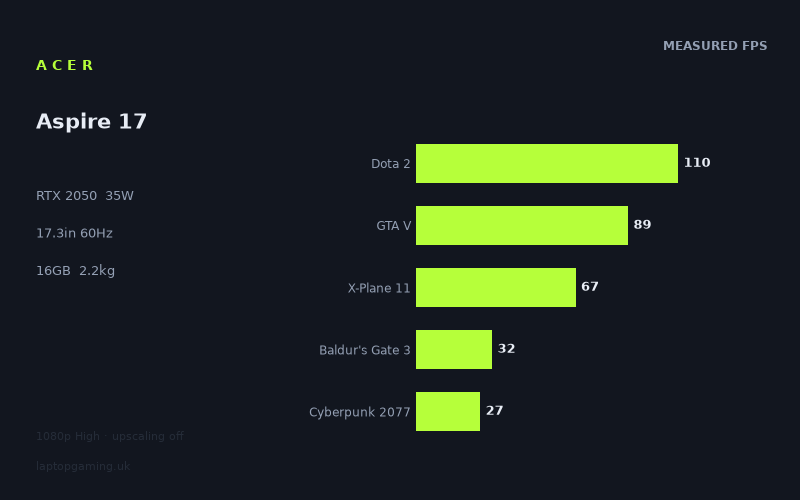
Frame rates
1920×1080, High preset, upscaling off.
Measured on this machine. Source: Notebookcheck, 2024-11-21.
Not scored: incomplete benchmark suite
Every scored laptop on this site is averaged over the same 5 games, and this one is short of Cyberpunk 2077, Baldur's Gate 3. A mean over 5 games is not comparable to a mean over 5, so we publish the figures we have and leave the score blank rather than rank it against machines tested on a different set. The numbers below are real - the suite is just incomplete.
How these numbers were produced
Frame rates here are not measured by us, and we label how each one was arrived at. A figure marked measured comes from a published run on that exact machine. A figure marked representative is derived from the GPU and its power limit (TGP) and cross-referenced against published reviews - a sound estimate of what that configuration delivers, but not a measurement of that specific laptop. Unless stated otherwise, numbers are 1920x1080, High preset, upscaling off. Where a laptop ships in several power configurations we use the wattage of the exact SKU listed, because a 140W RTX 5070 and a 115W one are not the same product.
In use
The short version
The Acer Aspire 17 is a large-screen laptop with a gaming-capable discrete GPU, but it is not a convincing £899 gaming buy if modern demanding games are the priority. The RTX 2050 is configured at a 35W GPU power limit, and Notebookcheck’s measured figures show a machine that can run older, lighter and better-scaled games well at its native 1920x1080 resolution, while struggling badly once a game makes sustained demands of the GPU.
There is a clear split in the results. Dota 2 reaches 110fps, GTA V manages 89fps, X-Plane 11 records 67fps and Strange Brigade reaches 64fps. Those are useful results for the Aspire 17’s 60Hz display: each is at or above the screen’s refresh rate, so the laptop has enough performance for a smooth-looking experience in those particular games at 1920x1080 on the High preset with upscaling disabled.
The position changes rapidly with newer games. F1 24 records 49fps, then Final Fantasy XV falls to 34fps. Baldur’s Gate 3 and God of War Ragnarök both reach 32fps, Space Marine 2 manages 31fps and Cyberpunk 2077 records 27fps. Ghost of Tsushima reaches 18fps, while Star Wars Outlaws, Final Fantasy XVI and Until Dawn sit in the mid-teens. Senua’s Saga Hellblade 2 is effectively not playable in this configuration, with a measured result of 2fps.
That spread matters more than the average alone. The five-game scoring-suite mean is 73fps, which sounds respectable in isolation, but it is supported heavily by Dota 2, GTA V, X-Plane 11 and Strange Brigade. The Aspire 17 can look much stronger than it is if the only question is whether it can run familiar, relatively light games at 1080p. It looks much weaker if the purchase is meant to cover current, graphically intensive releases without compromises.
At £899, the central problem is not that the Aspire 17 fails to run every game. No laptop should be judged by an impossible standard. The problem is that the measured performance leaves very little room for a buyer who wants a long-term 1080p gaming machine. The 17.3in IPS display, 16GB of memory and 1024GB SSD make the specification sound broadly sensible, but the GPU’s 35W limit defines the experience. This is a laptop for selective gaming, not a machine to buy on the assumption that a discrete RTX badge guarantees comfortable performance in demanding current titles.
It makes most sense for somebody who genuinely values the 17.3in screen and has a library centred on games closer to Dota 2, GTA V, X-Plane 11 and Strange Brigade than to Cyberpunk 2077, Star Wars Outlaws or Senua’s Saga Hellblade 2. It also suits a buyer who is prepared to reduce settings, lower resolution or use upscaling where a game offers it, although the published figures here are specifically from the High preset with upscaling off. There is no measured low-setting or upscaled result in the fact sheet, so it would be wrong to promise a particular recovery in performance from those changes.
It is not the right choice for someone spending £899 primarily to play recent blockbuster releases at the screen’s native resolution and High settings. The benchmark data does not support that expectation. Nor is it a natural fit for a buyer who wants to make proper use of a high-refresh gaming display, because this particular Aspire has a 60Hz panel and the demanding-game results are well below even that modest refresh target.
Performance
A 35W RTX 2050 sets the ceiling
The most important specification in the Aspire 17 is not the name of the GPU on its own, but the fact that the RTX 2050 has a 35W GPU power limit. A GPU power limit is central to how much performance a laptop graphics chip can sustain: it is the configured power ceiling within which the GPU has to operate. That means the RTX 2050 here should be assessed as the 35W implementation measured by Notebookcheck, not as a generic RTX 2050 with assumed performance.
This matters particularly because the Aspire 17 is being sold at £899. Buyers do not spend that amount on a laptop simply to read a component list; they spend it for the performance that specific combination of processor, graphics configuration, memory and cooling arrangement can deliver. The Core 7 150U, 16GB of memory and RTX 2050 may be enough to produce good figures in some games, but the measured results show that the 35W graphics configuration has a narrow comfort zone at 1920x1080 High.
Notebookcheck’s results were recorded at 1920x1080, using the High preset with upscaling off. That is an important and appropriately demanding baseline for this laptop because the Aspire 17 itself has a 1920x1080 screen. The results therefore answer the question most buyers will actually have: what can this machine do at its native display resolution without relying on an upscaling mode to make the numbers look better?
The answer is mixed rather than uniformly poor. A 35W RTX 2050 can still deliver strong performance where a game is comparatively light or where the wider system is able to keep the GPU supplied effectively. Dota 2 at 110fps is the best result in the published list. GTA V at 89fps is also comfortably beyond the display’s 60Hz refresh rate. X-Plane 11 at 67fps and Strange Brigade at 64fps both clear that same 60Hz threshold.
Those results are not meaningless outliers. They tell a prospective owner that the Aspire 17 is capable of delivering smooth native-resolution gaming in the right titles. For someone who mostly plays Dota 2, GTA V, X-Plane 11 or Strange Brigade, the machine’s practical gaming experience could be far more positive than the weaker headline results suggest. In these games, the display becomes the limiting factor before the measured frame rate falls short of the screen’s refresh rate.
But they must not be used as proof that the laptop is broadly capable of High-preset gaming. The same test conditions produce 49fps in F1 24, 34fps in Final Fantasy XV, 32fps in Baldur’s Gate 3, 32fps in God of War Ragnarök, 31fps in Space Marine 2 and 27fps in Cyberpunk 2077. The laptop is not merely missing a high-refresh target in these games; it is below the 60Hz screen’s ceiling, sometimes substantially so.
The deeper issue is consistency. A gaming laptop does not need to hit exactly the same result in every title, because games impose very different loads on the processor and graphics hardware. What matters is whether the lower end of the results remains useful for the buyer’s expected games. Here, the lower end falls away sharply. Ghost of Tsushima records 18fps. Star Wars Outlaws reaches 16fps. Final Fantasy XVI and Until Dawn each record 15fps. Senua’s Saga Hellblade 2 records 2fps.
That is too wide a gap to describe the Aspire 17 simply as a 1080p High gaming laptop. It is more accurate to call it a laptop that can run a selection of games well at 1080p High, while requiring a more cautious approach in demanding releases. The distinction matters because an £899 purchase should not force a buyer to discover, after the fact, that their preferred games sit at the wrong end of the list.
Games that suit the Aspire 17
Dota 2 is the clearest positive result. Notebookcheck’s figure of 110fps is well beyond the Aspire 17’s 60Hz refresh rate. At this preset and resolution, the machine has enough performance that the panel rather than the frame rate becomes the obvious constraint. A buyer whose competitive or social gaming is centred on Dota 2 should not look at the Aspire 17’s weaker results in newer games and assume the laptop is unusable for everything. It plainly is not.
GTA V at 89fps tells a similar story. The laptop can exceed the panel refresh rate at 1920x1080 High with upscaling disabled, which is a useful result for a game that remains widely played. Again, there is no need to pretend that this turns the Aspire 17 into a high-refresh gaming laptop; the panel is only 60Hz. But it does mean that GTA V is within the machine’s comfortable zone under the published conditions.
X-Plane 11 at 67fps is another result that clears the screen’s refresh rate. Flight simulation performance can be especially sensitive to the broader system as well as the graphics hardware, so it is useful that the Aspire 17 has a measured figure rather than an assumption based solely on the RTX 2050 name. The published result says that this game, in this test configuration, is viable at the laptop’s native resolution and High preset.
Strange Brigade reaches 64fps, again above 60Hz. This reinforces the pattern: the Aspire 17 can properly serve games that are less punishing at the tested settings. It does not have to be treated as a laptop that only runs games at low settings. The evidence is more nuanced. It can run some games at High settings well enough to match or exceed the display, but its suitability is title-dependent.
The five-game scoring-suite mean of 73fps is consistent with these better results. It includes Dota 2, GTA V, X-Plane 11, Strange Brigade and Final Fantasy XV. The first four are above the 60Hz display refresh rate, while Final Fantasy XV is not. As a summary of that particular suite, 73fps is useful. As a guide to demanding recent releases beyond that suite, it is insufficient on its own.
This is why buyers should treat the list of individual games as more valuable than a single average. The mean does not tell you whether the laptop can run Cyberpunk 2077, Ghost of Tsushima or Star Wars Outlaws well at the settings tested. The individual figures do, and those figures are much less encouraging.
The middle ground is already compromised
F1 24 at 49fps is the first warning that the Aspire 17’s native 1080p High setting is not a universal fit. A measured result below the screen’s 60Hz refresh rate is not automatically unacceptable. Different players have different expectations, and some games remain enjoyable below 60fps. But £899 is a substantial sum, and 49fps is not a result that suggests much headroom. It is a signal that the laptop is already operating close to its practical limit in a game that cannot reach the display’s basic refresh ceiling under the tested conditions.
Final Fantasy XV at 34fps is a more serious concern. It is included in the scoring suite, which is one reason the 73fps mean must be read carefully rather than treated as a blanket verdict. The Aspire 17 can produce high results in several lighter games, but Final Fantasy XV shows how quickly the system’s position changes when a title places greater demand on the GPU.
Baldur’s Gate 3 and God of War Ragnarök both record 32fps. The matching results are useful because they show that the Aspire 17’s limitations are not confined to one unusual engine or one isolated benchmark. Two very different games land at the same level in Notebookcheck’s measurements. That makes it hard to argue that the 35W RTX 2050 has enough reserve for broadly comfortable High-preset gaming at native resolution.
Space Marine 2 at 31fps supports the same conclusion. This is not a case where the Aspire 17 misses 60fps by a narrow margin in one or two games while otherwise holding up well. The laptop has several results around the low-thirties. That is a level at which settings decisions become part of ownership rather than an occasional tweak for one particularly demanding release.
Cyberpunk 2077 at 27fps is more concerning again. It is a demanding title and should not be used as the sole judge of any laptop, but it remains a useful stress test for a machine marketed with discrete graphics. At 1920x1080 High with upscaling disabled, the Aspire 17 is below a level many buyers would regard as comfortable. The benchmark data suggests that a player intending to run Cyberpunk 2077 on this laptop would need to make concessions, but it does not provide a measured result for any particular alternative setting.
That limitation is worth stating plainly. There is a temptation in gaming-laptop reviews to respond to a poor High-preset result by confidently declaring that a lower preset or upscaling will solve everything. It may improve performance, but the fact sheet does not include those measurements. The defensible conclusion is narrower: at 1920x1080 High with upscaling off, the Aspire 17 records 27fps in Cyberpunk 2077. Buyers should not purchase it expecting the published configuration to provide a smooth experience in that game.
The demanding-game results are decisive
Ghost of Tsushima at 18fps is a clear indication that the Aspire 17’s GPU configuration is overmatched by some modern games at the tested settings. There is no useful way to frame 18fps as a minor compromise against a 60Hz screen. It is not close to the panel’s refresh rate and it leaves no performance cushion for busier scenes or other demands that may arise during play.
Star Wars Outlaws at 16fps, Final Fantasy XVI at 15fps and Until Dawn at 15fps continue the pattern. These are not borderline results where a buyer might simply decide that 60fps is unnecessary. They show that the laptop’s performance can fall to a level that makes the native-resolution High preset impractical for a significant category of recent, graphically demanding games.
Senua’s Saga Hellblade 2, at 2fps, is the starkest result in the entire table. That figure makes the wider point more effectively than any product positioning language could. The Aspire 17 is not a machine to buy for the confidence that it will run every current high-profile release at its native resolution and High settings. It does not do so in the benchmark data.
It is important not to overstate the conclusion beyond the evidence. The data does not say that every recent game will run at 2fps, 15fps or 18fps. It says the laptop’s performance varies dramatically by game. Some titles are above 60fps, while others are far below it. The practical buying conclusion is that a buyer needs to know their own library. If the desired games resemble the stronger results, the Aspire 17 may work. If they resemble the weaker results, it is the wrong machine at this price.
The GPU power limit helps explain why this distinction is so pronounced. The RTX 2050 in this particular laptop is a 35W implementation, and the benchmark data is the outcome of that configuration. It has enough capability for lighter workloads at 1080p High, but it does not have the sustained graphical headroom needed to keep the same settings viable across more demanding games. A lower-demand game can make the system look entirely competent; a newer and heavier title exposes the ceiling quickly.
The screen
A sensible resolution, but only a 60Hz refresh rate
The Aspire 17 has a 17.3in IPS display with a 1920x1080 resolution and 60Hz refresh rate. For this GPU configuration, 1920x1080 is the sensible native resolution. The published benchmark data is also at 1920x1080, so there is no uncertainty about whether the performance figures apply to the built-in screen’s pixel count. They do.
The screen’s 60Hz refresh rate is modest for a laptop presented as a gaming option, but it also avoids creating a performance target that the 35W RTX 2050 would rarely be able to exploit. A higher-refresh panel would have made the strong results in Dota 2 and GTA V more useful, but the laptop would still be unable to approach that higher refresh rate in many of the demanding games listed. With this panel, the Aspire 17 is at least matched sensibly to the better half of its performance range.
Dota 2 at 110fps and GTA V at 89fps both exceed 60Hz. X-Plane 11 at 67fps and Strange Brigade at 64fps also exceed the screen refresh rate. In those games, the panel is not being starved of frames. A buyer who plays them regularly will see the benefit of the machine’s available performance, even if the panel cannot display more than 60 refreshes per second.
F1 24 at 49fps does not reach the panel’s 60Hz ceiling, but it is not dramatically distant from it. From that point down, however, the gap becomes more substantial. Final Fantasy XV at 34fps, Baldur’s Gate 3 at 32fps, God of War Ragnarök at 32fps, Space Marine 2 at 31fps and Cyberpunk 2077 at 27fps all leave the panel underfed relative to its refresh rate at the tested preset.
The lower results are more consequential still. Ghost of Tsushima at 18fps, Star Wars Outlaws at 16fps, Final Fantasy XVI at 15fps, Until Dawn at 15fps and Senua’s Saga Hellblade 2 at 2fps demonstrate that the limiting factor is plainly the graphics performance, not the display refresh rate. A 60Hz screen is not demanding by modern gaming standards. If a laptop cannot get close to it in a game, the answer is not that the panel is too ambitious; it is that the game is too heavy for the tested GPU configuration and settings.
IPS is the panel information available
The panel is specified as IPS. That is useful basic information, but the fact sheet does not provide measured brightness, colour coverage, contrast, response time or any assessment of panel quality. It would therefore be wrong to claim that the screen is bright, colour-accurate, fast, dim, slow or especially suitable for creative work. The reliable conclusion is limited to the supplied specification: it is a 17.3in IPS panel running at 1920x1080 and 60Hz.
For gaming, the larger concern is not an unknown panel measurement but the relationship between the screen and the GPU. The Aspire 17’s 60Hz display sets a realistic maximum target for its stronger games, but it does not rescue the weaker results. Buying this machine should not be about expecting the screen to deliver an esports-style high-refresh experience. It should be about wanting a large 1080p display for games that the RTX 2050 can run comfortably.
There is also a practical upside to the screen choice: the laptop does not ask its 35W RTX 2050 to render above 1920x1080. The benchmark data already shows that demanding titles can be difficult at this resolution and High settings. A higher-resolution panel would not have made that challenge easier. The Aspire 17’s display resolution is therefore appropriate to the graphics hardware, even if the graphics hardware is not powerful enough to make native-resolution High settings broadly reliable in newer games.
Build, size and portability
A large-screen laptop at 2.2kg
The Aspire 17 weighs 2.2kg and has a 17.3in screen. That combination puts it in a different use case from a smaller ultraportable laptop, even though the weight is not extreme in isolation. A buyer considering it should think of the Aspire 17 as a machine intended to provide a larger working and gaming area, with enough portability to move between rooms, take to work or study, or carry on occasion.
The fact sheet does not provide dimensions, chassis materials, port selection, keyboard details, webcam information, cooling noise or temperature measurements. Those are all important elements of day-to-day ownership, but they cannot be responsibly inferred from the model name, the screen size or the weight. The available evidence supports a narrow but useful conclusion: it is a 2.2kg laptop with a 17.3in display, rather than a claim about how compact, rigid, quiet or comfortable it may be.
At 2.2kg, the Aspire 17 is not a machine that has to remain on a desk permanently. But its 17.3in display means portability is unlikely to be its defining attraction. The larger screen is the reason to accept the larger format. It gives the buyer more display area than a smaller laptop, while the 1920x1080 resolution keeps the GPU’s rendering burden within a range that is at least workable for lighter games.
The portability argument is therefore conditional. It is portable enough for a buyer who wants a large-screen all-purpose machine that can be moved around rather than fixed in one place. It is less compelling for someone whose priority is frequent carrying and minimum luggage weight, because the 17.3in format and 2.2kg mass make it a meaningful item to transport. There is no need to dismiss it as immovable, but equally no reason to present it as a travel-first laptop.
Battery capacity is specified, battery life is not
The Aspire 17 has a 50Wh battery. That is the battery capacity available in the fact sheet. There is no measured battery-life figure, no web-browsing result, no video-playback result and no gaming battery result provided. It would be irresponsible to turn the 50Wh specification into a claim about how long the laptop lasts away from mains power.
For a buyer, this means battery life should remain an open question rather than a selling point. The machine may be carried between locations, but the published information does not establish its unplugged endurance. Anyone for whom battery life is central to the purchase should seek attributable battery testing before deciding, rather than assuming that the 50Wh figure guarantees a particular result.
The same caution applies to gaming away from the mains. The benchmark figures are published performance results at a stated resolution and preset, but the fact sheet does not say whether they were obtained on battery power or describe battery-mode behaviour. The review can assess the machine’s published gaming numbers, but it cannot claim what performance or runtime a buyer will see when unplugged.
Memory and storage are sensible, but not the deciding factor
The Aspire 17 includes 16GB of memory and a 1024GB SSD. Those are welcome specifications in a £899 laptop because they avoid the immediate concern of a very small memory allocation or very limited internal storage. They also make the machine more credible as a general-purpose large-screen laptop rather than a stripped-back configuration built around a discrete GPU badge.
However, the frame-rate data makes clear that memory capacity and storage capacity are not the issue defining the gaming verdict. The bottleneck in the weakest measured games is the overall graphics capability available from the RTX 2050 at its 35W power limit. A 1024GB SSD gives a buyer room for software and games, but it does not change the fact that Senua’s Saga Hellblade 2 records 2fps at the published settings, or that several recent games fall into the teens.
That is why the Aspire 17 needs to be judged as a complete purchase. Its 16GB memory, 1024GB SSD, Core 7 150U and 17.3in IPS screen make it a reasonably specified laptop on paper. Yet gaming value depends on the frame rates it actually delivers, and those figures do not support a broad recommendation for demanding 1080p High gaming at £899.
How it compares
Against the Acer Aspire 5 with the same GPU and power limit
The closest listed comparison is the Acer Aspire 5, also equipped with an RTX 2050 at a 35W GPU power limit. Across five shared games, the Aspire 17 averages 2fps lower than the Aspire 5. There is no confirmed UK price for the Aspire 5 in the fact sheet, so there is no sound basis for a direct value judgement between them. It would be wrong to imply that one is cheaper or better value without an attributable price.
The 2fps difference is near-zero in practical terms, and the fact sheet explains why such close results should not be over-read. At 1080p, lighter titles in the shared set can be CPU-bound, compressing genuine GPU gaps. In this case, the two laptops have the same RTX 2050 and the same 35W power limit, so a very small spread is unsurprising. The result should not be turned into a dramatic win or loss for either machine.
For the Aspire 17 specifically, the comparison confirms that its gaming position is not transformed simply by moving to the larger 17.3in format. Its 2fps deficit is too small to establish a meaningful performance separation. A buyer choosing between these Acer models should therefore focus on the available specifications that genuinely differ in the supplied information, particularly the Aspire 17’s 17.3in display, 2.2kg weight and confirmed £899 price. The shared-game benchmark gap is not a reason to choose one over the other.
It also reinforces the need to look at the individual game results rather than assume the RTX 2050 name delivers a consistent class of performance. The Aspire 17’s own results range from 110fps in Dota 2 to 2fps in Senua’s Saga Hellblade 2. A near-tie with another 35W RTX 2050 machine does not make that range disappear. It merely says that, in shared titles, the two implementations perform almost the same.
Against the Schenker XMG Core 15 with RTX 2060
The Schenker XMG Core 15 is listed with an RTX 2060. Across three shared games, the Aspire 17 averages 2fps lower. Again, there is no confirmed UK price for the Schenker in the fact sheet, so there is no direct price comparison to make. It would be misleading to describe either as the better deal without knowing what a buyer would actually pay.
The small difference should be interpreted carefully. An RTX 2060 label might lead a reader to expect a large and universal advantage over the Aspire 17’s RTX 2050, but the shared-game result does not show one. The explanation supplied with the comparison is important: at 1080p, lighter titles in the shared set can be CPU-bound and compress genuine GPU gaps. In other words, a small shared-game difference does not prove that the GPUs are interchangeable in every workload; it shows that the selected common games do not expose a large difference in the published comparison.
This is exactly why Laptop Gaming’s approach should remain frame-rate-led rather than specification-led. Component names are useful starting points, but the measured figures are what a buyer can actually use. The Aspire 17 being only 2fps behind across the shared games does not erase the fact that it has a 35W GPU power limit, and it does not overturn its weak results in games such as Cyberpunk 2077, Ghost of Tsushima, Star Wars Outlaws, Final Fantasy XVI, Until Dawn and Senua’s Saga Hellblade 2.
For someone comparing these specific machines, the result is not that the Aspire 17 has beaten the XMG Core 15. It has not: it averages 2fps lower across the shared games. Nor is the Schenker shown as decisively faster in the limited common data. The responsible reading is that the shared set is too compressed to support a sweeping claim, particularly where lighter 1080p games can become CPU-bound.
Against the MSI GT76 Titan DT with RTX 2080
The MSI GT76 Titan DT, equipped with an RTX 2080, is the comparison that makes the Aspire 17’s graphics limitations most obvious. Across five shared games, the Aspire 17 averages 78fps lower. Unlike the near-zero gaps against the Acer Aspire 5 and Schenker XMG Core 15, this is not a compressed result that needs careful reframing. It is a large performance deficit across the available shared-game sample.
There is no confirmed UK price for the MSI in the fact sheet, so this is not a claim that the GT76 Titan DT is the better value purchase. It may be in a different class of machine, but no value conclusion can be drawn here without a confirmed price. What the benchmark comparison does establish is performance separation: the Aspire 17 is far behind the RTX 2080-equipped MSI in the shared games.
This comparison is useful even if a buyer is not considering the MSI directly. It shows where the Aspire 17 sits in the spread of laptops from the same GPU generation. It is essentially level with the listed 35W RTX 2050 Aspire 5, only narrowly behind the listed RTX 2060 Schenker in the limited shared set, and substantially behind the RTX 2080 MSI. The Aspire 17 is therefore not a hidden high-performance bargain disguised as a large-screen general-purpose laptop. The published figures place it firmly in the lower-performance part of this comparison group.
The MSI comparison also puts the Aspire 17’s £899 price under pressure. A buyer does not need the most powerful possible laptop for every game, but they should expect a clear and usable performance proposition. The Aspire 17’s proposition is narrow: it can deliver strong frame rates in lighter games at 1080p High, but it falls sharply behind in demanding titles and sits well behind the strongest listed rival in shared-game performance.
Who it’s for
Buy it if the large screen and lighter-game performance are the priorities
The Acer Aspire 17 is most defensible for a buyer who wants a 17.3in 1920x1080 laptop for mixed use, values 16GB of memory and a 1024GB SSD, and plays games that resemble the better results in Notebookcheck’s data. Dota 2 at 110fps, GTA V at 89fps, X-Plane 11 at 67fps and Strange Brigade at 64fps show that the laptop can make sensible use of its 60Hz display in the right games.
It also suits someone who understands that the RTX 2050 is configured at 35W and is willing to treat High settings as a game-by-game option rather than a permanent expectation. The screen’s native 1920x1080 resolution is sensible for the hardware, and the laptop does not ask the GPU to drive a higher-resolution panel. For a buyer with modest graphical ambitions and a preference for a large display, that balance may be acceptable.
The 2.2kg weight is appropriate for someone who wants a laptop that can be moved when needed but will often be used on a desk or table. The supplied information does not establish battery life, so it should not be bought specifically for long unplugged use. But for a buyer who generally has access to mains power and values the larger screen area, its format can make sense.
The strongest case is therefore specific rather than broad: buy the Aspire 17 if your games are known to be light enough, your target is the 60Hz screen rather than a high-refresh competitive display, and the 17.3in form factor matters more to you than extracting the greatest possible gaming performance from £899.
Buy something else if modern demanding games are the reason for purchase
Anyone buying primarily for current demanding games should look elsewhere. The evidence is unambiguous at the tested settings. Cyberpunk 2077 records 27fps. Ghost of Tsushima records 18fps. Star Wars Outlaws records 16fps. Final Fantasy XVI and Until Dawn each record 15fps. Senua’s Saga Hellblade 2 records 2fps. Those are not the results of a laptop with comfortable 1080p High headroom for modern blockbuster gaming.
The same advice applies to buyers who expect a reliable 60fps experience. The Aspire 17 can meet or exceed the 60Hz panel refresh rate in Dota 2, GTA V, X-Plane 11 and Strange Brigade, but it cannot do so consistently across the wider benchmark list. F1 24 is at 49fps, Final Fantasy XV is at 34fps, Baldur’s Gate 3 and God of War Ragnarök are at 32fps, and Space Marine 2 is at 31fps. A buyer who considers 60fps a baseline rather than a bonus should not choose this machine on the strength of its best figures.
It is also a poor fit for someone shopping specifically for a high-refresh gaming experience. The panel is 60Hz, so even Dota 2 at 110fps and GTA V at 89fps cannot be fully presented as a higher-refresh experience on the built-in display. That does not make the screen unsuitable for all gaming, but it does mean the Aspire 17 is not aimed at the buyer who wants the display itself to be a performance feature.
Buyers concerned with portability should also be realistic. At 2.2kg with a 17.3in screen, the Aspire 17 is movable rather than minimal. It may be the right compromise for a large-screen laptop that occasionally travels, but not for someone who wants the smallest and lightest possible machine. There are no dimensions or battery-life measurements in the fact sheet, so there is no basis for claiming that it is especially compact or long-lasting away from the mains.
The value judgement
At £899, the Aspire 17 is difficult to recommend as a gaming-first purchase. The problem is not its 16GB memory, 1024GB SSD, 17.3in IPS display or 2.2kg weight. Those specifications give it a credible foundation as a large-screen laptop. The problem is that £899 buys a 35W RTX 2050 whose measured performance is highly uneven.
A buyer can reasonably enjoy Dota 2 at 110fps, GTA V at 89fps, X-Plane 11 at 67fps and Strange Brigade at 64fps. But the same buyer must accept 34fps in Final Fantasy XV, 32fps in Baldur’s Gate 3, 32fps in God of War Ragnarök, 31fps in Space Marine 2 and 27fps in Cyberpunk 2077 under the stated benchmark conditions. They must also accept that several more demanding games fall much further.
That is too much compromise for a laptop sold chiefly on gaming capability at this price. The Aspire 17 is better understood as a 17.3in general-purpose machine with some useful gaming ability than as a confident modern gaming laptop. It is capable in selected titles, and its best results are genuinely good for a 60Hz 1080p display. But it does not offer the consistency needed to justify a broad gaming recommendation.
The final verdict is straightforward. Choose the Acer Aspire 17 only if the large 17.3in screen, 16GB memory, 1024GB SSD and lighter-game performance line up closely with how you actually use a laptop. Avoid it if the £899 is being spent for demanding new games at 1920x1080 High with upscaling off. Notebookcheck’s measured figures show that the RTX 2050 at 35W cannot deliver that experience reliably, and the lower-end results are too severe to ignore.