Review
Lenovo Legion 5 Pro 16 G7 i7 RTX 3070Ti review
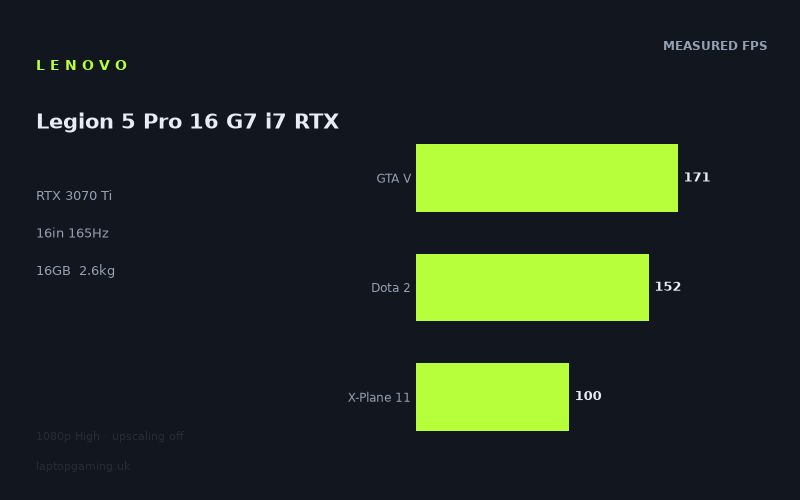
Frame rates
1920×1080, High preset, upscaling off.
Measured on this machine. Source: Notebookcheck, 2022-03-29.
Not scored: incomplete benchmark suite
Every scored laptop on this site is averaged over the same 5 games, and this one is short of Cyberpunk 2077, Baldur's Gate 3. A mean over 5 games is not comparable to a mean over 5, so we publish the figures we have and leave the score blank rather than rank it against machines tested on a different set. The numbers below are real - the suite is just incomplete.
How these numbers were produced
Frame rates here are not measured by us, and we label how each one was arrived at. A figure marked measured comes from a published run on that exact machine. A figure marked representative is derived from the GPU and its power limit (TGP) and cross-referenced against published reviews - a sound estimate of what that configuration delivers, but not a measurement of that specific laptop. Unless stated otherwise, numbers are 1920x1080, High preset, upscaling off. Where a laptop ships in several power configurations we use the wattage of the exact SKU listed, because a 140W RTX 5070 and a 115W one are not the same product.
In use
The short version
The Lenovo Legion 5 Pro 16 G7 with the Core i7-12700H and RTX 3070 Ti has a strong set of published gaming results, but its appeal depends heavily on how it is priced when available in the UK. There is no confirmed UK price for this exact configuration, so it is not possible to make a responsible value judgement or calculate its overall ranking. That is a limitation of the available market data, not a criticism of the laptop itself.
On Notebookcheck’s 1920x1080 High-preset figures with upscaling disabled, this Legion produces a mean of 151fps across the five scoring-suite games. That is a properly fast result for a machine with a 165Hz display, particularly in the lighter and more established games represented here. Strange Brigade reaches 224fps, The Witcher 3 reaches 219fps, F1 2021 reaches 210fps, GTA V reaches 171fps and Dota 2 reaches 152fps. Those are the games in which the panel’s refresh rate is most relevant: several results are at or above 165fps, while Dota 2 sits close enough to make the screen’s high-refresh capability meaningful.
The more demanding side of the benchmark list is less uniform. GRID Legends reaches 148fps, Far Cry 5 reaches 129fps, Final Fantasy XV reaches 107fps, X-Plane 11 reaches 100fps and Cyberpunk 2077 1.6 reaches 96fps. Those are still substantial frame rates at the stated settings, but they make an important point about this configuration: the 165Hz screen is not a promise that every game will run at 165fps. It is a ceiling the machine can approach or exceed in the games that allow it, rather than a figure it can sustain universally.
That distinction matters because this is a 16in laptop with a 2560x1600 panel, while the published figures are at 1920x1080. The results are useful, comparable and clearly sourced, but they are not native-resolution figures. Anyone buying the Legion 5 Pro specifically to play at 2560x1600 should treat these 1080p High-preset results as evidence of the machine’s general performance level, not as a guarantee of the same frame rates at the screen’s full resolution.
The strongest reason to consider this machine is straightforward: it has demonstrated high frame rates across a varied set of games, from esports-friendly titles to heavier releases such as Cyberpunk 2077 1.6. It is particularly persuasive for someone who values a fast 16in screen, does much of their gaming at 1080p-equivalent settings or is content to adjust settings game by game rather than demand one fixed frame-rate target everywhere.
The main reason to hold back is equally straightforward: without a confirmed UK price for this exact model, there is no way to say whether those frame rates are a bargain, reasonable or poor value. There are also practical reasons some buyers should look elsewhere. At 2.553kg, this is not a lightweight machine for daily carrying. The supplied data also does not give dimensions, battery-life measurements, noise figures or temperatures, so there is no basis for claiming that it is especially compact, cool, quiet or long-lasting away from mains power.
For performance alone, though, the evidence is solid. The Legion sits essentially level with the similarly configured Lenovo Legion 5 Pro 16ARH7H RTX 3070 Ti in the shared-game comparison, and it also draws with the Eurocom Nightsky TXi317 despite that machine carrying an RTX 3080 Ti at 155W. It is decisively ahead of the MSI Prestige 15 with an RTX 3050 Ti at 105W, while the MSI Raider GE77 HX with an RTX 3080 Ti at 175W remains the clear faster option among the listed rivals. That is a useful place to land: fast enough to be credible beside much larger GPU names in some shared results, but not so fast that the better-performing Raider can be dismissed.
Performance
What the published frame rates say
The benchmark data comes from Notebookcheck and was published on 2022-03-29. All listed results use 1920x1080, the High preset and upscaling switched off. That consistency is important. It means the numbers can be read as a single performance picture rather than as a mixture of settings, resolutions and rendering shortcuts.
At the top of the table, Strange Brigade runs at 224fps. The Witcher 3 follows closely at 219fps, and F1 2021 reaches 210fps. These are not marginally high frame rates; they are comfortably beyond the Legion’s 165Hz refresh rate. In these titles, the RTX 3070 Ti and Core i7-12700H combination has enough headroom at the tested settings for the panel to be a meaningful part of the experience. A 165Hz screen is useful when a laptop can consistently feed it high frame rates, and these three results show that the Legion can do so in at least part of the measured library.
GTA V reaches 171fps, which is also above the screen’s 165Hz refresh rate. This is particularly useful because GTA V is part of the scoring suite rather than an isolated extra result. It contributes to the Legion’s 151fps mean across the five scoring-suite games, alongside Strange Brigade, Dota 2, Final Fantasy XV and X-Plane 11. GTA V therefore reinforces the broader picture rather than merely providing one favourable headline number.
Dota 2 runs at 152fps. That is below 165fps, but it remains close to the panel’s maximum refresh rate and clearly belongs in the high-frame-rate side of the Legion’s results. It also demonstrates why averages must be handled carefully. The five-game scoring-suite mean is 151fps, almost identical to the Dota 2 result, but the average does not mean every game behaves like Dota 2. It is pulled upward by Strange Brigade and GTA V, and downward by Final Fantasy XV and X-Plane 11. The mean is useful for placing the laptop on a leaderboard; the individual results are more useful for deciding what kind of gaming experience to expect.
GRID Legends at 148fps is another strong result, although it falls short of 165fps. The key point is not that it misses a particular target by a particular amount. The useful conclusion is that it remains fast enough for a high-refresh display to matter, even if the panel cannot be fully saturated by the published result. The machine does not switch abruptly from “165Hz capable” to “not suitable for 165Hz” once a game is below the display maximum. Rather, the figures show a spectrum: some games exceed 165fps, some come close, and some require a more realistic expectation of a lower but still smooth-looking frame rate.
Far Cry 5 at 129fps is a further step down, but it remains a good result in the context of a High-preset benchmark with upscaling off. It is also a reminder that the Legion’s performance is not defined by the fastest titles alone. A buyer looking at the 224fps Strange Brigade result should not assume all games will be similarly light on the hardware. Far Cry 5 is part of the same 1080p High-preset test environment, yet its result is substantially lower. This is exactly why a review should show the spread rather than present a single average as the entire story.
Final Fantasy XV reaches 107fps. At that point the 165Hz panel remains an advantage in the sense that the display is not the limiting ceiling, but the laptop is no longer supplying anything close to the panel’s full refresh rate in the benchmark data. The same is true of X-Plane 11 at 100fps. Both results are still firmly into triple-digit territory, but neither supports the claim that this machine is a 165fps laptop in every sort of game.
Cyberpunk 2077 1.6 produces 96fps. That is the lowest listed result, and it is an important one because it prevents the review from becoming overly optimistic. The Legion can run the title at a substantial frame rate under the stated 1080p High-preset conditions, but it does not come close to the panel’s 165Hz maximum in this benchmark. Anyone whose main concern is demanding modern games should take Cyberpunk 2077 1.6 more seriously than Strange Brigade when deciding whether the 165Hz display aligns with their priorities.
The full spread, from 224fps in Strange Brigade to 96fps in Cyberpunk 2077 1.6, is therefore the central performance story. This laptop is not slow in the heavier games; 96fps, 100fps and 107fps are strong published results. But the gap between those figures and 210fps or 224fps is too wide to talk about the Legion as though one headline frame rate describes it. The machine is capable of very high frame rates, yet game choice remains decisive.
The scoring-suite mean in context
The 151fps mean across Strange Brigade, GTA V, Dota 2, Final Fantasy XV and X-Plane 11 is useful because it combines titles with very different outcomes. Strange Brigade reaches 224fps, GTA V reaches 171fps and Dota 2 reaches 152fps. Those three pull the mean towards the display’s refresh range. Final Fantasy XV at 107fps and X-Plane 11 at 100fps pull in the other direction. The result is an average that is high enough to make clear this is a quick gaming laptop, without pretending that its frame-rate delivery is perfectly consistent across genres and engines.
It is worth resisting the temptation to reduce the Legion to that 151fps mean. A mean is a ranking tool, not a personal gaming forecast. A player spending most of their time in F1 2021, GTA V, The Witcher 3, Strange Brigade or Dota 2 will see a different practical case for the machine than someone whose main game resembles Cyberpunk 2077 1.6, X-Plane 11 or Final Fantasy XV. The average is still useful, but individual game results are the more honest way to decide whether this configuration suits a particular library.
The benchmark spread also helps establish what the 165Hz panel should mean to a prospective buyer. In Strange Brigade, The Witcher 3, F1 2021 and GTA V, the published frame rates are above 165fps. In Dota 2 and GRID Legends, they are close but below. In Far Cry 5, Final Fantasy XV, X-Plane 11 and Cyberpunk 2077 1.6, the results are progressively further below that refresh ceiling. The conclusion is not that the display is excessive. It is that it is best matched to the lighter and faster-running side of the tested games, while serving as headroom in the more demanding titles.
GPU power limits: what can and cannot be concluded
The supplied specification identifies the graphics processor as an RTX 3070 Ti, but it does not state a GPU power limit for this Lenovo configuration. That means there is no basis for attaching a specific wattage figure to this machine or for claiming that it is configured at a particular power level. GPU power limits matter when comparing laptops with the same GPU name, but the evidence available here is the measured frame-rate output, not a confirmed power figure for this individual model.
That does not make the performance results less useful. On the contrary, the Notebookcheck figures show what this Legion actually delivered in the listed games and settings. It reaches 224fps in Strange Brigade, 219fps in The Witcher 3 and 210fps in F1 2021; it also produces 96fps in Cyberpunk 2077 1.6. Those results are concrete. They are more valuable than trying to infer performance from an unavailable power-limit specification.
The comparison data gives some context for how power limits can interact with the same GPU generation. The Lenovo Legion 5 Pro 16ARH7H carries an RTX 3070 Ti at 140W and averages just 1fps behind this machine across five shared games. The Eurocom Nightsky TXi317 has an RTX 3080 Ti at 155W yet is level with this Legion across five shared games. At the other end, the MSI Prestige 15 has an RTX 3050 Ti at 105W and trails by 79fps across four shared games, while the MSI Raider GE77 HX has an RTX 3080 Ti at 175W and leads by 18fps across five shared games.
Those comparisons do not permit a simplistic ranking of graphics chips by name or power limit alone. A higher GPU designation or a higher stated wattage in a rival does not automatically translate into a large advantage in every shared 1080p result. Equally, the Raider’s advantage shows that the Legion should not be treated as universally equal to every machine with an RTX 3080 Ti. The appropriate conclusion is narrower: at the tested resolution and shared games, the Legion’s measured output can sit remarkably close to some more ambitious GPU configurations, while a stronger rival can still pull ahead by a meaningful margin.
The rival notes also explain why near-zero differences should not be dismissed as errors. At 1080p, lighter games in the shared set can become CPU-bound, which compresses genuine GPU differences. That matters particularly when looking at the Legion’s 1fps lead over the 140W RTX 3070 Ti Legion 5 Pro 16ARH7H and its level result against the 155W RTX 3080 Ti Eurocom. A near-zero average does not prove that the hardware is identical in every circumstance. It shows that, in this specific shared set at 1080p, the faster GPU hardware does not necessarily have room to translate its potential into a visibly higher average.
For a buyer, the practical lesson is simple. Do not assume that an RTX 3070 Ti label tells the full story, but also do not assume a higher-tier label elsewhere guarantees a large lead in every game. Look at the measured results, look at the games that matter to you, and remember that these figures are for 1920x1080 High settings with upscaling disabled. That is the evidence available for this Legion, and it is enough to establish that performance is strong without making unsupported claims about its unspecified GPU power limit.
The screen
The Legion 5 Pro uses a 16in IPS display with a 2560x1600 resolution and a 165Hz refresh rate. On paper, that combination points towards a machine intended to offer more than a standard 1080p gaming-laptop experience. The taller 1600-pixel resolution and 16in panel distinguish it from a basic 1920x1080, 144Hz arrangement, while the 165Hz refresh rate gives it more headroom than a conventional 60Hz display.
The important qualification is that Notebookcheck’s frame rates were measured at 1920x1080, not at 2560x1600. Nothing in the published data supports quoting native-resolution game performance for this model. It would be wrong to take the 224fps Strange Brigade result, the 219fps The Witcher 3 result or the 96fps Cyberpunk 2077 1.6 result and present them as though they were achieved at the panel’s full 2560x1600 resolution. They were not. The stated test resolution is 1920x1080.
That does not mean the results are irrelevant to the screen. They establish how well the laptop can use the 165Hz refresh rate under the tested conditions. In Strange Brigade, The Witcher 3, F1 2021 and GTA V, the measured figures exceed 165fps. Those are the clearest examples of games where the screen’s refresh ceiling can be reached or surpassed at 1920x1080 High settings without upscaling. Dota 2 at 152fps and GRID Legends at 148fps are also close enough for the high-refresh panel to remain clearly appropriate.
Far Cry 5 at 129fps occupies a sensible middle ground. It does not reach the refresh maximum, but it is far above a conventional 60fps target. The screen is not wasted simply because a measured result is below 165fps. It still gives the laptop room to show a frame rate above 60fps without the display itself imposing a lower ceiling. The same broad argument applies to Final Fantasy XV at 107fps, X-Plane 11 at 100fps and Cyberpunk 2077 1.6 at 96fps, although those figures underline that the Legion’s display specification is more ambitious than the performance available in every game at the benchmark settings.
The best way to think about the 165Hz panel is as a flexible match for a wide performance range. The Legion has published results from below 100fps to above 220fps. A lower-refresh screen would place a tighter limit on the titles at the top of that range. A 165Hz screen, meanwhile, can accommodate the faster games without claiming to make the slower ones run any faster. That is a sensible fit for a laptop whose benchmark results vary as widely as they do here.
The 2560x1600 resolution requires a separate decision from refresh rate. The panel has more pixels than the benchmark resolution, and the benchmark data does not show the exact frame-rate consequence of running games at native resolution. Buyers who regard native 2560x1600 as non-negotiable should not make a purchase decision based on assumed performance. The available evidence is specifically for 1920x1080 High settings with upscaling off.
For some buyers, that limitation may not be a major issue. The supplied figures show that 1920x1080 can deliver very high frame rates in several games, which is directly relevant to a 165Hz display. For others, the extra panel resolution is the whole point of choosing this chassis, and they should be more cautious. The machine’s published 1080p performance is strong, but this review cannot responsibly turn it into a native-1600p forecast.
The IPS panel type is another part of the stated specification, but the fact sheet provides no measurements for brightness, colour coverage, contrast, response times or outdoor visibility. There is therefore no basis for calling the display bright, colour-accurate, rapid in pixel response or particularly good for creative work. The reliable conclusions are limited to its size, resolution, refresh rate and panel type. Those are already enough to say that Lenovo has paired the RTX 3070 Ti with a screen that makes sense for high-frame-rate gaming, provided the buyer keeps the benchmark resolution distinction in mind.
Build, size and portability
At 2.553kg, the Legion 5 Pro is best understood as a substantial gaming laptop rather than a machine chosen primarily for effortless daily transport. That does not make it immobile. A laptop can still be moved between rooms, taken to university, carried to work or packed for occasional travel. But the listed weight should shape expectations before purchase. This is a machine likely to be used mainly where it will be set down and used for a meaningful period, rather than treated as a lightweight companion that disappears into a bag.
The 16in screen reinforces that interpretation. A larger display can be a worthwhile trade for someone who wants more workspace and a 165Hz panel, but it is part of a package that prioritises a proper gaming setup over the smallest possible footprint. The 2.553kg figure is not a reason to reject the Legion automatically; it is a reason to be honest about the kind of ownership pattern it suits.
No chassis dimensions are supplied in the fact sheet. As a result, it is not possible to say how wide, deep or thick the Legion is, or to compare its physical footprint directly with the MSI Prestige 15, Eurocom Nightsky TXi317, MSI Raider GE77 HX or the other Legion 5 Pro. Weight is the only published portability figure provided here, and it is the one that should guide the judgement.
The battery capacity is 80Wh, but there are no battery-life measurements. It would be irresponsible to turn that capacity figure into a claim about hours away from mains power. There is no published information here about web use, video playback, idle time, gaming away from the charger or how the machine behaves under different power modes. Buyers who need a laptop for long periods away from a socket should treat battery life as unconfirmed rather than assume that the 80Wh figure guarantees a particular outcome.
The same applies to thermals and acoustics. The fact sheet gives no temperature or noise measurements, so there is no evidence to say whether the Legion runs cool, runs hot, stays quiet or becomes loud under gaming load. This is especially relevant because the laptop has strong measured frame rates and a fast display. High performance often makes buyers want to know about fan behaviour and sustained comfort, but those questions cannot be answered from the supplied material.
What can be said is that the listed components point towards a full gaming-machine role. The Core i7-12700H, RTX 3070 Ti, 16GB of memory and 1TB SSD are paired with a 16in 2560x1600 165Hz IPS panel. The published frame rates support that positioning: 224fps in Strange Brigade, 210fps in F1 2021, 171fps in GTA V and 96fps in Cyberpunk 2077 1.6 are not the profile of a laptop built merely to handle occasional low-demand gaming.
That makes the 2.553kg weight easier to interpret. This is a compromise in favour of a larger display and demonstrated gaming speed. Buyers who mainly use a desk, a fixed study space, a living-room table or another regular location may consider that compromise entirely reasonable. Buyers who carry a laptop constantly should put more emphasis on the weight figure, because no lighter figure, compact dimension or exceptional battery result in the supplied data offsets it.
How it compares
Against the MSI Prestige 15 RTX 3050 Ti
The MSI Prestige 15 is the clearest example of the Legion’s performance advantage within the listed rival group. The Prestige 15 uses an RTX 3050 Ti at 105W, and the Legion averages 79fps more across four shared games. That is not a close result and does not need complicated interpretation. On the shared benchmark evidence, the Legion is in a different performance class.
The point is not merely that the Legion has an RTX 3070 Ti rather than an RTX 3050 Ti. The important evidence is the 79fps shared-game lead. Buyers deciding between a lighter-looking productivity-oriented concept and a heavier gaming-focused configuration should recognise that the trade is not subtle in the benchmark data. The Legion’s 224fps Strange Brigade result, 219fps The Witcher 3 result and 210fps F1 2021 result fit with a laptop that prioritises gaming output.
There is no confirmed UK price for the MSI Prestige 15 in the supplied comparison data, so this cannot become a value comparison. A performance lead is not automatically a better purchase if the two machines were available at very different prices, but no responsible price argument can be made here. The dependable conclusion is narrower and useful: the Legion has a large measured performance advantage over the Prestige in their shared games.
Against the Lenovo Legion 5 Pro 16ARH7H RTX 3070 Ti
The closest rival is the Lenovo Legion 5 Pro 16ARH7H with an RTX 3070 Ti at 140W. It is listed at £1,701 and averages 1fps behind this machine across five shared games. That is effectively a tie in the context provided. The difference is real in the sense that it is the recorded shared-game average, but it is too small to support a meaningful claim that one is materially faster than the other in these tests.
The explanation supplied with the rival data matters here. At 1080p, lighter titles in the shared set can be CPU-bound and compress genuine GPU gaps. This does not mean that the two laptops are guaranteed to match in every game, setting or resolution. It means that the shared 1920x1080 results do not reveal a useful practical separation between them.
That is a valuable warning against over-reading specifications. Both machines use the RTX 3070 Ti name, but one listed rival has a confirmed 140W power figure while this Legion’s GPU power limit is not provided. It would be easy to assume the stated power number tells the whole story. The shared-game result says otherwise: the published performance average is almost identical. For a buyer choosing between these two particular Legion variants, price and configuration details would matter enormously, but this exact machine has no confirmed UK price. The benchmark data alone does not establish a winner.
Against the Eurocom Nightsky TXi317 RTX 3080 Ti
The Eurocom Nightsky TXi317 produces the most surprising comparison result. It uses an RTX 3080 Ti at 155W, yet the Legion is level with it across five shared games. Again, that should not be turned into a sweeping claim that an RTX 3070 Ti equals an RTX 3080 Ti in all circumstances. The evidence says only that the shared-game average at the stated test conditions is level.
The near-zero difference is exactly the kind of result that needs explanation rather than repetition. The supplied comparison notes state that 1080p lighter titles in the shared set can become CPU-bound, compressing genuine GPU differences. In other words, some games may stop exposing the full separation between the graphics hardware because another part of the system becomes the limiting factor at that resolution and workload.
For the Legion, the practical benefit is that its measured 1080p results stand up well against a machine with a more imposing RTX 3080 Ti label and a stated 155W GPU limit. That makes the Legion’s performance look credible rather than merely adequate. But it does not remove the need for caution. Buyers interested in more demanding games, different settings or the Legion’s native 2560x1600 resolution should not assume the same dead heat will continue, because no such comparison figures are supplied.
Against the MSI Raider GE77 HX RTX 3080 Ti
The MSI Raider GE77 HX is the rival that beats the Legion by the greatest amount in the supplied group. It uses an RTX 3080 Ti at 175W and averages 18fps more across five shared games. Unlike the 1fps result against the other Legion or the level result against the Eurocom, this is a meaningful lead. The Raider is the faster machine in the shared benchmark comparison.
That lead also provides useful context for the Legion’s position. The Legion is not the absolute performance champion among these rivals, and buyers who prioritise the highest possible shared-game figures should favour the Raider’s demonstrated advantage. The data does not provide a confirmed UK price for the Raider, however, so there is no basis for deciding whether its extra performance is worth its cost. It is faster in the listed comparison; that is all that can be concluded on value without price data.
The Raider comparison also prevents the Eurocom tie from being misunderstood. An RTX 3080 Ti label does not produce one fixed outcome across all laptops. The Eurocom with an RTX 3080 Ti at 155W is level with the Legion in the shared result, while the Raider with an RTX 3080 Ti at 175W is ahead by 18fps. Laptop performance is evidently shaped by the complete configuration and the conditions of the benchmark, not just the GPU family printed in a specification list.
The Legion therefore occupies a sensible middle position in this rival set. It is far ahead of the RTX 3050 Ti Prestige, essentially tied with the 140W RTX 3070 Ti Legion, level with one RTX 3080 Ti rival in the shared 1080p data, and behind the faster 175W RTX 3080 Ti Raider. That is a strong performance placement, but not an excuse to ignore the absent price for this exact configuration.
Who it’s for
The Lenovo Legion 5 Pro 16 G7 is for buyers who want a substantial 16in gaming laptop with a fast IPS display and published evidence that it can deliver high frame rates in a broad range of games. Its strongest audience is someone who plays a mixture of competitive, older, lighter and demanding titles rather than one game exclusively. The Notebookcheck results provide evidence across Strange Brigade, The Witcher 3, F1 2021, GTA V, Dota 2, GRID Legends, Far Cry 5, Final Fantasy XV, X-Plane 11 and Cyberpunk 2077 1.6. That is enough variety to show that the laptop is not relying on one unusually favourable game to make its case.
It is particularly suitable for players who value high-refresh gaming at the tested 1920x1080 resolution. Strange Brigade at 224fps, The Witcher 3 at 219fps, F1 2021 at 210fps and GTA V at 171fps all make practical use of a 165Hz panel. Dota 2 at 152fps and GRID Legends at 148fps also sit close enough to the refresh maximum for the screen to remain a sensible choice. If those games, or games with similar performance demands, dominate your gaming time, the Legion’s display and measured output are well aligned.
It is also a good fit for someone who accepts that settings and resolution should be chosen per game rather than treated as fixed. The benchmark spread makes that clear. Cyberpunk 2077 1.6 runs at 96fps, X-Plane 11 at 100fps and Final Fantasy XV at 107fps, while other titles exceed 200fps. A buyer who understands that different games will make different use of the hardware will get a more realistic picture of this laptop than one who expects the 165Hz panel to be filled in every release.
The 1TB SSD and 16GB of memory make this a credible general gaming configuration on the supplied specification, while the Core i7-12700H and RTX 3070 Ti are supported by the benchmark data rather than just by their names. That matters. The Legion does not need vague claims about being “powerful”; it has published results showing 151fps across the five scoring-suite games and triple-digit performance in every listed game except none, because even the lowest listed result, Cyberpunk 2077 1.6, reaches 96fps. The figures provide a concrete basis for confidence at 1080p High settings with upscaling off.
It is also for buyers who use their laptop mainly in settled locations. At 2.553kg, the Legion is better suited to a desk-based or semi-fixed routine than to constant carrying. Someone moving it occasionally may be entirely happy with that compromise, particularly given the 16in screen and strong gaming results. Someone carrying it all day should not ignore the weight simply because the graphics performance is appealing.
Who should buy something else? First, buyers who need a confirmed value proposition should wait until a verified UK price for this exact configuration is available. The absence of a confirmed price means no overall score can be calculated, because value accounts for part of that assessment. More importantly, it means there is no responsible way to say whether the Legion is good value at the point of purchase. Performance is established; value is not.
Second, buyers whose priority is the highest shared-game performance among the listed rivals should look towards the MSI Raider GE77 HX. Its RTX 3080 Ti at 175W averages 18fps ahead across five shared games. That is the clearest performance lead over the Legion in this comparison group. The Raider has no confirmed UK price in the supplied data, so it cannot be recommended on value grounds, but it is the stronger choice if the decision is made strictly on the published shared-game frame rates.
Third, buyers who require evidence of native 2560x1600 gaming performance should not assume it from these results. The Legion’s screen is 2560x1600, but every cited benchmark figure is measured at 1920x1080. The laptop may still appeal to those buyers, but the supplied data does not answer their key question directly. They should seek measured results at the resolution they intend to use rather than extrapolate from the 1080p figures.
Fourth, buyers who need a particularly portable machine should consider alternatives. The Legion weighs 2.553kg, and no dimensions are supplied to qualify that figure with an unusually compact footprint. There are also no battery-life measurements, so buyers with long periods away from mains power have no evidence here that the 80Wh battery will meet their needs. The right response is not to assume poor battery life, but to recognise that it is unverified.
Finally, buyers who need detailed reassurance about screen quality beyond size, resolution, refresh rate and panel type should look for additional measured display data. The supplied facts confirm a 16in 2560x1600 165Hz IPS panel, but not brightness, colour, contrast or response behaviour. Likewise, buyers concerned about fan noise or temperatures need more information than is available here.
The final judgement is therefore measured but positive. The Lenovo Legion 5 Pro 16 G7 i7 RTX 3070 Ti has strong, attributable 1080p High-preset gaming figures from Notebookcheck. It can exceed 165fps in several titles, stays near that territory in others and still delivers 96fps in Cyberpunk 2077 1.6. It compares exceptionally well with some rivals and is only clearly outpaced by the MSI Raider GE77 HX in the supplied shared-game data. The missing UK price prevents a value verdict, but the performance case is already clear: this is a serious gaming laptop for buyers who want a large, high-refresh screen and can accept a 2.553kg machine with game-by-game expectations rather than a universal 165fps promise.