Review
Asus ROG Zephyrus G14 2025 review
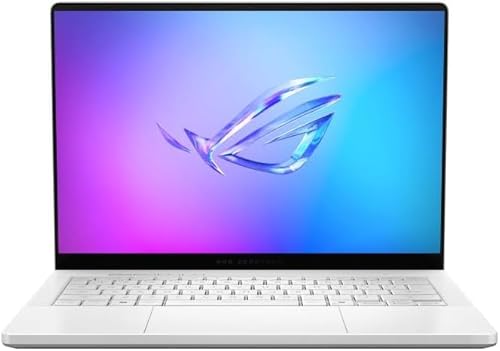
Frame rates
1920×1080, High preset, upscaling off. Averages 122fps across the 5 core benchmark games.
Measured on this machine. Source: Notebookcheck, 2025-05-12.
How these numbers were produced
Frame rates here are not measured by us, and we label how each one was arrived at. A figure marked measured comes from a published run on that exact machine. A figure marked representative is derived from the GPU and its power limit (TGP) and cross-referenced against published reviews - a sound estimate of what that configuration delivers, but not a measurement of that specific laptop. Unless stated otherwise, numbers are 1920x1080, High preset, upscaling off. Where a laptop ships in several power configurations we use the wattage of the exact SKU listed, because a 140W RTX 5070 and a 115W one are not the same product.
In use
The short version
The Asus ROG Zephyrus G14 2025 in this configuration is a very unusual proposition: a 1.58kg, 14in OLED gaming laptop with an RTX 5080, 64GB of memory and a 2048GB SSD, but also a UK price of £3,811. That price is the central problem. The measured gaming figures are good, often very good, but they do not establish the kind of clear performance lead that would make this machine easy to recommend purely on value.
Notebookcheck’s benchmark data shows that the Zephyrus G14 can deliver more than 120fps in several games at 1920x1080, High settings and with upscaling disabled. Strange Brigade reaches 323fps, F1 24 reaches 225fps, while Dota 2, Final Fantasy XV and Baldur’s Gate 3 sit around the mid-140fps range. GTA V also clears 120fps at 125fps. Those are strong results for a compact 14in laptop weighing 1.58kg.
The harder games are where the limitations of the 120W RTX 5080 become clearer. Cyberpunk 2077 records 118fps, Indiana Jones and the Great Circle reaches 109fps, Alan Wake 2 reaches 84fps, X-Plane 11 records 77fps and Assassin’s Creed Shadows falls to 68fps. Those are still playable-looking figures at the tested 1920x1080 High preset, but they are not results that consistently match the 120Hz panel refresh rate.
The result is a laptop that makes sense only for a narrow buyer. It is for someone who specifically wants a small, relatively light premium gaming machine, wants the supplied 14in 2880x1800 OLED panel, wants 64GB of memory and 2048GB of SSD storage, and is prepared to accept a very high purchase price for that combination. It is not the obvious choice for somebody whose priority is maximum gaming performance per pound.
That distinction matters because the closest comparison figures are uncomfortable for the G14. Against the Asus ROG Zephyrus G14 2025 with an RTX 5070 Ti at 110W, this RTX 5080 model averages only 1fps more across 11 shared games. Against the considerably less expensive MSI Katana 17 HX with an RTX 5070, priced at £2,312, it averages 2fps less across six shared games. Against the £2,359 Lenovo Legion 5 15IRX10, also with an RTX 5070, it averages only 4fps more across nine shared games. Those are not margins that make £3,811 look sensible if gaming performance is the main buying criterion.
The ROG Zephyrus G14 is therefore best understood as a portability-first premium machine rather than an uncomplicated RTX 5080 performance buy. Its 1.58kg weight is genuinely notable next to the hardware list, and the 14in OLED screen is a more distinctive feature than the graphics-card badge alone. But the published frame rates show that buyers should judge it by what it actually delivers at 120W, not by what they might assume from the RTX 5080 name.
There is also an important limitation to keep in mind throughout this review. The benchmark figures were measured by Notebookcheck at 1920x1080, High settings, with upscaling off. The laptop’s own screen is 2880x1800. The available figures therefore show useful baseline performance without upscaling, but they do not show native-resolution performance on the built-in panel. Anyone buying this machine primarily to play at 2880x1800 should not assume that the listed 1920x1080 results will carry over unchanged.
Performance
A fast compact laptop, but not a simple desktop-replacement result
The Zephyrus G14 pairs an RTX 5080 limited to 120W with a Ryzen AI 9 HX 370, 64GB of memory and a 2048GB SSD. On paper, that is a high-end specification, especially for a 14in laptop weighing 1.58kg. The benchmark data confirms that this is not a low-power ultrabook trying to pass as a gaming machine. It produces high frame rates in a wide range of games, including several results at or above the screen’s 120Hz refresh rate.
However, the same data also shows why the RTX 5080 label needs context. This is a 120W implementation, not an unrestricted description of gaming performance. GPU names do not tell a buyer the whole story when laptops use different power limits, cooling arrangements and chassis sizes. The useful number here is the measured output, and the measured output is strong without being consistently dominant against the listed RTX 5070 and RTX 5070 Ti rivals.
Across the five scoring-suite games, the Zephyrus G14 averages 122fps. That is a good overall result for a machine of this weight, and it means the laptop is clearly capable of smooth gaming at the tested 1920x1080 High preset. It also happens to sit just above the panel’s 120Hz refresh rate. But an average is not the same as a guarantee. The individual game figures range from 68fps in Assassin’s Creed Shadows to 146fps in Dota 2 and 145fps in Baldur’s Gate 3 within that scoring suite. A buyer interested in particular games should pay more attention to that spread than to the overall average.
The spread is substantial because games do not place the same demands on a laptop. The benchmark data does not provide component-level explanations for each title, so it would be wrong to pretend that one precise bottleneck has been identified for every result. What it does show is that this G14 is exceptionally quick in some older or lighter-running titles, very capable in several mainstream games, and meaningfully below 120fps in several demanding modern releases. That is the practical picture.
Games that comfortably suit the 120Hz panel
Strange Brigade is the standout result at 323fps. At the tested settings, that is far beyond the 120Hz refresh rate of the built-in display. A 120Hz screen cannot display more than 120 refreshed frames each second, so the headline here is not that the laptop can make full use of every measured frame on its own panel. It is that this game has abundant performance headroom at 1920x1080 High with upscaling disabled.
F1 24 follows at 225fps, also well above 120fps. This is another result that comfortably clears the display refresh rate under Notebookcheck’s test conditions. If this specific 1920x1080 High configuration reflects the way a buyer plays F1 24, the G14 has enough measured performance to target the panel’s maximum refresh rate with room to spare. That does not prove identical results at the laptop’s native 2880x1800 resolution, but it does show a strong baseline.
Dota 2 records 146fps, while Baldur’s Gate 3 reaches 145fps. Both are above 120fps, though not by the enormous margins seen in Strange Brigade and F1 24. For the 120Hz panel, these are still the kind of figures that make the screen’s refresh rate relevant rather than merely aspirational. The difference between 146fps and 120fps is not as significant to this display as the difference between 68fps and 120fps, because once a game is running above the panel refresh rate, the display itself becomes the limit on visible refreshes.
Final Fantasy XV also records 146fps. That places it in the same practical category as Dota 2 and Baldur’s Gate 3: the measured figure is above the panel refresh rate at 1920x1080 High without upscaling. GTA V, at 125fps, is closer to the line but still above it. In these titles, the G14 gives a plausible case for choosing a 120Hz panel rather than a lower-refresh display, at least when running the tested settings and resolution.
It is worth separating “above 120fps” from “always locked to 120fps”, because the published figures are benchmark results, not a promise that every scene in every game will behave identically. The correct conclusion is more modest: Notebookcheck’s measured figures show that Strange Brigade, F1 24, Dota 2, Final Fantasy XV, Baldur’s Gate 3 and GTA V can reach or exceed the panel refresh rate under the stated test conditions. That is strong evidence of capability, not a universal frame-rate guarantee.
Games close to the refresh-rate target
Cyberpunk 2077 records 118fps. That is an excellent result in isolation, and it is only just below the 120Hz panel refresh rate. In practical terms, it is much closer to the screen’s maximum refresh than to the lower figures recorded by the most demanding games here. Still, the number is 118fps, not 120fps, and it should be described accurately. At the tested 1920x1080 High preset with upscaling off, the measured figure falls just short of matching the display refresh rate.
Indiana Jones and the Great Circle records 109fps. This is still a high frame rate, but the difference from 120fps is more visible in the data than it is for Cyberpunk 2077. The laptop is not struggling at the benchmarked settings, yet it is not delivering a full 120fps result either. For buyers who want the panel’s 120Hz capability to be routinely filled in demanding newer games without depending on upscaling, this is a reminder that the G14 does not do that across the board.
These two results are particularly useful because they sit near the dividing line between games that can make full use of the panel refresh rate and games that cannot. They also demonstrate why a single average number can be misleading. A 122fps mean across the five scoring-suite games sounds like a direct match for a 120Hz display. Yet Cyberpunk 2077 is measured at 118fps, and the heavier titles below it are increasingly distant from 120fps. The average describes the collection of results; it does not mean every game lands near 122fps.
Demanding games where the 120Hz ceiling is not the realistic target
Alan Wake 2 records 84fps at 1920x1080 High with upscaling disabled. That is a substantial drop from the results in Dota 2, Baldur’s Gate 3 and Final Fantasy XV, and it is well below the 120Hz panel refresh rate. The figure remains much higher than the 68fps result in Assassin’s Creed Shadows, but it is not a result that supports buying the G14 on the assumption that a 120Hz OLED screen will be fully driven in every modern game.
X-Plane 11 records 77fps. Again, this is well below 120fps, and it reinforces that the laptop’s performance varies considerably by title. Buyers focused on this game should treat 77fps as the relevant published result rather than assuming that the RTX 5080 branding guarantees the same behaviour as the 146fps figures elsewhere in the suite.
Assassin’s Creed Shadows is the lowest measured result at 68fps. That is the clearest evidence in the published data that this G14 is not a machine that simply overwhelms every game at the tested settings. It remains a meaningful frame rate at 1920x1080 High without upscaling, but it is only a little over half of the display’s 120Hz refresh rate. The gap between 68fps and 120fps is large enough that the panel’s maximum refresh becomes unused performance potential in this title under the tested configuration.
That does not make the laptop slow. It means it should be bought with appropriate expectations. A compact 14in laptop at 1.58kg reaching 68fps in Assassin’s Creed Shadows and 84fps in Alan Wake 2 at the stated settings is clearly capable. The issue is price and positioning. At £3,811, a buyer has every reason to expect not merely capable performance but a strong and obvious lead over cheaper gaming alternatives. The rival figures do not show that kind of lead.
What the 120W RTX 5080 means in practice
The 120W GPU power limit is not a minor specification footnote. It is part of the reason that this model should be evaluated by its measured figures rather than by the graphics-card name alone. The Zephyrus G14 is a 14in machine weighing 1.58kg, so it is designed around a different balance than a larger gaming laptop. The facts supplied do not include cooling measurements, noise measurements or temperatures, so there is no basis for claims about how Asus achieves that balance. But the performance comparisons make clear that the 120W RTX 5080 does not create a wide practical gulf over every lower-tier GPU laptop listed here.
The nearest family comparison is the Asus ROG Zephyrus G14 2025 with an RTX 5070 Ti at 110W. Across 11 shared games, this RTX 5080 G14 averages only 1fps more. That is the most important comparison for a buyer considering whether the higher GPU specification in a similarly named G14 is likely to transform gaming performance. On the available shared-game data, it does not. A 1fps average advantage is too small to present as a meaningful upgrade in play.
That comparison does not establish that every RTX 5080 at 120W is only 1fps faster than every RTX 5070 Ti at 110W. It says something narrower and more useful: these specific G14 configurations are effectively tied across the 11 games they share in the database. For this model, the RTX 5080 badge is therefore not enough on its own to justify a buying decision. A buyer would need to value the complete specification, including the 64GB memory, 2048GB SSD, OLED panel and 1.58kg weight, rather than expecting a decisive frame-rate step.
The 120W figure also needs to be considered beside the Razer Blade 16 2025 RTX, which has an RTX 5090 at 160W. Across nine shared games, the Zephyrus G14 averages 5fps less than that Razer. The Razer has the higher GPU designation and a higher listed power limit, yet the measured shared-game gap is only 5fps. That is not a result that makes the G14 look weak; rather, it demonstrates how closely matched these specific published averages are despite their differing specifications.
At the same time, it would be a mistake to turn that 5fps comparison into a blanket statement that the G14 is essentially equivalent to every RTX 5090 laptop. The comparison covers nine shared games and one named rival. It is useful evidence about these two models, not a general rule for all hardware bearing these labels. The disciplined conclusion is that the G14 stays close to the listed Razer Blade 16 in the shared-game comparison, while still trailing it.
The less expensive RTX 5070 comparisons are even more damaging to the G14’s value argument. The MSI Katana 17 HX costs £2,312 and averages 2fps ahead across six shared games. The Lenovo Legion 5 15IRX10 costs £2,359 and trails the G14 by only 4fps across nine shared games. Those machines may differ in ways not covered by the supplied facts, and there are no panel, weight, memory or storage specifications for them here. It would be wrong to claim they are identical purchases. But as evidence of gaming output against price, they show just how little room the £3,811 G14 has to make a straightforward value case.
The screen
A premium display specification, with a performance caveat
The Zephyrus G14 has a 14in OLED screen with a 2880x1800 resolution and a 120Hz refresh rate. This is a premium display specification on paper, especially in a machine weighing 1.58kg. The panel is one of the strongest reasons to consider this model, because it separates the G14’s proposition from that of a conventional larger gaming laptop bought mainly for raw frame-rate value.
There are limits to what can be said from the available facts. The fact sheet confirms that the panel is OLED, 14in, 2880x1800 and 120Hz. It does not provide brightness, colour coverage, response-time, HDR, coating, adaptive-refresh or calibration data. Those are all relevant display characteristics, but they are not available here and should not be invented. The safe conclusion is that this is a high-resolution, high-refresh OLED panel in a compact chassis, not a fully characterised display review.
The key gaming question is whether the RTX 5080 at 120W can drive the screen properly. The answer is partly yes and partly no, depending on what “drive” means. It can clearly produce enough performance to exceed 120fps in several games at 1920x1080 High with upscaling disabled. It cannot be shown from the available data to do the same at 2880x1800, because Notebookcheck’s benchmark figures were recorded at 1920x1080 rather than the screen’s native resolution.
This distinction should influence the purchase. The 2880x1800 panel is a more demanding target than the tested 1920x1080 setting, but no native-resolution benchmark result has been supplied. It would therefore be irresponsible to state a native-resolution frame rate, estimate a likely percentage drop or claim that any particular game will run at 120fps on the built-in panel. The data simply does not establish that.
What the 120Hz refresh rate is actually useful for
The 120Hz refresh rate is fully relevant to the games that exceed 120fps in the benchmark data. Strange Brigade at 323fps and F1 24 at 225fps are obvious examples. Dota 2 at 146fps, Final Fantasy XV at 146fps, Baldur’s Gate 3 at 145fps and GTA V at 125fps also clear the 120fps threshold. In those games, at the tested resolution and settings, the panel’s refresh ceiling is not an idle specification.
Cyberpunk 2077 at 118fps sits just beneath the panel refresh rate, while Indiana Jones and the Great Circle at 109fps is closer but still below. These titles should still look to be running at high frame rates based on the numbers, but the specific 120fps target is not met in Notebookcheck’s stated test. Alan Wake 2 at 84fps, X-Plane 11 at 77fps and Assassin’s Creed Shadows at 68fps sit further away again.
That means the screen is better matched to the G14’s lighter and moderately demanding gaming workloads than to the hardest games in the list. There is nothing wrong with that; a 120Hz display does not require every game to run at 120fps to be worthwhile. But it does mean that buyers should not confuse the panel specification with a promise of 120fps performance in demanding new releases.
The measured figures also make this a more convincing laptop for a player with varied habits than for somebody focused exclusively on the most demanding titles. A player moving between Dota 2, F1 24, Baldur’s Gate 3, GTA V and games of similar demand can make stronger use of the display’s refresh rate under the tested conditions. A player whose time is centred on Alan Wake 2, X-Plane 11 and Assassin’s Creed Shadows should expect the measured results to sit below that ceiling.
Resolution versus benchmark resolution
The resolution mismatch between the panel and the supplied benchmark data is not a technicality. The laptop screen is 2880x1800, while the game results are for 1920x1080. This means the frame-rate list is best used to compare the G14 with rivals tested in the same way and to understand its baseline performance at the stated settings. It is not proof of what appears on the display at its native resolution.
For a £3,811 laptop, that uncertainty is particularly important. Buyers paying this much for a 2880x1800 OLED display are likely to care about using that display rather than treating it only as a 1920x1080 target. Yet no measured 2880x1800 figures are included in the available material. The sensible buying approach is to value the OLED panel as a premium feature while avoiding unsupported assumptions about native-resolution gaming performance.
Upscaling is also disabled in every supplied benchmark. That is useful because it gives clean, attributable numbers without an upscaling variable. It also means the figures do not answer what performance may be possible with upscaling enabled. There is no reason to speculate about the outcome here. The published data tells us what the G14 does at 1920x1080, High settings and no upscaling; that is the line that should be used for comparisons.
Build, size and portability
The 1.58kg figure is the heart of the case for this laptop
The most compelling specification in the Zephyrus G14’s favour may be its 1.58kg weight. This is a 14in laptop carrying an RTX 5080 at 120W, a Ryzen AI 9 HX 370, 64GB of memory, a 2048GB SSD and a 73Wh battery. Regardless of the price, that is a compact specification with serious gaming capability attached to it.
The supplied facts do not include the laptop’s dimensions, thickness, charger weight, build materials, keyboard details, port selection, webcam specification or chassis construction. There is therefore no basis for a full physical design assessment, and no claim should be made about how much bag space it occupies beyond the fact that it has a 14in screen and weighs 1.58kg.
Even so, weight matters. A 1.58kg gaming laptop is a different proposition from a machine bought solely to remain in one location. It gives the G14 a plausible role as a laptop that can be carried regularly while still delivering the listed frame rates. That matters more here than it would on a cheap gaming laptop, because the premium price is not being paid for performance alone. It is partly being paid for the combination of high-end internal specifications with a low quoted weight.
The portability case is strengthened by the 14in display size. A 14in screen is not automatically better for every buyer, but it does align with the 1.58kg weight. The G14 is clearly aimed at someone who wants a more compact machine than the 17in MSI Katana 17 HX named in the comparison list. The supplied facts do not provide the MSI’s weight, so no numerical portability comparison can be made. Still, the difference in stated screen size is enough to show that these are not identical categories of laptop.
Battery capacity is known; battery life is not
The G14 has a 73Wh battery. That is the only battery fact provided. There is no measured battery-life figure, no video-playback result, no web-browsing result and no gaming-on-battery result. It would be misleading to convert 73Wh into an expected number of hours, because battery life depends on workload and the available data does not provide a measured outcome.
For a buyer deciding between a compact premium laptop and a larger gaming machine, the correct interpretation is simply that this model includes a 73Wh battery and that no attributable runtime figure is available here. The laptop’s 1.58kg weight supports its portability argument; the battery capacity alone does not prove how long it will last away from mains power.
Memory and storage help justify the premium specification, not the gaming price
The G14 has 64GB of memory and a 2048GB SSD. These are generous specifications and more substantial than the stripped-back configurations sometimes used to make a gaming laptop appear cheaper. They contribute to the feeling that this is a fully equipped premium machine rather than a graphics-card-led compromise.
But they do not solve the value issue created by the £3,811 price. The gaming comparisons remain what they are: 1fps ahead of the RTX 5070 Ti G14 across 11 shared games, 2fps behind the £2,312 MSI Katana 17 HX across six shared games, and only 4fps ahead of the £2,359 Lenovo Legion 5 15IRX10 across nine shared games. The memory and storage may matter greatly to a buyer who needs them, but they should not be used to pretend that the measured gaming advantage is larger than it is.
The right way to view the 64GB memory and 2048GB SSD is as part of a buyer-specific case. If those capacities are genuinely required, the G14 becomes easier to rationalise as an all-round premium portable computer that also games well. If gaming is the main task and these capacities are not essential, the price is much harder to defend because the frame-rate evidence does not show a correspondingly large lead.
How it compares
Against the RTX 5070 Ti Zephyrus G14
The closest rival is another Asus ROG Zephyrus G14 2025, fitted with an RTX 5070 Ti at 110W. No confirmed UK price is available for that model, so there is no price comparison to make. What is available is more revealing for performance: across 11 shared games, the RTX 5080 G14 averages just 1fps more.
For a buyer choosing between these two configurations, that is a warning against paying a major premium solely for the RTX 5080 name. The supplied comparison does not show a meaningful gaming separation between them. A 1fps average difference across 11 shared games is not the kind of gap that changes the basic experience described by the benchmark data.
This does not mean the machines are identical in every specification; the fact sheet only confirms the RTX 5070 Ti model’s GPU and 110W power limit, along with the absence of a confirmed UK price. But it does mean the RTX 5080 G14 should be selected for its full specification and any price difference that proves acceptable, not on an expectation of clearly superior published gaming performance.
Against the MSI Katana 17 HX
The MSI Katana 17 HX has an RTX 5070 and costs £2,312. Across six shared games, the Zephyrus G14 averages 2fps less. That is a particularly severe comparison for Asus because the MSI is priced £1,499 below the G14 while holding a small measured frame-rate advantage in the shared selection.
The machines plainly serve different buyers in at least one respect: the MSI is a 17in model by name, while the Asus has a 14in screen and weighs 1.58kg. The supplied facts do not give the MSI’s weight, panel specification, memory capacity, storage capacity or battery capacity, so it would be wrong to call it a direct like-for-like replacement. It may make compromises that some buyers do not want.
Nevertheless, the MSI comparison is decisive for anyone who sees gaming frame rate as the priority. At £2,312, it is far cheaper, and the shared-game average does not show the G14 pulling ahead. The Asus can still be the better choice for someone who values its 14in OLED panel, 1.58kg weight, 64GB of memory and 2048GB SSD. But that buyer is paying for a very different overall package, not for superior benchmark output.
Against the Lenovo Legion 5 15IRX10
The Lenovo Legion 5 15IRX10 also uses an RTX 5070 and has a confirmed UK price of £2,359. Across nine shared games, the Zephyrus G14 averages 4fps more. This is a better result for Asus than the MSI comparison because the G14 is ahead rather than behind. But it is still not a large margin in the context of the price difference.
The G14 costs £1,452 more than the Lenovo. A 4fps average lead across nine shared games does not make that gap easy to justify for a performance-led buyer. Again, the missing specifications matter: the supplied facts do not provide the Lenovo’s weight, panel type, resolution, refresh rate, memory or storage. It is possible that a buyer may prefer the Asus for reasons the shared-game result cannot capture. But the gaming evidence alone points strongly towards the Lenovo as the more rational performance-per-pound option.
The comparison also makes a broader point about laptop GPU branding. An RTX 5080 at 120W in this compact G14 is not automatically far ahead of an RTX 5070 laptop. In this specific nine-game comparison, it is only 4fps ahead. That is exactly why attributable benchmark data is more useful than relying on the label printed on the specification sheet.
Against the Razer Blade 16 2025 RTX
The Razer Blade 16 2025 RTX has an RTX 5090 at 160W. No confirmed UK price is available for the Razer, so value cannot be assessed directly. Across nine shared games, the G14 averages 5fps less. That is a close result considering the Razer’s higher GPU tier and higher listed power limit.
The sensible reading is not that the G14 somehow replaces every RTX 5090 laptop. The comparison is limited to nine shared games and these two specific systems. But it does show that the compact Asus remains competitive with this particular Razer on the available benchmark selection. For someone comparing premium portable gaming laptops without a fixed budget, that is encouraging evidence for the G14’s performance density.
It also highlights the tension in the G14’s position. It can stay within 5fps of a 160W RTX 5090 Razer across the shared games, but it can also sit only 4fps ahead of the £2,359 RTX 5070 Lenovo across another shared-game set. Both facts can be true because the comparisons cover different games and different systems. The lesson is not to cherry-pick one rivalry. The lesson is that the G14 is competitively fast, but its high UK price makes its value case fragile.
Against the Schenker XMG Core 16 M25
The Schenker XMG Core 16 M25 has an RTX 5070 and no confirmed UK price. Across eight shared games, the G14 averages 6fps more. This is the largest stated lead for the G14 against the lower-tier GPU rivals listed here, but it remains a modest advantage rather than a decisive one.
Without a confirmed UK price for the Schenker, it is impossible to say whether 6fps more represents good value or poor value. The comparison can only establish gaming output. The G14 is ahead in the shared-game selection, but not by a margin that would make the RTX 5080 name alone sufficient reason to choose it.
The Schenker result sits well with the wider pattern. The G14’s RTX 5080 is generally competitive, and it can lead RTX 5070 systems. Yet the leads listed here are measured in a handful of frames rather than dramatic jumps. For a laptop at £3,811, that is the central criticism: the performance is strong, but the premium is much easier to see in the specification and portability than in the gaming comparison figures.
Who it’s for
Buy it if compact premium hardware is the actual priority
The Zephyrus G14 is for the buyer who wants a 14in gaming laptop rather than a conventional larger gaming laptop, and who values the 1.58kg weight enough to pay for it. It is also for somebody who specifically wants the combination of a 2880x1800 OLED screen with a 120Hz refresh rate, 64GB of memory and a 2048GB SSD.
It suits a player whose game library includes titles where the published results clear 120fps at 1920x1080 High without upscaling: Strange Brigade at 323fps, F1 24 at 225fps, Dota 2 at 146fps, Final Fantasy XV at 146fps, Baldur’s Gate 3 at 145fps and GTA V at 125fps. Cyberpunk 2077 at 118fps is also close enough to the panel refresh rate to show that the G14 has substantial performance in demanding games at the tested settings.
It also suits a buyer who understands that this is not a pure value purchase. The £3,811 price can only be rationalised if the compact form factor, OLED display, 64GB memory and 2048GB storage have real value to that individual. If those elements are important, the G14 offers a rare concentration of capability in a 1.58kg package.
A buyer considering the Razer Blade 16 2025 RTX may also find the G14 interesting. The G14 trails that RTX 5090 at 160W model by only 5fps across nine shared games. Since no confirmed UK price is available for the Razer, there is no direct value conclusion to draw. But the shared-game result makes the Asus a credible premium compact alternative rather than a machine that is obviously outclassed by the higher-tier Razer specification.
Buy something else if frame rate per pound is the priority
Do not buy the Zephyrus G14 primarily because it says RTX 5080. The closest published comparisons do not support that decision. The RTX 5070 Ti version of the same G14 is only 1fps behind across 11 shared games. The £2,312 MSI Katana 17 HX is 2fps ahead across six shared games. The £2,359 Lenovo Legion 5 15IRX10 is only 4fps behind across nine shared games. Those figures make the G14 difficult to defend as a value-led gaming laptop.
The Lenovo is the clearest alternative for a buyer who wants to spend substantially less and focuses on gaming output. It costs £1,452 less than the Asus, while the Asus leads by only 4fps across nine shared games. The MSI is even cheaper at £2,312 and is 2fps ahead across six shared games. There may be reasons to choose the Asus that are not captured by those comparisons, but gaming performance per pound is not one of them.
Buy something else if your main aim is to run every demanding new game at the screen’s 120Hz refresh rate without compromise. The benchmark data does not show that. Alan Wake 2 records 84fps, X-Plane 11 records 77fps and Assassin’s Creed Shadows records 68fps at 1920x1080 High with upscaling disabled. Those are respectable figures, but they do not approach 120fps in the way Strange Brigade or F1 24 do.
Buy something else, or wait for more relevant benchmark data, if native 2880x1800 gaming performance is essential to your decision. The supplied measurements are at 1920x1080, not at the laptop screen’s 2880x1800 resolution. There is no attributable native-resolution result here, and there is no basis for inventing one. The G14 may still be attractive because of its OLED panel, but the available figures do not prove how it performs at that panel’s full resolution.
Finally, buy something else if a measured battery-life figure, thermal result or noise result is essential. The fact sheet provides a 73Wh battery capacity but no runtime measurement, and it provides no temperature or noise data. The laptop can be judged confidently on its known weight, display specification, internal configuration, price and Notebookcheck frame rates. It cannot be judged responsibly on unprovided measurements.
The final verdict is straightforward. The Asus ROG Zephyrus G14 2025 is a highly specified, genuinely portable gaming laptop with strong 1920x1080 High results and a premium 14in 2880x1800 120Hz OLED panel. Its 1.58kg weight, 64GB memory and 2048GB SSD make it more than a simple gaming benchmark machine. But at £3,811, it is a specialist premium purchase. The measured frame rates are good enough to make it desirable; the comparisons against cheaper RTX 5070 and RTX 5070 Ti rivals are too close to make it good value for most gaming buyers.