Review
Razer Blade 15 Advanced (Mid 2021) review
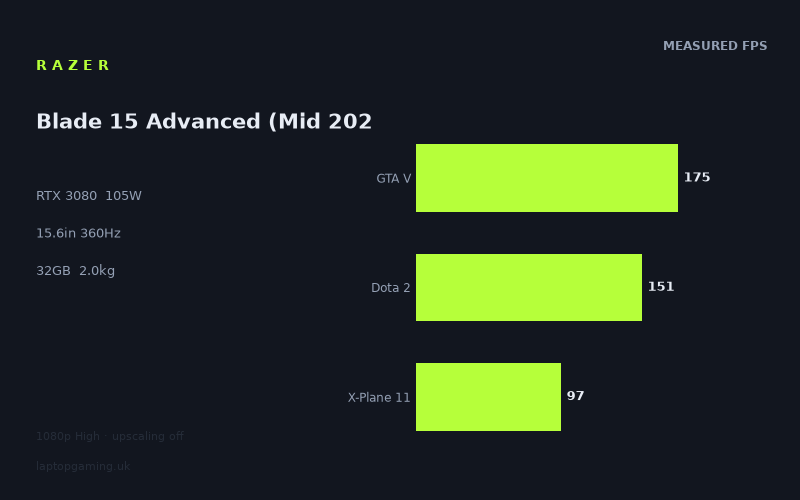
Frame rates
1920×1080, High preset, upscaling off.
Measured on this machine. Source: Notebookcheck, 2021-07-08.
Not scored: incomplete benchmark suite
Every scored laptop on this site is averaged over the same 5 games, and this one is short of Cyberpunk 2077, Baldur's Gate 3. A mean over 5 games is not comparable to a mean over 5, so we publish the figures we have and leave the score blank rather than rank it against machines tested on a different set. The numbers below are real - the suite is just incomplete.
How these numbers were produced
Frame rates here are not measured by us, and we label how each one was arrived at. A figure marked measured comes from a published run on that exact machine. A figure marked representative is derived from the GPU and its power limit (TGP) and cross-referenced against published reviews - a sound estimate of what that configuration delivers, but not a measurement of that specific laptop. Unless stated otherwise, numbers are 1920x1080, High preset, upscaling off. Where a laptop ships in several power configurations we use the wattage of the exact SKU listed, because a 140W RTX 5070 and a 115W one are not the same product.
In use
The short version
The Razer Blade 15 Advanced (Mid 2021) is a powerful 15.6in gaming laptop built around an RTX 3080 running at a 105W GPU power limit, a Core i7-11800H, 32GB of memory and a 1TB SSD. Notebookcheck’s 1920x1080 High-preset benchmark data shows that it remains a very capable Full HD machine: it reaches 204fps in Strange Brigade, 197fps in The Witcher 3 and 175fps in GTA V, while even the more demanding games in the list remain comfortably playable at 124fps in Shadow of the Tomb Raider, 97fps in Final Fantasy XV and 79fps in Assassin’s Creed Valhalla.
That is the important distinction with this Blade. It is not an RTX 3080 laptop that can be assumed to perform like every other RTX 3080 laptop. The GPU is limited to 105W, and mobile GPU names alone do not tell the whole story. A higher-power RTX 3080 Ti system can be substantially quicker in the games that make better use of the GPU, while a comparatively modest RTX 3050 Ti machine can be far behind. The Blade’s results sit in the middle of that reality: strong enough for high-refresh Full HD gaming, but not a machine that consistently feeds its 360Hz display anywhere near its maximum refresh rate in modern demanding games.
The measured average across the five scoring-suite games is 145fps. That is excellent for a 1920x1080 laptop screen and makes the Blade well suited to players who value a responsive feel in esports-friendly and older games, as well as people who want high settings without immediately needing to lower resolution or rely on upscaling. It is also a useful reminder that an average should not be treated as a guarantee. Strange Brigade, GTA V and Dota 2 are much lighter workloads here than Assassin’s Creed Valhalla. A buyer choosing this laptop specifically for the 360Hz panel should look at the individual frame rates, not just the average.
The Blade is especially convincing for someone who wants a relatively light gaming laptop rather than a large desktop replacement. At 2.026kg, it is not an ultrabook, but it is materially easier to justify as a machine that travels between home, university, work and a gaming setup than a much larger high-power gaming system. The specification also makes sense for broader use: 32GB of memory avoids the constrained feel of lower-memory configurations, while the 1TB SSD provides a sensible starting point for a gaming library. The available specifications do not provide dimensions, battery-runtime measurements, temperatures or noise figures, so those are areas where the published information cannot support a stronger conclusion.
There is no overall score for this exact configuration because its UK price is not confirmed, and value cannot be calculated without a price. That does not reflect a problem with the benchmark data: the performance suite is complete and the machine can still be judged normally on frame rates.
Buy the Blade 15 Advanced if the appeal is a 15.6in Full HD laptop with a very fast IPS panel, a strong RTX 3080 result at 105W, generous memory, and a manageable 2.026kg weight. It is particularly sensible for players of games such as Strange Brigade, The Witcher 3, GTA V and Dota 2, where the measured figures make good use of a high-refresh display. Be more cautious if the reason for choosing it is simply the RTX 3080 badge, if the main goal is to hold extremely high frame rates in every modern game, or if a larger and heavier 175W-class system is acceptable. The MSI Raider GE77 HX shows why: its RTX 3080 Ti configuration is ahead by 24fps across the shared games, even though both machines belong to the same broad GPU generation.
Performance
An RTX 3080 result needs its power limit attached
The specification that matters most here is not merely “RTX 3080”; it is RTX 3080 at a 105W GPU power limit. That power limit defines the performance context for every benchmark figure. Mobile GPUs are deployed across a wide range of laptop designs, and those designs can give the same GPU name very different operating headroom. A laptop with an RTX 3080 Ti at a much higher power limit is not automatically superior in every game at 1920x1080, because lighter games can become constrained elsewhere, but it has more potential in workloads where the GPU remains the limiting component.
Notebookcheck’s results show the Blade behaving like a high-end Full HD gaming laptop rather than an unrestricted desktop-replacement implementation. The mean across the five scoring-suite games is 145fps. That is a strong figure, and it confirms that the 105W RTX 3080 has enough performance for demanding 1920x1080 gaming at the High preset with upscaling off. It does not, however, turn the 360Hz panel into something every game can fully exploit.
The distinction is important because the 360Hz specification can be misunderstood. The panel can refresh extremely quickly, but the laptop must generate frames at a similarly high rate before a game can approach the panel’s ceiling. None of the listed measured results reaches 360fps. The closest results are 204fps in Strange Brigade and 197fps in The Witcher 3. Those are very high figures and should suit players who care about low-latency-feeling gameplay and smooth motion, but they remain well below the panel’s maximum refresh rate. The display is therefore best understood as providing headroom rather than as a target the laptop will automatically meet.
That is not a criticism unique to this Blade. A 360Hz screen is an ambitious match for a laptop GPU in graphically demanding games, particularly when testing is performed at the High preset with upscaling disabled. It is more useful in games that are light enough to run at very high frame rates, and it can still be useful when a game runs below 360fps because the panel is not the limiting refresh ceiling. What the benchmark data makes clear is that buyers should choose the Blade for fast Full HD gaming generally, not on the assumption that every game will run at 360fps simply because the screen is capable of 360Hz.
The fastest measured games
Strange Brigade is the strongest listed result at 204fps. At 1920x1080 on the High preset with upscaling off, that is a very strong outcome. It demonstrates that the Blade can deliver genuinely high-refresh gaming in titles where the workload allows it. A result above 200fps changes the character of a laptop screen specification: the 360Hz panel is not fully saturated, but it is no longer an abstract feature either. There is enough performance for players who prioritise fluidity to benefit from a display built for rapid refresh.
The Witcher 3 follows closely at 197fps. Again, that is far beyond the level generally associated with merely adequate gaming performance. The gap between 204fps and 197fps is small in practical terms compared with the gap between these games and the more demanding results lower down the list. Both demonstrate that the Blade’s combination of Core i7-11800H and RTX 3080 at 105W can produce exceptionally high Full HD figures when the game is not placing the same level of demand on the GPU as the heavier titles.
GTA V records 175fps. This is another result that makes the Blade attractive to buyers who spend a lot of time in well-established, popular games rather than only in the newest graphically demanding releases. The figure is below Strange Brigade and The Witcher 3, but it is still firmly in high-refresh territory. It also contributes to the wider pattern visible throughout the data: there is ample performance for a very fast 1920x1080 screen in suitable games, but the specific title matters considerably.
Dota 2 reaches 151fps. That is lower than the other lighter games listed, yet it remains a strong figure for a competitive-oriented title on a Full HD panel. It also reinforces that the Blade’s 360Hz display has more capacity than the measured GPU output in the supplied benchmark run. A player does not need 360fps for the laptop to feel fast, but a buyer who treats refresh rate as the central purchasing criterion should recognise the difference between a display’s maximum capability and the game-specific output recorded here.
The four figures of 204fps, 197fps, 175fps and 151fps establish the Blade’s best-case gaming character. It is a fast machine at 1920x1080, and it has enough headroom for games that reward high frame rates. It is not merely capable of reaching a basic smooth-playability threshold. The available benchmark data places it substantially above that level in several games without using upscaling.
The demanding games show the limits more clearly
Shadow of the Tomb Raider runs at 124fps. That remains a very good Full HD result, particularly at the High preset with upscaling off. It is below the lighter titles, but it still sits comfortably above the kind of result that would make a high-refresh screen feel wasted. For players who want a single-player action game to feel responsive and smooth while retaining high image-quality settings, 124fps is one of the most reassuring figures in the list.
Final Fantasy XV and X-Plane 11 both record 97fps. These two results are useful because they show the Blade in workloads where the result is still strong but no longer close to the very high figures seen in Strange Brigade and The Witcher 3. At 97fps, the laptop remains well placed for a 1920x1080 gaming experience with a fast IPS display. Yet it is much harder to argue that the 360Hz specification is the defining benefit in these games. The display is still faster than the game output, but the performance profile is closer to conventional high-refresh gaming than to the extreme end of the panel’s capability.
Assassin’s Creed Valhalla is the slowest supplied result at 79fps. That is the number prospective buyers should keep in mind before assuming that an RTX 3080 laptop necessarily means very high frame rates across every contemporary game at high settings. The Blade is not struggling in the sense of producing an unplayable figure; 79fps remains a respectable result at the stated settings. But it is far from the 360Hz ceiling, and it sits in a different performance class from the 204fps result in Strange Brigade.
The spread from 204fps in Strange Brigade to 79fps in Assassin’s Creed Valhalla is therefore the central performance story. The laptop’s average of 145fps is useful as a summary, but the individual games reveal a much broader range of outcomes. The Blade can be an extremely fast machine, a comfortably high-refresh machine, or simply a solid high-settings machine depending on the title. Buyers whose library resembles the lighter half of the benchmark list have a much stronger case for prioritising the 360Hz screen. Buyers whose priorities resemble Assassin’s Creed Valhalla should focus less on the panel’s maximum refresh figure and more on the fact that the Blade can still produce 79fps at 1920x1080 High with upscaling off.
What the benchmark average does and does not say
The 145fps mean across the five scoring-suite games is a good headline for the Blade, but it should be read carefully. An average describes the group, not the guarantee. It tells us that the machine has substantial 1920x1080 performance overall. It does not mean that every game will run at around 145fps, and it certainly does not mean that every game will approach 360fps.
The supplied list makes that clear without needing any extrapolation. GTA V at 175fps and Dota 2 at 151fps pull the gaming experience towards the high-refresh end. X-Plane 11 at 97fps and the much lower result in Assassin’s Creed Valhalla show that the same hardware faces very different demands across games. The result is not inconsistency in the negative sense; it is a normal consequence of differing engines, rendering workloads and CPU demands. What matters for a buyer is whether the games they actually play look more like the fast part of the list or the demanding part.
The same point helps explain why comparisons with other laptops can sometimes look surprising. At 1920x1080, lighter games in the shared set can become CPU-bound, which compresses real GPU differences. A near-zero result against a laptop with a nominally stronger GPU does not mean that the GPUs are identical. It means that, in this particular Full HD shared-game set, the rest of the system and the games themselves can restrict how much of the GPU advantage becomes visible. This Blade’s comparison with RTX 3080 Ti systems is especially revealing on that point.
High settings and upscaling off matter
Every measured frame rate here uses 1920x1080, the High preset and upscaling off. That makes the data particularly useful for someone deciding whether the Blade can provide strong native-resolution Full HD performance without leaning on image reconstruction. The answer is clearly yes in the listed games. Even the lowest result, 79fps in Assassin’s Creed Valhalla, is achieved under those conditions.
It also means the numbers should not be treated as universal results for every possible graphics setup. Different presets, different resolutions, ray-tracing settings where applicable, or use of upscaling can all alter performance behaviour, but those outcomes are not included in the fact sheet and should not be invented. The reliable conclusion is narrower and more valuable: at the stated Full HD High settings, this 105W RTX 3080 laptop has the performance to make demanding games run well and lighter games run very quickly.
For prospective owners, that points towards sensible expectations. The Blade is not dependent on reducing image quality just to achieve playable frame rates in the listed tests. At the same time, the fastest panel specification should not drive every graphics decision. In a game where Notebookcheck recorded 204fps or 197fps, prioritising high frame rates is a natural fit. In a game where the result is 79fps, the laptop is already producing a credible high-settings result, and expecting the same kind of performance as the lighter games would ignore the benchmark spread.
The screen
A fast Full HD IPS panel
The Blade uses a 15.6in IPS screen with a 1920x1080 resolution and a 360Hz refresh rate. That combination is unapologetically focused on speed rather than pixel density. A 1920x1080 panel puts less rendering pressure on the GPU than a higher-resolution gaming display would, which is one reason the RTX 3080 can produce figures such as 204fps in Strange Brigade, 197fps in The Witcher 3 and 175fps in GTA V at the tested settings.
For this laptop’s performance profile, Full HD is a coherent choice. The benchmark data shows that the GPU can produce very high frame rates in several games without upscaling. A higher-resolution panel would change the balance between image detail and frame rate, but that is not the configuration here. The Blade is built around making Full HD feel fast, not around using a larger pixel count as its main selling point.
The IPS panel type matters in practical terms because it identifies the display technology, but the available fact sheet does not include brightness, contrast, colour coverage, response-time measurements or any assessment of panel uniformity. It would be wrong to claim that the screen is especially bright, colour-accurate, fast in pixel response, or suitable for a particular colour-critical workflow without those measurements. The firm conclusions are that it is a 15.6in IPS panel, that it runs at 1920x1080, and that it has an exceptionally high 360Hz refresh specification.
Can the RTX 3080 actually use 360Hz?
The direct answer is: sometimes it can make meaningful use of a very fast screen, but the supplied results do not show it reaching 360fps in any listed game. This is not a failure of the laptop. Reaching 360fps at high settings with upscaling off is a demanding requirement, even at 1920x1080. The more useful question is whether the Blade produces enough frames for the display to be an asset. In several games, it clearly does.
Strange Brigade at 204fps is a strong match for a 360Hz panel. The game output is high enough that a standard lower-refresh display would impose more of a ceiling on what the hardware can show. The Witcher 3 at 197fps presents a similar case. GTA V at 175fps is also a convincing high-refresh result, while Dota 2 at 151fps remains firmly in the territory where a fast panel is relevant.
The picture changes in Shadow of the Tomb Raider, Final Fantasy XV, X-Plane 11 and Assassin’s Creed Valhalla. At 124fps, Shadow of the Tomb Raider still benefits from a high-refresh display in a broad sense, but the game is no longer remotely close to the panel’s maximum rate. At 97fps in Final Fantasy XV and X-Plane 11, the panel has abundant unused capacity. At 79fps in Assassin’s Creed Valhalla, the 360Hz number is not the useful performance metric at all; the important point is that the laptop sustains a respectable native Full HD High result without upscaling.
That does not make the 360Hz screen mismatched to the hardware. It makes it specialised. The display is most meaningful to buyers who play a mixture of lighter games, competitive games and older titles where high output is more realistic. It is less meaningful to someone who mainly plays the most graphically intensive games and expects every one of them to run at extreme frame rates. For that buyer, the Blade’s benchmark figures still show good performance, but the screen’s maximum refresh capability is more excess capacity than everyday target.
Resolution and GPU balance
There is a practical advantage to the 1920x1080 choice: it lets the machine turn its performance into frame rate rather than requiring the GPU to push a higher pixel count. The results demonstrate that clearly. The Blade produces 145fps on average across the five scoring-suite games at the stated settings, and several individual results are far above 100fps. That is precisely the kind of profile in which Full HD remains relevant for gaming laptops.
Buyers who want the sharpest possible desktop-like workspace may prefer a different screen approach, but the fact sheet does not provide an alternative panel option for this exact machine and there is no reason to judge it by a configuration it does not have. This Blade’s display specification is designed around competitive speed and Full HD gaming throughput. It should be judged on that basis, and the published numbers support that approach.
Build, size and portability
A 2.026kg gaming laptop is not a desktop replacement by default
The Blade weighs 2.026kg. That is a meaningful number because it positions the laptop differently from large, high-power gaming machines. It is still a dedicated gaming laptop with high-end hardware, a 15.6in display, 32GB of memory and an RTX 3080. It should not be described as weightless. But 2.026kg is also a figure that makes regular transport more realistic than with a bigger machine built primarily to sit in one place.
For a buyer moving between locations, the balance is appealing. The hardware is powerful enough to deliver 204fps in Strange Brigade and 197fps in The Witcher 3 under the supplied benchmark conditions, yet the weight remains within a range that can plausibly suit someone who does not want a permanently desk-bound system. The Blade’s appeal is therefore not only that it has a high-end GPU. It is that it combines that GPU class with a 15.6in format and a 2.026kg quoted weight.
The available specifications do not provide chassis dimensions, thickness, charger weight, port selection, keyboard information, materials, webcam details or build-quality measurements. It would be inappropriate to infer them from the name or from other Blade models. The portable-use conclusion should remain limited: based on weight alone, this is a more travel-friendly proposition than a very large gaming laptop, but buyers needing exact bag fit, desk footprint or connectivity should seek those specifications separately.
Memory and storage are sensible for the target buyer
The Blade is specified with 32GB of memory and a 1TB SSD. For a laptop aimed at high-end gaming and broader demanding use, that is a stronger baseline than configurations that pair a powerful GPU with minimal memory. The fact sheet does not provide memory speed, storage performance measurements or upgrade information, so there is no basis for claims about component quality or expansion. What can be said is that the headline capacity is appropriate for a machine intended to run demanding games and handle substantial applications alongside them.
The 1TB SSD capacity is also more practical than a smaller starting drive for a gaming laptop, although the fact sheet does not state usable formatted capacity or provide game-install comparisons. Rather than pretending a specific library size can be predicted, the useful observation is that 1TB gives the machine a credible starting point for someone buying a high-performance laptop rather than a minimal-capacity configuration.
Battery capacity is known; battery life is not
The battery is rated at 80Wh. That is the only battery figure supplied. It is not a battery-life measurement, and it should not be converted into an estimated runtime. Actual endurance depends on workload, display behaviour, power settings and many other factors that are not included here. There is no published runtime in the fact sheet, so buyers who need verified unplugged longevity should not treat the battery capacity alone as an answer.
For gaming specifically, the frame-rate figures in this review should be read as Notebookcheck’s benchmark data, not as a promise of unplugged gaming performance. No battery gaming figures are supplied, and there is no basis to claim that the Blade maintains the same performance away from mains power. The 80Wh capacity is useful context, but it is not enough to make a measured endurance judgement.
How it compares
Against the MSI Prestige 15
The MSI Prestige 15, configured with an RTX 3050 Ti at 105W, is the rival that the Blade beats by the widest margin in the supplied comparison group. Across four shared games, the Blade averages 76fps ahead. That is a substantial difference and provides the clearest evidence that the Blade’s RTX 3080 class hardware is not merely a specification upgrade on paper.
The comparison is useful because the two machines share the same stated 105W GPU power limit, yet the Blade’s RTX 3080 is in a very different performance tier from the RTX 3050 Ti. Power limit matters, but GPU class still matters as well. A 105W limit does not make all GPUs perform similarly. The Blade’s results show the benefit of pairing that limit with a substantially more capable GPU.
For a buyer whose choice is between a portability-oriented machine with lower-tier graphics and this Blade, the benchmark gap should carry more weight than the shared power-limit label. An average advantage of 76fps across the shared games is large enough to alter the sort of display and settings experience the laptop can support. The Blade is much better aligned with its 360Hz screen and with high-settings Full HD gaming.
There is no confirmed UK price for the MSI Prestige 15 configuration listed, so this is a performance comparison only. It should not be turned into a value claim. The reliable conclusion is simply that the Blade offers a major gaming-performance lead in the shared benchmark set.
Against the Acer Predator Triton 500 SE
The Acer Predator Triton 500 SE PT516-52s-70KX uses an RTX 3080 Ti and is listed at £2,451. Across five shared games, the Blade averages +0fps against it. That near-zero result is real, but it needs interpreting rather than repeating as if it proves the hardware is interchangeable.
At 1920x1080, lighter games in the shared set can be CPU-bound, which compresses genuine GPU differences. That means an RTX 3080 Ti system can fail to show its theoretical GPU advantage clearly when the game, processor or broader platform is already limiting the achievable frame rate. The Blade’s Full HD focus also contributes to that compression: when frame rates are already high, there is less room for a faster GPU to demonstrate a large lead.
For a prospective buyer, the important point is that this Blade is not embarrassed by the Acer in the shared Full HD games. The mean difference is effectively nil across the five-game set. That is strong evidence that the Blade’s 105W RTX 3080 can compete closely with a nominally higher-tier GPU in this particular test context.
It is not evidence that the RTX 3080 and RTX 3080 Ti are universally equivalent, nor is it a reason to assume identical results in every game, resolution or preset. The comparison is limited to games both machines hold and to the stated benchmark context. Still, it is a meaningful result for someone shopping specifically for Full HD performance: the Blade can stand alongside this RTX 3080 Ti rival rather than trailing it automatically.
Against the Schenker XMG Neo 17
The Schenker XMG Neo 17 M22 also carries an RTX 3080 Ti, and the Blade averages -0fps across five shared games. As with the Acer comparison, this is effectively a tie in the shared Full HD set. The minus sign should not be exaggerated into a practical deficit. The supplied comparison describes a near-zero difference.
Again, the explanation is not that a lower-power RTX 3080 has somehow erased every possible difference between GPU configurations. The shared games are being compared at 1920x1080, where lighter titles can become CPU-bound and compress GPU gaps. In those circumstances, the GPU name alone becomes a poor predictor of the final observed frame rate.
This comparison strengthens the Blade’s case for buyers who want high-end Full HD results from a 15.6in system. It shows that the laptop’s 105W RTX 3080 is not automatically behind RTX 3080 Ti machines in the benchmark conditions that matter to this review. It is competitive enough to match the Schenker’s shared-game result overall.
There is no confirmed UK price for the Schenker configuration listed, so the comparison should remain about performance. Buyers should not assume a value conclusion from a frame-rate tie without confirmed pricing for both systems. The performance conclusion is straightforward: within this shared 1920x1080 set, the Blade is effectively level.
Against the MSI Raider GE77 HX
The MSI Raider GE77 HX is the comparison that most clearly exposes the performance ceiling of the Blade’s 105W implementation. It uses an RTX 3080 Ti at 175W and averages 24fps ahead across five shared games. That is not a trivial difference. It is large enough to show that higher-power hardware can translate into a meaningful gaming advantage once the games allow the GPU to stretch its legs.
The contrast with the Acer and Schenker results is valuable. Against those RTX 3080 Ti rivals, the Blade’s shared-game average is effectively level. Against the 175W Raider, it is behind by 24fps. This is precisely why mobile GPU analysis needs more than a product name. The GPU power limit changes the practical hierarchy, and a 175W RTX 3080 Ti is in a different power class from the Blade’s 105W RTX 3080.
That does not make the Blade slow. The Blade still posts 145fps across its five scoring-suite games and reaches as high as 204fps in Strange Brigade. The Raider comparison simply tells a buyer what they give up by choosing a more portable 15.6in, 2.026kg design rather than a higher-power system. In GPU-limited scenarios, a machine with substantially more GPU power can create a visible lead.
This is the rival to consider if maximum frame rate matters more than weight and 15.6in portability. A buyer who wants the strongest possible result from this GPU generation should not assume the Blade is the answer merely because it has RTX 3080 branding. The shared-game deficit shows that the higher-power RTX 3080 Ti system is the stronger gaming performer in that comparison.
There is no confirmed UK price for the listed Raider configuration, so the evidence supports a performance judgement rather than a value judgement. The Raider is faster across the shared games; whether that makes it a better purchase depends on pricing and other priorities that cannot be established here.
Who it’s for
Buy it for fast Full HD gaming in a relatively manageable format
The Razer Blade 15 Advanced is for the buyer who wants serious gaming performance in a 15.6in laptop that weighs 2.026kg rather than a large desktop-replacement machine. Its core strengths are clear from the fact sheet: RTX 3080 graphics at 105W, Core i7-11800H processing, 32GB of memory, a 1TB SSD and a 360Hz Full HD IPS screen. That is a coherent specification for someone who values both speed and a machine that is not defined solely by its size.
It is particularly well suited to players whose games can benefit from high frame rates. Strange Brigade at 204fps, The Witcher 3 at 197fps, GTA V at 175fps and Dota 2 at 151fps all show the Blade delivering the kind of output that makes a fast panel worthwhile. These are the results that justify the screen specification. For someone who spends a lot of time in games with similar performance demands, the machine offers a compelling balance of visual settings and responsiveness.
It also suits a buyer who wants high settings at native Full HD without relying on upscaling in the listed games. The benchmark data was collected at 1920x1080, High settings and with upscaling off. That gives the results a clean practical meaning: this is not a laptop that needs image reconstruction merely to make the supplied games run well. Even demanding results such as 124fps in Shadow of the Tomb Raider, 97fps in Final Fantasy XV, 97fps in X-Plane 11 and 79fps in Assassin’s Creed Valhalla remain credible outcomes under those conditions.
The 32GB memory allocation also makes the Blade more attractive to someone who wants a gaming laptop to cover demanding general workloads as well as games. The fact sheet does not provide application benchmarks, so it would be wrong to promise a particular professional-workload result. But the capacity itself is a sensible fit for a premium-performance laptop rather than a specification that leaves the GPU looking overmatched by the rest of the system.
It is not for buyers chasing a universal 360fps experience
Do not buy this Blade simply because the screen says 360Hz and assume that the machine will run every game at 360fps. Notebookcheck’s figures do not support that expectation. The fastest listed result is 204fps, followed by 197fps, 175fps and 151fps. Those are excellent frame rates, but none reaches the panel’s maximum refresh rate.
The mismatch becomes more obvious in demanding titles. Shadow of the Tomb Raider at 124fps, Final Fantasy XV and X-Plane 11 at 97fps, and Assassin’s Creed Valhalla at 79fps are all far below 360fps. They are still good Full HD results, but they show that the panel’s maximum refresh rate is aspirational headroom rather than a game-by-game guarantee.
A buyer who mainly plays demanding modern games and wants the highest possible output in those titles should consider whether a higher-power alternative is more suitable. The MSI Raider GE77 HX, with its RTX 3080 Ti at 175W, is ahead by 24fps across the shared games. That comparison provides direct evidence that greater GPU power can matter more than a compact format when maximum performance is the priority.
It is not for buyers who need verified battery, noise or thermal data
The Blade has an 80Wh battery, but there is no measured battery-life figure in the supplied information. There are also no temperature or noise figures. That means this review cannot responsibly tell a buyer how long it lasts away from mains power, how loud it becomes under load, or how its chassis behaves thermally. Those may be decisive considerations for some people, especially buyers who expect to use the laptop regularly in quiet shared spaces or away from a charger.
If verified endurance, acoustic behaviour or temperatures are the main purchase criteria, wait for attributable measurements covering those areas rather than treating the 80Wh capacity as an answer. Capacity is a specification; runtime is a measured outcome. The same caution applies to noise and cooling.
It is not automatically the right choice for the cheapest route to performance
Because the exact UK price is unconfirmed, this review cannot judge whether the Blade is good or poor value. A strong performance result does not automatically make a laptop good value, and a premium design does not automatically justify an unknown price. The benchmark data shows that it is much faster than the MSI Prestige 15’s RTX 3050 Ti configuration across the shared games, effectively tied with the Acer Predator Triton 500 SE and Schenker XMG Neo 17 in their shared Full HD sets, and behind the higher-power MSI Raider GE77 HX. What cannot be established is where the Blade sits financially among them.
That makes this a machine to evaluate first on its form factor and performance profile. If the appeal is a 2.026kg 15.6in laptop with strong native Full HD gaming results, it has a credible case. If the appeal is only “an RTX 3080 laptop”, there is not enough information in the GPU name alone. The 105W power limit and the comparison data both show why.
The final buying view
The Razer Blade 15 Advanced (Mid 2021) is a strong Full HD gaming laptop with a clearly defined niche. It is not trying to be the highest-power RTX 3080-class system available, and the 105W GPU limit means it should not be judged as though it were. Instead, it delivers a capable blend of high-end graphics performance, 32GB of memory, 1TB of SSD storage, a fast 360Hz IPS display and a 2.026kg weight.
The measured gaming figures are genuinely good. The Blade is extremely fast in Strange Brigade, The Witcher 3 and GTA V; strong in Dota 2 and Shadow of the Tomb Raider; still solid in Final Fantasy XV and X-Plane 11; and respectable in Assassin’s Creed Valhalla. That range is more informative than the RTX 3080 label alone. It tells a buyer that the laptop can offer high-refresh gaming in suitable titles and high-settings Full HD gaming in tougher ones, but not a uniform extreme-frame-rate experience across every game.
Choose it if portability matters alongside performance, if a 15.6in Full HD 360Hz screen fits the games you play, and if the benchmark spread matches your expectations. Choose a higher-power alternative if the priority is extracting the maximum possible frame rate from the GPU generation. Choose something else if verified battery life, thermal behaviour, noise levels or a confirmed UK price are essential before purchase, because the supplied information does not provide those answers.