Review
Asus ROG Zephyrus Duo review
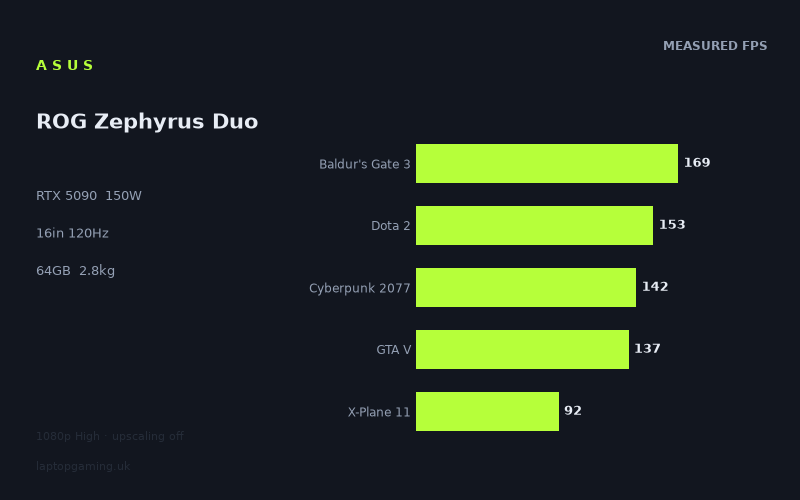
Frame rates
1920×1080, High preset, upscaling off. Averages 138fps across the 5 core benchmark games.
Measured on this machine. Source: Notebookcheck, 2026-05-07.
Not scored: no confirmed UK price
We have the full benchmark suite for this machine, so it ranks on the frame rate leaderboard like any other. What we don't have is a UK listing for this exact configuration - it's sold as a European review unit, or only in specifications that differ from the one tested. Since 30% of our score is value for money, scoring it would mean pretending price is no object, which would flatter it against every laptop you can actually buy. The frame rates below are real and comparable; there is just no buying recommendation to make yet.
How these numbers were produced
Frame rates here are not measured by us, and we label how each one was arrived at. A figure marked measured comes from a published run on that exact machine. A figure marked representative is derived from the GPU and its power limit (TGP) and cross-referenced against published reviews - a sound estimate of what that configuration delivers, but not a measurement of that specific laptop. Unless stated otherwise, numbers are 1920x1080, High preset, upscaling off. Where a laptop ships in several power configurations we use the wattage of the exact SKU listed, because a 140W RTX 5070 and a 115W one are not the same product.
In use
The short version
The Asus ROG Zephyrus Duo GX651 is a difficult gaming laptop to judge on specification alone, because its headline hardware suggests one thing while the available frame-rate data suggests something more complicated. It combines an RTX 5090 with a 150W GPU power limit, 24GB of VRAM, a Core Ultra 9 386H, 64GB of memory and a 2048GB SSD. That is an unquestionably high-end parts list. The measured results, however, do not establish it as a clear frame-rate leader against the specific RTX 5070 and RTX 5070 Ti rivals in our database.
Notebookcheck’s benchmark data shows strong gaming performance in absolute terms. Strange Brigade reaches 357fps, F1 24 reaches 261fps, F1 25 reaches 191fps, Baldur’s Gate 3 reaches 169fps, Final Fantasy XV reaches 164fps, Dota 2 reaches 153fps, Cyberpunk 2077 reaches 142fps and GTA V reaches 137fps. Those are substantial figures for the stated 1920x1080 High-preset test conditions with upscaling disabled.
But the same data also shows why the Zephyrus Duo should not be bought purely because of the RTX 5090 badge. Assassin’s Creed Shadows records 72fps and X-Plane 11 records 92fps. That is not a flaw in the benchmark data; it is the normal reality that games respond very differently to the same hardware. A laptop that can exceed the screen’s 120Hz refresh rate by a huge margin in some titles will not necessarily do so in demanding newer games or CPU-sensitive simulation workloads.
The most important buying point is therefore not whether the Zephyrus Duo is fast. It is. The important question is whether its measured performance is sufficiently better than cheaper or smaller alternatives to justify the eventual UK price. We cannot answer that yet, because there is no confirmed UK price for this exact configuration. The benchmark suite is complete and the machine ranks normally on the frame-rate leaderboard, but no overall score can be calculated without a price because value accounts for 30% of that calculation.
For a buyer who wants the particular combination of a 16in 2880x1800 OLED panel, 120Hz refresh rate, 64GB of memory, 24GB of VRAM and 2048GB of storage, the Zephyrus Duo is a serious option. It is especially plausible for someone whose workload benefits from its unusually large memory and VRAM allocation as well as gaming performance. For a buyer focused narrowly on game-frame-rate value, though, the close comparison results are a warning. The RTX 5090 configuration is not materially ahead of several RTX 5070 and RTX 5070 Ti machines across their shared game selections.
This is not a portable gaming laptop in the casual sense. At 2.82kg, it belongs in the category of machines that can move between places but will influence where and how often you choose to carry it. The 90Wh battery is substantial as a specification, but there is no measured battery-life figure in the available data, so it would be wrong to present it as evidence of all-day use or of any particular unplugged runtime.
The best case for the Zephyrus Duo is a buyer who values the whole configuration rather than one component: a high-resolution OLED screen, a high-end GPU with 24GB of VRAM, 64GB of system memory, large internal storage and measured gaming results that are consistently high even when they do not dominate every rival. The poor case is a buyer who sees RTX 5090 and expects automatic, decisive superiority over all RTX 5070-class laptops. The shared-game comparisons do not support that expectation.
Performance
The benchmark conditions matter
All quoted gaming figures come from Notebookcheck, dated 2026-05-07. The games were measured at 1920x1080 using the High preset with upscaling disabled. That last point is important. These are not figures produced by leaning on upscaling to make difficult games look easier to run. They show the benchmark data under the stated native rendering conditions for the test, rather than a mixture of different resolution modes or image-reconstruction settings.
They are also not measurements at the Zephyrus Duo’s own 2880x1800 panel resolution. That distinction should shape expectations from the start. The laptop’s display has substantially more pixels than the 1920x1080 benchmark setting, so the published frame rates should be read as a clean comparison point, not as a promise of the same performance at the panel’s full resolution. The data does not provide measured 2880x1800 frame rates, and it would be misleading to calculate or invent them.
The five scoring-suite games produce a mean of 139fps: Baldur’s Gate 3 at 169fps, Dota 2 at 153fps, Cyberpunk 2077 at 142fps, GTA V at 137fps and X-Plane 11 at 92fps. That mean is useful as a broad summary, but it is not a substitute for looking at the individual games. The gap between 169fps in Baldur’s Gate 3 and 92fps in X-Plane 11 is too large for an average alone to describe how the laptop will feel across different genres.
The broader results reinforce that point. Strange Brigade reaches 357fps, F1 24 reaches 261fps, F1 25 reaches 191fps and Final Fantasy XV reaches 164fps. At the other end, Assassin’s Creed Shadows reaches 72fps. A single “RTX 5090 performance” label is therefore less useful than understanding where the Zephyrus Duo’s measured performance lands in each type of workload.
Games that comfortably suit the 120Hz panel
Several measured results exceed the Zephyrus Duo’s 120Hz refresh rate at the 1920x1080 High setting. Strange Brigade at 357fps is far beyond what the 120Hz panel can display as distinct refreshes. F1 24 at 261fps is also well above the screen’s refresh rate, as are F1 25 at 191fps, Baldur’s Gate 3 at 169fps, Final Fantasy XV at 164fps, Dota 2 at 153fps, Cyberpunk 2077 at 142fps and GTA V at 137fps.
That does not make those extra frames meaningless. It means the Zephyrus Duo has performance headroom at the measured test settings in those titles. A player using the 120Hz screen is not going to see more than the panel’s refresh capability as displayed refreshes, but the benchmark figures show that the system is not merely scraping past 120fps in most of those games. It has a meaningful margin in several of them.
Strange Brigade is the clearest example. At 357fps, the measured result is dramatically higher than the panel’s 120Hz refresh rate. That tells us the combination of RTX 5090, Core Ultra 9 386H and 150W GPU limit is not constrained to modest frame rates in every game simply because it is fitted into a 16in laptop. The result also demonstrates why one benchmark should never be used to characterise all gaming performance. Strange Brigade gives the Zephyrus Duo a very large frame-rate number, but Assassin’s Creed Shadows does not.
F1 24 at 261fps and F1 25 at 191fps make a similar argument, though with a useful generational contrast inside the data itself. The Zephyrus Duo is still comfortably beyond 120fps in F1 25, but the result is lower than F1 24. The machine is unchanged; the game is not. This is exactly why buyers should resist treating a GPU model name as a fixed guarantee of performance in every title.
Baldur’s Gate 3 at 169fps is another strong result. It is one of the scoring-suite games and contributes to the 139fps mean, but it is clearly above that mean. Dota 2 at 153fps and Cyberpunk 2077 at 142fps also sit above the panel refresh rate under the stated conditions. These are the games where the Zephyrus Duo most clearly aligns with the promise of a 120Hz gaming display at the benchmark resolution and settings.
GTA V at 137fps is closer to the 120Hz target but still beyond it. That makes it a useful middle case. It shows that the laptop does not need to produce enormous figures like 357fps or 261fps to make effective use of a 120Hz display. A result of 137fps is already above the screen refresh rate in the published test. What changes from game to game is the amount of headroom available, not simply whether the laptop is “good” or “bad” for the panel.
Where the 120Hz screen is not fully fed
X-Plane 11 at 92fps and Assassin’s Creed Shadows at 72fps are the crucial counterweights to the high figures elsewhere. Neither result reaches the Zephyrus Duo’s 120Hz refresh rate at 1920x1080 High with upscaling off. That does not mean either game is unplayable, and the available data does not make any judgement about input response or frame-time consistency. It does mean that buyers should not assume that the laptop’s 120Hz screen will be driven to its maximum refresh rate in every demanding game under these benchmark conditions.
X-Plane 11 is especially valuable in the scoring-suite average because it lands at 92fps while the other scoring titles range from 137fps to 169fps. Without it, the mean would paint a more uniformly high picture. With it included, the 139fps mean better reflects that gaming workloads differ materially in their demands and bottlenecks.
Assassin’s Creed Shadows at 72fps is the lowest figure in the supplied list. It is the result most likely to matter to a buyer who is considering the Zephyrus Duo specifically for demanding newer games. The RTX 5090 and 150W power limit do not turn every game into a 120fps experience at the stated settings. In this title, there is a large gap between the measured result and the screen’s 120Hz refresh rate.
That gap becomes more relevant when considering the display’s 2880x1800 resolution. Since Notebookcheck’s figures were measured at 1920x1080, the data cannot tell us what frame rate Assassin’s Creed Shadows would produce at 2880x1800. It can tell us that there is already no 120fps margin at the lower benchmark resolution and High preset with upscaling disabled. Buyers who want to run demanding games at the panel’s full resolution should approach the 72fps figure as evidence that resolution and settings choices will matter, rather than as a reason to assume maximum refresh in every title.
What the 150W GPU power limit means here
The Zephyrus Duo’s RTX 5090 is specified with a 150W GPU power limit. That figure matters because laptop GPU names alone do not describe the entire performance picture. The available benchmark data is for this particular RTX 5090 configuration with this particular 150W limit, paired with the Core Ultra 9 386H and 64GB of memory. It is not evidence that every RTX 5090 laptop will produce the same frame rates, and it should not be treated as an abstract RTX 5090 result divorced from the machine around it.
In practical buying terms, the 150W specification means the published results should be read as the output of a 150W RTX 5090 laptop configuration, not as the output of an unrestricted desktop-class graphics card and not as the output of every lower-power or differently configured RTX 5090 implementation. The 150W limit is part of why the GPU specification needs context. A laptop buyer is not buying the GPU name alone; they are buying the GPU, its configured power limit, the CPU, memory, cooling arrangement and display package as a single system.
The measured figures show that this 150W implementation can deliver very high rates in several games. Strange Brigade at 357fps, F1 24 at 261fps and F1 25 at 191fps are not modest results. The same 150W configuration also records 72fps in Assassin’s Creed Shadows and 92fps in X-Plane 11. The important conclusion is not that the power limit is inadequate. There is no basis in the supplied data for such a claim. The more useful conclusion is that a 150W RTX 5090 still operates within the limits imposed by the individual game, the selected preset, the rendering resolution and the rest of the laptop platform.
It would be a mistake to claim from these figures that the GPU necessarily runs at 150W at every moment, that it sustains a specific clock speed, or that it produces a particular noise or temperature level. No measured thermals, acoustic figures or sustained-power behaviour are provided. The 150W figure is a stated GPU power limit, while the Notebookcheck numbers are the observed game-frame-rate results. They can be discussed together, but they should not be expanded into claims the data does not support.
The close-rival results make the practical point even more clearly. Despite the Zephyrus Duo’s RTX 5090 and 150W limit, it is not decisively faster than the RTX 5070 and RTX 5070 Ti machines listed in the comparison data. It trails the MSI Crosshair A16 HX by 1fps across eight shared games, trails the Alienware 16X Aurora Core Ultra 9 290HX Plus by 2fps across nine shared games, leads the MSI Katana 17 HX by 4fps across five shared games, trails the MSI Crosshair A17 HX by 5fps across seven shared games, and leads the MSI Crosshair 16 HX AI by 6fps across nine shared games.
That does not prove that the RTX 5090 is weaker than those lower-tier GPU names. The comparisons cover only games shared by each pair of machines, not one identical universal test list. It does prove something more useful for a shopper: on the available shared-game evidence, the Zephyrus Duo’s measured lead is not large enough to be assumed from its specification. The GPU name and 150W figure explain the intended class of the product, but the actual frame-rate gaps against rivals remain the evidence that should guide a purchase.
The benchmark spread is the real story
The Zephyrus Duo’s performance range, from 357fps in Strange Brigade to 72fps in Assassin’s Creed Shadows, is not an inconvenience in the data. It is the key to using the data properly. Buyers often focus on the highest number because it is easy to understand and makes expensive hardware feel justified. For actual purchasing, the lower and middle results are often more informative.
A 357fps result tells a buyer that the laptop has large overhead in Strange Brigade at 1920x1080 High without upscaling. It does not tell that buyer how the laptop will behave in X-Plane 11 or Assassin’s Creed Shadows. Likewise, 72fps in Assassin’s Creed Shadows does not erase the fact that Cyberpunk 2077 reaches 142fps or that F1 25 reaches 191fps. The machine is not defined by its best result or its worst result. It is defined by the distribution of results across games.
The scoring-suite mean of 139fps is a sensible broad reference, but the five component results show a more nuanced pattern. Baldur’s Gate 3 at 169fps, Dota 2 at 153fps, Cyberpunk 2077 at 142fps and GTA V at 137fps all sit above 120fps. X-Plane 11 at 92fps sits below it. The mean lands at 139fps because the strong results outweigh the lower X-Plane 11 figure, but a player who primarily uses simulation software is likely to care more about the 92fps result than the average. A player focused on Dota 2 may care more about 153fps than the average. Both are reasonable readings of the same data.
This is also why the Zephyrus Duo is not automatically the right choice for every person who wants the highest possible specification. The laptop is well equipped, but there is no single performance result that represents all use cases. Someone playing F1 24, F1 25, Baldur’s Gate 3, Dota 2, Cyberpunk 2077, GTA V, Final Fantasy XV or Strange Brigade at the stated benchmark settings can point to strong evidence that the system has more than enough output for its 120Hz screen. Someone buying around Assassin’s Creed Shadows or X-Plane 11 should read the same benchmark table more cautiously.
The screen
The Zephyrus Duo has a 16in OLED display with a 2880x1800 resolution and a 120Hz refresh rate. That is a premium display specification and it gives the laptop a clear identity beyond its internal components. The screen is not merely a standard 1920x1080 panel attached to a high-end GPU; it is a higher-resolution 16in OLED display with a refresh rate that invites gaming above conventional 60Hz levels.
The first thing to understand is that the panel resolution and the benchmark resolution are different. Notebookcheck’s game figures are at 1920x1080, while the built-in display is 2880x1800. The supplied data therefore establishes how the Zephyrus Duo performs in a common comparison test, not how it performs when rendering every game at the display’s full pixel count.
That gap is not a minor detail. The laptop can exceed 120fps in most of the measured titles at 1920x1080 High with upscaling disabled, but the data provides no direct evidence that it will do the same at 2880x1800. The strongest measured results create more room for resolution choices than the weaker ones, but it would still be wrong to convert 357fps, 261fps or 191fps into an asserted native-resolution result. No such measurement is available here.
For the games that already exceed 120fps in the benchmark, the 120Hz panel is well matched to the published data at 1920x1080. Strange Brigade at 357fps, F1 24 at 261fps, F1 25 at 191fps, Baldur’s Gate 3 at 169fps, Final Fantasy XV at 164fps, Dota 2 at 153fps, Cyberpunk 2077 at 142fps and GTA V at 137fps all clear the panel refresh rate. In those cases, the question is not whether the laptop can reach 120fps in the benchmark; it can. The question becomes what resolution and image settings the buyer intends to use on the 2880x1800 display.
For X-Plane 11 at 92fps and Assassin’s Creed Shadows at 72fps, the display’s 120Hz ceiling is not reached even at the stated 1920x1080 High benchmark setting with upscaling off. The 120Hz screen remains a capable display specification, but those figures make it clear that the panel’s maximum refresh rate is not a universal target the system hits in every title.
The OLED panel type is another reason the Zephyrus Duo is likely to appeal to buyers who care about the screen as much as raw performance. The supplied specification confirms that it is OLED, but does not provide measured brightness, colour coverage, response-time data, panel uniformity, reflections or HDR results. Those are all important screen considerations, especially for a laptop that may be chosen partly for its display, but they should not be assumed from panel type alone.
Likewise, the 120Hz refresh rate is known, but there is no measured information here about variable-refresh support, refresh behaviour on battery power, or any screen calibration mode. The responsible buying conclusion is simple: this is a 16in 2880x1800 120Hz OLED panel, and it is a major part of the configuration. Its suitability for a particular game depends on whether the buyer is comfortable adjusting resolution and settings when a game does not produce 120fps under the available 1920x1080 High test.
There is a wider strategic point here. A high-resolution screen can make an expensive gaming laptop more versatile, but it also raises the standard that the GPU must meet if the buyer expects to use the panel at its full resolution. The Zephyrus Duo’s results are strong enough that it does not look underpowered at the benchmark resolution. Yet the benchmark data does not support a blanket claim that the RTX 5090 will drive every measured game at 2880x1800 and 120fps without upscaling. Buyers should treat the panel as a high-resolution option, not as a guarantee that every game will meet its refresh rate at every setting.
Build, size and portability
The Zephyrus Duo weighs 2.82kg. That is the hard portability fact available, and it is enough to place the laptop in a different use category from a machine intended to disappear into a bag without much thought. A 2.82kg gaming laptop can be transported, moved between home and work, taken to a fixed study space or carried to an event. It is less naturally suited to being an effortless all-day companion.
This matters because the machine’s specification is otherwise broad enough to tempt buyers into seeing it as a single computer for everything. The Core Ultra 9 386H, 64GB of memory, 2048GB SSD, RTX 5090 with 24GB of VRAM and 16in OLED display make it a system that could plausibly cover gaming and memory-heavy work in one device. But the 2.82kg weight means that the convenience calculation is different from that of a lighter laptop, regardless of its internal capability.
No dimensions are provided in the fact sheet, so there is no basis for claiming that the chassis is thin, compact, deep, wide or especially easy to fit into a specific bag. Weight alone does not describe the full carrying experience. It does, however, give a clear indication that portability is a compromise rather than the central selling point.
The 90Wh battery is a meaningful part of the specification, but there are no battery-life measurements in the supplied data. It would be inappropriate to promise a particular runtime for web use, video playback, gaming or office work. It would also be inappropriate to assume that a 90Wh battery makes a 2.82kg, RTX 5090-equipped laptop practical for a whole day away from power. The battery capacity is known; the real-world runtime is not.
There are also no measurements for fan noise, chassis temperature, keyboard temperature or performance on battery power. Buyers deciding between a desktop-replacement-style gaming machine and a more portable laptop should not fill in those blanks with assumptions. The Zephyrus Duo’s high-end specification and 150W GPU power limit suggest a machine intended to deliver substantial performance, but this review can only attribute the frame rates to Notebookcheck’s benchmark data and the physical facts to the supplied specification.
The practical conclusion is that the Zephyrus Duo makes most sense where moving the machine is necessary but not constant. It suits a buyer who wants a 16in high-resolution OLED screen and high-end internals in a laptop form factor, while accepting that 2.82kg is a significant item to carry. It is less convincing for someone who prioritises minimal weight, frequent commuting convenience or proven long unplugged use, because the supplied data does not support those priorities.
How it compares
The closest machines in our database are particularly revealing because they prevent the RTX 5090 label from doing too much of the argument by itself. The Zephyrus Duo is compared only on games both machines have measured, which is the correct way to make these comparisons. Different pairs have different shared-game counts, so the results should be read as separate head-to-head snapshots rather than combined into one master ranking.
MSI Crosshair A16 HX
Against the MSI Crosshair A16 HX with an RTX 5070, the Zephyrus Duo averages 1fps lower across eight shared games. Neither machine has a confirmed UK price in the supplied data. The result is striking because the Asus has an RTX 5090 with a 150W power limit and 24GB of VRAM, while the MSI is listed with an RTX 5070. Yet across the shared games, the Asus is not ahead.
That does not mean the MSI is automatically the better choice. Price is unconfirmed for both machines, and the comparison does not include the full Zephyrus Duo specification such as its 16in 2880x1800 OLED panel, 64GB of memory or 2048GB SSD as a direct like-for-like rival specification comparison. What it does mean is that a buyer should not pay a premium for the Zephyrus Duo purely on the assumption of a straightforward frame-rate advantage over RTX 5070 hardware. The shared-game data does not show one.
Alienware 16X Aurora Core Ultra 9 290HX Plus
Against the Alienware 16X Aurora Core Ultra 9 290HX Plus with an RTX 5070 Ti, the Zephyrus Duo averages 2fps lower across nine shared games. The Alienware has a listed UK price of £2,569. Again, this is not a result that supports a simple GPU-tier narrative. The RTX 5090 Zephyrus Duo is not ahead in the shared-game average despite its more ambitious graphics specification.
The Alienware comparison is important because it covers nine shared games, more than the comparison against the MSI Katana 17 HX and more than several other listed rivals. A 2fps difference is small in absolute terms, but its direction matters when the Asus is the machine carrying the RTX 5090 designation. The available evidence says that buyers must compare actual benchmarks and eventual pricing, not infer value from the GPU name.
Since the Zephyrus Duo has no confirmed UK price, it is impossible to make a final value judgement against the £2,569 Alienware. If the Asus is priced far above it, a shared-game deficit would be difficult to justify for a buyer focused on gaming performance. If it is priced differently, the wider specification may matter more. The point is not to speculate on that price; it is to recognise that the final decision depends on it.
MSI Katana 17 HX
Against the MSI Katana 17 HX with an RTX 5070, the Zephyrus Duo averages 4fps higher across five shared games. The Katana has a listed UK price of £2,312. This is one of the comparisons where the Asus does lead, but the lead is modest and based on five shared games.
A 4fps advantage is better than a deficit, but it is not the kind of result that makes the rest of the buying decision irrelevant. The Zephyrus Duo offers a 16in 2880x1800 120Hz OLED screen, 64GB of memory, 24GB of VRAM and 2048GB of storage. Those may be meaningful advantages for the right buyer. The measured gaming difference against the Katana, however, is not so large that the Asus can be presented as an obvious performance bargain before its own price is known.
MSI Crosshair A17 HX
Against the MSI Crosshair A17 HX with an RTX 5070 at 115W, the Zephyrus Duo averages 5fps lower across seven shared games. The MSI has no confirmed UK price in the supplied data. This is arguably the most challenging comparison for the Asus specification on paper: the Zephyrus Duo has an RTX 5090 at 150W, while the Crosshair A17 HX is listed with an RTX 5070 at 115W, yet the Asus trails in the shared-game average.
The correct response is not to declare the RTX 5090 meaningless. The comparison is limited to seven games shared by both machines, and no individual shared-game results are supplied here. But the result is still strong evidence against buying by label alone. A machine with a lower-tier GPU and a stated 115W limit is ahead by 5fps across the games that can be directly compared.
For a gaming-first buyer, this is exactly the sort of comparison that should slow down an expensive purchase. The Zephyrus Duo may offer features the Crosshair does not, but its RTX 5090 and 150W specification do not guarantee the better game average in this direct dataset.
MSI Crosshair 16 HX AI
Against the MSI Crosshair 16 HX AI with an RTX 5070, the Zephyrus Duo averages 6fps higher across nine shared games. Neither machine has a confirmed UK price in the supplied data. This is the largest positive frame-rate margin among the listed direct comparisons, and it comes across nine shared games, making it more substantial than the 4fps lead over the Katana across five shared games.
Even here, the result should be kept in proportion. A 6fps average lead is a real lead, but it is not a dominant separation for an RTX 5090 machine against an RTX 5070 machine. The Zephyrus Duo’s appeal therefore remains tied to the full configuration: the 16in 2880x1800 OLED screen, 120Hz refresh rate, Core Ultra 9 386H, 64GB of memory, 24GB of VRAM and 2048GB SSD. If the purchase is made solely for higher game-frame rates than every RTX 5070 alternative, the supplied comparisons do not provide that assurance.
What these rivals collectively tell us
Across the five listed rivals, the Zephyrus Duo is behind two machines and ahead of two machines, with one further deficit against the Alienware. Its results range from 5fps behind the MSI Crosshair A17 HX to 6fps ahead of the MSI Crosshair 16 HX AI. That is a very narrow spread in the context of an RTX 5090 laptop being compared with RTX 5070 and RTX 5070 Ti systems.
The central lesson is that the Zephyrus Duo should be evaluated as a complete machine rather than as an RTX 5090 purchase. Its direct comparison results are close enough that price, display, memory, storage, portability and the particular games you play will determine whether it is the right choice. The Asus has the most imposing GPU name in this group, but the benchmark evidence does not show it running away from the field.
Who it’s for
The Zephyrus Duo is for the buyer who wants a high-end laptop configuration with a strong measured gaming baseline and places real value on 64GB of memory, 24GB of VRAM, a 2048GB SSD and a 16in 2880x1800 OLED display. That combination is more distinctive than the frame-rate comparisons alone. Someone who needs substantial memory capacity alongside gaming performance has a clearer reason to consider this Asus than someone whose only requirement is the highest frames per pound.
It is also for the buyer whose game library resembles the stronger end of the Notebookcheck results. Strange Brigade at 357fps, F1 24 at 261fps, F1 25 at 191fps, Baldur’s Gate 3 at 169fps, Final Fantasy XV at 164fps, Dota 2 at 153fps, Cyberpunk 2077 at 142fps and GTA V at 137fps all show the system comfortably exceeding 120fps at 1920x1080 High with upscaling off. A buyer who wants to make regular use of the display’s 120Hz refresh rate in those kinds of workloads has evidence that the Zephyrus Duo can do so under the stated test conditions.
It is also plausible for a buyer who wants a laptop that can be moved between fixed locations rather than carried constantly. At 2.82kg, it is transportable, but it should be chosen with realistic expectations about carrying weight. The 90Wh battery may matter to some buyers, but there is no measured runtime available, so it should not be the deciding reason to choose this model.
The Zephyrus Duo is not the obvious choice for someone who wants a light travel laptop. The 2.82kg weight is a direct compromise. It is also not the obvious choice for someone who wants confirmed battery endurance, low noise, cool surface temperatures or specific chassis dimensions, because none of those measurements are available in the supplied data.
Most importantly, it is not the obvious choice for a buyer who assumes that an RTX 5090 automatically makes it the fastest or best-value option against every RTX 5070 and RTX 5070 Ti laptop. The direct comparisons say otherwise. It averages 1fps behind the MSI Crosshair A16 HX, 2fps behind the Alienware 16X Aurora Core Ultra 9 290HX Plus and 5fps behind the MSI Crosshair A17 HX. Its leads over the MSI Katana 17 HX and MSI Crosshair 16 HX AI are 4fps and 6fps respectively. Those are close contests, not decisive victories.
Buy something else if your priority is the clearest gaming-value proposition and you are willing to choose based on confirmed UK pricing. The Zephyrus Duo’s price is not confirmed, so there is no way to determine whether its broader specification justifies any premium. The Alienware is listed at £2,569 and the MSI Katana 17 HX at £2,312, but the Asus cannot be meaningfully positioned against either on value until its exact UK price is known.
Buy something else if your priority is maximum 120fps performance in every demanding title without adjusting anything. The published data does not support that expectation. X-Plane 11 reaches 92fps and Assassin’s Creed Shadows reaches 72fps at 1920x1080 High with upscaling off. Since the Zephyrus Duo’s own display is 2880x1800, buyers who want to use the panel at full resolution should be especially prepared to make game-by-game decisions rather than expecting one fixed setting to suit everything.
For the right person, the Zephyrus Duo can make sense as a premium, heavily specified 16in gaming system whose screen, memory, VRAM and storage are as important as its GPU badge. For the wrong person, it risks being an expensive way to buy performance that several lower-tier GPU rivals match or beat in the available shared-game data. The sensible decision is to wait for the confirmed UK price, compare it directly with the listed alternatives, and judge the Asus on the games and features that actually matter to you rather than on the RTX 5090 name alone.