Review
Aorus 16X review
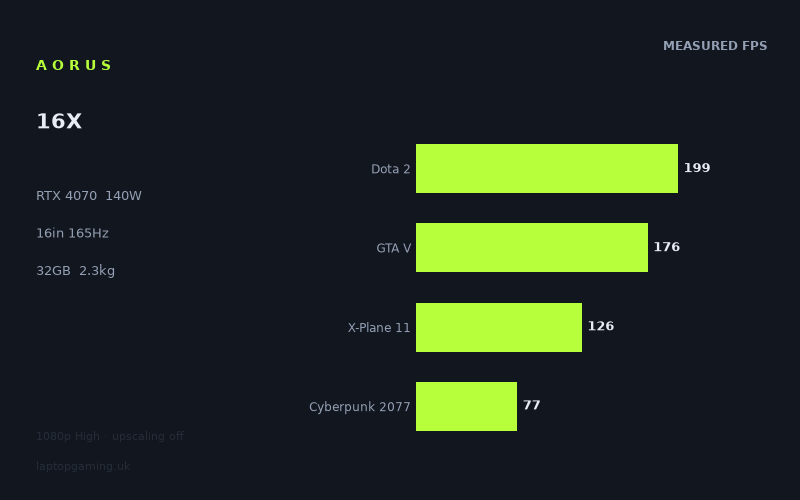
Frame rates
1920×1080, High preset, upscaling off.
Measured on this machine. Source: Notebookcheck, 2024-04-13.
Not scored: incomplete benchmark suite
Every scored laptop on this site is averaged over the same 5 games, and this one is short of Baldur's Gate 3. A mean over 4 games is not comparable to a mean over 5, so we publish the figures we have and leave the score blank rather than rank it against machines tested on a different set. The numbers below are real - the suite is just incomplete.
How these numbers were produced
Frame rates here are not measured by us, and we label how each one was arrived at. A figure marked measured comes from a published run on that exact machine. A figure marked representative is derived from the GPU and its power limit (TGP) and cross-referenced against published reviews - a sound estimate of what that configuration delivers, but not a measurement of that specific laptop. Unless stated otherwise, numbers are 1920x1080, High preset, upscaling off. Where a laptop ships in several power configurations we use the wattage of the exact SKU listed, because a 140W RTX 5070 and a 115W one are not the same product.
In use
The short version
The Aorus 16X is the RTX 4070 laptop that does not make excuses. Where a lot of machines built around that graphics card arrived with the power budget quietly trimmed to suit a slim chassis, this one runs its GPU at a 140W total graphics power limit, which is the upper end of what the part was ever given in a notebook. Behind it sits a Core i9-14900HX and 32GB of memory, and in front of it a 16in 2560x1600 IPS panel at 165Hz. On paper that is a coherent machine: a fast graphics card allowed to run fast, a processor that will not hold it back, and enough memory that nothing else in the system becomes the bottleneck first.
The measured evidence, published by Notebookcheck on 13 April 2024, largely bears that out. Twelve games at 1920x1080 on the High preset with upscaling switched off, and the spread runs from 233fps in Strange Brigade at the top to 73fps in Horizon Forbidden West at the bottom. That is a range of just over three to one on identical hardware at identical settings, and understanding where it comes from is most of what you need to know before spending money on this machine.
The headline judgement is this. If you play a broad mix that includes competitive titles, older engines and mid-weight single-player games, the Aorus 16X is comfortably faster than the 165Hz panel can display and will stay that way for a long time. If your list is dominated by the heaviest recent open-world releases, the picture is different but still respectable: it clears sixty frames a second in everything measured, and does so with the graphics settings turned up and upscaling turned off, which means there is meaningful headroom left in the settings menu that most owners will happily spend.
The reservation is not about speed. It is that the panel asks for more than the graphics card can supply at native resolution, and that the 16X is a 2.333kg machine with a 99Wh battery, which puts it in a category where you carry it deliberately rather than casually. Neither of those is a flaw. They are the shape of the machine, and they determine who it suits.
Performance
What 140W actually buys
Mobile graphics cards of this generation were sold under a single name across a very wide range of operating conditions. The same RTX 4070 silicon appeared in machines that were allowed to draw a great deal of power and in machines that were not, and the difference between the two ends of that range is large enough that treating the name as a specification is misleading. The number that matters is the power limit, and here it is stated: 140W.
What that buys, in practice, is the ability to hold clock speeds under sustained load rather than only in the first thirty seconds of a benchmark run. A graphics card that is given a generous power envelope does not have to make a choice between clock speed and memory bandwidth when a scene gets busy; it can simply run. The visible consequence in benchmark data is not a higher peak so much as a flatter curve across game types — the heavy titles suffer less relative to the light ones than they would on a constrained part.
You can see that in this data set. The floor here is 73fps. On a version of the same graphics card held to a much lower ceiling, the light titles at the top of the chart would barely move, because they are not asking the GPU for much in the first place, but the heavy titles at the bottom would fall further, because they are asking for everything the card has. A generous power limit therefore shows up disproportionately in exactly the games where you would notice a shortfall. That is why the 140W figure is worth more attention than the model name.
The second consequence is durability. A machine that is running its GPU near its designed ceiling in 2024 will still be running it near that ceiling in 2027, because the ceiling is set by the hardware and the cooling rather than by a marketing tier. Games get heavier; the power limit does not shrink. Buying the well-fed version of a mid-to-upper graphics card has historically aged better than buying the starved version of a nominally superior one, and the numbers below are consistent with that.
The top of the chart, and why it is less useful than it looks
Four titles here sit at 176fps or above: Strange Brigade at 233fps, The Witcher 3 at 223fps, Dota 2 at 199fps and GTA V at 176fps. These are the numbers a spec sheet would love to quote, and they are the least informative in the set.
Strange Brigade is in the suite because it is a reliable, repeatable, engine-friendly test rather than because anyone is choosing a laptop to play it. The Witcher 3 is a 2015 game; even in its updated form it was built for hardware two generations older than this. Dota 2 is a competitive title deliberately engineered to run on almost anything, and GTA V is now old enough that a modern processor is doing at least as much work to feed frames as the graphics card is doing to draw them.
That last point is the important one, and it recurs throughout this review. At 1920x1080 on High, with a Core i9-14900HX driving the pipeline, several of these games stop being tests of the graphics card at all. The GPU finishes each frame and waits. What you are measuring is how quickly the processor, the game engine and the driver can hand it the next one. Two laptops with genuinely different graphics cards can therefore land within a handful of frames of each other in these titles, not because the cards are equivalent but because neither is being asked a hard question.
None of that makes the high numbers worthless. If you play Dota 2 competitively, 199fps against a 165Hz panel is exactly what you want: the frame rate is above the refresh ceiling with enough margin that a busy team fight does not drop you below it. But if you are trying to work out how the machine will handle a game released next year, the top of this chart tells you almost nothing.
The middle, where the machine actually lives
The band between roughly 112fps and 156fps is where the honest reading of this laptop sits: Last Epoch at 156fps, Alone in the Dark at 151fps, X-Plane 11 at 126fps, Far Cry 5 at 114fps and Final Fantasy XV at 112fps.
These are five very different workloads and it is worth separating them. Last Epoch is an action role-playing game with a lot of simultaneous effects and a lot of entities; 156fps there means the machine is not going to stumble when the screen fills with projectiles, which is precisely when a weaker system does stumble. Alone in the Dark at 151fps is a modern release on a modern engine at a genuinely comfortable rate. X-Plane 11 at 126fps is not really a graphics test either — flight simulators of that vintage lean hard on single-thread processor performance and on how quickly scenery can be streamed in — and the i9-14900HX is doing most of the work for that figure.
Far Cry 5 at 114fps and Final Fantasy XV at 112fps are the two that reward a moment's thought. Both are several years old. Both land barely above a hundred frames a second on a well-fed RTX 4070. That is not a criticism of the laptop; it is a reminder that age is a poor proxy for load. Far Cry 5's open world does a lot of geometry and foliage work regardless of how old it is, and Final Fantasy XV was notoriously expensive on release and remains so. When someone tells you a machine "does 233fps", ask which game, because on this hardware the answer ranges from 233fps to 112fps within titles that all predate the laptop.
Where it runs out
Three games sit below a hundred: Skull & Bones at 94fps, Cyberpunk 2077 at 77fps and Horizon Forbidden West at 73fps.
This is the part of the chart that should drive the buying decision, because it is the part that predicts the future. All three are recent, all three are built for hardware of this generation rather than the last, and all three are doing the expensive things: dense open-world streaming, volumetric lighting, high-density foliage and, in Cyberpunk's case, a lighting model that will consume as much graphics performance as you hand it.
Cyberpunk 2077 at 77fps deserves particular attention because it has become the field's reference load. That figure is at High with upscaling switched off, which is a deliberately unfriendly test point — it is close to the worst case for a game that was designed around upscaling being available. Anyone actually playing it on this machine would turn DLSS on, and the frame rate would rise substantially. We do not have a measured figure for that, so we are not going to quote one, but the direction is not in doubt. The 77fps number should be read as a floor with slack behind it, not as a ceiling.
Horizon Forbidden West at 73fps is the lowest measured result here and it is still comfortably above sixty. That is the single most reassuring fact in the data set. A machine whose worst measured performance in a demanding 2024 test suite is in the low seventies is not a machine that is going to embarrass itself for several years. It will need settings adjustments as games get heavier. It will not need replacing.
Where the spread comes from
The 233fps to 73fps range across identical hardware is worth taking apart properly, because it is the single most useful thing in the data and it is routinely misread.
The first factor is what the game is asking for. A competitive title with simple geometry and a flat lighting model asks for a fraction of what a modern open world asks for. That accounts for most of the top-to-bottom distance on its own.
The second is where the limit sits. In the fast titles the graphics card is idle for part of each frame, waiting on the processor. In the slow titles it is saturated. Those are two different measurements wearing the same units, and averaging them together — which every "average frame rate" figure necessarily does — blurs a real distinction. It is why a single headline number for a laptop is close to meaningless without the spread behind it.
The third is memory pressure. The heaviest titles here are also the ones with the largest texture sets and the most aggressive streaming, and how a laptop behaves when the frame buffer gets tight is not visible in an average frame rate at all — it shows up as stutter rather than as a lower number. We do not have frame-time data, so we will not claim to know how this machine behaves in that respect. It is a genuine gap in what published averages can tell you.
Why there is no overall score
Every laptop we score is averaged over the same five games, so that a ranking compares like with like. For the Aorus 16X we have four of them — Dota 2, GTA V, X-Plane 11 and Cyberpunk 2077, averaging 144fps — but no figure for Baldur's Gate 3. A four-game average cannot be placed against five-game averages without quietly advantaging or penalising this machine depending on which title is missing, so we have left it unranked rather than guess.
That is a gap in our data, not a criticism of the laptop. Nothing in the twelve games we do have suggests the missing result would be unusual. But the whole point of publishing a leaderboard is that every entry on it was measured the same way, and a partial set does not qualify.
The screen
A 16in IPS panel at 2560x1600 and 165Hz is a well-judged specification for this class of machine, and it is also the component that creates the one genuine tension in the design.
Start with what is good. 2560x1600 is a 16:10 aspect ratio, which gives you noticeably more vertical space than a 16:9 panel of the same diagonal — useful for everything that is not a game, and unobtrusive in everything that is. The pixel density at 16in is high enough that text is crisp without needing aggressive scaling. 165Hz is a real improvement over the slower panels further down the market, in a way you feel in mouse movement rather than only in benchmark charts, and IPS at this size means viewing angles hold up when the machine is on a desk in front of two people rather than one.
Now the tension. Every measured figure quoted above was recorded at 1920x1080, not at the panel's native 2560x1600. That resolution carries roughly 78 per cent more pixels than 1080p, and while frame rate does not scale down in exact proportion to pixel count, it moves a long way in that direction in GPU-limited titles. The games at the top of the chart have so much headroom that native resolution is a non-issue — Strange Brigade, The Witcher 3, Dota 2 and GTA V will all still be quick. The games at the bottom are a different matter. Horizon Forbidden West at 73fps at 1080p is not going to hold 73fps at 1600p, and neither is Cyberpunk 2077 at 77fps.
This is not a defect and it is not unusual; it is the standard arrangement on 1600p gaming laptops of this generation, and it is exactly the problem upscaling was built to solve. The practical consequence is that a buyer should expect to run the heavy modern titles at native resolution with upscaling enabled, or at 1080p with it off, and to run everything older at native with everything turned up. Both are perfectly good outcomes. What you should not do is look at the 165Hz figure and assume the graphics card will feed it at native resolution in a 2024 open-world game, because the measured data says otherwise.
Where the refresh rate genuinely pays off is in the light half of the chart. Dota 2 at 199fps, GTA V at 176fps, The Witcher 3 at 223fps and Strange Brigade at 233fps are all above 165Hz, which means the panel is the limiting factor rather than the machine. That is the right way round. A high-refresh panel earns its keep when the system can overshoot it, because the margin is what keeps you above the refresh rate during the busy moments rather than only during the quiet ones.
One thing we do not have is measured panel data — brightness, contrast, colour coverage or response time. IPS at 165Hz on a machine of this class sets a reasonable expectation, but expectation is not measurement, and if panel quality is the deciding factor for you rather than speed, this review cannot settle it.
Build, size and portability
At 2.333kg with a 99Wh battery, the Aorus 16X sits in the part of the market where portability is real but conditional.
The weight first. Under two and a half kilograms for a 16in machine running a 140W graphics card is a genuinely good result, and it is worth being clear about why. Power limits and cooling mass are tied together: a chassis that can dissipate 140W of GPU heat plus a Core i9-14900HX under load needs fans, heat pipes and vents, and all of that has mass. Machines that come in much lighter than this in the same size class have generally bought the weight saving by lowering the power limit. This one has not, which means the 2.333kg figure is buying you something.
What it means day to day is that this is a laptop you can carry, but one you will notice. In a backpack alongside a charger it is a deliberate load rather than an incidental one, and the charger matters: a machine feeding a 140W graphics card and a high-core-count processor needs a substantial power brick, and that brick travels with you if you intend to game away from a desk. The realistic pattern of use is a machine that lives on a desk and moves between fixed locations — home to office, term-time to holidays, desk to LAN event — rather than one you pull out on a train.
The 99Wh battery is the largest capacity permitted on a passenger aircraft in most jurisdictions, which is not an accident; manufacturers who want maximum runtime specify exactly that figure. It is a meaningful advantage over the 90Wh and 73Wh packs found in a lot of competing machines, and it will show up in light-use runtime — browsing, video, office work — where the graphics card is largely idle.
It will not, however, deliver long gaming sessions unplugged, and no laptop in this class does. A 140W graphics card plus a 14900HX under load would drain a 99Wh pack in well under an hour if the machine even allowed the GPU to run at full power on battery, which most do not. We have no measured battery figures for this machine, so we are not going to put a number on runtime in any scenario. What we can say from the specification alone is that the capacity is at the top of what is legally available, and that a buyer choosing between this and a machine with a smaller pack is choosing more usable non-gaming runtime.
The 16in form factor deserves a note of its own. It has quietly become the sweet spot for gaming laptops, and this machine shows why: it is large enough for a genuinely useful screen and for the cooling volume a 140W GPU needs, without crossing into the 17in and 18in territory where the machine stops fitting on a train table or in a normal backpack. If you want the fastest possible hardware you go bigger; if you want something you can actually move, 16in is where the compromise lands best.
How it compares
Four machines from the same graphics generation give a useful spread here: one clearly below, two effectively alongside, and one clearly above. Each comparison is made only on games both machines have recorded, which is why the number of shared titles varies.
Against the MSI Thin GF63 (RTX 4050)
Across four shared games the Aorus 16X averages 65fps more than the MSI Thin GF63. That is the largest gap in this comparison set and it is the one that requires the least explanation: this is a well-fed RTX 4070 against an RTX 4050 in a thin, inexpensive chassis, and the result is exactly what the hardware predicts.
What makes it worth stating anyway is scale. A 65-frame average advantage is not a tier's worth of difference dressed up; it is the difference between a machine that has headroom and one that does not. On the Thin GF63, the games at the bottom of this chart — the Cyberpunk 2077s and Horizon Forbidden Wests — are where you start negotiating with the settings menu rather than choosing from it. On the 16X they are not. If your shortlist has both of these on it, the shortlist is really a budget question rather than a specification question, and the frame rate data makes the consequence of the budget decision unusually legible.
Against the Schenker XMG Pro 16 Studio, Mid 23 and Mid 24
Both Schenker machines run the same RTX 4070 at the same 140W limit as the Aorus. Against the Mid 23 model, the 16X averages 1fps more across four shared games. Against the Mid 24 model the two are level to within a frame across four shared games.
This is the most instructive result in the set, and it is instructive precisely because nothing separates them. Three machines from three different design teams, in three different chassis, land on top of one another. That is not coincidence and it is not measurement noise smoothing out real differences — it is confirmation that on this generation of hardware, at this test point, the power limit is the specification that matters. Give the same silicon the same watts and it produces the same frames, whatever badge is on the lid.
The practical conclusion for a buyer is worth stating bluntly. If you are choosing between these three, do not choose on frame rate, because there is nothing to choose. Choose on the things the benchmark data does not cover: keyboard, panel quality, port selection, fan noise, warranty, service, and price. Those are the real variables here, and a difference of one frame per second in a four-game average should not influence a purchase by so much as a pound.
It is also worth noticing what this says about the year-on-year comparison. The Mid 23 and Mid 24 versions of the same Schenker are separated by a model year and by whatever component changes came with it, and they still land in the same place as each other and as this machine. On a graphics card held at a fixed power limit, a model-year refresh does not move the frame rate. It may improve other things — and it may not — but the benchmark chart is not where you will find out.
Against the Asus ROG Strix Scar 17 (RTX 4090)
Across three shared games the Aorus 16X averages 32fps less than the Scar 17. This is the machine at the top of the comparison set, and the interesting part is not that it wins but by how little, given that it is two graphics tiers up.
The explanation is the one that runs through this whole review. The three shared titles here are drawn from the light end of the suite, and at 1920x1080 those are the games where the processor and the engine set the pace rather than the graphics card. Put an RTX 4090 into that situation and much of its advantage has nowhere to go; the extra silicon finishes each frame sooner and then waits longer. A 32-frame average gap on such a set is therefore a compressed picture of a much larger hardware difference, not a fair summary of it. Run the same two machines through the heaviest titles at native resolution and the distance would widen considerably.
The honest reading for a buyer is the reverse of what the number first suggests. The Scar 17 is a substantially faster machine and the shared-game average understates it. But the games in which that extra speed becomes visible are a specific subset — the newest, heaviest, highest-resolution ones — and if you do not play those, you would be paying for a difference that never materialises on your screen. The 16X's case against it is not that it is nearly as quick. It is that the situations in which it is meaningfully slower are narrower than the tier gap implies.
What the comparison set says as a whole
Line those four results up and a shape emerges. Against a genuinely weaker graphics card the Aorus 16X wins by a wide margin. Against identical hardware at an identical power limit it ties, twice, decisively. Against a far stronger card it loses by a margin that the shared-game selection compresses.
That is a coherent and quite reassuring picture. It says the 16X is delivering everything its specification promises, with no evidence of thermal shortfall or power-limit trimming relative to peers running the same configuration. For a machine at 2.333kg — lighter than some of the chassis it is being compared against — matching them frame for frame is the result you want to see. It suggests the cooling is doing its job rather than the power limit being a number in a brochure.
What we do not know
Being explicit about the gaps is part of reading benchmark data honestly, and there are several here.
- Fan noise and surface temperatures. We have no measured figures. A 140W graphics card and a Core i9-14900HX in a 2.333kg chassis is a demanding thermal brief, and a machine that matches larger rivals on frame rate has to be moving that heat somewhere. Whether it does so quietly is not something the frame rate chart can tell you, and it is the single most common reason people fall out with an otherwise fast laptop.
- Battery runtime. The pack is 99Wh. What that translates to in hours, in any workload, is not in our data.
- Panel measurements. Brightness, contrast, colour gamut and response times are unrecorded here.
- Frame-time consistency. Every figure above is an average. A game that averages 94fps with occasional long frames feels worse than one that averages rather less but does so steadily, and averages cannot distinguish the two.
- UK price. We have no confirmed figure for this configuration, which is why the machine carries no value judgement here. Everything above is about what it does, not what it costs to get it.
None of those gaps changes the performance conclusion, which rests on twelve measured games from a consistent source. But a review that pretends to know things it does not is worth less than one that draws a line around what it does know.
Who it's for
The person this suits best is someone who wants a single machine that games seriously and works seriously, and who is prepared to accept a 2.3kg carry to get it. The combination of a Core i9-14900HX, 32GB of memory and a 140W RTX 4070 is unusually well balanced for mixed use: the processor and memory handle compiling, rendering, virtual machines and heavy multitasking without the graphics card being a token gesture, and the graphics card handles modern games without the processor throttling the frame rate. Machines that do one of those things well are common. Machines that do both without a glaring compromise are less so.
It also suits the buyer who plays broadly rather than exclusively at the top end. If your library is a mix of competitive titles, a few years of back catalogue and the occasional big new release, this machine is over-provisioned for most of it and adequate for the rest, which is the right way round. Dota 2 at 199fps and The Witcher 3 at 223fps are not going to become problems. Cyberpunk 2077 at 77fps with upscaling off and settings high is not a problem either — it is a starting point with room to move.
It suits someone who values a machine ageing well. The 140W power limit is the reason. Frame rates fall as games get heavier, and they fall furthest on hardware that was already constrained. A graphics card running at the top of its designed envelope has less to lose.
Who should buy something else
If you want to run games at the panel's native resolution with everything turned up and upscaling off, this is not the machine. The data is unambiguous: the heaviest titles measured here are in the seventies at 1920x1080, and 2560x1600 asks for substantially more. You would be buying a graphics card that cannot feed the screen it is attached to in the games you care about. Either accept upscaling as a permanent part of the arrangement, which is entirely reasonable, or spend up to a genuinely faster card.
If portability is the priority, look smaller. 2.333kg plus a substantial charger is not a machine you carry casually. There are 14in machines built around the same graphics card at much lower power limits which weigh a great deal less, and if the trade you actually want is speed for weight, this machine has made the opposite choice on your behalf.
If your budget is genuinely tight, the comparison with the RTX 4050 machine is the one to look at hard. A 65-frame average advantage is real and large, but if it takes you past what you can comfortably spend, a slower machine that you own outright is better than a faster one you cannot afford. The frame rate data makes the size of the sacrifice clear, which is the point of publishing it.
If you are choosing between this and a Schenker XMG Pro 16 Studio at the same power limit, ignore performance entirely. They are the same speed. Decide on price, panel, keyboard, ports, noise and support, and treat any claim that one is faster than the other as unsupported by the measured data.
And if you need a scored, ranked position on our leaderboard before you commit, this machine cannot give you one. We are missing a Baldur's Gate 3 figure, so the five-game average that every ranked laptop is measured on cannot be computed. The twelve games we do have paint a clear and consistent picture, but a picture is not a ranking, and we would rather say so than fabricate one.
The bottom line
The Aorus 16X is a properly specified RTX 4070 laptop rather than a nominally specified one, and in this generation that distinction is the whole game. The 140W power limit shows up where it matters — in the heavy titles, where it keeps the floor at 73fps rather than somewhere less comfortable — and the measured results confirm it is delivering everything that machines with the same configuration deliver, in a lighter chassis than several of them. The processor and memory are strong enough that nothing else in the system becomes the constraint. The panel is a good one that outruns the graphics card at native resolution in exactly the games you would expect it to, which is a limitation to plan around rather than a fault to hold against it. If that shape of machine is what you are after, the data says this is a competent example of it.