Details
Product prices and availability are accurate as of the date/time indicated and are subject to change. Any price and availability information displayed on Amazon.co.uk at the time of purchase will apply to the purchase of this product.Review
MSI Pulse 17 review
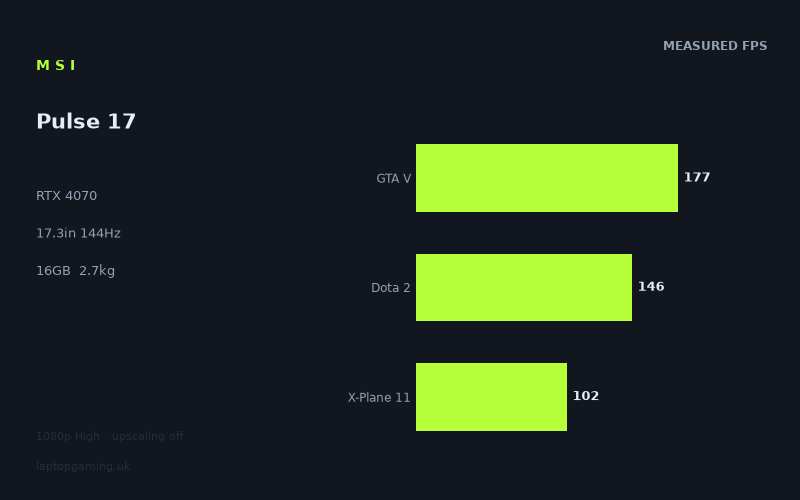
Frame rates
1920×1080, High preset, upscaling off.
Measured on this machine. Source: Notebookcheck, 2023-07-16.
Not scored: incomplete benchmark suite
Every scored laptop on this site is averaged over the same 5 games, and this one is short of Cyberpunk 2077, Baldur's Gate 3. A mean over 3 games is not comparable to a mean over 5, so we publish the figures we have and leave the score blank rather than rank it against machines tested on a different set. The numbers below are real - the suite is just incomplete.
How these numbers were produced
Frame rates here are not measured by us, and we label how each one was arrived at. A figure marked measured comes from a published run on that exact machine. A figure marked representative is derived from the GPU and its power limit (TGP) and cross-referenced against published reviews - a sound estimate of what that configuration delivers, but not a measurement of that specific laptop. Unless stated otherwise, numbers are 1920x1080, High preset, upscaling off. Where a laptop ships in several power configurations we use the wattage of the exact SKU listed, because a 140W RTX 5070 and a 115W one are not the same product.
In use
The short version
The MSI Pulse 17 (B13VGK) is a large, conventional 1080p gaming laptop built around an RTX 4070, a Core i7-13700H, 16GB of memory and a 1TB SSD. Its measured game results are strong in several titles, particularly the lighter and more scalable games in the set, but the important qualification is that the full picture is not available. Notebookcheck’s figures show excellent results in Strange Brigade, F1 23, F1 22, GTA V, Far Cry 5 and Dota 2, while Final Fantasy XV and X-Plane 11 are materially more demanding for this configuration.
That makes the Pulse 17 easier to recommend as a machine for someone who wants a 17.3in screen, a 144Hz panel and high frame rates in competitive, racing and older blockbuster games than as a laptop to buy on the assumption that every modern game will run at the screen’s full refresh rate at the High preset. The benchmark data does not support that assumption. In the measured games, some titles are comfortably beyond 144fps, some sit around that target, and some are well below it.
There is also a substantial buying caveat: the UK price is not confirmed. That prevents a proper value judgement. A laptop can have attractive benchmark results and still be the wrong purchase if its eventual price is too close to a more capable alternative, or too far above a less expensive machine delivering similar real-world playability. Until there is a confirmed UK price, the Pulse 17 should be assessed as a performance proposition rather than declared a bargain, an overpriced model or anything in between.
On the available evidence, the central appeal is clear. Notebookcheck recorded 233fps in Strange Brigade, 199fps in F1 23, 187fps in F1 22, 177fps in GTA V, 154fps in Far Cry 5 and 146fps in Dota 2, all at 1920x1080 on the High preset with upscaling disabled. Those are good results for a 144Hz 1080p gaming laptop. They show that the RTX 4070 is not merely capable of making recent games playable on this panel; in the right titles, it has enough headroom to make use of the display’s refresh rate.
The less flattering side is equally important. Final Fantasy XV reaches 112fps and X-Plane 11 reaches 102fps under the same stated conditions. Neither result is poor in isolation. Both are comfortably playable frame rates. But they demonstrate that the headline specification should not be mistaken for a promise of 144fps across every game. The spread from 233fps down to 102fps is wide, and it is the spread rather than the best single result that defines what ownership will feel like.
This is therefore a laptop for the buyer who values a large Full HD screen and wants strong performance without relying on upscaling in the measured tests. It is less clearly suited to somebody whose priority is maximum performance in the most demanding games, somebody who needs a portable machine for daily travel, or somebody who will only buy when the price-to-performance case is demonstrably strong. At 2.7kg, the Pulse 17 belongs more naturally on a desk, in a student room or in a semi-fixed work-and-play setup than in a bag carried all day.
There is another reason to be careful with broad conclusions. The available scoring suite is incomplete. We have figures for GTA V, Dota 2 and X-Plane 11, with a mean of 142fps across those three games, but there are no figures for Cyberpunk 2077 or Baldur’s Gate 3. Every scored laptop is averaged across the same five games, so this partial result cannot be ranked fairly against fully scored machines. It would be misleading to turn the 142fps mean into an overall league-table position when two of the required results are absent.
The most practical verdict, then, is this: the MSI Pulse 17 is a credible 17.3in Full HD gaming laptop with strong measured results in a broad set of games, but it is not a machine to buy blindly on the RTX 4070 badge alone. The screen is well matched to several of the measured results, less well matched to the demanding end of the set, and the missing price means the final buying case remains open. If its eventual UK price is sensible, it could be a straightforward choice for high-refresh 1080p gaming on a large screen. If it lands too close to stronger alternatives, the numbers here are not so dominant that they settle the argument by themselves.
Performance
What the measured figures say
Notebookcheck’s benchmark data was recorded at 1920x1080, using the High preset with upscaling switched off. That test condition matters. It gives a clean view of what this specific laptop delivered without leaning on resolution reconstruction techniques, but it is not a claim that every game, every setting level or every future release will behave the same way. The figures are useful because they put the MSI Pulse 17’s performance in context across games with very different demands.
At the fastest end, Strange Brigade reaches 233fps. That is far beyond the screen’s 144Hz refresh rate in the stated benchmark. It indicates that the machine has substantial performance headroom in this title at Full HD High settings. For a player who values responsiveness and a consistently rapid feel in games that are not especially punishing at this resolution, this is the sort of result a 144Hz display is designed to complement. The screen cannot display more than 144 refreshes per second, but having benchmark performance above that level still matters: it means the laptop is not struggling to feed the panel at its maximum refresh rate under those conditions.
F1 23 is next at 199fps, followed by F1 22 at 187fps. Both are strong results, and both sit comfortably above the panel’s 144Hz ceiling in the measured run. Racing games are among the clearest examples of why a high-refresh screen can be worthwhile. Smooth motion, rapid camera movement and quick reactions all benefit from higher refresh, and the data says that the Pulse 17 has enough performance in these two F1 titles to exploit the 144Hz panel rather than merely advertise it.
GTA V reaches 177fps. That is again above the screen’s 144Hz refresh rate, although with less surplus than Strange Brigade or the two F1 games. It remains a reassuring result for someone buying the Pulse 17 primarily for popular action games that have been around long enough to be well understood by laptop hardware. It also reinforces a theme visible throughout the data: at 1080p High settings, this laptop can deliver very high frame rates where the game is relatively accommodating.
Far Cry 5 records 154fps, which is still above 144fps. The margin is smaller, but the result remains significant because it places another game on the right side of the screen’s refresh target. The difference between 154fps and 233fps should not be ignored; the laptop clearly has less spare performance in Far Cry 5 than in Strange Brigade. Yet the practical point is that both results are high enough for the panel to be properly exercised in the stated benchmark conditions.
Dota 2 reaches 146fps, making it the closest measured result above the display’s 144Hz refresh rate. This is not the same kind of headroom shown in the F1 games or Strange Brigade. It is only just over the panel target. Still, it confirms that the Pulse 17 can meet the display’s maximum refresh in this benchmark rather than falling marginally short of it. For a player focused on Dota 2, that is a positive result, though the narrow margin means it should not be presented as evidence of unlimited spare performance.
Then the pattern changes. Final Fantasy XV reaches 112fps and X-Plane 11 reaches 102fps. These numbers are well below 144fps, but neither is evidence that the laptop is incapable of running those games well. A result above 100fps is still very fast by normal gaming standards. What it shows is that a 144Hz screen and an RTX 4070 do not automatically produce 144fps in every title at 1080p High settings with upscaling disabled.
That distinction is especially important for buyers who see “144Hz” as a target they expect every game to hit. The panel can refresh at 144Hz. The GPU can drive beyond that point in several measured games. But the panel specification is not a performance guarantee, and the benchmark results provide direct evidence of that. The Pulse 17 is capable of high-refresh gaming, not universally locked high-refresh gaming.
The benchmark spread matters more than one headline number
The results run from 233fps in Strange Brigade to 102fps in X-Plane 11. This is a large spread, and it is more informative than simply saying that the laptop is “fast”. Gaming laptops do not perform in a vacuum. Individual games place different demands on the graphics processor, processor, memory subsystem and game engine. A strong result in one title should not be used to predict an identical result in a different type of game.
The lighter end of this set is where the MSI looks particularly convincing. Strange Brigade, the two F1 games, GTA V, Far Cry 5 and Dota 2 all return results at or above the display’s refresh rate. That is six of the eight listed games. In practical terms, the Pulse 17 appears well suited to players whose regular library includes racing games, multiplayer titles, established action games and other titles where frame rate is often a priority.
The lower results in Final Fantasy XV and X-Plane 11 should not be treated as failures. Instead, they are a reminder that the same laptop can feel very different depending on the game. Someone moving from Strange Brigade at 233fps to X-Plane 11 at 102fps would still be playing smoothly, but would not be receiving the same degree of benefit from the 144Hz panel. The laptop has not suddenly become inadequate; the workload has changed.
That is also why buyers should resist broad claims such as “an RTX 4070 is enough for every game at Full HD”. The available data supports a more precise conclusion. This RTX 4070 configuration is enough to deliver high frame rates in the measured set, including several results above 144fps, while more demanding games in the same data set fall below the display refresh rate. Precision is more useful than a blanket reassurance, particularly when the machine’s price has not been confirmed.
The three scoring-suite results are GTA V at 177fps, Dota 2 at 146fps and X-Plane 11 at 102fps. Their mean is 142fps. That mean is useful as a compact summary of those specific results, but it needs careful interpretation. It sits just under the screen’s 144Hz refresh rate, which broadly reflects the balance of the three games: two are high enough to meet or exceed the panel target, while one is materially below it. It does not mean that every game will average 142fps, nor does it provide a full performance ranking against laptops tested across the complete scoring suite.
There are no supplied figures for Cyberpunk 2077 or Baldur’s Gate 3. Because those games are missing, the Pulse 17 cannot be placed in the same overall scoring comparison used for fully tested laptops. That limitation matters more than it may initially appear. A system’s ranking can shift considerably when additional demanding games are included. It would be easy, but wrong, to use the partial mean as though it were directly comparable with a complete five-game average.
What the GPU power limit means here — and what cannot be concluded
The machine specification identifies an RTX 4070, but no GPU power limit is supplied in the fact sheet. That means there is no basis for stating a wattage for this model, no basis for comparing its configured graphics power directly with another RTX 4070 laptop, and no basis for claiming that the Pulse 17 is using the GPU at a particular power level.
This is not a minor technical detail to invent around. The power configuration of a laptop GPU can be relevant to performance, but the only responsible approach here is to analyse the measured results that are available. Notebookcheck’s numbers tell us what this MSI achieved in the stated tests. They do not tell us, from the information provided, how much power the GPU was configured to use, how that configuration compares with other RTX 4070 implementations, or whether a different power setting would have altered the result.
For a prospective buyer, the practical reading is straightforward. Judge this Pulse 17 by the game figures in front of you, not by assumptions based on the GPU name. The RTX 4070 label explains the broad class of hardware, but the useful evidence is the actual benchmark spread: 233fps in Strange Brigade, 199fps in F1 23, 187fps in F1 22, 177fps in GTA V, 154fps in Far Cry 5, 146fps in Dota 2, 112fps in Final Fantasy XV and 102fps in X-Plane 11.
The comparison data makes this caution even more worthwhile. The Pulse 17 is level on the supplied shared-game average with an Acer Predator Helios 16 carrying an RTX 4060 at 140W, and also level with a Medion Erazer Scout E20 using an RTX 4050 at 100W. That does not mean these GPUs are inherently identical, nor does it prove that power limits do not matter. It means that in the selected shared games, at 1080p, the supplied comparison average is level. The games used and the resolution matter greatly when interpreting a result like that.
The stated explanation is that at 1080p the lighter titles in the shared set can be CPU-bound, compressing genuine GPU differences. That is an important warning against reading too much into a near-zero comparison. When a game is limited by factors other than raw GPU performance, a faster graphics processor may not create a large frame-rate gap. The result is real, but its meaning is narrower than “the hardware is the same”.
Playability, settings and realistic expectations
The Pulse 17’s measured results support a sensible expectation of strong 1080p gaming at the High preset in the listed titles. They do not support a promise that the laptop will always run every game at 144fps with every graphical option pushed as far as possible. The testing was done at High settings, not at an unspecified maximum-quality setting, and upscaling was off. That gives the results a welcome clarity: they represent native-resolution performance under one defined preset rather than a mixture of settings and image-reconstruction modes.
For the games above 144fps, the 144Hz display is clearly relevant. Strange Brigade, F1 23, F1 22, GTA V, Far Cry 5 and Dota 2 all reach or exceed it. A buyer whose regular games resemble that portion of the benchmark list is likely to get the kind of high-refresh experience the laptop is designed to offer.
For Final Fantasy XV and X-Plane 11, the screen remains a good display to have, but it is not being driven to its headline refresh rate in the recorded benchmark. That is not a reason to dismiss the machine. It is a reason to set the right expectation. In games of that sort, the appeal is less about seeing 144fps and more about receiving a frame rate that is already well above the level many people would consider smooth.
Nothing in the supplied information supports claims about ray tracing performance, higher resolution gaming, battery gaming performance, acoustics, temperatures, keyboard quality, webcam quality, port selection or upgrade access. Those topics may matter to a buyer, but they should not be filled with assumptions. The available evidence is strongest on Full HD High-preset game performance and the core specification, so that is where the judgement should remain.
It is also worth being clear about the role of the Core i7-13700H. The laptop uses this processor, but the fact sheet does not provide processor-specific benchmark results. It would therefore be overreach to claim exactly how much it contributes to any individual game result. What can be said is that the shared-game comparisons at 1080p are subject to CPU limits in lighter titles, according to the supplied comparison note. That helps explain why large differences in graphics hardware are not always expressed as large differences in frame rate in this kind of test.
The screen
A large Full HD panel with a meaningful refresh rate
The MSI Pulse 17 has a 17.3in IPS display with a resolution of 1920x1080 and a 144Hz refresh rate. This is a straightforward gaming-oriented screen specification. The physical size gives the laptop a more desktop-like character than a smaller gaming machine, while the Full HD resolution keeps the pixel workload aligned with the measured strengths of the RTX 4070 configuration.
A 1920x1080 screen is a sensible match for the benchmark results because all supplied frame rates were measured at that resolution. There is no need to speculate about how the laptop might perform at a higher native resolution, because this panel is not asking it to do that. The available data directly answers the most useful question: how does the machine perform at the resolution it is built to display?
The answer is mixed in a useful way rather than mixed in a confusing one. In six of the eight listed games, the notebook reaches at least the panel’s 144Hz refresh rate: Strange Brigade at 233fps, F1 23 at 199fps, F1 22 at 187fps, GTA V at 177fps, Far Cry 5 at 154fps and Dota 2 at 146fps. In those games, the screen is not simply decorative specification-sheet material. The hardware can make use of it.
In the remaining two games, Final Fantasy XV at 112fps and X-Plane 11 at 102fps, the benchmark data falls below 144fps. That is exactly why matching a laptop to its screen requires more than looking at a single headline figure. The Pulse 17 can drive its display at high frame rates in many measured titles, but it will not turn every workload into a 144fps experience at the stated settings.
How well the GPU matches 144Hz
The best way to describe the match is that it is good, but game-dependent. There is enough performance to exceed 144fps convincingly in Strange Brigade, F1 23, F1 22 and GTA V. There is enough to clear 144fps with a narrower margin in Far Cry 5 and Dota 2. Then there are games where the system remains fast but does not meet the panel’s maximum refresh rate.
That is a healthier position than a laptop which rarely approaches its display refresh target, but it is not the same as having performance far beyond the panel limit in every title. Buyers who mostly play the types of games represented by the strongest results should view the 144Hz screen as a genuine benefit. Buyers focused on titles that behave more like Final Fantasy XV or X-Plane 11 should treat it as useful headroom rather than a target guaranteed to be reached.
Because the figures were recorded with upscaling off, they also show native-resolution performance rather than a result dependent on an additional rendering mode. That is valuable for someone who wants to understand the base level of performance. It does not mean upscaling can never be used in games which support it; it simply means the supplied figures do not rely on it and should not be interpreted as upscaling results.
What IPS tells us, and what it does not
The panel is identified as IPS. That is all the supplied information establishes about the panel technology. It would be inappropriate to claim a particular brightness, colour coverage, contrast level, response time or outdoor usability because none of those measurements are provided. A buyer considering the Pulse 17 for colour-critical work, HDR use, media creation or frequent outdoor use would need display data beyond the panel type, resolution and refresh rate.
For gaming, the confirmed facts are enough to make a narrower judgement. It is a 17.3in Full HD IPS panel running at 144Hz, and the available game data shows that the laptop can exploit that refresh rate in much of the measured set. That is the core case for the display. It is a large, high-refresh screen designed around native 1080p gaming rather than a higher-resolution panel that would place a greater rendering demand on the GPU.
The absence of more detailed display measurements is not a criticism of the laptop; it is a limit on what can be responsibly claimed. There are no supplied figures for brightness, colour performance or response behaviour, so those remain unknown here.
Build, size and portability
This is a large laptop first, and a portable one second
The Pulse 17 weighs 2.7kg and uses a 17.3in display. Those two facts define its role more clearly than any marketing description could. This is not a small gaming laptop intended to disappear into a bag and be forgotten until needed. It is a sizeable machine built around a large screen, and its weight means it makes most sense for users who move it occasionally rather than people who carry it continuously.
That does not make it immobile. A 2.7kg laptop can be moved between rooms, taken to a friend’s house, carried to temporary accommodation or transported for a weekend away. But there is a difference between being transportable and being convenient for daily commuting. For someone walking between lectures, travelling regularly by public transport or carrying other equipment alongside the laptop, 2.7kg is a meaningful part of the load.
The 17.3in display also suggests a particular style of use. A larger screen is attractive if the laptop will usually sit on a desk, table or other stable surface. It gives more visual space than a smaller gaming laptop and is naturally suited to longer gaming sessions, general work and media use where the machine is not being balanced on a narrow lap or used in cramped spaces. The trade-off is that a larger laptop is less discreet and less convenient in the situations where portability matters most.
No chassis dimensions are supplied, so there is no basis for stating the laptop’s width, depth or thickness. That means we cannot assess how easily it would fit into a particular bag or compare its footprint precisely with a rival. The safe conclusion is the obvious one from the known information: a 17.3in, 2.7kg gaming laptop should be treated as a substantial machine.
Battery capacity is known; battery life is not
The MSI has a 90Wh battery. That is a useful specification to know, but it is not a battery-life measurement. There are no supplied results for web browsing, video playback, office work, idle use or gaming away from mains power. It would therefore be wrong to attach a number of hours to the 90Wh capacity or to promise all-day use.
For a buyer, the sensible interpretation is that the laptop has a 90Wh battery and that its actual endurance remains unconfirmed in the available data. Anyone for whom battery life is decisive should wait for measured battery results rather than infer them from capacity alone. The same applies to gaming on battery: there is no supplied gaming-on-battery frame-rate data, so no claim should be made about how it performs in that mode.
Core specification and everyday role
The Pulse 17 combines the RTX 4070 with a Core i7-13700H, 16GB of memory and a 1TB SSD. On paper, that is the specification of a gaming laptop intended to do more than run a single game. The processor, memory and storage capacity give it the basic ingredients expected from a modern all-purpose gaming system, while the large 17.3in screen reinforces its suitability as a machine likely to spend much of its time replacing a desktop setup.
However, the supplied information does not specify memory speed, memory configuration, SSD performance, storage expansion, ports, networking, keyboard layout, trackpad quality, speakers or webcam. Those omissions matter because a laptop is more than its GPU. Someone buying it for study, work, streaming, content creation or external-display use should seek those details before deciding.
There are also no supplied measurements for fan noise or temperature. This is especially relevant for a 2.7kg gaming laptop, where buyers may reasonably care about comfort and acoustics under load. But the right conclusion is not to guess. The available material does not establish whether the Pulse 17 is quiet, loud, cool or hot during gaming.
How it compares
Against the MSI Thin GF63
The MSI Thin GF63 is listed with an RTX 4050 and a UK price of £899. Across three shared games, the Pulse 17 averages 54fps more than the Thin GF63. That is the clearest performance advantage in the supplied rival set. A difference of this size is meaningful because it is not a marginal benchmark fluctuation or a near-zero result produced by a CPU-limited game. It indicates that the Pulse has a substantially stronger result across the shared games used for the comparison.
That does not automatically make the Pulse 17 the better buy, because its own UK price is not confirmed. The Thin GF63’s £899 price is known; the MSI Pulse 17’s is not. If the Pulse is priced much higher, the buyer must decide whether the extra measured performance, the 17.3in screen and the rest of the specification justify that premium. If it is priced competitively, the 54fps shared-game advantage becomes much more compelling.
The comparison is particularly useful for buyers choosing between a lower-cost gaming laptop and a larger, more performance-oriented model. The Thin GF63 provides a clear price reference, while the Pulse provides the higher shared-game average. But without a confirmed price for the Pulse, this is a performance comparison rather than a completed value verdict.
It is also worth remembering that the comparison is based on three shared games. It should not be turned into a claim that the Pulse will always be 54fps faster in every game. The reported average is real and useful, but it applies to the shared set only.
Against the Acer Predator Helios 16
The Acer Predator Helios 16 is listed with an RTX 4060 at 140W and a UK price of £1,862. Across three shared games, the supplied average difference is 0fps. In other words, the comparison is level on the available shared-game data.
This is one of the results where interpretation matters more than the headline. A level result does not mean that the RTX 4070 in the Pulse 17 and the RTX 4060 at 140W in the Acer are universally interchangeable. The supplied note explains that at 1080p, lighter titles in the shared set can become CPU-bound, compressing genuine GPU differences. In those circumstances, the graphics processor may not be the only factor determining the final frame rate.
The useful conclusion is not that there is no difference between the laptops. It is that the available comparison does not show a meaningful average frame-rate advantage for either one in the three shared games. For a buyer choosing specifically between these two models, that shifts attention towards price, screen preference, size, weight, battery behaviour, ports, noise and other details — but those details are not provided here for a direct comparison.
The Acer’s £1,862 UK price is known, while the Pulse’s price is not. That makes it impossible to decide which gives better value. The Pulse matching it in this specific shared-game average is promising, but promising performance is not the same as proven value without knowing the MSI’s selling price.
Against the Medion Erazer Scout E20
The Medion Erazer Scout E20 has an RTX 4050 at 100W and no confirmed UK price. The supplied shared-game comparison is again level, with a 0fps average difference across three games. At face value, an RTX 4070 laptop matching an RTX 4050 laptop may look surprising. The provided explanation is the key: lighter shared titles at 1080p can be CPU-bound, which can compress graphics-performance differences.
This is exactly the kind of result that rewards careful reading. It would be wrong to dismiss the Pulse 17’s RTX 4070 because of a level comparison in this limited set. It would be equally wrong to claim that the Pulse is definitely much faster in every situation simply because it has a higher-tier GPU name. The benchmark average says the machines are level across these particular shared games. The technical note explains why that can happen without proving that their graphics capabilities are identical.
Because neither machine has a confirmed UK price in the supplied information, there is no meaningful value comparison to make. The only robust conclusion is that the shared-game performance average is level, and that the result should be understood in the context of 1080p lighter titles where CPU limits can reduce visible GPU separation.
Against the Asus ROG Strix Scar 17
The Asus ROG Strix Scar 17 is listed with an RTX 4090 and a UK price of £4,864. Across three shared games, the Pulse 17 averages 57fps fewer than the Asus. This is the largest deficit in the supplied rival group and is the clearest evidence that the Pulse 17 is not positioned as an all-out performance machine.
A 57fps gap across shared games is substantial. It tells a buyer who wants the highest available frame rates that there is another level of performance above the Pulse 17. The Asus is also dramatically more expensive at £4,864, and that price difference cannot be ignored. These laptops are not trying to solve the same buying problem. The Scar 17 is the option for a buyer prepared to pay for much higher shared-game performance; the Pulse 17 is the more conventional RTX 4070-based machine whose own price still needs confirmation.
The comparison also helps put the Pulse’s strong individual figures in perspective. Results such as 233fps in Strange Brigade and 199fps in F1 23 are impressive for the MSI, but they do not mean it reaches the ceiling of current gaming-laptop performance. The Asus’s shared-game lead makes that clear. Whether that lead is worth paying for depends on budget, but the underlying performance hierarchy is unambiguous in the supplied comparison.
What the rival set really tells us
Taken together, the four rivals show why a laptop cannot be judged from its GPU label alone. The Pulse has a large 54fps shared-game advantage over the RTX 4050 MSI Thin GF63, is level with the RTX 4060 Predator Helios 16 at 140W, is level with the RTX 4050 Medion Erazer Scout E20 at 100W, and trails the RTX 4090 Asus ROG Strix Scar 17 by 57fps.
Those results are not contradictory once the testing context is respected. They reflect a shared set of games, 1080p conditions and the possibility that lighter titles can become CPU-bound. The figures show actual comparative outcomes in those tests, not an absolute rule for every game and every setting.
For the Pulse 17, the comparison set paints a balanced picture. It is decisively ahead of one cheaper RTX 4050 rival, competitive with two machines that might seem different on paper, and clearly behind the far more expensive RTX 4090 system. That is a credible place to be for a mainstream large-screen gaming laptop. The missing ingredient is its own confirmed UK price. Until that arrives, the performance position is clear enough, but the purchase recommendation cannot be final.
Who it’s for
Buy it if a large 1080p gaming screen is the priority
The strongest case for the MSI Pulse 17 is a buyer who wants a 17.3in gaming laptop with a 144Hz Full HD screen and has a game library that resembles the stronger half of the measured set. If you play F1 23, F1 22, GTA V, Far Cry 5, Dota 2 or Strange Brigade, the benchmark data shows that the laptop can reach or exceed the panel refresh rate at 1920x1080 on High settings with upscaling off.
It also suits someone who expects the laptop to live mostly in one place. At 2.7kg, it is better understood as a desktop replacement that can be moved when necessary than as an ultra-portable machine. A student in accommodation, a player with limited desk space for a separate tower, or someone who wants one machine for gaming and general use may find that balance appealing.
The 90Wh battery may also be reassuring as a capacity figure, but it should not be the reason to buy the laptop until measured endurance is available. The machine should be chosen for its screen size and its measured plugged-in gaming performance, not on an assumed battery-life figure.
The Pulse 17 is also a sensible option for a buyer who prefers native-resolution benchmark results. The listed frame rates were achieved without upscaling, which means the strongest results do not depend on an additional image-reconstruction setting. For someone who wants clear evidence of 1080p High performance, that is valuable.
Do not buy it purely for the RTX 4070 name
The RTX 4070 is an important part of the specification, but it should not end the buying process. The fact sheet does not provide this laptop’s GPU power limit, and the rival data demonstrates that shared-game performance can be compressed by CPU limits at 1080p. The only trustworthy conclusion is what the machine actually delivered in the measured games.
That means the Pulse 17 is not the right choice for someone who expects an RTX 4070 label to guarantee 144fps in every demanding game. Final Fantasy XV at 112fps and X-Plane 11 at 102fps are both good results, but neither meets the 144Hz display ceiling. If your priority is to maximise frame rate in every type of game, especially the most demanding workloads, you should look for broader benchmark coverage and compare against higher-performance options such as the RTX 4090-based Asus ROG Strix Scar 17 — while recognising its £4,864 UK price.
It is also not the right choice for someone who wants a small, light laptop for daily carrying. The 2.7kg weight and 17.3in screen point in the opposite direction. A buyer who commutes every day or travels constantly should seek a lighter class of machine rather than trying to make a large gaming laptop fit a highly mobile routine.
Wait if value is the deciding factor
The biggest reason to wait is simple: the MSI Pulse 17 has no confirmed UK price in the supplied information. Without that, it cannot be labelled good value or poor value. This is especially important because the rival list spans from the £899 MSI Thin GF63 to the £1,862 Acer Predator Helios 16 and the £4,864 Asus ROG Strix Scar 17, while the Medion Erazer Scout E20 also has no confirmed UK price.
The eventual price will determine which comparison matters most. If the Pulse 17 is priced near lower-cost RTX 4050 machines, its 54fps advantage over the MSI Thin GF63 across three shared games could make a strong case. If it approaches the Acer Predator Helios 16’s £1,862 price, the level shared-game result against that machine becomes more significant and the buyer would need to look closely at the unprovided details. If it moves towards premium territory, the 57fps deficit to the £4,864 RTX 4090 Asus will not make it a bad laptop, but it will sharpen the question of what performance level the buyer expects for the money.
Until the UK price is confirmed, the sensible position is not indecision for its own sake. It is to recognise that value depends on price, and price is the one vital part of the purchasing equation that is missing.
The final buying judgement
The MSI Pulse 17 is best understood as a large-screen Full HD gaming laptop with genuinely strong measured performance, not as a universal answer to every gaming-laptop buyer. Its strongest evidence is clear: 233fps in Strange Brigade, 199fps in F1 23, 187fps in F1 22, 177fps in GTA V, 154fps in Far Cry 5 and 146fps in Dota 2. Those figures make the 144Hz screen worthwhile in a substantial portion of the tested games.
Its limitations are equally clear. Final Fantasy XV at 112fps and X-Plane 11 at 102fps show that demanding titles do not automatically reach the panel’s maximum refresh rate. The missing Cyberpunk 2077 and Baldur’s Gate 3 results mean the partial scoring-suite mean of 142fps cannot be used to rank this laptop against fully scored systems. The unknown GPU power limit prevents power-configuration claims. The unconfirmed UK price prevents a final value verdict.
For the right buyer, those caveats do not erase the appeal. If you want a 17.3in IPS screen, play mostly at 1920x1080, value a 144Hz panel and are comfortable with a 2.7kg laptop that is primarily desk-based, the Pulse 17 has the measured frame rates to deserve consideration. If you need maximum portability, verified battery life, proven performance in the missing demanding games, or a confirmed value case before spending, wait for more information or choose a machine with the evidence you need.