Review
Lenovo Legion Slim 7-16IAH review
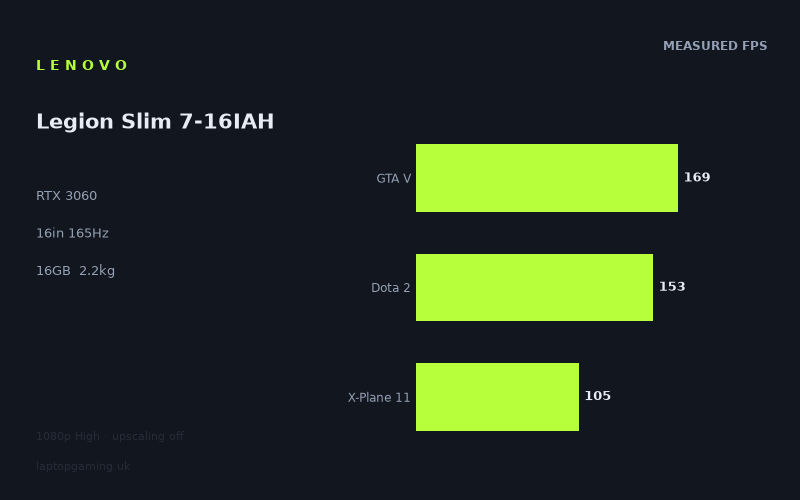
Frame rates
1920×1080, High preset, upscaling off.
Measured on this machine. Source: Notebookcheck, 2022-11-17.
Not scored: incomplete benchmark suite
Every scored laptop on this site is averaged over the same 5 games, and this one is short of Cyberpunk 2077, Baldur's Gate 3. A mean over 5 games is not comparable to a mean over 5, so we publish the figures we have and leave the score blank rather than rank it against machines tested on a different set. The numbers below are real - the suite is just incomplete.
How these numbers were produced
Frame rates here are not measured by us, and we label how each one was arrived at. A figure marked measured comes from a published run on that exact machine. A figure marked representative is derived from the GPU and its power limit (TGP) and cross-referenced against published reviews - a sound estimate of what that configuration delivers, but not a measurement of that specific laptop. Unless stated otherwise, numbers are 1920x1080, High preset, upscaling off. Where a laptop ships in several power configurations we use the wattage of the exact SKU listed, because a 140W RTX 5070 and a 115W one are not the same product.
In use
The short version
The Lenovo Legion Slim 7-16IAH is a strong 1080p gaming laptop on the evidence available, with Notebookcheck’s benchmark data showing particularly convincing results in lighter and moderately demanding games. Its RTX 3060 and Core i7-12700H combination delivers high frame rates in GTA V, Dota 2 and Strange Brigade, while The Witcher 3 remains comfortably playable at the same settings. More demanding titles such as X-Plane 11 and Final Fantasy XV expose the limits of the configuration more clearly, but neither result suggests a machine that is short of gaming capability.
The important caveat is the screen. This is a 16in 2560x1600 IPS panel with a 165Hz refresh rate, while the published game figures are at 1920x1080 on the High preset with upscaling off. The laptop can meet or exceed the panel refresh rate in GTA V, and it comes close in Dota 2 and Strange Brigade, but its measured performance does not support an assumption that every game will run at the screen’s full native resolution and full refresh rate without compromises. The display has considerably more pixels than the benchmark resolution, so the published figures are best read as a guide to 1080p gaming rather than proof of 2560x1600 performance.
This is therefore a laptop for someone who values high-refresh competitive or older games, wants a larger 16in screen, and is prepared to set resolution and graphical quality according to the game. It looks especially suitable for Dota 2, GTA V and Strange Brigade at the tested settings. It is less convincing for a buyer whose expectation is that the 165Hz screen will be fully utilised in every modern, graphically demanding title, particularly at the panel’s native 2560x1600 resolution.
The machine’s mean across the five scoring-suite games is 131fps. That is a useful overall indication of healthy 1080p High-preset performance, but the mean should not be mistaken for the experience in every title. The difference between the 169fps result in GTA V and the 75fps result in Final Fantasy XV is substantial. The Legion Slim 7-16IAH is not a laptop whose gaming behaviour can be reduced to one headline figure: it is fast where the game is light enough to take advantage of the CPU and GPU combination, and more ordinary where the workload is heavier.
There is no confirmed UK price for this exact configuration, so a price-based value judgement cannot be made. The benchmark suite is complete and the machine ranks normally on frame-rate performance; the missing price is the only reason there is no value conclusion tied to cost.
On performance alone, the Legion Slim 7-16IAH is a credible gaming machine rather than merely a slim-looking laptop with gaming components on the specification sheet. The measured figures support that conclusion. The RTX 3060 does not turn the 165Hz 2560x1600 screen into a guaranteed maximum-settings, maximum-refresh display in every game, but it delivers the sort of 1080p results that still make a high-refresh panel worthwhile in the right titles.
Performance
What the published results show
Notebookcheck’s figures were measured at 1920x1080, using the High preset with upscaling off. That is an important baseline. It removes upscaling from the comparison and gives a reasonably demanding but still practical setting for an RTX 3060 laptop. It also means that the figures show native rendered 1080p performance rather than a result assisted by a lower internal rendering resolution.
The strongest result is GTA V at 169fps. That is the one game in the published set where the measured figure exceeds the 165Hz refresh rate of the internal screen. In practical terms, GTA V is the clearest evidence that the Legion Slim 7-16IAH can take genuine advantage of its high-refresh display rather than merely carrying a fast panel on paper. A result above the refresh rate does not mean every moment of play will be identical, but it does show that the machine has enough performance at the tested settings for the screen to matter.
Dota 2 follows at 153fps. That is below the display’s 165Hz ceiling, but it is still very high frame-rate performance. The gap between 153fps and the panel’s maximum refresh is far less important than the difference between 153fps and conventional lower-refresh gaming. The published result places Dota 2 firmly in the category of games where the Legion’s 165Hz screen should have a meaningful role, even if the benchmark number does not reach the panel limit.
Strange Brigade records 152fps, effectively placing it beside Dota 2 in the published results. This is another title where the laptop is close to the display’s full refresh capability at 1080p High. It is also useful because it prevents the GTA V number being treated as an isolated best-case result. There are multiple games in the data set where the Legion Slim 7-16IAH is operating at a level suited to high-refresh gaming.
The Witcher 3 reaches 139fps. This is a step down from the leading results, but it remains a strong showing at the stated settings. It is below 165Hz, so the panel’s full ceiling is not reached in the published figure, yet 139fps is still well above the threshold at which a high-refresh display becomes an academic feature rather than something visible in use. The key point is not that The Witcher 3 falls short of the panel maximum; it is that the Legion remains capable of a high frame rate in a game that is clearly more demanding than the leaders in this set.
X-Plane 11 produces 105fps. That is still a good result, but it marks a more obvious change in the machine’s relationship with the screen. At 105fps, the Legion Slim 7-16IAH is delivering a smooth high-frame-rate experience by ordinary standards, but it is no longer close to saturating a 165Hz panel. A buyer principally interested in flight simulation should read this figure rather than extrapolating from GTA V or Dota 2. The benchmark data says that this laptop remains capable in X-Plane 11, but it also says that the 165Hz display will have more headroom than the game result at the tested settings.
Final Fantasy XV is the lowest measured result at 75fps. That is not a bad figure in isolation, especially given that it is recorded at 1080p High with upscaling disabled, but it is the clearest reminder that the RTX 3060 is not an all-purpose route to extremely high frame rates in every demanding game. At 75fps, the Legion can still provide a clearly playable result, yet the screen’s 165Hz specification is no longer the deciding part of the experience. The game, settings and rendering resolution matter more than the panel ceiling.
The benchmark spread matters more than the mean
The 131fps scoring-suite mean is helpful as a broad indication, but it hides a wide spread. The laptop moves from 169fps in GTA V to 75fps in Final Fantasy XV under the same broad test conditions. That range is not evidence of inconsistent benchmarking; it is evidence that games ask different things of the hardware.
Some games are light enough at 1080p that the processor, game engine behaviour and general platform balance become as important as the graphics processor. Others remain more demanding and push the GPU harder. The Legion Slim 7-16IAH has a Core i7-12700H alongside the RTX 3060, and the high results in GTA V, Dota 2 and Strange Brigade show that the platform is not obviously holding itself back in those titles. Where the games are able to run fast, it runs fast.
That does not mean the Core i7-12700H alone explains the leading results, nor does it mean the RTX 3060 will behave identically in every game. The point is that a laptop’s published frame rate is the result of the complete system and the specific game workload. Buyers should resist using the 169fps GTA V result to predict Final Fantasy XV, just as they should not use the 75fps Final Fantasy XV result to dismiss the laptop’s ability in Dota 2 or Strange Brigade.
The result distribution creates a clear practical hierarchy. GTA V is the best match for the panel’s 165Hz capability. Dota 2 and Strange Brigade are nearly as well suited. The Witcher 3 is still strongly positioned for high-refresh play, even if it does not reach the screen maximum in the benchmark. X-Plane 11 is comfortably playable but not a full-refresh showcase. Final Fantasy XV is the game in this set where settings decisions are most likely to matter if the priority is higher frame rate rather than image quality.
That hierarchy is more useful than a single claim that the Legion is either “a 165Hz laptop” or “an RTX 3060 laptop”. Both descriptions are technically true, but neither tells a buyer what to expect from the combination. The display’s 165Hz ceiling is attainable in at least one measured game, approached closely in two more, and increasingly out of reach as the workload becomes more demanding. The system is capable, but it is not uniformly capable in the same way across the whole benchmark set.
GPU power limit: what can and cannot be concluded
The fact sheet identifies the GPU as an RTX 3060, but it does not provide a GPU power limit for this particular Legion Slim 7-16IAH configuration. That missing figure matters because RTX 3060 laptop implementations can vary in their power configuration, and a GPU name alone does not fully describe how a particular laptop will perform.
It would therefore be wrong to assign a specific power limit to this Legion or to claim that its benchmark results are caused by a particular wattage. The measured figures are strong enough to assess the finished laptop in the games listed, but they do not establish the GPU’s configured power limit. The data supports performance conclusions; it does not support a precise explanation of the power setting behind them.
In practice, the benchmark data remains more valuable than an assumed wattage. A published power limit can suggest potential, but the actual results show what the laptop achieved in the tested titles. Here, the actual results show a machine capable of 169fps in GTA V, 153fps in Dota 2, 152fps in Strange Brigade, 139fps in The Witcher 3, 105fps in X-Plane 11 and 75fps in Final Fantasy XV at the stated 1080p High settings with upscaling off.
The absence of a stated power limit does mean that buyers should be careful when comparing this laptop with another RTX 3060 model. It is not safe to assume that every RTX 3060 notebook will match these figures, and it is not safe to assume that this Legion will match another RTX 3060 model in a game that has not been measured here. The comparison section is consequently based on the shared-game differences supplied, not on component labels alone.
What settings expectations are realistic
At 1920x1080 and High settings with upscaling off, the Legion Slim 7-16IAH performs best when the game is light enough to return well above 100fps. The results in GTA V, Dota 2, Strange Brigade and The Witcher 3 support that position directly. These are the games where the laptop’s screen and performance hardware look well matched.
For X-Plane 11, the 105fps result suggests a different kind of balance. The laptop is not struggling, but the game is not approaching the panel’s 165Hz maximum either. That makes the screen useful without making its full refresh rate the expected outcome. A buyer whose priorities centre on flight simulation should see this as a capable result rather than a promise of maximum-refresh operation.
Final Fantasy XV at 75fps is the clearest argument for treating graphical settings as adjustable rather than fixed. The benchmark is already using the High preset and no upscaling, so the result is an honest indication of what the system delivers under those conditions. Anyone wanting substantially higher frame rates in this kind of more demanding game would need to accept changes in settings, resolution or use of available rendering features where the game supports them. The supplied benchmark does not provide alternative settings results, so it would be wrong to put a number on the outcome of those changes.
The Legion is not a machine that needs lower settings to make every title playable in the published set. Even the lowest figure is 75fps. But it is also not one where “High” should be treated as a permanent, universal answer for a 165Hz target. The benchmark set shows both sides: substantial headroom in some games and a more limited relationship with the panel refresh rate in others.
The screen
A high-resolution, high-refresh combination
The Legion Slim 7-16IAH has a 16in IPS display with a 2560x1600 resolution and a 165Hz refresh rate. On paper, that is an appealing combination for a gaming laptop because it offers more workspace and image detail than 1920x1080 while retaining a refresh rate high enough to show the benefit of very high game performance.
The screen’s proportions and panel characteristics should not be overinterpreted beyond the supplied specification. It is an IPS panel, but there are no published figures here for brightness, colour coverage, response behaviour, contrast, outdoor usability or HDR performance. It would be inappropriate to make claims about those areas without measurement. What can be said is that the display is large by laptop gaming standards, high resolution, and designed around a 165Hz refresh target.
The central question is whether the RTX 3060 can drive it properly. The answer depends entirely on what “properly” means. If it means producing high frame rates in the benchmarked games at 1080p High with upscaling off, the measured data is encouraging. If it means rendering every game at 2560x1600 and reaching 165fps, the data does not support that conclusion.
1080p benchmark figures on a 2560x1600 panel
All published figures are at 1920x1080, while the panel is 2560x1600. That difference is fundamental. The benchmark results do not represent native-resolution performance on the internal display. The Legion’s screen contains more pixels than the benchmark workload, so native-resolution gaming is a heavier task than the tested 1080p scenario.
This does not make the benchmark results less useful. They remain a clear, attributable view of performance under a common setting: 1920x1080, High preset, upscaling off. It simply means that they must be read accurately. GTA V at 169fps demonstrates that the laptop can exceed the panel refresh rate at the tested resolution and settings. It does not demonstrate 169fps at 2560x1600. The same applies to every result in the set.
For games such as Dota 2 and Strange Brigade, the 153fps and 152fps figures show that 1080p High performance is close to the screen’s full refresh capability. That makes the 165Hz panel meaningful for those types of workloads. For The Witcher 3 at 139fps, the display still has obvious value, though the benchmark does not reach its maximum refresh. For X-Plane 11 at 105fps and Final Fantasy XV at 75fps, the screen offers plenty of refresh headroom beyond the measured output.
The practical implication is that the panel is more ambitious than the GPU result in the heavier games, but that is not necessarily a flaw. A 165Hz screen does not become pointless because a particular game runs below 165fps. It can still present frames up to the game’s output, and it ensures that lighter games are not artificially capped by a lower-refresh display. The problem only arises if a buyer assumes that the screen specification guarantees a matching frame rate in every title.
Which measured games suit the panel best
GTA V is the strongest match. Its 169fps result is above the 165Hz specification, making it the only listed title where the benchmark figure goes beyond the display maximum. This is the clearest example of the Legion’s hardware and screen pulling in the same direction.
Dota 2 and Strange Brigade also suit the display well. Their 153fps and 152fps results are close enough to the panel’s 165Hz ceiling that the laptop should be viewed as a high-refresh option for those games at the tested settings. Neither number equals the refresh specification, but both are far closer to it than to conventional lower frame-rate expectations.
The Witcher 3 at 139fps remains a good fit. It will not fully exploit the display’s maximum refresh based on the published number, but it is still a high-frame-rate result. This is an example of why “does it reach 165fps?” is too narrow a test. A game does not need to equal the panel maximum to benefit from a 165Hz screen.
X-Plane 11 and Final Fantasy XV are weaker matches for the refresh specification, not because their results are unusable, but because the measured outputs are more distant from 165Hz. At 105fps and 75fps respectively, the performance story is more about the game’s own demands than the panel’s maximum capability. A buyer focused on these kinds of games should prioritise the measured numbers rather than the marketing appeal of a high refresh rate.
Build, size and portability
The Legion Slim 7-16IAH weighs 2.206kg. That places it in a category where portability is possible, but it should not be described as effortless or weightless. A 16in gaming laptop with this weight is more suited to regular movement between a desk, home, office, study space or occasional travel than to being carried without thought all day.
The “Slim” name should not be used as a substitute for dimensions. The fact sheet does not provide the laptop’s thickness, width or depth, so there is no basis for claiming that it is unusually thin, compact for a 16in model or easy to fit into a particular bag. The weight is the only physical portability measurement supplied, and it is the figure that should guide expectations.
At 2.206kg, the Legion makes more sense as a machine that can move than as a machine designed around minimum carried mass. The 16in screen is likely to be a major part of its appeal for someone who wants a larger display than a smaller gaming notebook provides, but that larger screen and the stated weight mean portability is a compromise rather than the defining strength.
There is no battery-life data in the fact sheet. As a result, no claim can be made about how long the laptop lasts away from mains power, whether it is suitable for a full day away from a charger, or how its battery performance compares with any rival. Buyers for whom unplugged use is central should not assume an answer from the model name, weight or internal components.
Similarly, there are no supplied measurements for temperatures, fan noise, keyboard layout, port selection, storage capacity, webcam quality or chassis materials. Those omissions do not prove a problem in any of those areas; they simply mean the available evidence is focused on configuration, screen specification, weight and benchmark performance. The Legion should be assessed on that basis rather than credited with unmeasured strengths.
How it compares
Against the MSI Prestige 15
Against the MSI Prestige 15 with an RTX 3050 Ti at 105W, the Legion Slim 7-16IAH averages 72fps more across four shared games. That is the largest positive gap among the named comparisons, and it is significant enough that the Legion should be considered a materially stronger gaming option on the shared evidence.
The comparison is useful because it demonstrates that the Legion’s results are not merely adequate within a narrow band of similar machines. It has a substantial advantage over this RTX 3050 Ti rival in the games both laptops hold. The exact per-game figures are not supplied, so it would be wrong to claim where the advantage is largest or smallest. But an average lead of 72fps across the shared set is plainly not a marginal result.
For a buyer choosing primarily on game performance, the Legion is the stronger machine in this comparison. The Prestige 15 may have other characteristics that matter to a different buyer, but no such characteristics are provided here. On attributable shared-game performance, the Legion has the clear upper hand.
Against the Alienware x14 i7 RTX
The Alienware x14 i7 RTX also uses an RTX 3060, and the Legion averages only 1fps more across four shared games. That is effectively a near-zero difference in the available comparison. It should not be presented as a meaningful win for Lenovo or as evidence that the two machines are identical in every respect. It simply means that, in the four games both machines hold, their average published performance is extremely close.
This is where component labels can mislead. It would be tempting to look at two RTX 3060 laptops and expect close results automatically, but that is not a safe general rule. In this case, the shared benchmark data happens to show a near tie. The correct conclusion is specific: the Legion and Alienware are closely matched in the shared results provided.
The near-zero difference also reflects the nature of 1080p testing in lighter titles. At this resolution, some games in the shared set can become CPU-bound, compressing genuine GPU differences. In other words, a small average gap does not necessarily prove that every aspect of the two graphics implementations is the same. It may instead show that the games and settings are not always asking enough of the GPU to separate the machines clearly.
For a buyer comparing these two models, the benchmark evidence does not give the Legion a decisive performance advantage. Other factors would need to decide the purchase, but those factors are not supplied in this fact sheet. The sensible conclusion is not “buy either because they are identical”; it is “do not pay for the Legion on the assumption of a major shared-game frame-rate lead over the Alienware.”
Against the Eurocom RX315
The Eurocom RX315 has an RTX 3070 at 105W, yet the Legion Slim 7-16IAH averages only 2fps less across five shared games. Again, that is a near-zero practical difference in the shared benchmark set. It is particularly notable because the Eurocom carries a higher RTX model number, but the supplied data does not justify treating that badge as an automatic real-world lead in these games.
The comparison needs careful interpretation. The Legion is not shown to be universally equivalent to an RTX 3070 laptop. The data covers five shared games, not every possible workload, and it is gathered at 1080p High with upscaling off. What it does show is that, under those conditions and across those shared games, the Eurocom’s nominal GPU tier does not translate into a substantial average advantage.
The explanation supplied for these compressed differences is important: at 1080p, lighter titles in the shared set can be CPU-bound. When that happens, a genuine graphics-performance gap can be masked because the GPU is no longer the only limiting factor. This is why a 2fps average deficit should not be read as proof that an RTX 3060 and RTX 3070 are interchangeable in every game or at every resolution.
Still, the Legion deserves credit for staying so close in the stated comparison. A buyer focused on the measured 1080p High results should not assume that the Eurocom RX315 is dramatically faster merely because it is configured with an RTX 3070 at 105W. The shared-game evidence says the difference is minimal.
Against the MSI Raider GE77 HX
The MSI Raider GE77 HX provides the clearest counterpoint. It has an RTX 3080 Ti at 175W and averages 38fps more than the Legion across five shared games. This is the largest negative comparison for the Lenovo and the only one here that establishes a plainly meaningful performance gap against it.
The Raider’s advantage should not be surprising from the published components and shared-game result. More importantly, it is visible in the actual comparison rather than merely implied by the GPU name. An average difference of 38fps is large enough to change how the machines should be positioned. The Legion is a capable 1080p gaming laptop; the Raider is the stronger choice for someone whose priority is extracting higher frame rates from the same shared titles.
That does not make the Legion weak. Its own results remain high in several games, and its 131fps scoring-suite mean remains solid. But it does show the boundary of what the Lenovo offers. A buyer demanding the highest possible performance from this group should look towards the MSI Raider GE77 HX rather than expecting the Legion’s RTX 3060 configuration to compete directly with an RTX 3080 Ti at 175W.
The comparison also reinforces why the Legion’s 165Hz panel must be considered game by game. A stronger machine with a larger shared-game advantage has more scope to pursue very high refresh targets in demanding titles. The Legion can do that in some games, as GTA V demonstrates, but the Raider comparison shows that there is a meaningful performance tier above it.
Who it’s for
A good fit for high-frame-rate 1080p gaming
The Legion Slim 7-16IAH suits a buyer who wants strong measured 1080p performance rather than an abstract promise based on component names. The published figures make it particularly suitable for GTA V, Dota 2 and Strange Brigade. Those titles return 169fps, 153fps and 152fps respectively at 1920x1080 High with upscaling off, which is exactly the kind of output that gives the 165Hz display a clear purpose.
It also suits someone who plays a mix of competitive, older and moderately demanding games rather than only the heaviest available releases. The Witcher 3 at 139fps supports that broader use case. There is enough performance here for the laptop to feel like a high-refresh gaming machine in a meaningful selection of games, not just in one unusually light title.
The 16in 2560x1600 IPS display should appeal to a buyer who wants a larger, sharper panel than a standard 1080p gaming notebook offers. The caveat is that the benchmark data is at 1080p, so this buyer should be comfortable treating native resolution as a setting choice rather than an automatic default in every demanding game. The screen offers capability beyond the tested render resolution; the GPU results show that exploiting all of it simultaneously will depend on the title.
It is also a reasonable choice for someone who needs to move the laptop regularly but does not require the lowest possible weight. At 2.206kg, it is transportable, but the buyer should expect a substantial 16in machine rather than a minimal travel device.
Who should choose something else
A buyer whose main aim is to play demanding games at 2560x1600 while targeting the panel’s full 165Hz refresh rate should choose something else, or at least choose with more demanding native-resolution benchmark evidence in hand. The figures here do not show that level of performance. They show 1080p High results, and the lower outcomes in X-Plane 11 and Final Fantasy XV demonstrate that even at the tested resolution the laptop does not maintain a near-165fps result in every game.
Someone focused mainly on X-Plane 11 should be realistic about the 105fps figure. It is a capable result, but it is not evidence that the screen’s maximum refresh will be reached. Likewise, a buyer focused on Final Fantasy XV should not buy this laptop expecting the 165Hz display to be fully utilised at 1080p High with upscaling off. The published result is 75fps, which remains playable but sits in a very different performance category from the GTA V result.
A buyer chasing the highest frame rates among the compared machines should look away from the Legion and towards the MSI Raider GE77 HX. The Raider averages 38fps more across five shared games, and that is a substantial enough advantage to matter. The Legion can compete closely with the Alienware x14 i7 RTX and Eurocom RX315 in the supplied shared-game comparisons, but it does not match the Raider’s performance level.
Someone who requires a genuinely lightweight laptop should also be cautious. The Legion weighs 2.206kg. That does not rule out travel, but it does rule out describing the machine as a low-weight choice based on the information available. There are no dimensions or battery figures supplied, so there is no evidence for a stronger portability claim.
Finally, anyone whose purchase depends heavily on battery life, fan noise, temperatures, port selection, storage capacity, keyboard feel or display colour performance should wait for reliable measurements or specifications in those areas. None are supplied here. It would be wrong to fill those gaps with assumptions based on the Legion name, the RTX 3060, the Core i7-12700H or the 2.206kg weight.
The best way to understand the Legion Slim 7-16IAH is as a measured-performance-first option for 1080p High gaming, paired with a larger 2560x1600 165Hz screen that it can exploit very well in some games and less fully in others. It is strongest for buyers who will use that flexibility intelligently: high frame rates where the game allows them, sensible settings where it does not, and no assumption that one excellent result represents every workload.