Review
MSI Raider GE77 HX review
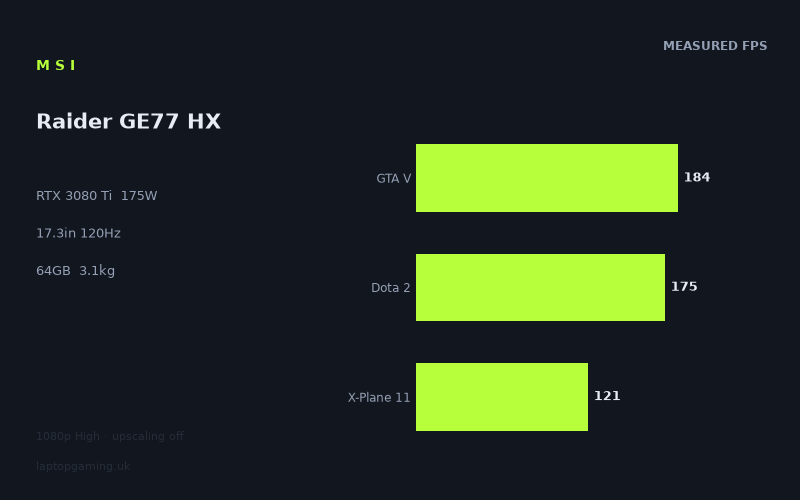
Frame rates
1920×1080, High preset, upscaling off.
Measured on this machine. Source: Notebookcheck, 2022-07-12.
Not scored: incomplete benchmark suite
Every scored laptop on this site is averaged over the same 5 games, and this one is short of Cyberpunk 2077, Baldur's Gate 3. A mean over 5 games is not comparable to a mean over 5, so we publish the figures we have and leave the score blank rather than rank it against machines tested on a different set. The numbers below are real - the suite is just incomplete.
How these numbers were produced
Frame rates here are not measured by us, and we label how each one was arrived at. A figure marked measured comes from a published run on that exact machine. A figure marked representative is derived from the GPU and its power limit (TGP) and cross-referenced against published reviews - a sound estimate of what that configuration delivers, but not a measurement of that specific laptop. Unless stated otherwise, numbers are 1920x1080, High preset, upscaling off. Where a laptop ships in several power configurations we use the wattage of the exact SKU listed, because a 140W RTX 5070 and a 115W one are not the same product.
In use
The short version
The MSI Raider GE77 HX is a high-power gaming laptop built around an RTX 3080 Ti running at a 175W GPU power limit, a Core i9-12900HX, 64GB of memory and a 17.3in 3840x2160 IPS display with a 120Hz refresh rate. The published benchmark data is very strong at 1920x1080 on High settings with upscaling disabled: Notebookcheck recorded 249fps in The Witcher 3, 234fps in Strange Brigade, 207fps in F1 2021, 184fps in GTA V, 175fps in Dota 2, 167fps in Far Cry 5, 132fps in Final Fantasy XV and 121fps in X-Plane 11.
That makes the Raider GE77 HX an unusually capable option for somebody who wants a large-screen machine for high-refresh gaming and is willing to accept the consequences of a 3.084kg chassis. Its measured figures are not merely good in one favourable title. They remain above the display’s 120Hz refresh rate in every listed game at the benchmark’s 1920x1080 High preset. In the lighter or more CPU-limited games, it is producing substantially more frames than the panel can show at once. In the heavier pair of Final Fantasy XV and X-Plane 11, it still reaches the panel’s refresh threshold, although with far less spare performance.
The important qualification is the screen resolution. The panel is 3840x2160, while the published gaming results are at 1920x1080. The figures show that the Raider has the performance for excellent high-refresh gaming at the measured setting; they do not establish what it will deliver at the screen’s native resolution. Anyone buying this laptop principally for native-resolution gaming should treat that distinction as central rather than incidental. A 120Hz screen is attractive, but the benchmark data only demonstrates 120fps-class performance at 1920x1080, not at 3840x2160.
There is no confirmed UK price for this exact configuration, so this machine cannot receive an overall score here. That is solely because value accounts for 30% of the calculation and cannot be assessed without a price, not because the benchmark suite is incomplete or because the Raider’s performance is in doubt.
Buy the Raider GE77 HX if your priorities are a large 17.3in display, very strong measured 1080p frame rates, abundant 64GB memory, and the highest 175W version of the RTX 3080 Ti specified here. It is especially sensible for someone using the laptop predominantly on a desk, perhaps moving it between a small number of fixed places rather than carrying it every day. Do not buy it on the assumption that the published figures prove effortless 120fps gaming at 3840x2160: they do not. Also look elsewhere if low weight, compact dimensions or a confirmed purchase price are essential to your decision.
Performance
A 175W RTX 3080 Ti with results to support it
The defining specification is the RTX 3080 Ti at a 175W GPU power limit. Laptop GPU names alone do not tell the whole story, particularly when comparing systems using the same nominal graphics processor. The power limit matters because it sets the operating context in which the GPU is intended to run. Here, the published results show a machine that is delivering at the very top end of the available comparison set rather than simply carrying an impressive badge.
Notebookcheck’s measured figures come from 1920x1080, High settings, with upscaling off, dated 2022-07-12. Those conditions matter. They provide a clean, comparable picture of conventional rasterised gaming performance without relying on an upscaling mode to increase the reported frame rate. They are also not native-resolution results for the Raider’s 3840x2160 display, and they should not be presented as such. The right reading is that this is what the machine achieved at 1920x1080 High, not a promise of equivalent performance at every resolution or setting combination.
Across the five scoring-suite games, the mean is 169fps. That is a genuinely high average for a laptop benchmark set, but the average is not the whole story. The individual results range from 234fps in Strange Brigade to 132fps in Final Fantasy XV within that scoring suite. The machine is therefore not operating at one uniform level across all workloads. It has enormous headroom in some games and much less in others, even though both ends of the published range remain strong at the measured settings.
The Raider’s 175W RTX 3080 Ti is joined by a Core i9-12900HX and 64GB of memory. The benchmark results do not isolate the contribution of each part, so it would be wrong to assign a particular number of frames to the processor, graphics chip or memory. What can be said is that the complete configuration has produced exceptionally high results in the less demanding and more CPU-sensitive titles, while retaining high performance when the game is more demanding. That is what a flagship-class CPU and a high-power GPU configuration should be judged on: not on the component list alone, but on whether the delivered results keep up across a varied set of games.
The fastest results: The Witcher 3, Strange Brigade and F1 2021
The Witcher 3 is the highest published result here at 249fps. At the benchmark’s 1920x1080 High settings, that is far beyond the 120Hz refresh rate of the Raider’s panel. For a buyer whose interest is in responsiveness and consistently high frame delivery rather than native-resolution presentation, it demonstrates ample performance headroom in this particular game under these conditions. The screen can refresh at 120Hz; the game result is much higher. The implication is not that the panel becomes faster than 120Hz, but that the GPU is not the limiting concern at this measured preset.
Strange Brigade is next at 234fps. It is one of the five games used for the 169fps mean, and it again sits well above the panel refresh rate. A result like this is useful because it shows the Raider is not dependent on one single game engine for its strongest showing. The result is also a reminder that a 175W RTX 3080 Ti has more potential at 1920x1080 High than a 120Hz display can fully expose in lighter titles. For this kind of workload, the 3840x2160 panel becomes the more consequential part of the specification. There is performance available at the measured setting, but the native screen asks for a much more demanding rendering target than the benchmark uses.
F1 2021 reaches 207fps. That places it comfortably above 120fps under the stated test conditions and gives the Raider a third result over 200fps. Again, the practical point is not that every player needs a frame rate above the display refresh rate. The point is that the machine has room to absorb more demanding settings choices than are represented by the published High preset, or to prioritise a lower-resolution high-frame-rate mode. The actual trade-off depends on the game and the user’s priorities, but the measured result makes clear that the Raider is not short of 1080p performance in F1 2021.
These three results also demonstrate why raw GPU tier is only part of the story. A laptop with an RTX 3080 Ti can vary considerably depending on its power limit and the rest of the system. The Raider’s 175W specification is paired with figures of 249fps, 234fps and 207fps in three of the listed games. That does not mean every title will scale in the same way, but it does show that this implementation is not behaving like a low-power version of the same GPU label.
Strong high-refresh gaming in GTA V, Dota 2 and Far Cry 5
GTA V runs at 184fps in the published result. It is one of the scoring-suite games and contributes to the 169fps mean. That is still decisively above the screen’s 120Hz refresh rate at 1920x1080 High with upscaling off. There is a meaningful distinction between 184fps and the results above 200fps, but it is not a distinction that makes the Raider unsuitable for high-refresh use. The benchmark result says the machine has substantial room above 120fps in this game at the measured settings.
Dota 2 produces 175fps. That remains above the 120Hz display refresh rate and reinforces the Raider’s suitability for games where stable high frame delivery is more important than forcing the panel to run at its native 3840x2160 resolution. It also illustrates why headline graphics specifications should be interpreted in context. A high-power RTX 3080 Ti can be a major advantage, but at 1920x1080 some games can become constrained by factors beyond straightforward GPU throughput. The rival data provided for this review makes that point particularly clearly, because laptops with the same RTX 3080 Ti but different power limits are separated by only very small shared-game averages.
Far Cry 5 is measured at 167fps. It is not part of the stated five-game scoring suite, but it is still a valuable result because it falls closer to the Raider’s 169fps scoring-suite mean than the exceptionally high The Witcher 3 or Strange Brigade results do. At 167fps, it remains well ahead of the panel refresh rate at the benchmark conditions. This gives a more balanced impression of the machine than looking only at the fastest games: it is not just capable of huge spikes in particularly favourable titles, but can also sustain clearly high-refresh performance in a game landing closer to its wider average.
Taken together, GTA V at 184fps, Dota 2 at 175fps and Far Cry 5 at 167fps form the middle of the Raider’s benchmark spread. This is arguably the most useful part of the published data for a prospective owner of a 120Hz screen. These are not merely numbers that clear the refresh rate by a tiny amount. They show consistent headroom at 1920x1080 High with upscaling disabled. That headroom is what gives a buyer flexibility: not a guarantee of native-resolution 120fps, but evidence that 1080p high-refresh play is firmly within the machine’s capability in these games.
The demanding end: Final Fantasy XV and X-Plane 11
Final Fantasy XV is measured at 132fps. It is one of the five scoring-suite results and is the lowest of those five. It is still above the Raider’s 120Hz refresh rate, but only by a relatively narrow margin compared with the results in Strange Brigade, GTA V or Dota 2. This is exactly why relying on a mean alone can be misleading. The 169fps average across the scoring suite is useful for broad comparison, yet the individual 132fps result is more relevant if Final Fantasy XV is among the games a buyer actually plays.
The encouraging point is that 132fps still clears the panel’s 120Hz refresh capability under the benchmark conditions. The caution is equally important: there is much less demonstrated spare performance here. A buyer who wants to increase the rendering workload beyond 1920x1080 High cannot use this figure as evidence that the same 120fps-class result will remain available. The native panel resolution is 3840x2160, and no published native-resolution result is supplied. The sensible conclusion is that Final Fantasy XV is already nearer the boundary of the screen’s refresh potential than the Raider’s much faster results suggest.
X-Plane 11 records 121fps. This is the closest published result to the display’s 120Hz refresh rate. It does technically meet that threshold at 1920x1080 High with upscaling off, but it leaves almost no demonstrated margin. This is not a poor result; 121fps is still a strong outcome in isolation. It is, however, the clearest warning against assuming that a 175W RTX 3080 Ti means every game will have the same level of excess performance. The Raider is powerful, but game workloads differ, and the benchmark spread shows that clearly.
For an owner focused on the 120Hz panel, X-Plane 11 is the result that demands the most careful interpretation. It supports the statement that the Raider reaches the display refresh rate in the listed games at the benchmark settings. It does not support a stronger claim of broad, effortless surplus above 120fps in every title. The machine has that surplus in The Witcher 3, Strange Brigade, F1 2021, GTA V, Dota 2, Far Cry 5 and Final Fantasy XV. X-Plane 11 is different: it is effectively aligned with the panel’s maximum refresh at the measured setting.
What the benchmark spread really says
The spread from 249fps in The Witcher 3 to 121fps in X-Plane 11 is not evidence of inconsistency in the sense of a badly configured laptop. It is evidence that games place different demands on a system. A single graphics card name cannot make every engine, simulation or rendering workload behave identically. The Raider’s results show a system that can be far beyond 120fps in some games while being much closer to 120fps in others at exactly the same stated resolution and quality level.
This is also why the 169fps mean must be used carefully. It is a useful shorthand for comparing machines tested in the same scoring suite, but it is not a promise that every game will run at 169fps. The individual results matter. A buyer concentrating on F1 2021 has a published figure of 207fps to consider. A buyer concentrating on Final Fantasy XV has 132fps. Someone interested in X-Plane 11 should pay attention to 121fps rather than assuming the scoring-suite mean applies to that game.
The Raider is therefore best described as a very strong 1080p High gaming laptop with a wide performance spread that remains favourable throughout the supplied data. At the lower-demand end, it is limited more by the 120Hz panel than by its ability to generate frames. At the more demanding end, the display refresh rate becomes a target it can meet but not necessarily exceed by much. That is a much more useful conclusion than simply saying that the machine is “fast”. It tells a prospective buyer where the performance is abundant and where the margin is much tighter.
The screen
A large 17.3in IPS panel with a demanding native resolution
The Raider GE77 HX has a 17.3in IPS display with a 3840x2160 resolution and a 120Hz refresh rate. On specification alone, this is a serious panel for a gaming laptop: it is large, it has a high native resolution, and it refreshes faster than a conventional 60Hz display. The complication is that the screen specification and the published gaming data point in slightly different directions. The display is built for detailed, high-resolution presentation, whereas the benchmark figures establish performance at 1920x1080.
This does not make the screen a mistake. It means the buyer needs to decide which attribute matters most. If the priority is screen resolution, the native 3840x2160 panel is the attraction. If the priority is getting as close as possible to 120fps in a broad range of games, the published data is most directly relevant at 1920x1080 High. The Raider’s results are excellent at that measured resolution, but the supplied figures do not show the native-resolution frame rates required to judge the full 3840x2160 experience.
The 120Hz refresh rate is well matched to the published 1920x1080 data. All listed game results meet or exceed 120fps: The Witcher 3 reaches 249fps, Strange Brigade 234fps, F1 2021 207fps, GTA V 184fps, Dota 2 175fps, Far Cry 5 167fps, Final Fantasy XV 132fps and X-Plane 11 121fps. That is a notably clean set of results for a 120Hz panel. There is no listed game that falls below the display refresh rate under the benchmark conditions.
However, “meets 120Hz” is not equally persuasive in every game. The Witcher 3 at 249fps has a great deal of performance headroom. Strange Brigade at 234fps and F1 2021 at 207fps also have substantial room above the panel limit. GTA V, Dota 2 and Far Cry 5 remain comfortably above it. Final Fantasy XV at 132fps is closer, while X-Plane 11 at 121fps is essentially at the threshold. Those distinctions matter when deciding whether the screen’s refresh rate is a genuine practical advantage in a particular game or simply a ceiling the hardware can just reach.
The resolution question cannot be avoided
The native 3840x2160 resolution is the central unresolved performance question. It would be irresponsible to turn the 1920x1080 results into claims about native-resolution gaming. No native-resolution frame rates are supplied, so none can be stated or inferred as a measured result. The Raider has a high-power RTX 3080 Ti and excellent 1080p figures, but that is not a substitute for a 3840x2160 benchmark.
For some buyers, this will be entirely acceptable. A person who values the 17.3in screen size and wants strong performance in the supplied 1920x1080 High benchmark mode has clear evidence that the Raider can deliver it. A person who considers 3840x2160 rendering non-negotiable should be more cautious. The panel can display that resolution, but this fact sheet does not provide the gaming measurements needed to establish whether the Raider can keep games near 120fps at that setting.
The most sensible buying interpretation is that the display offers flexibility, but the benchmark evidence supports only one side of that flexibility. The panel can operate at 120Hz, and the machine can reach that rate or better in every listed game at 1920x1080 High with upscaling off. What remains unknown is the performance cost of using the full native resolution. Buyers should not fill that gap with optimistic assumptions simply because the RTX 3080 Ti name and 175W power limit are impressive.
IPS and the limits of the available display data
The panel type is IPS. Beyond that, the supplied specifications do not include measurements for brightness, colour coverage, response behaviour, contrast, calibration, backlight behaviour or any other display characteristic. Those omissions matter, particularly on a 3840x2160 panel that may appeal to buyers for uses beyond games. It would be easy to treat an IPS label as proof of a particular visual experience, but the data here does not justify that.
What can be said with confidence is narrower and more useful: the Raider has a large IPS screen, a 3840x2160 native resolution and a 120Hz refresh rate. The gaming figures demonstrate that 120fps-class performance is available in the listed titles at 1920x1080 High without upscaling. They do not establish whether the screen is especially bright, colour-accurate or well suited to a specific professional workflow. A buyer requiring those characteristics should seek display measurements rather than treating the gaming benchmark data as evidence of them.
Build, size and portability
The Raider GE77 HX weighs 3.084kg. That single figure is enough to define the sort of ownership this machine suits. This is not a lightweight laptop intended to disappear into a bag and travel unnoticed. It is a large 17.3in gaming machine with a high-power RTX 3080 Ti configuration, and its weight aligns with that role. It is better understood as a portable system in the literal sense that it can be moved, rather than as a machine designed for effortless daily carrying.
For desk-based use, the 3.084kg weight is not inherently a drawback. A buyer who wants a large screen and maximum available GPU power is making a reasonable trade. The benefit is the performance profile shown in the benchmarks: 249fps in The Witcher 3, 234fps in Strange Brigade, 207fps in F1 2021 and a 169fps mean across the stated scoring suite. The cost is that the Raider is not aiming for the kind of low-weight convenience associated with smaller machines.
For regular commuting, frequent travel or use across multiple locations in a day, the same weight becomes much more significant. A 3.084kg laptop is a serious object to carry repeatedly, especially when the buyer’s priority may be flexibility rather than raw frame rate. The Raider makes sense when its performance and 17.3in display are used often enough to justify that compromise. It makes less sense for someone who values portability first and is prepared to accept lower gaming performance in exchange.
No dimensions are supplied in this fact sheet, so there is no basis for a precise claim about its footprint, thickness or how much bag space it requires. The weight and screen size are enough to establish the broad category, but not enough to make fine-grained comparisons with other large laptops. Similarly, there are no published details here on materials, keyboard, trackpad, ports, speakers, battery life, charger size, temperatures or fan noise. Those are all relevant ownership factors, but they cannot be responsibly invented or assumed from the Raider name.
The honest conclusion is therefore practical rather than decorative. The MSI Raider GE77 HX should be treated as a substantial 17.3in performance laptop. Its 3.084kg weight means it is best for a buyer who expects to use it primarily in fixed places and values gaming performance over daily portability. Anyone who needs a genuinely light machine should not rely on the Raider’s excellent benchmark figures to make the physical compromise disappear.
How it compares
Against the MSI Prestige 15: a very large performance gap
The MSI Prestige 15 is the rival that the Raider GE77 HX beats by the greatest supplied shared-game margin. The Prestige 15 uses an RTX 3050 Ti at 105W, while the Raider uses an RTX 3080 Ti at 175W. Across four shared games, the Raider averages 99fps ahead. That is not a marginal distinction created by a single unusual result. It is a broad performance separation across the shared data.
The comparison is useful because it shows what the Raider’s high-power configuration is buying in practical benchmark terms. The Prestige’s RTX 3050 Ti at 105W sits in a very different performance class from the Raider’s RTX 3080 Ti at 175W. The 99fps shared-game advantage is large enough that a buyer should not see the two machines as interchangeable simply because both are laptops with dedicated Nvidia graphics.
That does not mean the Prestige 15 is automatically a bad machine; no overall judgement can be made here without a confirmed UK price for either exact configuration, and the supplied comparison only gives the shared-game performance gap. It does mean that a buyer pursuing high-refresh gaming has clear evidence in favour of the Raider. The Raider’s published results are built for a 120Hz panel at 1920x1080 High. A 99fps average advantage across the shared games is the kind of difference that can change whether a game is merely playable, comfortably fast, or able to use a high-refresh display well.
The comparison also makes the Raider’s 3.084kg weight easier to understand. High performance has a physical cost, and buyers must decide whether they want the power demonstrated by the Raider or a different balance. The fact sheet does not provide the Prestige 15’s weight, display details or dimensions, so this cannot become a complete portability comparison. What it can be is a clear performance comparison: the Raider is far ahead in the supplied shared-game data.
Against the Asus ROG Strix Scar 17 SE: power limits do not create simple outcomes
The Asus ROG Strix Scar 17 SE is a much closer rival. It also uses an RTX 3080 Ti, but at a 150W GPU power limit rather than the Raider’s 175W. Across five shared games, the Raider averages only 3fps ahead. The Raider wins this comparison, but the size of that win is small.
This is exactly the kind of result that prevents simplistic conclusions from power-limit specifications alone. The Raider has the higher stated GPU power limit, yet the shared-game average lead is only 3fps. That does not invalidate the 175W specification. It shows that at 1920x1080, the shared game set includes lighter titles that can become CPU-bound and compress genuine GPU differences. Once a game is constrained by factors other than straightforward GPU throughput, adding GPU power does not necessarily produce a proportionate increase in the final frame rate.
The near-zero gap is therefore a real result rather than a reason to dismiss the comparison. The Raider is not dramatically faster than the Scar 17 SE in the shared 1920x1080 data, despite the difference between 175W and 150W. A buyer deciding between these two machines should not expect the Raider’s GPU power limit alone to create a transformative advantage in the listed shared games. The measured average says the systems are very closely matched under these conditions.
At the same time, it would be wrong to turn that 3fps average into a claim that the two laptops are identical. The supplied figure is an average across five shared games, not a complete account of every title, resolution or setting. It is evidence of a very close result in this test context. It does not prove that the difference remains the same at the Raider’s native 3840x2160 resolution, in different games, or under other quality settings. Those data points are not provided.
The practical takeaway is straightforward. If choosing between the Raider GE77 HX and the ROG Strix Scar 17 SE specifically for the listed 1080p benchmark conditions, do not pay for the Raider expecting a major performance gap solely from its 175W RTX 3080 Ti. The published shared-game lead is 3fps. Other considerations would need to decide the purchase, but the fact sheet does not provide enough information on price, display quality beyond the Raider’s stated specification, portability, noise or battery life to make those decisions here.
Against the MSI Titan GT77: virtually tied in the shared data
The MSI Titan GT77 is the other extremely close comparison. It uses an RTX 3080 Ti at the same 175W GPU power limit as the Raider GE77 HX. Across five shared games, the Raider averages 2fps ahead. This is a genuine near-tie.
The small advantage makes sense in the context of the supplied data. Both machines carry the same RTX 3080 Ti designation and the same 175W power limit. At 1920x1080, the lighter games in the shared set can be CPU-bound, reducing the opportunity for a graphics advantage to become visible. The result is a compressed gap: the Raider leads, but only by 2fps across the five shared games.
For a buyer, this means the Raider’s frame-rate case against the Titan GT77 is not one of clear superiority. The benchmark data says they are effectively in the same performance band in the available shared tests. A 2fps average lead is too small to be the foundation of a purchasing decision when the systems are otherwise not fully described in this fact sheet. There are no confirmed UK prices, and no comparable information is supplied here for their weights, displays, storage, memory, cooling behaviour or battery life.
This close comparison is still valuable because it validates the Raider’s position. The Raider is not merely beating lower-tier graphics configurations; it is matching another 175W RTX 3080 Ti system closely and finishing marginally ahead in the shared data. For someone considering the Raider as a top-end machine from this GPU generation, that is strong evidence that its benchmark position is legitimate.
What the rival set tells us overall
The four-machine spread is more informative than a single nearest-rival comparison. Against the MSI Prestige 15 with its RTX 3050 Ti at 105W, the Raider has a 99fps average lead across four shared games. Against the Asus ROG Strix Scar 17 SE with its RTX 3080 Ti at 150W, the Raider leads by 3fps across five shared games. Against the MSI Titan GT77 with an RTX 3080 Ti at 175W, it leads by 2fps across five shared games.
That range tells a coherent story. The Raider is far faster than a lower-tier, lower-power RTX 3050 Ti system. At the flagship end, among RTX 3080 Ti machines, the 1920x1080 shared-game gaps become much smaller. That is not evidence that GPU power does not matter. The large Prestige gap shows that configuration class matters enormously. Rather, it shows that once comparing very powerful laptops at 1080p in lighter titles, CPU limits and game-engine behaviour can reduce the visible difference between GPUs or GPU power limits.
The Raider’s 175W power limit should therefore be seen as a strength, not as an automatic guarantee of huge wins over every rival. The data supports a measured conclusion: it is among the leading systems in the supplied comparison set, it is dramatically ahead of the RTX 3050 Ti rival, and it is virtually tied with the two high-end RTX 3080 Ti rivals in the shared 1080p games.
Who it’s for
Buy it if high-refresh 1080p performance is the priority
The clearest audience for the MSI Raider GE77 HX is a buyer who wants very high frame rates at 1920x1080 High settings with upscaling off. The benchmark evidence is unusually convincing on that point. Every listed game reaches or exceeds the 120Hz refresh rate of the panel: 249fps in The Witcher 3, 234fps in Strange Brigade, 207fps in F1 2021, 184fps in GTA V, 175fps in Dota 2, 167fps in Far Cry 5, 132fps in Final Fantasy XV and 121fps in X-Plane 11.
It is especially well suited to players who care about games such as The Witcher 3, Strange Brigade, F1 2021, GTA V, Dota 2 or Far Cry 5 at the supplied benchmark conditions. In these titles, the published figures are not merely adequate for 120Hz. They are generally well beyond it. The Raider has the measured performance headroom to make the 120Hz display relevant rather than decorative when running at 1920x1080 High.
It also suits someone who wants a 17.3in laptop and does not need it to be a lightweight daily companion. The 3.084kg weight makes most sense for a machine spending much of its time on a desk. For that buyer, the compromise is clear: carry more mass in exchange for a large panel, 64GB of memory, a 1TB SSD, a Core i9-12900HX and a 175W RTX 3080 Ti configuration with elite-level published frame rates.
The Raider is also a reasonable choice for a buyer deciding between high-end RTX 3080 Ti laptops and wanting evidence that this particular implementation is competitive. It averages 3fps ahead of the Asus ROG Strix Scar 17 SE across five shared games and 2fps ahead of the MSI Titan GT77 across five shared games. Those are tiny leads, but they place the Raider in the same top performance group rather than behind it.
Do not buy it for native-resolution certainty
Buy something else, or seek additional native-resolution benchmarks, if the primary requirement is gaming at 3840x2160. The Raider’s panel has that resolution, but the published game results are at 1920x1080. There is no supplied evidence for frame rates at the panel’s native resolution, and it would be a mistake to assume that 249fps in The Witcher 3 or 121fps in X-Plane 11 at 1920x1080 translates directly to a native-resolution result.
This warning applies most strongly to buyers who regard 120fps at native resolution as mandatory. The Raider reaches 120fps or more in every listed game at the measured setting, but Final Fantasy XV at 132fps and X-Plane 11 at 121fps already show that not every game has vast surplus at 1920x1080 High. Without 3840x2160 benchmark data, there is no responsible way to promise how close the machine will come to the 120Hz ceiling at the screen’s native resolution.
A buyer who wants the native resolution principally for non-gaming work also needs more information than this fact sheet provides. The panel is IPS, but there are no brightness, colour, contrast or calibration measurements supplied. The screen may be attractive on specification, but the available data does not establish specialist display suitability.
Do not buy it if portability comes first
The Raider is not the obvious choice for someone who wants a light laptop for frequent travel. Its 3.084kg weight is a substantial commitment. There is nothing inherently wrong with that for a performance-focused 17.3in system, but it should be accepted deliberately rather than discovered after purchase.
A buyer who carries a laptop every day may value a smaller or lighter system more than the Raider’s frame-rate advantage. The supplied comparison data makes clear that a lower-tier alternative can be much slower: the Raider is 99fps ahead of the MSI Prestige 15 across four shared games. But that is a performance decision, not a universal buying decision. If gaming performance is secondary to portability, a large 3.084kg machine is unlikely to be the right answer regardless of how strong its benchmark figures are.
Do not buy blindly without a confirmed UK price
The final limitation is straightforward: there is no confirmed UK price for this exact MSI Raider GE77 HX configuration. That means its value cannot be judged here. The laptop’s performance case is strong and well supported by Notebookcheck’s numbers, but a sensible purchase decision requires knowing what is being asked for that performance.
Until a confirmed UK price is available, the best conclusion is performance-led rather than value-led. The Raider GE77 HX is a heavyweight 17.3in gaming laptop with a 175W RTX 3080 Ti that delivers excellent measured 1920x1080 High results, clears its 120Hz panel refresh rate in every listed game, sits extremely close to the fastest RTX 3080 Ti rivals, and massively outpaces the supplied RTX 3050 Ti comparison. It is a compelling machine for the right buyer. Whether it is a sensible deal is a separate question that cannot be answered without a price.