Review
Alienware x17 RTX 3080 review
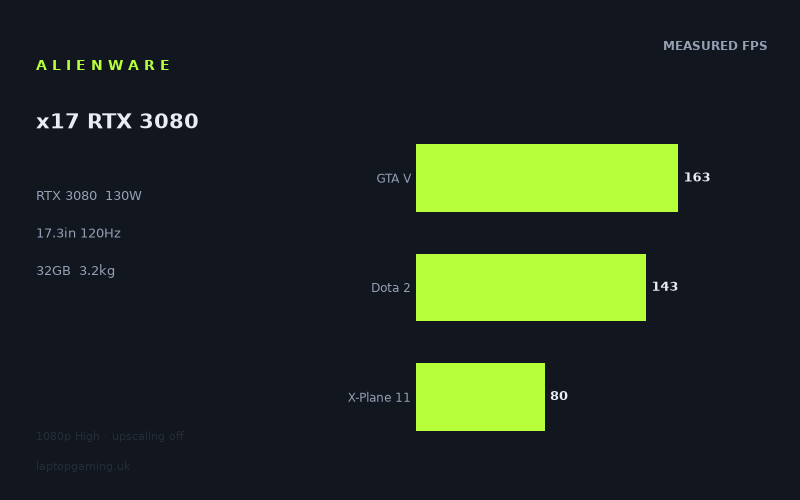
Frame rates
1920×1080, High preset, upscaling off.
Measured on this machine. Source: Notebookcheck, 2021-09-25.
Not scored: incomplete benchmark suite
Every scored laptop on this site is averaged over the same 5 games, and this one is short of Cyberpunk 2077, Baldur's Gate 3. A mean over 5 games is not comparable to a mean over 5, so we publish the figures we have and leave the score blank rather than rank it against machines tested on a different set. The numbers below are real - the suite is just incomplete.
How these numbers were produced
Frame rates here are not measured by us, and we label how each one was arrived at. A figure marked measured comes from a published run on that exact machine. A figure marked representative is derived from the GPU and its power limit (TGP) and cross-referenced against published reviews - a sound estimate of what that configuration delivers, but not a measurement of that specific laptop. Unless stated otherwise, numbers are 1920x1080, High preset, upscaling off. Where a laptop ships in several power configurations we use the wattage of the exact SKU listed, because a 140W RTX 5070 and a 115W one are not the same product.
In use
The short version
The Alienware x17 RTX 3080 is a powerful but difficult laptop to recommend at a UK price of GBP 4,576. Notebookcheck’s measured figures show that it is capable of very high frame rates at 1920x1080 using the High preset with upscaling disabled. It reaches 225fps in Strange Brigade, 192fps in The Witcher 3, 163fps in GTA V and 143fps in Dota 2. Those are unquestionably strong results, and they demonstrate that the RTX 3080 running at a 130W power limit is not being wasted in this chassis.
The problem is not that the x17 is slow. The problem is that its price asks the buyer to accept several compromises at once. It is a 3.217kg machine, it has a 17.3in 3840x2160 120Hz IPS display, and the published gaming figures are all from a 1920x1080 test run. That means the available benchmark data proves excellent 1080p High-preset performance, but does not establish that this laptop can maintain similarly high frame rates at the panel’s native 3840x2160 resolution. That distinction matters greatly when the screen is one of the machine’s headline specifications.
There is also a direct in-generation problem. The Alienware m15 R6 with the same Core i7-11800H and RTX 3080 is listed at GBP 3,215, while the x17 is listed at GBP 4,576. Across the four shared games, the x17 averages 1fps behind the m15 R6. That is not a result that supports paying more for the x17 on measured frame-rate grounds. The Aorus 17 XE4, equipped with an RTX 3070 Ti at the same 130W GPU power limit, is also effectively level with the x17 across five shared games, where the Alienware averages 1fps behind.
Buy this model only if its exact combination of 17.3in 3840x2160 IPS panel, 120Hz refresh rate, 32GB of memory and RTX 3080 configuration is more important to you than value, portability or demonstrated native-resolution gaming performance. It makes more sense as a large, mostly fixed-location machine than as something intended to travel regularly. The measured 1080p figures are strong enough for buyers who are content to play at 1920x1080, but the asking price is hard to defend when a less expensive same-GPU Alienware delivers effectively the same shared-game performance.
For most buyers, the sensible conclusion is straightforward: the x17 is a capable gaming laptop priced far beyond what its benchmark advantage justifies. Its frame rates are good. Its value is not.
Performance
What the measured figures actually show
The published results come from Notebookcheck, measured on 2021-09-25 at 1920x1080, High preset and with upscaling disabled. That is an important test configuration because it gives a clean view of conventional gaming performance without an upscaling mode affecting the result. It is also not the native resolution of this laptop’s 3840x2160 panel, so these numbers should be read as 1080p gaming results rather than proof of 4K performance.
Across the five games in the scoring suite, the Alienware x17 averages 143fps. That is a strong average, but the individual figures are more useful than the average alone because the spread is substantial. Strange Brigade reaches 225fps, GTA V reaches 163fps, Dota 2 reaches 143fps, Final Fantasy XV reaches 106fps and X-Plane 11 reaches 80fps. The average gives the x17 a useful overall position, but it does not mean every game will sit close to 143fps.
The fastest measured result is Strange Brigade at 225fps. This is comfortably beyond the panel’s 120Hz refresh rate at the tested 1920x1080 settings. The Witcher 3 also clears that refresh rate with 192fps, even though it is not one of the five scoring-suite titles. GTA V follows at 163fps, and Dota 2 reaches 143fps. In these four games, the benchmark data shows the x17 exceeding the display’s 120Hz refresh rate at 1080p High. For a buyer targeting those settings, the laptop has enough measured performance to make use of a 120Hz panel.
Far Cry 5 lands exactly at 120fps. That is a particularly neat fit for the display’s stated 120Hz refresh rate in the tested configuration. It does not leave the same headroom shown by Strange Brigade, The Witcher 3, GTA V or Dota 2, but it does reach the panel refresh rate at 1920x1080 High with upscaling disabled. For someone whose main interest is this kind of 1080p High-preset gaming, that is a satisfactory result.
Final Fantasy XV is lower at 106fps. That is still a high frame rate in isolation, but it is below the panel’s 120Hz refresh rate. X-Plane 11 is the clearest reminder that a high-end GPU does not produce the same result in every game: the measured figure is 80fps. This is not a poor frame rate, but it is materially below the x17’s stated 120Hz refresh rate and well below the 225fps result in Strange Brigade.
The practical message is that this laptop is not a universal 120fps machine even at the measured 1920x1080 High setting. It can exceed 120fps in several of the tested games, match 120fps in Far Cry 5, fall short in Final Fantasy XV and sit notably lower in X-Plane 11. Buyers should not take the 143fps scoring-suite average as a promise that every game will run above 120fps. The individual results give a more honest picture: this is a very fast 1080p machine in some games, a 120fps machine in others, and a machine below that level in more demanding or differently limited titles.
The 130W RTX 3080 configuration
The x17 uses an RTX 3080 with a 130W GPU power limit. That power limit is central to how this laptop should be judged. “RTX 3080” alone is not enough to describe gaming performance, because the fact sheet identifies the power limit as part of this machine’s actual configuration. Here, the relevant result is not a generic expectation for an RTX 3080; it is the performance achieved by this 130W RTX 3080 alongside the Core i7-11800H and 32GB of memory.
The measured figures show that 130W is enough for extremely high performance in lighter or more favourable titles at 1080p High. Strange Brigade at 225fps is the headline number. The Witcher 3 at 192fps, GTA V at 163fps and Dota 2 at 143fps all support the same conclusion: there is ample performance for high-refresh 1080p gaming in those specific titles and settings.
But the benchmark spread also shows why it is unwise to reduce the machine to a single GPU label or a single average. The same 130W RTX 3080 that records 225fps in Strange Brigade records 80fps in X-Plane 11. The GPU power limit does not create one fixed level of gaming performance. It is part of a system whose output changes substantially by game. The published data is especially valuable here because it prevents a buyer from assuming that an RTX 3080 badge guarantees a particular frame rate in every title.
The x17’s 130W power limit also becomes more meaningful when set against the listed rivals. The Aorus 17 XE4 has an RTX 3070 Ti with the same 130W GPU power limit and the x17 averages 1fps behind it across five shared games. That result does not mean the two machines are identical in every title, nor does it establish that the GPUs are interchangeable. It does show that, in the shared-game selection used here, the x17 does not turn its RTX 3080 label into a practical lead over the 130W RTX 3070 Ti system.
At the other end of the comparison list is the MSI Raider GE77 HX, which has an RTX 3080 Ti at 175W. Across five shared games, the x17 averages 26fps behind it. The Raider has a different GPU designation and a higher stated GPU power limit, so this is not a like-for-like comparison. It is still useful evidence of where the x17 sits within its generation: the Alienware’s 130W RTX 3080 is strong, but it is not the highest-performing option in this rival group.
That position is not inherently a fault. A 130W configuration can still be a sensible choice if the price reflects it and the rest of the laptop offers compensating strengths. The difficulty for the x17 is that its price is GBP 4,576, while its shared-game performance is effectively tied with machines below or beside it in the performance spread. The power limit is therefore not merely a technical specification. It helps explain why the x17 should be judged as a high-performance laptop, but not treated as an untouchable flagship simply because it carries an RTX 3080.
How close it gets to 120Hz
The panel refresh rate is 120Hz, so the useful frame-rate threshold in the available data is 120fps. At the tested 1920x1080 High settings, the Alienware clears that level in Strange Brigade, The Witcher 3, GTA V and Dota 2. Far Cry 5 reaches it exactly. That makes five of the seven listed games capable of reaching or exceeding the panel refresh rate in the published numbers.
There are two important qualifications. First, Final Fantasy XV at 106fps and X-Plane 11 at 80fps show that 120fps is not guaranteed. Second, the figures are not measured at the panel’s native 3840x2160 resolution. The x17 can clearly drive the panel refresh rate in several games at 1920x1080 High, but the fact sheet does not provide an equivalent 3840x2160 data set. It would be wrong to present the 1080p figures as evidence that the laptop delivers 120fps at 3840x2160.
For a buyer who intends to run games at 1920x1080, the 120Hz panel is supported by the measured results in a meaningful number of titles. Strange Brigade at 225fps has a large margin above 120Hz. The Witcher 3 at 192fps and GTA V at 163fps also have clear headroom. Dota 2 at 143fps is above the refresh rate, though by less. Far Cry 5 at 120fps is exactly on the line. The latter result matters because it illustrates the difference between “can reach 120fps” and “has a large performance reserve above 120fps”.
For Final Fantasy XV and X-Plane 11, the data points toward a different expectation. At 106fps and 80fps respectively, the x17 does not meet the panel refresh rate in the tested 1080p High configuration. That is still a useful outcome for a machine with a 120Hz display; a game does not become unplayable simply because it does not match the panel’s maximum refresh rate. But this review is about what the numbers support, and the numbers do not support calling the x17 a 120fps solution across the board.
Why the game-to-game spread matters
The difference between 225fps in Strange Brigade and 80fps in X-Plane 11 is large enough that no buyer should rely on a single headline frame rate. The x17’s benchmark profile is one of high peaks combined with meaningful variation. It performs exceptionally well in Strange Brigade, The Witcher 3, GTA V and Dota 2. It remains strong in Far Cry 5. It drops below 120fps in Final Fantasy XV and further in X-Plane 11.
This variation is also why shared-game comparison matters more than comparing a single result from two different machines in two different games. The rival figures supplied for this review compare only titles both laptops hold, with preference given to the scoring suite. That produces a more useful comparison than placing one machine’s best result against another machine’s result from a different title.
The rival notes also explain that a near-zero difference is a real result rather than an error. At 1080p, lighter titles in the shared set can become CPU-bound and compress genuine GPU gaps. That is particularly relevant to the x17’s near-level results against the Alienware m15 R6 and Aorus 17 XE4. The x17 is not shown to have a meaningful shared-game lead over either machine, but the near-zero gap should not be misread as proof that the graphics hardware always behaves identically. It means that, in the shared games at the tested resolution, the practical frame-rate gap is negligible.
For a buyer, the key lesson is simple. This x17 has enough performance to produce excellent 1080p results, but it is not a machine whose performance can be summarised honestly by saying “RTX 3080 equals 120fps” or “RTX 3080 equals 4K gaming”. The source data is more nuanced. It supports a claim of very good 1080p High-preset performance. It does not support a blanket claim that every game reaches 120fps, and it does not provide native 3840x2160 gaming figures.
The screen
The Alienware x17 has a 17.3in IPS display with a 3840x2160 resolution and a 120Hz refresh rate. On paper, that is an ambitious screen specification: a large panel, a high native resolution and a refresh rate that invites high-frame-rate gaming. The problem is not the screen specification itself. The problem is the gap between the screen’s native resolution and the available benchmark resolution.
Notebookcheck’s listed figures are all measured at 1920x1080 on the High preset with upscaling disabled. The panel is 3840x2160. Those are not the same resolution, and the fact sheet does not include 3840x2160 frame rates for Strange Brigade, The Witcher 3, GTA V, Dota 2, Far Cry 5, Final Fantasy XV or X-Plane 11. As a result, the available evidence can tell a buyer how the laptop performs at 1080p High, but it cannot tell them exactly how it performs at the screen’s native resolution.
This is the most important screen-related caveat in the review. The x17 may appeal to buyers specifically because it has a 3840x2160 panel, yet the published figures that demonstrate its gaming ability are 1080p figures. That does not make the screen a bad fit. It does mean the machine should not be bought on the assumption that its 120Hz panel will be driven at native resolution in the same way that it is driven in the 1080p benchmark data.
At 1920x1080, the measured numbers show that the display’s 120Hz refresh rate can be used well in several games. Strange Brigade at 225fps, The Witcher 3 at 192fps, GTA V at 163fps and Dota 2 at 143fps all exceed 120fps. Far Cry 5 reaches 120fps. These figures make a credible case for the 120Hz refresh rate when gaming at the benchmark resolution and settings.
However, there is a difference between a panel being 3840x2160 and the machine having verified 3840x2160 gaming performance. The fact sheet establishes the former and does not establish the latter. Buyers who want a laptop primarily for native-resolution gaming need to recognise that limitation before spending GBP 4,576. There is no published 4K result in this data set to justify a claim of native-resolution 120fps gaming.
The IPS panel type is another stated part of the specification, but the fact sheet does not provide measured brightness, colour coverage, contrast, response behaviour or any other display measurements. It would therefore be wrong to make claims about image quality beyond the known panel type, size, resolution and refresh rate. The panel may be attractive because it is a 17.3in 3840x2160 120Hz IPS unit, but this review cannot verify more than that from the supplied information.
For gaming use, the screen presents a clear choice. If you are content to base expectations on 1920x1080 High-preset performance, the measured frame rates show that the x17 can make useful use of 120Hz in a substantial share of the tested games. If the attraction is specifically 3840x2160 gaming, the benchmark evidence is incomplete. That should not be hidden behind the RTX 3080 name or the 120Hz specification.
Build, size and portability
The one portability figure supplied here is the weight: 3.217kg. That puts the x17 firmly in the large-laptop category in practical terms. It is not a machine that should be chosen for frequent, low-effort carrying. A buyer can of course transport it, but the weight makes it better suited to a desk, a regular gaming location or occasional moves than to a lifestyle built around taking a laptop everywhere.
The 17.3in screen reinforces that reading. This is a large-display gaming machine, and its 3.217kg weight is consistent with a product intended to prioritise screen size and performance over portability. The fact sheet does not provide physical dimensions, so this review cannot make a precise claim about its footprint in a bag or on a desk. It does, however, provide enough information to say that the x17 is not the sensible choice for someone whose priority is a light gaming laptop.
The 87Wh battery is a meaningful specification, but there is no measured battery-life result in the supplied data. It would be irresponsible to turn the battery capacity into a claim about how many hours the laptop lasts away from mains power. The correct conclusion is simply that it has an 87Wh battery and that no runtime figure is available here. Buyers who need dependable unplugged use should seek measured battery-life information rather than infer it from capacity alone.
The same restraint applies to build quality, keyboard behaviour, cooling, noise and temperatures. None of those measurements or observations are in the fact sheet. There is no basis here for saying that the x17 is quiet, loud, cool, hot, rigid or premium in use. The available evidence is strongest on weight, screen specification, processor, memory, GPU power limit, price and gaming performance. Those are enough to reach a buying conclusion without inventing impressions of the chassis.
In practical buying terms, 3.217kg changes the kind of owner this laptop suits. It suits someone who wants a large-screen gaming system that may be moved between rooms, used at a fixed desk or taken on less frequent trips. It does not suit someone who wants the convenience of a genuinely portable machine. At GBP 4,576, that compromise is especially difficult because the buyer is paying a premium price while still accepting a substantial weight.
How it compares
Against the MSI Prestige 15
The MSI Prestige 15 is listed with an RTX 3050 Ti at 105W, and no confirmed UK price is available. Across four shared games, the Alienware x17 averages 69fps ahead. This is the clearest performance win in the rival group and shows what the x17’s RTX 3080 configuration can do when compared with a lower-tier RTX 3050 Ti system.
That 69fps lead is significant, but it should be interpreted correctly. It is an average across four shared games, not a claim that the x17 is always 69fps faster in every title. The performance gap nevertheless supports a straightforward conclusion: the x17 is substantially faster than the Prestige 15 in the shared-game data.
The Prestige’s lack of a confirmed UK price prevents a direct value comparison. The x17’s GBP 4,576 price is known, but there is no corresponding confirmed UK figure for the Prestige in the supplied data. What can be said is that the x17 has a clear performance advantage over this rival, while the price relationship cannot be established here.
Against the Alienware m15 R6
The Alienware m15 R6 is the comparison that causes the biggest problem for the x17’s value case. It uses the same Core i7-11800H and RTX 3080 combination, and it is listed at GBP 3,215. Across four shared games, the x17 averages 1fps behind.
A 1fps average gap is effectively no practical performance advantage for the x17 in this shared-game comparison. The rival notes make clear that near-zero differences at 1080p can be genuine results because lighter titles in the shared set can become CPU-bound and compress genuine GPU gaps. That explanation matters. It means the x17’s lack of a lead should not be treated as a mistake or dismissed because both machines carry RTX 3080 graphics.
For a buyer choosing between these two Alienware machines based on the supplied data, the x17 does not justify its higher listed price through shared-game frame rates. The x17 has the larger 17.3in 3840x2160 120Hz IPS panel and 32GB of memory in the configuration described here, but the benchmark comparison does not show a frame-rate lead. If raw gaming performance is the priority, the m15 R6 is the more compelling position because it is listed at GBP 3,215 and the x17 averages 1fps behind across the games both hold.
This is where the x17’s price becomes especially hard to defend. A premium can be reasonable when it buys a clear performance improvement. The data does not show that here. It shows two same-CPU, same-GPU Alienware systems effectively tied in their shared 1080p gaming results, with the x17 sitting behind by 1fps on average.
Against the Aorus 17 XE4
The Aorus 17 XE4 has an RTX 3070 Ti at a 130W GPU power limit, matching the x17’s stated 130W limit. No confirmed UK price is available for the Aorus. Across five shared games, the x17 averages 1fps behind.
This is another near-zero result, and it is important because the Aorus uses a different GPU designation. A buyer could reasonably expect the RTX 3080 name to guarantee a clear lead over an RTX 3070 Ti configuration. The shared-game data does not show that outcome. Instead, it shows the two machines effectively level, with the x17 averaging 1fps behind.
The supplied comparison note gives the relevant explanation: at 1080p, lighter titles in the shared set can be CPU-bound and compress genuine GPU gaps. That means this result should not be stretched into a universal claim about every game, every setting or every resolution. But it is still a real buying result. In the five shared games, the x17 does not establish a useful lead over the Aorus 17 XE4.
Because there is no confirmed UK price for the Aorus, value cannot be settled directly. Performance can be discussed, though, and the conclusion is clear: the x17’s RTX 3080 at 130W does not produce a meaningful average advantage over the Aorus 17 XE4’s RTX 3070 Ti at 130W in the shared set.
Against the MSI Raider GE77 HX
The MSI Raider GE77 HX is the strongest listed rival in the shared-game figures. It has an RTX 3080 Ti at a 175W GPU power limit, and no confirmed UK price is available. Across five shared games, the x17 averages 26fps behind.
Unlike the m15 R6 and Aorus comparisons, this is not a compressed near-tie. A 26fps average deficit across five shared games is a meaningful difference. The Raider’s RTX 3080 Ti designation and 175W power limit make it a different class of configuration from the x17’s RTX 3080 at 130W, and the benchmark data reflects that difference.
This comparison does not make the x17 slow. The x17 still produces 225fps in Strange Brigade, 192fps in The Witcher 3 and 163fps in GTA V at the stated 1080p High settings. But it does show that the x17 is not the performance ceiling of its GPU generation. Buyers who want the strongest shared-game frame rates among these listed rivals should look towards the Raider rather than assume the x17’s high price places it at the top of the performance stack.
Without a confirmed UK price for the Raider, it is not possible to decide which machine is the better value from this data alone. What is clear is the performance order in the shared-game comparison: the Raider is ahead by 26fps on average, while the x17 is not.
Who it’s for
The Alienware x17 RTX 3080 is for the buyer who specifically wants a large 17.3in laptop with a 3840x2160 120Hz IPS display, 32GB of memory, a Core i7-11800H and an RTX 3080 running at 130W. It is also for someone who will use the laptop mostly in one place and is comfortable with a 3.217kg system. The performance data supports that kind of buyer if their gaming expectations are centred on 1920x1080 High settings.
It is particularly suited to someone who values high frame rates in the games where the x17 demonstrates them. Strange Brigade at 225fps, The Witcher 3 at 192fps, GTA V at 163fps and Dota 2 at 143fps show that the machine can exceed its 120Hz refresh rate in several of the tested titles. Far Cry 5 at 120fps also fits the panel’s refresh rate exactly. If those games, or games with similar performance demands, are central to your use, the x17 has the measured headroom to be satisfying at 1080p High.
It is also a reasonable fit for someone who accepts that the 3840x2160 panel is not automatically a promise of native-resolution high-refresh gaming. A buyer who understands that the available results are 1920x1080 figures, and who is content to make their purchasing decision on that basis, can judge the x17 more realistically. The screen is a high-specification component, but the benchmark evidence is for 1080p.
It is not for the value-focused buyer. At GBP 4,576, the x17 is difficult to defend against the Alienware m15 R6 at GBP 3,215 when the x17 averages 1fps behind across four shared games. The m15 R6 comparison is too direct to ignore: same listed processor, same listed RTX 3080, much lower listed UK price, and no meaningful frame-rate advantage for the x17 in the shared data.
It is not for the buyer who wants the highest gaming performance available among the named rivals. The MSI Raider GE77 HX averages 26fps ahead across five shared games. The x17 remains fast, but the Raider’s result is materially stronger. If the aim is maximum measured frame rate rather than a particular Alienware configuration or screen specification, the x17 is not the strongest option in this comparison group.
It is not for the buyer who expects the RTX 3080 badge to guarantee a meaningful lead over every RTX 3070 Ti machine. The Aorus 17 XE4 is effectively tied with the x17 across five shared games, with the x17 averaging 1fps behind. The explanation around CPU-bound 1080p results is important, but it does not change the immediate purchasing point: the x17 does not demonstrate a practical shared-game advantage there.
It is not for frequent travellers or anyone whose main criterion is low weight. At 3.217kg, the x17 is a substantial machine. The fact sheet does not provide dimensions, so there is no basis for more precise portability claims, but the weight alone is enough to rule it out for buyers seeking a genuinely easy-to-carry gaming laptop.
It is also not for someone who needs confirmed battery-life figures before buying. The battery capacity is 87Wh, but no runtime measurement is supplied. Likewise, this is not a review that can recommend the x17 for quiet operation, low temperatures, particular keyboard qualities or specific chassis behaviour, because the relevant evidence is not present. A responsible purchasing decision should not fill those gaps with assumptions.
The final recommendation is therefore narrow. The Alienware x17 RTX 3080 is a strong 1080p High-preset gaming laptop with a useful set of high-frame-rate results and a large 3840x2160 120Hz IPS display. It can exceed 120fps in several measured games, reaches 120fps in Far Cry 5, and remains above 100fps in Final Fantasy XV. But its performance varies enough that 120fps is not universal, as X-Plane 11 at 80fps demonstrates. More importantly, its GBP 4,576 price is not supported by a meaningful shared-game advantage over the cheaper Alienware m15 R6, and it sits 26fps behind the MSI Raider GE77 HX across five shared games.
That makes the x17 a machine to buy for a very specific preference set, not a machine to buy because it is the rational performance-per-pound choice. The benchmark data supports admiration for its speed. It does not support confidence in its value.