Review
Gigabyte Gaming A16 Pro GA6DH (Core 7 240H, RTX 5070 Ti) review
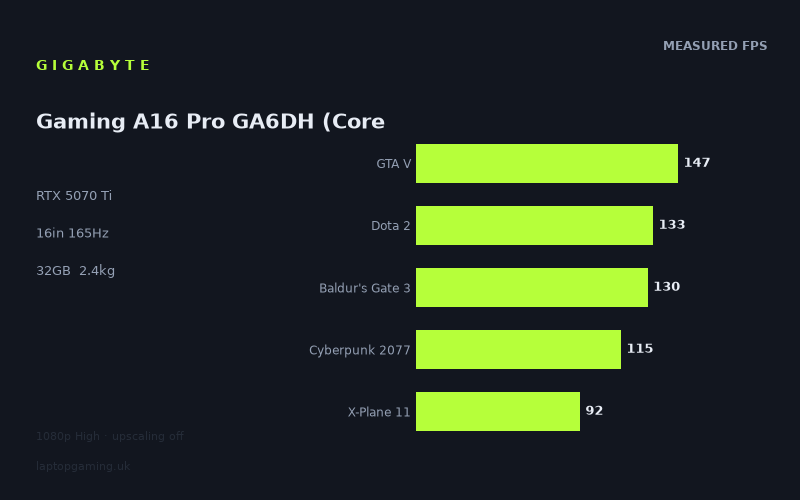
Frame rates
1920×1080, High preset, upscaling off. Averages 123fps across the 5 core benchmark games.
Measured on this machine. Source: Notebookcheck, 2026-03-26.
Not scored: no confirmed UK price
We have the full benchmark suite for this machine, so it ranks on the frame rate leaderboard like any other. What we don't have is a UK listing for this exact configuration - it's sold as a European review unit, or only in specifications that differ from the one tested. Since 30% of our score is value for money, scoring it would mean pretending price is no object, which would flatter it against every laptop you can actually buy. The frame rates below are real and comparable; there is just no buying recommendation to make yet.
How these numbers were produced
Frame rates here are not measured by us, and we label how each one was arrived at. A figure marked measured comes from a published run on that exact machine. A figure marked representative is derived from the GPU and its power limit (TGP) and cross-referenced against published reviews - a sound estimate of what that configuration delivers, but not a measurement of that specific laptop. Unless stated otherwise, numbers are 1920x1080, High preset, upscaling off. Where a laptop ships in several power configurations we use the wattage of the exact SKU listed, because a 140W RTX 5070 and a 115W one are not the same product.
In use
The short version
The Gigabyte Gaming A16 Pro GA6DH is a performance-led 16in gaming laptop built around an RTX 5070 Ti, a Core 7 240H, 32GB of memory and a 1TB SSD. Its strongest case is straightforward: Notebookcheck’s measured figures show consistently high frame rates at 1920x1080 on the High preset with upscaling disabled, including 305fps in Strange Brigade, 147fps in GTA V, 133fps in Dota 2, 130fps in Baldur’s Gate 3 and 115fps in Cyberpunk 2077.
That is a strong spread for someone who wants a laptop that can play both fast competitive titles and substantially heavier single-player games without leaning on upscaling in the benchmark configuration. The machine is not merely quick in lighter games. It also keeps Cyberpunk 2077 at 115fps, F1 25 at 117fps and Final Fantasy XV at 109fps under the published test conditions. Those are the results that matter most for a 165Hz display: the A16 Pro has the headroom to make high-refresh gaming feel meaningful in several games, rather than merely having a high-refresh panel attached to hardware that cannot approach it.
There are important limits to that conclusion. The measured results are at 1920x1080, while the fitted IPS display is 2560x1600. The benchmark data therefore demonstrates what this configuration can do at the lower resolution, not what it will necessarily deliver at the panel’s native resolution. The higher-resolution screen is attractive for desktop work, sharper game imagery and more usable workspace, but it asks more of the GPU. Anyone buying this machine primarily to run demanding new games at 2560x1600 should treat the 1920x1080 figures as a performance reference point rather than a native-resolution promise.
The other major caveat is price. There is no confirmed UK price for this exact configuration, so a value judgement cannot be made. That is not a criticism of the laptop or of the benchmark results; it is simply not possible to assess whether this is good buying against alternatives without a confirmed price. The benchmark suite is complete and the machine can be compared normally on frame rate, but value depends on the missing UK price.
On outright performance alone, this is an appealing option for a buyer who wants an RTX 5070 Ti laptop with 12GB of VRAM, 32GB of memory and a 165Hz 16in screen, and who is comfortable using resolution settings intelligently in the most demanding games. It is especially suitable for someone who values strong 1920x1080 performance today while retaining the option of using the 2560x1600 panel for less demanding games, work and media.
It is less convincing as a blind purchase for a buyer who needs a known budget, wants low carry weight, or expects every game to run at the panel’s full 165Hz refresh rate at 2560x1600 without compromise. The published data supports the A16 Pro as a capable gaming machine, but not as a universal answer to every use case.
Performance
What the benchmark data says
Notebookcheck’s numbers were measured at 1920x1080 using the High preset with upscaling off. That detail matters. Upscaling can substantially change frame rates and image quality, depending on the game and the selected mode, so these figures are useful precisely because they show the laptop’s performance without that variable. They are a baseline for conventional rasterised gaming performance at a commonly used resolution and a demanding but not necessarily maximum-quality preset.
The Gigabyte posts 305fps in Strange Brigade. That is the standout result in the list and shows that the RTX 5070 Ti has abundant headroom in a well-established, comparatively light game. On the A16 Pro’s 165Hz panel, Strange Brigade is one of the titles where the measured figure clearly exceeds the display refresh rate. That does not mean every visible frame can be shown simultaneously by a 165Hz panel, but it does mean the laptop has ample performance reserve for high-refresh play, frame caps, lower-latency settings or increased graphical settings where the game allows it.
GTA V reaches 147fps in the scoring suite. That is below the panel’s 165Hz maximum, but it is still a very high result and close enough to the display’s ceiling that the game should make effective use of a high-refresh screen under the published settings. The difference between 147fps and a locked 165Hz target matters to buyers chasing a perfectly capped experience, but it should not obscure the more useful conclusion: the A16 Pro is comfortably in high-refresh territory in GTA V at 1920x1080 High with upscaling disabled.
Dota 2 records 133fps, while Baldur’s Gate 3 records 130fps. These figures are valuable because they underline that game genre alone does not dictate performance. Dota 2 is often associated with competitive play, but the published result is not at the full panel refresh rate under this particular test configuration. Baldur’s Gate 3, by contrast, is not generally bought as a twitch competitive game, yet it also produces a very high frame rate. Both results should feel fluid on a 165Hz display, but neither supports a claim that the laptop will always saturate the panel at the tested settings.
Cyberpunk 2077 is one of the more useful tests here because it is a demanding modern game and often exposes the difference between a laptop that looks powerful in lighter titles and one that retains meaningful performance in heavier workloads. The A16 Pro achieves 115fps. That is a very strong result at 1920x1080 High with upscaling disabled, but it is also well short of the screen’s 165Hz refresh rate. The sensible reading is not that the laptop struggles with Cyberpunk 2077; it plainly does not under the published conditions. Instead, it is that a 165Hz label should not be mistaken for a guaranteed 165fps experience in demanding games.
X-Plane 11 is the lowest scoring-suite result at 92fps. It remains a smooth-looking result by ordinary gaming standards, but it is notably different from the figures in Strange Brigade, GTA V, Dota 2 and Baldur’s Gate 3. This is why a single average never tells the full story of a gaming laptop. The A16 Pro’s scoring-suite mean is 123fps, but the games around that mean vary significantly. A buyer who spends most of their time in simulation software should put more weight on the X-Plane 11 result than on the 305fps in Strange Brigade. A buyer mainly interested in older action titles may reach the opposite conclusion.
Outside the scoring suite, the published figures remain strong. F1 25 runs at 117fps and Final Fantasy XV reaches 109fps. Both results are comfortably into high-refresh territory in the broad sense, even though neither reaches the panel’s 165Hz limit. They reinforce the same pattern seen in Cyberpunk 2077: this is a machine capable of producing frame rates well above the conventional baseline for fluid play in graphically substantial games, but the screen refresh remains an aspirational upper ceiling in the most demanding titles rather than a result the machine reaches automatically.
The frame-rate spread matters more than the mean
The 123fps mean across the scoring-suite games is useful as a summary, but it should not be treated as a prediction for a random game. The difference between 147fps in GTA V and 92fps in X-Plane 11 is large enough to change how the screen is used. In one case, the laptop is approaching the 165Hz panel refresh limit. In the other, the display still has unused headroom. Both can be good experiences, but they are different experiences.
That spread comes from the games themselves as much as from the hardware. Games use CPUs and GPUs differently. Some are primarily limited by graphics rendering, some place heavier demands on the processor, and some respond strongly to engine design, scene complexity, simulation work or driver behaviour. The Core 7 240H is an important part of the A16 Pro configuration, particularly in games and scenes that do not scale purely with GPU power, but the available data does not isolate CPU-limited behaviour or provide per-game component utilisation. It would be wrong to claim that any one result is definitely CPU-bound or GPU-bound from these figures alone.
What can be said is that the A16 Pro does not show the sort of benchmark profile where a single lightweight game inflates an otherwise weak result. The performance is high across a varied list: 305fps in Strange Brigade, 147fps in GTA V, 133fps in Dota 2, 130fps in Baldur’s Gate 3, 115fps in Cyberpunk 2077, 117fps in F1 25, 109fps in Final Fantasy XV and 92fps in X-Plane 11. The lowest result is still materially useful for gaming, while the highest result gives the 165Hz panel a genuine purpose.
That balance is especially relevant for buyers moving from a lower-refresh display. A laptop does not need to hit its stated refresh rate in every game to benefit from a high-refresh panel. Higher measured frame rates can improve responsiveness, reduce the sensation of motion blur and make camera movement look more continuous, subject to the game, settings and any synchronisation option in use. However, the difference between games remains important. Strange Brigade is the clearest case for exploiting 165Hz. GTA V comes close. Dota 2 and Baldur’s Gate 3 remain strong. Cyberpunk 2077, F1 25 and Final Fantasy XV are high-frame-rate experiences, but they do not support an expectation of a constant panel-limit result. X-Plane 11 should be viewed as the result for a buyer who needs to calibrate expectations most carefully.
GPU power limit: what is known and what is not
GPU power limit is often one of the most consequential details in a gaming laptop specification. The same named GPU can perform differently across laptops because manufacturers can configure cooling, firmware and power behaviour differently. A higher-power implementation is not automatically better in every situation, but it can materially affect sustained performance, particularly in GPU-heavy games.
There is no GPU power limit published in the supplied specification for this Gigabyte Gaming A16 Pro GA6DH. As a result, there is no basis for stating a wattage for the RTX 5070 Ti, calling it a high-power or low-power implementation, or attributing the measured results to a particular power setting. The benchmark data is more useful than an unsupported assumption: it shows the performance this specific configuration actually achieved under Notebookcheck’s stated test conditions.
That distinction matters when comparing model names. An RTX 5070 Ti badge tells a buyer the GPU class and the 12GB VRAM capacity supplied here, but it does not by itself describe every aspect of implementation. The only defensible conclusion from the available data is that this particular A16 Pro delivers the listed results at 1920x1080 High with upscaling off. It would be inappropriate to infer more than that about its configured power limit, thermal behaviour or sustained clock behaviour.
The closest rival list includes an ASUS TUF Gaming A18 with an RTX 5070 specified at 115W. That is a useful confirmed specification for the ASUS, but it must not be turned into an assumed comparison against an unknown Gigabyte wattage. The A16 Pro is ahead by 1fps across the shared games, according to the supplied comparison data. That tells us that their observed gaming performance is extremely close in those shared tests. It does not establish why the results are close, whether power limits are responsible, or how either machine behaves outside those games.
Memory, storage and VRAM in the context of gaming
The A16 Pro has 32GB of memory, a 1TB SSD and 12GB of VRAM. These are not benchmark results, but they are relevant to the kind of buyer this machine targets. The 32GB memory allocation is reassuring for a gaming laptop intended to run demanding games alongside browsers, launchers, voice chat, capture tools or other background software. It does not guarantee a particular frame rate, because game performance depends on far more than system memory capacity, but it avoids the immediate concern that a premium GPU configuration is being paired with an obviously restrictive memory figure.
The 12GB VRAM allocation is similarly relevant when considering the fitted 2560x1600 display. Higher resolutions, high-resolution textures and demanding visual settings can place more pressure on graphics memory. The supplied benchmark figures do not include VRAM utilisation, texture settings beyond the High preset, or native-resolution results, so no claim should be made about the limits of 12GB in any individual game. Still, this is a more substantial VRAM specification than a buyer would expect from an entry-level gaming system, and it is appropriate for a machine positioned around high-refresh gaming and a high-resolution panel.
The 1TB SSD is a sensible starting point for a gaming laptop because modern game installations can be substantial. Whether it is enough depends entirely on a buyer’s library and whether the storage can be expanded, neither of which is established in the supplied information. There is no basis here to comment on upgrade access, spare storage slots or SSD speed. Buyers for whom storage expansion is essential should verify those details before purchase rather than assuming that a 1TB specification answers the question.
The screen
A useful panel specification, with a resolution-performance trade-off
The Gigabyte Gaming A16 Pro uses a 16in IPS display with a 2560x1600 resolution and a 165Hz refresh rate. On paper, that is a well-judged combination for a gaming machine of this class. The 2560x1600 resolution provides more desktop space than 1920x1080 and gives games a sharper presentation when the GPU can sustain it. The 165Hz refresh rate is meaningfully higher than a conventional display and is supported by the measured performance in several games.
The IPS panel type is also relevant. IPS is commonly chosen for wide viewing angles and a more balanced experience across gaming, general work and media use. However, the supplied information does not include brightness, contrast, colour coverage, response times, backlight behaviour, adaptive-sync support or panel calibration. Those are all significant factors in screen quality. The specification supports the claim that the A16 Pro has an IPS, 165Hz, 2560x1600 display; it does not support broader claims about colour accuracy, outdoor visibility or motion clarity.
The central practical issue is that the measured game figures are not at the display’s native 2560x1600 resolution. They are at 1920x1080. This is not an academic distinction. Rendering more pixels normally increases graphics workload, and demanding games can lose frame rate when moved to a higher resolution. The A16 Pro’s 115fps in Cyberpunk 2077, 117fps in F1 25 and 109fps in Final Fantasy XV demonstrate very capable 1920x1080 High performance without upscaling, but they do not demonstrate those same results at 2560x1600.
For a buyer who wants the best possible image sharpness in every game, this means settings management will matter. Less demanding games may make better use of the native resolution and the high refresh rate at the same time. Heavier games may call for a choice between native resolution, high graphical settings, a higher frame rate, or the use of upscaling. The benchmark data intentionally removes upscaling from the equation, which makes it a clean baseline, but it also means it cannot tell us how the laptop’s performance and image quality would balance with any particular upscaling mode enabled.
Which measured games suit 165Hz best?
Strange Brigade is the most obvious match for the 165Hz panel, with a measured 305fps. There is more rendering performance available than the screen can display at its stated refresh rate, so the display is not the limiting element for a high-refresh experience in that game under the tested configuration. GTA V at 147fps is also a strong match, sitting close to the panel limit even though it does not reach 165fps.
Dota 2 at 133fps and Baldur’s Gate 3 at 130fps are still good fits for a high-refresh display. They are not panel-saturating results, but they are far beyond the level where a 165Hz screen becomes irrelevant. The higher refresh rate can still make motion feel more fluid than on a lower-refresh panel, provided the game and settings are configured appropriately.
Cyberpunk 2077 at 115fps, F1 25 at 117fps and Final Fantasy XV at 109fps are the results that show why the display specification should be interpreted sensibly. The panel has headroom beyond those measured figures. That is not a fault in the screen; a 165Hz panel can still be desirable when a game runs below its maximum refresh. But buyers should not equate the panel specification with a guarantee that demanding games will run at 165fps.
X-Plane 11 at 92fps is the clearest reminder that a high-refresh display is not a substitute for game-specific performance. The result is still useful and should feel substantially smoother than a much lower frame rate, but it does not exploit the full refresh potential of the panel. Simulation-focused buyers should pay close attention to this result, particularly if X-Plane 11 is representative of the workload they care about most.
The resolution is an advantage beyond gaming
A 2560x1600 display is not solely about pushing more pixels in games. It can make the laptop more pleasant for general desktop use because there is more room for documents, browser windows, editing software and communications tools. The taller 1600-pixel dimension can also be useful in productivity applications where vertical workspace matters. That said, the supplied information does not provide keyboard details, webcam details, port layout or any measurement of display quality beyond resolution, refresh rate and panel type, so the screen should not be treated as proof that this is an all-round creator or office machine.
The sensible buyer will regard the panel as a flexible asset. At 1920x1080, the benchmark data is strong. At 2560x1600, the display offers a sharper native workspace and the potential for sharper game output where performance allows. The compromise is not unusual, but it is real: a high-resolution display asks more of the GPU, while the most concrete performance evidence for this laptop is at the lower resolution.
Build, size and portability
The A16 Pro weighs 2.351kg. That places it firmly in the category of a laptop that can be moved between locations, but should not be confused with a lightweight everyday carry machine. A buyer taking it occasionally between home, university, work or a gaming venue may find that manageable. A buyer carrying it daily alongside a charger, books, peripherals or other equipment should consider the total bag weight carefully.
The supplied specification does not include the laptop’s physical dimensions, thickness, charger weight, port selection, keyboard layout, chassis materials or cooling system details. It is therefore not possible to make a reliable claim about how much desk space it needs, how easily it fits into a particular bag, how rigid the chassis is, or whether the keyboard is suitable for a particular typing preference. The 2.351kg weight is the meaningful portability fact available here, and it suggests a machine designed primarily to be transported when needed rather than carried without thought every day.
The 16in screen also gives a useful indication of intended use. This is not a compact ultraportable built around the smallest possible footprint. A 16in gaming display offers more visual space than a smaller gaming laptop and is well suited to the 2560x1600 resolution, but it naturally points towards a more desk-oriented role. The machine makes most sense as a main computer that can travel, rather than as a machine selected chiefly for minimal bulk.
The 76Wh battery is a respectable capacity figure, but capacity alone is not battery-life evidence. The supplied information contains no measured runtime for web browsing, video playback, office work or gaming. It would be misleading to convert 76Wh into a claimed number of hours, particularly because battery life depends heavily on screen brightness, refresh rate, power settings, background tasks, game load and whether the discrete GPU is active. Buyers who need long unplugged use should seek measured battery-life data before assuming that the battery capacity will meet their needs.
Gaming performance itself should be considered primarily in the context of mains power unless published battery gaming figures state otherwise. There are no such figures in the supplied data. Gaming laptops can behave differently on battery, and the Notebookcheck frame rates supplied here should not be presented as battery performance. For the buyer, the practical point is simple: this looks like a capable gaming machine to use at a desk or wherever power is available, while its weight and unmeasured battery life make it less clearly suited to all-day mobile use.
How it compares
Lenovo Legion 5 15IRX10
The closest priced comparison available is the Lenovo Legion 5 15IRX10 with an RTX 5070 at GBP 2,359. Across the shared games, the Gigabyte averages +0fps. In plain terms, the supplied comparison data says there is no average frame-rate advantage between them in the games both machines have been measured in.
That is an important result because the Gigabyte carries an RTX 5070 Ti while the Lenovo is listed with an RTX 5070. GPU naming alone would encourage an assumption that the Gigabyte must be faster. The shared-game data does not support that assumption. On the available results, they are tied on average. This is exactly why attributable benchmark data matters more than relying on a GPU label in isolation.
It does not follow that the two machines are identical. They may differ in screen, weight, battery, cooling, ports, memory configuration, storage, keyboard, software or performance in games not shared between them. None of those differences can be established from the supplied comparison data. The useful conclusion is narrower: if the decision is based on the listed shared games, the Gigabyte does not establish a frame-rate lead over the Lenovo Legion 5 15IRX10.
The Lenovo has a confirmed price while the Gigabyte does not. That means the Lenovo can be assessed as a purchase at GBP 2,359, while the Gigabyte cannot yet be judged on value. Buyers considering these two should resist drawing a value conclusion until the Gigabyte’s exact UK price is confirmed.
Lenovo Yoga Pro 9 16IAH G10 RTX
The Lenovo Yoga Pro 9 16IAH G10 RTX is listed with an RTX 5060 and no confirmed UK price. Across the shared games, the Gigabyte averages +0fps. Again, that is a tie in the available comparison rather than a win for the RTX 5070 Ti machine.
This comparison is a useful warning against buying by GPU tier alone. The Gigabyte’s configuration includes an RTX 5070 Ti with 12GB of VRAM, but the shared-game frame-rate data does not show an average advantage over this RTX 5060 Lenovo. There may be configuration, power, cooling or game-selection reasons for that, but the supplied data does not permit a definitive explanation. The responsible conclusion is simply that their observed shared-game performance is equal on average.
Because neither machine has a confirmed UK price in the supplied information, there is no value comparison to make. The choice would have to come down to confirmed pricing and other specifications that are not included here. On gaming performance across the shared titles alone, there is no reason to assume the Gigabyte is automatically the better buy.
Asus ProArt P16
The Asus ProArt P16, listed with an RTX 5070 and no confirmed UK price, also matches the Gigabyte at +0fps across the shared games. This is another close result and another example of the A16 Pro’s benchmark position being more nuanced than its RTX 5070 Ti branding might imply.
The ProArt name suggests a different intended audience from a conventional gaming laptop, but intended audience is not a substitute for data. The shared-game comparison says the two machines are level on average in the measured overlap. There is no basis here to claim that the Gigabyte is better for gaming solely because it is called Gaming A16 Pro, nor to claim that the Asus is better for creative work solely because it is called ProArt. Those conclusions would need specifications and measurements not present in the fact sheet.
The Gigabyte remains a credible choice on its own 1920x1080 High results, but the comparison shows that an RTX 5070 rival can match it in the games both machines have been tested in. For a buyer choosing between them, the screen, portability, price and non-gaming features would likely matter greatly, yet those details are not available for the Asus in this data.
Schenker XMG Core 16 M25
The Schenker XMG Core 16 M25 is another RTX 5070 machine with no confirmed UK price. The Gigabyte averages +0fps across the shared games. The pattern is now clear: the A16 Pro is not separated from these nearby RTX 5070 and RTX 5060 rivals by a measurable average frame-rate lead in the supplied overlap.
This does not weaken the Gigabyte’s own performance results. A laptop delivering 147fps in GTA V, 133fps in Dota 2, 130fps in Baldur’s Gate 3 and 115fps in Cyberpunk 2077 remains a powerful gaming laptop under the stated conditions. It does mean that prospective buyers should not pay an arbitrary premium merely for the RTX 5070 Ti name unless the final price and the rest of the configuration justify it.
With no confirmed UK price for either machine in this comparison, no purchasing verdict can be drawn between the Gigabyte and the Schenker. The benchmark evidence says they are level on average across shared games. Beyond that, the fact sheet does not provide enough evidence to identify a better choice.
ASUS TUF Gaming A18
The ASUS TUF Gaming A18 is listed with an RTX 5070 at 115W and no confirmed UK price. Across the shared games, the Gigabyte averages +1fps. That is a lead in the supplied data, but it is an extremely narrow one. It should be read as practical parity rather than as evidence of a meaningful performance gap.
The ASUS specification is useful because its RTX 5070 is explicitly identified as 115W. The Gigabyte’s GPU power limit is not supplied, so no wattage-to-wattage judgement can be made. The shared-game result is more useful than guessing: the machines are effectively side by side in observed performance, with the Gigabyte holding only the smallest stated average advantage.
For a buyer, this means the decision should not rest on the +1fps figure. Screen size, weight, panel quality, price, portability and other features could easily matter more, but the relevant details are not supplied for the ASUS here. The Gigabyte should be considered competitive with the TUF Gaming A18, not clearly faster in a way that justifies a decision on frame rate alone.
Who it’s for
The Gigabyte Gaming A16 Pro GA6DH is for the buyer who wants strong measured gaming performance without needing to rely on upscaling in the published 1920x1080 High test configuration. It is a good fit for someone whose library spans fast action games, competitive games, large RPGs, driving games and demanding single-player titles. The benchmark spread is broad enough to show that this is not a machine built for one narrow genre.
It is particularly well suited to a player who values high-refresh gaming but understands what that means in practice. Strange Brigade at 305fps gives the 165Hz panel plenty to work with. GTA V at 147fps comes close to the screen’s maximum refresh. Dota 2 at 133fps and Baldur’s Gate 3 at 130fps remain very strong. Cyberpunk 2077 at 115fps, F1 25 at 117fps and Final Fantasy XV at 109fps show that demanding games can still run at high frame rates. This is a laptop for someone who wants high performance across a range of games, not someone who needs every title to lock to 165fps.
The 32GB memory and 1TB SSD also make the configuration sensible for a buyer who uses their gaming laptop as a main machine. There is enough system memory for a more demanding general workload than simple game launching, and the storage capacity is more practical than a smaller entry-level drive. The 2560x1600 screen adds appeal for desktop work and media use, even though the supplied data does not establish broader panel-quality characteristics.
It is also a reasonable choice for a buyer who accepts that a 2.351kg laptop is portable in the occasional sense rather than the ultralight sense. If the machine will usually live on a desk but needs to travel between locations, that weight is unlikely to be a deal-breaker for the intended audience. The 76Wh battery may be useful away from a socket, but there is no measured battery-life figure here, so it should not be bought on an assumption of all-day unplugged endurance.
Someone should buy something else if they need a confirmed purchase price before narrowing down a shortlist. The Gigabyte has no confirmed UK price in this exact configuration. That does not make it poor value, but it prevents a responsible value verdict. The Lenovo Legion 5 15IRX10 does have a listed price of GBP 2,359, and the supplied comparison says it ties the Gigabyte on average across shared games. Until the Gigabyte’s price is known, the Lenovo is the easier machine to place in a budget.
A buyer focused mainly on native 2560x1600 gaming should also be cautious. The screen is 2560x1600, but the published frame rates are at 1920x1080. The A16 Pro may still be capable at native resolution in many games, but those results are not in the supplied data. If native-resolution performance is the main buying criterion, seek measurements at that resolution rather than extrapolating from the available figures.
Simulation-focused buyers should give particular attention to X-Plane 11 at 92fps. That is not a bad result, but it is the lowest scoring-suite figure and well below the screen’s 165Hz refresh rate. If simulation is the primary use, rather than an occasional genre, it would be sensible to compare more simulation-specific benchmark data before committing.
Finally, buyers choosing between the Gigabyte and its closest rivals should not assume that the RTX 5070 Ti label settles the matter. The Lenovo Legion 5 15IRX10, Lenovo Yoga Pro 9 16IAH G10 RTX, Asus ProArt P16 and Schenker XMG Core 16 M25 all match it on average across their respective shared-game sets. The ASUS TUF Gaming A18 trails by only +1fps across shared games. The Gigabyte is clearly capable, but its nearest database rivals show that it sits in a tightly packed performance group.
The best reason to choose the A16 Pro is therefore not an assumption that it overwhelms every RTX 5070 laptop. It is that its own attributable benchmark figures are consistently strong, its 165Hz 2560x1600 IPS screen is a useful pairing for a powerful gaming configuration, and its 32GB memory, 1TB SSD and 12GB VRAM make it a substantial specification. Confirm the UK price, decide how often the 2.351kg weight will be carried, and be realistic about the difference between 1920x1080 benchmark results and native 2560x1600 gaming. If those points align with your needs, the Gigabyte Gaming A16 Pro GA6DH is a serious gaming laptop rather than a specification-sheet exercise.