Review
Lenovo Legion 5 15IAH7H review
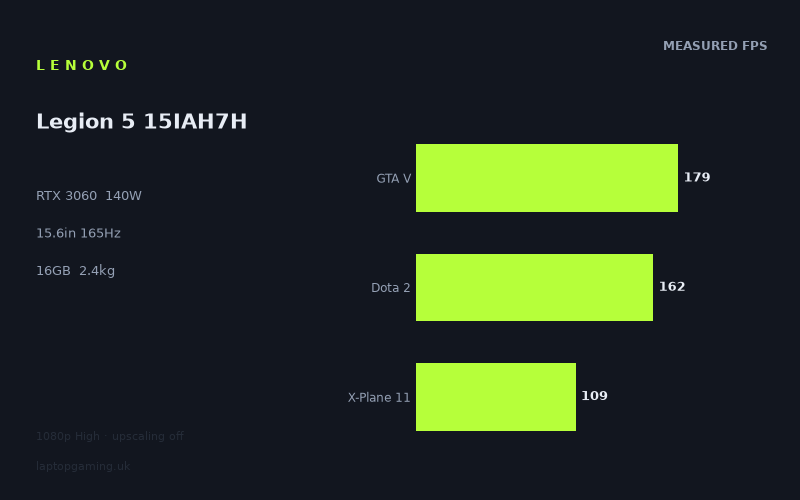
Frame rates
1920×1080, High preset, upscaling off.
Measured on this machine. Source: Notebookcheck, 2022-11-25.
Not scored: incomplete benchmark suite
Every scored laptop on this site is averaged over the same 5 games, and this one is short of Cyberpunk 2077, Baldur's Gate 3. A mean over 5 games is not comparable to a mean over 5, so we publish the figures we have and leave the score blank rather than rank it against machines tested on a different set. The numbers below are real - the suite is just incomplete.
How these numbers were produced
Frame rates here are not measured by us, and we label how each one was arrived at. A figure marked measured comes from a published run on that exact machine. A figure marked representative is derived from the GPU and its power limit (TGP) and cross-referenced against published reviews - a sound estimate of what that configuration delivers, but not a measurement of that specific laptop. Unless stated otherwise, numbers are 1920x1080, High preset, upscaling off. Where a laptop ships in several power configurations we use the wattage of the exact SKU listed, because a 140W RTX 5070 and a 115W one are not the same product.
In use
The short version
The Lenovo Legion 5 15IAH7H is a straightforward performance-led gaming laptop built around an RTX 3060 running at a 140W GPU power limit, a Core i7-12700H, 16GB of memory and a 15.6in 1920x1080 IPS display with a 165Hz refresh rate. The published benchmark data is strong for a Full HD machine. Notebookcheck’s figures show 192fps in Strange Brigade, 181fps in The Witcher 3, 179fps in GTA V, 162fps in Dota 2, 109fps in X-Plane 11, 101fps in Final Fantasy XV and 88fps in Cyberpunk 2077 1.6, all at 1920x1080 on the High preset with upscaling disabled.
That is a useful spread because it shows both sides of the Legion’s performance. In lighter or older games, it can get close to, meet or exceed the display’s 165Hz refresh rate. Strange Brigade, The Witcher 3 and GTA V all clear that threshold in the measured results, while Dota 2 comes close at 162fps. In more demanding titles, the RTX 3060 still produces clearly playable figures, but it does not make the 165Hz panel a realistic target at the stated settings. X-Plane 11 at 109fps, Final Fantasy XV at 101fps and Cyberpunk 2077 1.6 at 88fps are all well below 165fps, even though each result remains far from a low-frame-rate experience.
The important point is that this is not a laptop whose display specification and GPU performance are fundamentally mismatched. A 165Hz Full HD screen is ambitious enough to make the most of the Legion in games that run lightly, but it does not demand a level of performance that makes the laptop feel inadequate in heavier games. The panel has headroom where the benchmark data provides it, while the 1920x1080 resolution avoids asking the RTX 3060 to push more pixels than necessary.
The 140W power limit matters. This is not merely an RTX 3060 listed in a specification table with no indication of how much power it may receive. The stated 140W limit gives the GPU substantial room to work, and the published figures show that the Legion is capable of producing very high Full HD results in the games that allow it. It also explains why the machine should not be judged simply by the RTX 3060 name. GPU model names matter, but a mobile GPU’s power limit can materially affect the result seen on screen. Here, the benchmark data should be treated as the useful evidence: this particular RTX 3060 configuration delivers a mean of 149fps across the five scoring-suite games.
There is no overall score for this exact Lenovo configuration because there is no confirmed UK price. That is not a comment on the machine’s quality or its benchmark position. The benchmark suite is complete and the Legion ranks normally on the frame-rate leaderboard, but value cannot be assessed responsibly without a confirmed price. Potential buyers should therefore treat this as a performance verdict rather than a value verdict. The figures show what the machine can do; they do not establish whether any particular listing is good value.
This Legion is best suited to a buyer who wants a conventional, relatively substantial 15.6in gaming laptop for Full HD play, values high refresh-rate performance in less demanding games, and is content with very good rather than refresh-rate-matching results in the heaviest titles measured. It is especially credible for someone who plays a mixture of competitive games, established big-budget games and newer demanding releases rather than expecting every game to remain at the display’s maximum refresh rate without compromise.
It is less compelling for somebody shopping primarily for the lightest possible gaming machine, because the listed weight is 2.448kg. It is also not the right choice for a buyer who sees 165Hz and assumes that every demanding game will run at 165fps at 1920x1080 on the High preset with upscaling off. Notebookcheck’s Cyberpunk 2077 1.6 result makes that limitation plain. The Legion has high-refresh capability; it does not have universal high-refresh performance at the stated settings.
Performance
The measured results
The performance case for the Lenovo Legion 5 15IAH7H rests on a complete set of Notebookcheck measurements taken at 1920x1080, using the High preset with upscaling disabled. That test setup is particularly relevant here because it matches the laptop’s native display resolution. There is no need to infer how the RTX 3060 behaves at the panel’s pixel count: the published results already show it.
Across the five games used for the scoring suite, the Lenovo records a 149fps mean. The individual scoring-suite results are 192fps in Strange Brigade, 179fps in GTA V, 162fps in Dota 2, 109fps in X-Plane 11 and 101fps in Final Fantasy XV. These are not five versions of the same workload. They represent a broad range of game engines and performance demands, which is why the mean needs to be read alongside the individual figures rather than as a promise that every game will run near 149fps.
At the high end, Strange Brigade reaches 192fps. This is the clearest example of the Legion having enough performance to exceed the 165Hz panel refresh rate. The display cannot show more than 165 complete refreshes per second, but the result still matters because it indicates that the machine has performance headroom in this title at the stated preset. A 192fps measurement is not a guarantee of an uninterrupted 165fps experience in every scene or every setting combination, but it does establish that the Legion is operating in the territory where the screen’s high refresh rate can be properly used.
The Witcher 3 records 181fps. Although it is not part of the five-game scoring suite, it is another strong result and another one above the panel’s 165Hz refresh rate. At the measured Full HD High setting with upscaling off, the Legion can again produce more frames than the display can refresh each second. For a buyer with this game in mind, that is more useful than a generic statement that the laptop is “good for gaming”. The available data says that this specific configuration can run this specific game at a very high measured frame rate under the stated conditions.
GTA V is close behind at 179fps. That is also above 165Hz, reinforcing the point that the Legion’s screen is not an empty specification. In at least three measured games, the laptop exceeds the refresh-rate ceiling. This is the right way to describe the relationship between the display and the GPU: the 165Hz panel is genuinely relevant in parts of the measured library, rather than being a feature reserved for an entirely different class of hardware.
Dota 2 reaches 162fps. That is just below the display’s maximum refresh rate, but it should not be presented as a disappointing result. A difference of only a few frames from 165fps is not evidence that the screen choice is misguided. Rather, it shows that the Lenovo is operating very close to the point where the display can be fully utilised. The distinction between 162fps and 165fps matters if the stated target is literal refresh-rate matching, but it does not change the wider conclusion: the Legion has the performance to deliver a very high-frame-rate Full HD experience in Dota 2 at the measured settings.
The next part of the data is where the review needs to stay grounded. X-Plane 11 records 109fps, Final Fantasy XV records 101fps and Cyberpunk 2077 1.6 records 88fps. These are still substantial frame rates, but they are not close to 165fps. The Legion therefore has two distinct performance identities. In some games, it is refresh-rate-limited by the display. In heavier games, it is performance-limited by the workload, with the GPU and the wider system unable to reach the display’s maximum refresh rate under the published settings.
X-Plane 11 at 109fps is a good example of why a high average should never replace game-by-game reading. It is comfortably above a conventional 60fps target, but it is well below 165fps. A buyer choosing the Legion specifically for a flight-simulation workload should focus on this result rather than on Strange Brigade’s 192fps. The laptop has ample measured performance for a smooth-looking result at the specified setting, but the panel’s full refresh rate is not the likely target in this game.
Final Fantasy XV at 101fps makes a similar point. The number is high enough to support a responsive Full HD experience, yet it is not close to the panel limit. This is the kind of result that supports the Legion’s overall positioning: it is not a machine that has run out of performance, but it is also not a machine that turns every demanding game into a 165fps title with the High preset and upscaling disabled.
Cyberpunk 2077 1.6 at 88fps is the clearest lower-end result in the supplied data. It remains well above 60fps, which is significant, but it sits only a little over half of the panel’s 165Hz maximum. Anyone buying this laptop mainly for demanding newer games should set expectations here, not at the 192fps end of the graph. The Legion can run Cyberpunk 2077 1.6 at the stated Full HD High settings without upscaling and produce 88fps according to Notebookcheck’s numbers. That is a respectable measured result. It is not evidence that the RTX 3060 can sustain the display’s maximum refresh rate in this class of workload.
What the 140W GPU power limit means in practice
The Legion’s RTX 3060 is specified with a 140W GPU power limit. That number deserves attention because laptop GPU names alone do not tell the whole story. The published frame rates are the outcome of this specific configuration, including its GPU power limit, Core i7-12700H processor, 16GB of memory and Full HD screen target. It would be a mistake to assume that every laptop carrying an RTX 3060 will produce the same result.
What can be said with confidence is that the 140W configuration produces the benchmark results listed above. The laptop reaches 192fps in Strange Brigade, 181fps in The Witcher 3 and 179fps in GTA V. It also maintains 162fps in Dota 2. These are not marginal results for a 165Hz Full HD display. They indicate a system with enough available performance to make high-refresh gaming meaningful in the lighter part of the measured set.
At the same time, the power limit is not a magic guarantee of identical performance across all game engines. The measured spread from 192fps down to 88fps is substantial. That spread does not indicate that the machine is inconsistent in the casual sense; it shows that games place different demands on the hardware. A machine can be capable of a very high frame rate in one title and much lower, though still healthy, performance in another without either figure being misleading. The proper conclusion is not that the 192fps result is more “real” than the 88fps result, or vice versa. Both describe different practical uses of the same laptop.
The 140W figure is therefore best understood as part of the reason this is a performance-oriented RTX 3060 laptop, rather than as a number that buyers should use in isolation. The actual benchmark data is what matters most. A power limit is a specification. Frame rates are the observable result. In this case, the result is a machine that is capable of crossing 165fps in several measured games, staying near that level in another, and remaining above 100fps in two more demanding scoring-suite titles.
The processor is also relevant to the picture. The Legion uses a Core i7-12700H, and the supplied rival comparison notes that at 1920x1080 the lighter titles in the shared set can be CPU-bound, compressing genuine GPU gaps. That is important when reading both the Legion’s own high results and its unusual comparison position against much more expensive or higher-tier GPU rivals. At Full HD, especially in games that are not fully limited by graphics performance, the GPU is not always the only deciding factor. High frame rates can shift the limiting factor elsewhere in the system.
This does not mean that the RTX 3060 and the RTX 3080 Ti are interchangeable. It means that the shared games used in the comparison do not always expose the full difference between those GPUs at the measured resolution and settings. The Legion’s 140W RTX 3060 can look unexpectedly close to stronger GPU names in a set of lighter Full HD games because those games may be restricted by CPU-side limits. The heavier results within the Legion’s own benchmark list are the reminder that graphics workload still matters greatly.
How to read the 149fps mean
The 149fps mean across the five scoring-suite games is useful, but it should not be used as a universal estimate. It is an average of 192fps in Strange Brigade, 179fps in GTA V, 162fps in Dota 2, 109fps in X-Plane 11 and 101fps in Final Fantasy XV. The range is wide enough that the average alone hides the practical distinction between games that can take full advantage of the 165Hz panel and games that cannot.
The mean is most useful as a shorthand for the laptop’s overall Full HD standing within the supplied leaderboard context. It confirms that this is not a low-frame-rate configuration. The individual results then explain the kind of experience that mean represents. It is not five games running at around 149fps. It is three results from 162fps to 192fps and two results nearer to 100fps. A buyer should expect that same basic pattern to matter more than the mean when deciding whether the laptop suits their own library.
For competitive or lighter games, the important part of the data is the top end: 192fps, 179fps and 162fps. For visually heavier or more demanding games, the useful part is the lower end: 109fps, 101fps and 88fps. The Legion is not a one-note machine. It can produce extremely high frame rates where the workload permits it, and it still produces solid three-figure or near-three-figure figures when games become more demanding.
That makes it a more balanced proposition than a laptop whose results are all clustered around a modest number. A 165Hz panel needs a machine that can reach high frame rates somewhere, otherwise the refresh rate becomes mostly theoretical. The Legion clears that bar. But it also needs enough capability in heavier games that the buyer does not feel compelled to abandon the High preset immediately. The 109fps, 101fps and 88fps results suggest that the laptop remains viable at the stated settings when the workload rises, even if the screen’s full refresh rate is no longer the expected outcome.
The screen
The Legion 5 15IAH7H has a 15.6in IPS display with a 1920x1080 resolution and a 165Hz refresh rate. Those are the relevant confirmed display facts. There is no supplied measurement for brightness, contrast, colour coverage, response behaviour or outdoor visibility, so none of those areas should be assumed from the IPS label or the gaming positioning. The available information supports a performance assessment of the screen, not a full image-quality assessment.
From a gaming perspective, 1920x1080 is the right resolution to examine alongside the published benchmark data because all of Notebookcheck’s listed frame rates use that resolution. The Lenovo’s performance is not being extrapolated from a lower-resolution test or projected downward from a higher-resolution one. The figures directly match the panel’s native pixel count.
The 165Hz refresh rate is a meaningful specification on this laptop, but it should be interpreted game by game. Strange Brigade at 192fps, The Witcher 3 at 181fps and GTA V at 179fps all exceed the display’s refresh rate. In those games, the GPU can supply frames faster than the panel can refresh under the stated settings. Dota 2 at 162fps is extremely close to the 165Hz limit. These are the games where the Lenovo’s display specification is most fully justified by the measured data.
A 165Hz display is not only about a single fixed threshold. The benefit of a high-refresh panel is most obvious when frame rates are high, and this Legion reaches that territory repeatedly. The data does not support a claim that every game will sit at 165fps, but it does support the much more useful claim that the laptop has enough Full HD performance to make a 165Hz panel relevant rather than ornamental.
The heavier titles require a different expectation. X-Plane 11 at 109fps, Final Fantasy XV at 101fps and Cyberpunk 2077 1.6 at 88fps will not match 165Hz at the stated settings. That should not be framed as a screen failure. A high-refresh display does not require every game to reach its maximum refresh rate to remain sensible. It gives the system room to run faster where it can, rather than forcing the buyer to choose between a lower-refresh panel and a resolution increase that could reduce frame rates further.
The Full HD resolution is particularly well aligned with the available performance. The Legion already demonstrates a wide range at 1920x1080, from 88fps to 192fps. Moving to a higher pixel count would be a different workload, and there are no supplied figures for that scenario. It would be irresponsible to claim exact consequences without measurements. What the data does show is that 1920x1080 allows this RTX 3060 configuration to produce a strong mix of high-refresh and high-quality gaming results without upscaling.
The IPS panel type is also worth stating carefully. IPS identifies the panel technology, but it does not establish the quality of this specific panel beyond that classification. There are no supplied figures for colour, brightness, contrast or response. Buyers who need the screen for colour-critical work, particularly bright-room use, or a specific type of competitive display performance should seek panel measurements for this exact configuration rather than assuming that the 165Hz IPS description settles those questions.
For the gaming buyer, however, the core combination is sensible: 15.6in, Full HD and 165Hz. It is large enough to provide a conventional laptop gaming workspace, the resolution is directly supported by the benchmark data, and the refresh rate is attainable in several of the measured titles. The limitation is not that the display asks too much. The limitation is simply that the heaviest games measured remain below 165fps at the selected High settings with upscaling disabled.
Build, size and portability
The confirmed portability figure is a weight of 2.448kg. That places the Legion firmly in the substantial end of the laptop experience rather than the carry-anywhere category. It is not possible to give an exact judgement on bag fit, desk footprint or thickness because no dimensions are supplied for this configuration. Any claim about its width, depth or height would go beyond the available facts.
What can be said is that 2.448kg is a figure that should influence the buying decision. This is a machine for someone who wants gaming performance in a laptop format, not necessarily someone who wants the smallest possible computer to take everywhere with minimal burden. The 15.6in screen already signals a conventional gaming-laptop format, and the listed weight reinforces that impression.
That is not automatically a drawback. A buyer whose laptop will spend most of its time on a desk, move occasionally between rooms, or travel in a bag when needed may reasonably prioritise the performance shown by the benchmark data over the lowest possible weight. The Legion’s high frame rates in several games are the reason to accept a heavier design. Someone selecting a gaming laptop for frequent daily carrying should treat the weight as an equally important specification, not an afterthought.
The supplied configuration includes an 80Wh battery. No battery-life measurement is provided, so there is no basis for claiming a number of hours in gaming, video playback, web use or any other scenario. Capacity and runtime are not the same thing. The battery specification tells us that the unit has an 80Wh battery; it does not tell us how long this particular Legion lasts away from mains power.
This distinction matters especially for gaming machines. The benchmark data establishes gaming performance at the stated test conditions, but it does not establish performance on battery power, charging behaviour or battery longevity. Buyers who intend to use the Legion away from a mains socket should not assume that the published 192fps, 181fps or 88fps figures describe unplugged operation. The supplied data does not make that claim.
There are also no supplied facts on materials, keyboard layout, trackpad, ports, speakers, webcam, cooling noise or operating temperatures. Those omissions should not be filled with generic assumptions about the Legion name or about gaming laptops in general. The available review evidence is strong for measured frame rates and core specifications, but it does not support a complete physical-quality verdict.
The useful buying conclusion is therefore practical rather than speculative. At 2.448kg, this Lenovo is best considered a laptop that can be moved, not a lightweight machine chosen primarily for mobility. Its 80Wh battery is a confirmed capacity, not a confirmed endurance result. The machine’s appeal rests on its Full HD gaming performance and 165Hz display rather than on evidence of exceptional portability.
How it compares
The supplied rivals are all from the same GPU generation, but they are deliberately not a neat sequence of near-identical alternatives. They show the Lenovo against a lower-tier RTX 3050 Ti configuration, two much more expensive or higher-tier GPU systems that produce effectively identical shared-game averages, and an RTX 3080 Ti system that creates a clearer gap. This is a better comparison set than simply naming one close competitor, because it demonstrates how strongly Full HD shared-game testing can compress or expose hardware differences depending on the titles involved.
Against the MSI Prestige 15 with RTX 3050 Ti
The Lenovo averages 84fps ahead of the MSI Prestige 15 with an RTX 3050 Ti at 105W across four shared games. That is the largest positive gap in the supplied rival set, and it is a substantial one. The Legion’s 140W RTX 3060 configuration is not merely fractionally ahead in this comparison; it produces a very different shared-game average.
There is no confirmed UK price for the MSI Prestige 15 configuration listed here, so this comparison cannot responsibly become a value judgement. It is a performance comparison only. On the data available, the Lenovo is decisively stronger across the four shared games. For a buyer choosing specifically between these two machines and prioritising frame rate, the Legion has the much clearer case.
The difference also helps to put the Legion’s own benchmark results in perspective. Its 192fps, 179fps and 162fps results are not just high in isolation; they translate into a large lead over the lower-powered RTX 3050 Ti rival in the shared-game comparison. This is exactly why power limit and measured output need to be considered together. The Legion’s RTX 3060 has a 140W limit, while the supplied Prestige configuration has an RTX 3050 Ti at 105W, and the shared-game result heavily favours the Lenovo.
Against the Razer Blade 17 Early with RTX 3080 Ti
The comparison with the Razer Blade 17 Early is more surprising on paper. The Razer is listed with an RTX 3080 Ti and a UK price of £4,500, yet the Lenovo averages +0fps against it across five shared games. That is a near-zero difference, but it is a real result rather than a reason to pretend the hardware labels do not matter.
The supplied comparison guidance explains why this can happen: at 1920x1080, lighter titles in the shared set can be CPU-bound and compress genuine GPU gaps. When a game is limited elsewhere in the system, a stronger GPU does not necessarily translate into a large frame-rate advantage. In that situation, two laptops with very different GPU names can produce near-identical results in a small shared set.
That is what the +0fps comparison says. It does not prove that the Legion’s RTX 3060 is universally equal to an RTX 3080 Ti. It proves that, in these five shared Full HD games, the measured averages are effectively the same. The distinction is crucial. Buyers should value the result because it describes actual benchmark output, while avoiding the overreach of treating it as a universal GPU hierarchy.
The Razer’s £4,500 price is confirmed, but the Lenovo has no confirmed UK price, so there is no defensible direct value calculation between the two. It would be wrong to call the Lenovo cheaper, better value or a bargain without knowing the price of this exact configuration. What can be stated is narrower and more useful: in the supplied five-game Full HD comparison, the Lenovo matches the Razer’s shared-game average despite the Razer’s RTX 3080 Ti label.
Against the HP Omen 17-ck1075ng with RTX 3070 Ti
Against the HP Omen 17-ck1075ng with an RTX 3070 Ti, the Legion averages -0fps across five shared games. Again, this is effectively no measurable average separation in the supplied comparison. The minus sign should not be exaggerated. It does not describe a meaningful disadvantage in the stated shared-game average; it records an almost perfectly even result.
As with the Razer comparison, the explanation supplied with the data matters. At 1920x1080, lighter titles in the shared set can be CPU-bound and can compress genuine GPU gaps. The Lenovo’s close position against the RTX 3070 Ti Omen should therefore be read as a comment on the shared benchmark conditions, not as proof that all future games, settings or resolutions will produce the same relationship.
For someone deciding between these specific machines, the practical lesson is that GPU tier alone is not enough. The Legion’s published Full HD results are competitive in the shared set. If the buyer’s own library resembles those lighter titles, the expected gap may be much smaller than the GPU names imply. If the buyer’s library is more like the heavier end of the Lenovo’s own benchmark list, the shared-game average should be treated with more caution, because the available comparison does not provide individual rival results for Cyberpunk 2077 1.6, X-Plane 11 or Final Fantasy XV beyond the shared averages stated.
No confirmed UK price is supplied for the HP Omen configuration, so there is no basis for a value conclusion. The correct reading is performance-only: the Legion and the Omen are effectively level across their five shared games at the stated comparison conditions.
Against the MSI Raider GE77 HX with RTX 3080 Ti at 175W
The MSI Raider GE77 HX is the rival that beats the Lenovo by the largest supplied margin. The Legion averages 21fps behind it across five shared games. The Raider is listed with an RTX 3080 Ti at 175W, and unlike the near-zero gaps against the Razer Blade 17 Early and HP Omen 17-ck1075ng, this comparison produces a clearly visible advantage for the rival.
This is the comparison that stops the Lenovo’s unexpectedly close results against other higher-tier GPU machines from being overstated. The Legion is strong, but the benchmark data does not show it matching every more powerful configuration. Against the Raider’s RTX 3080 Ti at 175W, there is a meaningful shared-game average deficit. That makes the Raider the stronger performance option within this particular comparison set.
It also reinforces the importance of implementation. The Razer Blade 17 Early has an RTX 3080 Ti and produces a +0fps shared-game comparison against the Lenovo, while the Raider’s RTX 3080 Ti at 175W produces a 21fps advantage. GPU label alone does not tell the full story; neither does a single benchmark. The combination of power limit, wider system behaviour and the selected games determines the measured outcome.
There is no confirmed UK price for the Raider configuration listed here. That means the 21fps gap cannot be converted into a statement about whether the Raider is worth paying more for. If a buyer’s sole priority is the higher shared-game average and they are considering these two exact machines, the Raider has the stronger performance evidence. If value is the priority, a price is needed before a responsible conclusion can be reached.
What the rival spread actually tells us
The four rivals produce a useful performance story. The Legion is 84fps ahead of the MSI Prestige 15 with RTX 3050 Ti at 105W across four shared games. It is effectively level with the Razer Blade 17 Early with RTX 3080 Ti across five shared games. It is effectively level with the HP Omen 17-ck1075ng with RTX 3070 Ti across five shared games. It is then 21fps behind the MSI Raider GE77 HX with RTX 3080 Ti at 175W across five shared games.
That range should prevent two common mistakes. The first is assuming that an RTX 3060 laptop is automatically close to every other RTX 3060 laptop or automatically far behind every laptop with a higher GPU name. The second is assuming that a near-zero average against a stronger GPU proves complete equality. The supplied evidence supports neither shortcut.
The Legion’s 140W RTX 3060 is clearly capable of excellent Full HD output, and in lighter shared games it can sit remarkably close to nominally stronger machines because CPU limits can compress the gaps. But the Raider comparison shows that a more powerful configuration can still create a substantial advantage. Buyers should use the Legion’s own seven-game results as the clearest guide to its day-to-day performance, then use the rivals to understand where its position changes depending on the game selection.
Who it’s for
The Lenovo Legion 5 15IAH7H is for the buyer who wants strong measured Full HD performance from a 15.6in gaming laptop and does not need every game to run at 165fps. The evidence is especially convincing for someone whose library includes games such as Strange Brigade, The Witcher 3, GTA V and Dota 2. Notebookcheck’s figures of 192fps, 181fps, 179fps and 162fps show that the Legion can make meaningful use of its 165Hz screen in those games at 1920x1080 on High with upscaling disabled.
It is also for somebody who plays a broad mix of games rather than only the easiest titles. The heavier measurements remain strong enough to make the laptop credible beyond esports-style workloads. X-Plane 11 at 109fps, Final Fantasy XV at 101fps and Cyberpunk 2077 1.6 at 88fps show that the system still has substantial Full HD performance when the frame-rate figures fall away from the top of the display’s range.
This is a sensible choice for the buyer who understands the difference between “high refresh capable” and “always at maximum refresh”. The Legion is the former. It can exceed 165fps in some measured games, land very close in Dota 2, and then run more demanding titles below 165fps while remaining well above low-frame-rate territory. That is a balanced, realistic profile for a Full HD gaming machine.
It is also for someone who values evidence over assumptions. The listed 140W RTX 3060 is supported by actual published frame rates rather than vague performance claims. The mean of 149fps across the five scoring-suite games is useful confirmation of its wider position, while the seven supplied game results make it possible to see the variation behind that mean.
The Legion is not for the buyer who requires confirmed value before making a shortlist. There is no confirmed UK price for this exact configuration, and without that information it cannot be called good value, poor value, expensive or cheap. A buyer who is comparing listings should obtain a confirmed price and then compare it against the available frame-rate evidence. The absence of a price does not weaken the benchmark results, but it does prevent a complete buying verdict.
It is not for the buyer who expects a lightweight travel machine. At 2.448kg, the Legion should be chosen by someone comfortable with a substantial laptop. It can be moved between locations, but the supplied weight does not support positioning it as a minimal-burden option for constant carrying. Buyers who take a laptop to work, university or travel every day should treat that figure as a central part of the decision.
It is not for someone who needs confirmed battery endurance, display colour measurements, brightness data, thermal figures or noise figures before buying. Those measurements are not supplied here. The Legion may or may not meet a particular requirement in those areas, but this review cannot responsibly make the claim. The 80Wh battery capacity is known; runtime is not. The panel is confirmed as IPS at 165Hz and 1920x1080; broader panel quality is not established by the provided facts.
It is also not the right machine for the buyer whose main goal is to maximise frame rate in the most demanding games at the stated settings without relying on any compromise. Cyberpunk 2077 1.6 at 88fps is a good result, but it is not a 165fps result. If the desired outcome is consistently driving the panel at its maximum refresh rate in the hardest games, this benchmark data does not show that capability.
Finally, it is not for somebody who sees the close shared-game comparisons against the RTX 3070 Ti and RTX 3080 Ti rivals as proof that no stronger laptop can be faster. The MSI Raider GE77 HX comparison shows a 21fps shared-game advantage for the Raider. The Legion is highly competitive in the supplied Full HD shared sets, especially where CPU limits compress GPU differences, but it is not invulnerable to stronger hardware.
The strongest final judgement is therefore simple. The Lenovo Legion 5 15IAH7H is a well-targeted Full HD gaming laptop on performance evidence. Its RTX 3060 at 140W produces frame rates that can properly exploit a 165Hz display in several measured games, while retaining strong results in more demanding titles. Its 2.448kg weight makes it a more conventional gaming-laptop purchase than a portability-first one. Its missing confirmed UK price means value remains unresolved. If the eventual price is acceptable to the buyer, the benchmark data gives this configuration a credible and practical performance case.